

U.S., Europe, and Asia Pacific Molecular Diagnostics Market Size and Share - 2026 to 2033
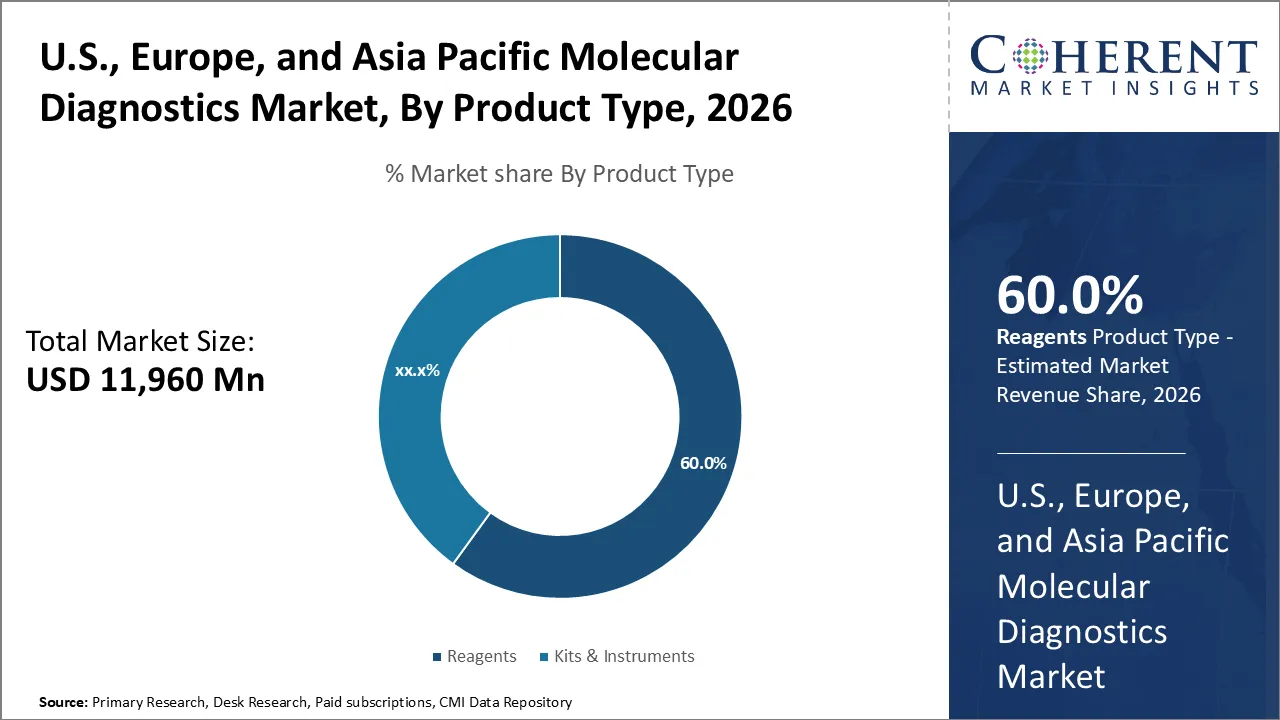
The U.S., Europe, and Asia Pacific molecular diagnostics market size is estimated to reach around USD 11,960 Mn in 2026 and is projected to grow at a CAGR of 10.7% during the forecast period (2026-2033), totaling USD 24,230 Mn by 2033.
Key Takeaways from the U.S., Europe, and Asia Pacific Molecular Diagnostics Market Report
- Reagents are expected to remain the most sought-after product type, accounting for a market revenue share of around 60% in 2026, due to their recurring consumption in PCR, NGS, and other diagnostic assays worldwide.
- Based on technology, PCR-based (liquid biopsy testing and tissue testing) segment is slated to account for over 64% of the U.S., Europe, and Asia Pacific molecular diagnostics market share in 2026, driven by rapid pathogen detection and broad clinical use.
- The U.S. is expected to lead the market, accounting for a share of more than 40% in 2026, owing to presence of advanced healthcare infrastructure and high adoption of cutting-edge diagnostic technologies.
- Asia Pacific, with an estimated share of about 20% in 2026, is slated to become a hotbed for molecular diagnostic product manufacturers during the forecast period. This is primarily due to expanding healthcare sector, rising prevalence of chronic and infectious diseases, and supportive government policies.
U.S., Europe, and Asia Pacific Molecular Diagnostics Market Overview
The U.S., Europe, and Asia Pacific molecular diagnostics market is expected to grow rapidly during the forecast period. This is primarily due to increasing prevalence of chronic and infectious diseases, rising demand for personalized medicine, and advancements in molecular diagnostic technologies such as PCR, next-generation sequencing (NGS), and CRISPR-based assays.
Molecular diagnostics involves analyzing biological markers in the genome and proteome to diagnose diseases, monitor progression, assess risk, and guide therapy decisions for individual patients. These techniques support personalized medicine by helping identify suitable candidates for gene therapies and biologic response modifiers.
Molecular diagnostics is also used to detect minimal residual disease, monitor therapy responses, and evaluate disease prognosis. By adopting molecular diagnostics, laboratories can significantly improve patient care, enabling clinicians to diagnose and treat infectious and genetic diseases more quickly and accurately.
According to a recent peer‑reviewed clinical reference, PCR is considered the gold standard for diagnosing many bacterial and viral infections and for screening genetic disorders. This is because of its high sensitivity and specificity. Rising adoption of PCR and NGS-based diagnostic technologies is expected to boost growth of molecular diagnostics market across the U.S., Europe, and Asia Pacific during the forecast period.
Current Events and Their Impact on the U.S., Europe, and Asia Pacific Molecular Diagnostics Market
Current Event | Description and its Impact |
Artificial Intelligence Integration in Clinical Diagnostics |
|
Aging Population Demographics and Healthcare Burden |
|
Segmental Insights
- Current Industry Events of 2026
- Market Size Estimation
- Regional Breakdown
- Competitive Landscape
- Customer Intelligence
- Segmental Analysis
- Pricing Analysis
- Key Market Drivers, Challenges & Future Trends
- Customized Insights Section
U.S., Europe, and Asia Pacific Molecular Diagnostics Market Insights, By Product Type: Reagents Segment to Account for the Lion’s Share in Molecular Diagnostics Market
By product type, reagents segment is expected to lead the U.S., Europe, and Asia Pacific molecular diagnostics industry, with a revenue share of about 60% in 2026. This is mostly due to high demand for reliable and accurate diagnostic testing, which heavily relies on reagents.
Reagents are essential for the functioning of molecular diagnostic assays, including PCR, next-generation sequencing (NGS), and other nucleic acid-based tests. The need to detect pathogens like SARS-CoV-2, influenza, HIV, and genetic disorders drives consistent reagent consumption. Similarly, reagents are critical for screening, monitoring, and tailoring treatments, especially in oncology and rare genetic conditions.
U.S., Europe, and Asia Pacific Molecular Diagnostics Market Insights, By Technology: PCR-Based Diagnostics Take the Lead in U.S., Europe, and Asia Pacific Markets
Based on technology, PCR-based segment is expected to account for about 64% of the U.S., Europe, and Asia Pacific molecular diagnostics market share in 2026. This is mainly due to its high sensitivity and specificity in detecting infectious diseases, genetic disorders, and cancer biomarkers. PCR-based technologies, such as liquid biopsy testing and tissue testing, are being increasingly used in the healthcare sector.
The widespread use of PCR in clinical laboratories, along with improvements in real-time PCR and multiplex PCR techniques, has significantly improved diagnostic accuracy and speed. In addition, the rising number of chronic and infectious diseases, along with government programs supporting early disease detection, is driving the demand for PCR-based molecular diagnostic solutions in these regions.
U.S., Europe, and Asia Pacific Molecular Diagnostics Market Outlook – Country-wise
United States Remains at the Epicenter of Molecular Diagnostics Market Growth
The U.S. is expected to remain the market leader, accounting for a share of more than 40% in 2026. This is mostly due to the presence of advanced healthcare infrastructure, high adoption of next-generation sequencing (NGS) and polymerase chain reaction (PCR) technologies, and strong investment in precision medicine and personalized diagnostics.
Strong presence of major molecular diagnostics companies, a robust research ecosystem, and government initiatives supporting early disease detection contribute to sustained growth. Rising prevalence of chronic diseases such as cancer, infectious diseases, and genetic disorders further drives the demand for molecular diagnostics in the U.S.
Rising adoption of high-throughput platforms is a key trend in the U.S. molecular diagnostic market. Companies across the nation are increasingly using automated, high‑throughput molecular instruments for disease detection and genetic analysis. For example, Integrated DNA Technologies (IDT) unveiled an expanded innovation roadmap for next‑generation sequencing (NGS) in February 2026.
The roadmap includes new library preparation kits, larger sequencing panels, and improved workflows that make NGS easier and enhance biomarker detection for cancer research and other precision medicine applications. These changes show the growing use of advanced sequencing technologies in the U.S. molecular diagnostics field and increased investment in high‑throughput, precision‑oriented tools. In addition, there is a rising emphasis on early detection and routine genetic screening in the U.S. This shift towards preventive healthcare is expected to fuel demand for molecular diagnostics during the assessment period.
Market Concentration and Competitive Landscape
U.S., Europe, and Asia Pacific Molecular Diagnostics Industry News
- In February 2026, Illumina launched TruPath Genome, setting a new benchmark for genomic insight in genetic disease research. TruPath Genome helps researchers read more complete human genomes faster and with better accuracy than many older methods.
- In November 2025, Synthego launched a portfolio of high-performance molecular reagents for clinical and molecular diagnostics. The new portfolio includes essential PCR enzymes, RNA synthesis tools, and advanced isothermal amplification kits to support both diagnostic labs and molecular biology research.
- In October 2025, Hologic received U.S. FDA clearance and a CE mark for its Panther Fusion molecular tests to detect common bacterial causes of infectious gastroenteritis. The tests help labs quickly identify bacteria such as Salmonella and E. coli.
- In September 2024, Roche launched the cobas Respiratory flex test, its first test to use the company’s breakthrough TAGS technology. The test enables high-throughput, simultaneous detection of 12 respiratory viruses from a single sample.
- In January 2024, QIAGEN announced the launch of its new QIAstat-Dx syndromic tests in India for rapid and accurate diagnosis of infectious diseases. These QIAstat-Dx tests provide fast results and help doctors detect infections quickly.
Market Report Scope
U.S., Europe, and Asia Pacific Molecular Diagnostics Market Report Coverage
| Report Coverage | Details | ||
|---|---|---|---|
| Base Year: | 2025 | Market Size in 2026: | USD 11,960 Mn |
| Historical Data for: | 2020 To 2024 | Forecast Period: | 2026 To 2033 |
| Forecast Period 2026 to 2033 CAGR: | 10.7% | 2033 Value Projection: | USD 24,230 Mn |
| Geographies covered: |
| ||
| Segments covered: |
| ||
| Companies covered: | Abbott Laboratories, Hologic, Inc., Grifols, S.A., Qiagen N.V., F.Hoffmann-La Roche Ltd., Siemens Healthineers, Becton, Dickinson and Company, Beckmann Coulter, Inc., Bio-Rad Laboratories, and Thermo Fisher Scientific Inc. | ||
| Growth Drivers: |
| ||
| Restraints & Challenges: |
| ||
U.S., Europe, and Asia Pacific Molecular Diagnostics Market Drivers
Rising Prevalence of Chronic and Infectious Diseases
There is a rise in cancer, genetic disorders, diabetes, hepatitis, and infectious diseases across the United States, Europe, and Asia Pacific. For instance, according to the American Cancer Society, about 2.1 million new cancer cases are expected to be diagnosed in the U.S. in 2026, excluding non-melanoma skin cancers.
The International Diabetes Federation (IDF) Diabetes Atlas projects the number of adults living with diabetes in the South‑East Asia region to increase by around 68 % by 2045, reaching approximately 152 million people. These trends are expected to increase demand for molecular tests, creating a conducive environment for the growth of molecular diagnostics market across the U.S. Europe, and Asia Pacific. Molecular diagnostics enable early detection, accurate disease characterization, and monitoring, which is critical across all regions.
Increasing Healthcare Spending in Emerging Markets
Countries in Asia Pacific and other emerging regions are increasing healthcare spending, improving hospitals, laboratories, and diagnostic centers. Governments and private companies are investing in modern equipment and better facilities, making molecular diagnostics more accessible. Urban growth and wider healthcare coverage also allow more people to get tested, driving growth in the molecular diagnostics market across the U.S., Europe, and Asia Pacific.
U.S., Europe, and Asia Pacific Molecular Diagnostics Market Trends
Shift Towards Point-of-care and Decentralized Testing
There is a shift toward point‑of‑care (POC) and decentralized molecular testing, as healthcare providers increasingly seek rapid, near‑patient diagnostic solutions to improve clinical decision‑making. Rapid molecular tests, especially for infectious diseases, are gaining traction in key markets such as the U.S., Germany, China, and the U.K. This increasing adoption of near‑patient molecular diagnostics is expected to boost growth of the U.S., Europe, and Asia Pacific molecular diagnostics market during the forecast period.
Growth of Personalized and Precision Medicine
Molecular diagnostics are increasingly used in oncology, pharmacogenomics, and rare disease management, driving demand for personalized and precision medicine. Companion diagnostics linked to targeted therapies are increasingly adopted in key markets such as the U.S., Germany, China, and the U.K. This rising adoption of precision diagnostics is expected to trigger sales of molecular diagnostics across the U.S., Europe, and Asia Pacific.
U.S., Europe, and Asia Pacific Molecular Diagnostics Market Opportunities
Increasing Government Initiatives and Regulatory Support
Increasing government initiatives and regulatory support are creating lucrative growth opportunities for molecular diagnostics. In the U.S., FDA approvals and expanded reimbursement programs facilitate clinical adoption. In Europe, the IVDR (In Vitro Diagnostic Regulation) strengthens standards and, along with public health programs, supports the adoption of advanced diagnostics.
For example, in February 2026, Meridian Bioscience secured IVDR certification for multiple molecular diagnostic assays, demonstrating how the regulatory framework actively enables access to advanced solutions. Similarly, in Asia Pacific, government-funded screening programs and infrastructure investments accelerate market penetration, driving broader accessibility and adoption across key healthcare sectors.
Continuous Technological Advancements
The molecular diagnostics market in the U.S., Europe, and Asia Pacific is rapidly expanding due to continuous technological advancements. Innovative tools such as PCR, real-time PCR, digital PCR, next-generation sequencing (NGS), CRISPR-based diagnostics, and point-of-care molecular tests are enhancing test sensitivity, speed, and affordability. These technologies are helping clinicians detect diseases earlier and more accurately.
In addition, the integration of artificial intelligence (AI) and laboratory automation is streamlining data analysis, reducing manual errors, and improving overall lab workflow efficiency. These advancements are making molecular diagnostics more accessible to hospitals, clinics, and point-of-care settings, driving market adoption across key regions.
Analyst Opinion (Expert Opinion)
- U.S. labs are betting on high‑plex PCR to cut inefficiencies. Hospitals using multiplex respiratory and GI panels report >40% fewer repeat tests compared with single‑target assays, showing labs now prioritize workflow speed and diagnostic throughput over kit volume.
- Europe’s IVDR regulation is reshaping assay portfolios. Over 40% of legacy in‑house assays were decommissioned or revalidated after IVDR enforcement; labs that invested early in compliance now dominate national tenders, while late adopters struggle to maintain testing breadth.
- Asia Pacific is skipping old lab models by using decentralization. Clinics with near‑patient platforms like GeneXpert can give same‑day TB and AMR diagnoses in over 85% of cases, compared to about 30% with traditional referral testing, greatly speeding up clinical decision-making.
- Payer mandates and clinical evidence are driving adoption worldwide. Hospitals in the U.S., Europe, and APAC now increasingly need documented clinical utility before using advanced molecular assays. Institutions that follow evidence-driven deployment get more than 50% higher reimbursement approval for high-complexity diagnostics.
Speak to the analyst
Want personalized insights?
Take the findings above to one of our principal consultants, or have the report rebuilt around the segments, geographies and competitors you actually track.
Market Segmentation
- By Product Type Insights ( Revenue, USD Mn, 2020 - 2033)
- Reagents
- Kits & Instruments
- By Technology Insights ( Revenue, USD Mn, 2020 - 2033)
- PCR-based
- NGS-based
- By Application Insights ( Revenue, USD Mn, 2020 - 2033)
- Genetic Testing
- Oncology
- Microbiology
- STDs
- Blood Screening
- Virology
- Tissue Typing
- Prenatal Diagnosis
- Others
- By End Users Insights (Revenue, USD Mn, 2020 - 2033)
- Hospitals
- Clinics
- Ambulatory Surgery Centers
- By Region Insights (Revenue, USD Mn, 2020 - 2033)
- U.S.
- Europe
- Germany
- U.K.
- France
- Italy
- Spain
- Russia
- Rest of Europe
- Asia Pacific
- China
- India
- Japan
- Australia
- South Korea
- ASEAN
- Rest of Asia Pacific
- Key Players
- Abbott Laboratories
- Hologic, Inc.
- Grifols, S.A.
- Qiagen N.V.
- F.Hoffmann-La Roche Ltd.
- Siemens Healthineers
- Becton, Dickinson and Company
- Beckmann Coulter, Inc.
- Bio-Rad Laboratories
- Thermo Fisher Scientific Inc.
Sources
Primary Research interviews
- Hospital laboratory directors
- Molecular diagnostics companies’ R&D heads
- Clinical microbiologists
- Pathologists and genetic counselors
- Diagnostic equipment procurement managers
Databases
- National Center for Biotechnology Information (NCBI)
- PubMed
- ClinicalTrials.gov
- FDA Medical Device Databases
- European Medicines Agency (EMA) databases
- WHO Global Health Observatory
Magazines
- GEN (Genetic Engineering & Biotechnology News)
- The Scientist
- Lab Manager Magazine
- Clinical Lab Products
Journals
- Journal of Molecular Diagnostics
- Clinical Chemistry
- Molecular Diagnosis & Therapy
- Nature Reviews Genetics
- BMC Genomics
Newspapers
- The New York Times – Health Section
- The Guardian – Science Section
- South China Morning Post – Health & Science Section
- Financial Times – Life Sciences
Associations
- American Association for Clinical Chemistry (AACC)
- Association for Molecular Pathology (AMP)
- European Society of Human Genetics (ESHG)
- Asia Pacific Molecular Diagnostics Association (APMDA)
Public Domain sources
- U.S. Food & Drug Administration (FDA) publications
- Centers for Disease Control and Prevention (CDC) reports
- World Health Organization (WHO) publications
- European Centre for Disease Prevention and Control (ECDC) reports
- National health ministries’ official data portals
Proprietary Elements
- CMI Data Analytics Tool
- Proprietary CMI Existing Repository of information for last 8 years
Get access to 250+ pages report
Every segment, forecast, competitor profile and data table behind the analysis above — available for instant download.
- ESOMAR Member
- ISO 9001:2015 Certified
- D-U-N-S Registered
- GDPR & CCPA Compliant
Missing comfort of reading report in your local language? Find your preferred language:
Transform your Strategy with Exclusive Trending Reports
Frequently Asked Questions
The target market is estimated to be valued at USD 11,960 Mn in 2026.
The U.S., Europe, and Asia Pacific Molecular Diagnostics Market value is expected to reach USD 24,230 Mn by 2033.
The U.S., Europe, and Asia Pacific Molecular Diagnostics market is poised to exhibit a CAGR of 10.7% from 2026 to 2033.
Major growth factors include rising prevalence of chronic diseases, increasing applications of biomarkers, and growing demand for molecular diagnostic tests.
High cost of instruments and regulatory framework in developed economies
Reagents segment, with about 60% market share in 2026, dominates the market.
Abbott Laboratories, Hologic, Inc., Grifols, S.A., Qiagen N.V., F.Hoffmann-La Roche Ltd., Siemens Healthineers, Becton, Dickinson and Company, Beckmann Coulter, Inc., Bio-Rad Laboratories, and Thermo Fisher Scientific Inc. are the major players.