

U.S. Post-Surgical Scar Treatment Market Analysis & Forecast 2026-2033
The U.S. post-surgical scar treatment market is estimated to be valued at USD 3,927.9 Mn in 2026 and expected to reach USD 7,686.0 Mn by 2033, witnessing a CAGR of 10.1% over the forecast period (2026-2033).
Key Takeaways
- Based on Product Type, the silicone sheets & patches segment is projected to capture 26.5% share of the market in 2026.
- Based on Channel, the OTC segment is expected to hold 63.2% share of the market in 2026.
- Based on Scar Type, the hypertrophic scars segment is estimated to dominate the market with 30% share in 2026.
- Based on Surgery Type, the caesarean section segment is expected to lead the market with 27.8% share in 2026.
- Based on End User, the hospital segment is projected to account for 36.9% share of the market in 2026.
Market Overview
Scars form as a result of the healing process of the body. The body creates tissue to repair damaged skin and fill gaps caused by an injury. Accident, burns, surgery, acne, and illness can develop scars on the body.
To close a wound quickly after an incision, skin cells multiply and synthesize the elements that surround them, such as collagen or elastin. The scar is formed as a result of the formation of new fibrous tissue. Any surgical incision results in the formation of a scar, the final appearance of which will be determined by a number of factors, including its anatomical site, operative techniques, sutures, intrinsic patient-related factors, extrinsic factors such as environmental factors.
Current Events and their Impacts on the U.S. Post-Surgical Scar Treatment Market
Current Event | Description and its Impact |
FDA Regulatory Modernization and Digital Health Integration |
|
U.S. Healthcare System Transformation and Value-Based Care |
|
Which Scar Treatments Deliver the Best Results for the Cost?
Treatment Type | Example | Effectiveness (%) | Typical Cost (USD) | Notes |
Natural remedies | Oils (rosehip, vitamin E), massage | 20–30% | $20–$100 (per month) | Limited clinical proof, mild improvement |
Topical silicone gels/sheets | Mederma, ScarAway | 40–60% | $30–$200 (course) | Strong evidence, effective for prevention & mild scars |
Laser therapy | Fraxel, CO₂ fractional laser | 70–90% | $800–$3,500 (course) | FDA-approved, best non-invasive option |
Injectables/biologics | Polynucleotide therapy, collagen stimulators | 50–75% | $500–$1,500 (session) | Emerging, promising collagen stimulation |
Surgical revision | Scar excision, grafting | 80–95% | $2,000–$6,000 (procedure) | Invasive, risk of recurrence |
- Current Industry Events of 2026
- Market Size Estimation
- Regional Breakdown
- Competitive Landscape
- Customer Intelligence
- Segmental Analysis
- Pricing Analysis
- Key Market Drivers, Challenges & Future Trends
- Customized Insights Section
Segmental Insights
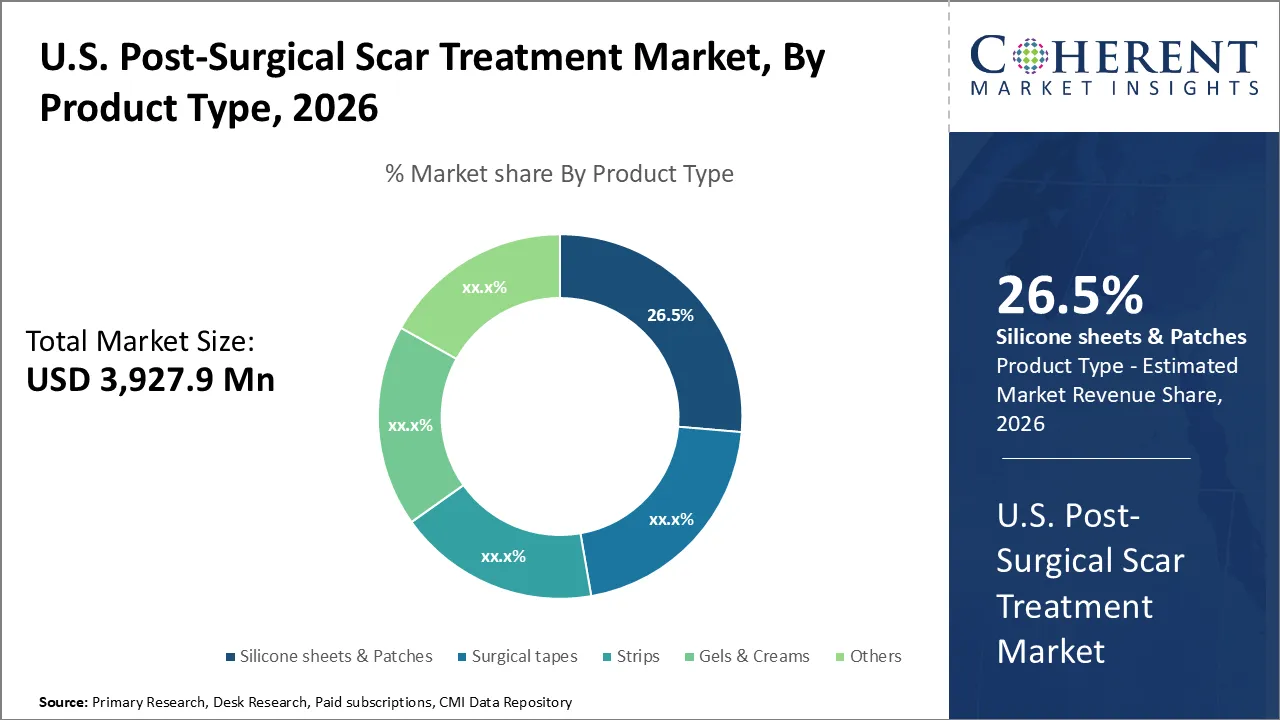
U.S. Post-Surgical Scar Treatment Market Insights, By Product Type: silicone sheets & patches leads as they keep scars covered, hydrated, and under pressure while healing
In terms of product type, the silicone sheets & patches segment is projected to capture 26.5% share of the market in 2026, as they keep the area covered, hydrated, and under pressure while it heals. They are often given after surgery due to the fact they proven to make scars thinner and less discolored. In 2026, they are the best type of product because they can be used on numerous occasions, are easy to use, and are highly recommended by doctors.
U.S. Post-Surgical Scar Treatment Market Insights, By Channel: OTC is driven by accessibility, affordability, and self-care trends
In terms of channel, the OTC segment is expected to hold 63.2% share of the market in 2026, because increasing numbers of individuals want to take care of themselves. Scar creams, gels, and silicone patches are easily accessible at drugstores and online. OTC products are more popular than Rx alternatives due to they are easy to find, affordable, and well-marketed. This lets people continue treatment at home without needing a prescription.
U.S. Post-Surgical Scar Treatment Market Insights, By Scar Type: hypertrophic scars dominate since collagen overproduction after surgeries like cesarean sections or joint replacements makes them common
In terms of scar type, the hypertrophic scars segment is estimated to dominate the market with 30% share in 2026. When collagen is overproduced during a wound is healing, it creates raised, red tissue that stays at the incision site. This is called hypertrophic scarring. After surgeries like cesarean sections or joint replacements, they happen a lot. Patients often want silicone sheets, gels, or corticosteroid treatments to make their skin thinner and improve cosmetic appearance, which drives up demand for these treatments.
U.S. Post-Surgical Scar Treatment Market Insights, By Surgery Type: caesarean section is reflecting high procedure volumes and growing cosmetic recovery demand
In terms of surgery type, the caesarean section segment is expected to lead the market with 27.8% share in 2026. Since there are so many procedures in the U.S., a growing number of women are seeking for ways to recover from cosmetic surgery after giving birth. This segment is the most dominant in the overall market because of awareness campaigns, doctor recommendations, and the availability of specialized scar products for abdominal incisions.
For instance, in January 2026, The NYU Langone report on cesarean delivery addresses a new surgical method that aims to lower the risk of long-term problems. It may make scars less severe by reducing tissue damage and improving closure methods. This new idea will have a direct effect on the future demand for scar therapies because cesarean scars directly impacts the U.S. market for post-surgical scar treatment.
U.S. Post-Surgical Scar Treatment Market Insights, By End User: hospitals surge as scar treatment typically begins immediately post-surgery under physician supervision
In terms of end user, the hospital segment is projected to account for 36.9% share of the market in 2026, because scar treatment usually starts right after surgery with the help of a doctor. Hospitals include scar management in post-operative care so that patients get the recommended products as soon as possible. Their role in clinical validation, bundled care packages, and patient trust makes hospitals the best place to get scar treatment.
For instance, in March 2026, Plastic surgeons have joined the advisory boards of HSL Labs to help them come up with new ways to help people recover after surgery. This has a lot to do with treating scars in hospitals, since hospitals are in charge of scar care and start managing it right after surgery. Clinical expertise guarantees that validated scar therapies are incorporated into recovery protocols, thereby strengthening hospital leadership in scar management.
Market Report Scope
U.S. Post-Surgical Scar Treatment Market Report Coverage
| Report Coverage | Details | ||
|---|---|---|---|
| Base Year: | 2025 | Market Size in 2026: | USD 3,927.9 Mn |
| Historical Data for: | 2020 To 2024 | Forecast Period: | 2026 To 2033 |
| Forecast Period 2026 to 2033 CAGR: | 10.1% | 2033 Value Projection: | USD 7,686.0 Mn |
| Geographies covered: |
| ||
| Segments covered: |
| ||
| Companies covered: | Smith & Nephew Plc., 3M, Cardinal Health, Merz Pharma, Biodermis, Scar Heal, Inc., Mölnlycke Health Care AB, Implantech, Covalon Technologies Ltd., Bio Med Sciences, Polymer Science, Inc., and Neodyne Biosciences, Inc. | ||
| Growth Drivers: |
| ||
| Restraints & Challenges: |
| ||
U.S. Post-Surgical Scar Treatment Market Driver
Increasing number of surgical procedures in the U.S. population
The steady rise in elective and reconstructive surgeries has made it even more important to find good ways to deal with scars. National health statistics show that millions of procedures are performed every year, from orthopedic to cosmetic, and all of them leave scars. This trend has sped up the U.S. Post-Surgical Scar Treatment Market growth because patients and providers are putting a growing emphasis on advanced therapies to speed up healing and reduce long-term cosmetic concerns.
Increasing number of product launches by market players
Top companies are actively coming up with new ways to treat scars, such as silicone-based products, laser devices, and combination therapies. These launches are carefully planned to treat different types of scars and meet the needs of different patients, making treatment more accessible and effective. The rise in the number of new products has greatly increased the U.S. Post-Surgical Scar Treatment Market demand. This is because healthcare providers are using modern solutions to meet patients' growing expectations for better recovery and cosmetic results.
Analyst Opinion (Expert Opinion)
Post-surgical scar treatment in the U.S. is in high demand because rising surgical volumes and they want better cosmetic results. Data shows a significant adoption silicone-based products, laser therapies, and injectables. Hospitals and clinics are the primary locations where these products are used.
- Clinical and procedural factors: The number of surgeries, especially cosmetic and reconstructive surgeries, is going up, which means that there is more demand for scar management solutions. There are different treatments for keloid, hypertrophic, and contracture scars. Silicone sheets and topical gels are still the most common because of their accessibility and efficacy. Also, laser therapy and injectables are becoming more popular in specialized clinics, which shows a move toward more advanced technologies.
- Trends in patients and providers: Most people who get treatment visit hospitals and dermatology clinics. Data shows that aesthetic concerns are a big reason for patients to want minimize scars to improve their quality of life and mental health. There has also been a big increase in laser-based treatments in the U.S. market. These are preferred because they are more accurate and help patients heal faster. Topical gels and silicone sheets, on the other hand, are still good options for a wider range of patients because they are cheaper. The demand for healthcare in both cities and suburbs is expected to stay strong on account of more surgeries, new technologies, and patients being more aware of their options.
Speak to the analyst
Want personalized insights?
Take the findings above to one of our principal consultants, or have the report rebuilt around the segments, geographies and competitors you actually track.
Recent Developments
- In April 2025, Bausch Health, through Solta Medical, released Fraxel FTX, a new fractional laser system. The FDA has approved it for acne scars, pigmentation, wrinkles, and surgical scars. It has two wavelengths, heals faster, has little downtime, and shows results. This makes it a better option for treating scars after surgery in dermatology and aesthetics in the United States.
Market Segmentation
- By Product Type
- Silicone sheets & Patches
- Surgical tapes
- Strips
- Gels & Creams
- Others
- By Channel
- OTC
- Rx
- By Scar Type
- Atrophic Scars
- Hypertrophic Scars
- Keloid Scars
- Contracture Scars
- By Surgery Type
- Caesarean Section
- Joint Replacement
- Appendectomy
- Heart Surgery
- Breast surgery
- Others
- By End User
- Ambulatory Surgical Centers
- Clinics
- Home Care Settings
- Hospitals
- Key Players
- Smith & Nephew Plc.
- 3M
- Cardinal Health
- Merz Pharma
- Biodermis
- Scar Heal, Inc.
- Molnlycke Health Care AB
- Implantech
- Covalon Technologies Ltd.
- Bio Med Sciences
- Polymer Science, Inc.
- Neodyne Biosciences, Inc.
Sources
Primary Research Interviews
- Dermatologists
- Plastic Surgeons
- Cosmetic & Reconstructive Surgeons
- Scar Treatment Product Manufacturers
- Medical Aesthetic Clinics & Laser Treatment Providers
- Wound Care Specialists
- Hospital Procurement Managers
- Distributors & Channel Partners
- Others
Databases
- Bloomberg Terminal
- Factiva
- Others
Magazines
- Dermatology Times
- Modern Aesthetics
- MedEsthetics
- Plastic Surgery Practice
- Aesthetic Authority
- Others
Journals
- Journal of the American Academy of Dermatology
- Plastic and Reconstructive Surgery
- Dermatologic Surgery
- Lasers in Surgery and Medicine
- Aesthetic Surgery Journal
- Wound Repair and Regeneration
- Others (Lippincott Journals)
Newspapers
- The Wall Street Journal
- Reuters
- Bloomberg News
- Financial Times
- USA Today
- Others
Associations
- American Society of Plastic Surgeons (ASPS)
- American Academy of Dermatology (AAD)
- The Aesthetic Society
- Wound Healing Society
- American Society for Dermatologic Surgery (ASDS)
- Others (American Society of Plastic Surgeons)
Public Domain Sources
- U.S. Food and Drug Administration (FDA)
- National Institutes of Health (NIH)
- National Library of Medicine (PubMed)
- Centers for Medicare & Medicaid Services (CMS)
- Agency for Healthcare Research and Quality (AHRQ)
- U.S. Census Bureau
- Others
Proprietary Elements
- CMI Data Analytics Tool
- Proprietary CMI Existing Repository of Information for the Last 8 Years
Get access to 250+ pages report
Every segment, forecast, competitor profile and data table behind the analysis above — available for instant download.
- ESOMAR Member
- ISO 9001:2015 Certified
- D-U-N-S Registered
- GDPR & CCPA Compliant
Missing comfort of reading report in your local language? Find your preferred language:
Transform your Strategy with Exclusive Trending Reports
Frequently Asked Questions
The global U.S. Post-Surgical Scar Treatment Market size was valued at USD 3,927.9 Mn in 2026 and is expected to reach USD 7,686.0 Mn in 2033.
The prominent players operating in the U.S. post-surgical scar treatment market include Smith & Nephew Plc., 3M, Cardinal Health, Merz Pharma, Biodermis, Scar Heal, Inc., Mölnlycke Health Care AB, Implantech, Covalon Technologies Ltd., Bio Med Sciences, Polymer Science, Inc., and Neodyne Biosciences, Inc.
An increasing number of surgical procedures in the U.S. population, and increasing number of product launches by the market players are some of the driving factors, which are expected to drive growth of the market.
The U.S. Post-Surgical Scar Treatment Market is hampered by high treatment costs, limited insurance reimbursement, variable clinical outcomes, lack of standardized treatment protocols, regulatory hurdles, competition from low-cost OTC products, and low patient awareness and compliance.