

UV Adhesives Market Analysis & Forecast: 2026-2033
UV Adhesives Market is estimated to be valued at USD 163.8 Mn in 2026 and is expected to reach USD 259.9 Mn in 2033, exhibiting a compound annual growth rate (CAGR) of 6.8% from 2026 to 2033.
Key Takeaways
- According to Product Type, The Acrylic Category is anticipated to account for the largest share of 35% for the UV Adhesives market in 2026.
- According to region, North America holds the largest market share of 39% for UV Adhesives market growth by 2026.
Market Overview
The UV Adhesives Market Size is growing rapidly due to rising demand in industries like electronics, healthcare, automotive, and packaging. UV adhesives are a type of radiation curable adhesives, which cure quickly under radiation such as electromagnetic radiation; this also includes visible light and electron beam.UV adhesives provide excellent adhesion to a variety of surfaces such as wood, plastics, metals, and paper. They emit low or zero emissions of volatile organic compounds during application.
For instance, in May 2024, Permabond is delighted to announce the launch of another new product, our ultra-fast curing UV643 UV adhesive. This product has been designed to bond both rigid plastics and thermoplastics very well. Substrates that UV643 adheres well to include PC, PMMA, PETG, PET, ABS and PVC. The adhesive also bonds dissimilar substrates, such as metal to plastic.
Current Events and Its Impact on the UV Adhesives Market
Event | Description and Impact |
Rise of 5G and IoT in Advanced Electronics |
|
Adoption of AI and Machine Learning in Automation |
|
Role of technologies like AI
Artificial Intelligence (AI) is increasingly transforming the UV adhesives market, including UV adhesives for plastics, by enhancing process optimization, predictive maintenance, and product innovation. AI-powered analytics enable manufacturers to precisely monitor and control curing times, temperature, and application methods in real time, optimizing throughput and reducing waste.
For example, AI-driven quality control systems detect defects during adhesive application, ensuring consistently high product standards for automotive or electronic devices. Moreover, AI can be used to tailor adhesive formulations for specific applications by analyzing large datasets from lab and field tests, allowing companies to accelerate the development of next-generation UV adhesives with improved performance, such as faster curing or greater environmental resistance.
- Current Industry Events of 2026
- Market Size Estimation
- Regional Breakdown
- Competitive Landscape
- Customer Intelligence
- Segmental Analysis
- Pricing Analysis
- Key Market Drivers, Challenges & Future Trends
- Customized Insights Section
Pricing Analysis
- Pricing for UV adhesives reflects a combination of raw material costs, energy for UV curing, manufacturing, packaging, and logistics. Typically, raw materials (such as acrylics, epoxies, and specialized photoinitiators) account for around 60% to 70% of the total production cost, depending on the formulation and scale of production.
- Labor and operational costs which includes energy for UV curing and process automation generally comprise about 15% to 20%, while packaging, distribution, and margin account for the remaining portion—usually 10% to 20%.
- Market pricing can also fluctuate based on supply chain conditions, advancements in curing technology, and scale; for example, large-scale applications in sectors like electronics, packaging, or medical devices can lower per-unit costs via economies of scale.
Segmental Insights
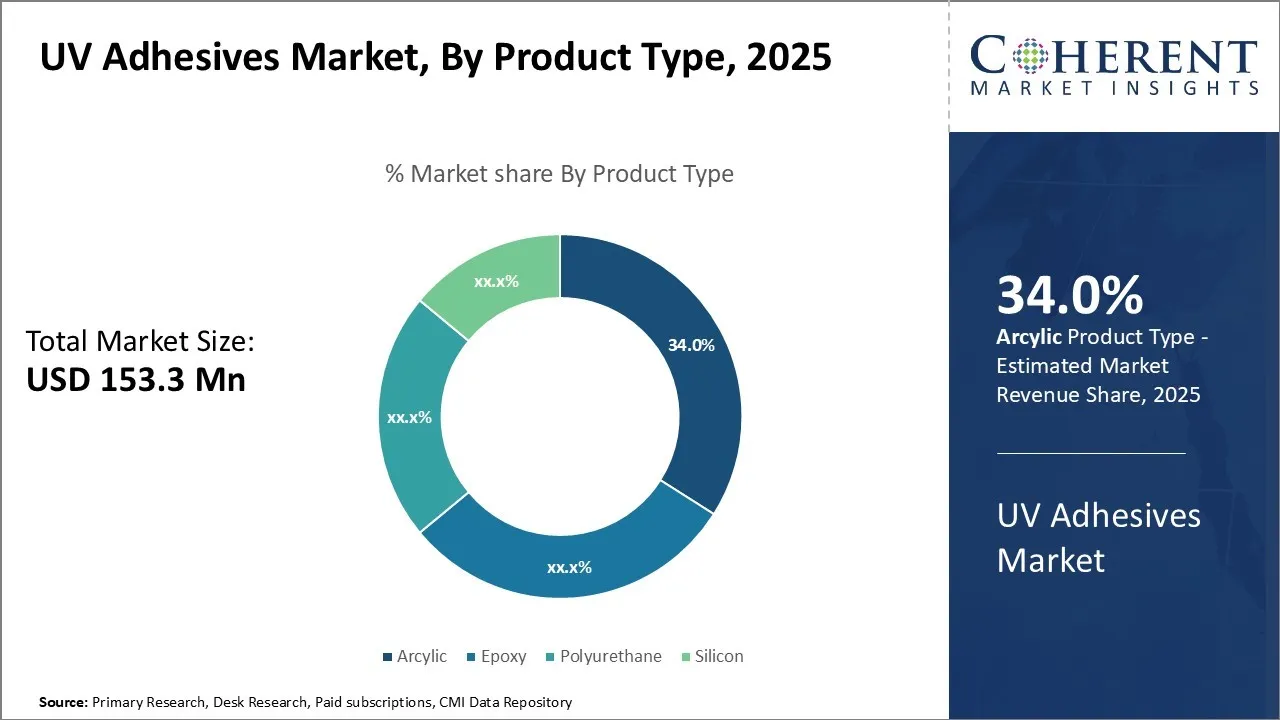
UV Adhesives Market Insights, By Product Type
In terms of product type, the acrylic segment is expected to contribute largest share of the UV Adhesives market trends in 2026. Acrylic UV adhesives cure rapidly under ultraviolet light, significantly improving manufacturing efficiency. They bond well to a wide range of materials including plastics such as ABS, acrylic, and polypropylene while maintaining flexibility and durability.
For instance, in December 2024, Panacol has developed Vitralit UV E-2113, a new UV acrylic adhesive that is ideal for the rapid securing of commutators. This UV adhesive can be applied robotically and cures within seconds under UV light. The process of securing commutators can be greatly accelerated with Vitralit UV E-2113.
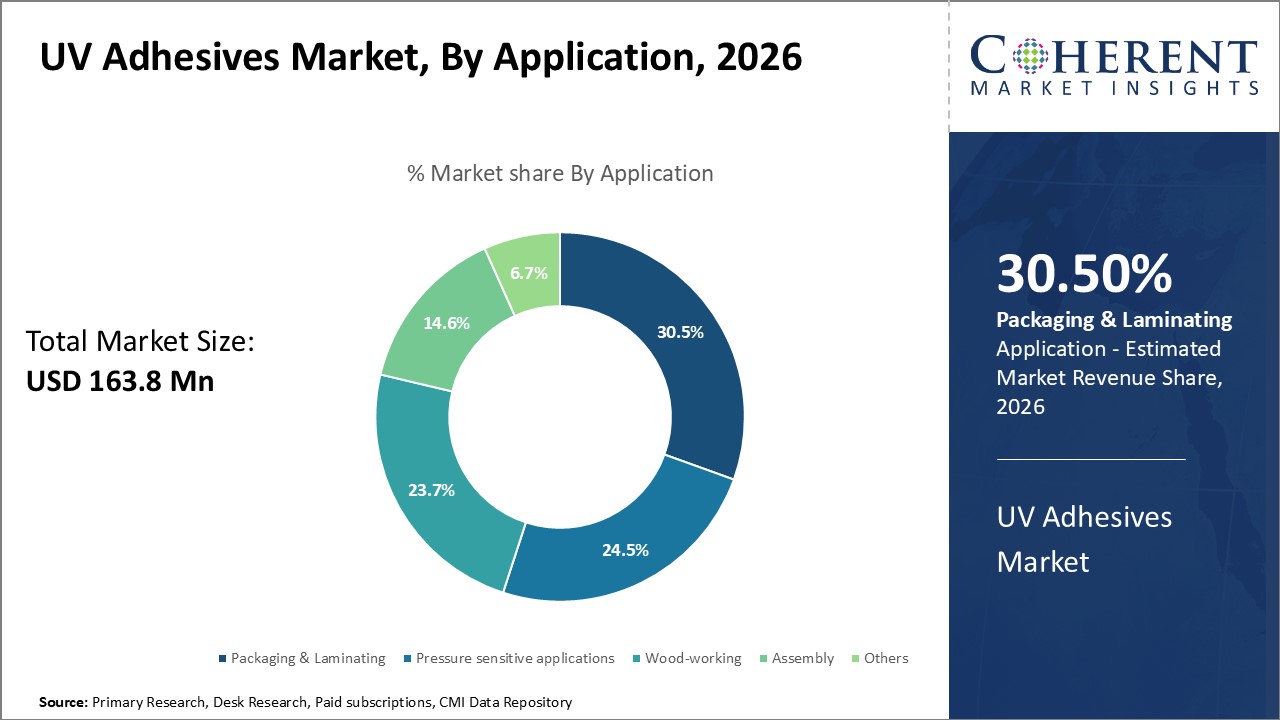
UV Adhesives Market Insights, By Application
In terms of application, the packaging & laminating segment is expected to contribute largest share of the UV Adhesives market trends in 2026. The market for UV adhesives' packaging and laminating segment is expanding quickly due to rising demand for flexible packaging, particularly as a result of the rise of the retail, e-commerce, and online food delivery industries.
Because UV adhesives cure quickly under UV light without the need for heat, they are especially well-suited for packaging applications. This makes them perfect for joining devices and materials that are sensitive to temperature changes. Their benefits include quick curing rates, strong bond strength, flexibility, resistance to chemicals and moisture, and low volatile organic compounds (VOCs), all of which are essential in packaging settings where quick turnaround times and weather resistance are frequently needed.
UV Adhesives Market – Regional Insights
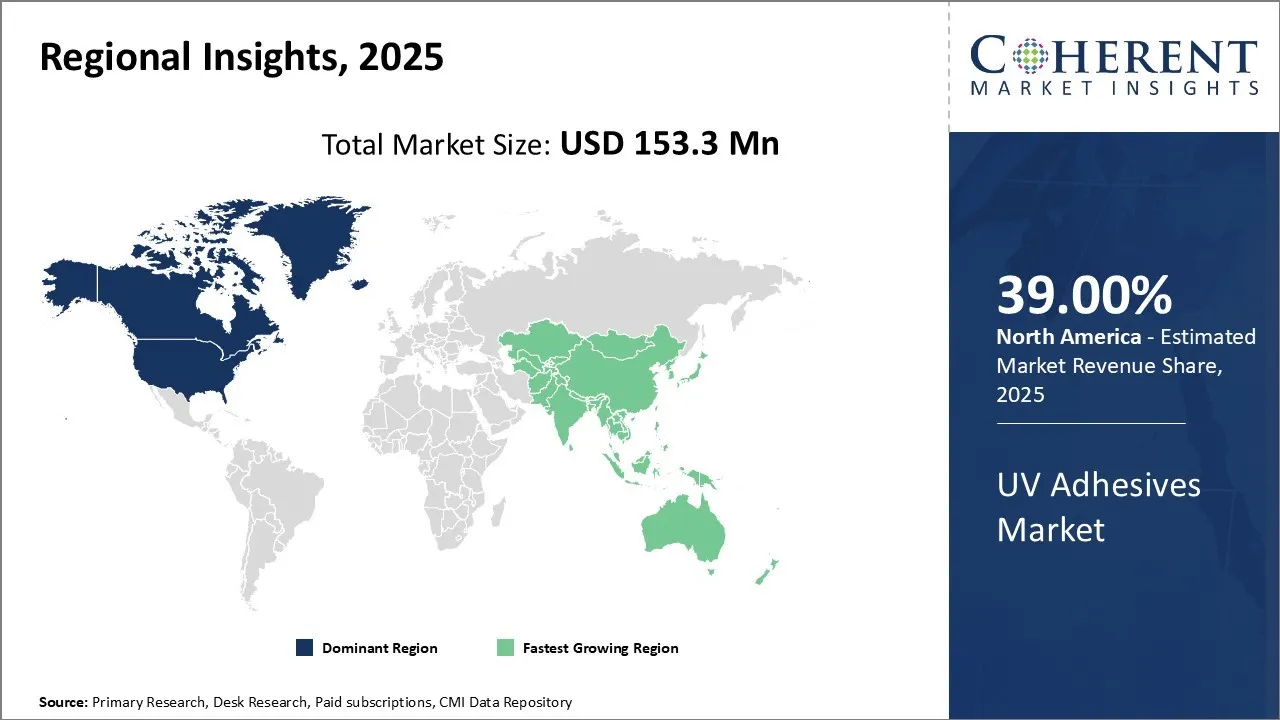
North America UV Adhesives Market
North America has historically been the dominant region and hold major share of 39.00% for UV adhesive market in 2026 as it drives major UV Adhesives Market Trends. The market for UV adhesives in North America is expanding rapidly thanks to substantial expenditures and innovation in important industries like electronics, semiconductors, automotive, packaging, and medical devices.
With continued growth in semiconductor manufacturing in the US and Canada, supported by government investments such as the US Department of Commerce's $1.6 billion support for new chip production facilities and Canada's $120 million funding for semiconductor R&D, North America continues to be a leading region. These advancements have increased the need for UV-curable adhesives, especially in high-precision applications like electronic assembly and wafer dicing.
Asia Pacific UV Adhesives Market
Strong demand in the automotive, electronics, and packaging industries is a major factor in this domination. China serves as a major production base, particularly in the automobile sector, and has made considerable investments in the electronics manufacturing sector. The consumption of UV adhesives is also rising as a result of the continuous digital transformation, the growing use of cutting-edge technologies like artificial intelligence, and the general urbanization of these industries.
UV Adhesives Market In Europe
Fast-curing, robust, and long-lasting adhesives are needed for advanced driver assistance systems (ADAS) and assembly, and the automotive industry is a key driver in the area, especially as car production resumes and electric vehicle adoption picks up speed. In order to meet the demands of sustainability and efficiency, leading companies are introducing cutting-edge technologies like one-step UV cure epoxy adhesives, which enable fast, dependable bonding while using less energy.
UV Adhesives Market Dominating Countries
U.S UV Adhesives Market
The major demand from the automobile, packaging, medical device, and electronics industries is one of the main growth drivers. Strong end-user sectors, cutting-edge R&D infrastructures, and a rapid uptake of novel assembly technologies are all advantages for American manufacturers. The transition to UV-curable adhesives has also been aided by stringent environmental legislation that promote low-VOC and solvent-free adhesives, further solidifying the nation's dominance in this sector.
India UV Adhesives Market
India's rapidly growing manufacturing sectors, especially in consumer electronics, automotive, and packaging, are driving the country's rise as a significant growth market for UV adhesives. The nation's flourishing electronics and smartphone manufacturing industries, as well as UV-curable solutions' appropriateness for quick, high-throughput production lines, are driving their growing acceptance.
The need for effective, environmentally friendly adhesive technology is increasing due to India's investments in local capacity and a growing trend toward automation in assembly processes, even though the country still trails China in terms of market size.
UV Adhesives Market In China
China is the world's largest market for UV adhesives, mostly because of its fast expanding automotive and packaging industries as well as its dominating electronics manufacturing sector. The business strategies of UV adhesives manufacturers in China increasingly focus on catering to this demand surge by optimizing production and expanding application areas. High-volume manufacture of mobile devices, screens, and automotive components all crucial uses for UV adhesives is made possible by the nation's vast industrial base.
Market Report Scope
UV Adhesives Market Report Coverage
| Report Coverage | Details | ||
|---|---|---|---|
| Base Year: | 2025 | Market Size in 2026: | USD 163.8 Mn |
| Historical Data for: | 2020 To 2024 | Forecast Period: | 2026 To 2033 |
| Forecast Period 2026 to 2033 CAGR: | 6.8% | 2033 Value Projection: | USD 259.9 Mn |
| Geographies covered: |
| ||
| Segments covered: |
| ||
| Companies covered: | 3M Company, Ashland, Inc., H.B. Fuller Company, Henkel AG & Co. KGaA, BASF SE, Huntsman Corporation, Avery Dennison Corporation, Adhesives Research, Inc., The Dow Chemical Company, and Bostik SA. | ||
| Growth Drivers: |
| ||
| Restraints & Challenges: |
| ||
UV Adhesives Market: Growth Drivers
- Growing demand for UV adhesives
Growing demand for UV adhesives due to its fast curing rates, high bond strength, and low VOC emissions is driving the market growth. Increasing environmental concerns coupled with growing strict norms regarding VOC emissions are expected to foster the market growth. For instance, Europe has issued EMICODE and M1 labels for showing low VOC emissions from adhesives. Thus, growing environmental rules and regulations is expected to propel the market growth of UV adhesives.
The growing popularity of smaller, thinner, and compact electronic devices is propelling the market growth of UV adhesives. Penetration of electronic devices such as tablets, laptops, mobile phones, and television has further augmented the demand for UV adhesives. UV adhesives are rapidly gaining demand as a substitute for conventional screws, clamps, and hinges in the miniaturization of electronic devices. Hence, the growing demand for miniaturization of electronic devices is accelerating the market growth of UV adhesives.
UV Adhesives Market: Trends
Increasing demand for UV adhesives from the Aerospace sector is expected to propel the market growth. Rise in the aerospace industry due to increasing travel and tourism is augmenting the market. This is also attributed to the rise in the investment by the airline industry for enhancing services and growing spending by consumers on the travels. All these factors are driving demand for high performance and novel adhesives that can be used in the bonding of the aerospace components.
The rise in the construction industry coupled with the increased spending by consumers on the home decor due to improving standard of living is expected to augment the market growth. UV adhesives are widely used in the floor tile installation, ceramic tile, prefinished panel installation, etc. Also, the growing demand for various consumer goods such as stationery products and decorative films is further accelerating the market growth of the UV adhesives over the forecast timeframe.
UV Adhesives Market: Opportunities
The UV adhesives market is positioned for substantial growth and presents numerous opportunities across multiple sectors. Emerging applications in renewable energy, electric vehicles, and advanced packaging are opening up new avenues for UV adhesives, as these industries require fast-curing, durable, and environmentally friendly bonding solutions. Additionally, the use of UV adhesives for medical devices is gaining traction, driven by the need for precision, strong biocompatible bonds, and efficient manufacturing processes in the healthcare sector.
The ongoing push towards eco-friendly and sustainable manufacturing driven by stringent global regulations and consumer preferences is further accelerating innovation in UV adhesive formulations, such as low-VOC and recyclable variants. Technological advancements and continuous evolution in curing technologies are enabling UV adhesives to be used for bonding a diverse array of materials, which expands their role in electronics, medical devices, and automotive manufacturing.
UV Adhesives Market: Key Developments
- April 2025, French startup Skinosive has developed a new generation of “bio-adhesive” UV filters designed for long-lasting efficacy and a reduced impact on the skin and the environment. After nearly two decades with no significant advancements in the delicate field of sun protection, a number of breakthroughs have surfaced in recent months. Among these is Skinosive, which aims to prolong the effectiveness of sunscreen.
- March 2024, Bostik, adhesive solutions by Arkema, has invested in UV acrylic hot melt pressure sensitive adhesive (UV acrylic HMPSA) capabilities, which, effective April 2024, expands the manufacture of UV acrylic HMPSAs within its North American facilities and brings its high-performance portfolio to market.
- July 2023, BASF launches its UV acrylic hotmelt acResin® with a cradle-to-gate product carbon footprint (PCF)1 of zero kg CO2e/kg2. The new products acResin® ZeroPCF A 260 UV, acResin® A 250 UV and acResin® A 204 UV are identical in quality and properties to their conventional counterparts. The carbon footprint of acResin® LowPCF UV 3532 has been reduced by more than 80%.
Analyst Opinion
- The robust expansion is attributed to sustained demand from the electronics sector, where UV adhesives provide the precision and performance needed for assembling increasingly complex devices.
- The market is also benefiting from heightened regulatory pressure for eco-friendly solutions, promoting the adoption of solvent-free, low-VOC adhesives across diverse industries. UV adhesives used in packaging are gaining traction as a result, offering efficient curing and environmental benefits that align with these regulations.
- Innovations in curing technologies and heightened efforts to bond a broader variety of materials are expected to deepen UV adhesives’ role, especially in medical, automotive, and consumer electronics sectors.
- As industries continue to emphasize speed, reliability, and sustainability, analysts remain optimistic about the long-term trajectory and continued innovation in the UV adhesives market.
Speak to the analyst
Want personalized insights?
Take the findings above to one of our principal consultants, or have the report rebuilt around the segments, geographies and competitors you actually track.
Market Segmentation
- Global UV Adhesives Market, By Product Type (Revenue, USD Mn, 2021 - 2033)
- Acrylic
- Polyurethane
- Epoxy
- Silicone
- Others
- Global UV Adhesives Market, By Application (Revenue, USD Mn, 2021 - 2033)
- Pressure sensitive applications
- Packaging & Laminating
- Wood-working
- Assembly
- Others
- Global UV Adhesives Market , By Region
- North America
- U.S.
- Canada
- Latin America
- Brazil
- Argentina
- Mexico
- Rest of Latin America
- Europe
- Germany
- U.K.
- Spain
- France
- Italy
- Russia
- Rest of Europe
- Asia Pacific
- China
- India
- Japan
- Australia
- South Korea
- ASEAN
- Rest of Asia Pacific
- Middle East
- GCC Countries
- Israel
- Rest of Middle East
- Africa
- South Africa
- North Africa
- Central Africa
- North America
- Company Profiles
- 3M Company
- Ashland, Inc.
- B. Fuller Company
- Henkel AG & Co. KGaA
- BASF SE
- Huntsman Corporation
- Avery Dennison Corporation
- Adhesives Research, Inc.
- The Dow Chemical Company
- Bostik SA
Sources
Primary Research Interviews
- Raw Material Suppliers
- UV Curing Equipment Manufacturers
- Distributors and Dealers in Adhesives Supply Chain
- Quality Assurance Heads in Optical and Glass Industries
Databases
- Elsevier Engineering Village
- Wiley Online Library
- Knovel
- SpringerMaterials
- IEEE Xplore (for electronics applications)
Magazines
- Plastics Today
- Fastener Technology International
- Electronic Design
- Modern Plastics India
Journals
- Surface and Coatings Technology
- Materials Today
- Journal of Biomedical Materials Research
- ACS Applied Materials & Interfaces
Newspapers
- Mint
- The Hindu Business Line
- Nikkei Asia
- Handelsblatt (Germany)
Associations
- Society for the Advancement of Material and Process Engineering (SAMPE)
- American Chemical Society (ACS)
- Federation of Adhesives, Paints & Ink Industries (FAPPI) – India
- International Ultraviolet Association (IUVA)
Proprietary Elements
- CMI Data Analytics Tool, Proprietary CMI Existing Repository of information for last 8 years
*Definition: UV adhesives are one-component, solvent-free adhesives that cure and form a permanent bond when exposed to ultraviolet (UV) light or other radiation sources without the need for heat. They consist of monomers, oligomers, photoinitiators, and other additives that polymerize rapidly upon UV exposure, resulting in strong, durable, and often transparent bonds.
Get access to 250+ pages report
Every segment, forecast, competitor profile and data table behind the analysis above — available for instant download.
- ESOMAR Member
- ISO 9001:2015 Certified
- D-U-N-S Registered
- GDPR & CCPA Compliant
Missing comfort of reading report in your local language? Find your preferred language:
Transform your Strategy with Exclusive Trending Reports
Frequently Asked Questions
The UV Adhesives Market size is estimated to be valued at USD 163.8 Mn in 2026, and is expected to reach USD 259.9 Mn by 2033.
Introduction of strict VOC emission norms is a prime factor fuelling growth of market.
Increasing demand for UV adhesives from the aerospace sector is expected to propel the market growth.
Easy availability of low cost and effective alternative adhesive is expected to hinder growth of the market.
Major players operating in the market include 3M Company, Ashland Inc, H.B. Fuller Company, Henkel AG & Co. KGaA, BASF SE, Huntsman Corporation, Avery Dennison Corporation, Adhesives Research Inc, The Dow Chemical Company, Bostik SA.
The CAGR of the UV Adhesives Market is projected to be 6.8% from 2026 to 2033.
Yes, UV adhesives are environmentally friendly as they emit low VOCs, use safer chemicals, and cure quickly with less energy, reducing environmental and health impacts.