

Waterborne Automobile Coatings Market Size and Share Analysis- 2026 To 2033
The Waterborne Automobile Coatings Market size is anticipated to grow at a CAGR of 6.3%, from USD 5.41 Bn in 2026 to approximately USD 8.29 Bn by 2033. The primary drivers are largely defined by increasingly stringent regulations on volatile organic compound (VOC) emissions, growing adoption of environmentally sustainable automotive coating technologies, expansion in global automobile production, and increasing demand for high-performance coatings with improved durability, corrosion resistance, and finish quality. In March 2025, PPG began production at a new 2,000-ton-per-year waterborne automotive coatings plant in Thailand to meet the increasing demand for waterborne basecoats and primers from automotive manufacturers across Southeast Asia.
Key Takeaways
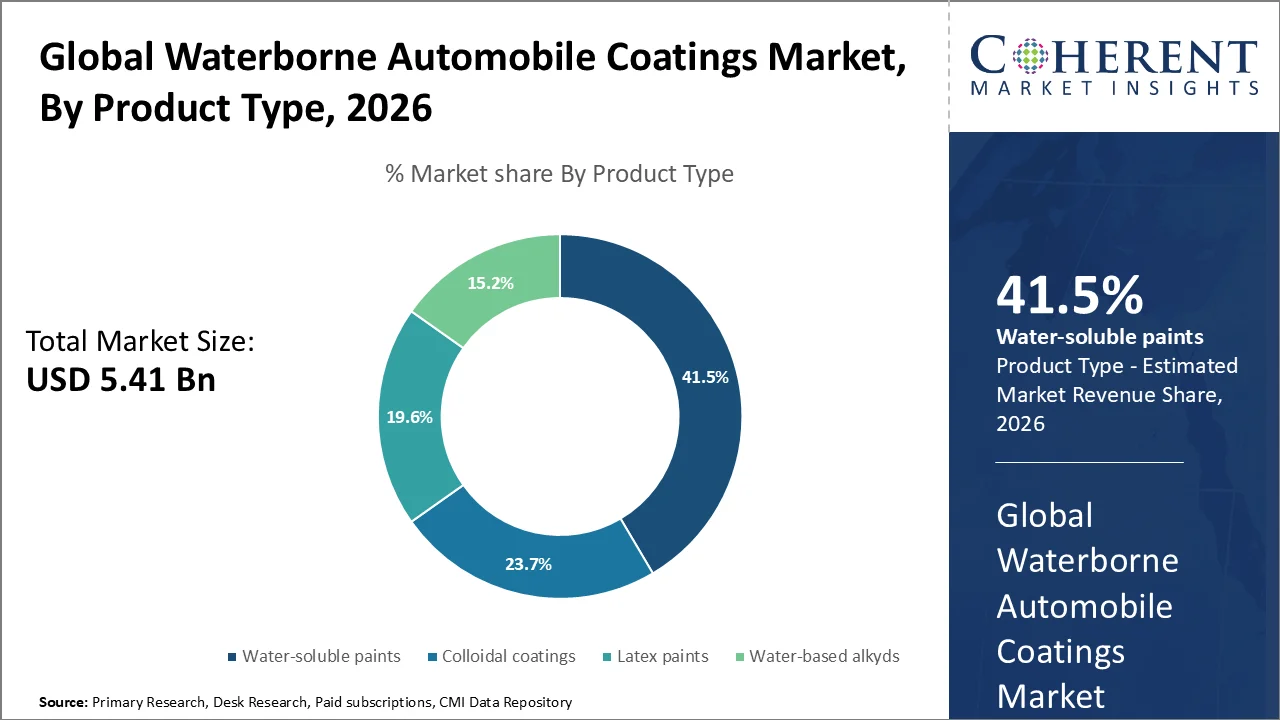
- The water-soluble paints segment is likely to dominate the market with 41.5% in 2026. The segment’s growth is owing to increasing substitution of solvent-borne automotive coatings, stringent VOC requirements, strong compatibility with automotive primers and basecoats, and growing OEM preference for lower-emission coating systems. According to BASF, as of April 30, 2024, more than 1,000 body shops across 20 countries had adopted its Glasurit 100 Line waterborne basecoat system, with users reporting around 40% lower process time and 30% lower material consumption per application.
- The acrylic segment is set to lead the resin category with 33.8% in 2026. The segment’s growth is owing to high gloss retention, weather resistance, chemical resistance, adhesion to automotive substrates, low-VOC formulation capability, and extensive use across OEM and automotive refinish In March 2025, BASF announced increased resin production capacity at its Caojing facility in China to address growing automotive coating demand across Asia Pacific. The facility produces several automotive coating raw materials, including acrylic resins, and operates using 100% renewable electricity.
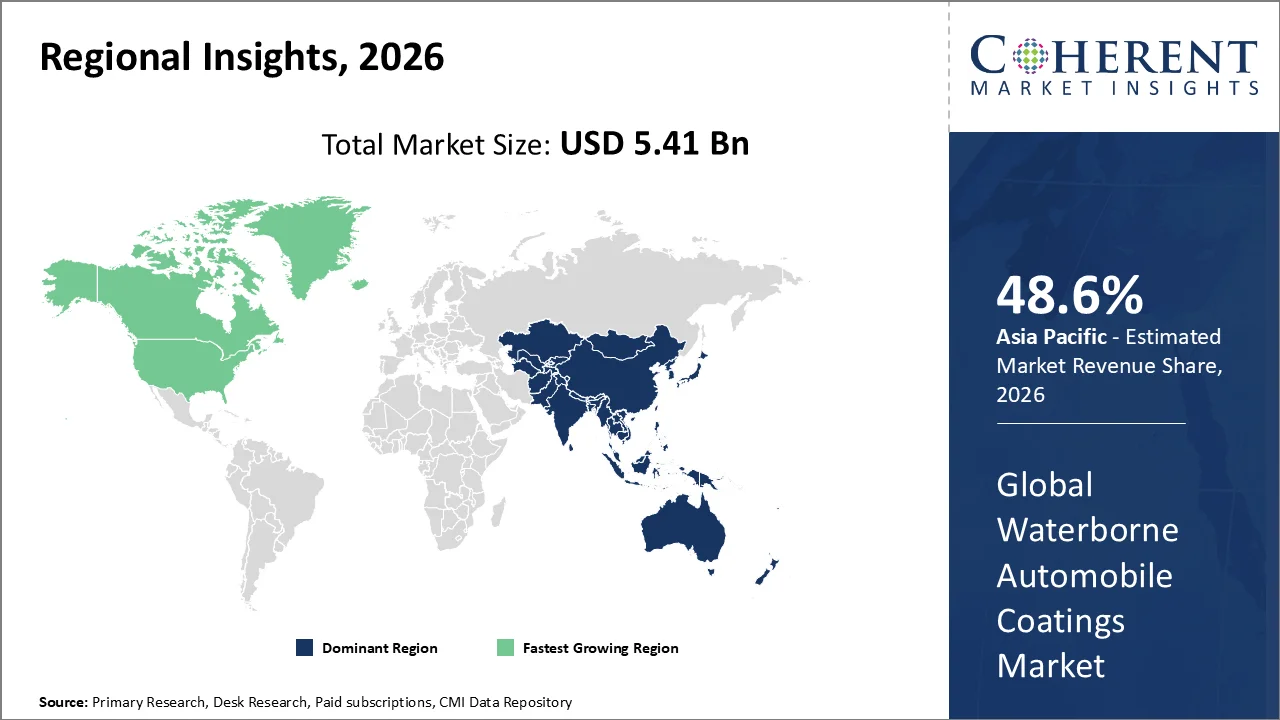
- Asia Pacific is likely to dominate the Waterborne Automobile Coatings Market with 48.6% in 2026. The region’s dominance is supported by its large automotive manufacturing base, rapid expansion of electric vehicle production, increasingly stringent emission-control requirements, and continued investment by coating manufacturers in localized automotive coating capacity across China, India, Japan, and Southeast Asia. According to China's Ministry of Industry and Information Technology said on Jan 14, 2026 that China reported automobile production of 34.53 million units in 2025, up 10.4% year on year. New-energy vehicle production hit 16.63 million units, up 29.0 percent, and NEVs accounted for 47.9 percent of total new-vehicle sales.
Market Drivers
Stringent VOC Regulations and Sustainability Requirements are Accelerating the Shift Toward Waterborne Automobile Coatings
The Waterborne Automobile Coatings Market is gaining strong growth momentum as governments and automotive OEMs are stepping up their efforts to curb volatile organic compound (VOC) emissions from vehicle manufacturing and refinishing operations. Waterborne formulations replace much of the organic solvents with water, allowing OEM paint shops and collision-repair shops to meet increasingly restrictive air-quality standards while still delivering the expected color, gloss, durability and corrosion protection.
According to the U.S. Environmental Protection Agency (EPA) estimates that the national VOC standards for automobile refinish coatings will reduce VOC emissions by about 31,900 tons per year or 33% from the applicable baseline emissions level. These restrictions directly drive coating manufacturers and body shops to move to lower-VOC technologies, such as waterborne basecoats and primers.
In February 2026 Form 10-K, Axalta said that sustainability and regulatory compliance are becoming more important to automotive coating suppliers. The company specifically highlighted its waterborne coatings as technologies that can help automotive customers improve productivity while decreasing their environmental impact.
Expanding and Aging Vehicle Parc is Strengthening Demand for Waterborne Automotive Refinish Coatings
Another major driver of the Waterborne Automobile Coatings Market is the increasing global installed base of vehicles. The longer vehicles are on the road, the greater the need for collision repair, scratch and surface repair, repainting, corrosion repair and other refinishing processes. At the same time, body shops are gradually shifting from traditional solvent-borne coatings to waterborne systems to comply with environmental regulations and improve paint-shop productivity.
According to the EU passenger-car fleet was about 256 million vehicles in 2024, rising 1.4% year-on-year, the European Automobile Manufacturers’ Association (ACEA) said on Jan. 15, 2026. The average age of EU cars was also around 12.7 years, showing a large installed base of vehicles that will continue to need maintenance and refinishing services.
Current Events and Their Impact on the Waterborne Automobile Coatings Market
Current Event | Description and its Impact |
California South Coast AQMD Accelerates Phase-Out of Selected Solvents in Automotive Refinish Coatings (2025–2026) |
|
China Implements New Mandatory GB 30981.2-2025 Industrial Coatings Standard (June 2026) |
|
- Current Industry Events of 2026
- Market Size Estimation
- Regional Breakdown
- Competitive Landscape
- Customer Intelligence
- Segmental Analysis
- Pricing Analysis
- Key Market Drivers, Challenges & Future Trends
- Customized Insights Section
Segmental Insights
Why are Water-Soluble Paints Acquiring the Largest Share?
On the basis of product type, the water-soluble paints segment is projected to account for the largest Waterborne Automobile Coatings Market share of 41.5% in 2026. The segment’s growth is owing to increasing substitution of conventional solvent-borne basecoats, lower VOC emissions, strong color-matching performance, compatibility with automated OEM painting processes, and growing adoption across automotive collision-repair facilities.
PPG states that almost all OEM vehicle finishes currently in production are applied using waterborne basecoats. In the European automotive refinish industry, basecoat/clearcoat repairs already represent nearly 80% of the market, with adoption continuing to increase as manufacturers and repair facilities shift toward water-based systems.
In January 2026, Axalta announced that its Spies Hecker Permahyd Hi-TEC 8260 Premium Waterborne Clearcoat was among six products recognized with BIG Innovation Awards.
Why is Acrylic Acquiring the Largest Share?
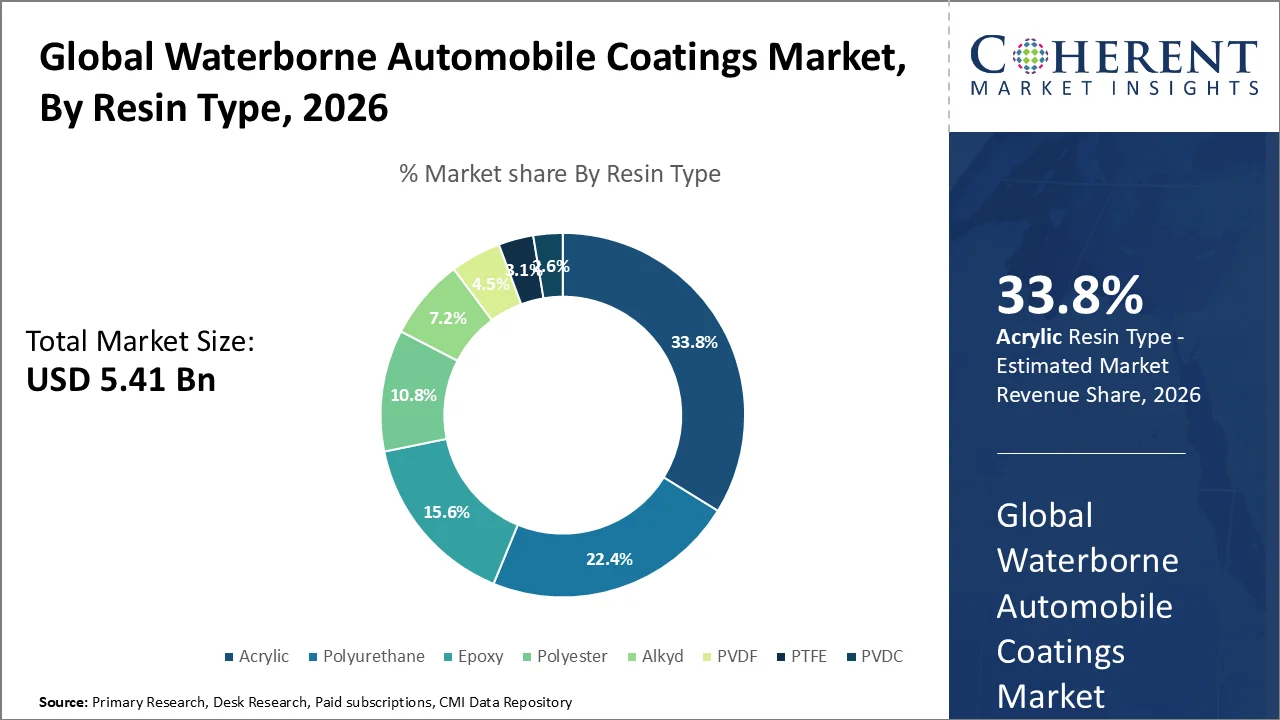
On the basis of resin, the acrylic segment is projected to lead the Waterborne Automobile Coatings Market with 33.8% share in 2026. The segment’s dominance is owing to acrylic resin's strong weatherability, gloss and color retention, adhesion, chemical resistance, fast curing characteristics, and ability to be formulated into low-VOC and waterborne automotive primers, basecoats, and topcoats.
Covestro's Bayhydrol A 145 is a water-reducible hydroxyfunctional polyacrylic dispersion specifically used for aqueous vehicle-repair clearcoats and topcoats. The commercial formulation is supplied at approximately 45% in water and can enable coating formulations containing less than 5% co-solvent at application viscosity.
In November 2025, Covestro launched Bayhydrol A 2670, a new aqueous hydroxyfunctional polyacrylic dispersion for high-performance waterborne coatings.
Waterborne Automobile Coatings Market Trends
- Improved accuracy and application efficiencies of waterborne automotive coatings from increased integration of digital color matching, automated mixing and connected body-shop platforms. In April 2025, BASF launched its improved Refinity digital-color capabilities, relying on its ScanR spectrophotometer that can make five measurements in 30 seconds. The system also can interface with automated mixing equipment that can handle up to six paint mixes at once, helping to reduce formulation errors and paint waste.
- The increasing use of robotic paint application is becoming a key trend across automotive refinishing. In May 2026, BASF Coatings expanded its activities in robotics-enabled automotive refinish with the integration of digital color scanning, matching, mixing and robotic paint application. Initial applications include primer, basecoat and clearcoat on the entire vehicle parts, allowing for higher repeatability, throughput and material efficiency.
- Increasing demand for fast-curing and low-temperature coating systems is reducing paint-booth energy consumption and increasing coating-process compatibility with electric vehicles. In March 2026, PPG introduced its Deltron D8178 Rapid Low Energy clearcoat, which can dry in 5 minutes at 50°C or 10 minutes at 40°C. Its 20°C air-dry mode provides up to 60% energy savings compared with a conventional clearcoat baked for 20 minutes at 60°C.
Regional Insights
Asia Pacific Dominates Owing to its Large Automotive Manufacturing Base and Rapid Shift Toward Waterborne Coating Technologies
The Asia Pacific region is projected to account for 48.6% of the Waterborne Automobile Coatings Market in 2026. The region’s dominance is owing to its large concentration of automotive OEM manufacturing, continued expansion of vehicle production, rising environmental compliance requirements, and growing adoption of waterborne primers and basecoats across China, Japan, India, South Korea, and Southeast Asia.
According to the International Organization of Motor Vehicle Manufacturers (OICA), on April 23, 2026, vehicle production in Asia-Pacific reached approximately 59.2 million units in 2025, increasing 7.6% year-on-year. The region represented more than 61% of total global vehicle production, providing a substantial addressable base for automotive OEM coating consumption.
North America is Expected to be the Fastest-Growing Region Owing to Rapid Waterborne Refinish Adoption and Advanced Automotive Manufacturing Infrastructure
North America is expected to witness the fastest growth in the Waterborne Automobile Coatings Market during 2026–2033. The regional growth is owing to increasing penetration of low-VOC automotive refinish systems, extensive collision-repair infrastructure, continued technology upgrades by major coating manufacturers, and strong demand for faster-drying and more productive waterborne paint systems across the U.S. and Canada.
According to Autos Drive America, international automakers alone manufactured 4.9 million vehicles in the U.S. during 2025, representing approximately 49% of total U.S. light-vehicle production. These automakers collectively operate around 70 R&D facilities across 14 states, strengthening the regional base for adoption and testing of advanced automotive coating technologies.
In June 2025, Arkema announced that its St. Charles, Louisiana facility received ISCC PLUS certification for the manufacture of waterborne acrylic resins. The certified portfolio includes waterborne resins containing up to 90% bio-attributed content and is intended to support lower-carbon coating solutions across applications including green mobility.
Strong Refinish Conversion and Domestic Manufacturing Investment are Accelerating the Waterborne Automobile Coatings Market in the United States
The U.S. Waterborne Automobile Coatings Market is witnessing steady growth owing to the increasing transition of collision-repair facilities toward low-VOC waterborne systems, continued automotive manufacturing activity, and investments by major coating companies in advanced domestic production capabilities.
According to the Alliance for Automotive Innovation, total U.S. light-duty vehicle sales increased by 2.2% in 2025, representing approximately 340,000 additional vehicles compared with 2024. The organization also reported 154 electric vehicle models available in the U.S. as of Q1 2026, indicating continued diversification of vehicle platforms, finishes, substrates, and repair requirements. This provides a broad underlying demand base for OEM and refinish coating systems.
China Waterborne Automobile Coatings Market Trends
China is expected to remain one of the most important markets for waterborne automobile coatings owing to its large automotive manufacturing ecosystem, rapid new-energy vehicle penetration, increasingly sophisticated vehicle color requirements, and tightening technical standards for automotive coating products.
In March 2025, PPG opened a new automotive coatings color creation studio in Tianjin. The company's global automotive color database contains more than 3,000 color design samples, with approximately 400 new colors added annually, and PPG specifically highlighted deeper cooperation with Chinese NEV manufacturers.
Who are the Major Companies in Waterborne Automobile Coatings Industry
Some of the major key players in Waterborne Automobile Coatings Market are Akzo Nobel N.V., BASF SE, Axalta Coating Systems, Berger Paints India Limited, Nippon Paint Company Limited, Kansai Paint Company Limited, PPG Industries Inc., Williams-Hayward Protective Coatings Inc., Tikkurila Oyj, The Valspar Corporation, RPM International Inc., and The Sherwin Williams Company.
Key News
- In March 2026, Kansai Paint highlighted its proprietary I-System automotive coating technology, which enables metallic-look coatings at approximately 1 μm film thickness, compared with around 15–20 μm for conventional metallic coatings.
- In April 2025, Axalta Coating Systems introduced the next generation of its Fast Cure Low Energy automotive refinish technology, including new surfacer and clearcoat products. The system is designed to reduce curing time and energy consumption while improving collision-repair throughput, complementing Axalta's existing waterborne automotive refinish portfolio.
Market Report Scope
Waterborne Automobile Coatings Market Report Coverage
| Report Coverage | Details | ||
|---|---|---|---|
| Base Year: | 2025 | Market Size in 2026: | USD 5.41 Bn |
| Historical Data for: | 2020 To 2024 | Forecast Period: | 2026 To 2033 |
| Forecast Period 2026 to 2033 CAGR: | 6.3% | 2033 Value Projection: | USD 8.29 Bn |
| Geographies covered: |
| ||
| Segments covered: |
| ||
| Companies covered: | Akzo Nobel N.V., BASF SE, Axalta Coating Systems, Berger Paints India Limited, Nippon Paint Company Limited, Kansai Paint Company Limited, PPG Industries Inc., Williams-Hayward Protective Coatings Inc., Tikkurila Oyj, The Valspar Corporation, RPM International Inc., and The Sherwin Williams Company. | ||
| Growth Drivers: |
| ||
| Restraints & Challenges: |
| ||
Analyst Opinion
- The Waterborne Automobile Coatings Market is moving from regulatory-led adoption toward productivity-led adoption, as OEMs and body shops increasingly evaluate waterborne systems on application speed, material efficiency, color accuracy, and energy consumption. In June 2025, Sherwin-Williams highlighted its Ultra 9K waterborne basecoat platform with a streamlined portfolio of 68 toners and a single reducer, supporting faster and more standardized automotive repair workflows.
- Waterborne coatings are increasingly incorporated into energy-efficient vehicle painting systems, rather than being used as stand-alone low-VOC products. BASF announced on May 27, 2026 that its industrial automotive two-tone coating process achieved a 100% transfer efficiency, reduced energy consumption by about 25% or 1.7 GWh per year and saved about 200 grams of paint per vehicle at Renault's Maubeuge production plant.
- The sizeable commercial base of automotive OEM and refinish coatings provides a strong platform for further conversion toward waterborne technologies. In its February 13, 2026 Form 10-K, Axalta reported USD 2.05 billion in automotive refinish sales and USD1.44 billion in light-vehicle coating sales during 2025. Axalta also identifies waterborne technology among the principal coating systems used to address customer requirements for sustainability, productivity, durability, and regulatory compliance.
Speak to the analyst
Want personalized insights?
Take the findings above to one of our principal consultants, or have the report rebuilt around the segments, geographies and competitors you actually track.
Market Segmentation
- By Product Type (Revenue, USD Bn, 2021-2033)
- Colloidal coatings
- Water-soluble paints
- Latex paints
- Water-based alkyds
- By Resin Type (Revenue, USD Bn, 2021-2033)
- Epoxy
- Polyester
- Polyurethane,
- PVDF
- PTFE
- Alkyd
- PVDC
- Acrylic
- By Region (Revenue, USD Bn, 2021-2033)
- North America
- U.S.
- Canada
- Latin America
- Brazil
- Mexico
- Argentina
- Rest of Latin America
- Europe
- Germany
- U.K.
- France
- Italy
- Spain
- Russia
- Rest of Europe
- Asia Pacific
- China
- India
- Japan
- Australia
- South Korea
- ASEAN
- Rest of Asia Pacific
- Middle East
- GCC
- Israel
- Rest of Middle East
- Africa
- South Africa
- Central Africa
- North Africa
- North America
Sources
Primary Research Interviews
- Automotive coating manufacturers and formulators
- Waterborne resin and additive suppliers
- Automotive OEM paint-shop and manufacturing managers
- Automotive refinish and collision-repair specialists
- Coating application equipment and spray-system manufacturers
- Environmental, VOC compliance, and regulatory specialists
- Automotive paint distributors and aftermarket suppliers
- Key opinion leaders (KOLs) in automotive coatings and surface technologies
Databases
- U.S. Environmental Protection Agency (EPA)
- European Chemicals Agency (ECHA)
- Eurostat
- UN Comtrade Database
- World Bank
- Organisation for Economic Co-operation and Development (OECD)
- National Bureau of Statistics of China
- U.S. Census Bureau
Magazines
- Coatings World
- Paint & Coatings Industry (PCI) Magazine
- European Coatings Journal
- Automotive News
- BodyShop Business
- Modern Paint and Coatings
Journals
- Progress in Organic Coatings
- Journal of Coatings Technology and Research
- Surface and Coatings Technology
- Coatings
- Polymer Testing
- Journal of Applied Polymer Science
Newspapers
- The Wall Street Journal
- Financial Time
- Reuters
- The Economic Times
- Nikkei Asia
- South China Morning Post
Associations
- International Organization of Motor Vehicle Manufacturers (OICA)
- European Automobile Manufacturers’ Association (ACEA)
- China Association of Automobile Manufacturers (CAAM)
- Society of Indian Automobile Manufacturers (SIAM)
- American Coatings Association (ACA)
- European Council of the Paint, Printing Ink and Artists’ Colours Industry (CEPE)
- Canadian Paint and Coatings Association (CPCA)
- Japan Paint Manufacturers Association (JPMA)
Public Domain Sources
- Company Annual Reports and Investor Presentations
- Automotive coating manufacturers’ product and technical datasheets
- Company press releases covering waterborne coating launches, capacity expansions, and partnerships
- Government VOC emission standards and environmental regulations
- Automotive production and vehicle parc statistics from industry associations
- Patent databases such as WIPO, USPTO, and Google Patents
- University and technical-institute publications on waterborne coating chemistry
- Regulatory and standards publications related to automotive paints, VOC limits, and hazardous substances
Proprietary Elements
- CMI Data Analytics Tool
- Proprietary CMI Existing Repository of Information for the Last 10 Years
Get access to 250+ pages report
Every segment, forecast, competitor profile and data table behind the analysis above — available for instant download.
- ESOMAR Member
- ISO 9001:2015 Certified
- D-U-N-S Registered
- GDPR & CCPA Compliant
Missing comfort of reading report in your local language? Find your preferred language:
Transform your Strategy with Exclusive Trending Reports
Frequently Asked Questions
The Waterborne Automobile Coatings Market is expected to reach approximately USD 8.29 Bn in 2033, up from USD 5.41 Bn in 2026.
Major players operating in the global Waterborne Automobile Coatings Market include Akzo Nobel N.V., BASF SE, Axalta Coating Systems, Berger Paints India Limited, Nippon Paint Company Limited, Kansai Paint Company Limited, PPG Industries Inc., Williams-Hayward Protective Coatings Inc., Tikkurila Oyj, The Valspar Corporation, RPM International Inc., and The Sherwin Williams Company.
The high initial investment cost and higher drying-time sensitivity under humid conditions are among the key factors hampering growth of the market.
The increasing adoption of low-VOC and environmentally sustainable automotive coatings, along with stringent regulations governing VOC emissions from automotive painting operations, are key factors driving market growth.
The Waterborne Automobile Coatings Market is anticipated to grow at a CAGR of 6.3% between 2026 and 2033.
Among regions, Asia Pacific is expected to dominate the global Waterborne Automobile Coatings Market with 48.6% share in 2026, supported by its large automotive manufacturing base, expanding EV production, and increasing adoption of waterborne primers and basecoats.
North America is expected to witness the fastest growth during 2026–2033, owing to rising penetration of low-VOC automotive refinish systems, extensive collision-repair infrastructure, and continued technology upgrades by coating manufacturers.