Food Automation Market Analysis & Forecast: 2026-2033

Food Automation Market Size and Forecast – 2026 – 2033
The Global Food Automation Market size is estimated to be valued at USD 14.3 billion in 2026 and is expected to reach USD 28.7 billion by 2033, exhibiting a compound annual growth rate (CAGR) of 10.4% from 2026 to 2033.
Global Food Automation Market Overview
The Food Automation Market encompasses a wide range of products designed to enhance efficiency, accuracy, and safety across food processing and packaging operations. Key product categories include automated processing equipment such as robotic arms, mixers, and slicers, which streamline production and reduce labor dependency. Packaging automation systems, including filling, labeling, and sealing machines, ensure consistency and hygiene. Inspection and quality control equipment, such as vision systems and metal detectors, maintain product standards. Conveyor systems and automated material handling solutions optimize workflow and throughput. Together, these products support scalability, cost reduction, and improved operational efficiency across the global food industry.
Key Takeaways
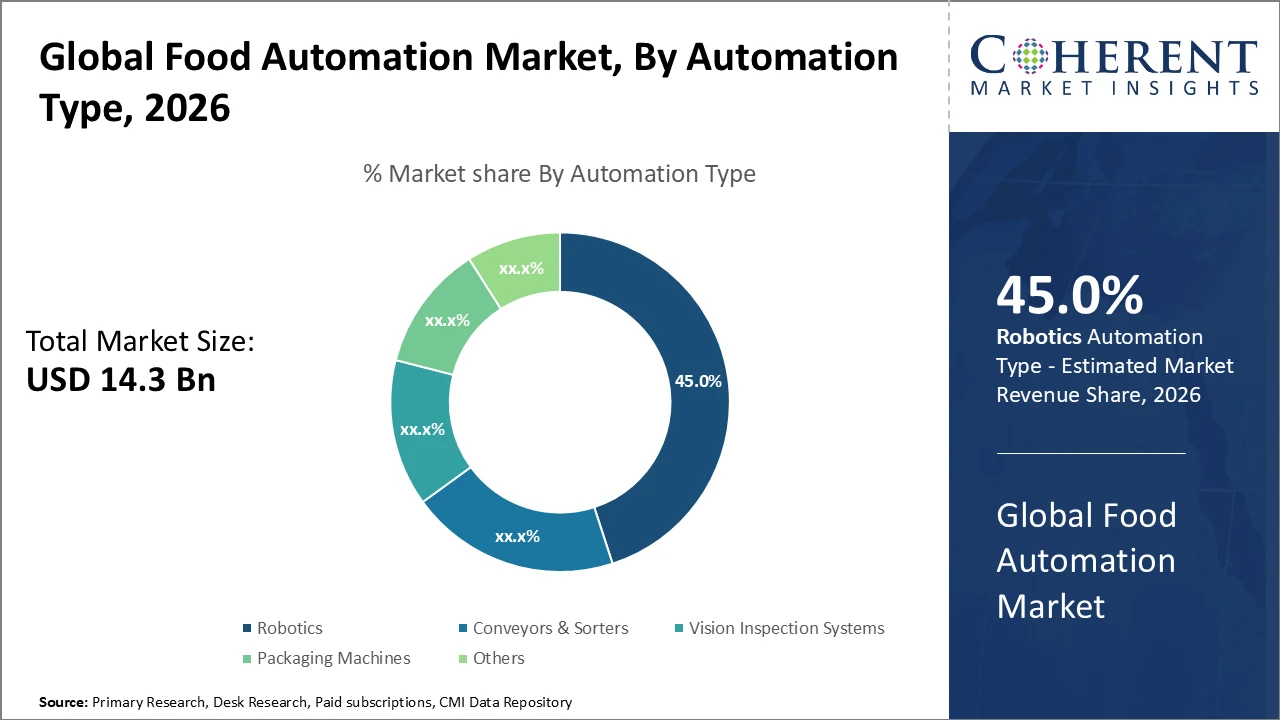
Within Automation Type, the robotics segment dominates with a 45% market share, driven by its ability to increase production throughput and minimize operational risks.
Conveyors & Sorters are the fastest-growing subsegment, supported by rising demand for efficient material handling in large-scale food processing facilities.
In Food Processing Type, Meat, Poultry, and Seafood processing hold the largest share due to the complexity and safety requirements of handling these products.
The dairy segment is the fastest-growing, fueled by increasing global demand for packaged and processed dairy goods.
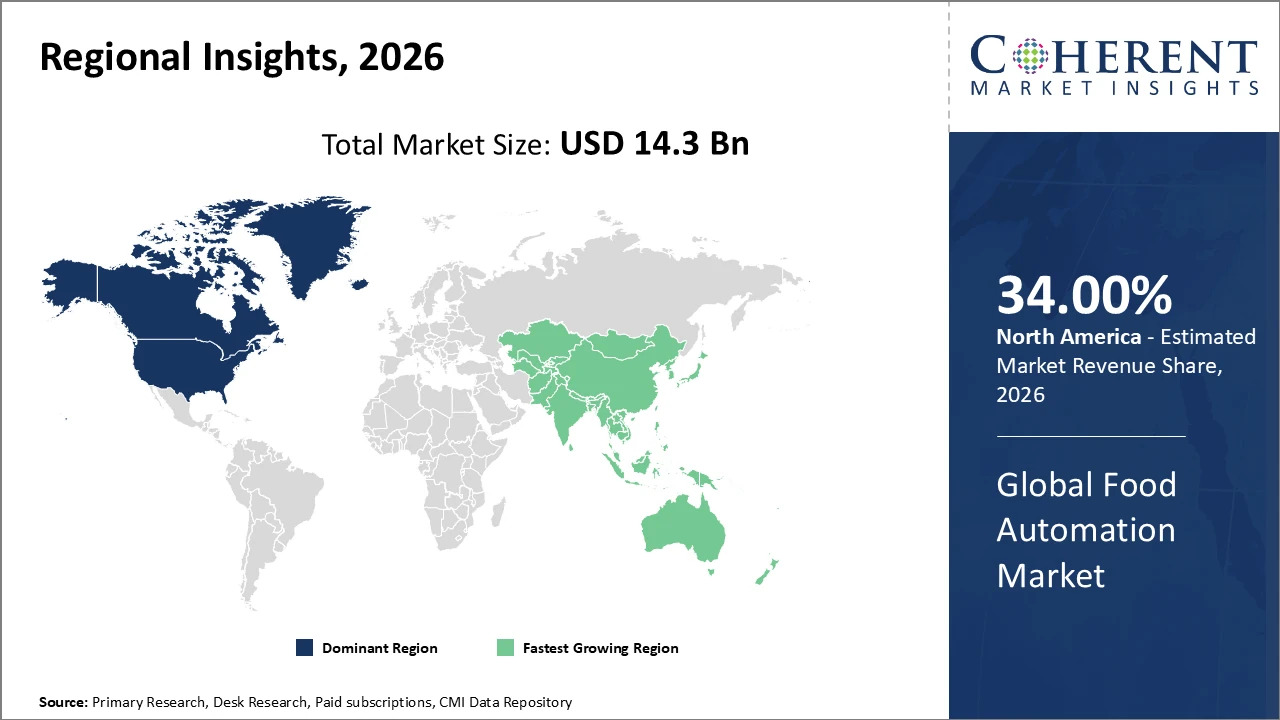
North America leads regionally, supported by strong infrastructure and regulatory backing for automation adoption.
Asia Pacific exhibits the fastest growth, with a CAGR exceeding 12%, driven by rapid industrialization and rising foreign direct investment in food processing in China and India.
Europe demonstrates steady growth, with strict food safety regulations encouraging automation investments.
Food Automation Market Segmentation Analysis
To learn more about this report, Request Free Sample
Food Automation Market Insights, By Automation Type
Robotics dominate the market with a 45% share, driven by their ability to automate complex, repetitive, and hazardous tasks across food processing and packaging lines with high precision, significantly contributing to revenue growth. Conveyors & Sorters are the fastest-growing subsegment, fueled by demand for efficient material transport and sorting in large-scale food manufacturing, enhancing throughput and reducing labor dependency. Vision Inspection Systems play a key role in quality control by detecting contaminants and defects accurately. Packaging Machines ensure hygienic sealing and extended shelf life to meet regulatory standards, while the Others category includes supplementary automation equipment for specialized food processing tasks.
Food Automation Market Insights, By Food Processing
Meat, Poultry, and Seafood processing dominate the market due to the complexity of handling perishable products that require strict safety and hygiene standards, driving extensive automation adoption. The Dairy Products segment is the fastest-growing, supported by rising global demand for processed and packaged dairy items and advancements in automated pasteurization and packaging technologies. Baking and Confectionery sustain steady growth, aided by automated dough handling and precision ovens that improve product consistency. Beverages leverage automation in bottling, filling, and quality inspections, while Fruits & Vegetables processing benefit from sorting, washing, and grading automation to maintain freshness and reduce waste. Other segments cover emerging niche food categories.
Food Automation Market Insights, By Application
Food Manufacturing holds the largest market share, driven by extensive use of automation technologies across multiple production stages to enhance operational efficiency and reduce costs. Quality Control is the fastest-growing subsegment, fueled by AI-powered vision inspection systems and sensor-based validation that ensure compliance with international food safety standards while minimizing recall risks. Food Packaging automation supports hygiene maintenance and extends shelf life, responding to growing consumer demand for convenient products. Logistics & Warehousing automation optimizes inventory management and internal transport, aligning with just-in-time delivery practices. The Others category includes automation in ancillary processes such as cleaning, maintenance, and equipment monitoring.
Food Automation Market Trends
The Food Automation market is increasingly integrating Industry 4.0 technologies such as IoT and AI, enhancing food safety and operational efficiency, particularly during 2025–2026.
Collaborative robots (cobots) are being widely adopted to address labor shortages and comply with strict hygiene protocols, with notable installations in Asia Pacific and Europe.
Sustainability-driven automation systems are gaining importance, helping reduce energy consumption and minimize food waste.
Regulatory frameworks, especially in Europe, are encouraging adoption of eco-friendly and efficient automation technologies.
Overall, technology integration, labor optimization, and sustainability are key trends shaping the future of food automation.
Food Automation Market Insights, By Geography
To learn more about this report, Request Free Sample
North America Food Automation Market Analysis and Trends
In North America, the Food Automation Market holds a leading share, driven by advanced manufacturing infrastructure and widespread adoption of robotics, AI, and IoT technologies in food production. The United States leads regional growth, with significant investments in robotic quality inspection systems, automated packaging lines, and intelligent process monitoring to improve efficiency and maintain food safety standards. Government initiatives and incentives further support automation deployment, encouraging manufacturers to adopt cutting-edge technologies. Strong consumer demand for packaged, convenient, and safe food products also fuels market expansion. Together, these factors position North America as a key hub for innovation and growth in food automation.
Asia Pacific Food Automation Market Analysis and Trends
The Asia Pacific region demonstrates the fastest growth in the Food Automation Market, with a CAGR exceeding 12%. This expansion is driven by rapid industrialization, the development of modern food processing infrastructure, and rising foreign direct investments, particularly in China and India. Government programs promoting smart manufacturing and Industry 4.0 adoption in countries such as South Korea and Japan further accelerate automation deployment. Additionally, increasing consumer demand for packaged, safe, and high-quality food products encourages manufacturers to implement advanced robotics, AI, and IoT solutions. These factors collectively position Asia Pacific as a dynamic and rapidly expanding market for food automation technologies.
Food Automation Market Outlook for Key Countries
USA Food Automation Market Analysis and Trends
The U.S. food automation market has experienced significant growth, driven by early adoption of robotics and AI-powered processing technologies. In 2025, poultry processing plants achieved a 20% improvement in operational efficiency through robotic deboning and automated packaging systems. Stringent regulatory requirements for food safety further incentivize investments in automated quality control and inspection technologies. Leading companies such as ABB Ltd. and Rockwell Automation have expanded their presence, supplying advanced automation solutions across production and packaging lines. Strong infrastructure, technological expertise, and supportive policies position the U.S. as a dominant market, setting benchmarks for efficiency, safety, and innovation in food automation.
Germany Food Automation Market Analysis and Trends
Germany’s food automation market is evolving rapidly, supported by strong industrial output, innovation, and a focus on sustainability within the broader food and manufacturing sectors. German manufacturers are increasingly investing in robotics, AI, and Industry 4.0 technologies to enhance precision, throughput, and quality control in food processing and packaging. Collaborative robots and AI‑based systems are becoming more common to address labor shortages and optimize production schedules, while digitalization efforts improve traceability and predictive maintenance. Sustainability remains central, with automation helping reduce energy use and waste. Government incentives and high consumer demand for quality and organic products further accelerate automation adoption across the food industry.
Analyst Opinion
Enhanced Production Capacity Drives Market Revenue: Automation systems in food processing plants increased throughput by over 22% in 2024, directly boosting market share. For example, large-scale U.S. meat processing units upgraded to robotic sorting systems, achieving up to 1,200 units per hour, highlighting production capacity as a key growth driver.
Rising Adoption of Robotics in Packaging Elevates Market Size: In 2025, automated robot deployment in packaging grew 19% globally, driven by consumer demand for hygienically sealed products. Germany leveraged automation in dairy packaging, reducing contamination risks and supporting market expansion.
Expansion of Automated Quality Control Augments Market Insights: AI-powered vision systems for food quality inspection surged 25% in 2026, enabling precise detection of contaminants and defects, enhancing process optimization and waste reduction.
Integration of Cloud and IoT Technologies Accelerates Market Revenue: IoT-enabled automation solutions for remote process monitoring increased by 30% from 2024 to 2026, improving operational efficiency and real-time decision-making, with companies in Japan and South Korea leading innovation.
Market Scope
| Report Coverage | Details | ||
|---|---|---|---|
| Base Year: | 2025 | Market Size in 2026: | USD 14.3 billion |
| Historical Data for: | 2020 To 2024 | Forecast Period: | 2026 To 2033 |
| Forecast Period 2026 to 2033 CAGR: | 10.4% | 2033 Value Projection: | USD 28.7 billion |
| Geographies covered: |
|
||
| Segments covered: |
|
||
| Companies covered: | ABB Ltd., Fanuc Corporation, KUKA AG, Buhler AG, Siemens AG, Hirata Corporation, Omron Corporation, Foxconn Technology Group, Mitsubishi Electric Corporation, Rockwell Automation | ||
| Growth Drivers: |
|
||
Uncover macros and micros vetted on 75+ parameters: Get instant access to report
Food Automation Market Growth Factors
The Food Automation Market is driven by rising demand for operational efficiency, with automation adoption reducing labor costs by an average of 16% in 2026. Growing consumer focus on food safety and hygiene has increased investments in automated quality control, especially in countries with strict regulations such as Japan and Canada. Advancements in AI and IoT enable real-time process monitoring and predictive maintenance, boosting equipment uptime by up to 12% in the beverage processing segment in 2025. Additionally, the trend toward smart factories with interoperable automation systems encourages cross-sector collaborations, enhancing market dynamics, expanding applications, and broadening overall market potential.
Food Automation Market Development
In January 2026, Chef Robotics and Packline introduced AI-enabled systems for end-to-end food and packaging assembly, using wireless integration to connect and coordinate production equipment.
Key Players
Leading Companies of the Market
ABB Ltd.
Fanuc Corporation
KUKA AG
Buhler AG
Siemens AG
Hirata Corporation
Omron Corporation
FoxConn Technology Group
Rockwell Automation
Mitsubishi Electric Corporation
Notably, ABB Ltd. expanded its robotics capabilities for food-grade automation, leading to a 15% increase in customer acquisitions across North American food manufacturing units in 2025. Mitsubishi Electric made significant investments in AI-driven vision inspection systems, achieving a 20% improvement in defect detection accuracy and establishing itself as a leader in quality control automation. Similarly, KUKA AG partnered with multiple dairy producers in Europe, optimizing conveyor system designs that reduced packaging time by 18%, strengthening its presence in the region’s highly regulated food automation market. These developments highlight strategic innovation and market expansion efforts by key players.
Food Automation Market Future Outlook
The Food Automation Market is expected to experience strong growth in the coming years, driven by increasing demand for operational efficiency, food safety, and consistent product quality. Adoption of robotics, AI, and IoT-enabled automation will continue to expand across processing, packaging, and quality control segments. Emerging trends such as smart factories, collaborative robots, and cloud-integrated monitoring systems will enhance real-time decision-making and predictive maintenance. Rising consumer demand for convenience foods and stringent regulatory standards will further accelerate automation adoption. Overall, technological innovation, sustainability initiatives, and cross-sector collaborations are set to shape the future trajectory of the global food automation market.
Food Automation Market Historical Analysis
The global Food Automation Market has witnessed steady growth over the past decade, driven by rising demand for efficiency, food safety, and consistent quality in processing and packaging. Initially, adoption focused on large-scale meat and dairy processing plants using basic conveyor and sorting systems. Between 2015 and 2020, robotics and automated packaging gained momentum, supported by technological advancements and increasing labor costs. AI and vision-based inspection systems emerged to enhance quality control and reduce contamination risks. E-commerce growth and consumer demand for packaged, ready-to-eat foods further propelled automation. Overall, historical trends reflect a shift from manual processes to integrated, technology-driven food manufacturing operations.
Sources
Primary Research Interviews:
Food processing plant managers and operations executives
Robotics and automation solution providers
AI and IoT technology developers for food manufacturing
Industry analysts and consultants specializing in food automation
Magazines:
Food Engineering – Automation and Processing Updates
Food Processing – Technology and Equipment Innovations
Food Navigator – Industry Trends and Product Developments
Beverage Industry – Automation in Food and Beverage
Journals:
Journal of Food Engineering – Food Processing Automation Research
Food Control – Quality, Safety, and Automation Studies
International Journal of Food Science & Technology – Food Manufacturing Innovations
Trends in Food Science & Technology – Advances in Processing Technologies
Newspapers:
The Wall Street Journal – Food Manufacturing and Technology Markets
Financial Times – Food Industry and Automation Developments
Reuters – Food Processing, Technology, and Market News
Bloomberg – Food Automation and Industrial Trends
Associations:
International Federation of Robotics (IFR)
Food Processing Suppliers Association (FPSA)
Institute of Food Technologists (IFT)
European Federation of Food, Agriculture and Tourism Trade Associations (EUROFEMA)
Share
Share
Ramprasad Bhute is a Senior Research Consultant with over 6 years of experience in market research and business consulting. He manages consulting and market research projects centered on go-to-market strategy, opportunity analysis, competitive landscape, and market size estimation and forecasting. He also advises clients on identifying and targeting absolute opportunities to penetrate untapped markets.

Credibility and Certifications

860519526


9001:2015

27001:2022


Need a Custom Report?
We can customize every report - free of charge - including purchasing stand-alone sections or country-level reports
Customize NowJoining thousands of companies around the world committed to making the Excellent Business Solutions.
View All Our Clients