Knee Implants Market Analysis & Forecast: 2026-2033

Knee Implants Market Size and Forecast – 2026 – 2033
The Global Knee Implants Market size is estimated to be valued at USD 15.9 billion in 2026 and is expected to reach USD 26.4 billion by 2033, exhibiting a compound annual growth rate (CAGR) of 7.5% from 2026 to 2033.
Global Knee Implants Market Overview
The Knee Implants Market is driven by the rising prevalence of osteoarthritis, rheumatoid arthritis, and joint injuries, which increase the demand for total and partial knee replacement surgeries. Aging populations and longer life expectancy contribute to higher incidence of degenerative knee conditions. Advancements in minimally invasive surgical techniques, computer-assisted surgery, and patient-specific implant designs improve recovery times and outcomes, boosting adoption. Growing awareness of enhanced mobility, pain relief, and quality of life post-surgery further supports market growth. Additionally, expanding healthcare infrastructure, increased insurance coverage, and rising orthopedic surgical volumes globally are fueling demand for advanced knee implant solutions.Top of Form
Bottom of Form
Key Takeaways
Cemented knee implants dominate the Knee Implants Market due to their strong fixation reliability, proven long-term performance, and widespread adoption in total knee replacement procedures.
Total knee replacement procedures account for the largest market revenue because of the increasing prevalence of osteoarthritis, obesity-related joint disorders, and aging populations worldwide.
Partial knee replacement procedures are growing rapidly due to their minimally invasive nature, bone-preserving advantages, shorter recovery periods, and improved postoperative mobility outcomes.
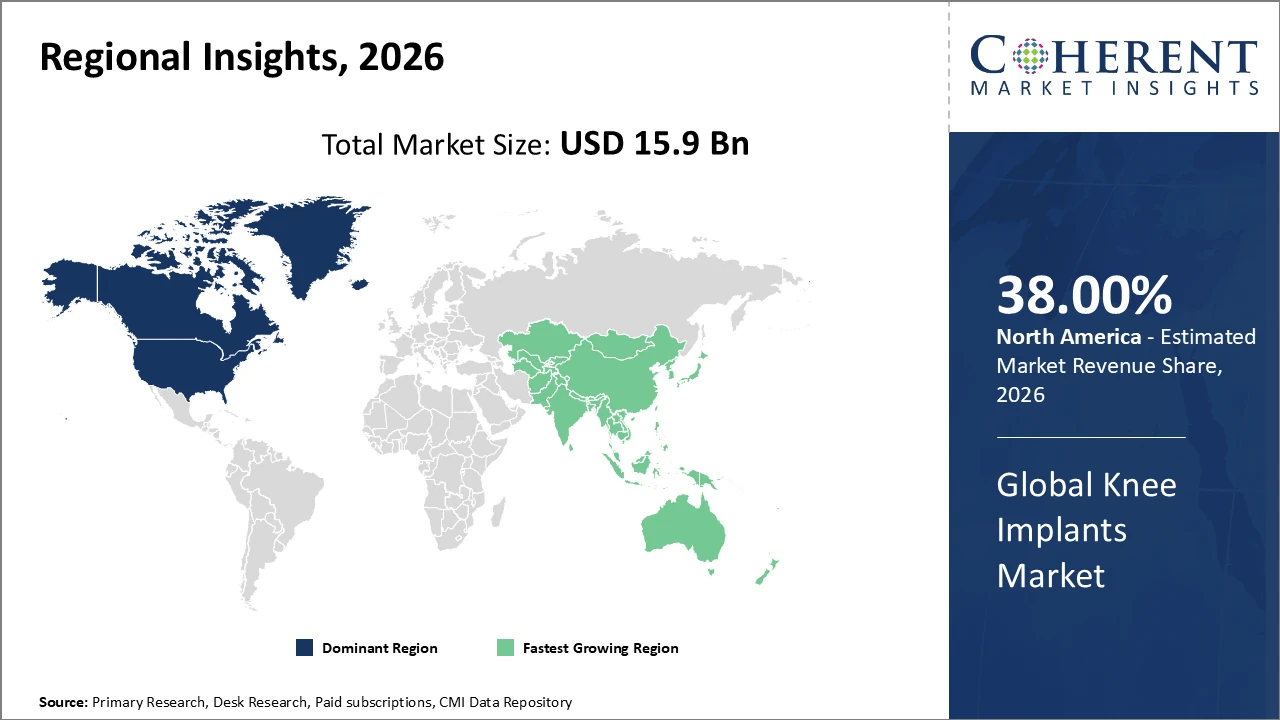
North America holds more than 38% of the global Knee Implants Market share owing to advanced healthcare infrastructure, high orthopedic surgery volumes, and strong healthcare expenditure.
Asia Pacific is the fastest-growing regional market, driven by expanding healthcare accessibility, rising orthopedic procedure rates, growing geriatric populations, and supportive government healthcare initiatives.
Knee Implants Market Segmentation Analysis
To learn more about this report, Request Free Sample
Knee Implants Market Insights, By Implant Type
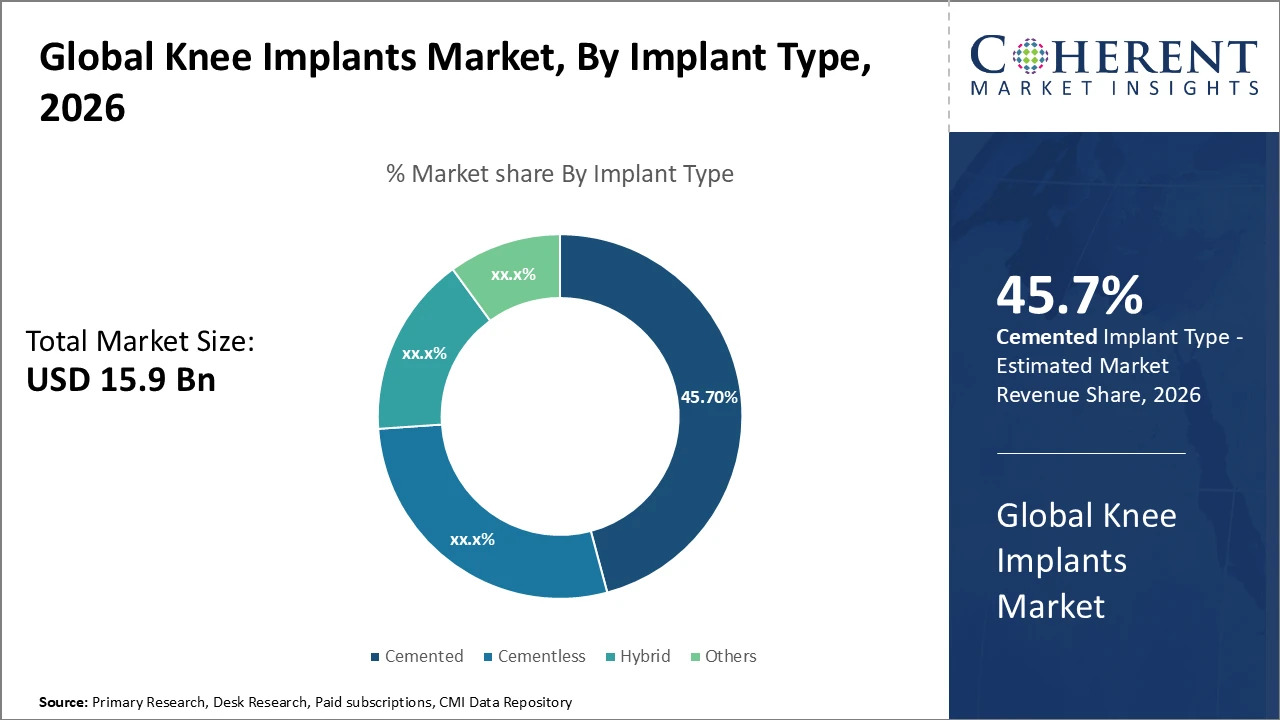
Cemented implants dominate the Knee Implants Market with approximately 45.7% market share due to their reliable immediate fixation, established clinical success, and simplified surgical procedures. These implants are widely preferred for elderly patients and individuals with reduced bone density because they provide stable implant support and predictable postoperative outcomes. Cementless implants represent the fastest-growing segment, driven by advancements in porous coatings and osseointegration technologies that encourage natural bone ingrowth and long-term implant durability. Hybrid implants, which combine cemented and cementless fixation methods, are gradually gaining acceptance because of their balanced performance benefits.
Knee Implants Market Insights, By Application
Total knee replacement dominates the Knee Implants Market because of its widespread use in treating moderate to severe osteoarthritis, rheumatoid arthritis, and degenerative joint disorders. The procedure delivers effective pain relief, improved mobility, and long-term functional outcomes, making it the most commonly performed knee implant surgery globally. Partial knee replacement represents the fastest-growing application segment due to its minimally invasive and bone-preserving approach, which supports faster recovery, reduced complications, and improved patient satisfaction. Revision knee replacement procedures are also increasing steadily as aging implant populations require secondary corrective surgeries. Additional specialized applications, including tumor reconstruction and congenital deformity correction, contribute modestly to overall market expansion and orthopedic surgical demand.
Knee Implants Market Insights, By End User
Hospitals dominate the Knee Implants Market due to their ability to perform large volumes of primary and revision knee replacement surgeries supported by advanced surgical infrastructure and multidisciplinary orthopedic care teams. These facilities remain the preferred setting for complex orthopedic procedures and postoperative rehabilitation services. Ambulatory surgical centers represent the fastest-growing segment because minimally invasive knee replacement techniques are reducing hospital stays, lowering treatment costs, and improving patient recovery efficiency. Orthopedic clinics continue expanding their role beyond diagnostics and rehabilitation into specialized surgical procedures through improved facilities and advanced technologies. Additional contributions come from academic institutions and research centers conducting orthopedic clinical trials and implant innovation programs.
Knee Implants Market Trends
The Knee Implants Market is witnessing rapid adoption of minimally invasive and robot-assisted knee replacement procedures, improving surgical precision, reducing recovery times, and lowering revision surgery rates.
Growing integration of AI-driven surgical planning and digital orthopedic technologies is increasing demand for patient-specific and customized knee implants tailored to individual anatomical requirements.
Sustainability initiatives and stricter regulatory standards are encouraging manufacturers to develop eco-certified implant materials and more environmentally responsible orthopedic production processes.
Knee Implants Market Insights, By Geography
To learn more about this report, Request Free Sample
North America Knee Implants Market Analysis and Trends
North America dominates the Knee Implants Market with a share of 38% due to its advanced healthcare infrastructure, high healthcare spending, and rapid adoption of innovative orthopedic technologies. The United States contributes the largest regional market share, supported by more than 1.3 million knee replacement procedures performed annually and strong reimbursement policies that improve patient access to orthopedic treatments. Major companies such as Zimmer Biomet and Stryker Corporation maintain extensive operations and research facilities across the region, continuously advancing implant technologies and robotic-assisted surgical systems. Collaborations with leading orthopedic hospitals and specialty centers further strengthen North America’s leadership in knee implant innovation and adoption.
Asia Pacific Knee Implants Market Analysis and Trends
Asia Pacific is projected to register the fastest growth in the Knee Implants Market, with a CAGR exceeding 9% during 2026–2033. Rapid expansion of healthcare infrastructure, increasing awareness regarding joint replacement procedures, and the growing prevalence of osteoarthritis and obesity-related joint disorders are major factors driving regional market growth. Countries such as China and India are heavily investing in advanced hospitals, orthopedic specialty centers, and healthcare modernization programs supported by government healthcare reforms. Rising geriatric populations and improving healthcare accessibility further strengthen market demand. Leading orthopedic manufacturers are expanding local manufacturing facilities, distribution networks, and strategic partnerships to efficiently address increasing demand for advanced knee implant technologies across the region.
Knee Implants Market Outlook for Key Countries
USA Knee Implants Market Analysis and Trends
The United States Knee Implants Market is supported by highly developed healthcare infrastructure, strong orthopedic expertise, and substantial investments in advanced medical technologies. Increasing adoption of robotic-assisted and minimally invasive knee replacement procedures continues transforming orthopedic surgical practices across the country. Robotic-assisted surgeries now account for a growing share of total knee replacement procedures, improving implant positioning accuracy and patient recovery outcomes. Major orthopedic manufacturers have established extensive clinical research and innovation centers in the United States to accelerate development of advanced implant materials, personalized implants, and digital surgical technologies. Favorable reimbursement frameworks and rising patient demand for faster recovery and improved mobility continue driving sustained market expansion nationwide.
Germany Knee Implants Market Analysis and Trends
Germany’s Knee Implants Market is experiencing steady growth driven by an aging population, increasing prevalence of osteoarthritis, and strong healthcare infrastructure supporting advanced orthopedic procedures. Rising demand for minimally invasive surgeries and robotic-assisted knee replacement procedures is accelerating adoption of technologically advanced implants across hospitals and orthopedic centers. Total knee replacement implants continue to dominate the market due to growing cases of degenerative joint disorders among elderly patients. Germany also benefits from the strong presence of orthopedic manufacturers such as Zimmer Biomet and Smith & Nephew investing in personalized implants and advanced biomaterials. Increasing healthcare expenditure and rehabilitation services further support market expansion.
Analyst Opinion
Rising global knee replacement surgery volumes continue driving strong market growth, supported by increasing osteoarthritis prevalence, aging populations, and improving access to orthopedic care in emerging economies.
Advancements in implant biomaterials such as highly cross-linked polyethylene and ceramic composites are improving implant durability, reducing revision surgery rates, and increasing long-term patient satisfaction.
Adoption of 3D printing technologies and patient-specific knee implants is optimizing surgical efficiency, shortening operative times, and enhancing precision in orthopedic treatment procedures.
Regulatory approvals and growing use of robotic-assisted surgical systems are improving implant placement accuracy, clinical outcomes, and adoption of advanced integrated orthopedic surgical technologies.
Market Scope
| Report Coverage | Details | ||
|---|---|---|---|
| Base Year: | 2025 | Market Size in 2026: | USD 15.9 billion |
| Historical Data for: | 2020 To 2024 | Forecast Period: | 2026 To 2033 |
| Forecast Period 2026 to 2033 CAGR: | 7.5% | 2033 Value Projection: | USD 26.4 billion |
| Geographies covered: |
|
||
| Segments covered: |
|
||
| Companies covered: | Zimmer Biomet Holdings Inc., Stryker Corporation, Johnson & Johnson, Medtronic plc, Smith & Nephew plc, DJO Global Inc., Globus Medical Inc., Exactech Inc. | ||
| Growth Drivers: |
|
||
Uncover macros and micros vetted on 75+ parameters: Get instant access to report
Knee Implants Market Growth Factors
The Knee Implants Market is experiencing strong growth driven by the rising global prevalence of osteoarthritis, obesity, and age-related joint disorders that are increasing demand for knee replacement surgeries. Expanding healthcare infrastructure and improving access to advanced orthopedic treatments across emerging economies, particularly in Asia Pacific, are further supporting market expansion. Growing adoption of minimally invasive surgical techniques, robotic-assisted procedures, and advanced implant biomaterials is improving recovery outcomes, implant longevity, and patient satisfaction, encouraging wider acceptance of knee arthroplasty procedures. Additionally, increasing healthcare expenditure, supportive reimbursement frameworks, and greater awareness regarding mobility restoration and quality-of-life improvements continue strengthening market growth across developed and developing healthcare systems.
Knee Implants Market Development
In December 2025, Fortis Hospital, Nagarbhavi, launched the Next Generation Mako Robotic System in Karnataka, featuring CT-based 3D modeling, AI surgical planning, and haptic-guided robotic-arm assistance for advanced robot-assisted knee replacement.
Key Players
Leading Companies of the Market
Zimmer Biomet Holdinsg Inc.
Stryker Corporation
Johnson & Johnson
Medtronic plc
Smith & Nephew plc
DJO Global Inc.
Globus Medical Inc.
Exactech Inc.
Leading companies in the Knee Implants Market are increasingly adopting aggressive growth strategies centered on digital innovation, robotic-assisted surgery, and personalized implant technologies. Stryker Corporation strengthened its market position through the expansion of AI-enabled robotic-arm assisted surgical systems, significantly increasing adoption of precision-based knee replacement procedures across North America. Meanwhile, Zimmer Biomet pursued strategic acquisitions of companies specializing in customized knee implant manufacturing and advanced orthopedic technologies. These initiatives expanded product portfolios, enhanced personalized treatment capabilities, and contributed to stronger revenue growth while improving competitive positioning within the global orthopedic implant industry.
Knee Implants Market Future Outlook
The Knee Implants Market is expected to witness strong growth over the coming years driven by rising incidences of osteoarthritis, obesity, sports injuries, and aging populations worldwide. Increasing demand for minimally invasive and robotic-assisted knee replacement procedures is accelerating adoption of advanced implant technologies and personalized orthopedic solutions. Technological innovations including 3D-printed implants, smart implants, and improved biomaterials are enhancing implant durability, surgical precision, and patient recovery outcomes. Expanding healthcare infrastructure and growing orthopedic surgery volumes in emerging economies will further support market expansion. North America is expected to maintain market leadership, while Asia Pacific is projected to experience the fastest growth due to increasing healthcare investments and patient awareness.
Knee Implants Market Historical Analysis
The Knee Implants Market has experienced substantial growth over the past decades due to increasing prevalence of osteoarthritis, rheumatoid arthritis, obesity, and age-related joint degeneration. Historically, total knee replacement implants emerged as the dominant product segment because of rising demand for pain relief and mobility restoration among elderly populations. Early implant technologies primarily relied on conventional metal and polyethylene materials, while advancements in biomaterials and fixation systems gradually improved implant longevity and surgical outcomes. North America and Europe historically led the market due to advanced healthcare infrastructure and high orthopedic surgery volumes. In recent years, robotic-assisted surgery, personalized implants, and minimally invasive procedures have transformed market dynamics globally.
Sources
Primary Research Interviews:
Orthopedic surgeons, joint replacement specialists, rehabilitation therapists, and hospital administrators utilizing knee implants for total knee replacement, partial knee arthroplasty, and trauma reconstruction procedures.
Supply chain executives, orthopedic device manufacturers, and procurement specialists responsible for sourcing implant biomaterials, surgical instruments, robotic-assisted orthopedic systems, and fixation technologies.
Market analysts, R&D directors, and regulatory experts involved in orthopedic implant innovation, minimally invasive knee replacement technologies, and advanced biomaterial development.
Magazines:
Orthopedic Design & Technology – Updates on orthopedic implant technologies, knee replacement innovations, and surgical advancements.
Medical Device and Diagnostic Industry – Insights into medical device development, orthopedic manufacturing trends, and robotic-assisted surgery technologies.
Orthopedics Today – Coverage of knee replacement procedures, implant technologies, and rehabilitation trends in orthopedic care.
Journals:
The Journal of Bone and Joint Surgery – Research on knee arthroplasty, implant performance, and orthopedic surgical outcomes.
Journal of Arthroplasty – Studies focused on knee replacement technologies, implant fixation methods, and patient recovery outcomes.
Clinical Orthopaedics and Related Research – Research on orthopedic implants, biomaterials, minimally invasive procedures, and musculoskeletal treatment advancements.
Newspapers:
Financial Times – Coverage of healthcare investments, orthopedic technology innovations, and medical device industry developments.
Reuters – Reporting on knee implant product launches, orthopedic device approvals, and mergers within the orthopedic healthcare sector.
Bloomberg – Insights into acquisitions, R&D investments, and strategic developments among orthopedic implant manufacturers and healthcare technology companies.
Associations:
American Academy of Orthopaedic Surgeons – Clinical guidelines, orthopedic research, and advancements in knee replacement technologies.
Orthopaedic Research Society – Research updates, biomaterial innovations, and orthopedic implant development trends.
Share
Share
Komal Dighe is a Management Consultant with over 8 years of experience in market research and consulting. She excels in managing and delivering high-quality insights and solutions in Health-tech Consulting reports. Her expertise encompasses conducting both primary and secondary research, effectively addressing client requirements, and excelling in market estimation and forecast. Her comprehensive approach ensures that clients receive thorough and accurate analyses, enabling them to make informed decisions and capitalize on market opportunities.

Credibility and Certifications

860519526


9001:2015

27001:2022


Need a Custom Report?
We can customize every report - free of charge - including purchasing stand-alone sections or country-level reports
Customize NowJoining thousands of companies around the world committed to making the Excellent Business Solutions.
View All Our Clients