Medical Holography Market Analysis & Forecast: 2026-2033

Medical Holography Market Size and Forecast – 2026 – 2033
The Global Medical Holography Market size is estimated to be valued at USD 1.85 billion in 2026 and is expected to reach USD 5.45 billion by 2033, exhibiting a compound annual growth rate (CAGR) of 16.5% from 2026 to 2033.
Global Medical Holography Market Overview
The medical holography market comprises several key product categories, including holographic displays, holographic microscopes, holographic prints, and holography software. Holographic displays dominate due to their use in 3D visualization for surgical planning, diagnostics, and medical education. Holographic microscopes enable high-resolution, label-free imaging of cells for biomedical research. Holographic software converts 2D imaging data (CT/MRI) into interactive 3D models. Additionally, holographic prints and emerging tools like holoscopes support visualization and training. These products enhance minimally invasive procedures, improve diagnostic accuracy, and enable better understanding of complex anatomical structures in healthcare.
Key Takeaways
Surgical Planning Segment continues to lead in market share, driven by improved patient outcomes and procedural efficiency, accounting 35% share by 2026.
Hospitals and Clinics dominate end-user adoption due to high capital budgets and technology readiness, commanding over 52% industry share.
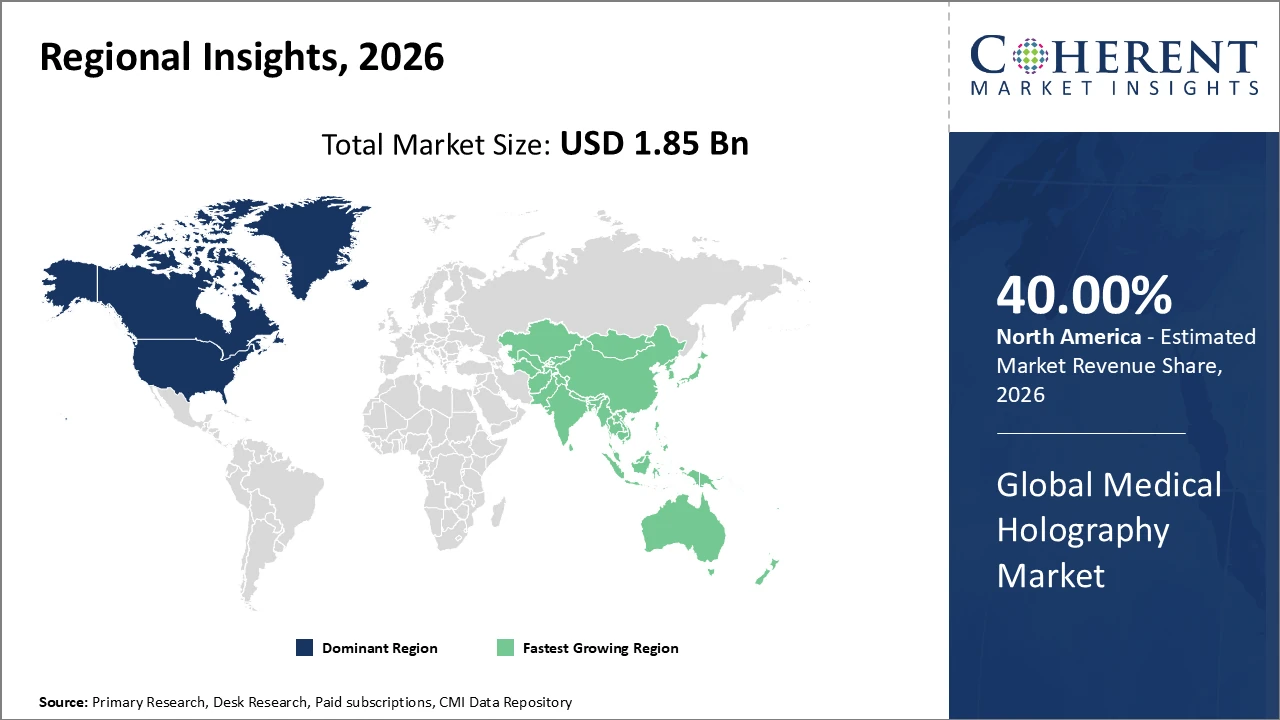
North America remains the dominating region with over 40% market share, supported by extensive healthcare infrastructure and strong R&D investments.
Asia Pacific is the fastest-growing region, registering a CAGR exceeding 18%, bolstered by government healthcare digitization policies and expanding medical device manufacturing hubs, particularly in China and India.
Medical Holography Market Segmentation Analysis
To learn more about this report, Request Free Sample
Medical Holography Market Insights, By Technology
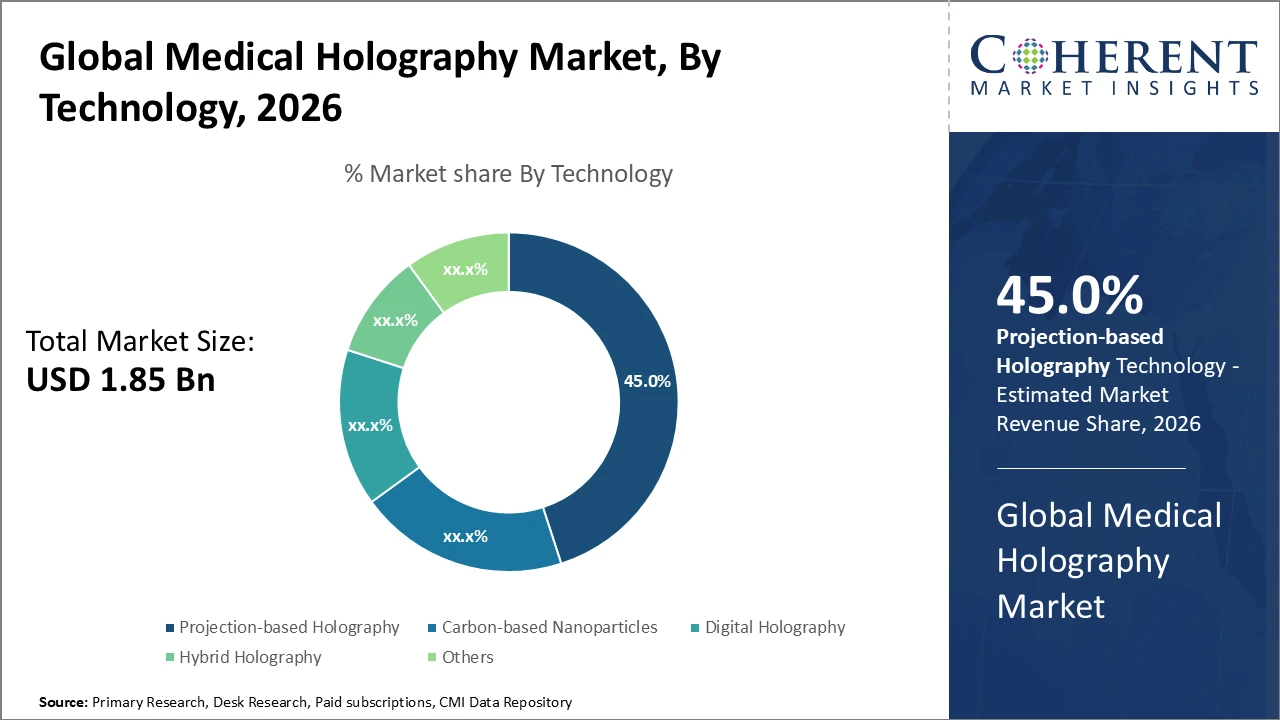
Projection-based Holography dominates the market with a 45% share, driven by its cost-effectiveness and seamless integration with existing surgical display systems, supporting widespread clinical adoption. Laser-based Holography is the fastest-growing segment, fueled by advancements in laser precision and depth perception, enhancing image clarity for complex procedures like neurosurgery and vascular interventions. Digital Holography provides real-time imaging capabilities, making it valuable for diagnostics and monitoring. Hybrid Holography integrates multiple technologies to enable tailored medical applications. Other segments include experimental holographic techniques that are currently under clinical evaluation and hold potential for future advancements in specialized medical fields.
Medical Holography Market Insights, By Application
Surgical Planning dominates the market with the largest share, driven by its significant role in improving procedural accuracy, reducing operative time, and enhancing overall clinical efficiency. Diagnostics is the fastest-growing application, supported by advanced holographic imaging techniques that enable early disease detection, especially in oncology. Medical Training & Education leverages holography to deliver interactive and immersive learning experiences for students and professionals. Patient Monitoring uses real-time holographic visualization to support effective chronic disease management. Other applications include research and telemedicine, where holography is increasingly being explored to enable remote consultations and advanced medical analysis across distributed healthcare systems.
Medical Holography Market Insights, By End User
Hospitals and Clinics dominate the market with a 52% share, supported by strong infrastructure and higher budget allocation for advanced technological adoption. Telemedicine Providers represent the fastest-growing subsegment, driven by increasing demand for remote healthcare services and digital health solutions. Research Institutes play a key role in advancing holographic technologies and translating innovations into clinical applications. Other end users include specialized outpatient centers and mobile health units that contribute to broader service delivery. The rapid expansion of telemedicine highlights improved healthcare accessibility and significantly enhances the overall market scope across both urban and remote patient populations.
Medical Holography Market Trends
Market trends indicate a strong shift toward AI-driven holography solutions that enhance diagnostic accuracy and surgical precision.
Advancements in deep learning integration with holographic imaging platforms in 2026 have significantly improved real-time visualization, supporting complex surgical procedures.
Increasing adoption of holographic technology in telemedicine is enabling immersive 3D remote consultations, with usage expanding by over 30% in 2025.
Growing sustainability concerns are encouraging manufacturers to develop eco-friendly holographic display materials, aligning with global environmental regulations and evolving consumer expectations.
Medical Holography Market Insights, By Geography
To learn more about this report, Request Free Sample
North America Medical Holography Market Analysis and Trends
In North America, the Medical Holography Market maintains dominance with a share of 40% due to its well-established healthcare infrastructure, significant R&D investments, and rapid adoption of advanced medical technologies. The United States contributes the majority of regional revenue, supported by leading hospitals, research institutions, and favorable regulatory frameworks that accelerate technology deployment. The presence of key industry players such as VividWave Imaging Technologies and LuminaSight Health Solutions further strengthens the region’s market position. Additionally, government initiatives and funding programs aimed at promoting healthcare innovation continue to drive growth, ensuring sustained leadership and early adoption of holography solutions across clinical and research applications.
Asia Pacific Medical Holography Market Analysis and Trends
Meanwhile, the Asia Pacific region demonstrates the fastest growth trajectory, registering a CAGR of over 18%, driven by rapid healthcare digitization in major economies such as China and India. Government initiatives aimed at modernizing healthcare infrastructure and expanding telemedicine services are key growth drivers. Increasing investments in medical technology, along with a rising focus on improving healthcare accessibility, further support market expansion. Additionally, the region’s expanding medical device manufacturing capabilities and growing healthcare expenditure are accelerating adoption of advanced solutions like medical holography, contributing to dynamic market development and positioning Asia Pacific as a critical growth hub.
Medical Holography Market Outlook for Key Countries
USA Medical Holography Market Analysis and Trends
The USA remains the pivotal market globally, characterized by rapid adoption of projection-based holography technology and extensive use in complex surgical planning. In 2025, over 60% of all medically applied holographic systems were installed across U.S. healthcare facilities, reflecting a strong industry share and market revenue. Key players such as VividWave and LuminaSight have driven pioneering innovations, focusing on portable holographic devices for emergency care applications. The FDA’s accelerated device approval processes post-2024 have further supported market expansion. Additionally, strategic collaborations between technology companies and clinical institutions have strengthened commercialization and optimized overall market deployment strategies.
Germany Medical Holography Market Analysis and Trends
Germany’s Medical Holography Market is experiencing steady growth, driven by its advanced healthcare infrastructure, strong biomedical research ecosystem, and high adoption of precision medicine. The country benefits from extensive hospital networks and university medical centers that actively integrate holographic imaging into surgical planning, diagnostics, and medical training. Increasing demand for non-invasive, radiation-free imaging solutions in oncology and cardiology is a key growth driver. Germany also leads in Europe due to strong R&D investments and the presence of innovative medical technology firms. Growing use of AI-integrated holography and cloud-based visualization platforms further supports market expansion and clinical adoption.
Analyst Opinion
Integration of Augmented Reality (AR) and holography is acting as a key supply-side catalyst, with AR-enhanced holographic displays nearly doubling production efficiency in 2025, reducing costs and improving visualization fidelity.
Increasing clinical demand for patient-specific 3D models is driving market revenue growth, with U.S. hospitals reporting a 38% rise in holographic-assisted surgical planning in 2024, supported by higher imports of components from Asia-Pacific.
Neurological applications are emerging strongly, accounting for 22% of new holography deployments in 2026, up from 15% in 2024, indicating diversification beyond cardiovascular imaging and expanding revenue opportunities.
Advances in microfabrication and nano-scale techniques in 2025 are enabling compact, portable holographic systems for bedside diagnostics, improving accessibility in outpatient and remote healthcare settings.
Market Scope
| Report Coverage | Details | ||
|---|---|---|---|
| Base Year: | 2025 | Market Size in 2026: | USD 1.85 billion |
| Historical Data for: | 2020 To 2024 | Forecast Period: | 2026 To 2033 |
| Forecast Period 2026 to 2033 CAGR: | 16.5% | 2033 Value Projection: | USD 5.45 billion |
| Geographies covered: |
|
||
| Segments covered: |
|
||
| Companies covered: | HoloMed Systems Inc., OptiScan Diagnostics, MedScope Holography, PlexiClear Solutions, Apex Health Technologies, NeuroRay Medical Devices, ZenithMed Imaging, HoloSurg Instruments, Quantum Imaging Labs, BioVisual Technologies | ||
| Growth Drivers: |
|
||
Uncover macros and micros vetted on 75+ parameters: Get instant access to report
Medical Holography Market Growth Factors
Several critical factors are driving the growth of the Medical Holography Market. Rising demand for minimally invasive surgeries has increased reliance on precise visualization tools, with studies indicating a 25% reduction in surgical time when holography-assisted guidance is used. Growing investments in healthcare digitization are expanding market adoption, particularly in North America and Europe. The increasing geriatric population, with higher prevalence of cardiovascular and neurological diseases, is further boosting demand for advanced diagnostic platforms. In addition, supportive government initiatives, including the U.S. FDA’s streamlined approval process for holographic devices in 2025, are reducing entry barriers and accelerating market expansion.
Medical Holography Market Development
In February 2025, Honeywell announced Digital Holographic Microscopy, an AI-powered technology designed to count and classify microscopic particles and cells. It has potential applications across industries requiring fast analysis and streamlined operations.
Key Players
Leading Companies of the Market
HoloMed Systems Inc.
OptiScan Diagnostics
NeuroRay Medical Devices
MedScope Holography
Apex Health Technologies
ZenithMed Imaging
HoloSurg Instruments
PlexiClear Solutions
Quantum Imaging Labs
BioVisual Technologies
Leading market players have adopted aggressive business growth strategies such as strategic mergers and acquisitions to consolidate technological expertise. For instance, VividWave’s acquisition of TriD Healthcare Innovations in late 2025 strengthened its product portfolio and boosted its market share by over 6%, enabling broader deployment of advanced holographic imaging solutions across surgical applications. Additionally, partnerships between surgical equipment manufacturers and holography-focused firms have accelerated clinical adoption. A notable example is LuminaSight Health Solutions’ collaboration with major orthopedic centers in 2024, which improved integration of holographic visualization in orthopedic procedures and enhanced revenue generation, setting new benchmarks for industry expansion strategies.
Medical Holography Market Future Outlook
The Medical Holography Market is expected to witness strong growth in the future, driven by advancements in AI, augmented reality, and 3D imaging technologies. Increasing adoption of minimally invasive surgeries and demand for real-time, high-precision visualization tools will further accelerate market expansion. Rising healthcare digitization, particularly in emerging economies, will broaden access to holographic solutions. Integration with telemedicine and remote diagnostics is anticipated to create new application areas. Additionally, ongoing R&D investments and supportive regulatory frameworks will foster innovation. The market is likely to become more cost-efficient and widely adopted across hospitals, clinics, and research institutions globally.
Medical Holography Market Historical Analysis
The Medical Holography Market has evolved steadily over the past decade, transitioning from experimental research to early clinical adoption. Initially, its use was limited to academic and research institutions focused on 3D imaging and visualization studies. With advancements in computing power, optics, and imaging technologies, adoption expanded into surgical planning and medical education. Between 2018 and 2023, increasing integration of digital imaging systems such as CT and MRI with holographic software significantly improved usability. Growing investments in healthcare digitization and rising demand for precision medicine further accelerated development, setting the foundation for broader commercial deployment in hospitals and clinical environments.
Sources
Primary Research Interviews:
Medical holography device manufacturers, biomedical engineers, and healthcare imaging specialists focusing on holographic imaging accuracy, surgical visualization, and diagnostic applications
Hospital administrators, radiologists, and surgical experts involved in adoption of 3D holographic systems for surgical planning, education, and patient monitoring
Executives from medical imaging companies, R&D heads, and product developers working on AR/VR integration, AI-driven holography, and advanced visualization technologies
Magazines:
Medical Device & Diagnostic Industry (MD+DI) – Innovations in imaging devices and surgical visualization tools
Healthcare IT News – Digital health transformation and adoption of advanced imaging technologies
Imaging Technology News – Updates on radiology, 3D imaging, and holographic visualization systems
Journals:
IEEE Transactions on Medical Imaging – Research on holographic reconstruction, AI imaging, and visualization systems
Journal of Biomedical Optics – Studies on optical engineering and holographic medical applications
Nature Biomedical Engineering – Advances in medical imaging technologies and translational healthcare solutions
The Lancet Digital Health – Digital health innovations and AI-enabled diagnostic imaging
Newspapers:
The Wall Street Journal – Healthcare technology investments and medical imaging industry developments
Financial Times – Global healthcare innovation and medical device market trends
Reuters Health – Updates on medical technology approvals, hospital adoption, and imaging breakthroughs
Bloomberg Healthcare – Medical device sector performance and healthcare innovation financing
Associations:
International Society for Optics and Photonics (SPIE) – Research and standards in optical and holographic technologies
Radiological Society of North America (RSNA) – Imaging research, radiology innovations, and clinical adoption trends
American Medical Association (AMA) – Healthcare technology adoption and clinical integration insights
European Society of Radiology (ESR) – Imaging standards and advanced diagnostic technology updates
Share
Share
Manisha Vibhute is a consultant with over 5 years of experience in market research and consulting. With a strong understanding of market dynamics, Manisha assists clients in developing effective market access strategies. She helps medical device companies navigate pricing, reimbursement, and regulatory pathways to ensure successful product launches.

Credibility and Certifications

860519526


9001:2015

27001:2022


Need a Custom Report?
We can customize every report - free of charge - including purchasing stand-alone sections or country-level reports
Customize NowJoining thousands of companies around the world committed to making the Excellent Business Solutions.
View All Our Clients