Polymer Emulsion Market Analysis & Forecast: 2026-2033

Polymer Emulsion Market Size and Forecast – 2026 – 2033
The Global Polymer Emulsion Market size is estimated to be valued at USD 10.26 billion in 2026 and is expected to reach USD 14.32 billion by 2033, exhibiting a compound annual growth rate (CAGR) of 6.3% from 2026 to 2033.
Global Polymer Emulsion Market Overview
Polymer emulsions are water-based dispersions of polymer particles produced through emulsion polymerization of monomers such as acrylics, vinyl acetate, and styrene-butadiene. These emulsions act as binders and film-formers in applications like paints, coatings, adhesives, textiles, and paper processing. They offer advantages such as low VOC emissions, environmental safety, high mechanical stability, and excellent adhesion to substrates. Polymer emulsions come in various types—acrylic emulsions, vinyl emulsions, and SB latex—each offering unique properties like weather resistance, flexibility, or cost-effectiveness. Their water-based nature makes them a key component in modern eco-friendly formulations.
Key Takeaways
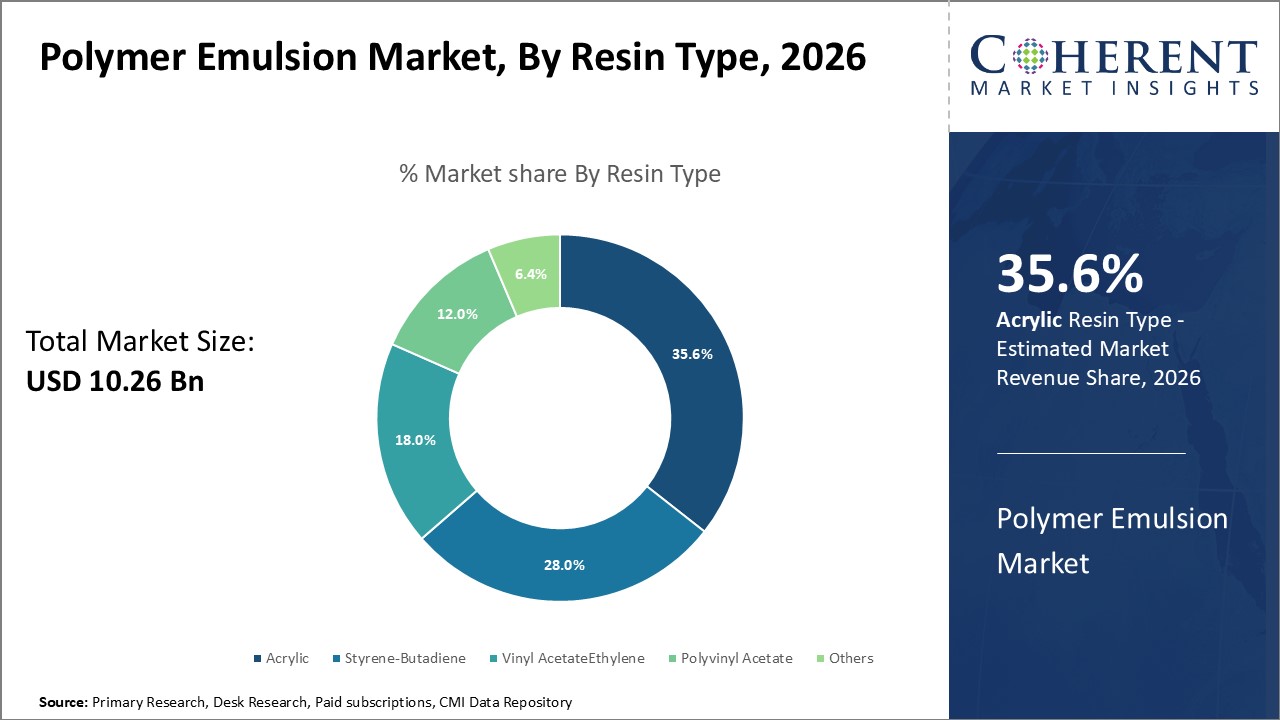
The Acrylic resin segment dominates the market with over 35.6% market share, primarily due to superior performance in coatings and adhesives.
Paints & Coatings application leads the market, benefitting from increased building renovations and new construction activities across the Asia Pacific and Europe.
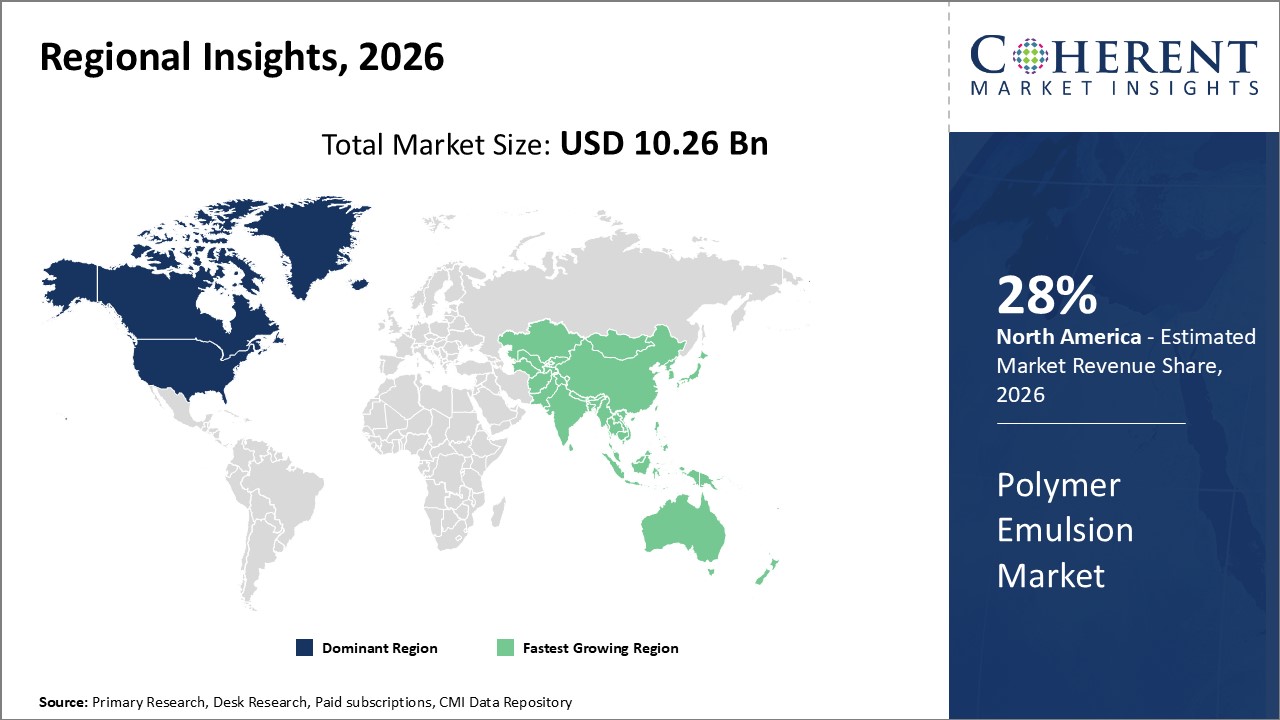
North America remains a dominant regional hub, accounting for approximately 28% of market revenue, driven by strong regulatory frameworks and infrastructure demand.
Asia Pacific, exhibiting the fastest CAGR, owes its growth to rapid urbanization and investments in the automotive and construction sectors, particularly in China and India.
Polymer Emulsion Market Segmentation Analysis
To learn more about this report, Request Free Sample
Polymer Emulsion Market Insights, By Resin Type
Acrylic resin dominates the market share with 35.6% due to its excellent durability, adhesion properties, and compatibility with a wide range of applications, including coatings and adhesives. Acrylic emulsions form the backbone of the paints & coatings segment, favored for their weather resistance and quick drying time. Styrene-Butadiene is the fastest growing subsegment, gaining momentum particularly in adhesives and textile coatings where its elastic and flexible properties are advantageous. Its ability to withstand varying temperature conditions makes it ideal for industrial applications requiring high-performance elastomers.
Polymer Emulsion Market Insights, By Application
Paints & Coatings dominate the market, driven by the growing focus on eco-friendly waterborne coatings and renovation projects. This segment benefits from the rising demand for durable, low-VOC, and high-performance architectural coatings, especially in developed regions like North America and Europe, as well as emerging urban centers in the Asia Pacific. Construction applications are the fastest growing, buoyed by governmental infrastructure initiatives and increasing use of emulsions in sealants, waterproofing, and insulation materials. Adhesives and Textile coatings see steady demand growth, driven by lightweight packaging innovations and performance improvements in fabrics, respectively.
Polymer Emulsion Market Insights, By End-Use Industry
Building & Construction is the dominant segment, reflecting its extensive use of polymer emulsions in paints, coatings, and adhesives essential for durable infrastructure. This segment accounts for a major portion of market revenue due to ongoing global urbanization and renovation trends. Automotive emerges as the fastest-growing end-use industry, incorporating polymer emulsions in interior and exterior coatings that provide enhanced durability and emission compliance. Innovations enabling lighter and sustainable vehicle components are expanding emulsion applications. Packaging and Textile & Leather industries exhibit moderate growth with increasing use of emulsions to improve material performance and aesthetics.
Polymer Emulsion Market Trends
The market trend underscores a decisive shift toward sustainability and performance-enhancing innovations.
Notably, bio-based polymer emulsions have gained significant traction, capturing nearly 19% market share in 2026 due to growing environmental legislation worldwide.
Furthermore, nano-technology integration in emulsions has improved the protective qualities for automotive and construction applications, with leading manufacturers incorporating such formulations to meet evolving consumer demands.
Additionally, digital transformation in supply chain management has optimized material sourcing and production scheduling, mitigating the impact of feedstock price volatility witnessed in early 2025.
Polymer Emulsion Market Insights, By Geography
To learn more about this report, Request Free Sample
North America Polymer Emulsion Market Analysis and Trends
In North America, the Polymer Emulsion market’s dominance is attributed to stringent emission regulations and a mature industrial ecosystem. The region accounts for approximately 28% of the market share, benefiting from government incentives promoting green materials and extensive infrastructure projects. Leading market players such as Dow Chemical and Arkema have expanded manufacturing bases here, catering to domestic demand with sustainable emulsions. The robust construction and automotive sectors further stimulate consumption, making this region crucial for market revenues.
Asia Pacific Polymer Emulsion Market Analysis and Trends
Meanwhile, the Asia Pacific region exhibits the fastest growth with a CAGR exceeding 7% between 2026 and 2033. Rapid urbanization, industrialization, and supportive government policies in China and India have accelerated polymer emulsion adoption. Investments in green building projects and automotive component manufacturing bolster demand. Additionally, local companies are enhancing technological capabilities to serve expanding domestic markets, which further drives market expansion in this region.
Polymer Emulsion Market Outlook for Key Countries
USA Polymer Emulsion Market Analysis and Trends
The USA holds a strategic position in the market owing to its advanced chemical manufacturing sector and comprehensive environmental regulations. In 2025, investments in low-VOC waterborne emulsions by key players enhanced market penetration in construction coatings, supported by green building codes across various states. Leading companies have also pioneered innovations in nano-enhanced emulsions, gaining approval in the automotive and packaging sectors. The country’s emphasis on sustainability and large-scale renovation projects maintains steady demand growth.
China Polymer Emulsion Market Analysis and Trends
China’s Polymer Emulsion market is fueled by massive infrastructure initiatives like the Belt and Road project and rising automotive production. Domestic manufacturers have increased output capacities by over 15% in 2025 to meet the escalating demand for high-performance emulsions in paints and adhesives. Government policies favoring environmental protection have also accelerated the shift towards bio-based emulsions, which compose a rapidly expanding segment. This dynamic market continues to attract investments, positioning China as a key driver of market growth in the Asia Pacific.
Analyst Opinion
The rising demand for eco-friendly and sustainable products is a primary driver, with manufacturers increasing production capacity to meet stricter environmental standards. In 2025, over 40% of new polymer emulsion production globally was aligned with sustainability goals, reflecting a decisive shift towards bio-based and less toxic components. This trend is bolstered by regulatory pressures in Europe and North America, prompting market players to innovate their product lines.
Pricing trends in raw materials such as vinyl acetate and ethylene have fluctuated moderately, influencing the market’s cost structure. Recent data from 2026 indicates that despite supply chain constraints early in the year, pricing stabilized due to increased feedstock availability in key regions, enabling expanded market access without steep price escalations. This pricing stability supports broader adoption in price-sensitive segments like adhesives and textiles.
Growing demand from the construction segment, particularly in Asia Pacific, plays a significant role in market revenue expansion. For instance, China’s polymer emulsion consumption in construction applications surged by 12.7% in 2025, driven by government stimulus packages focused on infrastructure development and renovation of aging buildings. This translates to robust market share gains in that region for polymer emulsion products tailored for coatings and sealants.
The increasing use of polymer emulsions in automotive interiors and exterior coatings is changing product application dynamics. In 2026, leading automotive manufacturers incorporated polymer emulsions in over 26% of their surface treatment formulations, targeting enhanced durability and environmental compliance. This demand is a crucial market growth driver, reflecting evolving consumer preferences for vehicles with improved safety and emission profiles.
Market Scope
| Report Coverage | Details | ||
|---|---|---|---|
| Base Year: | 2025 | Market Size in 2026: |
USD 10.26 billion |
| Historical Data for: | 2020 To 2024 | Forecast Period: | 2026 To 2033 |
| Forecast Period 2026 to 2033 CAGR: | 6.3% | 2033 Value Projection: |
USD 14.32 billion |
| Geographies covered: |
|
||
| Segments covered: |
|
||
| Companies covered: | Wacker Chemie AG, Eastman Chemical Company, LG Chem Ltd., Kao Corporation, Perstorp Holding AB, INEOS Group AG, Nippon Paint Holdings Co., Ltd., Sika AG, H.B. Fuller Company, Zhenjiang SinoProud Chemical Co., Ltd. | ||
| Growth Drivers: |
|
||
Uncover macros and micros vetted on 75+ parameters: Get instant access to report
Polymer Emulsion Market Growth Factors
The growing emphasis on environmental sustainability has accelerated the replacement of solvent-based products with polymer emulsions, significantly expanding the market revenue across regions with strict emission regulations like North America and Europe. Recent reports in 2025 indicated a 11% annual growth in demand for green emulsions in these territories. Additionally, urban infrastructure development in the Asia Pacific fuels the paints and coatings segment, where polymer emulsions improve durability and weather resistance. Enhanced formulation technologies facilitating better adhesion and faster drying times further incentivize adoption. Furthermore, increasing investments in automotive coatings for lightweight and durable surfaces provide new avenues for market players. Collectively, these drivers amplify the overall market growth and set the stage for robust market dynamics.
Polymer Emulsion Market Development
In May 2023, BASF introduced its Acronal® ECO range of bio-based acrylic polymers, designed to support low-VOC and environmentally responsible paint formulations. The launch enabled coatings manufacturers to reduce reliance on fossil-derived binders while maintaining high performance in durability, adhesion, and film formation for architectural and industrial applications.
In October 2025, Lubrizol launched its November CS multifunctional polymer, engineered for dual emulsion stabilization and enhanced sensory textures in skincare formulations. The innovation provided formulators with improved viscosity control, long-lasting emulsion stability, and premium aesthetic profiles, supporting the development of next-generation creams, gels, and hybrid cosmetic products.
Key Players
Leading Companies of the Market
Wacker Chemie AG
Eastman Chemical Company
LG Chem Ltd.
Kao Corporation
Perstorp Holding AB
INEOS Group AG
Nippon Paint Holdings Co., Ltd.
Sika AG
H.B. Fuller Company
Zhenjiang SinoProud Chemical Co., Ltd.
Several leading companies have adopted aggressive growth strategies, including capacity expansion and mergers. For example, Arkema’s recent investment to increase its acrylic polymer emulsion capacity in North America resulted in a 16% increase in production throughput by Q1 2026, empowering the company to respond rapidly to construction sector demand spikes. Similarly, BASF’s innovation-driven approach targeting sustainable polymer emulsions led to the launch of two eco-certified products in Europe in 2025, capturing key market share in low-VOC coatings.
Polymer Emulsion Market Future Outlook
Future growth will be driven by sustainable coating technologies, bio-based emulsions, and advanced performance polymers tailored for high-durability applications. Increasing demand for low-odor, eco-friendly paints will push manufacturers to innovate in ultra-low-VOC and zero-VOC formulations. Expanding urbanization, modern housing development, and infrastructure renewal programs across Asia-Pacific and Africa will sustain long-term demand. Additionally, emerging applications in automotive lightweighting and specialty textiles will create new opportunities.
Polymer Emulsion Market Historical Analysis
The Polymer Emulsion market has historically benefited from rising demand in paints, coatings, adhesives, and paper applications. Early emulsions focused on vinyl acetate and acrylic polymers, but technological progress enabled more stable formulations, improved water resistance, and low-VOC performance. Environmental regulations in Europe and North America boosted the adoption of water-based emulsions as industries shifted away from solvent-based systems. Growing construction and industrial activities in developing economies also accelerated consumption, especially in architectural coatings, waterproofing materials, and packaging adhesives.
Sources
Primary Research Interviews:
Polymer Chemists
Paint & Coatings Manufacturers
Adhesives Specialists
Latex Technologists
Industrial Chemical Buyers
Databases:
ICIS Chemicals
ChemData
GlobalData Chemicals, Statista Polymers
UN Comtrade Chemical Data
Magazines:
Coatings World
Adhesives & Sealants Magazine
Chemical Week
Paint & Coatings Industry
Polymer Update
Journals:
Journal of Applied Polymer Science
Progress in Organic Coatings
Polymer Chemistry
Colloids & Surfaces
Industrial & Engineering Chemistry Research
Newspapers:
The Economic Times (Industry)
Financial Express (Chemicals)
The Guardian (Environment)
The Washington Post (Industry)
The Times (Manufacturing)
Associations:
European Coatings Association
ACI
Polymer Processing Society
ASTM International
Share
Share
Yash Doshi is a Senior Management Consultant. He has 12+ years of experience in conducting research and handling consulting projects across verticals in APAC, EMEA, and the Americas.
He brings strong acumen in helping chemical companies navigate complex challenges and identify growth opportunities. He has deep expertise across the chemicals value chain, including commodity, specialty and fine chemicals, plastics and polymers, and petrochemicals. Yash is a sought-after speaker at industry conferences and contributes to various publications on topics related commodity, specialty and fine chemicals, plastics and polymers, and petrochemicals.

Credibility and Certifications

860519526


9001:2015
27001:2022


Need a Custom Report?
We can customize every report - free of charge - including purchasing stand-alone sections or country-level reports
Customize NowJoining thousands of companies around the world committed to making the Excellent Business Solutions.
View All Our Clients