

Betaine Market Size and Share Analysis – 2026 To 2033
The global Betaine Market size is anticipated to grow at a CAGR of 5.9%, from USD 5.01 Bn in 2026 to USD 7.49 Bn by 2033. The market growth is majorly driven by increasing demand for betaine in animal feed formulations, increasing use in personal care and cosmetic products, increasing application in food and beverage manufacturing, and increasing industrial and chemical applications. Betaine is a broadly used osmoprotectant, methyl donor and functional ingredient in a variety of formulations, which supports its use in animal nutrition, pharmaceuticals, personal care and industrial applications. According to the National Institutes of Health’s PubChem database, betaine is a methyl donor and helps regulate cellular hydration.
Key Takeaways
- The synthetic betaine segment is projected to account for the largest market share of 68% in 2026. The segment’s expansion is driven by affordable chemical synthesis, uniform product quality, scalable manufacturing and growing acceptance in surfactants, detergents and personal care formulations. According to Cosmetics Europe, the European cosmetics and personal care industry achieved EUR 104 Bn in retail sales in 2024, showing strong downstream demand for specialty ingredients used in cleansing and personal care products.
- The cocamidopropyl betaine segment is projected to hold the largest market share of 42% in 2026. The growth is attributed to its superior foaming properties, compatibility with other surfactants, mild cleansing properties, and application in shampoos, body wash, facial cleansers, and liquid soaps. According to Cosmetics Europe, the size of the personal care segment that drives demand for amphoteric surfactants is highlighted by European retail sales of hair care products which hit EUR 18.1 Bn in 2024.
- The animal feed segment is expected to dominate the application segment with a share of around 35% in 2026. Growth is driven by increasing use of betaine as methyl donor and osmoregulator in poultry, swine and aquaculture nutrition, especially for improving nutrient utilization and dealing with heat stress. According to Alltech’s 2026 Agri-Food Outlook, global compound feed production reached an estimated 1.44 Bn metric tons in 2025, a 2.9% increase from 2024.
- North America is estimated to account for a prominent market share of 32% in 2026. The demand in the region is supported by the established personal care manufacturing, demand for nutritional supplements, and the presence of animal feed manufacturers and specialty chemical producers. Alltech’s 2026 Agri-Food Outlook estimates the U.S. produced around 267.4 million metric tons of compound feed in 2025, solidifying the country’s position as one of the largest feed-producing markets in the world and bolstering demand for specialty feed ingredients.
Market Drivers
Rising Demand for Mild Surfactants in Personal Care Products is Accelerating Betaine Market Expansion
The betaine market is propelled by the growing demand for skin-friendly cleansing formulations and multifunctional surfactants, particularly cocamidopropyl betaine. It is widely used in shampoos, facial cleansers, body washes and liquid soaps because of its amphoteric surfactant properties, foam stabilization capabilities and compatibility with anionic surfactants.
The European market for cosmetics and personal care products posted retail sales of EUR 110 billion in 2025, with skin care products accounting for EUR 32.3 billion, toiletries EUR 26.4 billion and hair care products EUR 20.3 billion.
According to Cosmetics Europe, exports of European cosmetic products reached EUR 29.8 billion in 2025, demonstrating the level of activity of the industry in the production and distribution of products on an international scale. This export-driven ecosystem favors opportunities for suppliers of amphoteric surfactants used in personal care formulations.
Current Events and Their Impact on the Betaine Market
Current Event | Description and its Impact |
European Food Safety Authority Reassesses Betaine Feed Additive Safety and Specifications (2026) |
|
European Union Introduces Updated Detergents and Surfactants Regulation (2026) |
|
- Current Industry Events of 2026
- Market Size Estimation
- Regional Breakdown
- Competitive Landscape
- Customer Intelligence
- Segmental Analysis
- Pricing Analysis
- Key Market Drivers, Challenges & Future Trends
- Customized Insights Section
Segmental Insights
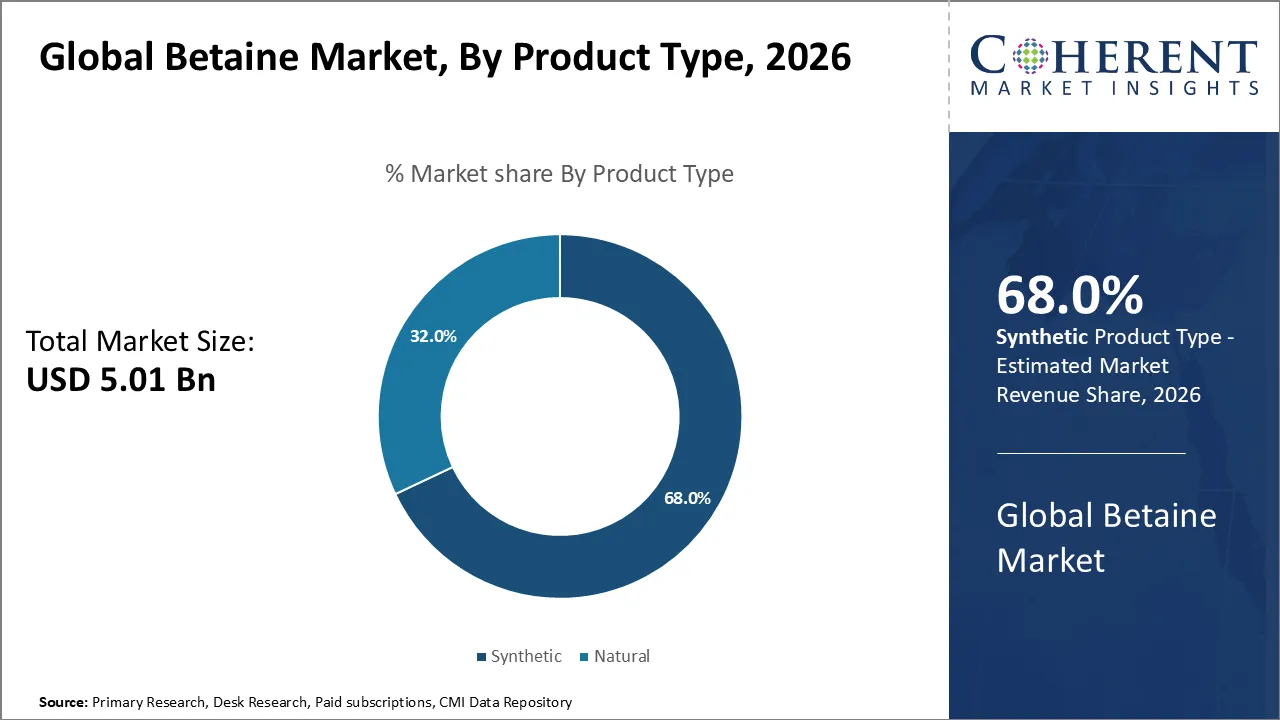
Why is Synthetic Betaine Acquiring the Largest Market Share?
Based on the product type, the synthetic betaine segment is expected to hold the highest betaine market share of 68% in 2026. This segment benefited from cost-effective chemical synthesis, consistent product purity, large-scale manufacturing capabilities, and growing demand from personal care, industrial cleaning and specialty chemical applications. Synthetic betaine derivatives find extensive use in shampoos, liquid detergents, facial cleansers and other applications based on surfactants.
According to the European surfactants industry has an estimated annual turnover of EUR 5-10 billion. In 2024, the European Committee of Organic Surfactants and Their Intermediates (CESIO) estimated European surfactant production to be about 3.5 million metric tons.
In April 2025, Eastman Chemical Company announced the commencement of dimethylaminopropylamine with enhanced sustainability (DMAPA ES) production at its St. Gabriel manufacturing facility in Louisiana, U.S. The company stated that this renewable-content intermediate can help producers of cocamidopropyl betaine surfactants reduce global warming potential by up to 50%, depending on the production system.
Why is Cocamidopropyl Betaine Holding the Largest Share by Form?
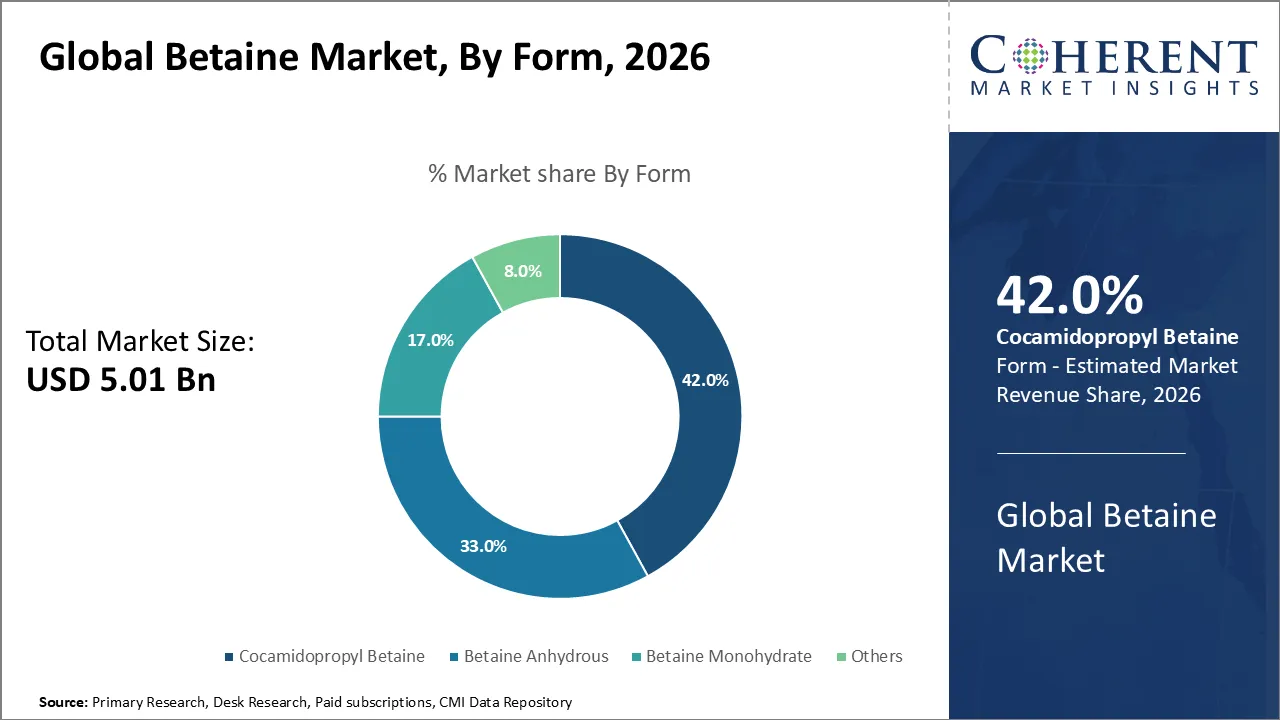
In terms of form, the cocamidopropyl betaine segment is projected to account for the largest market share in 2026, with an estimated market share of 42%. Its leading position is based on its excellent foaming properties, mild cleansing performance, viscosity building properties and compatibility with other surfactants. This substantiates its wide use in shampoos, body washes, facial cleansers, liquid hand soaps and personal hygiene formulations. According to L'Oreal's Universal Registration 2025, the company’s hair care sales increased from EUR 7,034.0 million in 2024 to EUR 7,711.1 million in 2025, a reported growth of 9.6%.
In April 2025, BASF SE launched Dehyton PK45 GA/RA, a Rainforest Alliance certified coconut oil-based surfactant cocamidopropyl betaine (CAPB) at in-cosmetics Global 2025. The new amphoteric surfactant is easy to biodegrade and suitable for shampoos, shower gels, bath products and skin cleansers.
Why is Animal Feed Holding the Largest Application Share?
On the basis of application, the animal feed segment is expected to hold the largest share of the betaine market, with a share of approximately 35% in 2026. The growth of the segment is credited to the increasing use of betaine in poultry, swine, and aquaculture nutrition as a methyl donor and osmoprotectant. Its role in nutrient metabolism, feed utilization and physiological response to heat stress is driving the development of tailored feed formulations.
According to Alltech’s 2026 Agri-Food Outlook China’s compound feed production reached 330.063 million metric tons in 2025, up 4.8% year on year. China continued to be the world’s largest compound feed producer, reflecting the scale of demand for livestock nutrition products and functional feed ingredients.
In March 2026, Biochem launched RumiPro Adapt, a new dietary feed supplement for dairy cattle, created with betaine, plant extracts, rumen buffers and BetaTrace Zinc, to support dairy cattle during heat stress and metabolic challenges. Betaine is an osmoprotectant that helps to keep cells hydrated and physiologically robust at elevated temperatures.
Betaine Market Trends
- Increasing demand for natural and upcycled betaine is prompting ingredient manufacturers to make use of raw materials derived from sugar beets in cosmetics, personal care and specialty formulations. IFF’s GENENCARE OSMS BA is a 100% natural, ISO 16128, betaine ingredient sourced from sugar beet and carries Upcycled Certified status, a sign of the movement toward circular economy ingredient sourcing.
- The growing use of betaine in aquaculture nutrition is reinforcing its application in fish feed formulations, improving growth performance, nutrient utilization and resistance to environmental stress. In April 2026, a study published in Scientific Reports examined the effect of liquid betaine supplementation (0.8–2.4 mL/kg feed) in 180 Nile tilapia. The supplementation of the highest level of betaine significantly improved the growth performance and ammonia stress resistance, reflecting the opportunities of the functional additives of betaine in aquaculture.
- The growing use of betaine in metabolic health and nutritional formulations is prompting research into its potential role in homocystein management and metabolic regulation. A randomized controlled trial with 102 subjects, published in June 2026, demonstrated that nutritional intervention with betaine-containing nutritional supplements for 8 weeks improved the homocysteine level and some indicators of glucose-lipid metabolism compared with the control treatment, supporting the need for further research on specialized nutritional applications.
Regional Insights
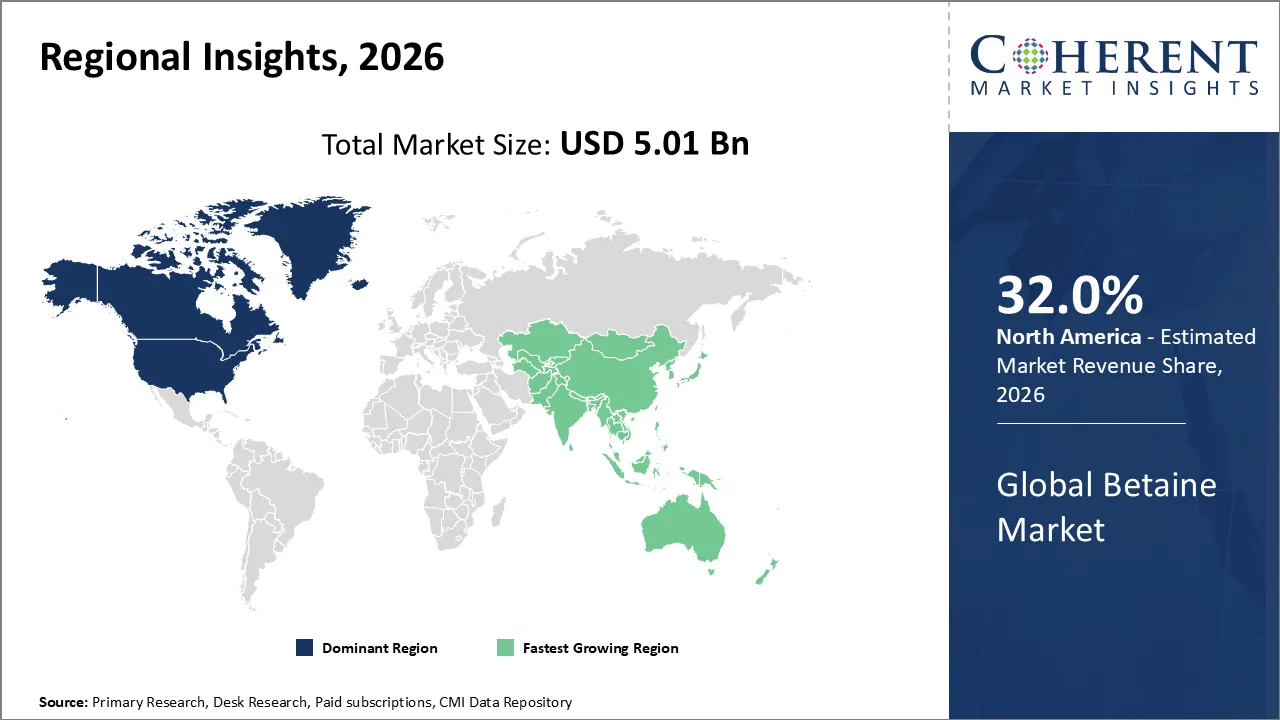
North America Dominates the Betaine Market Owing to Strong Personal Care Demand and Established Specialty Chemical Manufacturing
North America is expected to hold 32% share of global betaine market by 2026. The region’s dominance is attributed to the presence of a well-established specialty chemical manufacturing industry. Other factors driving market growth in the region include increasing demand for betaine-based surfactants, growing use of functional ingredients in personal care products and continuous adoption of betaine in animal nutrition and dietary supplements.
In April 2025, BASF SE announced the launch of its first EcoBalanced personal care ingredients in North America including the cocamidopropyl betaine products Dehyton PK 45 and Dehyton KE UP. The products utilize a certified biomass-balance approach to incorporate renewable feedstocks and reduce their product carbon footprints.
Asia Pacific Betaine Market Trends
Asia Pacific is expected to emerge as the fastest-growing region in the global betaine market during 2026–2033. The growth in the region is due to the rising personal care manufacturing, increasing consumption of specialty surfactants, growing adoption of betaine in livestock nutrition, increasing demand for functional ingredients in China, India, Japan and Southeast Asia. Published forecasts for the betaine industry also identify Asia Pacific as the fastest growing region.
According to China’s National Bureau of Statistics, retail sales of cosmetics by enterprises above the designated size increased 5.1% in 2025 and sales of daily necessities rose 6.3%. These developments suggest a growing downstream demand for specialty surfactants like cocamidopropyl betaine, used in shampoos, facial cleansers and other personal care products.
In April 2025, AGRANA and Azelis announced an expanded distribution agreement for PuraBeet, a 100% plant-based crystalline betaine ingredient derived from sugar beet molasses, in China, Japan, the Philippines and Thailand.
Growing Demand for Functional Animal Nutrition and Specialty Ingredients is Driving the U.S. Betaine Market
The U.S. betaine market is witnessing steady growth owing to increasing utilization of betaine in animal feed, companion animal nutrition, dietary supplements, and specialty chemical formulations. The increasing focus on animal health, nutritional efficiency and scientifically formulated functional ingredients is creating opportunities for betaine manufacturers particularly in livestock and premium pet nutrition applications.
According to the U.S. Department of Agriculture (USDA), U.S. farm feed expenditure is projected to reach USD 69.5 billion in 2026, indicating the huge commercial scale of animal nutrition in the country.
In March 2026, the American Pet Products Association (APPA) announced U.S. pet industry expenditure reached USD 158 billion in 2025, up 3.7% and is expected to reach USD 165 billion in 2026. The association also said about 95 million U.S. households had at least one pet in 2025.
China Betaine Market Trends
China betaine market is anticipated to witness significant growth from 2026 to 2033. The growth in the market is attributed to the thriving chemical manufacturing industry, rising production of specialty surfactants, and growing application of betaine in animal nutrition, personal care, and industrial formulations. The country’s large production infrastructure and competitive chemical manufacturing capacities support the domestic consumption and export-oriented supply of betaine and its derivatives.
According to the National Bureau of Statistics of China, the value added of raw chemical materials and chemical products manufacturing increased by 7.8% in 2025, while overall manufacturing value added increased by 6.4%.
Who are the Major Companies in Betaine Industry
Some of the major key players in Betaine Market are American Crystal Sugar Company, BASF SE, DowDuPont Inc., Lubrizol Corporation, Nutreco N.V., Amino GmbH, Kao Corporation, Solvay S.A., Stepan Company, and Evonik Industries AG.
Key News
- In May 2026, Nutreco announced the expansion of its Eruvaka intelligent shrimp farming ecosystem across 12 countries. The company reported that over 60,000 intelligent feeding devices were operating across more than 45,000 hectares of shrimp ponds.
Market Report Scope
Betaine Market Report Coverage
Report Coverage | Details | ||
Base Year: | 2025 | Market Size in 2026: | USD 5.01 Bn |
Historical Data for: | 2020 to 2024 | Forecast Period: | 2026 to 2033 |
CAGR: | 5.9% | 2033 Value Projection: | USD 7.49 Bn |
Geographies covered: |
| ||
Segments covered: |
| ||
Companies covered: | American Crystal Sugar Company, BASF SE, DowDuPont Inc., Lubrizol Corporation, Nutreco N.V., Amino GmbH, Kao Corporation, Solvay S.A., Stepan Company, and Evonik Industries AG. | ||
Growth Drivers: |
| ||
Restraints & Challenges: |
| ||
Analyst Opinion
- The global betaine market is expected to benefit from the increasing commercialization of natural and sugar beet-derived ingredients, particularly in personal care, nutritional supplements, and specialty chemical applications. According to the USDA’s September 2026 projections, U.S. beet sugar production for FY 2026/27 was projected at 4.769 million short tons, down about 307,000 short tons from last year. This suggests potential raw material supply pressures for sugar beet-based ingredient manufacturers, highlighting the need for diverse sourcing and effective betaine recovery technologies.
- The rising demand for pharmaceutical grade betaine and specialty metabolic therapies is creating opportunities for producers of high purity betaine anhydrous. The U.S. National Library of Medicine’s DailyMed database in February 2026 revised the prescribing information for betaine anhydrous to affirm its approved therapeutic indication in adults and children with homocystinuria due to three types of metabolic defects.
- The long-term competitiveness of betaine producers will depend increasingly on production efficiency, raw material availability and the robustness of supply chains. According to a September 2026 analysis using USDA data, approximately 59% of U.S. sugar beet production was located in drought-affected areas in August 2026, compared with 32% during the corresponding period in 2025. The same analysis reported approximately 33,421 acres of prevented or failed sugar beet planting in 2026.
Speak to the analyst
Want personalized insights?
Take the findings above to one of our principal consultants, or have the report rebuilt around the segments, geographies and competitors you actually track.
Market Segmentation
- By Product Type (Revenue, USD Bn, 2021-2033)
- Natural
- Synthetic
- By Form (Revenue, USD Bn, 2021-2033)
- Betaine Anhydrous
- Betaine Monohydrate
- Cocamidopropyl Betaine
- Others
- By Application (Revenue, USD Bn, 2021-2033)
- Animal Feed
- Food and Beverages
- Dietary Supplements
- Others
- Cosmetics
- Detergents
- Pharmaceutical
- Others
- By Region (Revenue, USD Bn, 2021-2033)
- North America
- U.S.
- Canada
- Latin America
- Brazil
- Mexico
- Argentina
- Rest of Latin America
- Europe
- Germany
- U.K.
- France
- Italy
- Spain
- Russia
- Rest of Europe
- Asia Pacific
- China
- India
- Japan
- Australia
- South Korea
- ASEAN
- Rest of Asia Pacific
- Middle East
- GCC
- Israel
- Rest of Middle East
- Africa
- South Africa
- Central Africa
- North Africa
- North America
Sources
Primary Research Interviews
- Betaine manufacturers and chemical production specialists
- Specialty chemical and surfactant formulation experts
- Animal feed manufacturers and livestock nutritionists
- Personal care and cosmetic ingredient manufacturers
- Pharmaceutical and dietary supplement manufacturers
- Procurement managers from food, feed, cosmetics, and detergent industries
- Key opinion leaders (KOLs) in animal nutrition, specialty chemicals, and functional ingredients
Databases
- World Bank
- Organisation for Economic Co-operation and Development (OECD)
- United Nations Comtrade Database (UN Comtrade)
- Food and Agriculture Organization (FAO) – FAOSTAT
- United States Department of Agriculture (USDA)
- European Food Safety Authority (EFSA)
- U.S. Food and Drug Administration (FDA)
- National Center for Biotechnology Information (NCBI) – PubChem and PubMed
Magazines
- Chemical & Engineering News (C&EN)
- Chemical Week
- Cosmetics & Toiletries
- Personal Care Magazine
- Feed Strategy
- All About Feed
- Nutraceuticals World
Journals
- Journal of Animal Science
- Poultry Science
- Aquaculture
- Animal Feed Science and Technology
- Journal of Agricultural and Food Chemistry
- International Journal of Cosmetic Science
- Food Chemistry
- Nutrients
Newspapers
- The Wall Street Journal
- Financial Times
- Reuters
- The Economic Times
- The Guardian
- The New York Times
Associations
- American Feed Industry Association (AFIA)
- International Feed Industry Federation (IFIF)
- American Cleaning Institute (ACI)
- Cosmetics Europe
- European Federation for Cosmetic Ingredients (EFfCI)
- European Committee of Organic Surfactants and Their Intermediates (CESIO)
- American Chemical Society (ACS)
- European Chemical Industry Council (Cefic)
Public Domain Sources
- Company Annual Reports and Investor Presentations
- Government Agricultural, Chemical Industry, and Trade Statistics
- USDA Agricultural Production and Feed Industry Publications
- EFSA Scientific Opinions and Feed Additive Authorization Reports
- U.S. FDA and European Chemicals Agency (ECHA) Regulatory Publications
- FAO and UN Comtrade Production and International Trade Databases
- Company Product Catalogues, Technical Data Sheets, and Safety Data Sheets
- Publicly Available Clinical Trials and Animal Nutrition Research Publications
- Patent Databases such as WIPO, USPTO, and Google Patents
- Regulatory and Standards Publications Related to Betaine, Food Additives, Feed Ingredients, and Surfactants
Proprietary Elements
- CMI Data Analytics Tool
- Proprietary CMI Existing Repository of Information for the Last 10 Years
Get access to 250+ pages report
Every segment, forecast, competitor profile and data table behind the analysis above — available for instant download.
- ESOMAR Member
- ISO 9001:2015 Certified
- D-U-N-S Registered
- GDPR & CCPA Compliant
Missing comfort of reading report in your local language? Find your preferred language:
Transform your Strategy with Exclusive Trending Reports
Frequently Asked Questions
The global Betaine Market is expected to reach USD 7.49 Bn by 2033, compared to USD 5.01 Bn in 2026.
Major players operating in the global Betaine Market include American Crystal Sugar Company, BASF SE, DowDuPont Inc., Lubrizol Corporation, Nutreco N.V., Amino GmbH, Kao Corporation, Solvay S.A., Stepan Company, and Evonik Industries AG.
Fluctuating raw material prices, high production and processing costs of natural betaine, stringent regulatory requirements for food and feed applications, and the availability of substitute ingredients are the key factors hampering market growth.
Increasing adoption of betaine in animal feed formulations, rising demand for mild surfactants in personal care products, growing utilization in dietary supplements and pharmaceuticals, and expanding applications in industrial cleaning products are driving market growth.
The global Betaine Market is anticipated to grow at a CAGR of 5.9% between 2026 and 2033.
North America is expected to account for the largest share of the global Betaine Market, with approximately 32% in 2026, owing to its established specialty chemical manufacturing industry and strong demand from personal care, animal nutrition, and dietary supplement applications.
Betaine, also known as trimethylglycine, is a naturally occurring compound that acts as a methyl donor and osmoprotectant. It is used in animal nutrition, dietary supplements, pharmaceuticals, and personal care formulations. The broader commercial betaine market also includes related derivatives such as cocamidopropyl betaine.