

Polycrystalline Silicon Market Analysis & Forecast 2026-2033
Polycrystalline Silicon Market is estimated to be valued at USD 14.08 Bn in 2026 and is expected to reach USD 34.36 Bn in 2033, exhibiting a compound annual growth rate (CAGR) of 13.6% from 2026 to 2033.
Key Takeaways
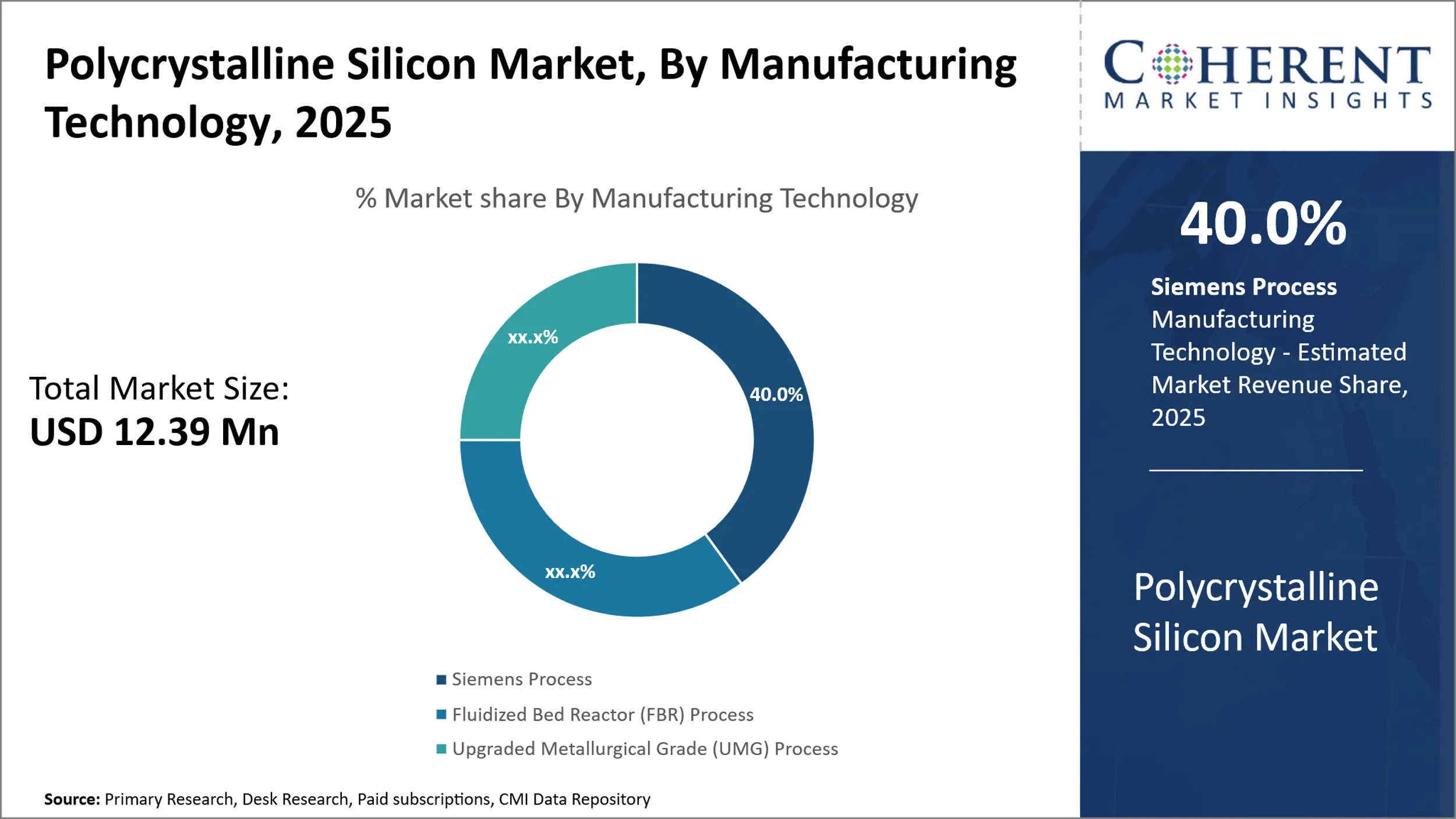
- By Manufacturing Technology, The Siemens Process is projected to account for the largest share approximately 41% of the global polycrystalline silicon market in 2026. This dominance is primarily driven by its high product purity, proven scalability, and widespread industry adoption.
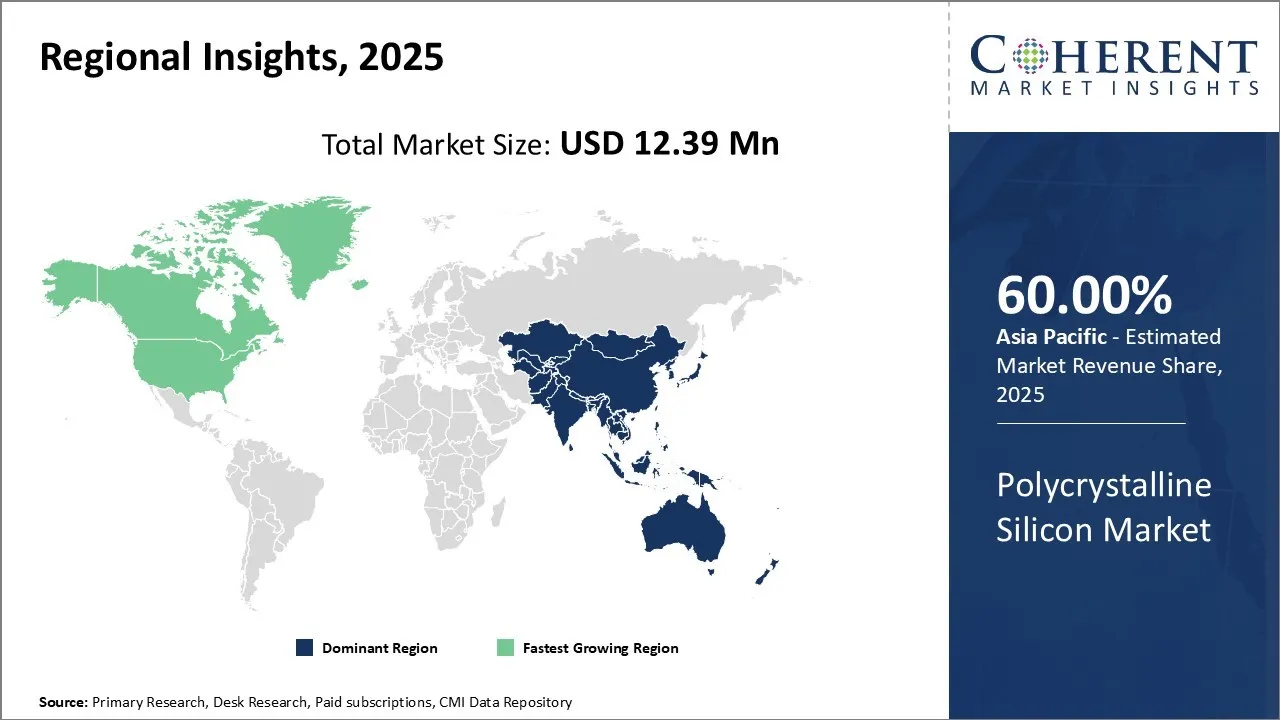
- Asia Pacific is poised to dominate the global polycrystalline silicon market with an estimated 60% share in 2026. This leadership position is attributed to the region’s rapidly expanding solar photovoltaic (PV) manufacturing base.
- North America is poised to hold second position in the global market and accounting for around 15% shares in the global market, owing to a large number of polycrystalline silicon producers.
- Europe is holding third position in the global market with 10% shares in 2026, owing to its commitment to reduce carbon emissions.
Market Overview
The global Polycrystalline Silicon Market is witnessing stable growth, fuelled by rising demand from the solar photovoltaic and electronics industries. Key manufacturing technologies include the Siemens process and fluidized bed reactors, with the Siemens process accounting for a significant market share due to its high purity output. Increasing investments in renewable energy, particularly solar power, are propelling market expansion.
Current Events and its Impact on the Polycrystalline Silicon Market
Current Event | Description and its impact |
Latest Launches and Approvals |
|
Strategic Partnerships and Capacity Expansion |
|
Regulatory Changes and Market Implications |
|
Pricing Analysis: Polycrystalline Silicon Market
The pricing of polycrystalline silicon is influenced by a combination of factors, including raw material costs, manufacturing technology, supply-demand dynamics, and global energy policies. As of 2025, prices remain moderately volatile due to fluctuations in energy costs and periodic supply-demand imbalances caused by capacity expansions and policy changes in major markets like China and the EU. The Siemens process, despite its higher production cost compared to newer alternatives like fluidized bed reactors (FBR), still commands a premium due to its high purity and widespread adoption in solar and electronics-grade applications.
In Asia Pacific, particularly China, economies of scale and low operational costs have enabled competitive pricing, while Western markets experience higher prices due to stricter environmental regulations and reliance on imported polysilicon. Additionally, trade tariffs, especially in the U.S. and Europe, have pushed regional price variations. As solar demand grows globally, prices are expected to stabilize with gradual downward pressure from technological advancements.
- Current Industry Events of 2026
- Market Size Estimation
- Regional Breakdown
- Competitive Landscape
- Customer Intelligence
- Segmental Analysis
- Pricing Analysis
- Key Market Drivers, Challenges & Future Trends
- Customized Insights Section
Role of Artificial Intelligence (AI) in the Polycrystalline Silicon Market
Artificial Intelligence (AI) is playing a transformative role in optimizing the production, quality control, and supply chain management of the polycrystalline silicon market. In manufacturing, AI-powered systems are being used to monitor reactor conditions, predict equipment failures, and enhance the Siemens process by improving energy efficiency and reducing waste.
Machine learning algorithms analyse large volumes of operational data to optimize temperature, pressure, and gas flow parameters, resulting in higher purity output and lower production costs.
AI also supports quality assurance by using image recognition and predictive analytics to detect defects in silicon ingots and wafers, ensuring consistent product standards. In logistics, AI enhances inventory forecasting and demand planning, helping companies better align supply with rapidly changing solar and semiconductor market needs.
Furthermore, AI is increasingly influencing strategic planning by offering precise simulations and financial modelling that help estimate polycrystalline silicon plant setup cost, including variables like equipment investment, energy consumption, raw material sourcing, and yield optimization. These insights enable companies to make more data-driven decisions regarding capacity expansion and facility location. AI-driven market analytics tools also assist stakeholders in tracking global price trends, trade flows, and policy impacts, enabling more informed decision-making across the value chain.
Polycrystalline Silicon Market Trends
- Solar Energy Demand
Polycrystalline silicon is a crucial material that is used in the production of solar panels. Increasing global demand for renewable energy sources, particularly solar energy, has been a significant driver for the polycrystalline silicon market growth. As governments and industries worldwide are shifting towards cleaner energy solutions, demand for solar panels and, demand for polycrystalline silicon is also rising.
For instance, according to U.S. Energy Information Administration, the demand for solar panels and polycrystalline silicon has been on the rise. In 2022, solar photovoltaic panel shipments in the U.S. increased by 10% from 2021, setting another annual record.
In July 2025, China’s National Development and Reform Commission introduced its first Renewable Portfolio Standards (RPS) for polysilicon production. This mandate requires polysilicon manufacturers to source a minimum percentage of their electricity from renewables, varying by province up to 70% in hydropower-rich regions like Yunnan. This policy aims to accelerate clean energy adoption in heavy industries, improving environmental credentials and potentially increasing production costs in less renewable-rich areas.
- Growing Photovoltaic (PV) Installations
The photovoltaic industry, which relies on solar panels, had been experiencing steady growth in installations for both residential and commercial purposes. The expansion of PV installations contributes to increased demand for polycrystalline silicon.
For instance, according to National Renewable Energy Resource H1 2022, PV installations increased significantly (y/y) in China (137%) and India (82%), and to a lesser extent Germany (16%).
In March 2025, Wacker Chemie projected a rise in semiconductor-grade polysilicon sales for 2025, despite flat or slightly lower pricing. The German chemicals firm expects annual polysilicon revenue between €1.0–1.3 billion—up from €949 million in 2024 driven by growing demand in the electronics sector, showcasing resilience amid solar-grade market pressures.
Opportunities in the Polycrystalline Silicon Market
- Emerging Solar Markets: While solar energy adoption is already growing in mature markets, there is significant opportunities in emerging economies with vast untapped solar potential. Countries in Asia Pacific, Africa, and Latin America are showing increasing interest in solar energy as a way to meet their growing energy demands sustainably. Expanding into these regions can offer opportunities for polycrystalline silicon manufacturers to tap into new markets.
- Technological Innovations: Continued research and development (R&D) in the solar industry offered opportunities for improvements in polycrystalline silicon technology. Enhancing the efficiency of solar cells, reducing production costs, and developing new manufacturing techniques are some of the areas where advancements could lead to increased market share and competitiveness.
Segmental Insights
Global Polycrystalline Silicon Market Insights, By Manufacturing Technology
The Siemens process is projected to dominate the global polycrystalline silicon market, accounting for approximately 41.0% of the total market share in 2026. This leadership is primarily attributed to its ability to produce ultra-high purity polysilicon, which is critical for both solar-grade and electronic-grade applications, especially within the market in semiconductor fabrication. Its long-standing industry presence, established production infrastructure, and consistent product quality have solidified its position as the preferred manufacturing method.
Despite the rise of alternative technologies like fluidized bed reactors (FBR) that offer cost advantages and energy efficiency, the Siemens process continues to lead due to its proven scalability, technical reliability, and compatibility with downstream photovoltaic and semiconductor technologies. It is especially favoured by large-scale manufacturers looking to meet the stringent quality demands of the solar photovoltaic industry and the highly sensitive market in semiconductor fabrication.
Ongoing innovations in reactor efficiency and energy usage are helping address operational cost concerns, while global clean energy investments further fuel demand for Siemens-based polysilicon. As countries intensify solar capacity expansions and chip manufacturers seek ultra-pure inputs, the Siemens process’s ability to deliver consistent, high-purity output positions it as a strategic enabler of both the energy transition and semiconductor industry advancement.
Regional Insights
Asia Pacific Polycrystalline Silicon Market Trends and Analysis
Asia Pacific is poised to dominate the global polycrystalline silicon market with an estimated 60.00% share in 2026, reinforcing its role as the most influential and rapidly expanding region in this sector. This regional leadership is driven by a robust solar photovoltaic (PV) manufacturing ecosystem, aggressive renewable energy targets, and government-backed industrial policies supporting clean energy initiatives.
China remains the central hub, both as the world’s largest producer and consumer of polysilicon, leveraging its vertically integrated supply chains, low production costs, and extensive infrastructure. In addition, South Korea and India are emerging as key players, benefiting from technological advancements in wafer and cell manufacturing and increased domestic solar installations.
Supportive government initiatives, including subsidies, feed-in tariffs, and tax incentives for solar projects, continue to boost regional demand. The presence of leading global solar module manufacturers and rapid adoption of advanced manufacturing technologies have further enhanced Asia Pacific’s competitive advantage. The region’s strategic focus on sustainability, energy security, and clean technology innovation firmly positions it as the global engine for growth in the polycrystalline silicon market.
Polycrystalline Silicon Market Dominating Countries
China
China leads the global polycrystalline silicon market within the Asia Pacific region, driven by its extensive solar photovoltaic (PV) manufacturing base, vertically integrated supply chains, and dominant position as both the largest producer and consumer of polysilicon. The country accounts for the majority of Asia Pacific’s projected 60% market share in 2026, fuelled by aggressive renewable energy targets and significant government investment in solar infrastructure.
China’s industrial policies strongly support the development of domestic polysilicon production, with subsidies, tax incentives, and tariff protections encouraging scale and innovation. Leading Chinese manufacturers continue to expand capacity and invest in advanced technologies to improve purity levels and reduce production costs.
Additionally, the country’s focus on achieving energy security and carbon neutrality has further accelerated demand for solar-grade polysilicon. With its global export strength and low-cost manufacturing advantage, China remains the central engine of growth in the polycrystalline silicon market.
South Korea
South Korea plays a vital role in the global polycrystalline silicon market, backed by a strong technology infrastructure and a growing clean energy sector. The country is recognized for its advanced wafer and semiconductor manufacturing capabilities, making it a significant consumer of high-purity polysilicon. South Korea also hosts leading manufacturers focused on producing electronic-grade polysilicon for domestic and international markets.
Government-backed initiatives promoting energy diversification and carbon neutrality are driving new investments in solar technology, including integrated solar PV projects and R&D for higher-efficiency cells. South Korea’s emphasis on quality, innovation, and export-oriented policies supports its growing influence in the polycrystalline silicon supply chain. As demand for semiconductors and renewable energy solutions rises globally, South Korea continues to strengthen its position as a strategic contributor to the market.
Market Report Scope
Polycrystalline Silicon Market Report Coverage
| Report Coverage | Details | ||
|---|---|---|---|
| Base Year: | 2025 | Market Size in 2026: | USD 14.08 Bn |
| Historical Data for: | 2020 To 2024 | Forecast Period: | 2026 To 2033 |
| Forecast Period 2026 to 2033 CAGR: | 13.6% | 2033 Value Projection: | USD 34.36 Bn |
| Geographies covered: |
| ||
| Segments covered: |
| ||
| Companies covered: | Wacker Chemie AG, OCI Company Ltd., GCL-Poly Energy Holdings Limited, Hemlock Semiconductor Corporation, Tokuyama Corporation, REC Silicon ASA, Daqo New Energy Corp., SunEdison, Inc. (acquired by MEMC Electronic Materials), LDK Solar Co., Ltd. (faced financial difficulties in the past), and TBEA Co., Ltd. | ||
| Growth Drivers: |
| ||
| Restraints & Challenges: |
| ||
Analyst Viewpoint – Polycrystalline Silicon Market
- The global polycrystalline silicon market is poised for sustained growth, driven by surging demand from the solar photovoltaic (PV) and semiconductor industries. Analysts highlight Asia Pacific, particularly China, as the epicenter of production and consumption, supported by favourable government policies, expanding clean energy targets, and cost-efficient manufacturing ecosystems.
- Technological advancements in manufacturing methods such as AI-integrated process optimization, fluidized bed reactor (FBR) technology, and enhanced purity refinement—are seen as key enablers of operational efficiency, cost reduction, and improved product quality. Industry experts note that companies investing in automation, energy-saving processes, and sustainable production practices are gaining a significant competitive advantage.
- Despite pricing volatility influenced by trade policies, energy costs, and overcapacity risks, the long-term market outlook remains optimistic. Strategic collaborations, vertical integration across the solar supply chain, and growing investments in green energy infrastructure are expected to drive volume growth, ensure supply stability, and strengthen global market value over the forecast period.
Polycrystalline Silicon Market: Key Development
- In June 2023, Wacker Chemie AG announced that the company is expanding its capacity for semiconductor grade polysilicon purification.
- In March 2023, Tongwei is engage in production and distribution of feed products in China and internationally. acquired a 70% stake in the polysilicon business of LDK Solar.
- In February 2023, Hanwha Chemical and KCC announced a partnership to build a 20,000 metric ton per year polysilicon plant in South Korea
Market Segmentation
- Polycrystalline Silicon Market Segmentation, By Application (Revenue, USD Bn, 2021 - 2033)
- Photovoltaics (solar cells and solar panels)
- Electronics (semiconductors and integrated circuits)
- Photovoltaic solar cells have been the dominant application, driving much of the demand for polycrystalline silicon in recent years.
- Polycrystalline Silicon Market Segmentation, By End User Industry (Revenue, USD Bn, 2021 - 2033)
- Solar Energy Industry
- Electronics and Semiconductor Industry
- Polycrystalline Silicon Market Segmentation, By Manufacturing Technology (Revenue, USD Bn, 2021 - 2033)
- Siemens Process
- Fluidized Bed Reactor (FBR) Process
- Upgraded Metallurgical Grade (UMG) Process
- Polycrystalline Silicon Market Segmentation, By Purity Level (Revenue, USD Bn, 2021 - 2033)
- Electronic Grade (High purity, suitable for electronics and semiconductor applications)
- Solar Grade (Lower purity, primarily used in solar photovoltaic applications)
- Polycrystalline Silicon Market Segmentation, By Distribution Channel (Revenue, USD Bn, 2021 - 2033)
- Direct Sales to Manufacturers
- Distributors and Traders
- Polycrystalline Silicon Market Segmentation, By Geography (Revenue, USD Bn, 2021 - 2033)
- North America
- U.S.
- Canada
- Latin America
- Brazil
- Argentina
- Mexico
- Rest of Latin America
- Europe
- Germany
- U.K.
- Spain
- France
- Italy
- Russia
- Rest of Europe
- Asia Pacific
- China
- India
- Japan
- Australia
- South Korea
- ASEAN
- Rest of Asia Pacific
- Middle East
- GCC Countries
- Israel
- Rest of Middle East
- Africa
- South Africa
- North Africa
- Central Africa
- North America
- Key Players Insights
- Wacker Chemie AG
- OCI Company Ltd.
- GCL-Poly Energy Holdings Limited
- Hemlock Semiconductor Corporation
- Tokuyama Corporation
- REC Silicon ASA
- Daqo New Energy Corp.
- SunEdison, Inc. (acquired by MEMC Electronic Materials)
- LDK Solar Co., Ltd. (faced financial difficulties in the past)
- TBEA Co., Ltd.
Sources
The Stakeholders Consulted
- Executives and operations managers from polysilicon manufacturing facilities
- Suppliers of metallurgical-grade silicon and chemical feedstocks (e.g., trichlorosilane)
- Technology providers and engineers specializing in Siemens and FBR processes
- Utility experts and energy efficiency consultants involved in solar manufacturing optimization
- Environmental compliance advisors and regulatory officials overseeing industrial emissions
- Research institutes focused on photovoltaic (PV) materials and semiconductor innovation
- Government agencies promoting clean energy and industrial self-reliance (e.g., solar PLI schemes)
- End-users in solar panel manufacturing, electronics, and semiconductor fabrication
Databases Opened
- International Renewable Energy Agency (IRENA) – Solar and PV Materials Reports
- U.S. Energy Information Administration (EIA) – Solar Supply Chain Data
- Ministry of New and Renewable Energy (India) – National Solar Mission Statistics
- China Photovoltaic Industry Association (CPIA) – Production and Export Trends
Magazines & Trade Publications
- PV Tech Magazine
- Solar Power World
- Semiconductor Manufacturing & Design
- Photovoltaics International
- Chemical Engineering Magazine
- Manufacturing.net – Clean Energy & Electronics Section
Scientific and Industry Journals
- Solar Energy Materials and Solar Cells
- Journal of Crystal Growth
- Journal of Materials Science Materials in Electronics
- Renewable and Sustainable Energy Reviews
- IEEE Journal of Photovoltaics
Newspapers & Media Outlets
- The Wall Street Journal – Energy & Solar Sector
- Bloomberg – Clean Energy and Semiconductor Industry Coverage
- Reuters – Global Photovoltaics and Trade Policy Updates
- The Economic Times – Renewable Energy & Solar Manufacturing News
- Business Standard – Indian Solar and Industrial Development Reporting
Associations and Regulatory Bodies
- International Renewable Energy Agency (IRENA)
- U.S. Department of Energy (DOE) – Solar Energy Technologies Office
- Bureau of Energy Efficiency (BEE), India
- Ministry of Industry and Information Technology (MIIT), China
- International Energy Agency (IEA) – PV Manufacturing Trends
- International Electrotechnical Commission (IEC) – Photovoltaic Standards
Public Domain Sources
- U.S. Geological Survey (USGS) – Silicon and Polysilicon Mineral Data
- European Commission – Trade and Emissions Reports Related to Solar Production
- World Bank – Solar Investment and Carbon Reduction Metrics
- National Renewable Energy Laboratory (NREL) – Materials and Solar Technology Insights
- International Trade Centre (ITC) – Import/Export Data on Polysilicon and Wafers
Proprietary Research Elements
- CMI Data Analytics Tool
- Proprietary CMI Repository of Market Data (covering the last 8+ years across solar and semiconductor sectors)
- CMI Expert Interviews and Transcripts (focused on polysilicon production, global trade, clean energy adoption, and technology innovation in PV manufacturing)
Get access to 250+ pages report
Every segment, forecast, competitor profile and data table behind the analysis above — available for instant download.
- ESOMAR Member
- ISO 9001:2015 Certified
- D-U-N-S Registered
- GDPR & CCPA Compliant
Missing comfort of reading report in your local language? Find your preferred language:
Transform your Strategy with Exclusive Trending Reports
Frequently Asked Questions
The Polycrystalline Silicon Market size is estimated to be valued at USD 14.08 Bn in 2026, and is expected to reach USD 34.36 Bn by 2033.
The CAGR of the global Market is projected to be 13.6% from 2026 to 2033.
Increasing demand for solar photovoltaic (PV) installations, government incentives and policies, technological advancements and cost reductions, environmental awareness and sustainability & energy security and diversification are the major factors driving the market growth.
Solar panels is the leading component segment in the market.
Wacker Chemie AG, OCI Company Ltd., GCL-Poly Energy Holdings Limited, Hemlock Semiconductor Corporation, Tokuyama Corporation, REC Silicon ASA, Daqo New Energy Corp., SunEdison, Inc. (acquired by MEMC Electronic Materials), LDK Solar Co., Ltd. (faced financial difficulties in the past), and TBEA Co., Ltd.
Asia Pacific is the leading segment region in the market.