Single Cell Analysis Market Analysis & Forecast: 2026-2033
Single Cell Analysis Market Size and Forecast – 2026 – 2033
The global Single Cell Analysis market is expected to grow from around USD 4.1 Bn in 2026 to about USD 11.35 Bn by 2033, expanding at a 13.5 % CAGR over 2026–2033, reflecting strong demand in research, oncology, and precision medicine applications.
Global Single Cell Analysis Market Overview
Single cell analysis is a set of techniques used to study the genetic, molecular, and functional characteristics of individual cells rather than bulk cell populations. Unlike traditional methods that average signals across many cells, single cell analysis reveals cellular heterogeneity, enabling researchers to identify rare cell types, distinct cell states, and dynamic biological processes. It includes technologies such as single-cell sequencing, flow cytometry, and high-resolution imaging. This approach is widely applied in cancer research, immunology, neuroscience, and developmental biology. By providing detailed insights at the cellular level, single cell analysis supports precision medicine, biomarker discovery, and targeted therapeutic development.
Key Takeaways
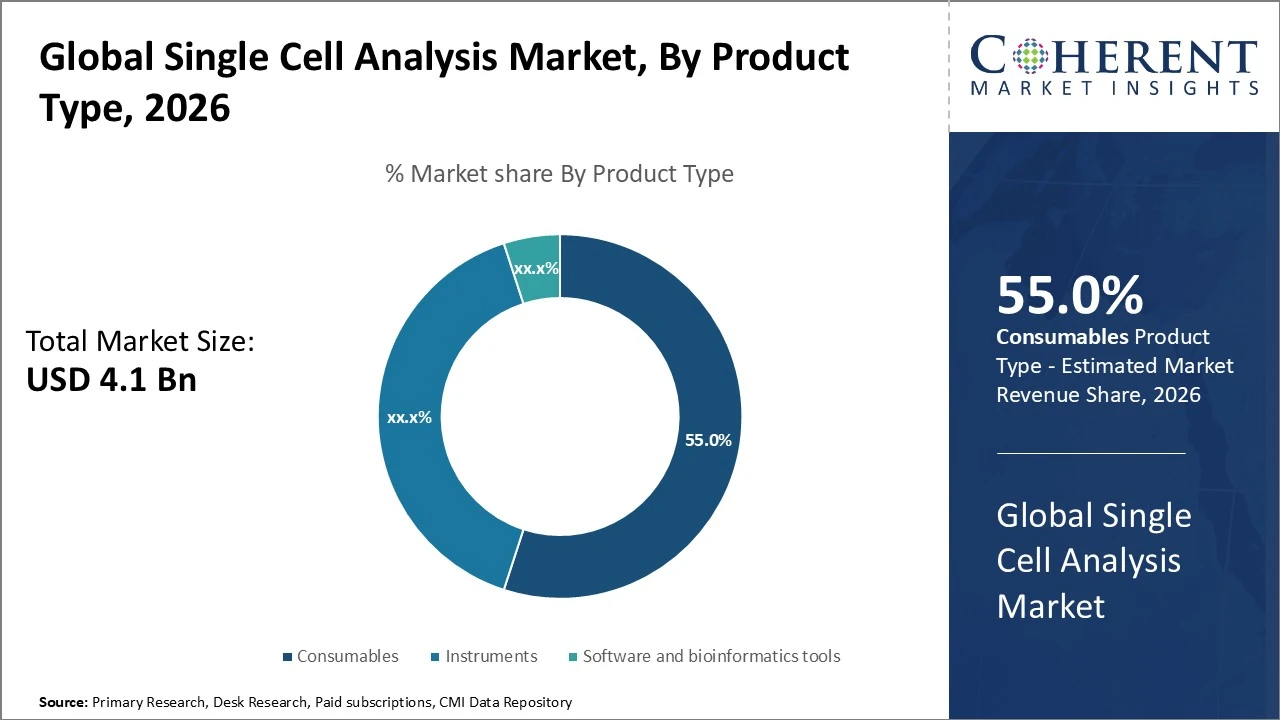
The global Single Cell Analysis market by product type is primarily dominated by Consumables, accounting for approximately 55 % of total revenue.
In the global Single Cell Analysis market by technology, Flow cytometry holds the largest share at around 34 %.
The Single Cell Analysis market by end‑user is led by Academic and research laboratories, holding about 60 % share.
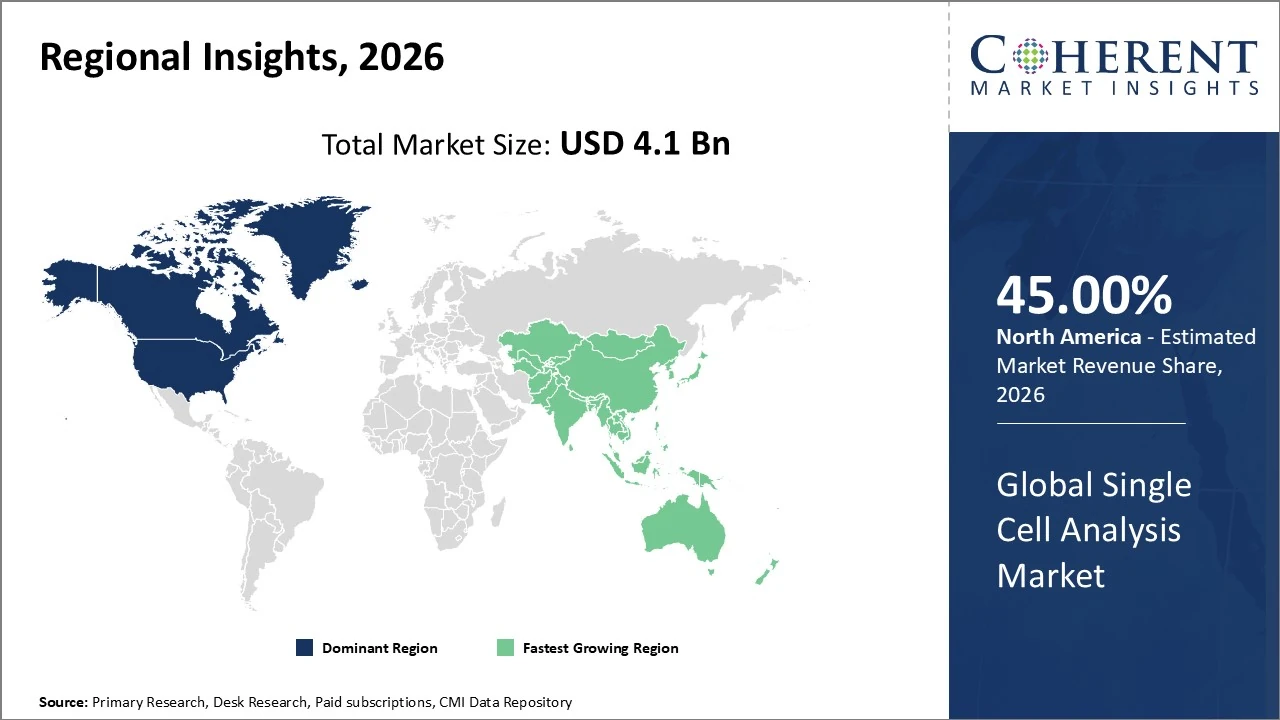
The North America single cell analysis market holds a dominant share of approximately 45 % of the global market.
The Asia Pacific Single Cell Analysis market is experiencing rapid growth, with a market size projected from around USD 1.04 B in 2026 to USD 2.23 B by 2033.
The U.S. holds roughly 38 % of the global single cell analysis market revenue.
Germany accounted for around 5.7 % of the global single cell analysis market in 2026 and is the fastest‑growing European country
Single Cell Analysis Market Segmentation Analysis
To learn more about this report, Request Free Sample
Single Cell Analysis Market Insights, By Product Type
The global Single Cell Analysis market by product type is primarily dominated by Consumables, accounting for approximately 55 % of total revenue, driven by frequent demand for reagents, assay kits, beads, and other laboratory essentials. Instruments contribute around 40 %, encompassing cytometers, sequencers, microscopes, and related hardware essential for high-throughput and precise single-cell experiments. Software and bioinformatics tools represent a smaller 5%, emerging segment, facilitating complex data analysis and interpretation, though exact global revenue share is often not separately reported. Overall, consumables ensure recurring revenue, instruments support technological growth, and software adoption is expanding alongside advanced analytics and AI-assisted workflows.
Single Cell Analysis Market Insights, By Technology
In the global Single Cell Analysis market by technology, Flow cytometry holds the largest share at around 34 %, benefiting from widespread use in cell profiling and immunology research. Next‑generation sequencing (NGS) is a key technology with strong adoption for transcriptomic profiling and is often a leading or rapidly expanding segment. Other technologies include mass spectrometry, microscopy, and PCR‑based methods, each contributing smaller portions of the market. Advanced approaches like microfluidics and spatial transcriptomics are emerging, but detailed exact share figures for all individual sub‑technologies vary by report.
Single Cell Analysis Market Insights, By End-User
The Single Cell Analysis market by end‑user is led by Academic and research laboratories, holding about 60 % share as core early adopters due to heavy funding and research demand. Biotechnology and pharmaceutical companies follow with roughly 30 %, driven by drug discovery and biomarker studies. Hospitals & diagnostic laboratories and contract research organizations (CROs) make up the remaining ~10 %, as clinical uptake and outsourced services grow. Research settings dominate, but industry and clinical segments are expanding as precision medicine and translational applications increase.
Single Cell Analysis Market Trends
Researchers increasingly combine genomics, transcriptomics, proteomics, and spatial data for comprehensive cellular insights, boosting adoption of integrated single‑cell workflows.
Spatial profiling and scalable microfluidic systems are gaining traction for detailed tissue mapping and large‑sample studies.
Machine learning and cloud analytics are streamlining big‑data interpretation, reducing analysis time and improving reproducibility.
Single Cell Analysis Market Insights, By Geography
To learn more about this report, Request Free Sample
North America Single Cell Analysis Market Analysis and Trends
The North America single cell analysis market holds a dominant share of approximately 45 % of the global market in 2026, led by the United States’ strong biotech, pharmaceutical, and research infrastructure. Advanced adoption of next‑generation sequencing, spatial transcriptomics, and AI‑driven analytics fuels regional growth. High healthcare expenditure and substantial federal research funding further accelerate uptake in oncology, immunology, and precision medicine applications. The market is expected to expand robustly, with forecasts indicating a ~17 % CAGR as demand for high‑throughput technologies and personalized therapies rises.
Asia Pacific Single Cell Analysis Market Analysis and Trends
The Asia Pacific Single Cell Analysis market is experiencing rapid growth. China dominates with about 37.8 % regional revenue share, while India shows the fastest growth at ~18 % CAGR, driven by government initiatives and biotech expansion. Demand is fueled by precision medicine, oncology research, and rising R&D investments across Asia Pacific.
Single Cell Analysis Market Outlook for Key Countries
USA Single Cell Analysis Market Analysis and Trends
The U.S. Single Cell Analysis market is outpacing global averages due to strong R&D and precision medicine demand. The U.S. holds roughly 38 % of the global single cell analysis market revenue, driven by high adoption of consumables (largest product segment) and advanced techniques like NGS and flow cytometry. Growth is supported by rising cancer research, government funding, and integration of automated and multi‑omics platforms in biotech and pharma sectors.
Germany Single Cell Analysis Market Analysis and Trends
The Germany Single Cell Analysis market is growing due to strong research infrastructure and biotech innovation. Consumables are the largest product segment, reflecting recurring demand, while instruments support advanced profiling applications. Germany accounted for around 5.7 % of the global single cell analysis market in 2026 and is the fastest‑growing European country in this space. Growth is driven by personalized medicine, immunotherapy research, and substantial public‑private R&D investment.
Analyst Opinion
Analysts believe single cell analysis demand will continue rising due to precision medicine, cancer research, and drug discovery, supporting double‑digit CAGR through 2033.
Consumables (reagents, kits) command the largest share, ensuring recurring revenue for suppliers.
Adoption of multi‑omics approaches and AI‑enabled bioinformatics is critical for deeper insights and workflow scalability.
High instrument/consumable costs and complex data interpretation remain key adoption challenges.
Expanding use in clinical diagnostics and personalized therapies presents significant long‑term opportunities if regulatory and standardization barriers are addressed.
Market Scope
| Report Coverage | Details | ||
|---|---|---|---|
| Base Year: | 2025 | Market Size in 2026: | USD 4.1 Billion |
| Historical Data for: | 2020 To 2024 | Forecast Period: | 2026 To 2033 |
| Forecast Period 2026 to 2033 CAGR: | 13.5% | 2033 Value Projection: | USD 11.35 Billion |
| Geographies covered: |
|
||
| Segments covered: |
|
||
| Companies covered: | Thermo Fisher Scientific, Illumina, Becton, Dickinson & Company (BD), 10x Genomics, Bio‑Rad Laboratories | ||
| Growth Drivers: |
|
||
Uncover macros and micros vetted on 75+ parameters: Get instant access to report
Single Cell Analysis Market Growth Factors
The Single Cell Analysis market is experiencing robust growth due to several key factors. Increasing demand for precision medicine and oncology research drives adoption, as single-cell techniques enable detailed cellular profiling for targeted therapies. Technological advancements, including next-generation sequencing, microfluidics, and spatial transcriptomics, expand analytical capabilities. Rising R&D investments by pharmaceutical, biotechnology, and academic institutions further fuel market expansion. Consumables, instruments, and AI-enabled bioinformatics solutions create recurring revenue streams. Additionally, the growing prevalence of chronic diseases, government funding for life sciences, and the push toward personalized diagnostics and therapeutics significantly contribute to market growth.
Single Cell Analysis Market Development
In December 2025, BD Life Sciences–Biosciences, a division of global medical technology company BD, inaugurated its first Centre of Excellence for single-cell multiomics in India. Established in collaboration with the CSIR–Institute of Genomics and Integrative Biology (IGIB), the center aims to advance and accelerate cutting-edge research nationwide.
Key Players
Leading Companies of the Market
Thermo Fisher Scientific
Illumina
Becton
Dickinson & Company
10x Genomics
Bio‑Rad Laboratories
Key Single Cell Analysis market players include Thermo Fisher Scientific, Illumina, Becton, Dickinson & Company (BD), 10x Genomics, Bio‑Rad Laboratories, among others driving innovation in instruments, reagents, and data solutions.
Single Cell Analysis Market Future Outlook
The Single Cell Analysis market is poised for strong growth in the coming years, driven by increasing demand for precision medicine, cancer research, and immunology studies. Emerging technologies, including spatial transcriptomics, high-throughput microfluidics, and AI-enabled bioinformatics, will expand analytical capabilities and reduce data interpretation complexity. Consumables will continue to generate recurring revenue, while instruments and software adoption rises. Geographically, North America and Asia Pacific are expected to lead growth, supported by robust R&D investment. Strategic collaborations, technological innovation, and integration of multi-omics approaches position the market for rapid expansion, with long-term potential in clinical diagnostics and personalized therapeutics.
Single Cell Analysis Market Historical Analysis
The Single Cell Analysis market has experienced steady growth over the past decade, driven by increasing adoption in academic research, biotechnology, and pharmaceutical sectors. Historically, flow cytometry and PCR-based technologies dominated, with reagents and consumables forming the largest revenue segment. Early developments focused on basic cellular profiling, while advancements in next-generation sequencing (NGS) and microfluidics expanded capabilities for transcriptomic and proteomic analyses. North America led historically due to strong research infrastructure, followed by Europe. Investments in precision medicine, cancer research, and immunology studies fueled demand, setting the foundation for today’s high-throughput, multi-omics approaches and AI-assisted bioinformatics, shaping the modern market landscape.
Sources
Primary Research Interviews:
Industry experts and subject‑matter specialists
C‑level and senior executives
Supply‑side stakeholders
Demand‑side participants
Databases:
PubMed / MEDLINE
ClinicalTrials.gov
Gene Expression Omnibus
Journals:
Nature Methods
Cell
Nature Biotechnology
Genome Biology
Newspapers:
The Wall Street Journal
Financial Times
The Guardian
The New York Times
Associations:
American Society for Cell Biology (ASCB)
International Society for Stem Cell Research (ISSCR)
Society for Neuroscience (SfN)
American Association for Cancer Research (AACR)
Share
Share
Abhijeet Kale is a results-driven management consultant with five years of specialized experience in the biotech and clinical diagnostics sectors. With a strong background in scientific research and business strategy, Abhijeet helps organizations identify potential revenue pockets, and in turn helping clients with market entry strategies. He assists clients in developing robust strategies for navigating FDA and EMA requirements.

Credibility and Certifications

860519526


9001:2015
27001:2022


Need a Custom Report?
We can customize every report - free of charge - including purchasing stand-alone sections or country-level reports
Customize NowJoining thousands of companies around the world committed to making the Excellent Business Solutions.
View All Our Clients