

Bloodstream Infection Testing Market Size and Trends: (2026-2033)
The Bloodstream Infection Testing Market is estimated to be valued at USD 5,000 Mn in 2026 and is expected to reach USD 8,025 Mn by 2033, growing at a compound annual growth rate (CAGR) of 7% from 2026 to 2033.
Key Takeaways
- Based on Product Type, the Reagents & Consumables segment is expected to lead the market with 64.80 % share in 2026, due to recurring use in testing workflows and frequent replenishment requirements.
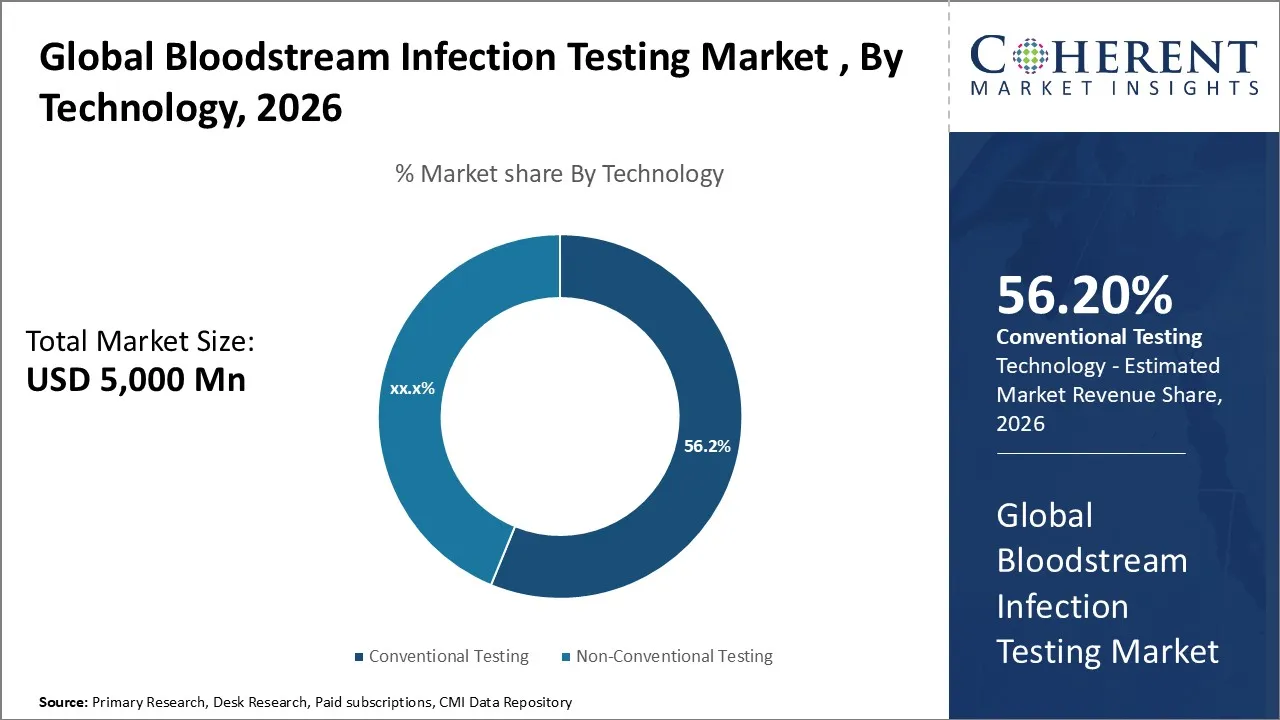
- Based on Technology, the Conventional Testing segment is expected to hold 56.20 % share of the market in 2026, driven by widespread adoption of traditional culture methods, though non-conventional technologies grow faster.
- Based on Test Type, the Conventional Blood Culture Tests segment is expected to lead the market with 34.50 % share in 2026, supported by their status as clinical gold standards.
- Based on End User, the Hospitals segment is expected to hold 53.70 % share of the market in 2026, driven by high testing volumes in inpatient and critical care settings.
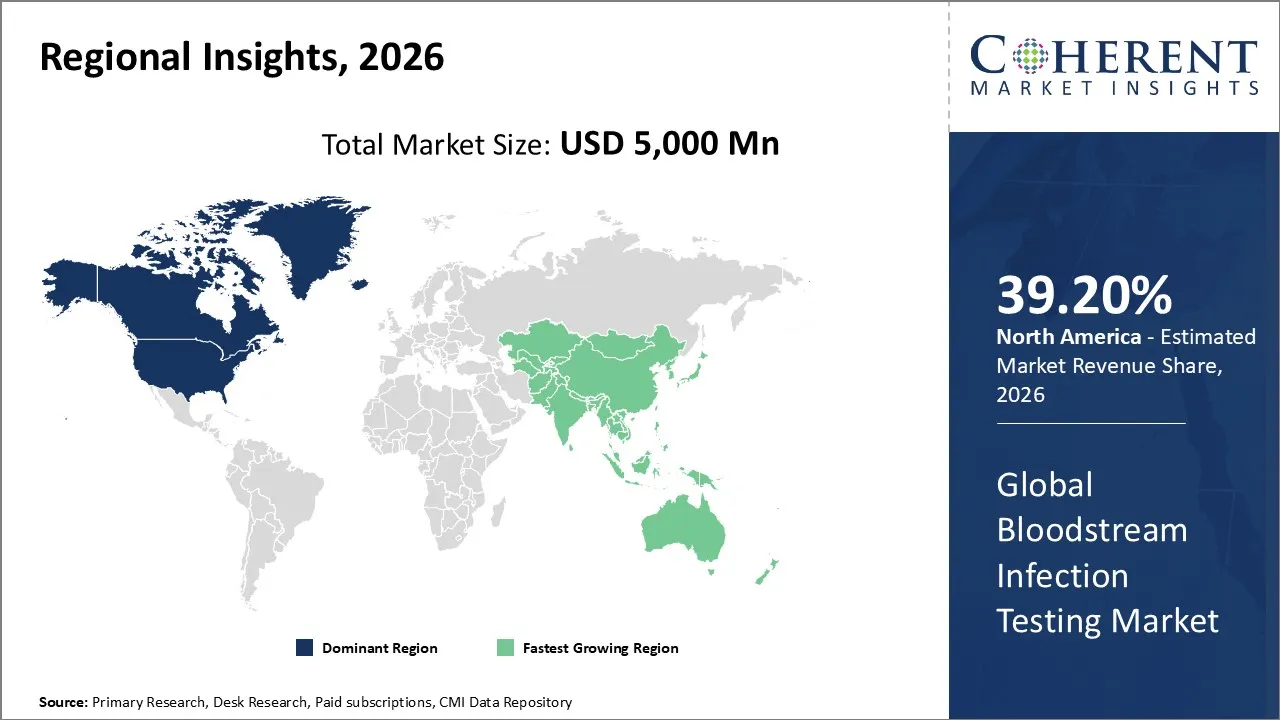
- Based on Region, North America is set to lead the market with 39.20 % share in 2026. While, Asia Pacific is anticipated to be the fastest growing region.
Market Overview
The Bloodstream Infection Testing Market is advancing significantly with rising applications in molecular diagnostics and personalized medicine. Moreover, expanding clinical research and tightening regulatory standards are expected to drive market growth over the forecast period. Pathogens such as bacteria and fungi are primary causes of systemic infections. Bloodstream infection testing is a commonly used diagnostic technique in the biotechnological, clinical, and biochemical industries. Bloodstream infection analyzers are utilized for quantitative analysis of pathogens present in a blood sample, which aids in the accurate characterization of infections and sepsis.
The bloodstream infection testing industry is having a revolutionary period bolstered by a number of advancing analytical factors and the adoption of sophisticated detection systems, along with high demand for particular biochemical analysis in different industries, including pharmaceuticals, clinical diagnostics, biotechnology, emergency medicine, and others. These developments have spread the capabilities of bloodstream infection analyzers and enhanced their efficiency and sensitivity as well as automation, marking a transformative phase in the market.
Current Events and Its Impacts on the Bloodstream Infection Testing Market
Current Event | Description and the Impact |
Geopolitical and Regulatory Developments |
|
Technological Innovations and Advancements |
|
Economic and Healthcare Infrastructure Trends |
|
Market Dynamics and Competitive Landscape |
|
Segmental Insights
- Current Industry Events of 2026
- Market Size Estimation
- Regional Breakdown
- Competitive Landscape
- Customer Intelligence
- Segmental Analysis
- Pricing Analysis
- Key Market Drivers, Challenges & Future Trends
- Customized Insights Section
Bloodstream Infection Testing Market Insights By, Technology - Conventional Testing Leads with Widespread Adoption of Traditional Culture Methods
In terms of technology, the conventional testing segment contributes the highest share of 56.20% in 2026 of the market driven by widespread adoption of traditional culture methods. The laboratories mainly favor these methods, as they provide a cost-effective and reliable way to identify viable pathogens. These techniques allow microbiologists to observe microbial growth and perform critical phenotypic antimicrobial susceptibility testing. Although molecular diagnostics provide results at a faster rate, their high implementation costs often limit their use to supplement testing. As a result, the proven reliability of culture-based methodology will continue to dominate the overall market as healthcare providers choose proven technologies for definitive and long-term patient management.
Bloodstream Infection Testing Market Insights, By Product Type- Recurring Use in Testing Workflows Drives Preference for Reagents & Consumables
In terms of product type, the reagents & consumables segment contributes the highest share of 64.80% in 2026 of the market due to the recurring use in testing workflows and frequent replenishment requirements. Clinicians demand a constant supply of assay kits and blood culture bottles to manage the rising incidence of sepsis and hospital-acquired infections. Unlike diagnostic instruments that represent a single capital purchase, these materials require continuous repurchasing for every patient sample. The transition toward high-throughput automated platforms is speeding up this consumption, as these systems rely on specialized proprietary reagents. This continual demand profile ensures that reagents & consumables remain the primary revenue generator for manufacturers. They also support the daily operational needs of clinical laboratories worldwide.
Bloodstream Infection Testing Market Insights, By Test Type - Conventional Blood Culture Tests Leads Supported by Their Status as Clinical Gold Standards
In terms of test type, the conventional blood culture tests segment contributes the highest share of 34.50% in 2026 of the market due to its status as a clinical gold standard. Physicians prefer these tests as the first line of defense to confirm the presence of bacteria or fungi in patients' blood. These tests provide the necessary isolates for detailed laboratory analysis, thus helping the clinicians address the specific antibiotic treatments. The detection capabilities of these tests for a wide range of aerobic and nonaerobic organisms make them more versatile than many of the targeted molecular assays. Even with new technologies, conventional blood cultures are trusted by the medical fraternity for their broad-spectrum diagnostic ability and for clinical validation.
For instance, in January 2025, Rapid Infection Diagnostics Inc. (RID) launched BSIDx, a revolutionary microbiology platform for detecting bloodstream infections. The system requires just a button press to identify pathogens and conduct antibiotic susceptibility testing directly from positive blood cultures, thereby delivering results in under five hours.
Regional Insights
North America Bloodstream Infection Testing Market Analysis & Trends
North America has remained the dominant region with 39.20% in 2026 of the global Bloodstream Infection Testing Market over the past decade owing to its extremely advanced healthcare system and the availability of leading diagnostic manufacturers in this region. The widespread knowledge about the treatment of sepsis cases and the early adoption of rapid molecular diagnostic techniques by healthcare professionals are also contributing to the high market share generated in this region. Moreover, favorable insurance policies and rigorous government regulations about hospital infections further encourage healthcare institutions to invest in advanced testing technologies. These rising cases of chronic diseases as well as the aging population of this region also require accurate bloodstream monitoring. As a result, the region remains at the forefront of the world in terms of efficiency of diagnostics and continues its immense lead in total revenue.
For instance, in April 2025, Diasorin obtained 510(k) clearance from the U.S. Food and Drug Administration (FDA) for the LIAISON PLEX Gram-Positive Blood Culture Assay. This completes the syndromic blood culture panel lineup on the LIAISON PLEX platform for the microbiological diagnosis of bloodstream infections.
Asia Pacific Bloodstream Infection Testing Market Analysis & Trends
Asia Pacific is set to become the fastest-growing region. This rapid expansion occurs because governments across the region are significantly increasing their healthcare expenditures and modernizing clinical laboratory networks. The rising economies within nations such as China and India help drive this market by ensuring that the populations have greater access to basic tests for a wide array of patients. The prevalence of infectious diseases, as well as the need to improve sepsis-related mortalities, is boosting the market. Furthermore, the local manufacturers are introducing cost-effective diagnostic platforms that cater to the specific needs of resource-limited settings. These aggressive infrastructure improvements and rising medical needs solidify the status of Asia Pacific as the most dynamic globally.
For instance, in November 2024, Indonesia’s Ministry of Health (MoH) and World Health Organization (WHO) initiated the nation’s inaugural national survey addressing antimicrobial resistance (AMR) in bloodstream infections (BSIs). This effort aligns with the WHO Global Antimicrobial Resistance and Use Surveillance System. It also functions as a key indicator for measuring progress on Sustainable Development Goals.
Bloodstream Infection Testing Market Outlook Country-Wise
The US Bloodstream Infection Testing Market Trends
The US market is a highly sophisticated landscape dominated by a transition toward rapid molecular diagnostics and integrated laboratory automation. With a heavy emphasis on antimicrobial stewardship programs, hospitals are increasingly bypassing traditional culture methods in favor of technologies like multiplex PCR and metagenomic sequencing. These platforms allow clinicians to identify pathogens and genetic resistance markers within a single work shift in order to minimize the mortality rates. The high healthcare expenditure and favorable reimbursement policies are propelling the adoption of premium AI driven diagnostic tools that streamline complex laboratory workflows.
For instance, in October 2025, Scanogen Inc., a molecular diagnostics innovator focused on next-generation infectious disease detection, was granted Breakthrough Device Designation by the U.S. Food and Drug Administration (FDA). The designation applies to its rapid assay which identifies bloodstream infection pathogens from patient samples.
China Bloodstream Infection Testing Market Trends
The China market is known for its aggressive growth strategy coupled with enormous government investment directed at promoting the modernization of the country’s healthcare infrastructure. Even though conventional blood cultures are considered the standard in many local hospitals due to cost-effectiveness considerations, the large city-based medical institutions have already started embracing automated diagnostic tools coupled with proteomics analysis. The government’s initiative towards emphasizing indigenous innovation has triggered a phenomenal increase in indigenous companies competing head-to-head against already entrenched multinational companies.
For instance, in July 2025, PHASE Scientific signed an exclusive U.S. distribution agreement with Lumos Diagnostics for FebriDx. This point-of-care (POC) test uses a single drop of blood to distinguish bacterial acute respiratory infection from non-bacterial causes in about 10 minutes.
Market Report Scope
Bloodstream Infection Testing Market Report Coverage
| Report Coverage | Details | ||
|---|---|---|---|
| Base Year: | 2025 | Market Size in 2026: | USD 5,000 Mn |
| Historical Data for: | 2020 To 2024 | Forecast Period: | 2026 To 2033 |
| Forecast Period 2026 to 2033 CAGR: | 7% | 2033 Value Projection: | USD 8,025 Mn |
| Geographies covered: |
| ||
| Segments covered: |
| ||
| Companies covered: | BioMérieux SA, Becton, Dickinson and Company, AB Sciex, IRIDICA, Abbot Laboratories, Cepheid Inc., C. R. Bard, Inc., F. Hoffmann-La Roche AG, Nanoshpere, Dade Behring, AdvanDX, and Siemens Healthcare. | ||
| Growth Drivers: |
| ||
| Restraints & Challenges: |
| ||
Bloodstream Infection Testing Market Drivers
Rising incidences of sepsis
The bloodstream infection testing market is experiencing substantial growth with the increase in sepsis incidence across global healthcare systems. Medical facilities require fast and precise pathogen detection capabilities for managing increasing patient loads effectively. Hospital-acquired infections present substantial challenges mainly for immunocompromised patients and those undergoing complex medical procedures.
Antibiotic-resistant pathogens complicate treatment strategies. this makes timely identification critical for optimal patient outcomes. Healthcare organizations recognize that diagnostic delays has a direct impact on mortality rates and treatment costs. The rising knowledge among healthcare providers and consumers is fueling significant investment in automated blood culture systems as well as molecular diagnostic platforms.
For instance, in January 2025, Inflammatix, an innovator in host-response diagnostics, revealed that the U.S. Food and Drug Administration (FDA) approved the TriVerity™ Test System (TriVerity) for marketing. This groundbreaking molecular tool targets patients with suspected acute infection or sepsis. It provides accurate bacterial-versus-viral differentiation alongside an assessment of overall illness severity based on immune response biomarkers for quick, comprehensive clinical insights.
Analyst Opinion (Expert Opinion)
- The Bloodstream Infection Testing Market is experiencing steady expansion, driven by the increasing clinical burden of sepsis and other severe bloodstream infections, which remain among the leading causes of hospital admissions and mortality worldwide. Epidemiological data indicate that hundreds of thousands of bloodstream infection cases are reported annually in major healthcare systems, reinforcing the need for timely and accurate diagnostic solutions, particularly in critical care and emergency settings.
- Technological advancement is a key growth catalyst. While conventional blood culture methods continue to serve as the diagnostic standard, their longer turnaround times are accelerating the adoption of molecular and rapid diagnostic platforms. Polymerase chain reaction–based assays, multiplex panels, and next-generation sequencing solutions are gaining traction due to their ability to identify pathogens and resistance markers within hours rather than days. These technologies are increasingly integrated with automated laboratory workflows, improving efficiency and diagnostic confidence.
- From a regional perspective, North America remains a leading market due to advanced laboratory infrastructure, high testing volumes, and strong adoption of automated diagnostics. Europe follows closely, supported by standardized clinical guidelines and antimicrobial stewardship programs. Asia Pacific is showing notable momentum, driven by healthcare infrastructure expansion, rising hospital capacity, and increased investment in diagnostic modernization.
- Overall, the market outlook is supported by rising test volumes, growing emphasis on early infection detection, and continuous innovation in rapid and multiplex testing technologies, positioning bloodstream infection testing as a critical component of modern clinical diagnostics.
Speak to the analyst
Want personalized insights?
Take the findings above to one of our principal consultants, or have the report rebuilt around the segments, geographies and competitors you actually track.
Bloodstream Infection Testing Industry News
- In October 2025, London Blood Tests, a top private medical testing provider, introduced its cutting-edge TORCH screening services to promote maternal and fetal well-being via early detection of infections.
- In June 2025, deepull, a diagnostics company specializing in culture-free methods for fast pathogen identification, completed an oversubscribed Series C funding round, securing USD 58 million. The investment will propel the development of the UllCORE system for direct from blood pathogen detection.
- In April 2025, Karius, Inc., a frontrunner in metagenomic sequencing for infectious disease testing, unveiled Karius Focus | BAL, a microbial cell-free DNA assay that enables doctors to pinpoint pathogens behind pneumonia and other respiratory infections with high precision.
- In December 2024, BD, a global leader in medical technology partnered with Babson Diagnostics, a pioneering health care tech firm, to broaden fingertip blood collection and testing solutions U.S. health systems and large provider networks for use in urgent care centers, physician offices and other outpatient facilities.
Market Segmentation
- Product Type Insights (Revenue, USD Mn, 2026 - 2033)
- Instruments
- Reagents & Consumables
- Others
- Technology Insights (Revenue, USD Mn, 2026 - 2033)
- Conventional Testing
- Non-Conventional Testing
- Test Type Insights (Revenue, USD Mn, 2026 - 2033)
- Conventional Blood Culture Tests
- PCR Method
- Nucleic Acid Testing
- Mass Spectroscopy
- Point-Of-Care Testing
- End User Insights (Revenue, USD Mn, 2026 - 2033)
- Hospitals
- Independent Diagnostics Centers
- Others
- Regional Insights (Revenue, USD Mn, 2026 - 2033)
- North America
- U.S.
- Canada
- Latin America
- Brazil
- Argentina
- Mexico
- Rest of Latin America
- Europe
- Germany
- U.K.
- France
- Italy
- Russia
- Rest of Europe
- Asia Pacific
- China
- India
- Japan
- Australia
- South Korea
- ASEAN
- Rest of Asia Pacific
- Middle East
- GCC
- Israel
- Rest of Middle East
- Africa
- North Africa
- Central Africa
- South Africa
- Key Players Insights
- BioMérieux SA
- Becton
- Dickinson and Company
- AB Sciex
- IRIDICA
- Abbot Laboratories
- Cepheid Inc.
- C. R. Bard, Inc.
- F. Hoffmann-La Roche AG
- Nanoshpere
- Dade Behring
- AdvanDX
- Siemens Healthcare
Sources
Primary Research Interviews
- Bloodstream Infection Diagnostic Test Manufacturers
- In-Vitro Diagnostics (IVD) Companies
- Microbiology & Molecular Diagnostics Experts
- Hospital Laboratory Directors & Pathologists
- Infectious Disease Specialists
- Clinical Microbiologists
- Distribution & Channel Partners
- Others
Databases
- Bloomberg Terminal
- Thomson Reuters Eikon
- IHS Markit
- Euromonitor International
- S&P Global Market Intelligence
- Statista
- Others
Magazines
- Clinical Laboratory News
- The Pathologist
- Diagnostics World
- Medical Device & Diagnostic Industry (MD+DI)
- Infection Control Today
- Others
Journals
- Clinical Infectious Diseases
- Journal of Clinical Microbiology
- The Lancet Infectious Diseases
- Journal of Antimicrobial Chemotherapy
- Diagnostic Microbiology and Infectious Disease
- Others
Newspapers
- Financial Times
- The Wall Street Journal
- Reuters
- Bloomberg News
- The New York Times
- Others
Associations
- Infectious Diseases Society of America (IDSA)
- American Society for Microbiology (ASM)
- European Society of Clinical Microbiology and Infectious Diseases (ESCMID)
- Clinical and Laboratory Standards Institute (CLSI)
- International Society for Infectious Diseases (ISID)
- Others
Public Domain Sources
- World Health Organization (WHO)
- Centers for Disease Control and Prevention (CDC)
- U.S. Food and Drug Administration (FDA)
- European Medicines Agency (EMA)
- National Institutes of Health (NIH)
- World Bank Open Data
- Others
Proprietary Elements
- CMI Data Analytics Tool
- Proprietary CMI Existing Repository of Information for the Last 8 Years
*Definition: The bloodstream infection testing market employs advanced diagnostic computer software and high-throughput automated instruments for the detection of life-threatening pathogens. This industry is concerned with the utilization of molecular diagnostics and automated blood culture systems for performing critical tasks such as microbial detection, identification, and antibiotic susceptibility testing with high accuracy. These platforms are essential in hospitals and reference laboratories where rapid turnaround times and diagnostic accuracy are essential for managing sepsis and improving patient outcomes. The cutting-edge engineered instruments and multiplex PCR panels assist in minimizing the risk of diagnostic errors and reducing the time to results compared to traditional manual culture methods. The demand for these solutions comes from healthcare providers, diagnostic centers, and clinical laboratories.
Get access to 250+ pages report
Every segment, forecast, competitor profile and data table behind the analysis above — available for instant download.
- ESOMAR Member
- ISO 9001:2015 Certified
- D-U-N-S Registered
- GDPR & CCPA Compliant
Missing comfort of reading report in your local language? Find your preferred language:
Transform your Strategy with Exclusive Trending Reports
Frequently Asked Questions
The Bloodstream Infection Testing Market is estimated to be valued at USD 5,000 Mn in 2026, and is expected to reach USD 8,025 Mn by 2033.
The CAGR of the Bloodstream Infection Testing Market is projected to be 7% from 2026 to 2033.
The rising incidence of sepsis, chronic diseases, and hospital-acquired infections are the major factors driving the growth of the Bloodstream Infection Testing Market.
The high cost of advanced diagnostics and limited access in developing nations are the major factors hampering the growth of the Bloodstream Infection Testing Market.
In terms of product type, the reagents & consumables is estimated to dominate the market revenue share in 2026.
BioMérieux SA, Becton, Dickinson and Company, AB Sciex, IRIDICA, Abbot Laboratories, Cepheid Inc., C. R. Bard, Inc., F. Hoffmann-La Roche AG, Nanoshpere, Dade Behring, AdvanDX, and Siemens Healthcare are the major players.
North America is expected to lead the Bloodstream Infection Testing Market in 2026.