Smart Hospitality Management Market Analysis & Forecast: 2026-2033

Smart Hospitality Management Market Size and Forecast – 2026 – 2033
The Global Smart Hospitality Management Market size is estimated to be valued at USD 4.86 billion in 2026 and is expected to reach USD 9.7 billion by 2033, exhibiting a compound annual growth rate (CAGR) of 13.0% from 2026 to 2033.
Global Smart Hospitality Management Market Overview
Smart hospitality management includes digital, connected, and automated technologies deployed in hotels to enhance guest experience and operational efficiency. The market covers smart room controls, AI concierge services, mobile check-ins, IoT-enabled energy systems, robot assistants, automated housekeeping, and centralized hotel management platforms. These solutions allow hotels to deliver personalization, efficient resource use, and seamless service across guest touchpoints.
Key Takeaways
The Property Management Systems segment dominates market share, driven by its essential role in operational integration and guest management, with emerging cloud-based PMS solutions amplifying growth opportunities.
The Hotels segment leads end-use revenue, influenced by increasing digital adoption rates in luxury and boutique hotels.
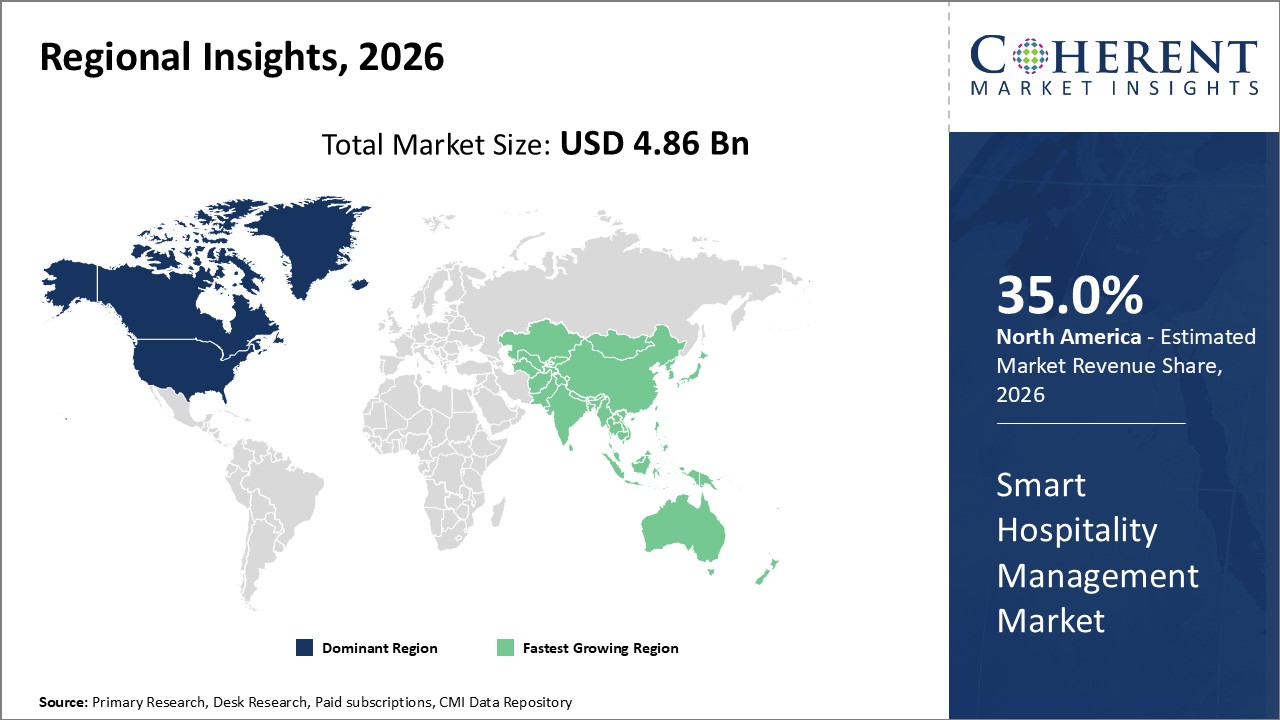
Regionally, North America holds the largest market share due to mature infrastructure and proactive technological investment, while Asia Pacific demonstrates the fastest CAGR, propelled by rapid hospitality infrastructure development and rising tourism demand.
Europe remains a key adopter of sustainable and secure smart hospitality solutions, capitalizing on regulatory frameworks.
Smart Hospitality Management Market Segmentation Analysis
To learn more about this report, Request Free Sample
Smart Hospitality Management Market Insights, By Solution Type
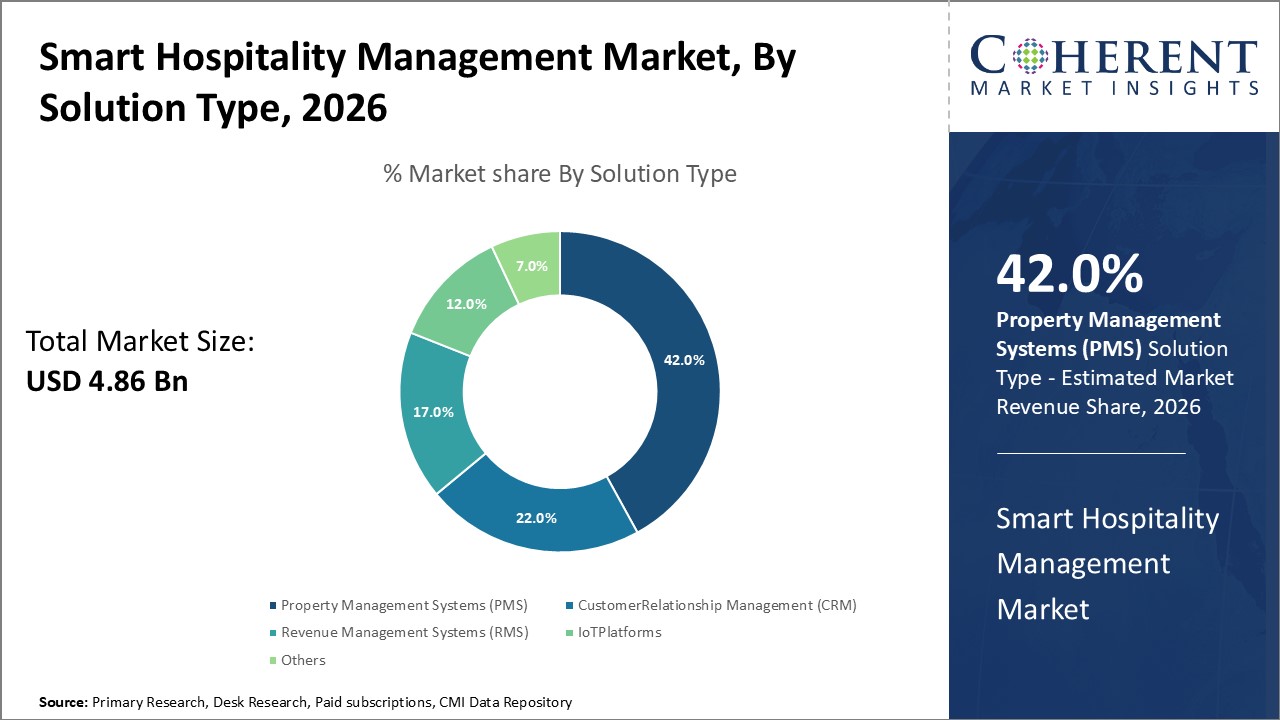
Property Management Systems dominate the market share at 42%, standing as the backbone of smart hospitality operations by streamlining check-in/out, reservations, and housekeeping workflows. The rising migration to cloud-based PMS solutions enhances scalability and real-time data access, further consolidating their dominance. The fastest growing subsegment is IoT Platforms, which enable smart automation ranging from smart room controls to predictive maintenance, expanding rapidly due to energy-saving and guest satisfaction priorities. CRM solutions are vital for guest data analytics and targeted marketing, growing steadily, while RMS facilitates dynamic pricing strategies crucial during peak seasons or events.
Smart Hospitality Management Market Insights, By Service Type
Cloud-based services are the dominating segment, favored for their cost-efficiency, seamless upgrades, and robustness against cybersecurity threats, enabling faster deployment across diverse property types. Adoption of cloud models grew substantially in 2025 and 2026, especially among mid-sized hotel chains and resort operators, emphasizing flexible scalability. The fastest growing segment remains Managed Services, where external providers handle system maintenance and upgrades, freeing internal resources for service excellence. On-Premises systems hold traditional ground in regions with stricter data sovereignty laws but face pressure due to higher capital expenditure and slower innovation rates.
Smart Hospitality Management Market Insights, By Application
Hotels constitute the dominating application segment, leveraging smart hospitality management solutions to enhance guest personalization, streamline front and back-office operations, and maximize revenue through integrated RMS and CRM functionalities. The Hotels segment benefits extensively from large-scale investments, driving sustained market share leadership. Resorts represent the fastest-growing subsegment, driven by demand for immersive guest experiences and energy management solutions in luxury and wellness resorts globally. Cruise ships, although niche, are witnessing increased adoption of integrated IoT systems for safety, navigation, and onboard entertainment, reflecting evolving market dynamics.
Smart Hospitality Management Market Trends
The Smart Hospitality Management market is witnessing accelerated adoption of AI and automation technologies, with service providers focusing on hyper-personalization and operational efficiency.
In 2026, customer data integration from multiple touchpoints became a critical market trend, enabling better decision-making and revenue enhancement.
Additionally, cloud-based platform migration has emerged as a dominant development trajectory due to increased demand for scalable and flexible operational models.
Smart Hospitality Management Market Insights, By Geography
To learn more about this report, Request Free Sample
North America Smart Hospitality Management Market Analysis and Trends
In North America, the dominance in the Smart Hospitality Management market is driven by advanced technology infrastructure and substantial investments in hospitality digital transformation. Combined contributions from the U.S. and Canada account for over 34% of global market revenue, supported by large-scale cloud adoption and a robust presence of major market players. Government initiatives promoting innovation and digital integration have accelerated market penetration.
Asia Pacific Smart Hospitality Management Market Analysis and Trends
Meanwhile, the Asia Pacific exhibits the fastest growth with a CAGR exceeding 15%, fuelled by burgeoning tourism, rising disposable incomes, and rapid hospitality sector expansion in countries such as China, India, and Southeast Asia. Booming infrastructure projects, enhanced regulatory support, and increasing foreign investments contribute significantly to the market dynamics.
Smart Hospitality Management Market Outlook for Key Countries
USA Smart Hospitality Management Market Analysis and Trends
The USA market leads in innovation and adoption of smart hospitality technologies, with industry players such as Oracle Hospitality and Amadeus IT Group spearheading cloud-native solutions and AI-driven management systems. Hospitality entities in metropolitan areas like New York and San Francisco have adopted advanced IoT platforms, achieving operational savings exceeding 20%. The U.S. government’s support for smart city initiatives indirectly propels smart hospitality demands, making this market vital to the overall industry size and trends.
China Smart Hospitality Management Market Analysis and Trends
China’s market shows remarkable growth driven by rising inbound tourism and the government’s push toward digital economy modernization. Leading domestic and international companies are investing heavily in integrated IoT and AI platforms, with metropolitan hubs like Shanghai and Beijing hosting pilot smart hospitality projects that improve guest experience and operational management. Increasing adoption of mobile payments and contactless services also contributes significantly to business growth and industry share.
Analyst Opinion
Demand for AI-Driven Personalization: The rise in demand for AI-driven personalization within smart hospitality management solutions is a crucial driver of market size. In 2025 alone, over 69% of hospitality enterprises invested significantly in AI-enhanced platforms to tailor guest experiences and upsell services, resulting in measurable increases in average spend per guest by up to 16%. Such demand-side indicators strongly support forecasted market revenue growth.
Expansion of Cloud-Based Management Solutions: Cloud deployment of smart hospitality management systems has surged, with cloud-based solutions accounting for 54% of new platform implementations worldwide in 2026. This supply-side shift is led by cost-efficiency and scalability demands among mid-to-large size hotels, particularly in North America and Europe, underscoring a broader shift in market dynamics.
This micro-indicator aligns with a rising number of business growth strategies aimed at integrating zero-touch interactions to boost guest confidence.
Increasing Investments in IoT Deployments: Recent data show a 36% annual increase in IoT device installations in hospitality properties globally, from smart thermostats to predictive maintenance sensors. The technical efficiencies gained drive operational cost reductions up to 21%, correlating directly with enhanced industry share and increasing market size.
Market Scope
| Report Coverage | Details | ||
|---|---|---|---|
| Base Year: | 2025 | Market Size in 2026: |
USD 4.86 billion |
| Historical Data for: | 2020 To 2024 | Forecast Period: | 2026 To 2033 |
| Forecast Period 2026 to 2033 CAGR: | 13.0% | 2033 Value Projection: |
USD 9.7 billion |
| Geographies covered: |
|
||
| Segments covered: |
|
||
| Companies covered: | Maestro PMS, Guestline Group PLC, Springer-Miller Systems, MSI Solutions, eZee Technosys, Cloudbeds Inc.,StayNTouch, Mews Systems, GuestBridge, and ResNexus. | ||
| Growth Drivers: |
|
||
Uncover macros and micros vetted on 75+ parameters: Get instant access to report
Smart Hospitality Management Market Growth Factors
The smart hospitality management market experiences rapid expansion fueled by rising investments in cloud technology, which optimizes operational scalability and provides real-time analytics that empower decision-making. The increasing prevalence of smart IoT devices across properties improves guest comfort and energy efficiency, consolidating business growth across various hospitality segments. Elevating guest expectations for seamless, personalized services stimulates technological adoption, with hotels reporting a 26% year-over-year increase in revenue linked directly to smart tech integration. Furthermore, stringent regulatory requirements around data security and guest privacy push market players toward advanced cybersecurity measures, underpinning sustainable market growth strategies.
Smart Hospitality Management Market Development
In April 2026, RateGain launched Smart ARI, an AI-powered engine designed to automate real-time updates for Availability, Rates, and Inventory across distribution channels. The solution helps hotels reduce distribution costs, eliminate manual errors, and react instantly to market changes with dynamic pricing synchronization.
In February 2026, Infor introduced its next-generation AI-driven Revenue Management Solution, enabling hotels and travel operators to optimize pricing decisions using predictive demand modeling and real-time market intelligence. The platform focuses on improving RevPAR through automated recommendations and multi-property optimization.
In 2025, Oracle Hospitality rolled out an AI-based guest experience platform aimed at delivering hyper-personalized interactions throughout the customer journey. The system uses behavioral data, preferences, and stay history to tailor offers, automate service delivery, and enhance loyalty programs across hotel chains.
Key Players
Leading Companies of the Market
Maestro PMS
Guestline Group PLC
Springer-Miller Systems
MSI Solutions
eZee Technosys
Cloudbeds Inc.
StayNTouch
Mews Systems
GuestBridge
ResNexus
Several leading market companies have adopted aggressive digital transformation strategies, such as Oracle Hospitality's expansion into cloud-native solutions, which resulted in a 22% increase in market penetration in 2025. Amadeus IT Group’s investment in AI-powered demand forecasting mechanisms boosted client retention by 18% in the same year. Meanwhile, Sabre Corporation’s partnership with major hotel chains enabled accelerated RMS adoption, contributing to their robust market revenue growth.
Smart Hospitality Management Market Future Outlook
The future market will be shaped by full-scale digitalization, AI adoption, and connected guest ecosystems. Smart hospitality will increasingly integrate voice-controlled rooms, AI-powered concierge bots, predictive maintenance, energy-saving systems, and robot-assisted services. Data analytics will allow hotels to personalize stays based on guest behavior profiles. Sustainability initiatives will drive the adoption of smart energy systems, automated climate control, and water-usage optimization. With rising global tourism and competition among hotel brands, investment in smart technologies will become essential for differentiation and profitability.
Smart Hospitality Management Market Historical Analysis
The smart hospitality management market historically evolved from traditional hotel management systems toward integrated, technology-driven platforms designed to improve guest experience and operational efficiency. Early adoption focused on property management systems (PMS) and automated booking engines. Over time, the expansion of IoT, mobile technologies, and AI introduced innovations such as smart room controls, digital check-in, automated housekeeping, and centralized operations dashboards. Hotels increasingly adopted these technologies to reduce labor costs, streamline workflows, and deliver personalized guest services.
Sources
Primary Research Interviews:
Hotel IT Managers
Smart Systems Integrators
Hospitality Consultants
IoT Solution Providers
Property Managers
Databases:
Statista Hospitality Tec
UNWTO Tourism Data
Gartner Smart Hospitality Reports
Euromonitor Travel Tech
IBISWorld Hospitality Intelligence
Magazines:
Hospitality Technology Magazine
Hotel Management
Smart Buildings Magazine
IoT World Today
Hospitality Insights
Journals:
International Journal of Hospitality Management
Journal of Tourism Technology
Service Industry Journal
IEEE IoT Journal
Journal of Smart Environments
Newspapers:
The Wall Street Journal (Hospitality)
Financial Times (Travel)
Reuters Tourism
The Guardian Travel
The New York Times (Business Travel)
Associations:
Hospitality Technology Association
American Hotel & Lodging Association
IoT Industry Associations
Smart Building Councils
Global Hospitality Leaders Forum
Share
Share
Monica Shevgan has 9+ years of experience in market research and business consulting driving client-centric product delivery of the Information and Communication Technology (ICT) team, enhancing client experiences, and shaping business strategy for optimal outcomes. Passionate about client success.

Credibility and Certifications

860519526


9001:2015

27001:2022


Need a Custom Report?
We can customize every report - free of charge - including purchasing stand-alone sections or country-level reports
Customize NowJoining thousands of companies around the world committed to making the Excellent Business Solutions.
View All Our Clients