Pharmaceutical Packaging Equipment Market Analysis & Forecast: 2026-2033
The Pharmaceutical Packaging Equipment Market is estimated to be valued at USD 6.45 Bn 2026 and is expected to reach USD 10.05 Bn by 2033, growing at a compound annual growth The rate (CAGR) of 6.5% from 2026 to 2033.
The pharmaceutical packaging equipment market is advancing significantly driven by its expanding role in biotechnology, personalized medicine, and the global surge in generic drug production. The growth in self-administration therapies and tightening global regulatory standards like mandatory serialization and track-and-trace requirements are expected to drive market growth over the forecast period. The modern packaging machinery is a fundamental pillar of the healthcare sector engineered to maintain product sterility and integrity via high-precision technologies like aseptic filling, blister packaging, and tamper-evident labeling.
The pharmaceutical packaging equipment industry is witnessing a transformative phase due to the incorporation of Industry 4.0, robotic automation, and AI driven visual inspection systems. There is a high demand for specialized modular equipment capable of handling diverse formulations, including biologics that require cold chain compatibility and sustainable, eco-friendly materials. These developments have expanded the functional capabilities of packaging lines, drastically improving Overall Equipment Effectiveness (OEE) and sealing efficiency while ensuring rigorous compliance with international safety standards.
|
Current Event |
Description and the Impact |
|
Geopolitical and Regulatory Developments
|
|
|
Technological Advancements and Innovations
|
|
|
Regional Industry Shifts and Strategic Collaborations |
|
Uncover macros and micros vetted on 75+ parameters: Get instant access to report
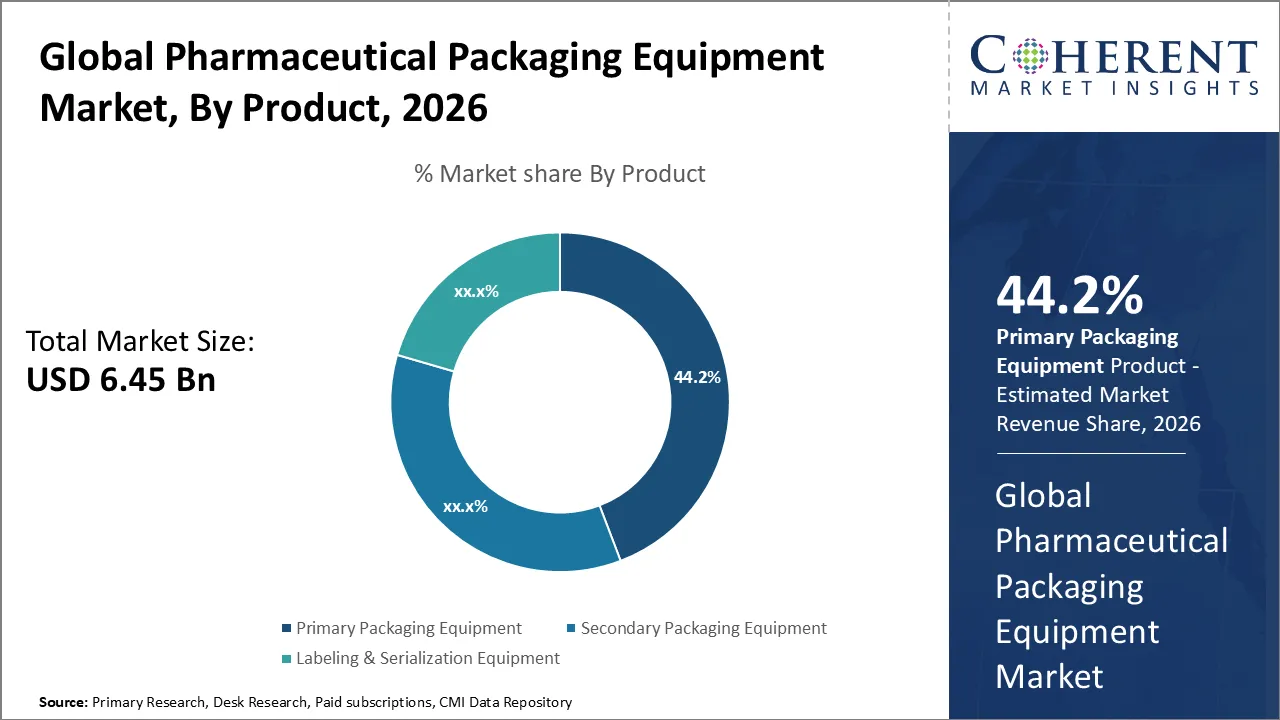
In terms of product, the primary packaging equipment segment contributes the highest share of 44.20% in 2026 of the market. The primary packaging equipment constitutes the first line of defense for medical products by controlling and processing materials that are in direct contact with the drug substance. This machinery handles essential containers like blister packs, vials, bottles, and prefilled syringes, thereby maintaining sterility and preventing contamination throughout the packaging process. The businesses prioritize this equipment due to its ability to maintain chemical stability and therapeutic efficacy of medications throughout their shelf life. The advanced systems incorporate aseptic filling and sealing technologies to cater to stringent global safety mandates. This equipment prevents exposure to moisture, oxygen, and light, which are critical factors in preserving patient safety.
In terms of type, the liquids packaging equipment segment contributes the highest share of 39.40% in the market in 2026. The liquids packaging equipment segment focuses on overcoming the unique operational challenges involved in packaging fluid medications, from low-viscosity syrups to thicker suspensions and ophthalmic drops. This category encompasses high-precision filling machines, cappers, and induction sealers mainly engineered to prevent leakage while maintaining precise dosing accuracy. The modern liquid packaging lines use flow meters and vacuum filling technology to achieve high speed production while reducing product waste. They are equipped with cleaning-in-place systems that preserve sterility and prevent cross-batch contamination. The increasing adoption of injectable biologics and oral solutions is pushing manufacturers to deploy equipment capable of efficiently managing varied container sizes and shapes.
In terms of end user, the pharmaceutical manufacturing segment contributes the highest share of 53.80% in 2026 of the market because they integrate comprehensive, high-volume packaging lines directly into their production facilities. These firms are making investment in automated equipment to streamline operations and reduce human error in the packaging process. They exercise enhanced control over quality assurance and regulatory compliance by implementing mandatory serialization and track and trace systems. These firms are also concentrating on scalable and validated systems that can support diverse product portfolios such as blockbuster generic drugs as well as specialized clinical formulations. This commitment to technological upgrades ensures that manufacturers quickly adapt to changing market demands while upholding the highest standards of drug integrity.
For instance, in December 2025, SmartSkin Technologies, a pioneer in pharmaceutical manufacturing intelligence, released SmartSkin Seal Assurance. This innovative solution offers pharmaceutical manufacturers real-time insights into seal tightness, ensuring Container Closure Integrity for both vial and cartridge capping.
To learn more about this report, Download Free Sample
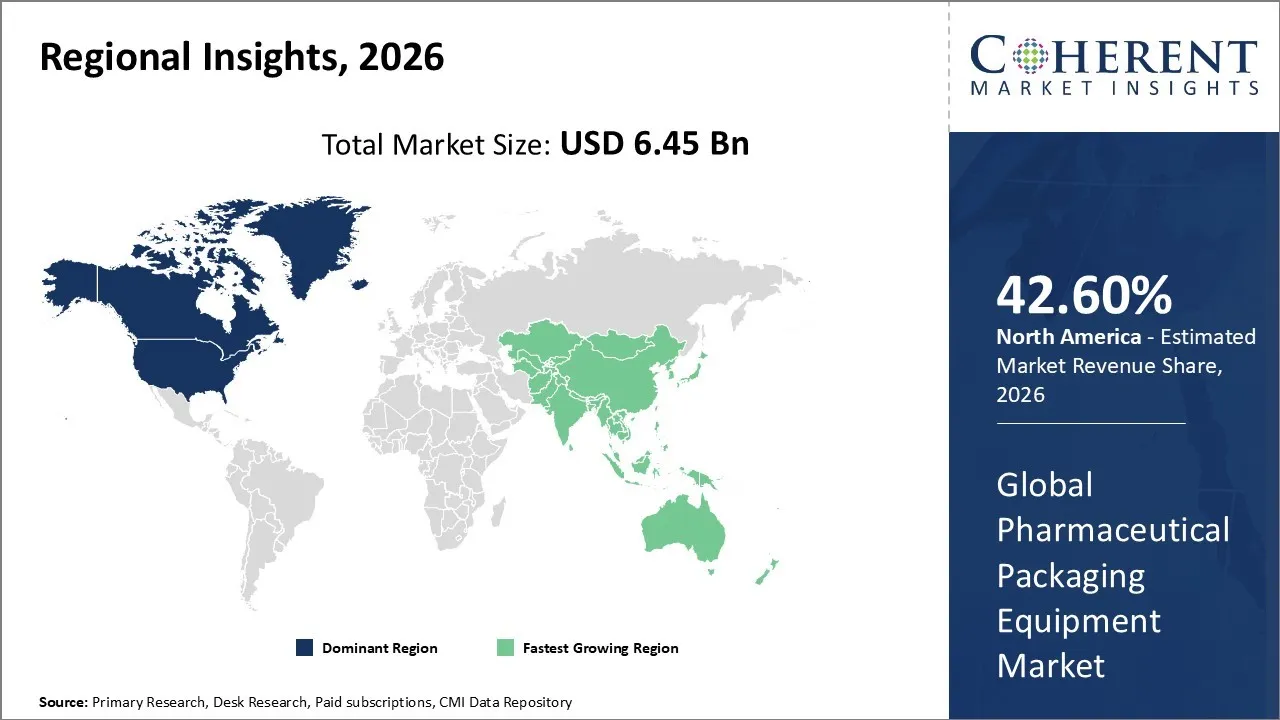
North America has remained the dominant region, with 42.60% in 2026 of the global Pharmaceutical Packaging Equipment Market over the past decade. The growth is due to its advanced healthcare infrastructure and the presence of top companies. The growth is mainly driven by stringent FDA mandates regarding sterilization and track and trace capabilities aimed at curbing the counterfeiting drug trade. In addition, a notable surge in biopharmaceutical research has increased the demand for specialized high-precision equipment like aseptic filling lines and prefilled syringe systems. These businesses are incorporating AI and IoT in smart packaging lines to improve operational efficiency and precision. This technological shift alongside the aging population requiring chronic disease medication positions North America at the forefront of automated packaging solutions.
For instance, in December 2025, IWK Packaging Systems, a pharmaceutical packaging equipment firm headquartered in Germany, has introduced a machine that creates entirely cardboard blister packs for the North American market.
The Asia Pacific region is likely to register the fastest expansion and has established itself as a major hub for drug packaging machinery worldwide. The growth is attributed to China and India, where production facilities are upgrading quickly to meet global export requirements and growing domestic consumption. The combination of government initiatives and growing healthcare expenditure has accelerated production capacity expansion, creating strong demand for high-speed, cost-efficient machinery. Western companies are moving manufacturing offshore in the region to take advantage of lower production costs. As a result, there is a burgeoning demand for diverse equipment, from high-capacity blister packaging to modular liquid filling systems, supporting the region's trajectory as a primary global supplier.
For instance, in April 2025, Syntegon has launched a new filling machine designed for ready-to-use (RTU) nested syringes. The MLD Advanced meets the pharmaceutical industry's increasing demands for high production and comprehensive in-process control (IPC).
The market in the US prioritizes high-tech integration and stringent regulatory compliance to ensure patient safety. The businesses are focusing on advanced serialization and track and trace capabilities to meet the mandates of the Drug Supply Chain Security Act. There is a significant move toward modular, flexible packaging lines that can handle the smaller, more specialized batches required for personalized medicine and biologics. In addition, companies are adopting robotic systems to enhance precision and maintain sterile environments during the primary packaging process.
China is experiencing a massive shift toward domestic modernization and high-speed automation within its pharmaceutical sector. The market is evolving from basic machinery to sophisticated, integrated production lines that align with global manufacturing standards and digital transformation goals. There is a heightened demand for specialized equipment capable of handling temperature-sensitive vaccines and injectable drugs due to a surge in biopharmaceutical research. In addition, government initiatives are encouraging the adoption of smart manufacturing technologies to improve overall efficiency and ensure consistent quality across the supply chain.
| Report Coverage | Details | ||
|---|---|---|---|
| Base Year: | 2025 | Market Size in 2026: | USD 6.45 Bn |
| Historical Data for: | 2020 To 2024 | Forecast Period: | 2026 To 2033 |
| Forecast Period 2026 to 2033 CAGR: | 6.5% | 2033 Value Projection: | USD 10.05 Bn |
| Geographies covered: |
|
||
| Segments covered: |
|
||
| Companies covered: |
Robert Bosch GmbH, Industria Macchine Automatiche S.p.A., Marchesini Group S.p.A., Korber AG, MG2 s.r.l., Accutek Packaging Equipment Companies, Inc., Vanguard Pharmaceuticals Machinery, Inc., Romaco Pharmatechnik GmbH, Bausch + Ströbel Maschinenfabrik Ilshofen GmbH+Co. KG, and OPTIMA packaging group GmbH |
||
| Growth Drivers: |
|
||
| Restraints & Challenges: |
|
||
Uncover macros and micros vetted on 75+ parameters: Get instant access to report
Contract manufacturing is one of the fastest-growing segments in the pharmaceutical industry because it provides international standard quality at a low cost. It is increasingly viewed as a strategic option by pharmaceutical companies looking to expand their global market presence. This shift is driven by the rising demand for generic drugs, the expiration of patents for major therapeutic brands, the necessity for high-quality research and development facilities, and the availability of cost-effective production technologies that comply with global regulatory standards.
A significantly reduced cost of operation and production enhances multinational companies' capabilities to enter emerging markets like India and meet their outsourcing requirements. This trend is driving a growing demand for pharmaceutical and medical-grade packaging materials, as well as the related equipment, in developing countries throughout the forecast period.
Furthermore, the growth in the active pharmaceutical ingredient (API) market is driven by several factors, including the increase in the development of biological APIs, a rising demand for API packaging, an upsurge in applications for abbreviated new drug applications (ANDA), and an increase in drug master files (DMF) submitted by Indian companies. These factors contribute to a growing need for efficient and cost-effective packaging and delivery of formulated products within the pharmaceutical industry.
The Pharmaceutical Packaging Equipment Market is witnessing strong growth driven by regulatory compliance, technological innovation, and expanding pharmaceutical production. Global demand is rising steadily, with Asia-Pacific emerging as a major contributor due to increasing manufacturing capacity in China, India, and Southeast Asia. North America and Europe continue to lead in technological sophistication and regulatory influence, shaping investment and equipment adoption patterns.
Segment analysis highlights the dominance of primary packaging equipment, particularly for sterile formats such as vials, syringes, and blister packs, while secondary equipment supporting case packaging and aggregation is also growing. Automation and integrated systems account for a significant portion of new installations, with robotics, machine vision, and digital serialization increasingly standard. Data shows that over 70% of new systems incorporate traceability modules, reflecting industry emphasis on quality and compliance.
Blister packaging remains a key format, and filling machinery maintains a leading role across liquid, sterile, and solid dosage lines. Industry drivers include mandatory serialization laws, growth in biologics and specialty therapies, and rising adoption of digital and predictive maintenance technologies. Major suppliers focus on innovation, modular systems, and service contracts, fostering a competitive landscape.
Overall, the market exhibits sustained expansion, underpinned by regulatory demand, automation adoption, and global pharmaceutical production growth, making it a high-priority segment for strategic investment.
Definition: The pharmaceutical packaging equipment market encompasses the design, production, and sale of specialized machinery for the packaging of medicinal goods. These machines are essential for protecting, sealing, and labeling medicinal products, ensuring their safety and quality. This sector includes various technologies like blister packers, bottle fillers, and sterilization systems designed to ensure the integrity and safety of drugs throughout the supply chain. The sector places a greater emphasis on maintaining product efficacy and preventing contamination. It covers a diverse range of formats, like solid, liquid, and semi-liquid formulations. It also incorporates advanced automation and robotics to improve product efficiency. The growth is mainly driven by stringent regulatory mandates and the rise of biopharmaceuticals.
Share
Share
About Author
Komal Dighe is a Management Consultant with over 8 years of experience in market research and consulting. She excels in managing and delivering high-quality insights and solutions in Health-tech Consulting reports. Her expertise encompasses conducting both primary and secondary research, effectively addressing client requirements, and excelling in market estimation and forecast. Her comprehensive approach ensures that clients receive thorough and accurate analyses, enabling them to make informed decisions and capitalize on market opportunities.
Missing comfort of reading report in your local language? Find your preferred language :
Transform your Strategy with Exclusive Trending Reports :
Frequently Asked Questions
Joining thousands of companies around the world committed to making the Excellent Business Solutions.
View All Our Clients
 Schedule a meeting with report Author