

Refinery Catalyst Market Size and Forecast — 2026 - 2033
The Global Refinery Catalyst Market size is estimated to be valued at USD 12.5 billion in 2026 and is projected to reach USD 18.7 billion by 2033, registering a compound annual growth rate (CAGR) of 6.1% during the forecast period from 2026 to 2033.
Overview
The growth of the refinery catalyst market is driven by rising global demand for cleaner fuels and stricter environmental regulations regarding sulfur emissions and fuel quality standards. Increasing crude oil processing activities and expansion of refinery capacities, particularly in emerging economies, are boosting catalyst consumption across fluid catalytic cracking, hydrotreating, and hydrocracking applications. Growing demand for transportation fuels, petrochemicals, and energy products further supports market expansion. Technological advancements in catalyst efficiency and performance are helping refineries improve yield optimization and operational efficiency. In addition, rising investments in upgrading aging refinery infrastructure and increasing focus on sustainable refining processes continue to drive demand for advanced refinery catalysts globally.
Key Takeaways
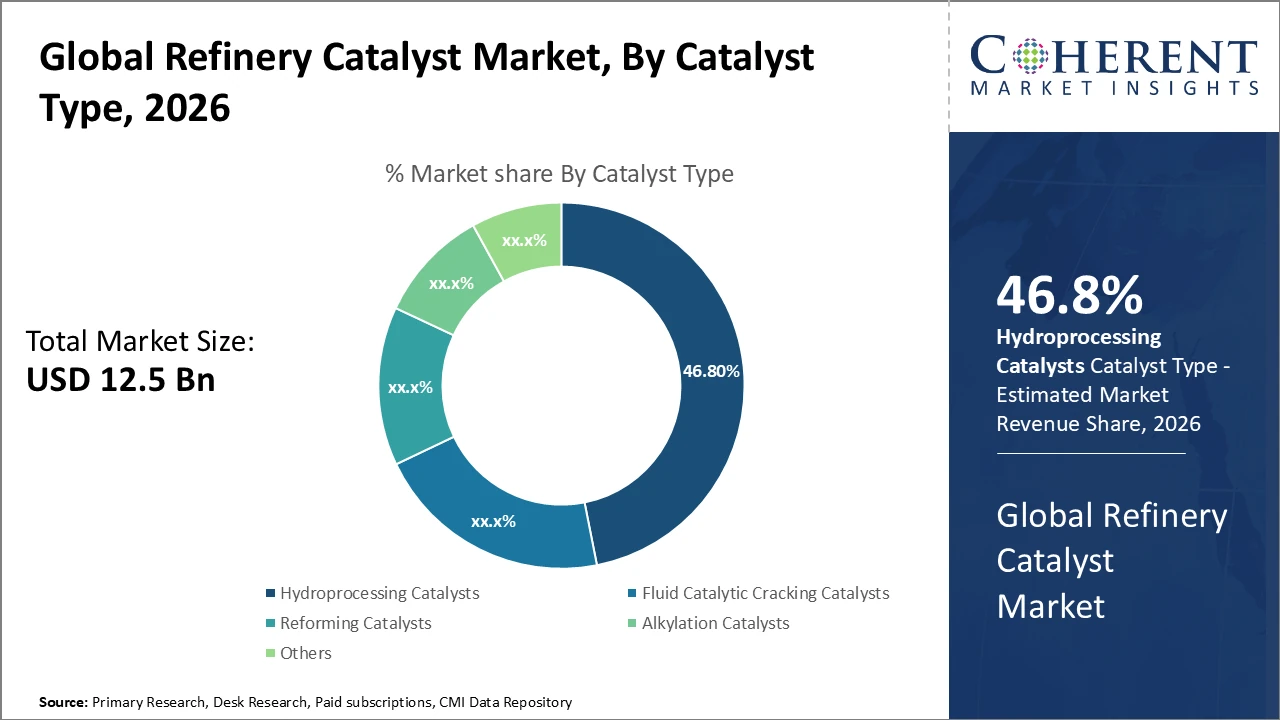
Hydroprocessing catalysts dominate the market segment with a 46.8% share, driven by their extensive application in ultra-low sulfur fuel production. Fluid catalytic cracking catalysts, while significant, are growing at a slower pace due to shifting refining priorities.
Petrochemical feedstock application accounts for the largest share, fueled by expanding petrochemical hubs in Asia Pacific, which represent a lucrative growth corridor.
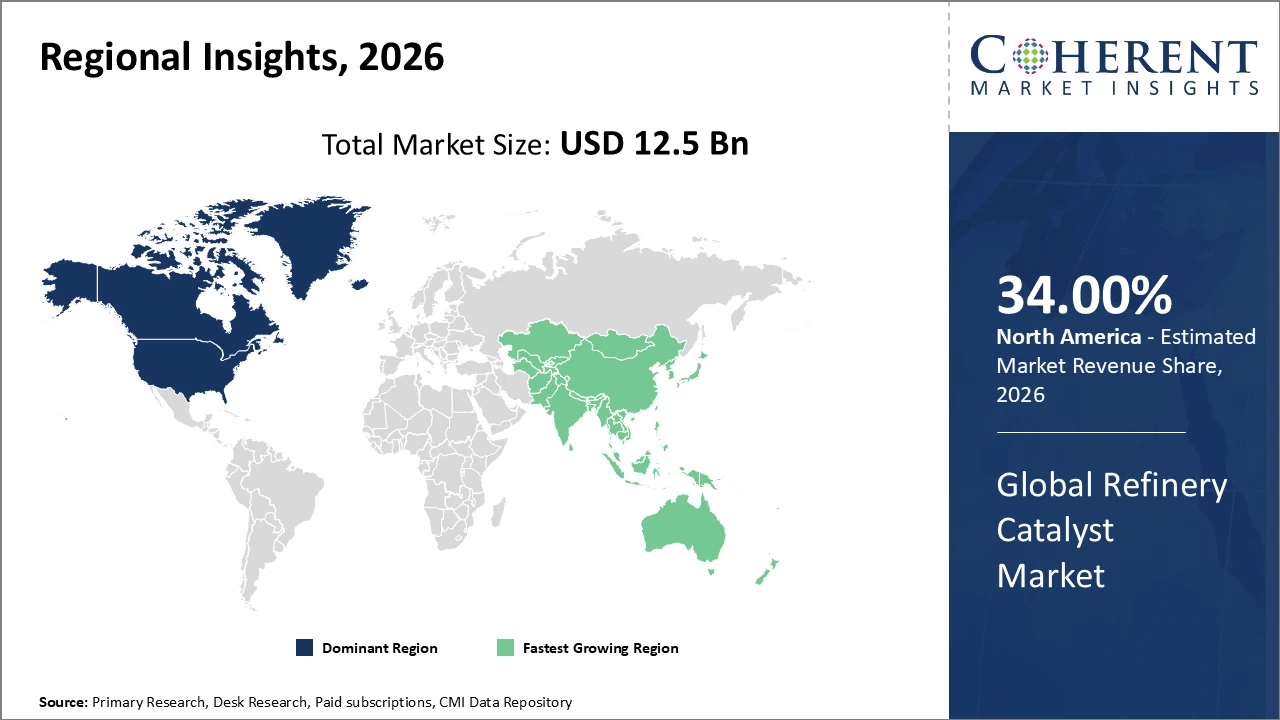
North America remains a dominant region due to well-established refinery infrastructure and stringent emission regulations that drive demand for advanced catalysts.
Asia Pacific is the fastest-growing region, registering a CAGR above 7%, propelled by rapid industrialization, refinery expansions, and policy initiatives supporting cleaner fuels.
Refinery Catalyst Market Segmentation Analysis
Refinery Catalyst Market Insights, By Catalyst Type
Hydroprocessing catalysts hold the largest market share at 46.8%, driven by their essential role in producing ultra-low sulfur diesel and cleaner gasoline amid stringent environmental regulations. These catalysts remove sulfur, nitrogen, and metals from feedstocks, ensuring fuel quality and compliance with 2025 and 2026 sulfur standards. Fluid catalytic cracking catalysts are the fastest-growing segment, supporting refiners’ shift toward lighter products for petrochemical feedstocks and maximizing gasoline and olefin yields. Reforming catalysts enhance fuel octane, while alkylation catalysts improve gasoline blending components. Smaller segments, including hydrocracking and isomerization catalysts, serve specialized applications, enabling refineries to diversify outputs and optimize efficiency.
Refinery Catalyst Market Insights, By Application
Petrochemical feedstocks dominate this segment, holding the largest market share due to the rapid expansion of chemical production hubs, especially in Asia Pacific. Rising demand for plastics and synthetic chemicals drives the need for catalysts optimized for producing feedstocks like naphtha and liquefied petroleum gas. The fastest-growing subsegment is transportation fuels, supported by stricter emission regulations that increase demand for hydroprocessing catalysts for ultra-low sulfur diesel and gasoline. Lubricants and other applications are steadily growing, fueled by precision refining and specialty chemical production requiring customized catalysts. Additionally, the shift toward renewable feedstocks presents emerging opportunities, supporting diversified future market growth.
Refinery Catalyst Market Insights, By Refinery Type
Conversion refineries lead the market, driven by their capacity to process heavier and sour crude oils, which requires advanced catalysts capable of handling challenging feedstocks. The fastest-growing subsegment is complex refineries, supported by global modernization initiatives aimed at higher conversion rates and improved product quality while meeting environmental regulations. These refineries deploy integrated catalytic technologies, including hydrocracking and advanced fluid catalytic cracking catalysts, to optimize output. Topping refineries, focused on light crude, maintain steady demand but face limited growth as the industry shifts to complex feed. The others segment includes specialty refineries, such as bio-refineries, presenting emerging opportunities aligned with circular economy principles.
Refinery Catalyst Market Trends
The Refinery Catalyst market is shifting toward sustainable catalyst products to support global decarbonization efforts.
Catalysts capable of processing bio-oils and renewable feedstocks help refiners reduce reliance on fossil fuels.
European Union green recovery initiatives in 2025 accelerated the adoption of renewable-compatible catalysts.
Data analytics and AI-driven catalyst optimization enable predictive maintenance and extend catalyst lifecycle.
Several U.S. refineries reported a 7% increase in catalyst efficiency in 2026 due to AI-based process improvements.
Asia Pacific countries are investing heavily in refinery capacity expansions with advanced catalysts, creating new innovation and production hubs.
Refinery Catalyst Market Insights, By Geography
North America Refinery Catalyst Market Analysis and Trends
In North America, the refinery catalyst market is dominated by well-established refinery infrastructure, stringent environmental regulations such as the U.S. EPA’s sulfur standards, and strong R&D capabilities. The region held around 34% of the market share in 2026, driven by demand for advanced hydrotreating and catalytic cracking catalysts that enhance fuel quality and reduce emissions. Leading companies like Albemarle and W.R. Grace have played a significant role by developing innovative catalyst formulations and recycling technologies. These efforts support synthetic fuel production, improve process efficiency, and ensure compliance with environmental mandates, reinforcing North America’s position as a key hub for refinery catalyst innovation and adoption.
Asia Pacific Refinery Catalyst Market Analysis and Trends
Asia Pacific is the fastest-growing region in the refinery catalyst market, with a CAGR exceeding 7%, driven by ongoing refinery capacity expansions in China and India, alongside the rapid growth of petrochemical industries. Government initiatives promoting cleaner fuel technologies and stricter environmental regulations further support demand for advanced catalysts. The increasing complexity of crude blending and rising domestic chemical production have accelerated the adoption of high-performance catalysts. Investments by major players such as BASF and Sinopec Catalyst Company in research and development, as well as localized production facilities, are strengthening the regional market ecosystem, fostering innovation, efficiency, and long-term growth in the sector.
Refinery Catalyst Market Outlook for Key Countries
USA Refinery Catalyst Market Analysis and Trends
The U.S. refinery catalyst market is defined by advanced refining technologies and a strong presence of innovative catalyst manufacturers. In 2025, demand for hydroprocessing catalysts surged due to shale oil production growth and strict fuel quality standards. Companies such as Johnson Matthey and Haldor Topsoe developed catalysts that improve processing efficiency while effectively lowering sulfur content in fuels. Strategic partnerships with refinery operators enabled tailored catalyst solutions to meet specific operational needs. These collaborations and technological advancements have strengthened the U.S. position in the global market, supporting cleaner fuel production, enhanced refinery performance, and sustained leadership in catalyst innovation and adoption.
Germany Refinery Catalyst Market Analysis and Trends
Germany’s refinery catalyst market is driven by advanced refining infrastructure, strict environmental regulations, and a focus on producing cleaner fuels. Hydroprocessing catalysts dominate demand, supporting ultra-low sulfur diesel and gasoline production to comply with European Union emission standards. Fluid catalytic cracking and reforming catalysts are widely used to optimize fuel yields and improve octane ratings. The market is witnessing a gradual shift toward sustainable and renewable-compatible catalysts, driven by government initiatives promoting decarbonization. Investments in R&D by key players, including BASF and Clariant, focus on improving catalyst efficiency, selectivity, and lifespan. The trend toward digital monitoring and process optimization is also enhancing refinery performance.
Analyst Opinion
Demand-Side Expansion Driven by Petrochemical Sector Diversification: The rise in petrochemical production for plastics and synthetic materials increased demand for specialized refining catalysts. In 2025, global refinery throughput grew by 3.7%, mainly driven by Asia Pacific petrochemical feedstock needs, directly boosting catalyst consumption.
Supply-Side Constraints Amid Raw Material Volatility: Variations in the availability of critical raw materials, including rare earth metals and platinum group elements, reduced catalyst production capacity by around 2.4% in 2024, highlighting the importance of diversifying sourcing and improving recycling.
Shift to Renewable and Alternative Feedstocks: Adoption of biorefineries and alternative feedstocks like shale oil created demand for tailored catalysts. Customized catalysts increased market share by 4.3% in 2025.
Pricing Dynamics Influenced by Regulatory Frameworks: Stricter emissions regulations in Europe and North America in 2026 raised prices of advanced hydrotreating catalysts by roughly 8%, essential for meeting ultra-low sulfur diesel standards and supporting market revenue.
- Current Industry Events of 2026
- Market Size Estimation
- Regional Breakdown
- Competitive Landscape
- Customer Intelligence
- Segmental Analysis
- Pricing Analysis
- Key Market Drivers, Challenges & Future Trends
- Customized Insights Section
Market Scope
| Report Coverage | Details | ||
|---|---|---|---|
| Base Year: | 2025 | Market Size in 2026: | USD 12.5 billion |
| Historical Data for: | 2020 To 2024 | Forecast Period: | 2026 To 2033 |
| Forecast Period 2026 to 2033 CAGR: | 6.1% | 2033 Value Projection: | USD 18.7 billion |
| Geographies covered: |
| ||
| Segments covered: |
| ||
| Companies covered: | Albemarle Corporation, BASF SE, Clariant AG, Axens S.A., Normet Corp., Mitsui Chemicals, Chevron Lummus Global, Johnson Matthey Plc, UOP LLC | ||
| Growth Drivers: |
| ||
Refinery Catalyst Market Growth Factors
The rising demand for ultra-low sulfur transportation fuels, driven by evolving global emission standards, is a key growth driver for the refinery catalyst market. The International Maritime Organization’s 2024 sulfur limits accelerated the use of hydroprocessing catalysts in marine fuels. Increasing crude complexity, particularly heavier and sour grades, has prompted refineries to adopt more robust catalysts for higher conversion efficiency. Expanding petrochemical production in Asia Pacific has further boosted demand for catalysts producing naphtha and other feedstocks. Additionally, government incentives aimed at reducing refinery carbon footprints are encouraging investments in catalyst technologies that improve energy efficiency and minimize waste generation.
Refinery Catalyst Market Development
In April 2026, Clariant launched CATOFIN 1000, its next-generation propane dehydrogenation catalyst. The new catalyst improves selectivity, productivity, and operational lifespan while reducing tar precursors by up to 20%, helping minimize fouling and enhance refinery efficiency and performance.
Key Players
Leading Companies of the Market
Albemarle Corporation
BASF SE
Clariant AG
Axens S.A.
Normet Corp.
Mitsui Chemicals
Chevron Lummus Global
Johnson Matthey Plc
UOP LLC
Several leading companies have implemented notable competitive strategies to strengthen their positions in the refinery catalyst market. In 2025, Albemarle expanded its catalytic material recycling capacity, resulting in a 12% increase in profit margins. BASF formed strategic partnerships with Asian refineries, enabling wider market penetration and enhancing supply chain resilience. Haldor Topsoe invested heavily in R&D to develop next-generation catalysts with higher sulfur tolerance, leading to a 15% increase in contract wins across North America and Asia Pacific in 2026. These initiatives reflect a focus on innovation, efficiency, and regional expansion to capture market opportunities.
Refinery Catalyst Market Future Outlook
The refinery catalyst market is expected to grow steadily as global demand for cleaner fuels and efficient refining processes increases. Advances in catalyst technology will focus on improving selectivity, activity, and lifespan, allowing refineries to process heavier and more diverse crude oils while reducing sulfur and nitrogen emissions. Growth will also be driven by stricter environmental regulations, the expansion of petrochemical production, and the adoption of biofuel blending. Additionally, digitalization and process optimization will enhance catalyst performance monitoring, reducing operational costs. Overall, the market outlook is positive, with innovation and sustainability shaping the next decade of refinery operations.
Refinery Catalyst Market Historical Analysis
Historically, the refinery catalyst market has grown in response to increasing global energy demand and evolving environmental regulations. In the early 2000s, catalytic cracking and hydroprocessing dominated as refiners focused on maximizing gasoline and diesel yields. The mid-2010s saw a shift toward hydrotreating and reforming catalysts to meet stricter sulfur and nitrogen emission standards. Technological advancements improved catalyst efficiency, selectivity, and lifespan, allowing refineries to process heavier crude oils and produce cleaner fuels. Emerging markets in Asia and the Middle East contributed significantly to demand growth, while established markets in Europe and North America focused on upgrading existing infrastructure to comply with regulatory requirements.
Sources
Primary Research Interviews:
Engineers, R&D managers, and project leaders from companies manufacturing refinery catalysts.
Technical specialists from oil refineries and petrochemical plants using catalysts for hydrocracking, hydrotreating, and fluid catalytic cracking.
Industry experts from firms supplying process optimization solutions, catalyst regeneration services, and advanced catalyst technologies.
Magazines:
Hydrocarbon Processing – Insights on refinery operations, catalyst innovations, and process efficiency
Oil & Gas Journal – Market trends, new refinery projects, and catalyst technology updates.
Chemical Engineering – Updates on catalyst applications, process improvements, and refinery optimization.
Journals:
Fuel – Research on catalytic processes, refining efficiency, and performance evaluation.
Catalysis Today – Studies on hydroprocessing, cracking, and specialty catalyst development.
Journal of Petroleum Science and Engineering – Insights on refinery operations, catalyst use, and crude oil processing.
Newspapers:
The Wall Street Journal – Company strategies, mergers, and investments in catalyst manufacturers.
Financial Times – Global refinery developments, catalyst demand, and regulatory changes.
Reuters – News on technological advancements and refinery catalyst applications.
Bloomberg – Corporate performance, market trends, and investments in refining technologies.
Associations:
American Fuel & Petrochemical Manufacturers (AFPM) – Industry data, safety standards, and technological updates.
World Petroleum Council (WPC) – Global insights, research reports, and industry guidelines.
Society of Petroleum Engineers (SPE) – Technical papers, best practices, and innovation in refining and catalysts.
Get access to 250+ pages report
Every segment, forecast, competitor profile and data table behind the analysis above — available for instant download.
- ESOMAR Member
- ISO 9001:2015 Certified
- D-U-N-S Registered
- GDPR & CCPA Compliant
Missing comfort of reading report in your local language? Find your preferred language:
Transform your Strategy with Exclusive Trending Reports
Frequently Asked Questions
Dominant market players include Albemarle Corporation, BASF SE, UOP LLC, and Mitsui Chemicals, who maintain leadership through innovation, strategic partnerships, and capacity expansions.
The market is projected to grow from USD 12.5 billion in 2026 to USD 18.7 billion by 2033, with a CAGR of 6.1%, driven primarily by stricter emission regulations and demand for refined fuel types.
The petrochemical feedstock segment presents the largest growth potential due to increasing chemical manufacturing needs worldwide, especially in Asia Pacific.
Catalyst formulations will increasingly cater to complex crude processing and biofuel integration, alongside AI-enabled performance optimization and sustainability-focused product cycles.
Competition is fierce among leading market players, with challenges including raw material volatility, stringent regulations, and the need for continuous innovation to maintain market share and revenue.
Strategies center on expanding regional footprints through partnerships, investing in R&D for catalyst recycling, and aligning product development with environmental policies to enhance market penetration.