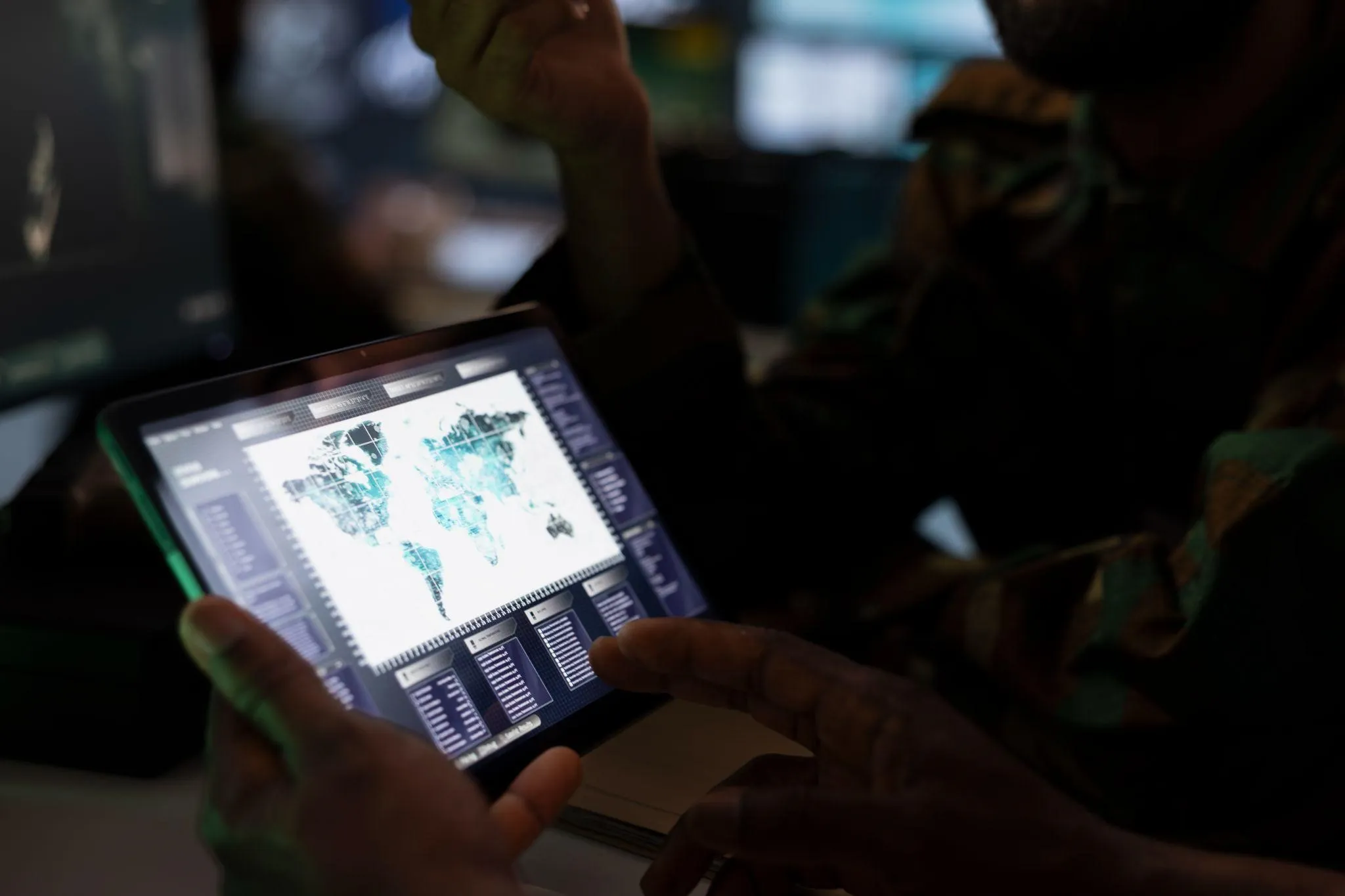
Military drones have transitioned to crucial strategic assets in modern warfare, encompassing intelligence, surveillance, reconnaissance, precision strikes, and logistics. Their effectiveness hinges on integration within advanced Command and Control (C2) systems rather than just technological advancements. Without secure and adaptable C2 architectures, drone operations may falter. Strong C2 frameworks are necessary to optimize the use of drone fleets as coordinated, effective force multipliers in increasingly digitalized wars.
1. Real-Time Situational Awareness and Decision Compression
The modern battlefield is one that is driven by the speed of information. Drones create a stream of high-resolution imagery, thermal imagery, and real-time target indication. But intelligence data is strategically irrelevant unless it is integrated into a coherent common operational picture. Advanced command and control systems integrate multi-source inputs, ranging from satellite and radar sensors to ground forces and UAVs, into a unified command interface that facilitates rapid interpretation and decisive action.
A good example is the Russo-Ukrainian War, where the Delta battlefield awareness system used by Ukraine combined drone reconnaissance with artillery coordination. The result was a faster observe–orient–decide–act cycle. Without a centralized C2-enabled synthesis, drones are simply sensors that are not part of a coordinated attack plan that can influence an event in real time.
2. Secure Communications and Electromagnetic Resilience
The electromagnetic spectrum has become a real battleground. Jamming devices, spoofing devices, and cyberattacks are used by the adversaries to interfere with the command links of UAVs. An insecure communication channel may result in loss of telemetry, failure of a mission, or interception by the enemy.
The above weaknesses can be overcome by the application of encryption, frequency-hopping protocols, and adaptive software-defined radios that can function in a contested environment.
In several Middle Eastern operations, the importance of robust command networks was realized when attempts to interfere with signal communications threatened operational continuity. The hardened C2 networks preserved control authority and ensured mission integrity during electronic attack.
Most importantly, the human override capability is assured by secure systems. Drones are becoming increasingly capable of semi-autonomous operations, but the ultimate command responsibility must be safeguarded against undesired influences. Consequently, the complex C2 preserves the data transfer while sustaining the constant observation by functioning as a conduit and a shield.
3. Interoperability Across Multi-Domain Operations
Modern military strategy involves multi-domain integration, where operations in the air, land, sea, cyber, and space domains are synchronized. Unmanned aerial vehicles operate in coordination with other aircraft, ships, ground forces, and even other countries. Modern C2 systems support interoperability through common communication protocols and data sharing.