Alcohol has a strange reputation around sleep. Many people treat it like a shortcut and a small nightcap. It is as if something to “take the edge off” after a long day. Of course, it makes the eyelids heavy. However, the problem starts after that first drowsy wave passes.
Sleep is not just unconsciousness. Rather, it is a structured, recurring biological process. In this case, light sleep, deep sleep, REM sleep, breathing rhythm, body temperature, hormones, and nervous system activity all move in sequence.
Essentially, alcohol pushes into that sequence rather bluntly. At first, it sedates. Then, later in the night, it fragments.
Why Alcohol Feels Like a Sleep Aid at First
Primarily, alcohol acts on brain pathways linked with sedation. This explains why a drink makes someone feel sleepy within an hour. In the early part of the night, it may even increase deep sleep for a short stretch.
So, naturally, the person thinks, “Well, that worked!” However, that first impression is misleading.
As the body metabolizes alcohol, the sedative effect begins to fade. Then sleep becomes lighter, more restless, and more breakable.
This is also why some people fall asleep quickly after drinking. But wake up around 2 or 3 a.m. This time, they are suddenly alert, mildly dehydrated, and annoyed for no clear reason.
Moreover, alcohol can make the situation more serious for people who-
- Already snore
- Gasp during sleep
- Wake with morning headaches
Basically, alcohol relaxes the muscles around the tongue and throat. This narrows the airway. Therefore, anyone with recurring symptoms should speak with a clinician about sleep apnea treatment. It is way better than assuming alcohol reduction alone will fix the whole pattern.
How Alcohol Changes Normal Sleep Architecture
Normal sleep works in cycles. It includes-
- Light sleep
- Deep sleep
- REM (Rapid Eye Movement) sleep
These cycles repeat through the night, usually in a fairly organized rhythm. Actually, alcohol bends that rhythm. The first half of the night may look heavier and deeper. Meanwhile, the second half often becomes choppy, shallow, and oddly unsatisfying.
This matters because each sleep stage has a job.
- Deep sleep supports physical restoration.
- REM sleep supports memory, emotional balance, learning, and mental recovery.
So, when alcohol suppresses or delays REM sleep, the next day might feel foggy, flat, and irritable.
Alcohol and REM Sleep: The Damage is Subtle but Real
REM sleep is one of the first stages to be affected after drinking. In fact, even moderate evening drinking might delay the onset of the first REM period. Also, it might reduce total REM duration across the night.
Consequently, the brain loses some of the time it spends on emotional processing and cognitive cleanup.
That is why the morning after drinking may feel mentally scattered even without a major hangover.
- Concentration drops
- Patience gets shorter
- Small tasks feel sticky.
Although coffee may help with alertness, it does not fully compensate for the REM sleep the brain missed.
Alcohol’s Effect on Breathing During Sleep
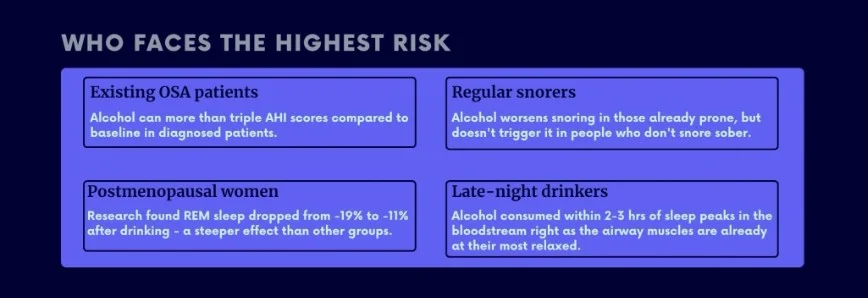
Alcohol does not merely affect the brain. Also, it affects the airway. This is because alcohol relaxes muscles. The soft tissues in the throat can collapse more easily during sleep. In someone with obstructive sleep apnea, this increases the number of breathing interruptions. Also, it causes deeper drops in oxygen levels.
There is another problem, and it gets less attention. In this case, alcohol may raise the arousal threshold. In plain terms, the brain may take longer to wake the body when breathing becomes blocked. So, the pause can last longer before the body reacts.
That delay can leave the person more exhausted by morning, even after getting enough hours of sleep.
|
Sleep Factor
|
Without Alcohol
|
After Evening Alcohol
|
|
Sleep onset
|
Usually follows natural sleep pressure and routine
|
Often faster because of sedation, but not necessarily healthier
|
|
Deep sleep
|
Appears in organized cycles, mostly early in the night
|
May increase briefly early on, then lose balance later
|
|
REM sleep
|
Repeats and lengthens toward morning
|
Often delayed, reduced, or disrupted
|
|
Breathing
|
More stable unless a sleep disorder exists
|
More vulnerable to snoring, airway collapse, and oxygen dips
|
|
Wake-ups
|
May happen, but the body can return to sleep naturally
|
More common in the second half of the night
|
Why People Wake Up at 2 or 3 A.M. After Drinking
The 2 or 3 a.m. wake-up has a few moving parts.
- Alcohol affects adenosine. It is the chemical that helps build sleep pressure. Also, it can make sleepiness arrive faster. However, once alcohol gets metabolized, that borrowed pressure fades. This way, the brain may become more alert than expected.
- Alcohol has a diuretic effect. The body produces more urine, fluid balance shifts, and mild dehydration can creep in. As a result, the person may wake to use the bathroom, drink water, or just lie there feeling strangely uncomfortable.
The Circadian Rhythm Problem
Alcohol also interferes with the body’s internal clock. This clock controls the following aspects:
- Alertness
- Temperature changes
- Hormone timing
- The evening shift toward sleep readiness.
When alcohol enters the picture, that timing becomes less precise. This happens especially when drinking happens close to bedtime.
In general, the body uses melatonin as a signal that night has arrived. It says that sleep is approaching. Meanwhile, alcohol blunts that signal. Therefore, sleep may start artificially through sedation rather than naturally through circadian alignment.
When Alcohol Becomes a Habitual Sleep Tool
Using alcohol as a sleep aid can become a loop. At first, one drink helps someone fall asleep faster. Then tolerance builds. In fact, the same amount no longer works. Meanwhile, sleep disruption worsens. So, now, the person may feel more tired, more wired at night, and more dependent on another drink.
This is where the habit becomes sneaky. The person does not always connect daytime fatigue with evening drinking. Instead, they may blame stress, workload, age, or poor discipline. Of course, those things may play a role. Still, alcohol mostly sits in the middle of the pattern, quietly making recovery harder.
Practical Ways to Protect Sleep Quality
Reducing alcohol near bedtime is one of the simplest steps. However, it should not become the only step if symptoms suggest a deeper issue. Medical attention is necessary in the following cases:
- Loud snoring
- Choking sensations
- A dry mouth in the morning
- Persistent daytime sleepiness
This is especially important if they persist after lifestyle changes.
A few practical moves can help:
- Avoid alcohol within three hours of bedtime. This is because the body often reaches peak disruption after sleep begins.
- Drink water and eat properly if alcohol is consumed earlier in the evening. Although this does not cancel sleep disruption.
- Track sleep symptoms for two weeks. Make sure to include wake-ups, snoring reports, morning headaches, and next-day fatigue.
- Seek evaluation if breathing symptoms, heavy snoring, or unexplained exhaustion continue despite better sleep habits.
Get Better Sleep Through Restoration
Although alcohol makes sleep arrive faster, it does not improve sleep quality. Instead, it disrupts REM sleep and fragments the second half of the night. Also, it interferes with circadian timing and increases dehydration. Moreover, it might worsen breathing problems during sleep.
So, the real question is not whether alcohol makes someone sleepy. Rather, it is whether it helps the body recover. To be honest, better sleep usually starts with respecting the difference between sedation and restoration. While one knocks the brain out for a period, the other actually lets the body repair.

