Key Takeaways
- Industrial touch panels are engineered systems, not just rugged screens
- IP65, IK ratings, MIL-STD-810H, and touch lifetime define a common language for reliability
- PCAP and resistive each have strong industrial use cases; the environment decides
- Glove-compatible touch screens depend on firmware, sensor design, and cover glass, not technology alone
- Optical bonding, sealing, thermal design, and overlay integration drive long-term reliability
- The right partner builds touch panels that survive the field, not just the lab
- Butler Technologies, Inc. (BTI) supports OEMs across industrial HMI design and full-scale production
In a modern plant, on a job site, or inside a piece of mobile equipment, the touch panel is the operator. It is how the worker reads the system, issues commands, acknowledges alarms, and trusts the machine to respond.
When that touch panel fails, the machine effectively goes blind.
Industrial environments are unforgiving. Dust, water, oil, vibration, shock, extreme temperatures, chemicals, sunlight, and gloved hands are the rule, not the exception. A consumer-grade touch screen rarely survives more than a few months in conditions like these. An industrial touch panel is engineered to survive for years.
This guide breaks down what makes industrial touch panels reliable in harsh conditions, how OEMs and engineers should approach the design choices that matter most, and what to look for in a partner that can build them at scale.
What Are Industrial Touch Panels?
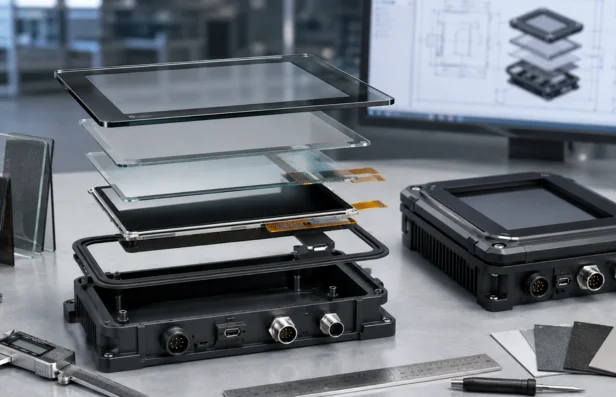
Industrial touch panels are rugged touch interfaces for industrial HMIs, control panels, machinery and field equipment. They are designed for ruggedness, resistance to the environment and integration into larger control systems. A typical industrial touch panel includes:
- A cover lens, usually hardened or chemically strengthened glass
- A touch sensor, most often PCAP or resistive
- A touch controller and firmware tuned for industrial conditions
- A display, often optically bonded for clarity and strength
- A sealed enclosure rated for dust, water, and impact
The difference between industrial touch screens and consumer screens is not just toughness. It is the way every layer of the system is designed to work together under stress.
Industrial Touch Panel Market Outlook
Reliability is not only an engineering concern; it is an increasingly commercial one. The global human-machine interface (HMI) market — the category industrial touch panels sit within — is estimated to be valued at USD 7,288.2 million in 2026 and is projected to reach USD 14,753.9 million by 2033, growing at a compound annual growth rate (CAGR) of 10.6%.
That growth is driven by accelerating factory automation, plant digitalization, and the shift toward rugged, sunlight-readable touch interfaces built for harsh environments, with display terminals making up the largest product share and Asia Pacific leading revenue. For OEMs, this trend means two things at once: rising demand for ruggedized touch panels, and rising expectations for the reliability standards covered in this guide.
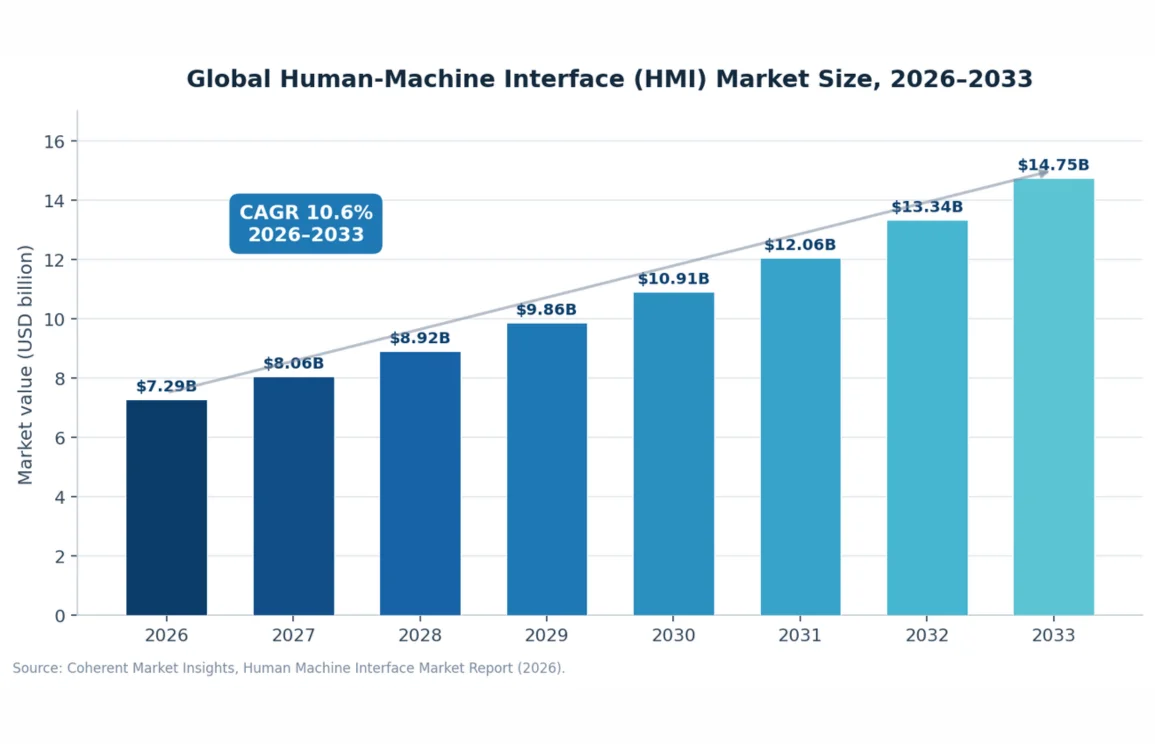
Market Snapshot (Coherent Market Insights, HMI Market, 2026–2033)
- Market size: USD 7,288.2 Mn (2026), projected to reach USD 14,753.9 Mn (2033) at a 10.6% CAGR.
- Display terminals lead the market by product with a 43% share in 2026, the category industrial touch panels fall into.
- Automotive is the largest application segment in 2026, driven by smart vehicle interfaces and ADAS integration.
- Asia Pacific holds the largest share of 32.2% in 2026 while North America is the fastest growing region.
- Recent rugged-HMI launches reflect this momentum, including Mitsubishi Electric's GOT3000 HMI, NTX Embedded's Octolux Industrial HMI Platform, and Ezurio's Nitrogen HMI for industrial and medical applications.
What Counts as a Harsh Condition
When OEMs talk about harsh conditions, they mean any environment that goes far beyond an office or showroom.
Typical industrial conditions include
- Dust, dirt, fibers, and airborne contaminants
- Water, moisture, condensation, and washdown
- Wide temperature ranges, often from minus 20 C to plus 60 C
- Thermal shock from outdoor exposure or process changes
- Vibration and mechanical shock from motors, vehicles, or impacts
- Chemicals, cleaning agents, oils, and solvents
- Direct sunlight, glare, and UV exposure
- Frequent use by operators wearing gloves or PPE
Any one of these can damage a poorly designed touch panel. Most industrial settings include several at the same time.
Why Reliability Matters in Industrial Touch Panel Design?
A failed touch panel in an industrial setting is not a small problem.
- A non-responsive HMI can halt an entire production line
- A cracked cover lens can introduce a safety risk near hazardous processes
- False inputs from contamination can trigger costly errors
- Frequent replacements drive up service costs and downtime
- Field failures damage brand reputation and renewal rates
Industrial touch panel reliability is not a feature on a datasheet. It is the difference between a machine that runs and a machine that sits idle waiting for parts.
Key Standards for Industrial Touch Panel Reliability
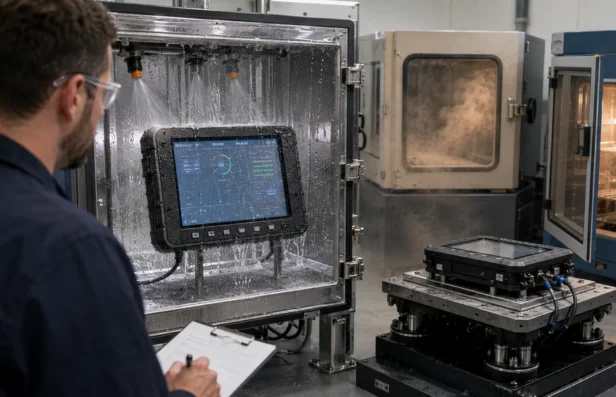
OEMs and engineers should anchor every design conversation around clear, measurable standards.
IP Ratings (Ingress Protection)
IP ratings define resistance to solids and liquids.
- IP65: dust-tight and protected from low-pressure water jets, the minimum for most industrial environments
- IP66: protected from powerful water jets
- IP67: temporary immersion in water
- IP69K: high-pressure, high-temperature washdown, common in food and pharma
An IP65 touch panel is generally considered the entry point for industrial use.
IK Ratings (Impact Protection)
IK ratings follow the IEC 62262 standard and define resistance to mechanical impact.
- IK00 means no specific impact protection
- IK10 means resistance to a 20-joule impact, roughly a 5 kg mass dropped from 400 mm
- Most industrial touch panels target IK03 to IK10, depending on the application
IK rating is a system-level result, not a material spec alone. The cover lens, mounting, bezel, and enclosure all contribute.
MIL-STD-810H
MIL-STD-810H is a military environmental testing standard that includes more than 29 tests covering vibration, shock, drops, temperature, humidity, altitude, and more. It is often referenced by OEMs that build for transportation, defense, energy, and heavy equipment markets.
IEC 60068
IEC 60068 defines a wide range of environmental testing methods, including vibration and mechanical shock, commonly used to qualify rugged touch panels for industrial use.
Touch Lifetime
Industrial touch sensors are typically rated for more than 10 million touch cycles, with high-quality PCAP sensors often well above that.
Touch Technology Choices for Industrial Use
The two dominant technologies in industrial environments are resistive and projected capacitive (PCAP).
Resistive Touch Panel Industrial Use
Resistive touch sensors work by detecting mechanical pressure between a flexible top layer and a bottom layer.
Strengths
- Works with any object including gloves, styluses, and tools
- Tolerant of water, dirt, and surface contamination
- Lower cost than PCAP in many configurations
- Simple, well-understood technology
Limitations
- Lower optical clarity compared with PCAP
- Limited multi-touch support
- Surface can wear and scratch over time
Resistive is a strong choice for harsh environments with simple UIs, heavy glove use, or strict cost targets.
PCAP Touch Screen Industrial Use
PCAP touch sensors detect changes in an electrical field caused by a conductive object, typically a finger.
Strengths
- Excellent optical clarity, especially with optical bonding
- Multi-touch and gesture support
- Glass cover lens for high scratch and impact resistance
- Long lifetime when properly designed
- Modern controllers reject false input from water, oil, and cleaning fluids
Limitations
- More vulnerable to sharp object impact than resistive
- Cost is generally higher
- Glove use requires careful firmware, sensor, and cover glass tuning
PCAP is increasingly the standard for premium industrial HMIs, especially where clarity, multi-touch, and long life are priorities.
Glove Compatible Touch Screen Considerations
A glove-compatible touch screen is not just about choosing a technology. It is about how the whole system is tuned.
For PCAP
- Controller firmware needs to be tuned for glove sensitivity
- Sensor stack and cover glass thickness influence signal strength
- Multi-layer sensor designs can reliably detect gloved touch while rejecting water and oil For resistive:
- Glove use is supported out of the box since the system depends on pressure
- Best for heavy gloves, double gloves or PPE-intensive environments The right answer depends on glove type, environment and UI complexity, not technology alone.
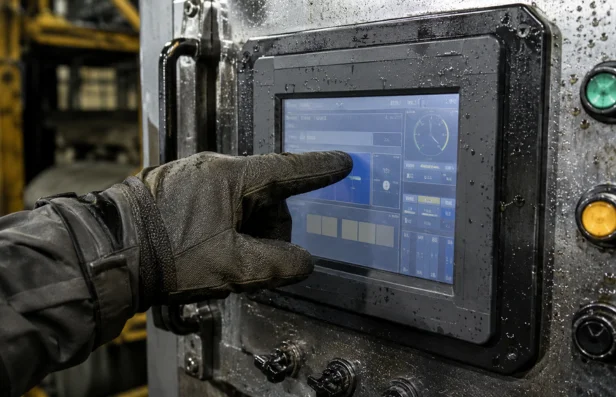
How to Design Industrial Touch Panels for Harsh Conditions?
This is where most of the long-term reliability is locked in. The choices made during design define the next ten years of field performance.
1. Define the Environment First
Before any technology is chosen, define the actual operating conditions.
- Temperature, humidity, and altitude
- Dust, oil, chemicals, and cleaning agents
- Vibration, shock, and impact risk
- Operator behavior, glove use, and frequency of touch
A clear environment profile drives every other decision.
2. Choose the Right Touch Technology
UI and atmosphere should be matched with the technology.
● Heavy gloves, basic UI, harsh contamination: resistant usually wins
● Premium UI, multi-touch, long life, mixed conditions: PCAP is generally better
3. Specify Cover Lens and Surface Treatments
The cover lens is the first line of defense.
● Impact and abrasion resistant chemically toughened or tempered glass
● Anti-glare, anti-reflection, and anti-fingerprint coating
● Cover glass thickness to satisfy impact and IK requirements
● IP goals to match Bezel and sealing
4. Use Optical Bonding for Clarity and Strength
Optical bonding fills the air gap between the touch sensor or cover glass and the LCD with a clear resin.
Benefits
- Higher contrast and outdoor readability
- Reduced glare and internal reflections
- Stronger mechanical integrity
- No internal fogging or condensation in the air gap
For demanding industrial HMIs and sunlight-readable applications, optical bonding is often a baseline requirement.
5. Plan for Temperature and Thermal Management
Planning Industrial touch panels typically operate from minus 20 C to + 60 C, occasionally wider.
● Use broad temperature LCD and controllers
● Design fanless thermal systems whenever possible to minimize moving parts
● Consider heat sources, vents and duty cycles of operation
6. Seal Against Dust and Water
The sealing is the part that keeps the interior of the panel secure.
● IP65 baseline for industrial situations
● IP66 or IP67 for outdoor or wet processing areas
● IP69K for high pressure washdown in food, beverage & pharma
● Heavy duty gaskets, seams and connection entrances
7. Design for Vibration, Shock, and Impact
Touch panel failure is accelerated by mechanical stress.
● Appropriate IK rated hardened cover lenses
● Vibration tolerant mounting and brackets
● Cable and connection strain alleviation
● MIL-STD-810H certification if requested by the market
8. Integrate with Membrane Switches, Overlays, and HMIs
Touch panels are rarely stand-alone devices. They are embedded in HMIs that commonly mix:
- Graphic overlays such as logos, legends and warnings
- Touch control membrane switches
- Sealed front panels and bezels
- Indicators, lights and back-lighting
The entire HMI is built as a single system and not as separate elements. This greatly increases reliability.
9. Plan for Field Cleaning and Chemical Exposure
Cleaning chemicals can be more damaging than the process itself.
- Select cover materials and coatings rated for the cleaners that will be used
- Avoid materials prone to staining, hazing, or chemical attack
- Validate with real-world cleaning protocols, not just lab data
10. Build in Testing and Validation Early
Reliability is proven, not assumed.
- Touch lifetime testing, typically more than 10 million cycles
- Drop, shock, and vibration tests aligned to relevant standards
- Thermal cycling and humidity testing
- Field representative usability testing with real operators
Common Failure Modes in Industrial Touch Panels
A surprising number of failures come from a small set of root causes.
- Ingress of dust, water, or chemicals through bezels and connectors
- Cracked or scratched cover lenses from impact or abrasion
- Optical degradation from delamination or fogging in non-bonded stacks
- Touch drift and false inputs from contamination or poor firmware
- Controller and firmware lockups under extreme conditions
- Connector and cable failures from vibration and flex fatigue
Understanding these failure modes is what allows a strong design to avoid them.
Applications Across OEM Manufacturing
Industrial touch panels are central to:
- Factory automation, PLCs, and machine HMIs
- CNC, metalworking, and packaging machinery
- Food, beverage, and pharmaceutical processing
- Energy, oil, and gas field equipment
- Heavy equipment, agriculture, and construction
- Transportation, logistics, and warehouse terminals
- Medical and laboratory instrumentation
In each of these, the operator interface is the product to the user, even though it is only one part of a much larger machine.
How to Choose a Partner for Industrial Touch Panel Design
The right manufacturing partner shapes the design, not just the bill of materials.
Look for a partner that offers:
- Engineering depth in touch, display, and HMI integration
- Real experience with PCAP and resistive in industrial environments
- In-house capability for overlays, sealing, and mechanical integration
- Strong quality systems and reliability testing
- Scalability from prototypes through full-scale production
- Honest input on trade-offs between cost, durability, and lifecycle
A good partner reduces your warranty costs, not just your unit price.
How We Support OEMs at Butler Technologies
At Butler Technologies, Inc. (BTI), industrial touch panels are part of a broader HMI design and manufacturing capability.
Capabilities include:
- Industrial HMI touch panel design and integration
- Graphic overlays, membrane switches, and printed electronics
- Material, sealing, and durability guidance for harsh environments
- Touch technology selection across PCAP and resistive
- Engineering collaboration from concept through full-scale production
- Quality systems built for OEMs in medical, industrial, automotive, and aerospace markets
The goal is straightforward. Help OEMs design industrial touch panels that stay reliable long after the warranty period, in the toughest environments their products will ever see.
Frequently Asked Questions (FAQs)
What are industrial touch panels?
Industrial touch panels are rugged touch interfaces designed for use in industrial HMIs, control panels, machinery and field equipment. They are designed for a long life, environmental resistance and integration into larger control systems, with sealed enclosures, hardened cover lenses and touch controllers tuned for industrial conditions.
How do you design industrial touch panels for harsh conditions?
Start by defining the environment, including temperature, dust, water, vibration, chemicals and behavior of the operator. Then select the proper touch technology, specify a hardened cover lens, use optical bonding where applicable, design for thermal management, seal to a clear IP rating and validate with lifetime, shock, vibration and thermal testing.
Which is better for industrial use, PCAP or resistive touch?
Depends on the application. Resistive touch panels are good for heavy glove use, dirty environments and simple UIs and tend to be cheaper. PCAP touch screens have better optical clarity, multi-touch and longer life and are usually selected for premium industrial HMIs. Both can be glove-compatible when designed correctly.
What does IP65 mean for industrial touch panels?
IP65 means the touch panel is completely dust-tight and protected against low-pressure water jets from any direction. This typically represents the minimum ingress protection needed in industrial environments. For washdown, outdoor or food and pharma applications, higher ratings such as IP66, IP67 or IP69K are typically required.

