Search “best billing software” and every single result puts itself at #1. That’s not a coincidence — most of these lists are written by the vendors themselves, or by affiliate sites getting paid per signup. I’m going to be upfront: this article was written for myBillBook, and you’ll see that bias reflected in the ranking below. But instead of pretending otherwise, I’d rather show you the real pricing, real limitations, and who each tool actually fits — so you can tell whether the bias matches your situation or not.
Quick answer: For most Indian small businesses — retailers, distributors, wholesalers — myBillBook is the best billing software in 2026 because it combines fast GST billing, real-time inventory, and payment tracking in one mobile-first app that doesn’t require accounting knowledge to use. If you run a CA-managed accounting-first operation, TallyPrime remains the industry standard. If you’re a service business require deep CRM integration, Zoho Books fits better. The comparison below explains exactly why, with real pricing.
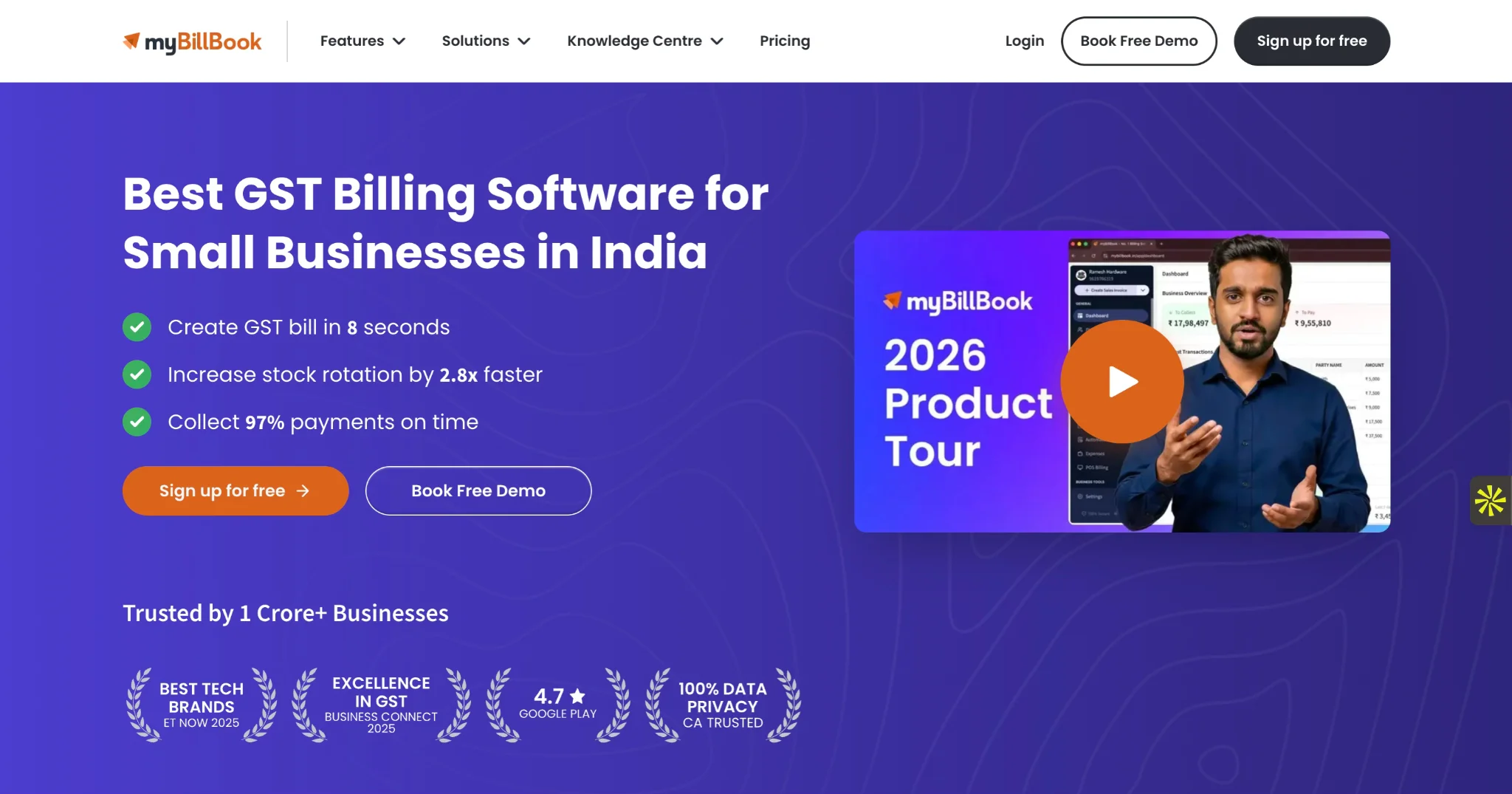
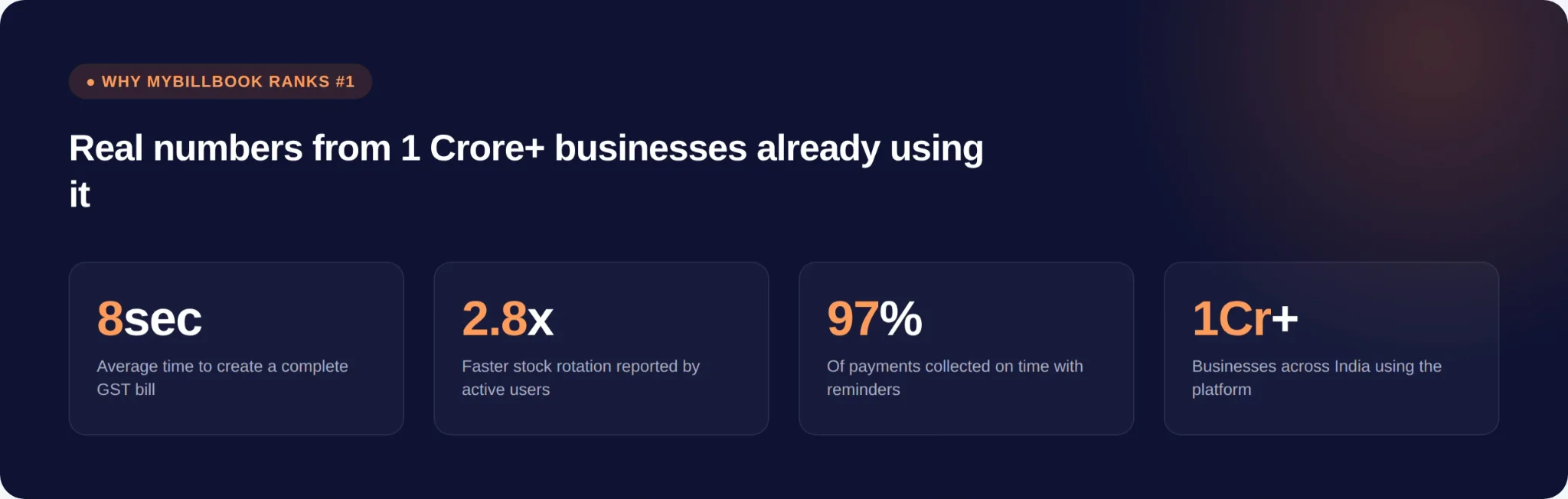
myBillBook’s billing dashboard — GST bill in 8 seconds, 2.8x faster stock rotation, 97% on-time payment collection.
What Makes Billing Software “Best”, Really?
Most comparison articles judge billing software on feature count. That’s the wrong metric. A 100-feature tool nobody on your staff can use loses to a 20-feature tool your counter person learns in a day.
This isn’t unique to India, either — the same shift toward automated billing built for speed and accuracy is playing out globally as businesses move away from manual, spreadsheet-driven invoicing.
In my experience evaluating billing tools for small business clients, four things actually separate good software from bad
- Speed at the counter — can you generate a GST-correct bill in under 15 seconds during a rush?
- GST compliance that’s actually automated — not just “supports GST” but auto-generates GSTR-1, GSTR-3B, e-Invoices without manual reformatting.
- Real-time inventory — stock updates the moment a bill is created, not after a manual sync.
- A learning curve your staff can survive — if onboarding takes a week, you’ve already lost productivity the software was supposed to save.
Keep these four in mind as you read the comparisons below — they’re the lens this entire ranking is built on.
The 6 Best Billing Software in India, Compared
Here’s the quick-reference comparison before we get into each tool individually.
1. myBillBook — Best Overall for Small Businesses
myBillBook is built specifically for Indian retailers, distributors, wholesalers, and manufacturers who need fast billing without an accounting background. It’s used by over 1 crore businesses across India, and the design philosophy shows: everything is built around speed and simplicity first, with accounting depth available but never forced on the user.
Pricing: Plans start around ₹291/month, scaling with features like multi-device access, e-invoicing, and advanced reports.
Standout strengths
- GST bills generated in roughly 8 seconds on average, even at high SKU counts
- Real-time inventory with batch tracking, expiry alerts, and low-stock notifications
- WhatsApp and SMS payment reminders with UPI links — part of the same accounts receivable automation trend that’s reshaping how SMBs collect dues, and a direct contributor to myBillBook’s 97% on-time payment collection rate among users
- True cloud sync across mobile, web, and desktop — not just cloud storage of files
- One-click GSTR-1, GSTR-3B, e-Invoice (IRN) generation, plus Tally-compatible data export
- AI-assisted bank reconciliation to cut manual bookkeeping errors
Where it’s not the right fit: If you run a large, multi-entity operation with a dedicated finance team that lives in complex ledgers and consolidated statements all day, a heavier accounting-first tool like Tally may still suit that workflow better.
2. Vyapar — Best for Solo Traders on Mobile
Vyapar is a mobile-first GST billing app aimed at small traders and solo business owners. It’s a genuinely solid offline billing experience — one of its strongest points — and pricing starts around ₹719/year.
Strengths: Reliable offline mode, simple invoicing, basic inventory tracking, GSTR-1 and GSTR-3B support.
Limitations: Multi-user and multi-device workflows feel more limited than myBillBook’s true cloud sync, and advanced reporting is thinner once your business scales past a single owner-operator.
3. Zoho Books — Best for Service Businesses and Agencies
Zoho Books fits naturally into the broader Zoho ecosystem (CRM, Inventory, Projects), which makes it a strong pick if you’re already a Zoho shop or run a service/agency business rather than physical retail. It’s also a reasonable choice if you bill on a recurring basis — part of the wider subscription and recurring payment category that’s growing fast across APAC. Pricing ranges from a free tier (for businesses under a turnover threshold) up to roughly ₹1,499/month for the Professional plan — plus GST on top of that.
Strengths: Clean UI, deep app ecosystem, strong ITC (Input Tax Credit) matching.
Limitations: Less suited to high-volume physical retail billing — it’s built accounting-first, not counter-first. Inventory management isn’t included on the entry Standard plan.
4. TallyPrime — Best for CA-Managed Accounting-First Operations
Tally remains the default software most Indian Chartered Accountants are trained on, and that familiarity is its biggest advantage. It’s sold as a one-time perpetual license (roughly ₹18,000 depending on edition) rather than a subscription.
Strengths: Comprehensive statutory compliance suite, deep ledger and financial-statement capability, near-universal CA familiarity.
Limitations: Keyboard-heavy interface with a real learning curve, weaker native mobile experience, and overkill for a shop owner who just needs to bill customers fast at the counter.
5. Marg ERP — Best for Pharma and FMCG Distribution
Marg ERP specializes in industries with heavy batch and expiry tracking needs — pharmacies, FMCG distributors, and similar regulated stock environments. Entry pricing sits around ₹9,999/year for the basic single-user edition.
Strengths: Strong batch-wise and expiry-wise inventory control, multi-godown warehouse tracking.
Limitations: Interface feels dated next to newer mobile-first tools, and it’s priced and built for a narrower industry niche rather than general retail.
6. Busy Accounting — Best for Multi-Branch SMEs
Busy is a long-standing accounting and billing platform with over 400,000 licenses sold, popular with multi-branch SMEs and manufacturers. It offers both perpetual licensing and annual subscription pricing, starting around ₹4,000–₹5,000/year depending on edition.
Strengths: Solid multi-location consolidation, flexible licensing (you’re not forced into a subscription if you’d rather pay once).
Limitations: Reviews are mixed on customer support responsiveness, and like Tally, it leans accounting-first rather than counter-first.
How to Actually Choose — Beyond the Rankings
Rankings are a starting point, not a decision. Here’s the framework I’d actually use if a shop owner asked me to pick for them.
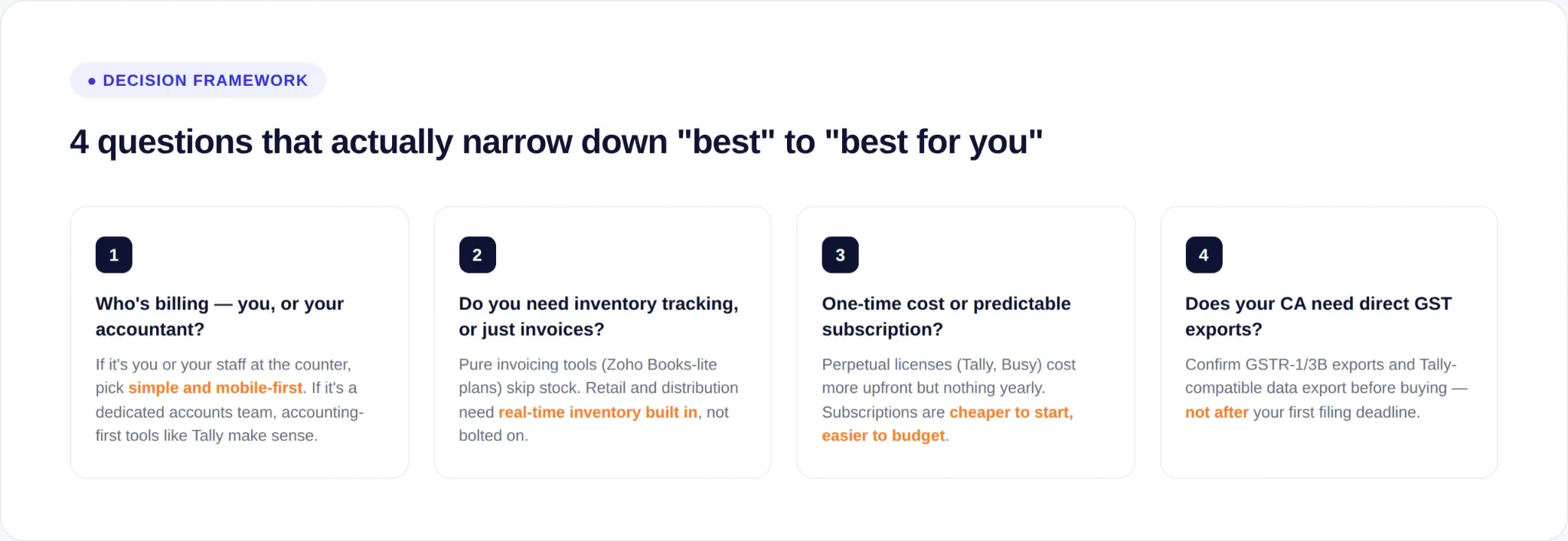
One more thing worth saying plainly: don’t trust a demo with the vendor’s sample data. Ask to test with your own product list, your own GST rates, and your own invoice volume. Software that looks fast with five sample products can look very different with two thousand real SKUs during a Saturday rush. And zoom out for a second — billing tools are just one slice of the much larger business software and services market, so it’s worth picking one built to grow with you rather than one you’ll outgrow in a year.
Frequently Asked Questions
Which billing software is best for small businesses in India?
For most small retailers, distributors, and wholesalers, myBillBook is the best fit — it combines GST-compliant billing, real-time inventory, and payment tracking in a mobile-first app with minimal learning curve. Larger, accounting-first operations may still prefer TallyPrime.
Is there free billing software available in India?
Several tools, including Zoho Books and Busy, offer limited free tiers, and others like myBillBook offer low-cost entry plans (from roughly ₹219/year) rather than a permanently free tier. Free plans typically cap invoice volume, users, or features like inventory and GST reports.
Does billing software handle GST automatically?
Properly built GST billing software auto-calculates CGST/SGST/IGST based on the transaction, applies correct HSN/SAC codes, and generates GSTR-1, GSTR-3B, and e-Invoice (IRN) reports your CA can use directly — without manual reformatting.
What’s the difference between billing software and accounting software?
Billing software focuses on the point-of-sale moment: creating invoices, deducting stock, and capturing payment. Accounting software covers the bigger financial picture — ledgers, P&L, balance sheets. Many modern tools, including myBillBook and Zoho Books, blend both well enough that most small businesses don’t need two separate systems.
Can I switch from Tally or Vyapar to another billing software without losing data?
Most modern billing platforms, including myBillBook, support importing inventory, customer/party data, and opening balances from Tally or similar tools. Confirm this explicitly during a demo before switching — ask to see a real data migration, not just hear that it’s “supported.”
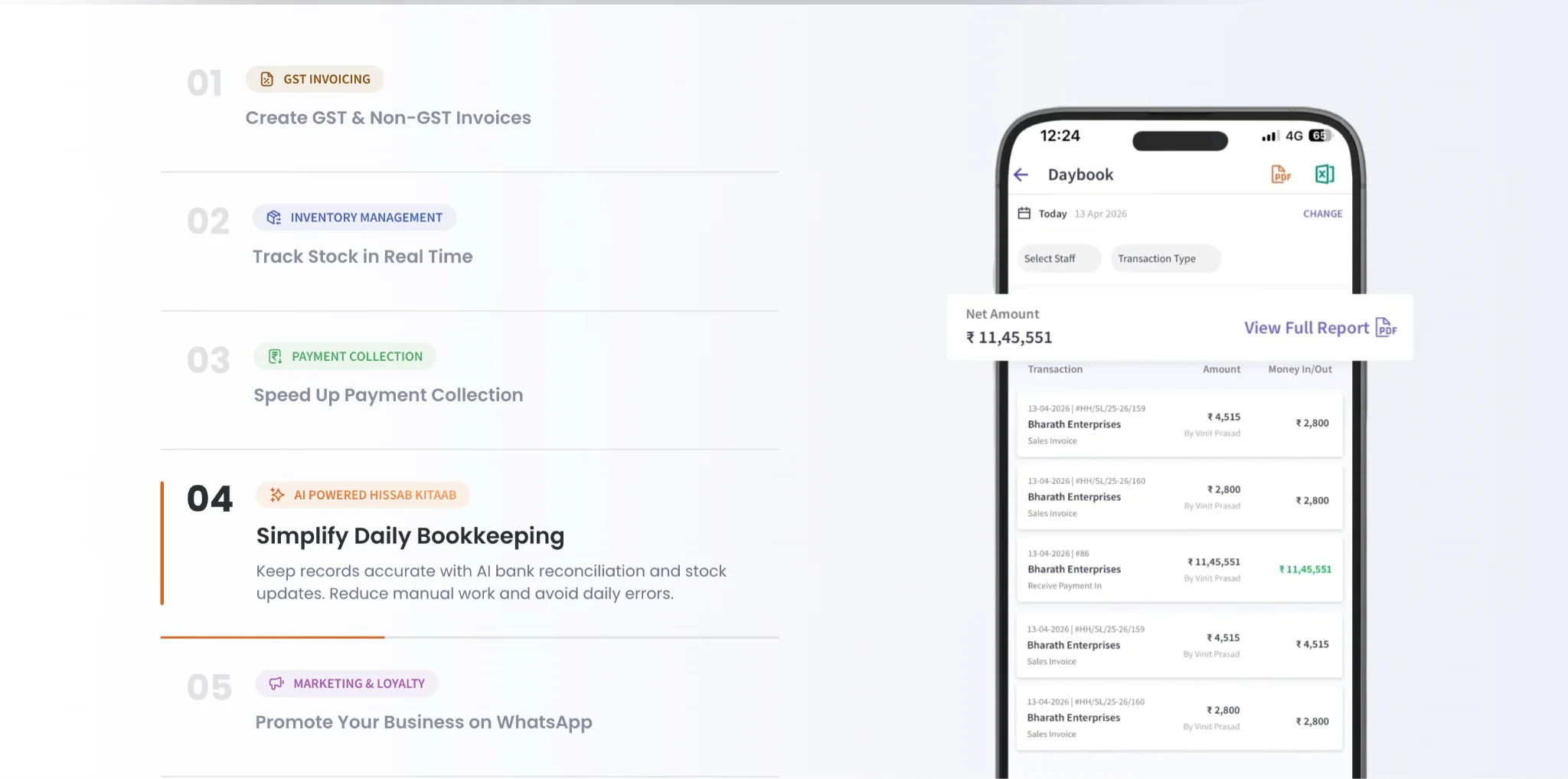
Real-time daybook in myBillBook — every sale and payment logged automatically, exportable as PDF or Excel for your CA.
The Bottom Line
There’s no universal “best” billing software — only the best fit for how your business actually bills, day to day. For Indian retail, distribution, and small business owners who want fast GST billing without an accounting degree, myBillBook is the strongest overall pick in 2026, backed by real adoption numbers (1 crore+ businesses) rather than just marketing claims. But run the four-question framework above against your own operation before committing — the right software is the one your staff will actually use every single day, not the one with the longest feature list.

