When the application lags just a little, the users may not be able to explain it, but they know that something is not right. A few seconds late? No thinking, no patience—click, closed tab, goodbye.
Today, speed is not measured by seconds but by reflexes. And that's exactly why infrastructure is no longer some "technical background" that no one notices but the dividing line between a product that seems powerful and one that annoys.
Bare metal servers are here! No hiding behind layers, no resource sharing, no invisible brakes. Pure hardware, directly under your control. There is no hypervisor that intervenes between you and performance, no "neighbor" that eats your CPU at the wrong moment. This is exactly why bare metal server hosting often turns out to be the solution that makes the difference when every millisecond counts.
What are Bare Metal Servers?
A physical server that is 100% yours. No virtualization, no resource sharing, no surprises at 3 in the morning.
Unlike VMs, a dedicated bare metal server gives you direct access to CPU, RAM, disk and network. Everything that happens on that server - happens because of you. And only because of you.
Why is this important for latency?
Because every additional layer (hypervisor, shared storage, noisy neighbor) adds delay. Little by little. And in real-time systems, that "little" quickly turns into a problem.
What Is Latency?
That's how fast the system reacts. Online gaming, fintech applications, video streaming, AI inference, VoIP, IoT… they all have one thing in common: they can't stand waiting.
And that's not just a subjective impression. The FCC clearly states in its reports that increased latency directly affects the quality of user experience, especially with interactive and real-time services such as cloud applications, online platforms, and communication systems. In other words, the longer the delay, the more pronounced the feeling of "slowness".
Where Do Experts Fit In?
The real question: who will set it all up? Because poorly tuned bare metal is like a sports car in first gear.
That's why many rely on the experts at Atlantic, who help maximize the potential of a bare metal server hosting environment—from hardware selection to network and system optimization. Less guesswork, more concrete results.
Why Are Bare Metal Servers Faster?
They remove everything that slows down the application, leaving only what it really needs. With latency-sensitive systems, there is no room for improvisation—performance must be stable, predictable, and constant.
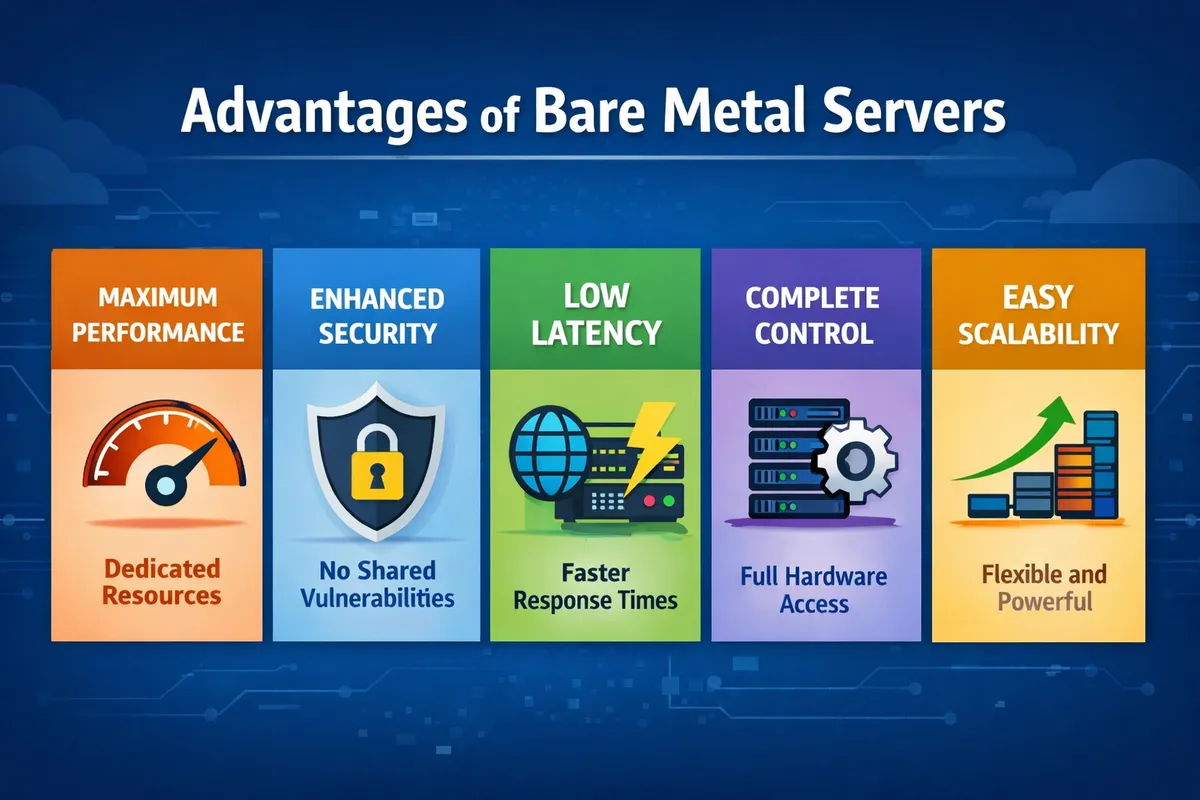
No "noisy neighbor" effect: No sharing of CPU, memory or I/O resources; no one else can "steal" your server power at the worst possible moment, which means stable performance without unpleasant surprises.
Direct access to hardware: Without a hypervisor, there is no additional layer that introduces latency. Less overhead means faster task execution, lower latency, and more reliable application behavior—especially important for real-time workloads.
Predictability: The power of bare metal servers is precisely that consistency: you know what you're getting today, tomorrow, and a month from now. And every time.
When Configuration Makes a Difference
Not all workloads are the same. Some need raw CPU power, others require memory, and others need ultra-fast storage. That's why custom bare metal servers are so popular.
36-Core Bare Metal Server
If you push complex analyses, AI models or intensive real-time processing, the 36-Core Bare Metal Server is like adding a turbo to the infrastructure. More cores, more parallelism, less waiting.
Intel vs AMD
Whether you choose Intel Bare Metal Servers for single-thread performance or AMD Bare Metal Servers for more cores and a better price-to-performance ratio, the point is the same: choose hardware that works for your use case, not against it.
Server Location
You can have strong hardware and a perfectly tuned system, but if the server is far from the user, latency will quickly ruin it.
That's why server location plays a huge role in performance. The closer the server is to users, the faster the responses and the more stable the application. This is especially important for real-time and latency-sensitive systems, where even small differences in latency become noticeable.
In this context, USA Bare Metal Server Hosting makes sense for applications targeting the North American market. When you use a dedicated bare metal server close to your audience, you get predictable performance, lower latency, and a more reliable user experience.
Security and Performance
At first glance, security and speed seem like a compromise. However, this is not the case with bare metal servers. When there are no shared resources, there are no typical problems of a multi-tenant environment, such as side-channel attacks that exploit shared hardware. Vulnerabilities like Specter and Meltdown have just shown how risky shared CPU and memory can be. Researchers explain in detail why shared hardware increases security risks.
This is why a dedicated bare metal server is often used in regulated industries. Isolated hardware means a smaller attack surface but also more stable performance—no extra layers to slow down the system.
Scaling
At first, it sounds illogical: how can something that is a physical server scale easily? We are used to tying "scaling" to the cloud, VMs, and click-click solutions. But in practice, Buy Bare Metal Server Hosting today doesn't mean you're stuck with one machine forever.
When the application starts to grow, you have some very clean options. You can add new dedicated bare metal servers and distribute the workload (e.g. load balancer in front), you can switch to a stronger configuration with more cores or RAM, or take a specialized server for database, cache, or real-time processing. All this without complicated VM migrations, without fighting with hypervisors, and without unpredictable performance.
The key here is control. With a bare metal environment, you know exactly where your application is running, what resources it uses, and how it behaves under load. When you add capacity, you add real hardware, not another layer of abstraction. That's why performance remains stable and latency under control.
Conclusion
Latency is unforgiving. Users don't wait. The winning apps are the ones that react immediately.
This is exactly where the true power of Bare Metal Servers can be seen. Clean hardware, full control, maximum performance. No tricks. No excuses.
If your application must always be fast, maybe it's time to stop asking "if" and start asking "how quickly can I switch to bare metal?".
Disclaimer: This post was provided by a guest contributor. Coherent Market Insights does not endorse any products or services mentioned unless explicitly stated.
Share this story
M
About Author
Marijana
Marijana a creative and innovative, highly specialized in link-building strategies, creating professional and interesting SEO content for individuals and companies.