TikTok verification has quietly become one of the fastest ways for small businesses to get discovered. A single video can reach thousands of potential customers in hours. When someone lands on your account, they make a decision in seconds.
Are you legitimate? Are you established? Are you safe to buy from? The verified badge does not make you popular. It confirms you are real and publicly recognized. That distinction changes perception.
For a small business, perception drives clicks, inquiries, and sales. Verification can reduce the impersonation risks, strengthen the brand positioning, and support the long-term trust. The growing importance of verification is also connected with the wider expansion of social media analytics.
As per the Coherent Market Insights analysis, the global social media analytics market is estimated to be valued at USD 7.57 Billion in 2026 and is expected to reach USD 17.81 Billion by 2033, growing at a CAGR of 13.0% from 2026 to 2033. As the businesses now use social platforms to understand customer behavior, improve engagement, and measure brand performance, verification has become one element within a broader digital trust and analytics ecosystem.
This article breaks down eligibility standards, notability strategy, ROI considerations, and risk management factors so you can evaluate verification as a smart business move.
TikTok Verification Eligibility Criteria Explained Clearly
TikTok reports over 1 billion monthly active users, and many use the platform to search for products, reviews, and local services. Their approval tends to come down to four checks: authentic, active, unique, and notable, and TikTok explicitly says follower and like counts do not decide verification.
Authenticity and Business Identity Consistency
TikTok wants clean identity proof that matches what customers can verify in seconds. That means your business name, handle, website, and public profiles tell the same story.
When the details conflict, the reviewers hesitate because impersonation risk rises. TikTok favors accounts that appear authentic and represent a genuine entity rather than a lookalike brand page.
- Use the exact legal business name or a consistent trading name across TikTok, your website header, and the contact page
- Match your TikTok bio name to the name on your website footer, Google Business Profile, or business directories
- Use one simple brand logo or founder headshot across platforms to avoid “two brands” confusion
- Keep the website live, branded, and posted with the same services, location, and contact details shown on TikTok
Account Activity and Compliance Standards
TikTok also looks for an active account in good standing. A business that posts regularly and avoids policy trouble looks lower risk than an account with removals, strikes, and spam-like behavior.
TikTok enforces its Community Guidelines by implementing removals and bans for violations. The repeated issues can weaken the trust signals during the review process.
- Publish on a consistent schedule your team can maintain such as 3–5 posts per week for 60 days
- Avoid aggressive engagement bait (fake giveaways, misleading claims, and “comment YES to win” funnels) that affects moderation
- Keep captions, offers, and landing pages aligned so the content does not look deceptive
- Reduce risk before applying: remove borderline posts, fix duplicate bios, and standardize branding across recent uploads
Notability: The Deciding Factor for Approval
Notability usually decides the outcome. TikTok says verification considers whether an account is notable and unique, and not use follower or like totals as a requirement.
For the businesses, notability means third-party proof that real people identify your brand outside TikTok, such as credible media mentions or recognized industry presence.
- Collect 3–5 strong third-party links that mention your business by name (local press, industry publications, partner announcements)
- Make proof simple to verify: one page on your site that lists press, awards, and partnerships with direct links
- Use consistent naming so search results clearly connect to your TikTok handle and business website
- Prioritize sources with editorial standards; low-quality “pay-to-post” articles rarely strengthen reviewer confidence
Without verification, brand confusion becomes easier. The verified status makes a clear distinction that protects customer pathways. If impersonation escalates or account access issues arise, structured mitigation such as a social media recovery service becomes part of strategic risk control, not emergency damage repair.
How the Small Businesses Can Build Notability Strategically
Notability does not appear overnight. Instead, it develops when multiple public signals align and support each other. The reviewers look for clear as well as independent confirmation that your business matters even outside TikTok.
Earning Credible Media Coverage
First, understand that not every article qualifies as strong proof. The TikTok reviewers tend to value independent editorial coverage because it reflects third-party recognition. For example, a feature in a regional newspaper, a respected trade journal, or a well-known online business publication carries more weight as compared to a self-published blog post.
In addition, the article should clearly mention your business name and ideally link to your website. Short-term paid placements rarely make real authority. Instead, a long-term PR strategy, which is built around expertise, case studies, or industry insights, makes durable credibility.
Strengthening Digital Footprint and Search Presence
Next, consider what happens when someone searches your business. If the results are inconsistent, incomplete, or even fragmented, then such as situation can quickly lead to increased doubt. The reviewers anticipate a clean and organized digital presence that verifies its legitimacy.
Therefore, your website, LinkedIn page, and business directories should align in name, logo, contact details, and messaging. Consistency reinforces identity. Moreover, strong branded search results signal public relevance.
The businesses are using AI-powered social media analytics to understand the audience behavior, identify the content trends, and optimize their digital strategies. These insights help the brands in creating more relevant content, improving engagement, and strengthening their overall online visibility.
The businesses are also using social listening and sentiment analysis to monitor the online conversations, understand the customer perception, and identify the reputation risks before they impact brand trust. When every major listing supports the same brand story, approval becomes more plausible.
This is particularly important in the U.S., where the businesses are using social platforms to connect with the customers and strengthen their online presence. The companies across retail, e-commerce, healthcare, and financial services are using analytics tools to understand the customer reactions, track the brand conversations, and improve the engagement. These insights help businesses build stronger digital credibility and trust.
The tools businesses use to maintain this visibility are also changing. The cloud-based social media analytics solutions are gaining attention because they allow the businesses to monitor customer conversations, measure performance, and access insights without building complex internal systems. The segment is supported by demand for flexible and cost-effective solutions, especially among businesses that want better control over their online presence without high technology investments.
Industry Authority and Strategic Partnerships
Finally, notability strengthens when other credible organizations acknowledge your brand. Collaborations with established creators or recognized companies offer visible third-party validation. Likewise, industry awards, certifications, or conference participation demonstrate recognized expertise.
Each signal builds cumulative authority. Reviewers assess whether your business operates at a publicly visible level within its niche. When media coverage, search presence, and partnerships align, the case for approval becomes stronger.
Each signal builds cumulative authority. Reviewers assess whether your business operates at a publicly visible level within its niche. When media coverage, search presence, and partnerships align, the case for approval becomes stronger.
The way the businesses evaluate their digital performance is also becoming more data-driven. Social media analytics platforms are used to understand the audience reactions, track the campaign outcomes, and identify the opportunities for stronger engagement. The platform solutions segment accounts for around 43% of the social media analytics market. These solutions allow businesses to move beyond basic engagement numbers and understand the reasons behind customer interactions.
The businesses also have access to various platforms that help them understand their audience and improve digital performance. The leading companies such as Sprinklr, Brandwatch, Meltwater, Sprout Social, Hootsuite, Adobe, and Salesforce provide tools for monitoring the conversations, analyzing the customer sentiment, and measuring the campaign performance. reputation.
If internal efforts do not produce strong enough notability signals, you can consider TikTok verification with Social Rescue as a structured alternative to strengthen your approval strategy and reduce rejection risk.
Cost-Benefit Analysis: Is TikTok Verification a Smart Investment?
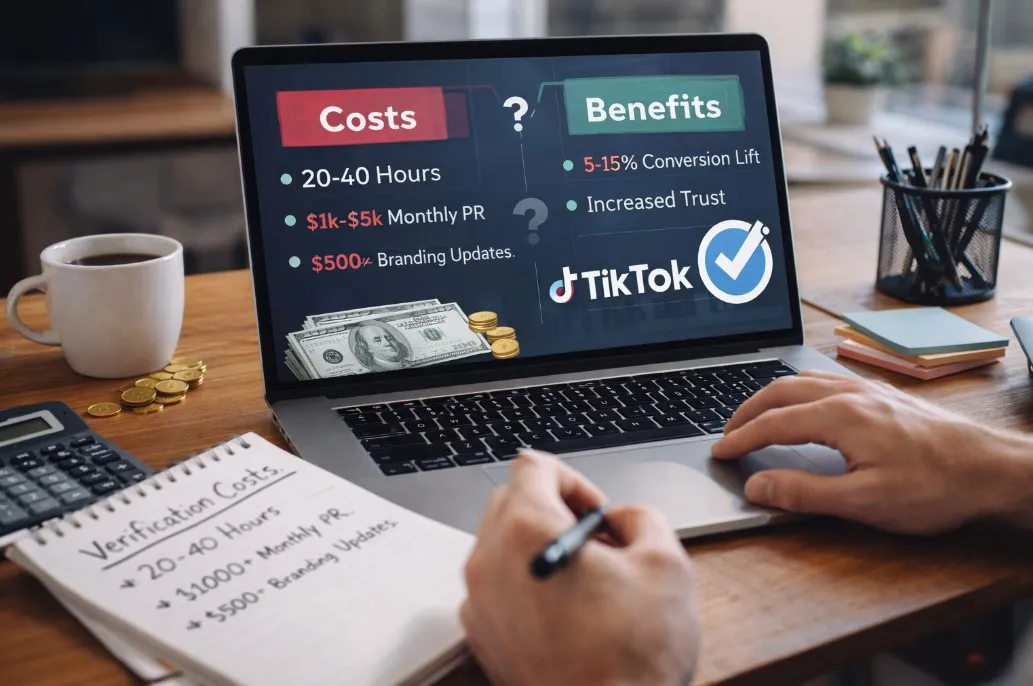
Before applying, treat verification as a measurable business decision, not a symbolic upgrade.
-
Direct Costs and Internal Resource Allocation
TikTok does not charge a public fee for verification, but preparation requires real investment. A focused PR push can cost around $1,000–$5,000 per month and internal prep usually takes 20–40 staff hours across branding alignment, press outreach, as well as documentation audits.
Website updates and media assets can add $500–$2,000. For a small team, that time directly affects the marketing output as well as revenue-generating tasks.
-
Opportunity Cost of Remaining Unverified
Visible trust indicators can influence performance. E-commerce studies show that the trust signals may increase conversions by 5–15%, depending on industry and traffic source. Without verification, customer hesitation increases when similar accounts appear.
Impersonation risk also surges, which can lead to refund disputes and brand confusion. Over time, even a small drop in conversion rate compounds into meaningful revenue loss.
-
DIY Application vs Professional Strategic Support
A DIY submission costs less upfront, but rejection can delay progress for weeks. Poorly structured applications often fail due to weak notability proof. Structured preparation improves clarity and reduces avoidable errors.
The long-term planning should also include the account risk mitigation. If access issues or impersonation disrupt the operations then proactive support such as TikTok account recovery protects revenue continuity as well as brand stability.
Conclusion
TikTok verification is not a vanity milestone. It is a structured credibility signal that affects trust, brand control, and conversion performance.
For small businesses, the decision should balance preparation costs against measurable benefits such as improved consumer confidence, reduced impersonation exposure, and stronger competitive positioning.
If you want structured guidance and a clearer readiness assessment before applying, you can explore TikTok verification with Social Rescue to evaluate your documentation, notability signals, and approval strategy with professional oversight.
Frequently Asked Questions
- How many followers do you need to get verified on TikTok?
- TikTok does not publish a minimum follower requirement. The platform focuses more toward authenticity, activity, as well as notability, and not toward follower count. Many verified accounts have strong media presence rather than massive audience size.
- Does TikTok verification increase views automatically?
- No, verification does not guarantee the algorithm preference. TikTok still ranks the content on the basis of watch time and engagement quality. However, the badge can help in improving the click-through rates and profile trust.
- How long does TikTok verification take?
- TikTok does not provide fixed timelines. Some reviews conclude within days, while the others take several weeks, and this depends on documentation clarity and eligibility strength.
- Can a business account get verified?
- Yes, the business accounts can qualify if they demonstrate public relevance, consistent branding, and third-party recognition. The media mentions and a clear digital footprint can assist in strengthening the probability of approval.
- What happens if TikTok verification gets denied?
- Rejection usually means notability proof or identity clarity needs improvement. Businesses should strengthen media presence, align branding signals, and wait before reapplying to increase approval chances.

