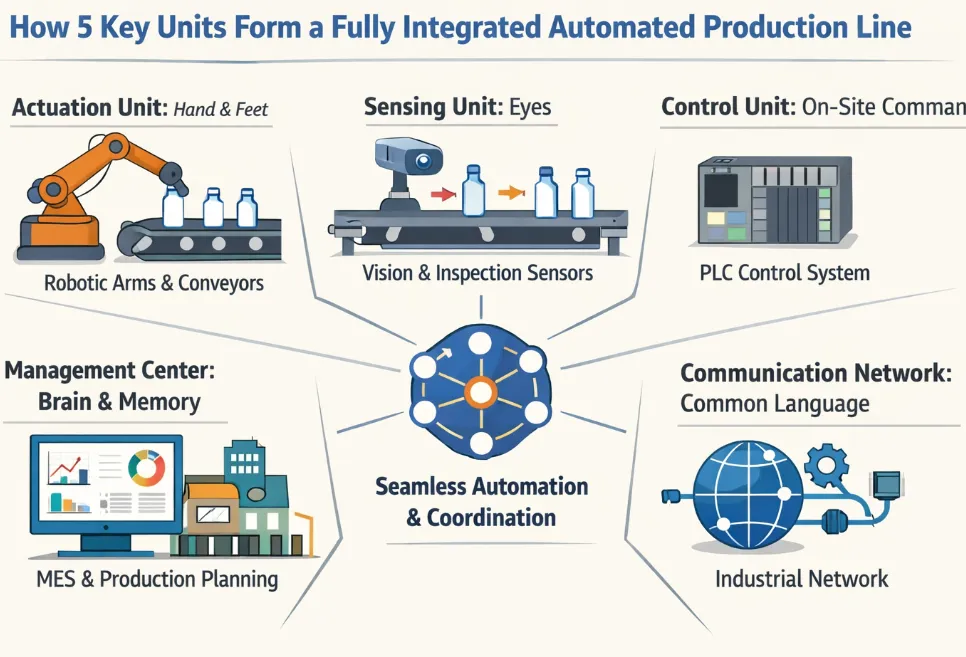
From powder pretreatment to final packaging, pharmaceutical production involves multiple steps. When pharmaceutical production is organized as a production line, the processes become more complex. Normally, materials are transferred between stages manually, which increases the risk of contamination and lowers production efficiency. Therefore, more and more pharmaceutical companies are now choosing integrated production lines to improve efficiency and product quality.
Essential Machines in a Powder Filling Production Line
Automation is no longer a “nice-to-have” option. It’s an essential part for increasing production and ensuring quality. In this article, we take a powder filling production line as an example to explore why automation is crucial in pharmaceutical manufacturing.
Powder Pretreatment Machine
Powder grinders and blenders can crush dry materials into fine, uniform powder and then mix them fast and evenly, which ensures stable and high-quality material preparation for the next processes. Also, a granulator machine can turn the powder into uniform granules for tablet or capsule production.
Powder Filling Machine
Accurately and quickly fills powders into targeted containers. The machine ensures no cross contamination that can occur in manual filling.
Bottle Auxiliary Machine
Bottle unscramblers orient bottles in the right direction to increase packaging efficiency. After the powder filling step, the cotton and desiccant inserters place cotton and desiccants into the bottles automatically.
Capping & Sealing Machine
To protect products from leakage and contamination, the capping and sealing machine tightens screw caps and seals containers.
Labeling & Code Printing Machine
Labeling and code printing machines ensure product traceability, meeting standards like GMP (Good Manufacturing Practice). In the integrated pharmaceutical line, they cooperate with other equipment to achieve process production.
Inspection & Rejection Machine
Detection equipment, like pharmaceutical metal detectors in the powder filling line, works like a monitor. This system detects and removes defective or contaminated products, even when defects cannot be seen by the human eye.
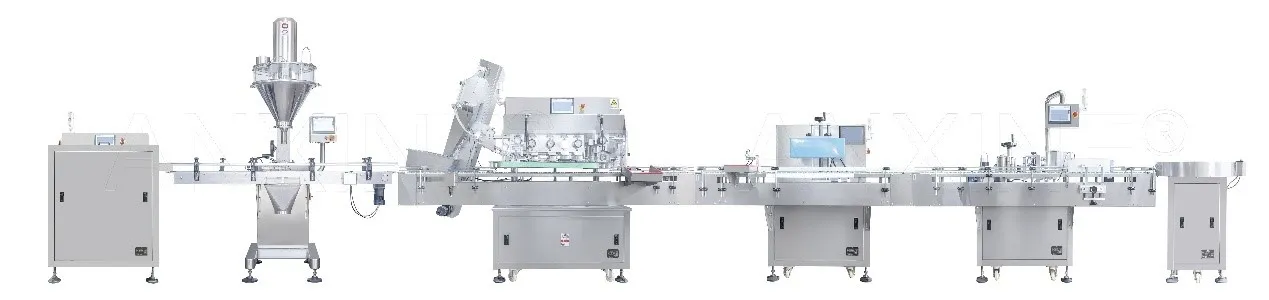
How Five Key Units Form a Fully Integrated Automated Production Line
Automation requires more than equipment. It’s a system-level concept. Equipment is connected via materials transfer, unified communication standards, and centralized digital controls. This integration makes the machines cooperate like a team, achieving seamless workflow.
-
Actuation Unit: Hand and Feet
The actuation unit includes devices like robotic arms, conveyors, and valves. They are responsible for powder transfer, bottle alignment, and cotton and desiccant insertion. They can avoid contamination without the need for extra labor.
-
Sensing Unit: Eyes
Metal detectors, vision cameras, and scanners are all sensing units. They monitor production like the human eye, but are more powerful at detecting defects. If containers are in the wrong position, contain metal, or are underfilled, the system rejects them automatically.
-
Control Unit: On-Site Command
The control unit relies on Programmable Logic Controller (PLC) to respond and coordinates the actuation and sensing units. When working, the unit receives feedback and then adjusts machine actions. It works like a commander to ensure smooth and continuous production.
-
Management Center: Brain and Memory
The Manufacturing Execution System (MES) is the management center of the automated production line. The center is responsible for production scheduling, recipe management, and data recording of the entire production process, allowing full traceability from raw materials to finished products.
-
Communication Network: Common Language
As the common language, the communication network transmits action commands and data through unified industrial networks and protocols, such as OPC UA and Industrial Ethernet.
All of these five units form a fully integrated automation system. So, what are the benefits of this seamless workflow? Let’s explore it in the next section.