Regulators are squeezing waste out of every box, bottle, and bag. In April 2024, the European Parliament approved strict “reduce, reuse, recycle” rules that will ban several single-use formats by 2030.
Luxury brands feel the pinch first. Shoppers still expect an unforgettable unboxing, yet boards want lower carbon footprints, shorter lead times, and crystal-clear costs. That tension is forcing packaging teams to rethink which partners they trust—and how they work.
We reviewed annual reports, factory audits, and dozens of case studies, then scored each supplier on ten factors, with service breadth and sustainability carrying the most weight. The result is a ranked shortlist of 15 standout partners and a candid look at when one end-to-end supplier beats a patchwork of specialists. Use it as your roadmap to packaging that delights customers, satisfies auditors, and ships on time.
Here’s what we found.
How we built a smarter shortlist
First, we gathered every credible source we could find: annual reports, CSR disclosures, award lists, and customs data that hint at real shipping volumes. Then we stress-tested every claim by talking with buyers, scanning factory audits, and checking certification databases. Hype fell away fast.
From that mountain of intel, we shaped a seven-point scorecard. Breadth of services and sustainability each carry 20 percent of the final mark because luxury brands now expect both creative magic and a lighter footprint. Innovation and manufacturing clout sit right behind. Flexibility on minimums, global logistics support, and price transparency round out the mix.
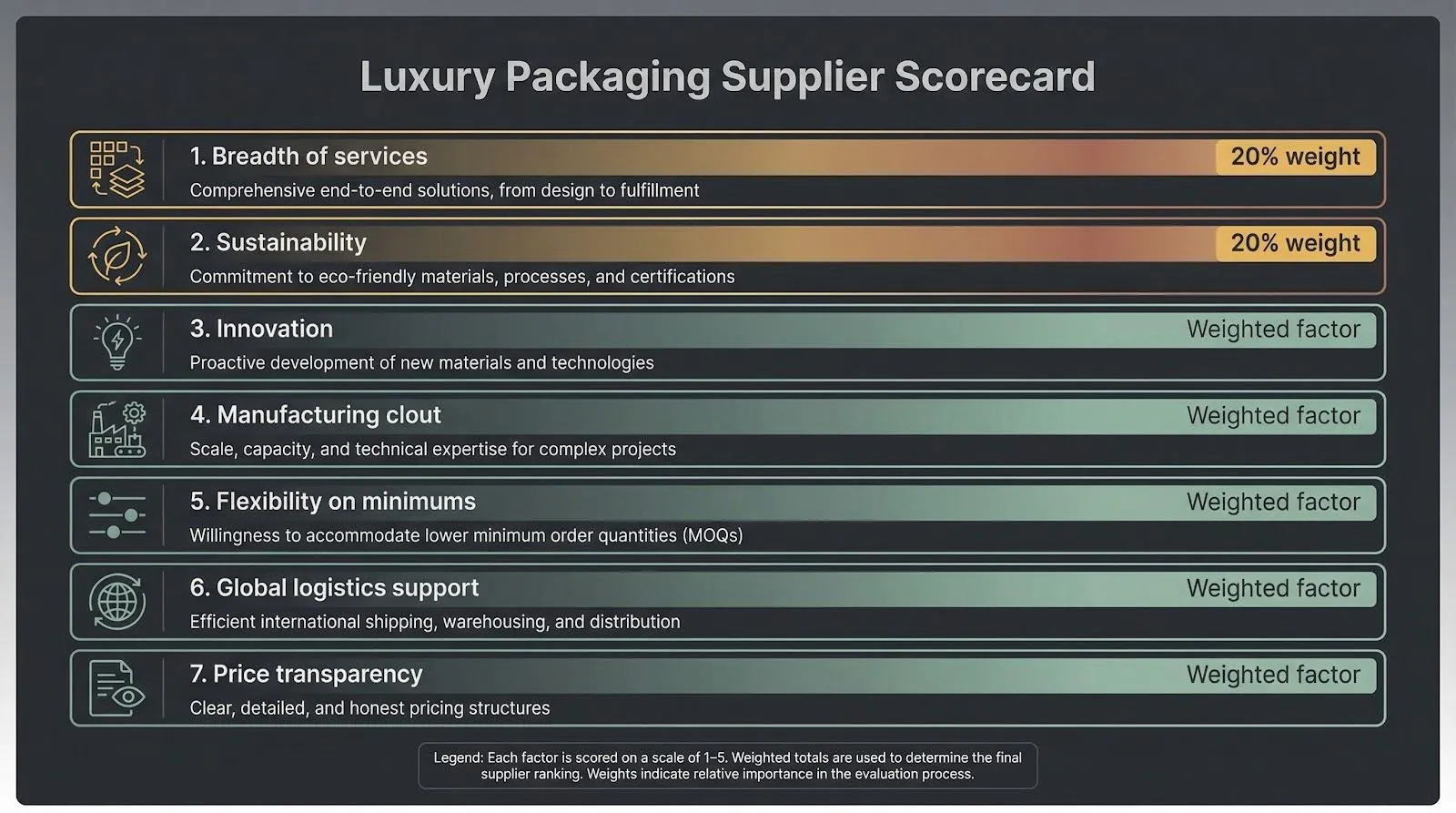
Each factor gets a one-to-five score. We weight, total, and stack-rank. The math keeps us honest, but numbers alone never tell the full story. A supplier’s craft heritage, recent M&A deals, and client roster color the final judgment. That qualitative layer is why a boutique like Progress can outrank giants in certain niches.
The result is a list that mirrors the real trade-offs you juggle: speed versus scale, artistry versus automation, and sustainability versus spend. Use it as a starting grid, not a finish line, and map your own priorities against the criteria before you brief any vendor.
What’s driving the shake-up in luxury packaging
Sustainability is no longer a side quest. New EU waste rules lock in aggressive reduction targets, and similar legislation is rolling out in California and Japan. Brands that still rely on plastic windows or foam inserts face a countdown clock. Suppliers with FSC papers, molded-pulp inserts, and life-cycle data rise up the shortlist because they help you clear that compliance bar without dulling the unboxing thrill.
Geography is shifting too. After years of port snarls and tariff ping-pong, near-shoring has become a board-level mandate. GPA Global’s 2023 purchase of Cosfibel shows why. By adding plants in Spain, Portugal, and Belgium, GPA trimmed weeks from lead times for its European clients and cut freight emissions in one move. That deal sparked a mini-rush: Pusterla added Pollard to its fold, and even mid-sized boutiques are scouting partners across borders.
Then there’s speed. Digital prototyping, AR previews, and short-run digital foiling let a startup order 500 influencer boxes that look as polished as a legacy brand’s million-unit carton. Tech once reserved for mass players is now table stakes. The upshot? You can test, learn, and relaunch packaging almost as quickly as you tweak social ads.
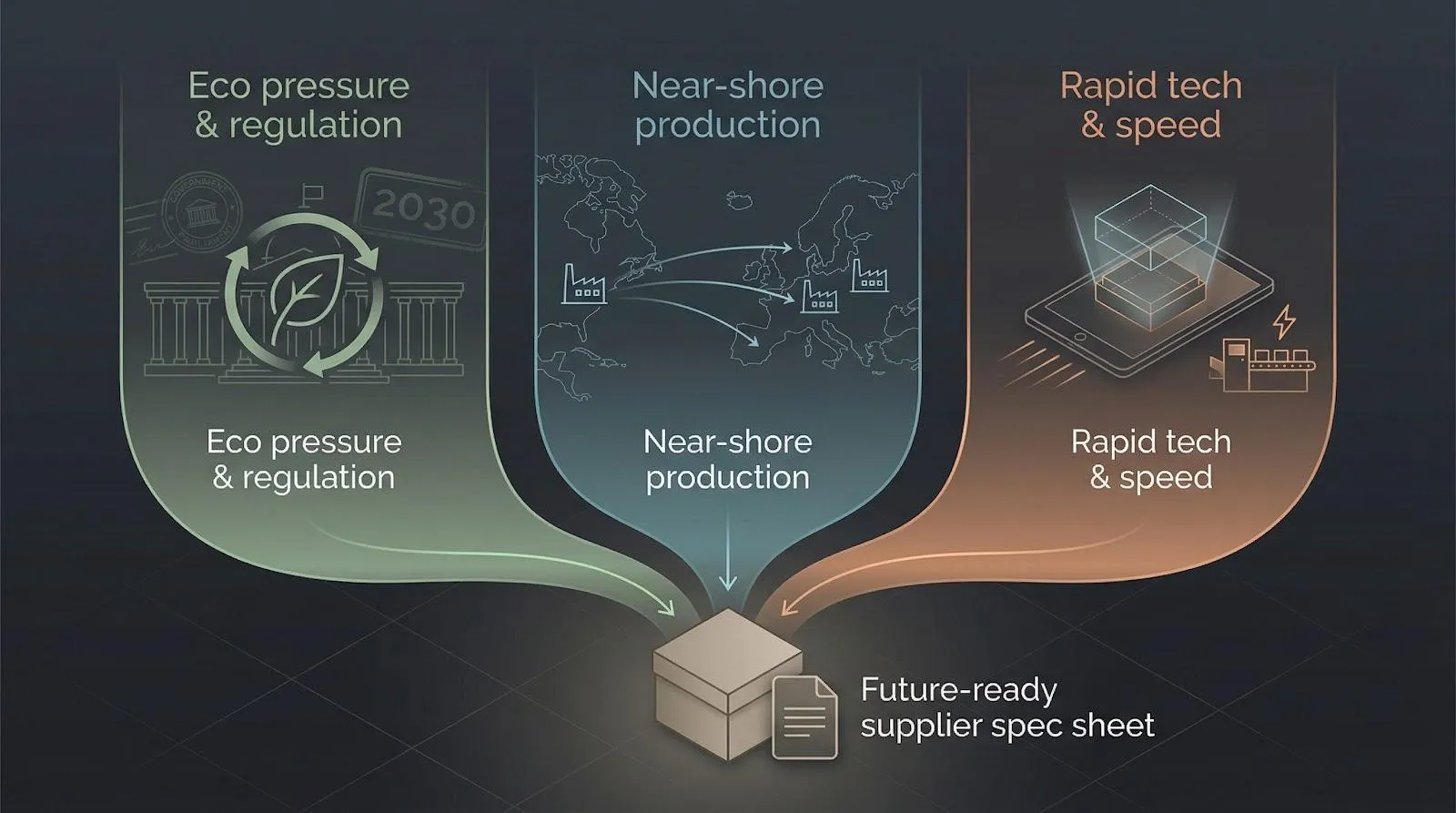
Taken together, these three forces — eco pressure, near-shore production, and rapid tech — rewrite the spec sheet for any future-ready supplier. The firms in our top 15 list ride at least two of those waves. The leaders catch all three.
1. Zenpack: end-to-end agility for design-driven brands
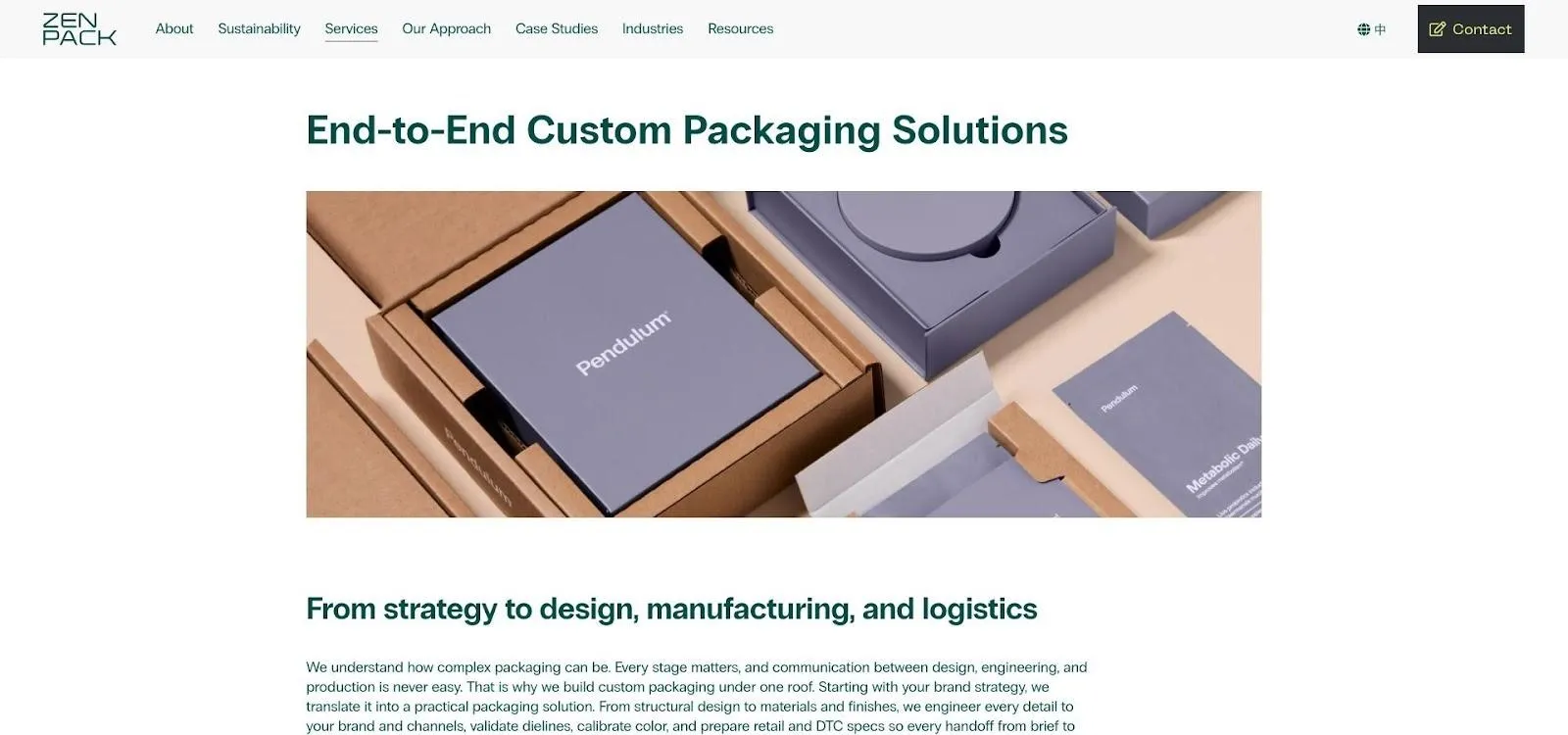
Think of Zenpack as the creative studio and production floor rolled into one. Your brief lands on a desk in San Jose; prototypes cut on automated tables in Taiwan follow days later. That tight loop between design and manufacturing lets teams tweak dielines, materials, and print finishes in real time instead of waiting through multi-week cycles.
The company’s strength is range. One week it engineers molded-pulp inserts that replace plastic trays for a tech giant. The next it hand-wraps rigid boxes in vegan leather for a fashion house’s influencer kit. Low minimums, often just a few hundred units, make Zenpack a safe test bed for first runs, yet its ISO-certified network scales smoothly when demand climbs.
Clients value the single point of contact. Zenpack follows a four-step process that integrates strategy, design, manufacturing, and logistics; you can learn more about how this end-to-end workflow keeps deadlines intact and colors matching across every batch. If you need nimble creativity wrapped in tight process control, start your vendor calls here.
2. GPA Global: scale meets creativity for 70 household names
GPA answers the classic brief: “Give us the artistry of a boutique and the muscle of a multinational.” With more than three thousand staff and factories on three continents, the group can prototype a perfume coffret in Paris, scale it in Shenzhen, and finish assembly in Mexico for North-American drop dates.
Its 2023 acquisition of Cosfibel supercharged that model. European clients now tap near-shore plants in Spain and Portugal, trimming weeks from lead times and avoiding carbon-heavy sea freight. The merged creative studios swap ideas daily, so the same team that dreamed up a Chanel holiday trunk may refine your whiskey canister’s hinge tomorrow.
Beyond capacity, GPA wins points for breadth. Paper, metal, molded pulp, textiles — it owns or oversees each process, then layers on logistics, warehousing, and product kitting. One PO, one invoice, global coverage. For brands juggling multiple launches and territories, that simplicity saves time, money, and a few grey hairs.
3. Pusterla 1880: old-world craft, modern speed
Walk into a Pusterla plant and you feel the heritage at once. Wooden-handled tools hang beside CNC cutters, and third-generation artisans share the floor with vision-system robots. That blend of hand and high tech lets the company deliver heirloom-quality boxes on lead times a startup marketing calendar can handle.
Family ownership keeps decision lines short. When Scotland’s Pollard Boxes joined the fold in 2021, Pusterla gained extra capacity and a U.K. hub that trims customs delays for British spirits brands. The network now spans Italy, France, Tunisia, and the U.S., so a champagne house can source locally while an American perfume label taps stateside production to avoid trans-Atlantic freight costs.
Minimums hinge on spend, not unit count. Hand-wrapped collector cases might run just a few hundred pieces as long as the overall order hits the ten-thousand-dollar mark. That appeals to limited releases and advent calendars where scarcity is part of the allure.
Sustainability runs through every step. Expect FSC papers, water-based glues, and plastic-free inserts by default. Pusterla claimed a Luxe Pack “in green” award years before many rivals even filed their first CSR report, proving eco and luxury can coexist without compromise.
4. Cosfibel: haute-couture gifting, now boosted by GPA
Cosfibel built its name on boxes that feel like objets d’art. Picture ribbon-trimmed coffrets, leather-touched handles, and tins that double as keepsakes. Beauty houses and champagne maisons line up because every project gets runway treatment from Paris-based designers who live and breathe luxury cues.
The 2023 merger with GPA Global added fresh horsepower. European factories in Spain, Portugal, and Belgium now sit inside GPA’s wider network, so Cosfibel concepts can stay local for short runs or scale in Asia when volumes climb. Same Paris flair, broader production palette.
Multi-material mastery is the ace card. Paper, metal, wood, and textiles blend into cohesive pieces that photograph like jewelry and ship like cartons. Brands chasing standout holiday sets or VIP mailers should flag this partner early. Flexibility on unit counts is higher than you might expect, provided the brief stretches creative boundaries.
5. WestRock: industrial scale with luxe finishing touches
WestRock is best known for corrugated giants, yet its specialty carton division prints perfume boxes that meet the white-glove test. Because the company owns its paper mills, the team can tweak board caliper, texture, and recycled content on demand, then run millions of units through seven-color presses without slowing down.
A merger with Smurfit Kappa, expected to close in early 2026, will extend that edge to about 400 plants worldwide. You will be able to source identical folding cartons in Atlanta, Dublin, and São Paulo under one contract. Minimums stay high, but if you run a global cosmetics line that launches in 40 markets on the same Friday, WestRock’s muscle is hard to match.
6. Crown Holdings: metal precision for collectible tins and spirits canisters
If your brief calls for a sculpted tin that stays on a customer’s mantel long after the goodies are gone, Crown is the name to know. Two hundred plants worldwide give it direct access to recycled steel and aluminum, and litho lines that print photographic detail straight onto metal at speed.
Crown’s embossing tricks turn flat sheets into tactile keepsakes, such as multi-level relief scenes on a whisky canister or tea caddy. Food safe coatings and airtight seams come built in, so compliance teams rest easy. Tooling costs and minimum order quantities start high, but the payoff is permanence: metal packs that amplify brand heritage and recycle forever.
7. Tinshine: custom tins without the megacorp overhead
Tinshine proves you do not need Fortune 500 scale to deliver precision metalwork. From its Dongguan base the firm punches, prints, and polishes bespoke tins in runs as low as ten thousand units, a modest figure in metalwork and perfect for premium limited editions.
Engineers sit a staircase above the press hall, so design tweaks move from CAD to sample in days. That speed lets marketers lock artwork late while still meeting ship dates. Expect inside lid printing, window cut outs, and deep embossing that matches much larger players, without the long corporate chain of command.
Shipping from China adds time, but Tinshine offsets the wait with competitive unit economics and meticulous QC. For chocolates, tea, cosmetics, or any giftable that benefits from a collectible shell, this specialist supplies metal packaging that boutique brands can afford.
8. Delta Global: B-Corp brains for fashion’s green makeover
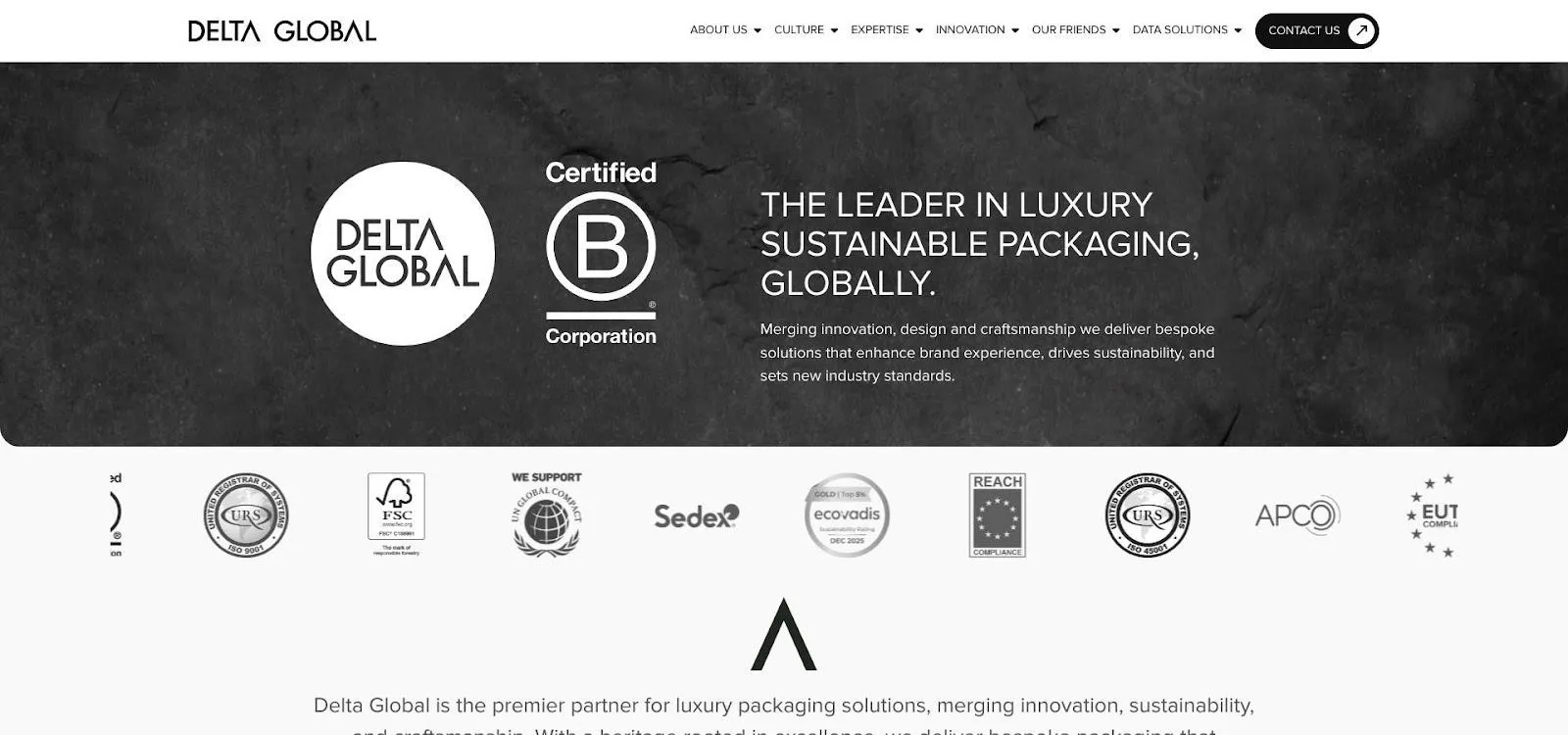
Delta speaks fluent ESG. Before sketching a dieline, its analysts crunch carbon data and benchmark recycled content so you can walk into the next board meeting with facts, not fluff. That rigor earned Delta its B-Corp badge in 2025 and a seat with luxury houses racing to hit science-based targets.
Production sits with a hand-picked network of audited factories, and Delta orchestrates them with tight control. The Leicester HQ handles design and inventory planning, while partner plants in Turkey, China, and Portugal handle the heavy lifting. Finished bags and boxes land in Bunzl-run warehouses, ready for just-in-time drops to flagship stores and e-commerce hubs.
The clever move is consolidation. A fashion label once juggling five vendors for bags, tissue, and e-com mailers now signs one Delta contract and watches admin time fall by half. Sustainability metrics climb at the same pace, with carbon cuts of up to twenty-seven percent logged across recent client portfolios.
If your CFO counts every ton of CO₂ and your CMO obsesses over brand consistency, Delta stitches both needs into one tidy parcel.
9. IPL Packaging: personal touch for complex, multi-material briefs
IPL began life crafting wooden wine boxes on the South African coast. Two decades later its designers juggle wood, board, acrylic, and electronics to build presentation packs that light up, sing, or pour a perfect dram when opened.
Global offices in New York, London, and Shenzhen keep creative close to the client while production stays near raw-material hubs. That split pays off in speed: concept to gold sample in four weeks, full run on a boat two weeks later for many mid-volume projects.
MOQ flexibility is the key advantage. Need 300 hand-stained cigar boxes for a press launch? Done. Ready to scale that format to 50,000 units for retail? The same team handles it without a redesign. Add in seasoned project managers who speak packaging, freight, and finance, and you have a partner that treats every SKU like a flagship.
10. Hunter Luxury: boutique brilliance for beauty and spirits
Hunter’s studio in Yorkshire feels more like a fashion workshop than a packaging supplier. Mood boards cover the walls, prototypes sit under soft lights, and every surface brims with ribbons, foils, and fabric swatches ready for the next Charlotte Tilbury or limited release gin pack.
Awards confirm the flair. Hunter’s seasonal gift sets have topped the Luxury Packaging Awards twice in the past five years, proof that judges, influencers, and shoppers all notice the difference. Yet service stays personal: senior creatives join every kickoff call and often fly samples to clients rather than rely on courier surprises.
Production is outsourced but tightly managed. Hunter’s QC teams camp in partner factories during each run, catching micro flaws before they reach the pallet. Minimums hover around a few hundred units, making the firm ideal for boutique launches, press kits, and advent calendars where presentation matters as much as the product inside.
11. Keenpac: retail packaging and fulfillment in one tidy bundle
Keenpac specializes in the unsung hero of luxury: the shopping bag that bridges store counter to street selfie. Since 1979 the company has perfected the art of crisp folds, color-matched rope handles, and foil logos that survive a rainy walk home.
Now under the Bunzl umbrella, Keenpac pairs that craft with a logistics backbone few rivals can match. Twelve regional warehouses hold stock, so boutiques in Paris, Dubai, and Miami all pull the same lot-coded bags and gift boxes year-round. Store teams never scramble for replenishment, and finance enjoys one consolidated invoice instead of dozens.
Minimum runs start around three thousand units, but the inventory model means you print once, warehouse centrally, and draw down as needed. The result is tighter brand consistency and fewer urgent reorders before holiday peaks. If retail presentation and supply chain simplicity sit high on your scorecard, add Keenpac to your top three.
12. Knoll Printing & Packaging: award-winning ingenuity for beauty icons
Walk the beauty floor at Selfridges and chances are at least three coffrets started on a Knoll drafting table. The company, with studios in New York and Hong Kong, marries daring structures with flawless cosmetics-grade finishing, then scales each concept in its own ISO-audited plants.
Knoll’s signature is constant product refinement. Its Ecoform molded-pulp trays have replaced millions of plastic fitments without dulling the high-gloss unboxing many makeup lines rely on. That blend of eco and elegance earned an Oscar de l’Emballage for Bulgari and a Luxe Pack “in green” trophy the following year.
Minimums hover around a thousand units, and the team happily prototypes in runs of 50 so creative directors can approve tactile details early. If your next fragrance launch needs Instagram applause and sustainability receipts in equal measure, Knoll is your go-to partner.
13. Progress Packaging: U.K. craft with a carbon-neutral badge
Progress turns bold design briefs into shelf-ready reality, all from its Yorkshire facility powered by renewable energy. B-Corp certification keeps the sustainability bar high without sacrificing luxury. Expect embossed slipcases for art books, suede-lined sneaker boxes, or foil-hit mailers that arrive in perfect condition.
Local production means speed. Designers can tweak Pantone shades at the press in real time, cutting the proofing dance many offshore jobs require. Small MOQs, often around 200 units, let indie brands play in the same luxury league as global names without big-volume risk.
For teams that crave tactile storytelling and transparent ethics, Progress delivers both under one carbon-neutral roof.
14. Burgopak: patented slide-out theatre for tech and pharma
Burgopak’s slide-out mechanism turns a simple carton into a reveal sequence that feels part jewellery box, part magic trick. Originally built for SIM cards, the design now accommodates earbuds, supplements, and luxury chocolate bars, while reducing drop damage by locking the product in place.
The London studio licenses its patents or supplies turnkey production through certified partners. Lead times beat most custom tooling because the core mechanism is pre-engineered, so brands focus on graphics and inserts. Runs start around 5,000 units, making the concept viable for limited edition tech or DTC wellness launches.
If you want a guaranteed showpiece without reinventing the structural wheel, Burgopak is the fast route.
15. Smurfit WestRock: global fiber advances at industrial scale
Smurfit Kappa’s merger with WestRock closed in early 2026, creating the largest paper-based packaging group on earth. For luxury teams, the headline is reach: more than 400 converting plants and nine proprietary paperboard grades, all under one sales agreement.
Need a perfume carton that matches the board on your U.S. candle sleeve and your Korean skincare set? The merged R&D lab now calibrates surface finishes across continents, so color drift disappears. Early pilots with cellulose barrier films show promise for plastic-free window cartons, a shift that regulators will soon require.
Volumes remain hefty, but for enterprise brands that ship global SKUs by the million, Smurfit WestRock signs one service-level contract and meets the delivery dates your ERP lives by.
Conclusion: One-stop vs. Multi-Vendor
Picture two roads.
On the first, you brief a single partner. Designers, engineers, printers, and logistics specialists share one roof. They swap files in real time, solve snags before you notice, and hand you a finished pack that passes color checks and drop tests on the first try. Zenpack, GPA Global, and Delta all work this one-stop way.
The gains are speed and accountability. One project manager owns the schedule, so delays have nowhere to hide. Costs surface sooner, too. Tooling, freight, and warehousing all appear on one quote, letting finance lock budgets early. The trade-off is dependence. If your concept needs an ornate tin but the chosen partner lacks metal presses, you accept their subcontracting markup or add a second vendor.
Take the second road and you assemble a dream team yourself. A Paris design studio crafts the look, Crown stamps the tin, Progress prints the cartons, and a 3PL slots pieces together. You pick best-in-class talent for every task and play referee when timelines clash. Done well, this multi-vendor route unlocks niche craft and competitive bids. Managed poorly, it spawns email chains that read like blame ping-pong.
So how do you choose? Use three filters.
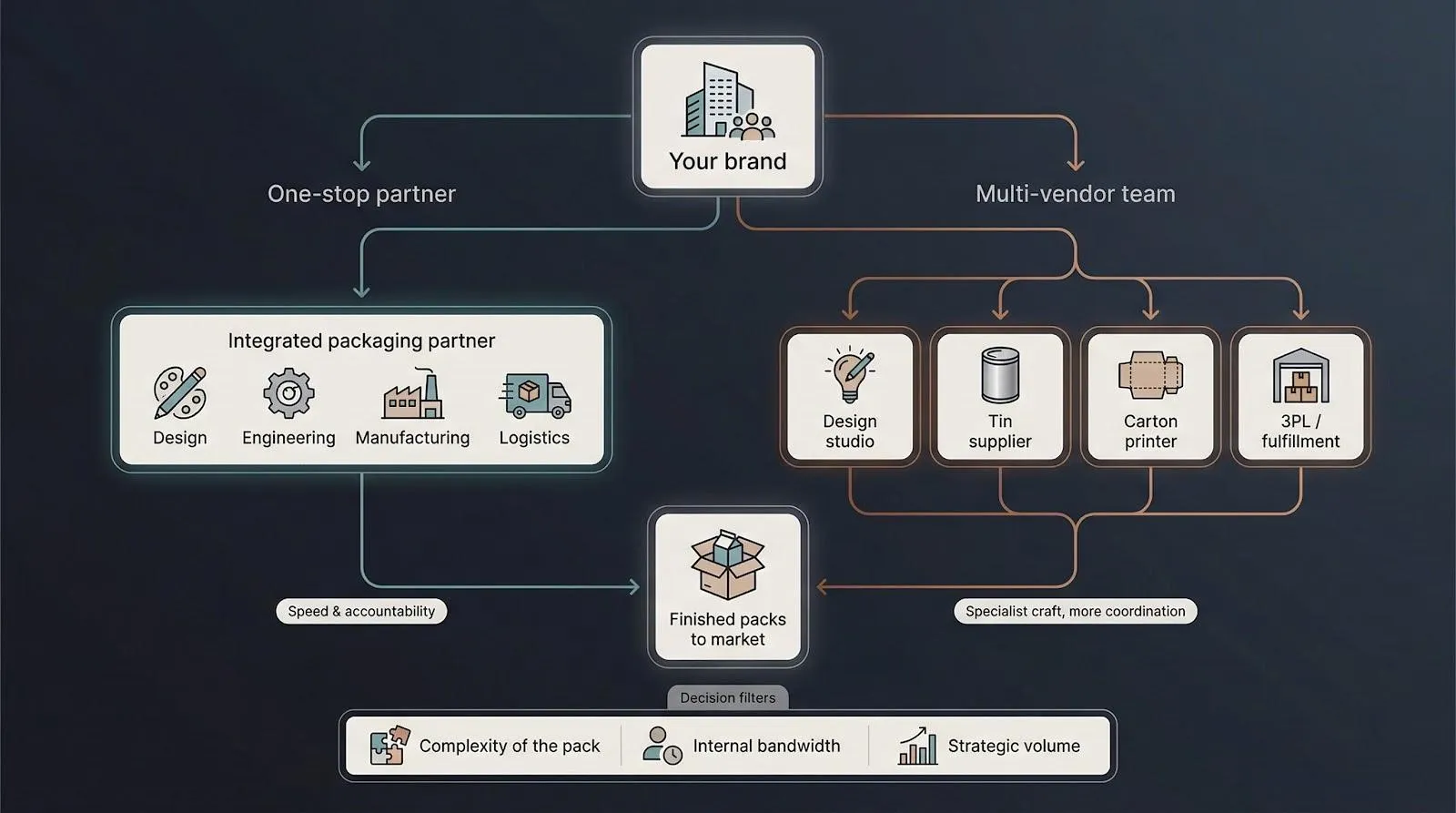
- Complexity of the pack. The more moving parts, the more one-stop simplicity pays off.
- Internal bandwidth. If your team lacks a dedicated packaging engineer, outsource the orchestration.
- Strategic volume. High, steady runs favor one contract with robust SLAs. Hyper-seasonal capsules often warrant specialist flair, even if that means juggling two or three suppliers.

