

Global 3D Printing Filament Market Size and Forecast – 2026-2033
The global 3D printing filament market is estimated to be valued at USD 1.95 Bn in 2026 and is expected to reach USD 5.86 Bn by 2033, exhibiting a compound annual growth rate (CAGR) of 17.0% from 2026 to 2033.
Key Takeaways of the 3D Printing Filament Market
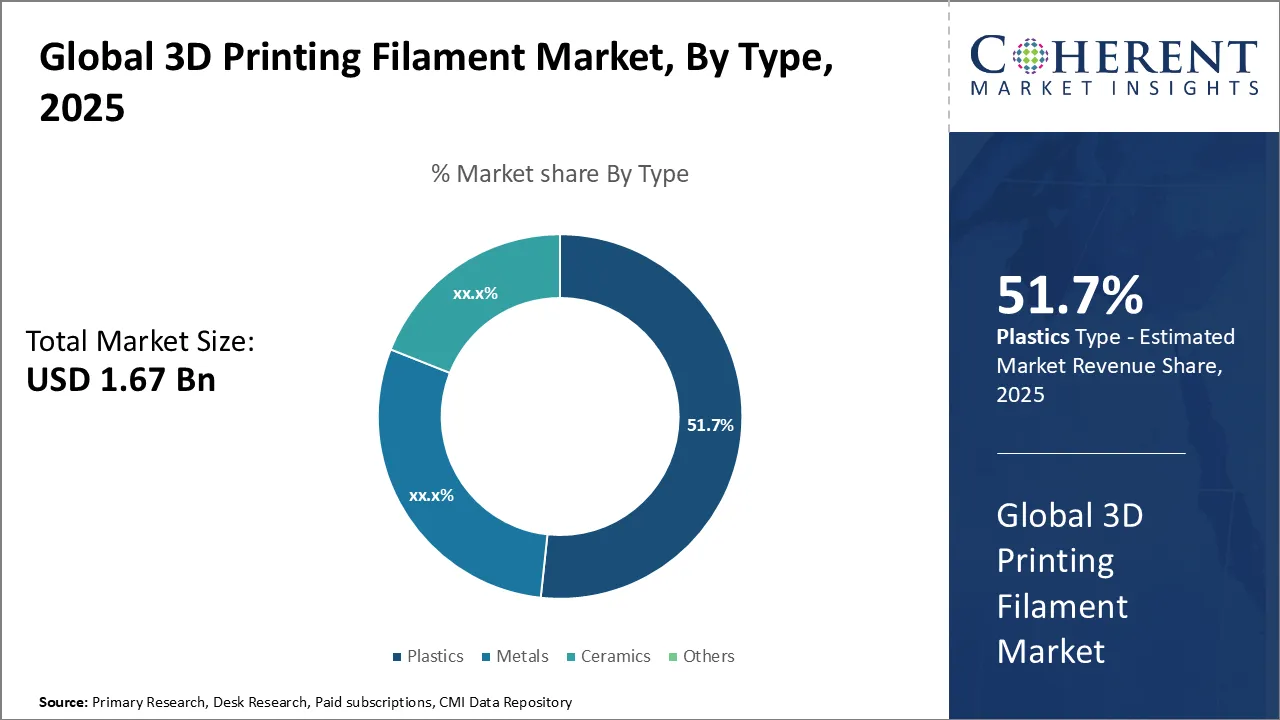
- The plastics segment is projected to account for 52.7 % of the market share in 2026.
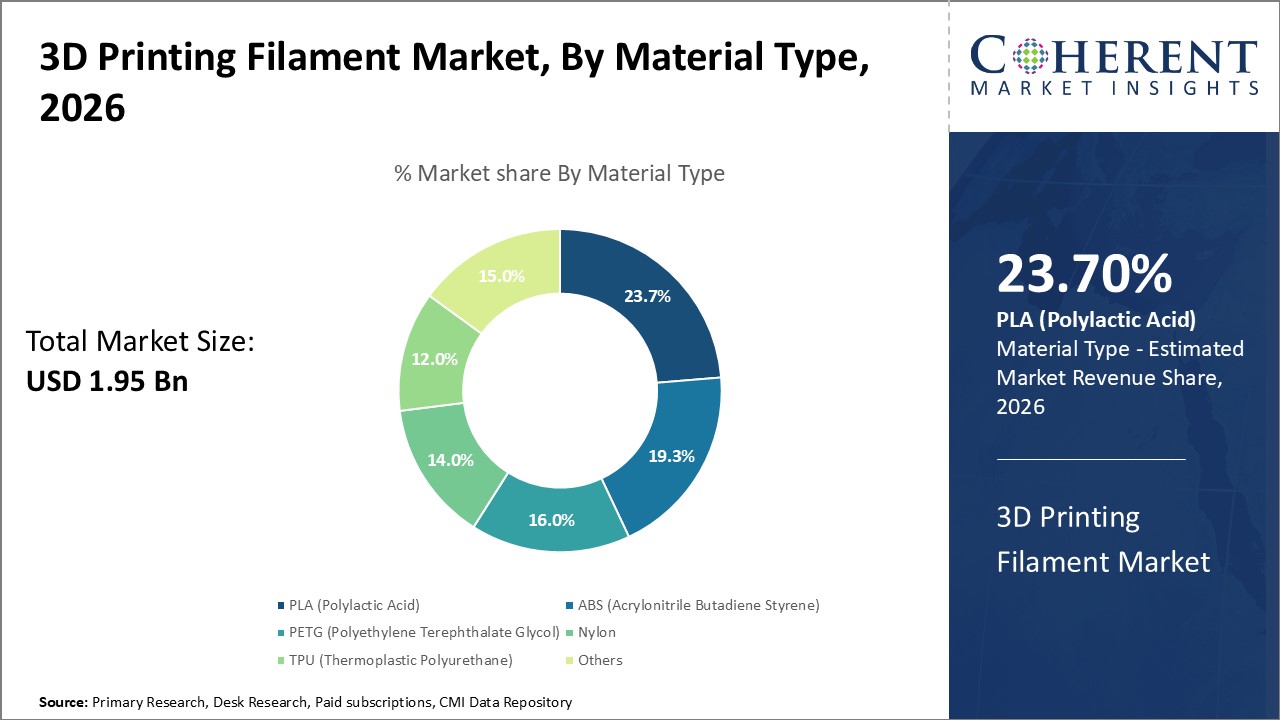
- The PLA (Polylactic Acid) segment is expected to account for 23.7 % of the market share in 2026.
- The aerospace segment is projected to capture 36.7 % of the 3D printing filament market share in 2026.
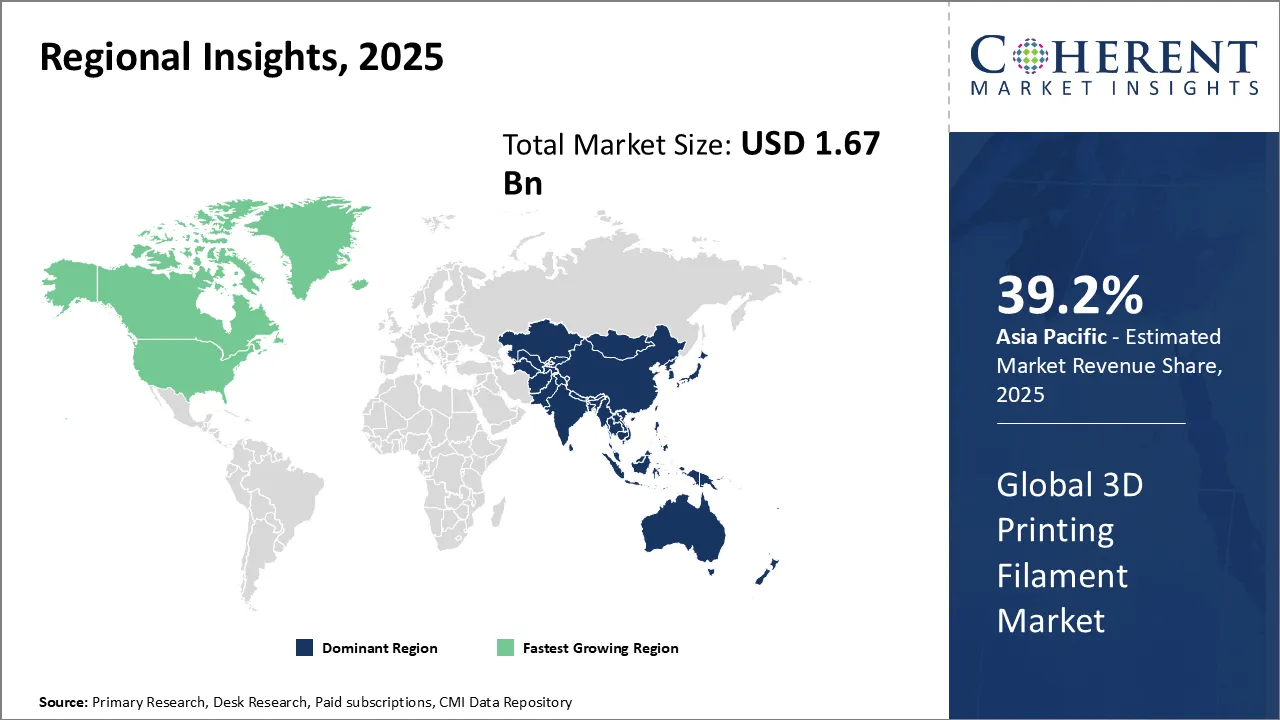
- Asia Pacific is expected to lead the global 3D printing filament market in 2026 with a 39.2 % share. North America is expected to hold a share of 24.5% in 2026, and it is the fastest-growing region.
Market Overview
Current market trends highlight a shift towards sustainable and innovative filament materials, with growing preference for biodegradable and recycled options to reduce environmental impact. Additionally, advancements in filament technology, such as improved strength and flexibility, are enabling broader application possibilities, enhancing the overall customer base, particularly in commercial printing. Integration of 3D printing with Industry 4.0 and smart manufacturing processes is further propelling the market, making filament materials an essential component for modern production techniques, while expanding opportunities in digital printing.
Current Events and Its Impact
Current Events | Description and its Impact |
Surge in Demand for Customized Manufacturing |
|
Adoption of AI and Automation in Filament Production |
|
Segmental Insights
- Current Industry Events of 2026
- Market Size Estimation
- Regional Breakdown
- Competitive Landscape
- Customer Intelligence
- Segmental Analysis
- Pricing Analysis
- Key Market Drivers, Challenges & Future Trends
- Customized Insights Section
3D Printing Filament Market Insights, by Type - Plastics Segment Contributes the Highest Share of the Market Owing to its Versatility, Cost-Effectiveness, and Wide-Ranging Application Potential
The plastics segment holds an estimated share of 52.7% in 2026, driven by their adaptability and broad appeal across multiple industries. Plastics, including thermoplastics such as PLA, Acrylonitrile Butadiene Styrene (ABS), and Polyethylene Terephthalate Glycol (PETG), offer superior ease of processing, which directly translates into greater efficiency and quality in 3D printing operations. One key factor fueling this segment’s growth is the extensive range of plastics available that cater to different mechanical and thermal requirements, allowing manufacturers and end-users to select materials tailored to specific needs without substantially driving up costs.
For instance, PLA has become the go-to material for educational institutions and prototyping companies due to its biodegradable nature, low toxicity, and ease of printing, which makes it ideal for desktop 3D printers widely used in academic settings and small businesses. This widespread adoption of PLA highlights how plastics not only dominate in volume but also serve diverse end-use requirements that are driving broader market expansion.
3D Printing Filament Market Insights, by Material Type - PLA (Polylactic Acid) Segment Leads the Market due to its Eco-Friendly Properties and User-Friendly Printing Characteristics
The PLA (Polylactic Acid) segment is expected to capture 23.7% share in 2026. PLA’s popularity stems largely from its sustainable, biodegradable nature as it is derived from renewable resources such as corn starch or sugarcane. This ecological advantage addresses growing environmental concerns, positioning PLA as the most acceptable filament choice in an era where sustainability increasingly influences purchasing decisions.
Additionally, PLA is well-suited for a wide range of users, from beginners to professionals, due to its low printing temperature requirements and minimal warping during printing. This ease of use means that the PLA filaments reduce printing defects and material waste, making it cost-effective in both prototyping and production environments. Its compatibility with most standard 3D printers reinforces its ubiquity as a filament material for various applications.
3D Printing Filament Market Insights, by Application – Aerospace Segment Dominates the Market due to the Demand for Precision-Engineered, Lightweight, and Customized Components
The aerospace segment is projected to hold 36.7% share in 2026, driven by the industry’s demand for advanced materials that provide significant weight savings while meeting stringent safety and performance standards. 3D printing enables aerospace manufacturers to produce complex geometries and lightweight parts that are either impossible or prohibitively expensive to fabricate using traditional subtractive manufacturing methods.
Weight reduction is a critical factor in aerospace manufacturing. Every gram saved translates directly into fuel efficiency and cost savings over the lifespan of an aircraft or spacecraft. Filaments used in aerospace must exhibit high mechanical strength, heat resistance, and durability under extreme environmental conditions. As such, the industry favors advanced plastic and metal filaments that provide a balance of weight and functional performance.
Regional Insights
Asia Pacific 3D Printing Filament Market Analysis and Trends
The Asia Pacific region is projected to lead the market with a 39.2% share in 2026, fueled by rapid industrialization, expanding manufacturing capabilities, and increasing adoption of advanced production techniques in countries like China, Japan, South Korea, and India. The region benefits from a large consumer base, growing startups ecosystem, and investments in additive manufacturing infrastructure.
Government initiatives such as China’s “Made in China 2026” and India’s “Make in India” campaigns directly incentivize innovation and production efficiency in emerging technologies including 3D printing. Key filament manufacturers and 3D printer OEMs are increasingly establishing regional production facilities to capitalize on lower operational costs and proximity to raw material sources. Leading companies like Shenzhen Esun Industrial Co., Ltd., and Mitsubishi Chemical Corporation are pivotal players driving product development and the market penetration.
North America 3D Printing Filament Market Analysis and Trends
The North America region is expected to exhibit the fastest growth in the market contributing 24.5% share in 2026, driven by a mature technological ecosystem, strong industrial base, and favorable government initiatives promoting additive manufacturing. The presence of leading Original Equipment Manufacturers (OEMs) and filament suppliers, coupled with extensive research and development activities, reinforces the region’s leadership. The U.S., in particular, benefits from supportive policies such as grants for advanced manufacturing and collaborations between academia and industry, fostering innovation in new filament materials.
Trade policies that encourage import of raw materials and export of value-added products further enhance North America 3D printing filament market position. Notable companies like Stratasys, 3D Systems, and MatterHackers contribute significantly, providing a broad spectrum of filament types tailored for aerospace, automotive, healthcare, and consumer goods sectors.
3D Printing Filament Market Outlook for Key Countries
U.S. 3D Printing Filament Market Trends
The U.S. 3D printing filament market is marked by a diverse filament material portfolio, focusing heavily on engineering-grade polymers such as Acrylonitrile Butadiene Styrene (ABS), Polyetherimide (PEI), and Polyetheretherketone (PEEK), catering to demanding industrial applications. Major entities like Stratasys and 3D Systems hold substantial influence through continuous innovation, particularly in biocompatible and high-performance filaments. Strong collaborations among government agencies, universities, and private players foster a dynamic environment where new filament technologies are rapidly prototyped and commercialized. The healthcare and aerospace sectors especially benefit due to stringent quality and certification standards, promoting the adoption of specialized filament materials.
China 3D Printing Filament Market Trends
China rapid expansion in the 3D printing filament market is driven by its vast manufacturing base, government-backed investments, and focus on automation and smart manufacturing solutions. The country's strategic push to reduce reliance on imports motivates domestic filament producers to improve quality and diversify product ranges. Companies such as Shenzhen Esun Industrial Co., Ltd. and Polymaker leverage cost-efficient production and extensive supply chain networks to serve both domestic and international markets. Additionally, the affordability of filaments and growing consumer awareness fuel rapid adoption in education, prototyping, and small-scale manufacturing segments.
Germany 3D Printing Filament Market Trends
Germany continues to lead Europe 3D printing filament market with its strong industrial heritage, particularly in automotive and machinery manufacturing sectors. The government's support for Industry 4.0 initiatives facilitates integration of 3D printing technology in traditional manufacturing workflows. Corporate giants like BASF and Evonik are instrumental in developing advanced filament materials with superior mechanical properties and sustainability features, aligning with increasing environmental regulations. The focus on high-precision and specialty filaments caters to Germany’s robust prototyping and serial production demands.
Japan 3D Printing Filament Market Trends
Japan 3D printing filament market benefits from its advanced material science capabilities and a strong emphasis on electronics and precision manufacturing. Companies such as Mitsubishi Chemical and Fujifilm are notable for investing in unique filament formulations including conductive and flexible materials. The Japanese government’s support for innovation, through subsidies and public-private partnerships, accelerates R&D in next-generation filaments designed for robotics and medical applications. Japan’s cautious yet steady adoption of the 3D printing technology complements its manufacturing culture centered on quality and reliability.
India 3D Printing Filament Market Trends
India 3D printing filament market is characterized by burgeoning startup activity and growing awareness about additive manufacturing benefits in automotive, healthcare, and consumer goods industries. Government initiatives like “Digital India” and support for innovation hubs stimulate domestic demand and encourage local filament producers to scale operations. Companies such as Imaginarium and Think3D are becoming key players by offering cost-effective filaments suited for prototyping and educational uses. While the market is still maturing, improving infrastructure and increased collaborations with global technology providers accelerate India’s ascent as a prominent market in the Asia Pacific region.
End User Feedback and Unmet Needs
- End users of 3D printing filaments across key sectors such as industrial manufacturing, utilities, healthcare, and government bodies share a range of feedback regarding product performance, accessibility, and operational integration. Industrial users, particularly in aerospace, automotive, and medical device manufacturing, emphasize the critical need for filaments that meet stringent mechanical, thermal, and regulatory requirements.
- For example, aerospace manufacturers express satisfaction with high-performance carbon fiber-reinforced nylon filaments, which enable the production of lightweight, durable components that reduce fuel consumption by up to 7% compared to traditional parts. This highlights a positive user experience where advanced filament properties directly support operational efficiency and product innovation. Conversely, a frequently cited concern among end-users is the lack of standardization across filament specifications and printer compatibility.
- The unmet needs in the 3D printing filament market are multifaceted. There is a clear gap in technological advancement regarding universal filament compatibility and standardized quality assurance protocols. End-users seek greater customization options tailored to specific industrial applications while also desiring more affordable high-performance materials and streamlined support for regulatory compliance. Moreover, accessibility challenges persist in emerging markets and among smaller users who cannot easily invest in expensive printer upgrades or certified filaments.
- Addressing these needs could unlock significant growth opportunities for manufacturers and developers by expanding market adoption and improving end-user satisfaction. Introducing standardized filament dimensions, enhanced quality certifications, and cost-effective high-performance options could reduce operational disruptions and foster trust among industrial users.
Market Players, Key Development, and Competitive Intelligence
Key Developments
- In May 2025, Stratasys announced the acquisition of Forward AM, the former BASF Additive Manufacturing business. The unit will operate as a standalone company within Stratasys under the new name Mass Additive Manufacturing GmbH.
- In February 2025, Stratasys Direct’s Tucson, Arizona facility achieved ISO 13485 certification, a key quality management standard for medical device manufacturing. This milestone strengthens regulatory compliance and supports scalable production of complex, patient-specific medical components.
- In June 2024, Arkema granted SEQENS exclusive rights to produce PEKK (under the Kepstan trademark) for long-term medical implantable applications. Building on a 15-year collaboration, the agreement enables SEQENS to commercialize IMPEKK materials as potential alternatives to titanium and PEEK through its global manufacturing and distribution network.
Top Strategies Followed by Global 3D Printing Filament Market Players
- Established market leaders invest heavily in research and development to innovate high-performance filaments that meet the evolving demands of industries such as aerospace, automotive, healthcare, and consumer goods. These companies focus on creating advanced materials with superior strength, flexibility, and heat resistance to cater to specialized applications. By forging alliances and joint ventures, these established players solidify their presence across key industrial segments.
- For example, Stratasys Ltd. and 3D Systems, introduced advanced composite filaments infused with carbon fiber and high-temperature polymers to serve aerospace and automotive clients requiring lightweight yet strong components.
- Mid-level competitors within the 3D printing filament market adopt a different yet effective competitive strategy focused on cost-effective solutions that strike a balance between quality and affordability. Targeting price-sensitive end-users such as educational institutions, small businesses, and hobbyists, these players emphasize producing reliable filaments that meet essential performance standards without the premium price tag.
- For example, eSUN, a leading Chinese filament brand, gained popularity in academic and prototyping environments by providing reliable PLA and PETG filaments at competitive price points, often partnering with regional distributors to scale accessibility.
- Small-scale players and startups in the 3D printing filament market leverage specialized strategies to compete effectively against industry giants and mid-tier firms. Concentrating on niche markets, these companies develop filaments with unique features such as eco-friendly biodegradable materials, custom color blends, or filaments designed for specific printing technologies like FDM or SLA. By adopting cutting-edge manufacturing techniques and rapid prototyping tools, small players remain agile and innovative, quickly responding to emerging customer demands and technological trends.
- For example, Filamentive (UK) emphasizes eco-friendly biodegradable filaments made from recycled materials, appealing to sustainability-conscious users and industries adopting green initiatives.
Market Report Scope
3D Printing Filament Market Report Coverage
| Report Coverage | Details | ||
|---|---|---|---|
| Base Year: | 2025 | Market Size in 2026: | USD 1.95 Bn |
| Historical Data for: | 2020 To 2024 | Forecast Period: | 2026 To 2033 |
| Forecast Period 2026 to 2033 CAGR: | 17.0% | 2033 Value Projection: | USD 5.86 Bn |
| Geographies covered: |
| ||
| Segments covered: |
| ||
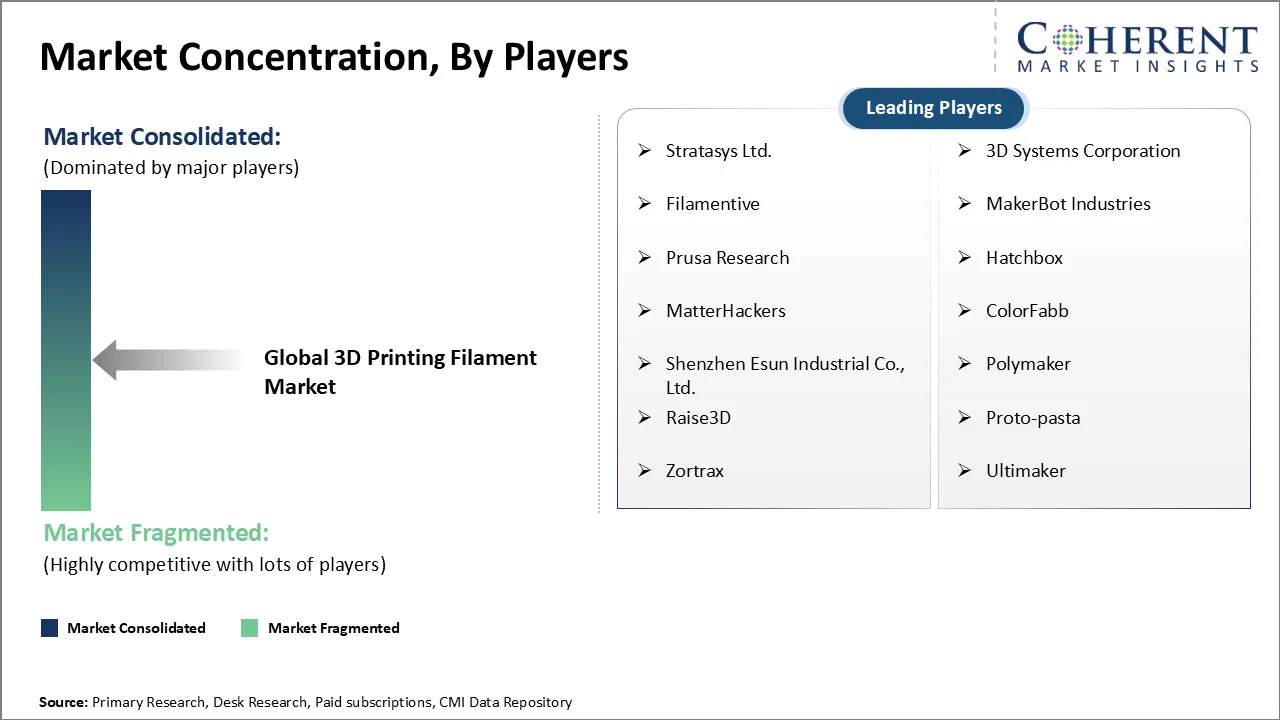
| Companies covered: | Stratasys Ltd., 3D Systems Corporation, Filamentive, MakerBot Industries, Prusa Research, Hatchbox, MatterHackers, ColorFabb, Shenzhen Esun Industrial Co., Ltd., Polymaker, Raise3D, Proto-pasta, Zortrax, and Ultimaker | ||
| Growth Drivers: |
| ||
| Restraints & Challenges: |
| ||
3D Printing Filament Market Dynamics
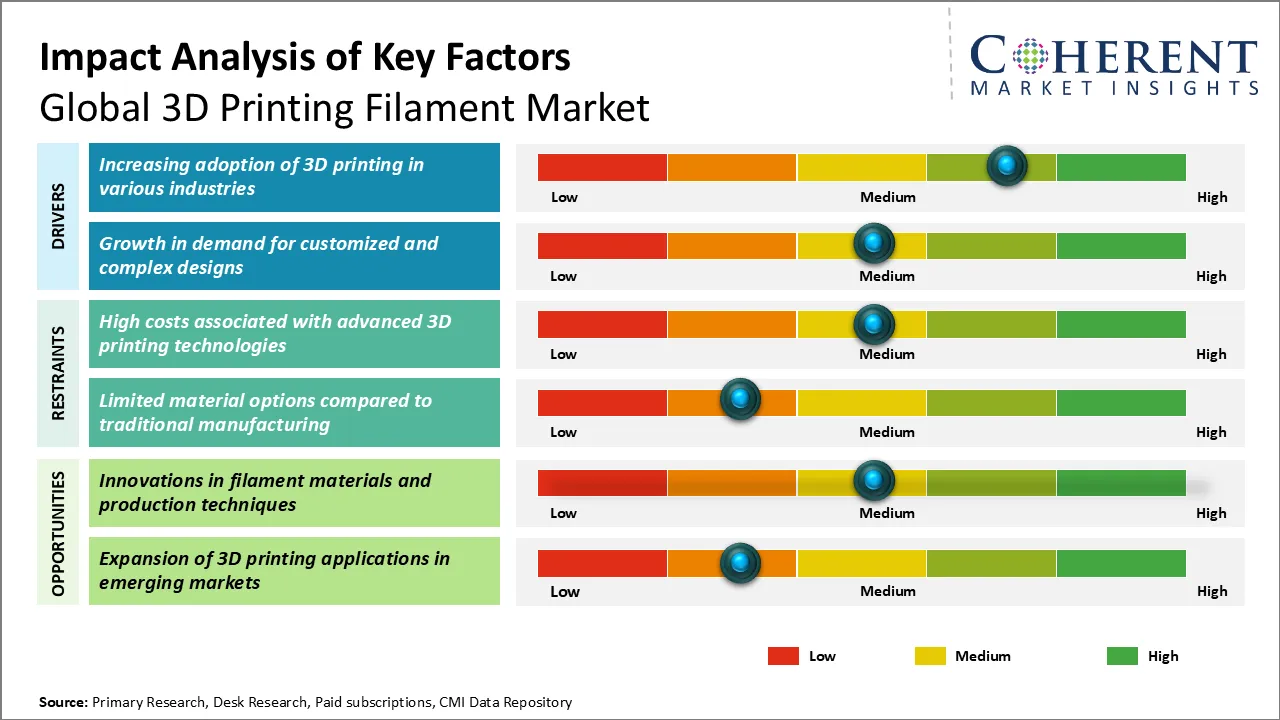
3D Printing Filament Market Driver - Increasing Adoption of 3D Printing in Various Industries
The growing adoption of 3D printing technology across a wide range of industries serves as a major driver for the global 3D printing filament market. Industries such as automotive, aerospace, healthcare, and consumer goods are increasingly integrating additive manufacturing into their production processes due to its ability to enable rapid prototyping, customization, and complex design fabrication with reduced material waste. This shift is accelerating demand for high-performance and specialized filaments that can meet specific mechanical, thermal, and chemical property requirements unique to each sector.
For example, in the automotive sector, companies like BMW and Ford have deployed 3D printing to produce lightweight prototypes and customized tooling components, driving demand for high-performance filaments such as carbon fiber-reinforced PLA and ABS. Similarly, in the aerospace industry, Airbus and Boeing use advanced filaments like PEEK (polyether ether ketone) and ULTEM for manufacturing lightweight yet durable interior parts, which helps in improving fuel efficiency and reducing operational costs.
3D Printing Filament Market Opportunity - Innovations in Filament Materials and Production Techniques
The global 3D printing filament market stands to benefit significantly from continuous innovations in filament materials and production techniques. Advances in material science are enabling the creation of new filaments with enhanced properties such as greater strength, flexibility, heat resistance, and biodegradability. These innovations enable manufacturers to produce functional end-use parts rather than mere prototypes, particularly evident in aerospace components requiring lightweight yet durable materials, medical implants demanding biocompatibility, and automotive parts needing heat resistance.
For instance, according to the U.S. Department of Energy's Advanced Manufacturing Office, additive manufacturing technologies utilizing advanced materials have demonstrated up to 90% material waste reduction compared to traditional subtractive manufacturing processes, highlighting the environmental and economic advantages driving adoption.
Analyst Opinion (Expert Opinion)
- The global 3D printing filament market is poised for transformative growth, fueled by innovations in materials and expanding applications across industries. Insights from the 3D Printing Industry Conference (2023) and the Additive Manufacturing Expo (2022) highlighted significant advancements, with companies like MatterHackers and Prusa Research at the forefront of developing high-performance filaments.
- MatterHackers’ recent launch of a biodegradable filament exemplifies the industry's shift towards sustainability, aligning with increasing consumer and regulatory demands for eco-friendly solutions. Discussions at these events emphasized the critical role of material diversity, particularly the rise of specialty filaments like carbon fiber composites, which are gaining traction in aerospace and automotive sectors for their superior strength and lightweight properties. However, challenges such as filament consistency and supply chain disruptions were noted as potential hurdles.
- Companies that invest in R&D to enhance filament quality and explore new material formulations will likely secure a competitive edge. Moreover, strategic collaborations with educational institutions and research organizations can drive innovation and market growth. Ultimately, the 3D printing filament market future will depend on its ability to innovate while addressing sustainability and material performance challenges effectively.
Speak to the analyst
Want personalized insights?
Take the findings above to one of our principal consultants, or have the report rebuilt around the segments, geographies and competitors you actually track.
Sources
Primary Research Interviews
- R&D Director – Leading 3D Printing Filament Manufacturer (PLA, ABS, PETG)
- Procurement Manager – Major Additive Manufacturing Service Bureau
- Product Development Head – Global OEM specializing in FDM printers
- Sustainability Manager – Materials Certification Body (Bioplastics & Recyclable Filaments)
Stakeholders
- Manufacturers – Filament producers, polymer companies, composite material developers
- End Use Sectors:
- Aerospace & Defense (lightweight prototyping and parts)
- Automotive (tooling, prototyping, lightweight parts)
- Healthcare (medical devices, prosthetics, dental)
- Consumer Goods & Electronics (toys, home appliances, gadgets)
- Education & Research Institutions (STEM adoption, prototyping)
- Regulatory & Certification Bodies – ISO, ASTM International, REACH, RoHS
- E-commerce Platforms and Retailers – Amazon, MatterHackers, 3DPrima, FilamentOne
- Technology Integration Players – AI-driven design optimization and filament quality monitoring startups
Databases
- UN Comtrade Database (plastics, polymers, and filament trade flows)
- U.S. International Trade Commission (USITC) Import/Export Data
- India Import Export (EXIM) Database (3D printing raw materials)
Magazines
- 3D Printing Industry Magazine – Global additive manufacturing trends and innovations
- TCT Magazine – 3D printing technologies and material advances
- Additive Manufacturing Media – Industrial adoption of filaments and polymers
- Make Magazine – Consumer-level 3D printing and filament updates
- 3D Printing World – Market updates and material developments
Journals
- Additive Manufacturing (Elsevier) – Research on filament development and composites
- Journal of Manufacturing Processes – Advances in 3D printing filaments for industry
- Rapid Prototyping Journal – Studies on filament usability and mechanical properties
- Journal of Materials Research – Polymer science and composites for 3D printing
- Polymers (MDPI) – Biodegradable and high-performance filament innovations
Newspapers
- The Financial Times – Market growth and investments in additive manufacturing
- The Guardian – Sustainability and environmental impact of plastic materials
- The New York Times – Consumer trends in 3D printing adoption
- South China Morning Post – Asia-Pacific’s role in filament manufacturing
- Business Standard (India) – India’s polymer and 3D printing filament market developments
Associations
- ASTM International – Additive Manufacturing Standards Committee (F42)
- ISO/TC 261 – International Standards for Additive Manufacturing
- America Makes – U.S. National Additive Manufacturing Innovation Institute
- European Association for Additive Manufacturing (CECIMO Additive)
- 3D Printing Materials Association (regional industry bodies)
Public Domain Sources
- U.S. FDA – Guidelines on 3D printed medical devices and materials safety
- European Commission – Regulations on polymer safety and sustainability
- U.S. Department of Energy (DOE) – Reports on advanced manufacturing materials
- World Intellectual Property Organization (WIPO) – Patent activity in 3D filaments
- OECD – Reports on additive manufacturing adoption and sustainability
Proprietary Elements
- CMI Data Analytics Tool, Proprietary CMI Existing Repository of information for last 8 years.
Get access to 250+ pages report
Every segment, forecast, competitor profile and data table behind the analysis above — available for instant download.
- ESOMAR Member
- ISO 9001:2015 Certified
- D-U-N-S Registered
- GDPR & CCPA Compliant
Missing comfort of reading report in your local language? Find your preferred language:
Transform your Strategy with Exclusive Trending Reports
Frequently Asked Questions
The global 3D printing filament market is estimated to be valued at USD 1.95 Bn in 2026 and is expected to reach USD 5.86 Bn by 2033.
The CAGR of the global 3d printing filament market is projected to be 17.0% from 2026 to 2033.
Increasing adoption of 3D printing in various industries and growth in demand for customized and complex designs are the major factors driving the growth of the global 3D printing filament market.
High costs associated with advanced 3D printing technologies and limited material options compared to traditional manufacturing are the major factors hampering the growth of the global 3D printing filament market.
In terms of type, the plastics segment is estimated to dominate the market revenue share in 2026.
Stratasys Ltd., 3D Systems Corporation, Filamentive, MakerBot Industries, Prusa Research, Hatchbox, MatterHackers, ColorFabb, Shenzhen Esun Industrial Co., Ltd., Polymaker, Raise3D, Proto-pasta, Zortrax, and Ultimaker are the major players.
Asia Pacific is expected to lead the global 3D printing filament market in 2026.