

Cryogenic Valves Market Size and Forecast – 2026 to 2033
Cryogenic Valves Market is estimated to be valued at USD 2,325.5 Mn in 2026 and is expected to reach USD 3,450.7 Mn in 2033, exhibiting a compound annual growth rate (CAGR) of 5.8% from 2026 to 2033.
Key Takeaways
- By Product Type, Ball Valve acquired the prominent share of 37% in 2026 on account of dominance of ball valves in LNG sector.
- By Gas, Liquified Natural Gas hold the largest market share in 2026 owing to the rapid expansion of global LNG infrastructure.
- By End User Industry, Oil and Gas dominates the overall market share in 2026 owing to the expansion of oil & gas infrastructure.
- By Region, North America dominates the overall market with an estimated share of 38% in 2026 owing to the leading market share and robust growth.
Market Overview
Rising demand from industries such as LNG, oil and gas, healthcare, and aerospace is driving the cryogenic valves market growth. These valves handle liquefied gases at extremely low temperatures, ensuring safe and efficient transport, storage, and processing. Companies are investing more in LNG infrastructure and adopting cleaner energy sources like hydrogen, which further fuels market expansion. Technological advancements in valve design and increasing industrialization across regions are also accelerating the global adoption of cryogenic valves.
Current Events and their Impact on the Cryogenic Valves Market
Current Events | Description and its impact |
Geopolitical Shifts in Energy Policy |
|
Regional Infrastructure Investments and Projects |
|
Supply Chain Disruptions and Raw Material Pricing |
|
End-user Feedback and Unmet Needs in the Cryogenic Valves Market
- Reliability and Performance: End-users emphasize the need for cryogenic valves that deliver consistent and reliable operation under harsh, ultra-low temperature conditions. Failures or inconsistencies can cause costly downtime and safety risks, so durability and leak-proof designs remain a top priority for long-term confidence in valve performance.
- Maintenance and Serviceability: Customers want cryogenic valves that are easy to maintain with minimal downtime. Quick access to parts, reduced servicing frequency, and simplified repair procedures are essential. Improved serviceability helps reduce operational interruptions and lowers overall maintenance costs, meeting the demands of highly regulated industries.
- Customization and Application Specificity: End-users often require cryogenic valves customized for unique industry applications, such as hydrogen fuel systems or LNG transport. Standard valves sometimes fall short in specialized scenarios, prompting demand for tailored solutions that match specific pressure, temperature, and flow requirements.
- Current Industry Events of 2026
- Market Size Estimation
- Regional Breakdown
- Competitive Landscape
- Customer Intelligence
- Segmental Analysis
- Pricing Analysis
- Key Market Drivers, Challenges & Future Trends
- Customized Insights Section
Price Ranges in India
Category | Typical Price Range (USD) |
Simple Stainless Steel Ball Valves | USD 640 – USD 920 |
Electric Ball Valves | USD 985 – USD 3,500 |
ASCO Brass Cryogenic Valves | USD 2,040 – USD 2,770 |
Imported Globe/Changeover Valves | USD 600 – USD4,100+ |
Industrial Bulk (China suppliers) | USD 203 – USD 214 (SS ball valves) |
Low-cost Bulk (Brass/Globe) | Less than USD 50 (manual, large MOQ) |
Pneumatic Globe Valves (China) | USD 595 – USD 4,850 |
Segmental Insights
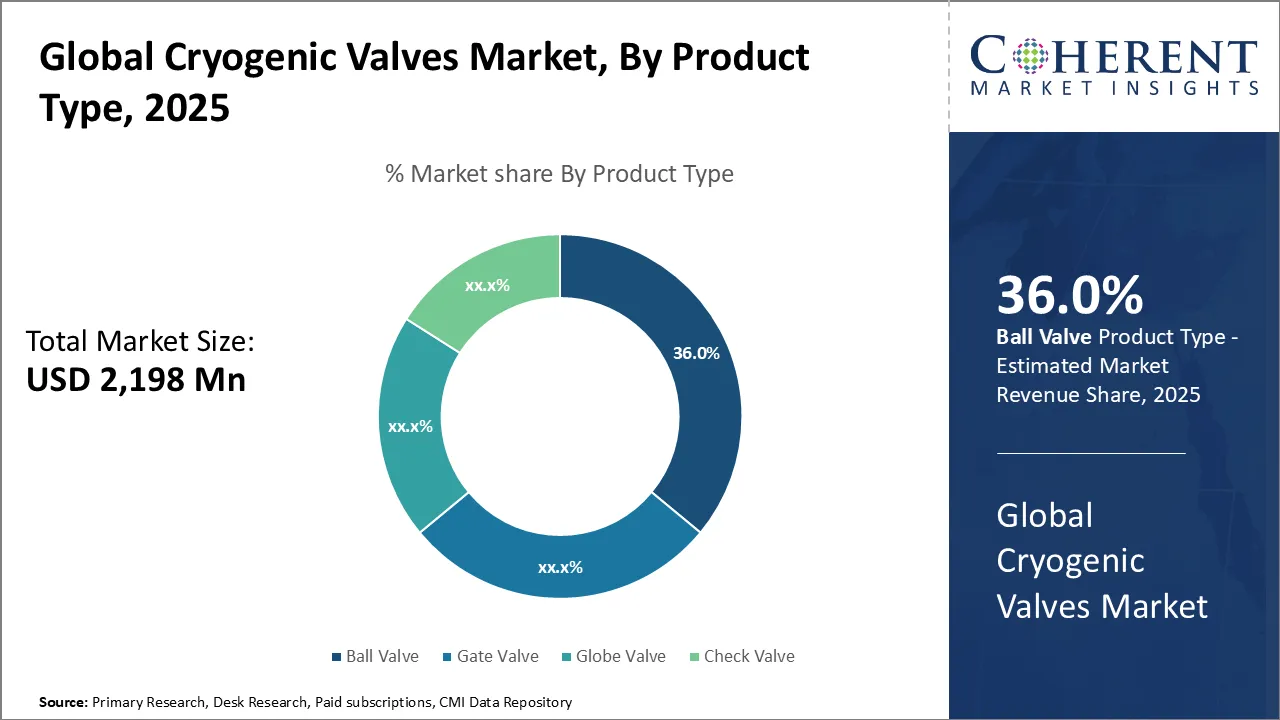
Cryogenic Valves Market Insights, By Product Type: Ball Valve contribute the highest share of the market owing to its expanding LNG infrastructure
Ball Valve acquired the prominent share of 37% in 2026. The cryogenic valves market sees growing demand for ball valves as industries prioritize their durability, fast shut-off function, and dependable performance in extremely low temperatures. Energy companies widely use them in LNG production, storage, and transportation, making ball valves a favored solution across the sector. The rising use of liquefied gases like hydrogen and industrial gases drives further adoption. Manufacturers continue to improve sealing technology and automation, which boosts the efficiency and suitability of ball valves for diverse cryogenic operations. For instance, in December 2024, Salvalco announced that it is expanding its Eco-Valve family by introducing the Eco-Inverted ball valve. They designed the new valve specifically for use with inert gas propellants like nitrogen, ensuring it delivers all the great benefits of the Eco-Valve, including superior performance while minimizing environmental impact. Such advancements are propelling the cryogenic valves market share.
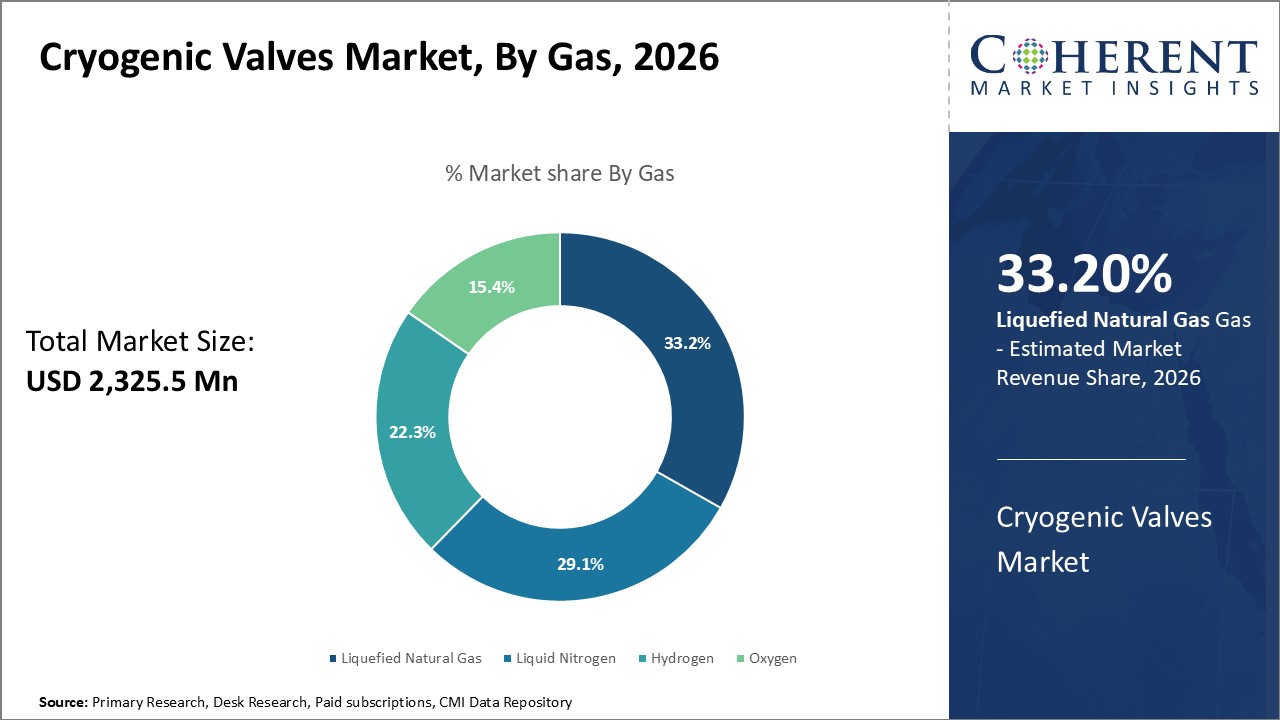
Cryogenic Valves Market Insights, By Gas: Liquified Natural Gas contribute the highest share of the market owing to its marine & bunkering applications
The growing use of liquefied natural gas (LNG) as a cleaner energy source drives strong demand in the cryogenic valves market. Energy companies expand LNG infrastructure—such as liquefaction plants, storage terminals, and transport systems—boosting the need for dependable cryogenic flow control. They use cryogenic valves to manage LNG safely at extremely low temperatures. As global markets shift toward low-emission fuels and LNG trade increases, industries continue to invest in advanced cryogenic valve solutions to support efficient and secure operations.
For instance, in June 2024, Flowserve Corporation, a leading provider of flow control products and services for global infrastructure markets, acquired the intellectual property and in-process R&D related to cryogenic Liquefied Natural Gas (LNG) submerged pump technology, systems, and packaging from NexGen Cryogenic Solutions, Inc., a privately held Arizona-based company specializing in engineering, designing, and testing LNG pumps and turbines.
Cryogenic Valves Market Insights, By End User Industry: Oil & Gas contribute the highest share of the market owing to its cleaner fuel transition & energy policy support
The oil and gas sector drives demand for cryogenic valves by expanding infrastructure for extracting, processing, and transporting liquefied gases. Companies increasingly rely on LNG, boosting the need for durable and efficient cryogenic valves. They adopt advanced valve technologies to meet strict safety regulations and support the shift toward cleaner fuels. Continuous investments in pipeline networks, storage facilities, and processing plants maintain market growth by requiring reliable flow control solutions designed for extremely low-temperature environments.
For instance, in April 2025, Emerson, an industrial technology and automation company, opened a new Global LNG Solutions Centre in Qatar to promote innovation, sustainability, and workforce development in the expanding LNG industry. The centre offers advanced solutions such as mission-critical control and safety systems, cryogenic-rated valves, fire and gas detection systems, and tools for corrosion prevention, emissions monitoring, and asset optimization.
Regional Insights
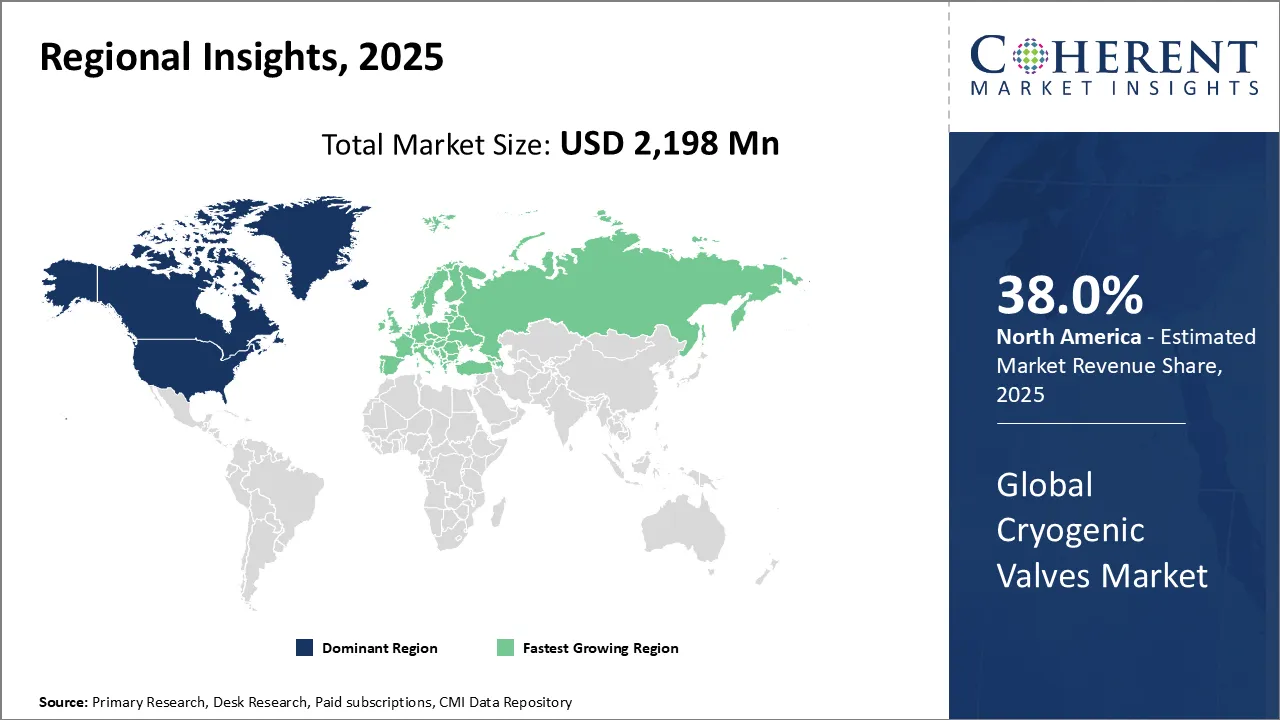
North America Cryogenic Valves Market Trends
North America dominates the overall market with an estimated share of 38.0% in 2026. Innovation and diversification drive the evolution of North America’s cryogenic valves market. Growing demand from LNG exports, aerospace, and healthcare sectors pushes manufacturers to develop specialized valves. The focus on sustainability encourages the adoption of valves designed for hydrogen and other clean energy uses. Companies invest significantly in digital technologies and smart solutions to improve valve performance and maintenance. Strong domestic production and supportive regulations help North America maintain its role as a leading force in the global cryogenic valves market.
For instance, in July 2026, Butting announced planned to establish its North American headquarters and its first U.S. production facility as part of a USD 61 million expansion initiative. As a global leader in stainless steel pipe manufacturing, Butting specializes in clad pipes, customized spools and components, as well as cryogenic pipe and valve technology.
Europe Cryogenic Valves Market Trends
Environmental regulations and clean energy adoption drive the advancement of Europe’s cryogenic valves market. The region prioritizes integrating valves into hydrogen infrastructure and LNG terminals to achieve its energy transition goals. European manufacturers enhance valve reliability and reduce emissions by developing innovative designs and materials. Governments and industries collaborate to promote research and development, accelerating technological progress. Increased use of cryogenic valves in pharmaceuticals and aerospace also helps strengthen Europe’s position in the global market.
For instance, in June 2026, Spain Based PLD Space developed a MIURA 5 launcher's key system—the TEPREL-C engines—by actively designing, manufacturing, and testing new components required for orbital flight. The company has created its own turbopumps, gas generators, and a new line of cryogenic valves entirely from scratch.
United Kingdom Cryogenic Valves Market Trends
The United Kingdom is expanding its LNG import capacity and developing hydrogen energy projects, driving growth in its cryogenic valves market. Investments in renewable energy and low-carbon initiatives increase demand for advanced cryogenic valves that provide safety and efficiency at ultra-low temperatures. UK manufacturers focus on innovating valve materials and automation to comply with strict regulatory standards. Growing requirements for cryogenic technology in healthcare and industrial gas sectors also contribute to market expansion, establishing the UK as a key player in cryogenic valve applications.
United States Cryogenic Valves Market Trends
Expanding LNG export facilities and the growing use of hydrogen as an alternative fuel drive growth in the United States cryogenic valves market. Manufacturers respond to increasing investments in energy infrastructure and stricter safety regulations by developing high-performance, durable valves designed for extreme temperatures. The country’s robust industrial base fosters innovations in valve automation and digital monitoring technologies. Additionally, rising demand from aerospace, healthcare, and industrial gas sectors fuels market expansion, establishing the U.S. as a key center for cryogenic valve development. For instance, with nearly 20 years of experience in the cryogenic and gas industry, Ratermann Manufacturing has launched a new division called Ratermann Cryogenics. This new division will offer exceptional support to customers with cryogenic needs.
Market Report Scope
Cryogenic Valves Market Report Coverage
| Report Coverage | Details | ||
|---|---|---|---|
| Base Year: | 2025 | Market Size in 2026: | USD 2,325.5 Mn |
| Historical Data for: | 2020 To 2024 | Forecast Period: | 2026 To 2033 |
| Forecast Period 2026 to 2033 CAGR: | 5.8% | 2033 Value Projection: | USD 3,450.7 Mn |
| Geographies covered: |
| ||
| Segments covered: |
| ||
| Companies covered: | Velan Inc., Samson AG, Parker Hannifin Corp., Meca-Inox, L&T Valves Limited, Herose GmbH, Flowserve Corporation, Emerson Electric Co., ECI LLC, Cryofab, Bray International, Baker Hughes (General Electric), Bac Valves, Powell Valves, and Habonim Industrial Valves & Actuators Ltd. | ||
| Growth Drivers: |
| ||
| Restraints & Challenges: |
| ||
Cryogenic Valves Market Trend
- Expansion of LNG Infrastructure
The growth of liquefied natural gas (LNG) infrastructure worldwide is a major trend shaping the cryogenic valves market. Increasing construction of liquefaction plants, storage terminals, and export facilities drives demand for highly reliable valves that can operate safely at ultra-low temperatures. As LNG trade expands, industries prioritize valves with enhanced durability and leak resistance to maintain operational efficiency and safety during the liquefaction, storage, and transportation processes.
U.S. LNG export capacity is set to grow 75% by 2030, driven by new project approvals from major firms like Cheniere and Venture Global.
- Adoption of Hydrogen and Clean Energy
The rising focus on clean energy solutions accelerates the adoption of hydrogen fuel and other low-emission gases, creating new opportunities for cryogenic valves. These valves must meet stringent standards for handling ultra-cold hydrogen safely and efficiently. The push towards decarbonization compels manufacturers to innovate valve designs with improved sealing technologies, corrosion resistance, and compatibility with renewable energy applications, supporting the broader energy transition.
Cryogenic Valves Market Opportunity
- Hydrogen Economy Development
The emerging hydrogen economy offers vast potential for cryogenic valves, as hydrogen storage and transport rely heavily on low-temperature technologies. Governments and private sectors are investing in hydrogen production, fueling infrastructure, and distribution networks. This creates a need for valves specifically designed to handle hydrogen’s unique properties safely. Manufacturers can capitalize on this trend by innovating materials and designs that enhance valve performance, durability, and safety in hydrogen-related applications, positioning themselves as key players in clean energy markets.
Cryogenic Valves Market News
- In August 2025, Pune-based deep-tech space startup Astrophel Aerospace has secured Rs 60.84 million in a pre-seed funding round led by a group of individuals and angel venture firms. The company will use the funds to develop a reusable semi-cryogenic launch vehicle and to scale up its in-house R&D for building missile-grade guidance systems and components.
Analyst Opinion (Expert Opinion)
- The cryogenic valves market is at a pivotal juncture where technological innovation and strategic energy shifts are redefining competitive dynamics. From my analysis, it’s clear that the ongoing LNG infrastructure boom, particularly in regions like the U.S. Gulf Coast and Qatar, is not just expanding demand—it is setting a new benchmark for valve performance under extreme conditions. For instance, the recent Sabine Pass LNG expansion project in Louisiana, which doubled its export capacity, underscores how valve suppliers that deliver ultra-reliable, zero-leakage solutions gain a decisive advantage.
- Furthermore, the rapid emergence of hydrogen as a mainstream energy carrier is reshaping product requirements. Traditional valve designs fall short in hydrogen applications due to its low molecular weight and propensity for leakage. Companies like Swagelok and Emerson have begun pioneering next-gen sealing technologies, employing advanced metal alloys and composite materials, positioning themselves ahead in a market that expects stringent durability and safety standards. I believe this pivot towards hydrogen-compatible valves will dictate market leadership in the next five years.
- On automation, integrating IoT and AI-driven diagnostics is no longer optional—it’s fundamental. The deployment of smart cryogenic valves with real-time health monitoring, as seen in Shell’s Quest CCS project, reduces unplanned shutdowns by upwards of 30%, directly impacting operational expenditure. This trend elevates vendors who invest heavily in digital ecosystems, creating barriers for traditional valve manufacturers reliant on legacy technologies.
Speak to the analyst
Want personalized insights?
Take the findings above to one of our principal consultants, or have the report rebuilt around the segments, geographies and competitors you actually track.
Market Segmentation
- By Product Type (Revenue, USD Mn, 2021 - 2033)
- Ball Valve
- Check Valve
- Gate Valve
- Globe Valve
- Others
- By Gas (Revenue, USD Mn, 2021 - 2033)
- Liquefied Natural Gas
- Liquid Nitrogen
- Hydrogen
- Oxygen
- Other Gases
- By End-User Industry (Revenue, USD Mn, 2021 - 2033)
- Chemicals
- Oil and Gas
- Energy and Power
- Food and Beverages
- Medical
- Other End-user Industries
- Cryogenic Valves Market, By Region (Revenue, USD Mn, 2021 - 2033)
- North America
- U.S.
- Canada
- Latin America
- Brazil
- Argentina
- Mexico
- Rest of Latin America
- Europe
- Germany
- U.K.
- Spain
- France
- Italy
- Russia
- Rest of Europe
- Asia Pacific
- China
- India
- Japan
- Australia
- South Korea
- ASEAN
- Rest of Asia Pacific
- Middle East
- GCC Countries
- Israel
- Rest of Middle East
- Africa
- South Africa
- North Africa
- Central Africa
- North America
- Key Players Insights
- Velan Inc.
- Samson AG
- Parker Hannifin Corp.
- Meca-Inox
- L&T Valves Limited
- Herose GmbH
- Flowserve Corporation
- Emerson Electric Co.
- ECI LLC
- Cryofab
- Bray International
- Baker Hughes (General Electric)
- Bac Valves
- Powell Valves
- Habonim Industrial Valves & Actuators Ltd.
Sources
Primary Research Interviews
- Industry Experts
- Valve Manufacturers
- End-Users
- Technical Specialists Involved in Cryogenic Valve Production and Application.
Databases
- Government Trade and Industry Databases
- International Trade Statistics
- Patent Databases.
Magazines
- Industry-specific publications such as Valve World
- Flow Control Magazine
- Cryogenics Today.
Journals
- Peer-reviewed journals including Journal of Pressure Vessel Technology
- Cryogenics
- Industrial & Engineering Chemistry Research.
Newspapers
- The Wall Street Journal
- Financial Times
- The Economic Times.
Associations
- International Valve Federation (IVF)
- American Society of Mechanical Engineers (ASME)
- Cryogenic Society of America (CSA).
Public Domain Sources
- Government Reports
- Regulatory Filings
- Patent Filings
- Open-Access Scientific Publications.
Proprietary Elements
- CMI Data Analytics Tool and Proprietary CMI Existing Repository of information for last 8 years.
Get access to 250+ pages report
Every segment, forecast, competitor profile and data table behind the analysis above — available for instant download.
- ESOMAR Member
- ISO 9001:2015 Certified
- D-U-N-S Registered
- GDPR & CCPA Compliant
Missing comfort of reading report in your local language? Find your preferred language:
Transform your Strategy with Exclusive Trending Reports
Frequently Asked Questions
The Cryogenic Valves Market is estimated to be valued at USD 2,325.5 Mn in 2026, and is expected to reach USD 3,450.7 Mn by 2033.
An increase in oil and gas exploration activities and increasing demand from the chemical industry are fueling the growth of the market.
The CAGR of the Cryogenic Valves Market is projected to be 5.8% from 2026 to 2033.
Key Companies are Velan Inc., Samson AG, Parker Hannifin Corp., Meca-Inox, L&T Valves Limited, Herose GmbH, Flowserve Corporation, Emerson Electric Co., ECI LLC, Cryofab, Bray International, Baker Hughes (General Electric), Bac Valves, Powell Valves, and Habonim Industrial Valves & Actuators Ltd., among others.
Safety concerns regarding the operation of liquefied gases and the high cost of production are major factors restraining growth of the market.