

Global Agar Gum Market Size and Forecast – 2026 To 2033
The Global Agar Gum Market is estimated to be valued at USD 352.6 Mn in 2026 and is expected to reach USD 535.4 Mn by 2033, growing at a compound annual growth rate (CAGR) of 6.1% from 2026 to 2033. Market expansion is supported by agar gum’s natural gelling, thickening, stabilizing, and texturizing properties across food, pharmaceuticals, bio technology, and cosmetics industry.
Growing preference for plant-based alternatives to animal-derived gelatin is also widening its use in new food formulations. In August 2024, Ajinomoto Co., Inc launched Atlr.72 Flowering Mooncakes in Singapore, using agar instead of animal gelatin in the product’s guimauve filling. The development demonstrates how major food manufacturers are incorporating agar into environmentally conscious, plant-oriented formulations, supporting broader commercial adoption of agar-based ingredients.
Key Takeaways of the Global Agar Gum Market
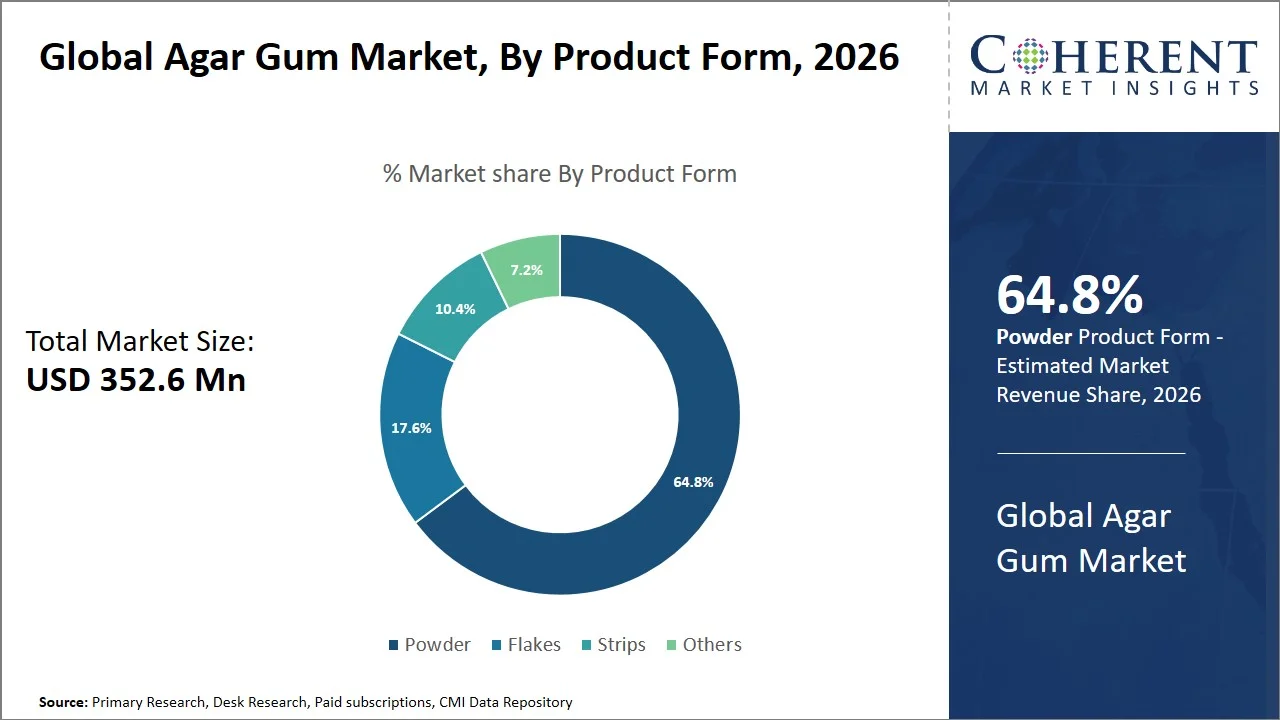
- Powder agar gum segment is projected to register an estimated CAGR of 6.4% during 2026–2033 and account for 64.8% of the global agar gum market in 2026. Its dominance reflects easier handling, longer shelf stability, and suitability for standardized industrial formulations across food and laboratory uses. In June 2025, Meron highlighted its agar powder portfolio for food, pharma, and bacteriological applications.
- Gracilaria agar gum segment is estimated to achieve a CAGR of 6.2% from 2026–2033 and represent 57.6% of the market in 2026. Its position is supported by scalable cultivation, reliable extraction characteristics, and expanding seaweed value chains. In March 2025, India’s Ministry of Fisheries reported initiatives supporting Gracilaria cultivation for agar production through national seaweed development programs.
- Food and Beverage application is expected to record an estimated CAGR of 6.0% during 2026–2033 and capture 48.7% of the global agar gum market in 2026. Growth is associated with agar’s role as a plant-based gelling, stabilizing, and texturizing ingredient in multiple food formulations. In April 2025, B&V Agar Company showcased food-grade agar solutions for beverage and food processing applications.
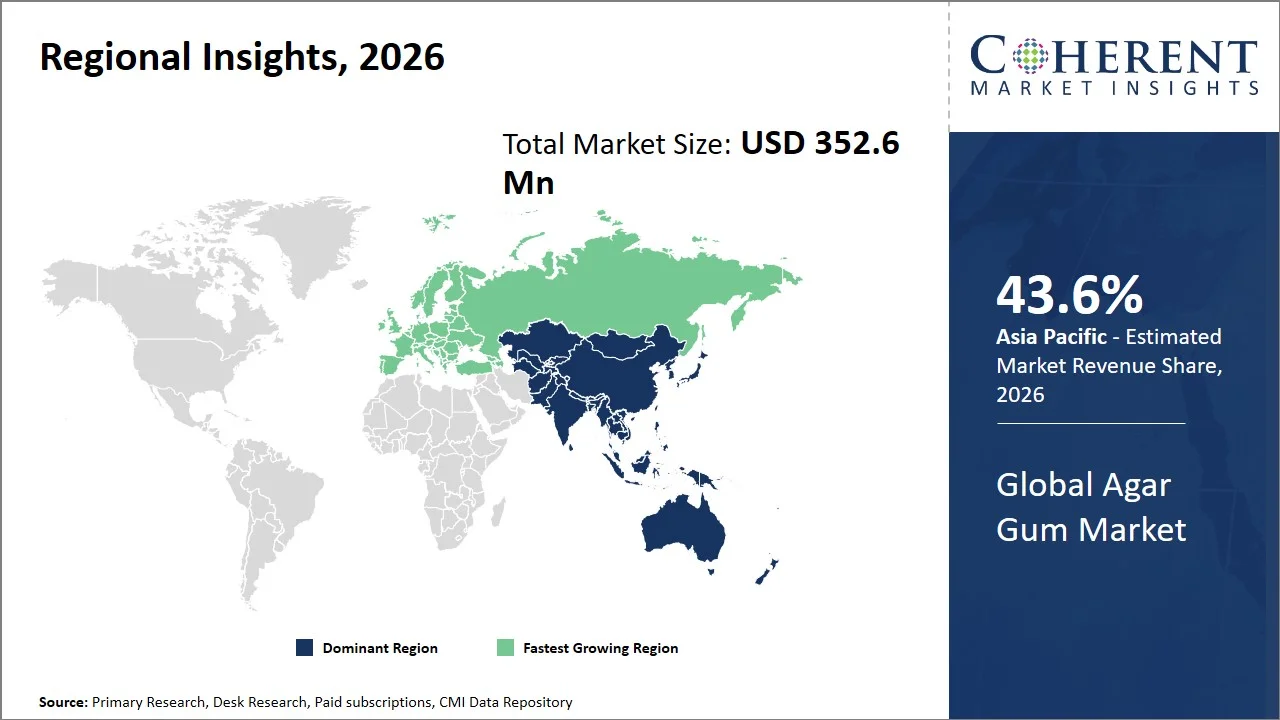
- Asia Pacific agar gum market is forecast to register an estimated CAGR of 6.3% between 2026–2033 and account for 43.6% of global revenue in 2026. The region benefits from established seaweed cultivation ecosystems, processing capabilities, and strong consumption of agar-based foods. In June 2025, ICAR-CIBA demonstrated a seaweed-shrimp integrated farming model in India involving Gracilaria cultivation.
- Europe agar gum market is anticipated to achieve an estimated CAGR of 6.8% from 2026–2033 and contribute 25.7% of the global market in 2026. Expansion is supported by demand for clean-label hydrocolloids, regulatory acceptance of natural ingredients, and advanced food ingredient applications. In May 2025, the European Commission continued maintaining agar as an approved food additive under the E-406 classification framework.
Segmental Insights
Why Does Powder Dominate the Global Agar Gum Market?
Powder agar gum leads the product form category with market share 64.8% in 2026 of the global agar gum market due to its superior versatility, longer shelf stability, ease of transportation, and compatibility with industrial-scale formulation processes. Food manufacturers, microbiology laboratories, pharmaceutical companies, and biotechnology users prefer powder formats because they allow accurate dosing, faster dispersion, and consistent functional performance compared with other forms such as flakes or strips. From a supply perspective, powder production enables standardized grading based on gel strength, viscosity, and purity, supporting applications requiring precise specifications. Manufacturers benefit from wider distribution opportunities as powder formats are easier to package and export globally. In March 2025, Meron highlighted its range of food-grade agar powder grades designed for applications including confectionery, dairy, and food stabilization, demonstrating continued commercial focus on powder-based agar solutions.
- Current Industry Events of 2026
- Market Size Estimation
- Regional Breakdown
- Competitive Landscape
- Customer Intelligence
- Segmental Analysis
- Pricing Analysis
- Key Market Drivers, Challenges & Future Trends
- Customized Insights Section
Why Does Gracilaria Represent the Largest Raw Material Source Category in the Global Agar Gum Market?
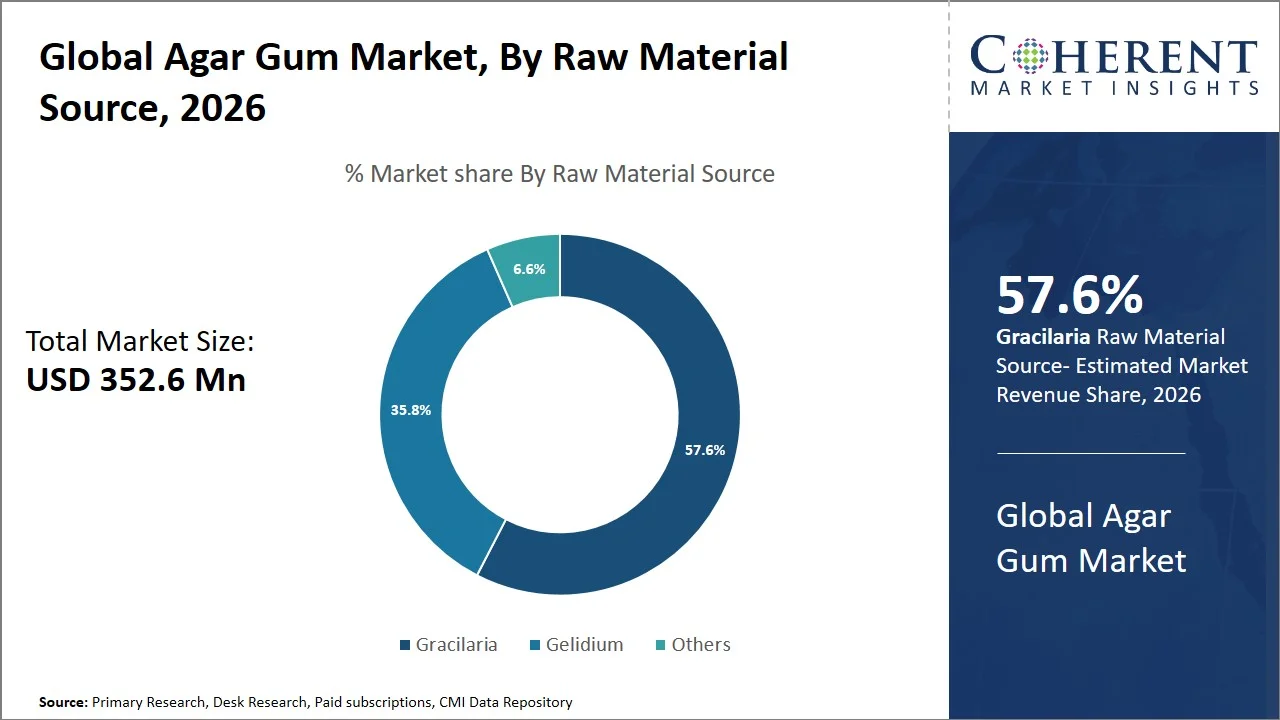
Gracilaria maintains leadership among agar raw material sources with expected market share of 57.6% of the global agar gum market in 2026 due to its suitability for commercial cultivation, reliable agar yield, and broader availability across tropical and subtropical coastal regions. Unlike some wild-harvested seaweed sources, Gracilaria cultivation provides greater control over biomass supply, enabling processors to improve production planning and reduce raw-material uncertainty. The species is widely utilized for food-grade agar production because of its adaptability to farming systems and compatibility with industrial extraction processes. This creates opportunities for integrated suppliers that combine cultivation, preprocessing, and agar manufacturing capabilities. In June 2025, India’s Science, Technology and Innovation portal highlighted CSIR-Central Salt and Marine Chemicals Research Institute’s technology for producing food-grade agar from cultivated Gracilaria edulis and Gracilaria debilis, supporting sustainable biomass production and improved agar quality.
Why Do Food and Beverage Dominate the Application Category of the Global Agar Gum Market?
Food and beverage applications account for the largest share of 48.7% in 2026 of agar gum consumption due to its functional role as a natural gelling, thickening, and stabilizing ingredient across confectionery, desserts, bakery fillings, dairy alternatives, and processed foods. Food manufacturers select agar because it provides strong gel formation, clean texture, plant-based positioning, and compatibility with vegetarian and vegan formulations. Suppliers serving this segment increasingly focus on customized grades that meet specific processing requirements such as dissolution behavior, firmness, and sensory performance. The commercial opportunity is strongest among ingredient manufacturers capable of supporting formulation development rather than supplying only commodity agar. In March 2025, the Government of India highlighted that cultivated Gracilaria edulis is widely used for agar production serving food applications, reinforcing the importance of reliable agar supply for food processing industries.
Current Events and their Impact
Current Event | Description and Its Impact |
India’s GST Rationalization Covering Agar-Agar – September 2025 |
|
USDA National Organic Program Agar-Agar Technical Review – February 2026 |
|
Global Agar Gum Market Dynamics
Key Market Drivers
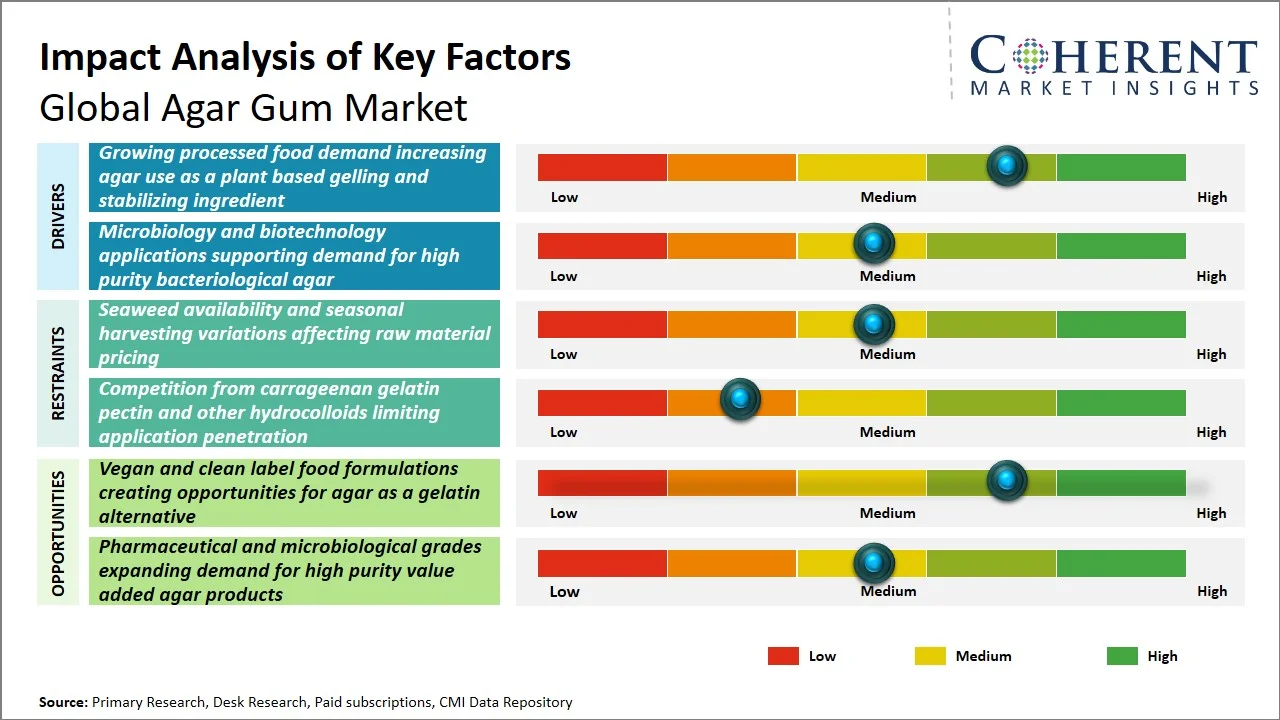
- Growing Processed Food Demand Increasing Agar Use as a Plant-Based Gelling and Stabilizing Ingredient: Processed-food manufacturers increasingly require texture systems that simplify production while delivering stable gels, icings, confectionery, dairy-style desserts, and bakery formulations. Agar is commercially attractive because its thermos reversible gel behavior, strong setting characteristics, and plant origin allow formulators to replace or complement gelatin and other hydrocolloids. This broadens purchasing among industrial bakeries, confectionery manufacturers, dessert processors, and ingredient-premix suppliers while favoring agar producers capable of application-specific formulation support. In August 2025, Vantage introduced Perma-Frost No-Boil, an agar-based icing stabilizer for commercial frosted baked goods designed to eliminate the boiling-water preparation step while maintaining shelf life and product quality. The development demonstrates how agar can create value not merely as a gelling ingredient but as a processing-efficiency solution for large-scale food production.
- Microbiology and Biotechnology Applications Supporting Demand for High-Purity Bacteriological Agar: Solid culture media for microbiological testing must support colony growth that is reproducible, have a controlled strength of the gel, be clear, and contain minimal inhibitory impurities. As a result, the bacteriological agar is ordered on technical specifications and not just commodity price, and this benefits suppliers with a tight control of purity, mineral content, pH, syneresis and batch consistency. There are regular demands for validated grades from food and water laboratories, pharmaceutical quality-control labs, prepared-media manufacturers and environmental laboratories. In July 2024, the Bureau of Indian Standards issued it IS 13428:2024 product manual for packaged natural mineral water, whose microbiological testing requirements identify chromogenic coliform agar containing bacteriological agar within the prescribed medium formulation. This illustrates how formal testing protocols translate directly into continuing consumption of laboratory-grade agar and strengthen the commercial importance of documented quality, traceability, and dependable technical performance.
Emerging Market Trends
- Shift from Commodity Agar Toward Application-Engineered Texture Systems: Agar suppliers are increasingly developing customized solutions focused on gel strength, dissolution behavior, mouthfeel, and processing performance rather than competing only on standard powder grades. Food manufacturers are evaluating ingredients based on formulation outcomes, creating opportunities for suppliers offering technical support, blended hydrocolloid systems, and application-specific grades. This shift favors companies with formulation expertise and application laboratories while increasing pressure on commodity-focused producers.
- Greater Buyer Scrutiny of Seaweed Traceability and Processing Methods: Agar buyers are placing greater emphasis on raw-material origin, harvesting practices, processing controls, and supply-chain transparency, especially for premium food, pharmaceutical, and regulated applications. Suppliers with traceable seaweed sourcing, standardized processing, and strong quality documentation are better positioned to meet evolving procurement requirements. Over time, traceability is expected to become a key supplier qualification factor rather than only a sustainability consideration.
Regional Insights
Why Does Asia Pacific Dominate the Global Agar Gum Market?
The Asia Pacific region is projected to retain its dominance in the global agar gum market, accounting for 43.6% of the market share in 2026 owing to its conducive seaweed cultivation ecosystem, existing infrastructure for agar processing, and the presence of key raw material suppliers. Countries like China, Japan, India, and Indonesia offer Gracilaria and Gelidium resources that allow the regional producers to cater the application to food, microbiology, pharmaceutical and biotechnology fields. The area is characterized by historical use of agar and related products, growth of food processing industries and rising demand for functional hydrocolloids. The increase of investment in seaweed farming and value-added marine biotechnology also further boosts supply security. In January 2025, India’s Ministry of Fisheries, Animal Husbandry and Dairying highlighted continued efforts to promote seaweed cultivation through government-supported programs, supporting the development of marine-based ingredient supply chains.
Why Is Europe Emerging as the Fastest-Growing Region in the Global Agar Gum Market?
Europe is projected to be the fastest-growing region in the global agar gum market, representing 25.7% share in 2026, driven by increasing adoption of natural hydrocolloids, clean-label food ingredients, and sustainable alternatives to synthetic additives. Food manufacturers across Europe are increasingly reformulating products with plant-derived stabilizers, while pharmaceutical and microbiology industries continue to require high-purity agar grades. Strong regulatory standards for food safety and ingredient transparency are encouraging suppliers to improve traceability, quality certification, and specialty-grade production capabilities. The region’s advanced food processing sector and premium product positioning create opportunities for customized agar solutions. In February 2025, the European Commission continued implementation of its regulatory framework for approved food additives, including agar (E406), reinforcing compliance requirements for ingredient suppliers operating in European markets.
Global Agar Gum Market Outlook for Key Countries
Why Is the U.S. a Key Market for the Global Agar Gum Market?
The U.S. is a significant market for the global agar gum market owing to its diversified application across the food manufacturing, microbiology laboratories, biotechnology research and pharmaceutical applications. The country's sophisticated food processing industry enables the application of Agar as a natural gelling and stabilizing agent for specialty food, desserts, dairy products and functional formulations. Moreover, a large research infrastructure and biotechnology industry continue to demand bacteriological agar for use in the culture media. Marine derived hydrocolloids are also highly dependent on imports, which further demands that suppliers are reliable, their products are certified as of good quality and that they adhere to regulatory standards. Manufacturers are seeing more use of premium food trends, clean label and plant-based ingredients. In April 2025, The U.S. Food and Drug Administration continued to approve agar as a food ingredient under the food additive regulatory program for its use in food applications.
Why Is India Important in the Global Agar Gum Market?
India plays a significant role in the global agar gum market due to its extensive coastline, expanding seaweed cultivation initiatives, and growing domestic processing capabilities. The country provides access to Gracilaria-based raw materials and has established marine biotechnology programs supporting the development of seaweed-derived products. Agar demand is supported by food processing, microbiology laboratories, pharmaceutical research, and institutional users requiring reliable hydrocolloid materials. Government focus on blue economy initiatives and alternative livelihood opportunities through seaweed farming is improving raw material availability and encouraging downstream value creation. Indian producers also benefit from cost advantages and export potential to international markets. In March 2025, the Ministry of Fisheries, Animal Husbandry and Dairying promoted seaweed cultivation activities under fisheries development initiatives, supporting broader commercialization of marine resources.
Why Does China Support Growth in the Global Agar Gum Market?
China supports the global agar gum market through its large-scale food processing industry, extensive marine resource base, and established hydrocolloid manufacturing capabilities. The country has a strong position in seaweed cultivation, processing infrastructure, and export-oriented ingredient production, allowing domestic suppliers to serve both regional and international customers. Agar demand is supported by applications in food products, laboratory culture media, biotechnology research, and industrial formulations. China’s advanced manufacturing ecosystem enables efficient production of different agar grades, including food-grade and high-purity variants, while domestic consumption of jelly products and processed foods provides additional demand. The country’s expanding marine biotechnology sector is also encouraging higher-value utilization of seaweed resources. In June 2025, China’s Ministry of Agriculture and Rural Affairs continued promoting marine economic development initiatives, including sustainable utilization of ocean resources, supporting long-term opportunities for seaweed-based industries.
Why Is Japan a Strategic Country in the Global Agar Gum Market?
Japan remains strategically important in the global agar gum market due to its historical expertise in agar production, advanced food technology ecosystem, and strong demand for high-quality functional ingredients. Agar has deep relevance in Japanese food culture, particularly in traditional desserts and processed foods, while pharmaceutical and biotechnology industries require consistent-quality agar grades. Japanese manufacturers emphasize purity, processing precision, and specialized applications, creating opportunities for premium agar products rather than only commodity supply. The country’s aging population and healthcare-focused research environment further support demand for laboratory and pharmaceutical-grade materials. Japan’s strong quality standards also influence broader market expectations for traceability and performance consistency. In August 2024, Japan’s Fisheries Agency continued initiatives supporting sustainable utilization of marine resources, reinforcing the importance of responsible seaweed resource management.
Why Is Indonesia an Important Growth Market for the Global Agar Gum Market?
Indonesia represents an emerging growth market for the global agar gum market due to its extensive marine resources, favorable coastal conditions, and increasing focus on seaweed-based industries. The country is one of the world’s important seaweed-producing regions, providing access to raw materials used in hydrocolloid production. Expansion of seaweed farming communities and improvements in processing capabilities are creating opportunities for greater participation in the global agar supply chain. Domestic food industries, export-oriented processing, and government-supported blue economy initiatives are strengthening the commercial potential of marine-derived ingredients. Indonesia’s ability to expand cultivation while improving value-added processing will determine its future competitiveness in agar production. In October 2024, Indonesia’s Ministry of Marine Affairs and Fisheries continued supporting seaweed development programs aimed at strengthening coastal economic activities and marine product value chains.
Technology Adoption Landscape in the Global Agar Gum Market
Technology | Adoption Level | Key Application Area | Business Impact |
Alkaline Pretreatment of Gracilaria | High | Food-grade agar extraction | Reduces sulfate-related performance limitations and improves gel strength, enabling processors to achieve more consistent commercial specifications from cultivated Gracilaria feedstock. |
Controlled Hot-Water Extraction | High | Agar extraction from processed red seaweed | Precise management of temperature, residence time, and processing conditions supports extraction yield, polymer functionality, batch consistency, and efficient scale-up. |
Pressure and Membrane-Based Hot-Gel Filtration | Medium | Clarification of extracted agar liquor | Improves removal of suspended solids, supports higher product clarity, reduces dependence on labor-intensive filtration, and can improve throughput and process yield. |
Mechanical Gel Pressing and Dehydration | High | Concentration before drying | Removes substantial water from gel before final drying, lowering downstream thermal load and supporting higher-capacity, more economical industrial production. |
Freeze-Thaw Dehydration | Medium | Specialty and higher-purity agar grades | Provides strong gel purification and water separation characteristics but involves longer processing cycles and greater energy requirements than mechanical pressing. |
Controlled Milling, Sieving and Agar Instantization | Medium | Quick-dissolve powders and customized formulation grades | Allows suppliers to engineer particle size, dispersion, dissolution behavior, and application-specific functionality, supporting premiumization and more predictable customer processing. |
How Are Commercial Micropropagation and Plant Tissue Culture Creating New Growth Opportunities in the Global Agar Gum Market?
Commercial plant tissue culture represents an attractive but comparatively underdeveloped opportunity for agar suppliers seeking business beyond conventional food and routine microbiology applications. Micropropagation laboratories require culture-media gelling agents with reliable transparency, controlled firmness, low impurity levels, and consistent performance across sterilization cycles, making product reproducibility particularly important. Demand can emerge from horticultural nurseries, seed companies, forestry programs, agricultural biotechnology laboratories, ornamental-plant producers, and disease-free planting-material operations. Agar manufacturers can capture this opportunity by developing plant-culture-specific grades supported by detailed quality certificates, contamination controls, application guidance, and smaller laboratory-oriented packaging alongside industrial formats. Technical collaboration with media formulators and micropropagation laboratories can also help suppliers optimize gel firmness for different plant species and protocols. Entry requires stronger analytical testing and quality documentation than commodity food-grade production. Specialist agar processors and vertically integrated suppliers are therefore likely to be advantaged, although technically capable new entrants could build defensible niches through application-focused product development and responsive laboratory support.
Market Players, Key Development, and Competitive Landscape
Key Developments
- In April 2026, Green Future Food Hydrocolloid Marine Science Company Limited reported continuing investment in product technology, including development of higher-value hydrocolloid solutions and quick-dissolve agar targeted at dairy applications. The company positioned value-added processing as a means of improving product mix and profitability. This is important for the global agar gum market because it shows major manufacturers seeking margin expansion through functionality and processing convenience rather than depending solely on conventional agar volumes.
- In February 2025, Kao Corporation announced the development of a humidity-responsive UV protection film technology using agar hydrogel capsules within cosmetic formulations. This innovation demonstrates agar’s expanding role beyond traditional food and laboratory applications into advanced personal-care formulations. The development is important for the global agar gum market because it highlights opportunities for specialty agar grades with controlled gel properties, moisture retention capability, and compatibility with sophisticated cosmetic delivery systems.
Competitive Landscape
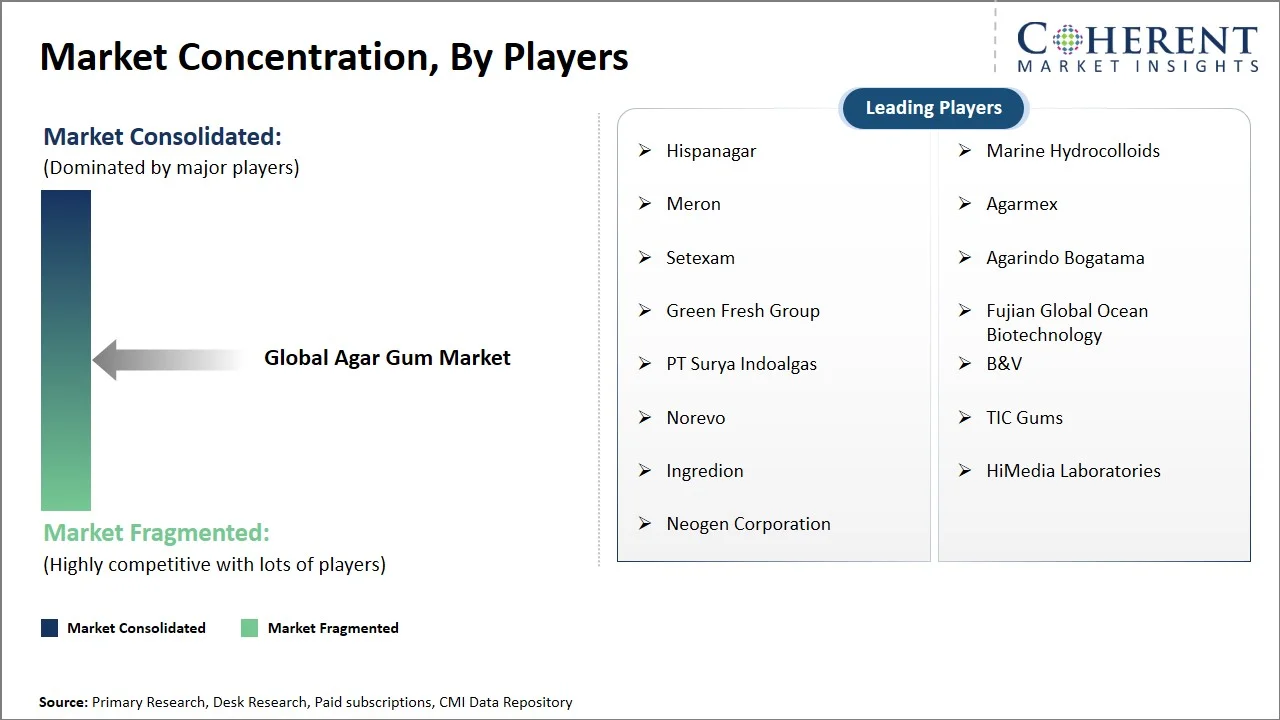
The global agar gum market is moderately fragmented, combining large hydrocolloid processors, integrated seaweed extractors, regional agar specialists, laboratory-grade suppliers, and distributors. Competitive advantage depends less on brand scale alone than on access to consistent seaweed feedstock, control of extraction and purification, grade-specific quality assurance, supply continuity, regulatory documentation, and application expertise. Regional processors can compete effectively through proximity to raw materials and cost-efficient production, whereas specialty suppliers differentiate through high-purity grades, customized functionality, certifications, and technical customer support. Long-term competitiveness increasingly depends on the ability to protect product consistency despite seasonal variability in biological raw materials.
Key focus areas include
- Raw-material control: Securing dependable Gracilaria and Gelidium supply reduces production variability and procurement exposure.
- Batch consistency: Stable gel strength, viscosity, color, clarity, and microbiological quality are essential to repeat industrial purchasing.
- Grade differentiation: Food, bacteriological, pharmaceutical, tissue-culture, and specialty agar require distinct technical specifications.
- Process efficiency: Improved filtration, dehydration, drying, and milling can reduce conversion costs while protecting functional performance.
- Certification capability: Food-safety, organic, pharmaceutical, and customer-specific documentation increasingly influences supplier qualification.
- Technical service: Application testing and formulation support create stronger customer retention than commodity sales alone.
- Channel architecture: Direct B2B relationships support customized industrial grades, while specialist distributors remain important for laboratory and smaller-volume customers.
- Supply resilience: Multi-origin sourcing and inventory planning provide an advantage when seasonal seaweed quality or availability changes.
Market Report Scope
Agar Gum Market Report Coverage
| Report Coverage | Details | ||
|---|---|---|---|
| Base Year: | 2025 | Market Size in 2026: | USD 352.6 Mn |
| Historical Data for: | 2020 To 2024 | Forecast Period: | 2026 To 2033 |
| Forecast Period 2026 to 2033 CAGR: | 6.1% | 2033 Value Projection: | USD 535.4 Mn |
| Geographies covered: |
| ||
| Segments covered: |
| ||
| Companies covered: | Hispanagar, Marine Hydrocolloids, Meron, Agarmex, Setexam, Agarindo Bogatama, Green Fresh Group, Fujian Global Ocean Biotechnology, PT Surya Indoalgas, B&V, Norevo, TIC Gums, Ingredion, HiMedia Laboratories, Neogen Corporation | ||
| Growth Drivers: |
| ||
| Restraints & Challenges: |
| ||
Analyst Opinion (Expert Opinion)
- The global agar gum market leadership is likely to shift toward suppliers combining raw-material control, application expertise, quality documentation, and customized grades. Buyers will increasingly prioritize predictable performance and technical support, enabling differentiated suppliers to strengthen customer retention and reduce direct price-based competition.
- Greater control over seaweed quality at cultivation and preprocessing stages could reshape agar production economics. Managing species, harvest maturity, and pretreatment more precisely may reduce variability, favor integrated suppliers while pressure processors dependent on inconsistent spot-market raw materials.
- Producers should prioritize raw-material diversification, batch consistency, efficient dehydration, contamination control, and specialty-grade development. Higher-value laboratory, pharmaceutical, and plant-culture applications deserve greater focus, while excessive investment in undifferentiated food-grade capacity should be avoided without secured feedstock and demand.
Speak to the analyst
Want personalized insights?
Take the findings above to one of our principal consultants, or have the report rebuilt around the segments, geographies and competitors you actually track.
Market Segmentation
- Product Form Insights (Revenue, USD Mn, 2021 - 2033)
- Powder
- Flakes
- Strips
- Others
- Raw Material Source Insights (Revenue, USD Mn, 2021 - 2033)
- Gracilaria
- Gelidium
- Others
- Application Insights (Revenue, USD Mn, 2021 - 2033)
- Food and Beverage
- Microbiology and Culture Media
- Pharmaceuticals and Nutraceuticals
- Cosmetics and Personal Care
- Biotechnology and Research
- Others
- Distribution Channel Insights (Revenue, USD Mn, 2021 - 2033)
- Direct Sales
- Indirect Sales
- Regional Insights (Revenue, USD Mn, 2021 - 2033)
- North America
- U.S.
- Canada
- Latin America
- Brazil
- Argentina
- Mexico
- Rest of Latin America
- Europe
- Germany
- U.K.
- Spain
- France
- Italy
- Russia
- Rest of Europe
- Asia Pacific
- China
- India
- Japan
- Australia
- South Korea
- ASEAN
- Rest of Asia Pacific
- Middle East
- GCC Countries
- Israel
- Rest of Middle East
- Africa
- South Africa
- North Africa
- Central Africa
- North America
- Key Players Insights
- Hispanagar
- Marine Hydrocolloids
- Meron
- Agarmex
- Setexam
- Agarindo Bogatama
- Green Fresh Group
- Fujian Global Ocean Biotechnology
- PT Surya Indoalgas
- B&V
- Norevo
- TIC Gums
- Ingredion
- HiMedia Laboratories
Sources
Primary Research Interviews
- Agar manufacturers, seaweed processors, hydrocolloid producers, and bacteriological agar suppliers
- Gracilaria and Gelidium cultivators, raw-material traders, distributors, and processing-equipment suppliers
- Food, pharmaceutical, biotechnology, cosmetics, and microbiology end users
- Procurement managers, formulation scientists, microbiologists, R&D executives, and industry consultants
Stakeholders
- Agar manufacturers, seaweed cultivators, processors, and hydrocolloid companies
- Raw-material suppliers, distributors, importers/exporters, packaging and logistics providers
- Food processors, culture-media manufacturers, pharmaceutical, biotechnology, and cosmetics companies
End-use Sectors
- Food and beverage processing
- Microbiology and culture media
- Pharmaceuticals and nutraceuticals
- Cosmetics and personal care
- Biotechnology and research
Regulatory and Government Bodies
- U.S. Food and Drug Administration (FDA)
- European Commission and EFSA
- FAO/WHO JECFA and Codex Alimentarius
- FSSAI, China NHC/SAMR, and Japan MHLW
- National food-safety, customs, aquaculture, and marine-resource authorities
Databases
- UN Comtrade and ITC Trade Map – HS 130231 (Agar-Agar)
- FAO fisheries and aquaculture databases
- Eurostat, USITC, China Customs, India Department of Commerce, and Japan Customs
- Company annual reports, catalogues, pricing records, and customs shipment data
Magazines and Journals
- Food Hydrocolloids
- Journal of Applied Phycology
- Algal Research
- Carbohydrate Polymers
- International Journal of Biological Macromolecules
Associations
- International Seaweed Association
- Global Seaweed Coalition
- European Algae Biomass Association
- National seaweed, hydrocolloid, and food-ingredient associations
Public Domain Sources
- Agar product launches, specialty grades, and hydrocolloid technologies
- Seaweed cultivation, processing facilities, extraction technologies, and capacity expansions
- Product catalogues, patents, technical specifications, and application guides
- Import-export data for agar, seaweed, and hydrocolloids
Key Standards and Regulations
- Codex GSFA – Agar, INS 406
- FAO/WHO JECFA Specifications for Agar
- U.S. 21 CFR §184.1115 – Agar-Agar
- EU Commission Regulation (EU) No. 231/2012 – E 406 Agar
- Applicable food-safety, purity, labeling, packaging, GMP, HACCP, and quality standards
Proprietary Elements
- CMI Data Analytics Tool, Proprietary CMI Existing Repository of information for the last 10 years
Get access to 250+ pages report
Every segment, forecast, competitor profile and data table behind the analysis above — available for instant download.
- ESOMAR Member
- ISO 9001:2015 Certified
- D-U-N-S Registered
- GDPR & CCPA Compliant
Missing comfort of reading report in your local language? Find your preferred language:
Transform your Strategy with Exclusive Trending Reports
Frequently Asked Questions
The CAGR of global agar gum market is projected to be 6.1% from 2026 to 2033.
The global agar gum market is estimated to be valued at USD 352.6 million in 2026 and is expected to reach USD 535.4 million by 2033
The U.S., China, India, Japan, and Indonesia are among the key countries in the global agar gum market due to their food processing activities, microbiology and biotechnology applications, seaweed resources, agar manufacturing capabilities, and established end-use industries.
Major applications of agar gum include food and beverage, microbiology and culture media, pharmaceuticals and nutraceuticals, cosmetics and personal care, and biotechnology and research.
Gracilaria and Gelidium are the major seaweed sources used for agar gum production, with their suitability varying according to desired gel strength, purity, processing requirements, and end-use applications.
Growing processed food demand increasing agar use as a plant based gelling and stabilizing ingredient and Microbiology and biotechnology applications supporting demand for high purity bacteriological agar are the major factor driving the growth of global agar gum market.
Seaweed availability and seasonal harvesting variations affecting raw material pricing and Competition from carrageenan gelatin pectin and other hydrocolloids limiting application penetration are the major factor hampering the growth of global agar gum market.