

Global Agricultural Analytics Market Size and Forecast – 2026-2033
The global agricultural analytics market is estimated to be valued at USD 2.15 Bn in 2026 and is expected to reach USD 4.72 Bn by 2033, exhibiting a compound annual growth rate (CAGR) of 11.9% from 2026 to 2033.
Key Takeaways of the Agricultural Analytics Market
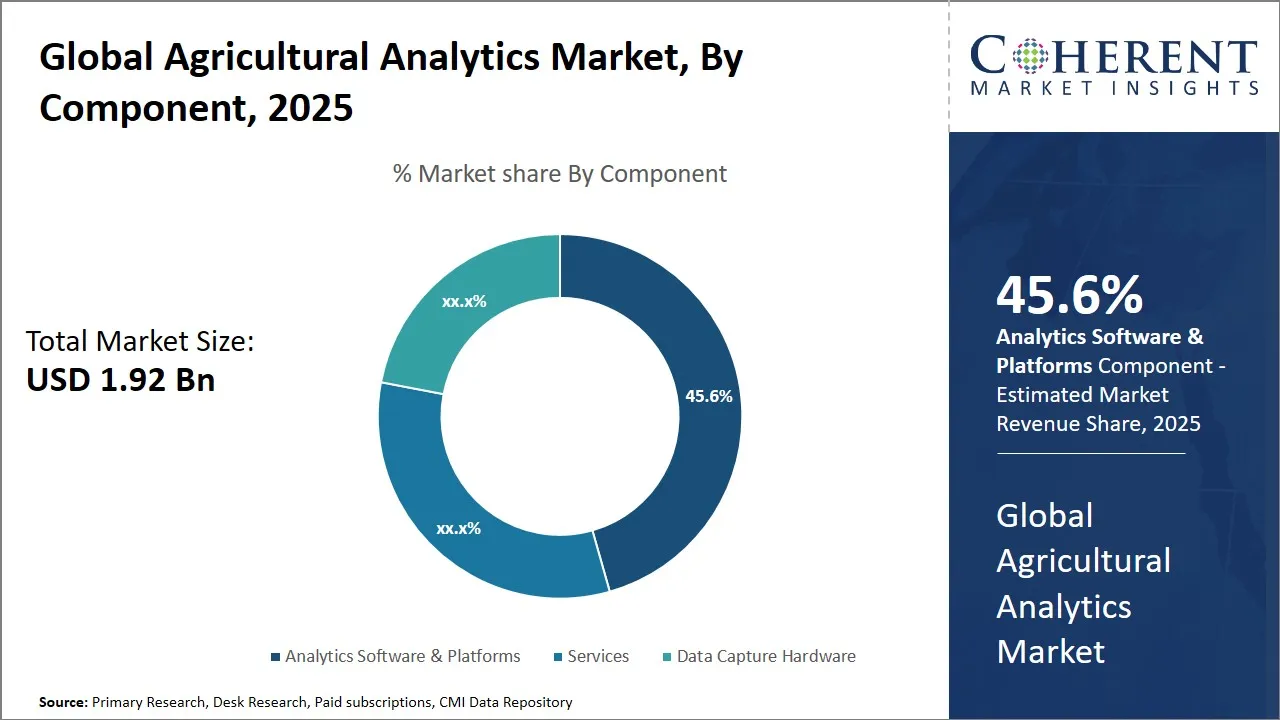
- The analytics software & platforms segment leads the market holding an estimated share of 46.6 % in 2026.
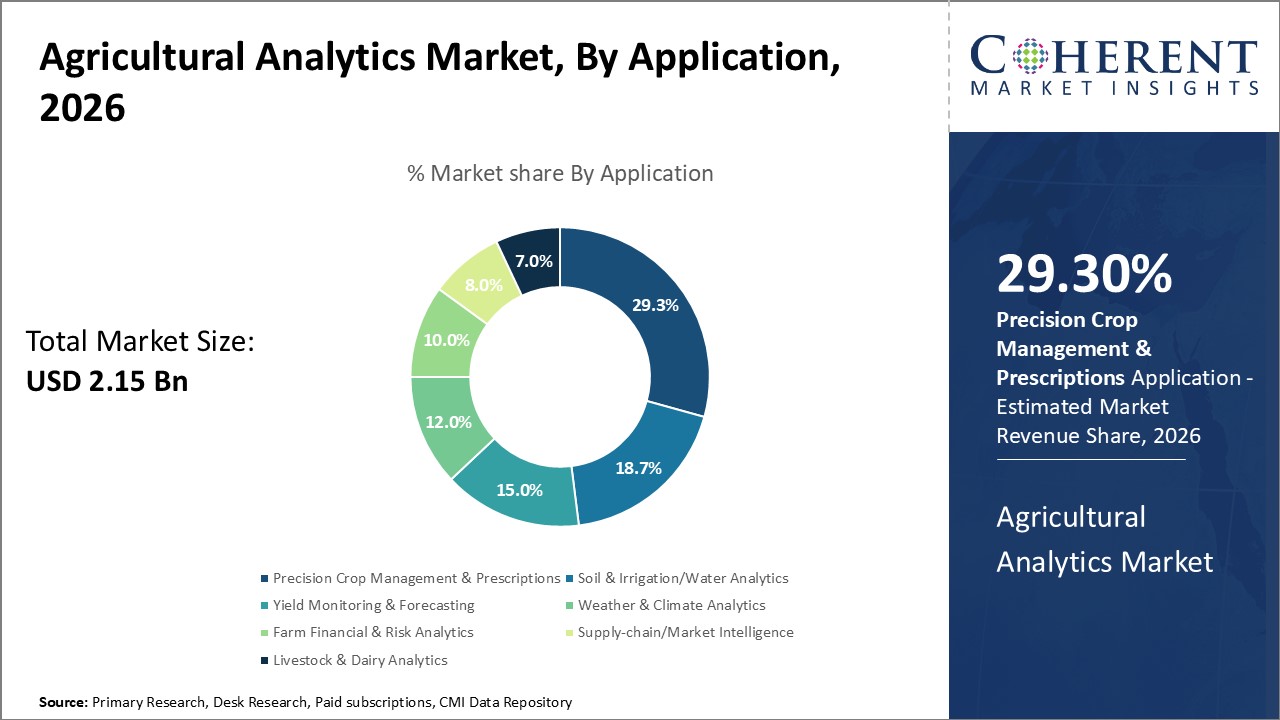
- The precision crop management & prescriptions segment leads the market holding an estimated share of 29.3 % in 2026.
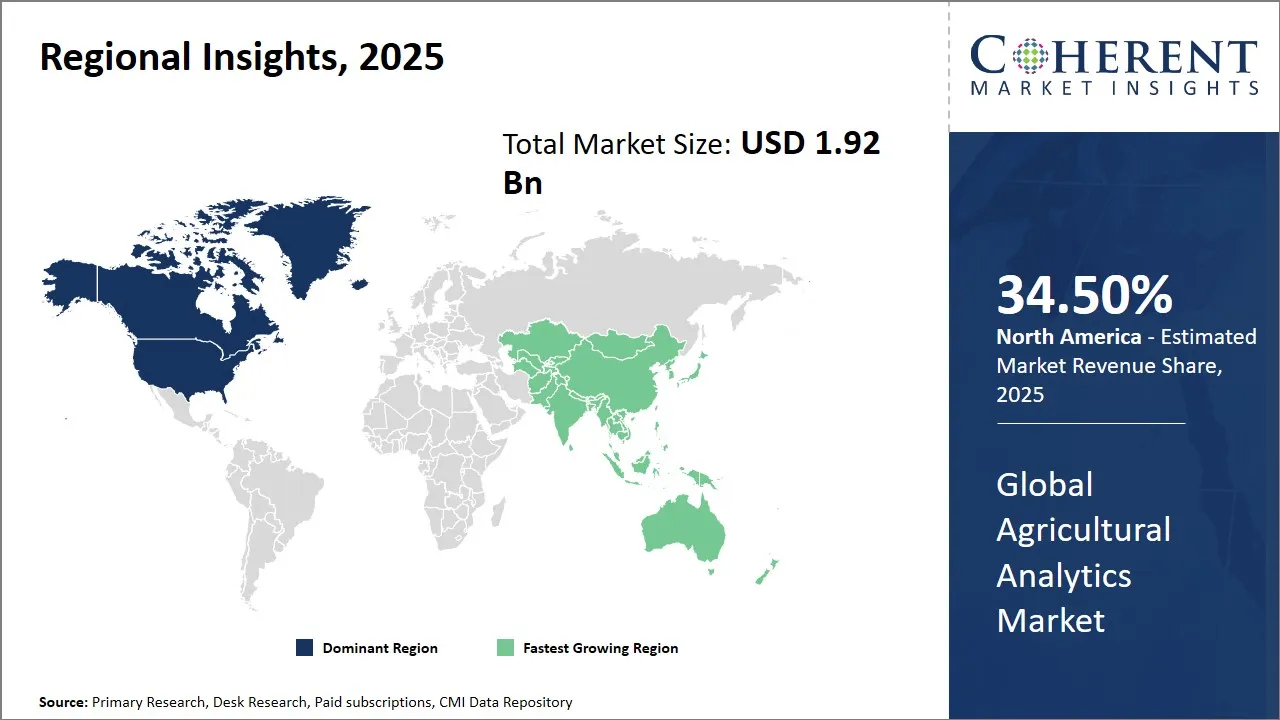
- North America is estimated to lead the market with a share of 34.5 % in 2026.
- Asia Pacific, holding an estimated share of 28.5 % in 2026, is projected to be the fastest growing region.
Market Overview
A significant trend shaping the agricultural analytics market is the integration of advanced technologies such as AI, IoT, and remote sensing in farming practices. Precision agriculture, enabled by real-time data analytics, is helping farmers make informed decisions on irrigation, fertilization, and pest control. Additionally, rising demand for sustainable farming and government initiatives promoting digital agriculture contribute to the market expansion, fostering enhanced productivity and environmental conservation efforts across key regions.
Current Events and Its Impact
Current Events | Description and its Impact |
Geopolitical and Trade Developments |
|
Economic and Infrastructure Trends |
|
Segmental Insights
- Current Industry Events of 2026
- Market Size Estimation
- Regional Breakdown
- Competitive Landscape
- Customer Intelligence
- Segmental Analysis
- Pricing Analysis
- Key Market Drivers, Challenges & Future Trends
- Customized Insights Section
Global Agricultural Analytics Market Insights, by Component – Analytics Software & Platforms Leads Owing to its Critical Role in Data Integration and Decision Support
The analytics software & platforms segment is expected to hold a share of 46.6% in 2026. This segment will dominate the global agricultural analytics market, driven by its ability to transform vast volumes of agricultural data into actionable insights. As modern farming increasingly relies on data-centric approaches, software platforms serve as the backbone for managing, analyzing, and interpreting data collected from a variety of sources such as IoT devices, satellite imagery, and sensor networks.
Cloud-based analytics platforms offer scalability and real-time data processing, allowing users to access powerful analytics tools without significant upfront infrastructure costs. AI and machine learning algorithms embedded in these platforms enhance predictive capabilities, enabling early pest detection, disease forecasting, and optimized fertilizer application. Moreover, the integration capabilities of analytics software are instrumental in providing end-to-end agricultural management solutions. These platforms often include modules for precision agronomy, weather forecasting, supply chain optimization, and financial analytics, making them versatile tools for various stakeholders from farmers to large agribusinesses.
Bayer’s Climate FieldView platform has become one of the most widely adopted agricultural analytics solutions globally. It integrates data from satellites, sensors, and machinery to deliver real-time insights on crop health, planting, and fertilizer needs.
Global Agricultural Analytics Market Insights, by Application – Precision Crop Management & Prescriptions Lead due the Need for Optimized Input Use and Yield Enhancement
Precision crop management & prescriptions segment leads the market holding an estimated share of 29.3% in 2026. This application focuses on applying the right inputs—such as seeds, fertilizers, and pesticides—in the precise quantities and locations needed within a field, thereby maximizing efficiency and crop yield while minimizing waste and environmental harm.
A primary driver behind this segment’s growth is the escalation of global food demand coupled with limited arable land. Farmers are pressed to produce more from less, pushing the adoption of data-driven precision techniques that tailor interventions to specific crop and soil conditions. Precision crop management platforms use detailed soil mapping, nutrient profiling, and real-time sensor data to generate prescriptions that guide field operations, ensuring that resources are deployed effectively. This targeted approach markedly improves input-use efficiency, which is critical amid rising costs of agricultural inputs and increasing environmental regulations.
Technological advancements in remote sensing and drone-based imaging have significantly enhanced the accuracy and scope of crop monitoring. The availability of high-resolution data allows for early detection of crop stress caused by pests, diseases, or nutrient deficiencies. Prescription analytics utilize this information to recommend localized treatments, reducing blanket applications of chemicals and promoting integrated pest and nutrient management practices.
Impact of AI on the Agricultural Analytics Market
Artificial Intelligence (AI) is transforming the agricultural analytics market by enabling highly precise, real-time decision-making for farmers. Machine learning algorithms analyze vast datasets from satellites, drones, sensors, and farm equipment to generate predictive insights on crop health, irrigation needs, pest outbreaks, and yield forecasting. This reduces reliance on generalized farming practices and empowers growers to optimize inputs like water, fertilizers, and pesticides, thereby improving productivity and sustainability. AI also accelerates automation by embedding predictive analytics into farm machinery, making analytics actionable at the field level.
A notable example is John Deere’s acquisition of Sentera in 2025, which strengthened Deere’s AI-driven agronomic analytics platform. By integrating Sentera’s drone and imagery analytics into the John Deere Operations Center, farmers can now access AI-enhanced field scouting, disease detection, and prescription mapping tools directly within their existing farm management systems.
Regional Insights
North America Agricultural Analytics Market Analysis and Trends
North America, holding an estimated share of 34.5% in 2026, dominates the global agricultural analytics market, due to advanced agricultural ecosystem characterized by widespread adoption of precision farming techniques and data-driven decision-making. The U.S., in particular, benefits from strong government initiatives supporting smart agriculture, such as funding for agri-tech innovation and the promotion of sustainability practices. The presence of established agro-tech companies like John Deere, Climate Corporation (a subsidiary of Bayer), and Trimble enables the integration of cutting-edge sensor technology, IoT, and AI analytics into farming operations.
Furthermore, the robust agricultural infrastructure, well-established supply chains, and favorable trade agreements facilitate the deployment and scaling of agricultural analytics solutions across both large-scale commercial farms and smaller holdings. This comprehensive ecosystem propels North America as the leading region in agricultural analytics adoption and innovation.
Asia Pacific Agricultural Analytics Market Analysis and Trends
The Asia Pacific region, holding an estimated share of 28.5% in 2026, exhibits the fastest growth in the agricultural analytics market, due to rapid digital transformation, expanding agricultural activities, and increasing government focus on food security. Countries like India, China, and Australia are investing heavily in smart agriculture initiatives to boost productivity amidst challenges posed by climatic variability and limited arable land. The growing penetration of smartphones, improved internet connectivity, and increased awareness of data-driven farming practices encourage adoption among a large base of smallholder farmers and commercial enterprises alike.
Domestic and multinational firms such as AgroStar in India, XAG in China, and AgriWebb in Australia are innovating with localized analytics platforms and precision tools tailored to diverse farming conditions. Additionally, various supportive policy frameworks and international collaborations are accelerating technology diffusion and investment, making the Asia Pacific the fastest-growing region in the sector.
Global Agricultural Analytics Market Outlook for Key Countries
U.S. Agricultural Analytics Market Analysis and Trends
The U.S. is characterized by early adoption and integration of advanced analytics in agriculture, supported by significant R&D investment from both private and public enterprises. Major players like John Deere are pioneering connected machinery and predictive analytics platforms, while startups like Granular offer farm management software that enhances operational efficiency. The country’s emphasis on sustainability and regulatory support for ag-tech startups fosters continuous innovation and commercial deployment of analytics, particularly in large-scale corn, soybean, and wheat farms.
India Agricultural Analytics Market Analysis and Trends
India agricultural analytics market is expanding rapidly, driven by government programs such as Digital India and the promotion of precision agriculture through subsidies and training. The country is home to emerging companies like CropIn and AgroStar, which deliver mobile-based analytics and advisory services suited for smallholder farmers who form the backbone of India’s agriculture. Increasing smartphone penetration and digital literacy are facilitating widespread uptake, helping farmers optimize inputs and increase crop yields despite fragmented farmland and challenging climatic conditions.
China Agricultural Analytics Market Analysis and Trends
China continues to lead the Asia Pacific agricultural analytics market with its integration of big data, AI, and drone technology into agriculture. Enterprises such as XAG and DJI are key contributors, offering agricultural drones and analytical platforms that enable real-time crop monitoring and automated precision spraying. Strong governmental initiatives like the “Smart Agriculture” pilot zones and investments in agri-tech innovation hubs at provincial levels accelerate the development and deployment of analytics systems focused on improving food security and reducing labor intensity in farming.
Brazil Agricultural Analytics Market Analysis and Trends
Brazil benefits from its status as a global agricultural powerhouse, leveraging analytics for crop monitoring, yield prediction, and optimization of resource utilization across its vast soybean, maize, and coffee plantations. Players like Solinftec and Strider are actively introducing IoT-enabled sensors and analytics tools that accommodate the large-scale and geographically dispersed nature of Brazilian agriculture. Government incentives promoting sustainable farming and digital transformation complement industry efforts to improve efficiency and environmental impact, fueling the market momentum.
Australia Agricultural Analytics Market Analysis and Trends
Australia agricultural analytics market is driven by the need to manage water scarcity and climate variability through data-centric solutions. Companies such as AgriWebb and SwarmFarm Robotics focus on farm management platforms and autonomous agricultural equipment integrated with predictive analytics. Supportive policies aimed at precision agriculture adoption including grants and extension services help farmers transition toward data-driven practices. The country’s export-oriented grain and livestock sectors rely increasingly on analytics to maintain competitiveness on the global stage.
Market Players, Key Development, and Competitive Intelligence
Key Developments
- In May 2025, John Deere announced the acquisition of Sentera, a leading provider of remote imagery solutions for agriculture headquartered in St. Paul, Minnesota. This acquisition advanced the capabilities of John Deere’s existing technology offerings, providing farmers and ag service providers with a more comprehensive set of tools to generate and use data to make decisions that improve farm profitability, efficiency, and sustainability.
- In March 2025, Trimble and PTx Trimble announced the availability of Trimble IonoGuard for the precision agriculture industry. IonoGuard is a next-generation technology engineered to enhance RTK GNSS signal tracking and hardware positioning performance.
- In March 2025, Syngenta, a leading global agriculture technology company, signed a new partnership with Planet Labs PBC, an important provider of global, daily satellite imagery and geospatial solutions. The multi-year expansion of their strategic partnership enables farmers to remotely monitor crop health, detect pest infestations, and identify disease outbreaks. The high-resolution, commercially available satellite imagery is delivered to farmers globally as part of Syngenta’s Cropwise digital agriculture platform.
- In March 2025, BASF Digital Farming GmbH announced its global expansion into horticulture, launching xarvio FIELD MANAGER For Fruits & Veggies. The new offering will initially support the cultivation of wine and table grapes, targeting the markets of France, Italy, Spain, and Türkiye. From 2026 onwards, it will expand to include crops like tomatoes and potatoes, extending its reach to support growers in more countries.
Top Strategies Followed by Agricultural Analytics Market Players
- Established players, often multinational corporations with substantial resources, primarily invest heavily in research and development (R&D) to drive product innovation and maintain technological leadership.
- In March 2025, BASF Digital Farming launched its xarvio FIELD MANAGER for Fruits & Veggies, expanding precision analytics beyond row crops into specialty farming. This was made possible through sustained R&D in digital agronomy and predictive modeling.
- Mid-level players in the agricultural analytics market adopt a more balanced approach by focusing on delivering cost-effective solutions that maintain a competitive balance between quality and affordability.
- CropIn (India) offers its SmartFarm platform, designed to deliver AI-driven farm monitoring at lower costs, making advanced analytics accessible for smallholder farmers across Asia Pacific and Africa where budget constraints are the major barrier.
- Small-scale players carve out their niche in the global agricultural analytics market by focusing on specialized features or highly innovative products that address unique challenges or untapped segments.
- Prospera Technologies specializes in computer-vision-based crop analytics for greenhouse and open-field farms.
Market Report Scope
Agricultural Analytics Market Report Coverage
| Report Coverage | Details | ||
|---|---|---|---|
| Base Year: | 2025 | Market Size in 2026: | USD 2.15 Bn |
| Historical Data for: | 2020 To 2024 | Forecast Period: | 2026 To 2033 |
| Forecast Period 2026 to 2033 CAGR: | 11.9% | 2033 Value Projection: | USD 4.72 Bn |
| Geographies covered: |
| ||
| Segments covered: |
| ||
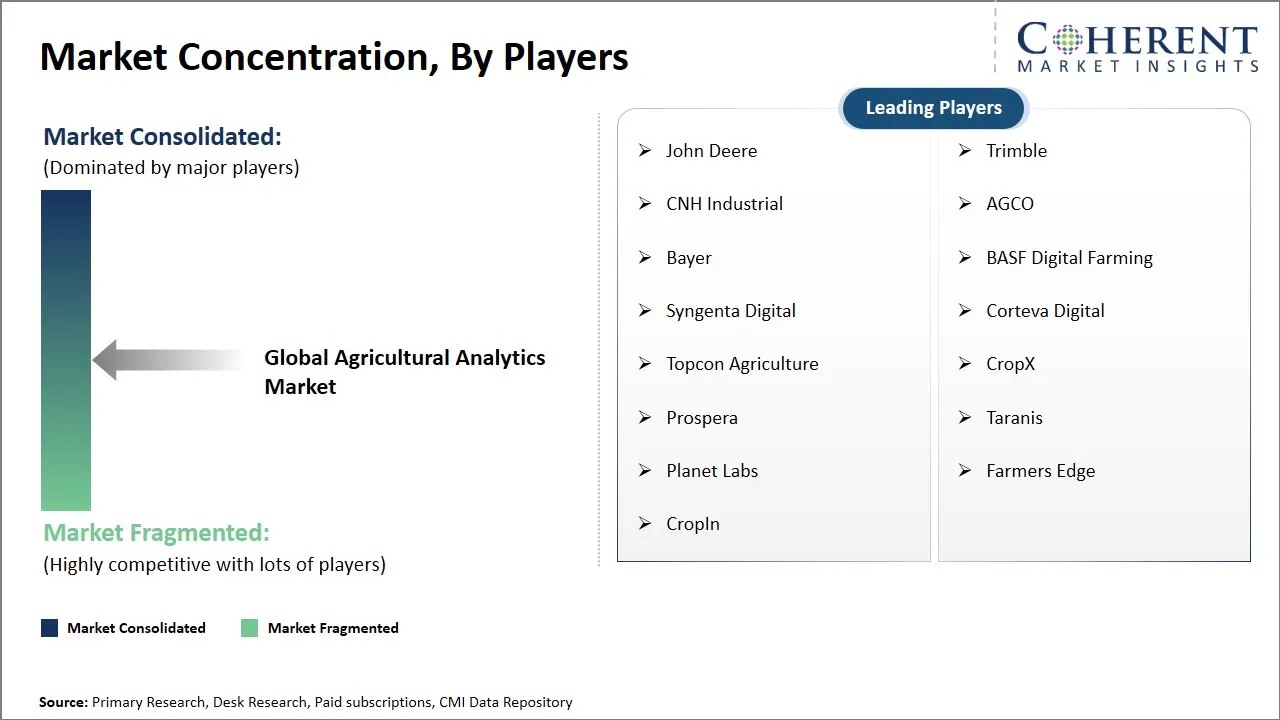
| Companies covered: | John Deere, Trimble, CNH Industrial, AGCO, Bayer, BASF Digital Farming, Syngenta Digital, Corteva Digital, Topcon Agriculture, CropX, Prospera, Taranis, Planet Labs, Farmers Edge, and CropIn | ||
| Growth Drivers: |
| ||
| Restraints & Challenges: |
| ||
Market Dynamics
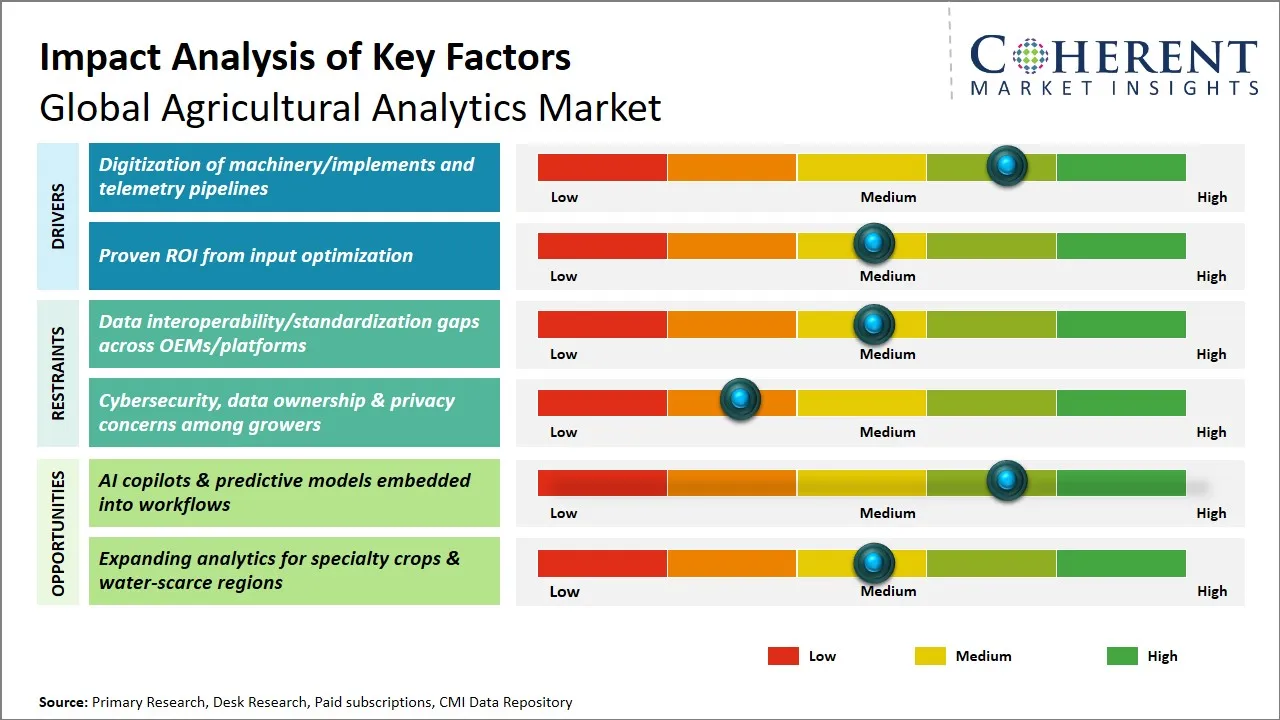
Global Agricultural Analytics Market Driver - Digitization of Machinery/Implements and Telemetry Pipelines
The increasing integration of digitization in agricultural machinery and implements, coupled with advanced telemetry pipelines, is significantly transforming farming practices and driving the demand for agricultural analytics. Modern tractors, harvesters, and irrigation systems are now equipped with sensors and IoT-enabled devices that continuously collect vast amounts of real-time data related to soil conditions, weather patterns, crop health, and equipment performance. CNH Industrial has introduced AI-powered sprayer precision technology for its Case IH, New Holland, and Miller brands. This system digitizes machine operations by integrating real-time crop sensing, analytics, and automated spraying adjustments.
This seamless connectivity allows farmers and agribusinesses to monitor operations remotely and make data-driven decisions that optimize resource utilization, reduce wastage, and improve crop yields. Telemetry pipelines facilitate the smooth transmission and processing of this data, enabling analytics platforms to deliver actionable insights quickly. Such technological advancements empower precision agriculture by offering granular visibility into every stage of the farming cycle, fostering sustainable practices and enhancing operational efficiency.
Global Agricultural Analytics Market Opportunity – Integration of AI Copilots and Predictive Models in Agricultural Analytics Workflows
The global agricultural analytics market is poised to benefit significantly from the integration of AI copilots and predictive models directly embedded into agricultural workflows. These advanced technologies offer farmers, agronomists, and supply chain managers real-time, data-driven guidance, enhancing decision-making accuracy across crop management, pest control, irrigation, and yield optimization. Bayer’s Climate FieldView platform has increasingly integrated AI-driven predictive models for yield forecasting and variable-rate prescriptions. By embedding AI copilots directly into growers’ digital workflows, FieldView supports decision-making on seeding, fertilization, and irrigation strategies.
Predictive models anticipate potential issues such as disease outbreaks, nutrient deficiencies, or adverse weather events before they occur, enabling proactive interventions that save costs and increase productivity. Embedding these AI tools into workflows facilitates seamless adoption, reduces the learning curve, and accelerates benefits by providing context-specific recommendations tailored to local conditions. Additionally, integration across farm management systems, supply chain logistics, and commodity trading platforms creates a holistic ecosystem where data flows effortlessly, enhancing overall operational efficiency and the market responsiveness.
Analyst Opinion (Expert Opinion)
- The embedding of AI copilots, digital twins, and predictive models into farm management workflows is redefining agricultural analytics. These technologies move beyond historical reporting to prescriptive and autonomous decision-making, enabling precision in seeding, irrigation, and crop protection.
- The convergence of satellite imagery, drone-based vision systems, and in-field IoT sensors is creating a multi-layered data ecosystem. This integration supports granular analytics for soil health, water management, and climate adaptation, particularly benefiting regions with resource constraints.
- While analytics adoption is strongest in large-scale row cropping, emerging applications in specialty farming (vineyards, orchards), livestock management, and supply chain intelligence are unlocking new growth avenues. These niches are increasingly attractive to mid-level and niche players aiming for differentiation.
Speak to the analyst
Want personalized insights?
Take the findings above to one of our principal consultants, or have the report rebuilt around the segments, geographies and competitors you actually track.
Market Segmentation
- Component Insights (Revenue, USD Bn, 2021 - 2033)
- Analytics Software & Platforms
- Services
- Data Capture Hardware
- Application Insights (Revenue, USD Bn, 2021 - 2033)
- Precision Crop Management & Prescriptions
- Soil & Irrigation/Water Analytics
- Yield Monitoring & Forecasting
- Weather & Climate Analytics
- Farm Financial & Risk Analytics
- Supply-chain/Market Intelligence
- Livestock & Dairy Analytics
- Regional Insights (Revenue, USD Bn, 2021 - 2033)
- North America
- U.S.
- Canada
- Latin America
- Brazil
- Argentina
- Mexico
- Rest of Latin America
- Europe
- Germany
- U.K.
- Spain
- France
- Italy
- Russia
- Rest of Europe
- Asia Pacific
- China
- India
- Japan
- Australia
- South Korea
- ASEAN
- Rest of Asia Pacific
- Middle East
- GCC Countries
- Israel
- Rest of Middle East
- Africa
- South Africa
- North Africa
- Central Africa
- North America
- Key Players Insights
- John Deere
- Trimble
- CNH Industrial
- AGCO
- Bayer
- BASF Digital Farming
- Syngenta Digital
- Corteva Digital
- Topcon Agriculture
- CropX
- Prospera
- Taranis
- Planet Labs
- Farmers Edge
- CropIn
Sources
Primary Research Interviews
Stakeholders
- Large-scale Farmers and Agribusiness Owners
- Agricultural Equipment Manufacturers and OEMs
- AgriTech Platform Providers
- Agrochemical & Seed Companies
- Government Agricultural Departments and Policy Makers
- Agri-Cooperatives and Farm Advisory Services
- Sustainability & Climate-Smart Agriculture Experts
Databases
- Food and Agriculture Organization Statistics (FAOSTAT)
- USDA National Agricultural Statistics Service (NASS)
- Eurostat Agriculture Database
- OECD Agri-Food Data Portal
- World Bank Agriculture & Rural Development Database
Magazines
- PrecisionAg Magazine
- AgFunderNews
- Successful Farming
- Future Farming
- Agritech Tomorrow
Journals
- Journal of Precision Agriculture
- Agronomy Journal
- Computers and Electronics in Agriculture
- International Journal of Agricultural Sustainability
- Remote Sensing in Agriculture Journal
Newspapers
- The Guardian (Global Agriculture Section)
- The Economic Times (India – Agribusiness Section)
- Farm Progress Daily (U.S.)
- The Hindu Business Line (India – Agriculture & Commodity Section)
- Financial Times (AgriTech & Sustainability Section)
Associations
- International Society of Precision Agriculture (ISPA)
- American Society of Agronomy (ASA)
- Asia-Pacific Association of Agricultural Research Institutions (APAARI)
- European Society for Agronomy (ESA)
- National Farmers Union (U.S. & U.K.)
Public Domain Sources
- Food and Agriculture Organization (FAO)
- U.S. Department of Agriculture (USDA)
- EUROSTAT
- United Nations Economic and Social Council (ECOSOC – Agriculture Programs)
- World Bank Agriculture Knowledge Portal
- ResearchGate
Proprietary Elements
- CMI Data Analytics Tool, Proprietary CMI Existing Repository of information for last 8 years
Get access to 250+ pages report
Every segment, forecast, competitor profile and data table behind the analysis above — available for instant download.
- ESOMAR Member
- ISO 9001:2015 Certified
- D-U-N-S Registered
- GDPR & CCPA Compliant
Missing comfort of reading report in your local language? Find your preferred language:
Transform your Strategy with Exclusive Trending Reports
Frequently Asked Questions
The global agricultural analytics market is estimated to be valued at USD 2.15 billion in 2026 and is expected to reach USD 4.72 billion by 2033.
The CAGR of the global agricultural analytics market is projected to be 11.9% from 2026 to 2033.
Digitization of machinery/implements and telemetry pipelines and proven ROI from input optimization are the major factors driving the growth of the global agricultural analytics market.
Data interoperability/standardization gaps across OEMs/platforms and cybersecurity, data ownership & privacy concerns among growers are the major factors hampering the growth of the global agricultural analytics market.
In terms of component, the analytics software & platforms segment is estimated to dominate the market revenue share in 2026.
It refers to the use of data, AI, and digital platforms to optimize farming decisions, from crop management to supply-chain planning.
Precision crop management & prescriptions is the leading application holding an estimated share of 28.3% in 2026.