

Global AI Detector Market Size and Forecast: 2026 to 2033
The global AI detector market is estimated to be valued at USD 747.59 Bn in 2026 and is expected to reach USD 4,231.64 Bn by 2033, exhibiting a compound annual growth rate (CAGR) of 28.1% from 2026 to 2033.
Key Takeaways of the Global AI Detector Market
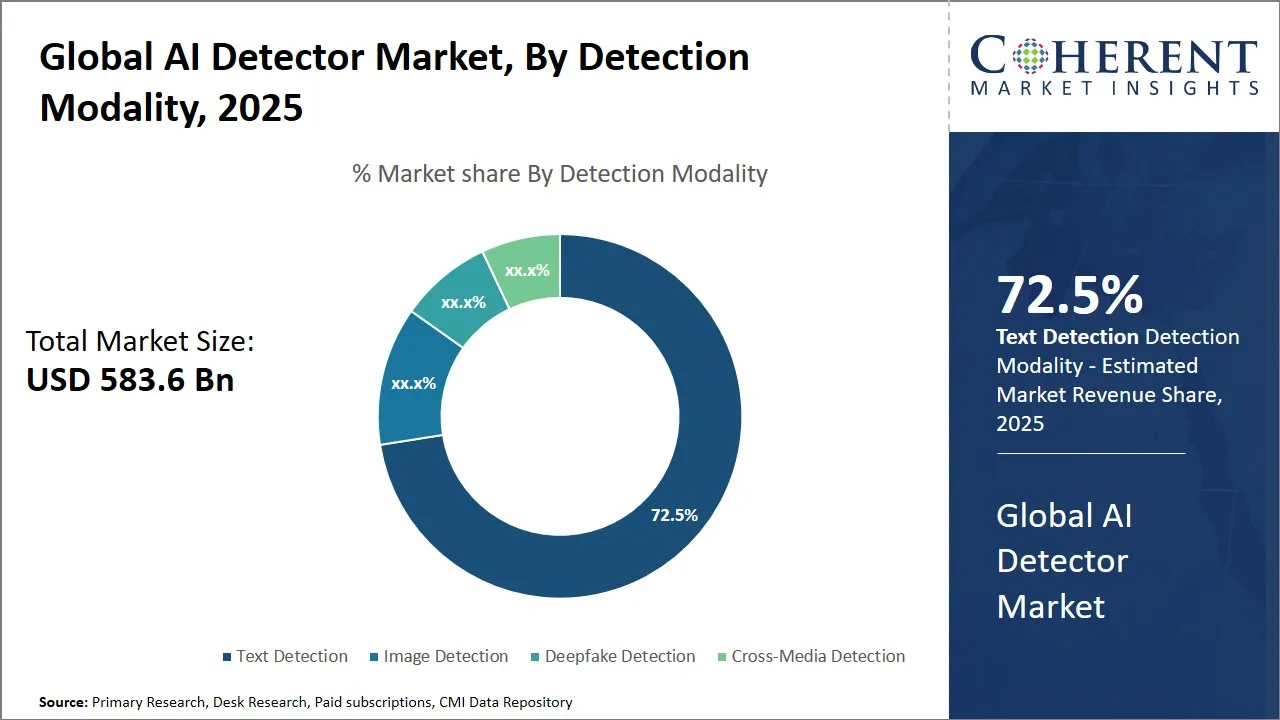
- The text detection segment is expected to lead the market holding a share of 73.5% in 2026.
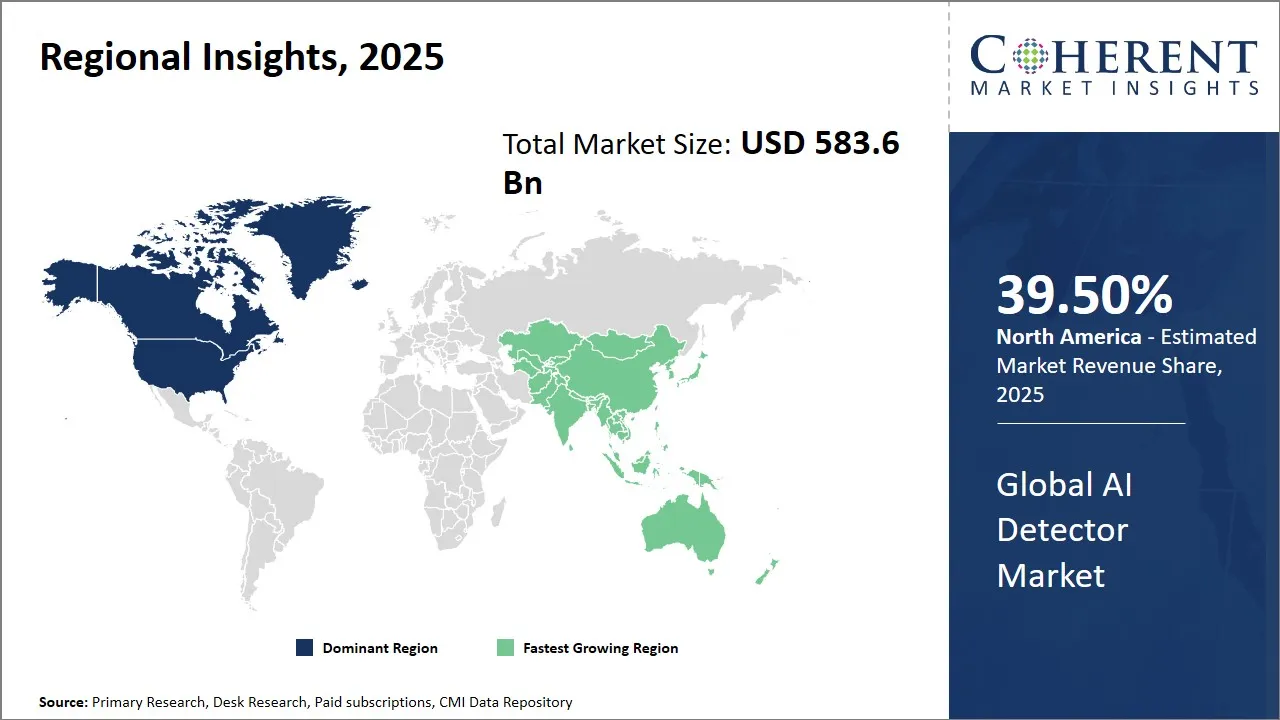
- North America, expected to hold a share of 39.5% in 2026, dominates the market.
- Asia Pacific, projected to hold a share of 22.3% in 2026, shows the fastest growth in the market.
Market Overview
The market sees a rise in the use of AI detectors across sectors such as cybersecurity, finance, and media to identify and mitigate AI-generated deepfakes and fraudulent content. Addition of AI detectors to existing security frameworks and the proliferation of cloud-based AI detection services are also shaping market dynamics. Also, increasing government regulations and policies aimed at combating AI-related threats are making demand for sophisticated detection solutions, supporting innovation and broader adoption globally.
Current Events and Its Impact
Current Events | Description and its Impact |
Geopolitical & Trade Developments |
|
Regulation & Law (EU) |
|
National AI Governance (India & Others) |
|
Segmental Insights
- Current Industry Events of 2026
- Market Size Estimation
- Regional Breakdown
- Competitive Landscape
- Customer Intelligence
- Segmental Analysis
- Pricing Analysis
- Key Market Drivers, Challenges & Future Trends
- Customized Insights Section
Global AI Detector Market Insights, By Detection Modality – Dominance of Text Detection is Driven by Rising Need for Content Authenticity and Misinformation Control
Text detection is projected to hold 73.5% of the global AI detector market share in 2026, driven by the urgent need to maintain content authenticity and curb misinformation across digital platforms. With the explosion of AI-generated text used in news, academia, and corporate communication, organizations are increasingly deploying detection tools to distinguish between human-authored and machine-generated content.
The rise of advanced generative models has added to the concerns over fake news, academic dishonesty, and manipulated digital content. This has made governments, publishers, and enterprises invest in sophisticated text detection systems capable of identifying subtle linguistic patterns and contextual irregularities typical of AI-generated text. Continuous improvements in NLP algorithms have significantly improved detection accuracy, expanding adoption across sectors like media, education, cybersecurity, and regulatory compliance.
Regulatory scrutiny further makes demand, as platforms face high pressure to monitor and mitigate misinformation. The education sector also remains a major customer because of the need to uphold academic integrity.
In 2023–2024, Turnitin reported that its AI detection feature was adopted by over 10,700 educational institutions globally, following rising concerns about AI-assisted academic submissions. This surge exemplifies the widespread reliance on text-based detection solutions and underscores why text detection continues to dominate the market.
Model Performance & Detection Benchmark
AI Detector/Model | Detection Modality | Accuracy (%) | False Positive Rate (%) | False Negative Rate (%) | Benchmark Notes |
Turnitin AI Detector | Text | 92.4 | 7.1 | 10.3 | Strong in academic workflows; optimized for long-form text. |
GPTZero | Text | 88.7 | 8.5 | 13.2 | Effective for student essays; struggles with short-form content. |
Originality.ai | Text | 94.1 | 5.8 | 9.6 | High enterprise adoption; strong paraphrase resistance. |
Copyleaks AI Detector | Multi-modal (Text + Image) | 90.3 | 6.7 | 12.1 | Notable for multilingual detection performance. |
Hive Moderation | Image/Deepfake | 87.5 | 8.9 | 14.8 | Industry leader for image-level synthetic content detection. |
Reality Defender | Multi-modal (Text + Video + Audio) | 89.4 | 7.3 | 13.5 | Strong reputation for real-time detection across formats. |
TrueMedia | Image + Video | 91.2 | 7.8 | 11.9 | Widely used for political misinformation and journalism verification. |
Sensity AI | Video/Deepfake | 86.8 | 9.4 | 15.2 | High accuracy for face-swap detection; challenged by diffusion-based content. |
OpenAI Internal Classifier (Legacy) | Text | 78.2 | 14.9 | 22.7 | Discontinued early due to inconsistent accuracy; included as baseline. |
Deepware Scanner | Audio/Video | 84.3 | 10.1 | 16.4 | Effective for audio deepfake detection but weaker with speech-to-speech models |
Subscription Model & ROI
Subscription Model | Pricing Structure (Typical) | Target Users | Key Features Included | Estimated ROI Timeline | ROI Drivers |
Freemium Tier | USD 0 – Limited usage | Students, Small creators | Basic text detection, short document scans | Low ROI/Immediate | Eliminates cost barriers; drives user acquisition for paid upgrades. |
Individual Monthly Plan | USD 10–USD 25 per month | Freelancers, Writers, Tutors | Unlimited scans, accuracy reports, plagiarism + AI mix analysis | 1–2 months | Improved productivity, reduced content errors, better authenticity checks. |
Enterprise SaaS Subscription | USD 200–USD 2,500 per month (based on seats & API usage) | Corporates, Publishers, EdTech platforms | Advanced detection, dashboards, compliance tools, user management | 3–5 months | Reduced misinformation risk, regulatory compliance, operational efficiency. |
API Pay-as-You-Go | USD 0.002–USD 0.01 per scan/API call | Startups, Developers, Integrators | High-volume detection, integration with platforms & CMS | 1–3 months | Scalability, reduced manual verification cost, better workflow automation. |
Custom Enterprise Contract | USD 25,000–USD 150,000 per year | Universities, Governments | Multi-modal detection, SOC-compliant infrastructure, dedicated support | 6–12 months | Large-scale risk mitigation, institutional integrity, automated monitoring. |
Annual Subscription Discounted Plan | 15–30% savings vs monthly | SMBs, Agencies, Teams | Full features + priority support |
Pricing Analysis of the AI Detector Market
Tool/Vendor | Plan/Tier/Pricing (USD) |
Originality.AI | USD 14.95/month (Pro plan) |
Originality.AI | USD 136.58/month (Enterprise plan) |
Originality.AI | Pay-as-you-go: USD 30 (one-time) for 3,000 credits |
GPTZero | Free tier: 10,000 words/month |
GPTZero | USD 14.99/month (monthly billing) — “Essential” plan |
GPTZero | USD 23.99/month — “Premium” plan |
GPTZero | USD 45.99/month — “Professional” plan |
ZeroGPT | Free plan: USD 0 — basic detections (per-scan limit) |
ZeroGPT | USD 9.99/month (Pro plan) |
ZeroGPT | USD 26.99/month (Max plan) |
Copyleaks | ~ USD 7.99/month (AI-detection only tier) |
Copyleaks | ~ USD 13.99/month (AI + Plagiarism combined tier) |
Winston AI | ~ USD 12/month (starter) — small-volume use |
Regional Insights
North America AI Detector Market Analysis and Trends
North America, expected to hold a share of 39.5% in 2026, dominates the global AI detector market, because of a highly developed technological ecosystem, aggressive private sector investment, and supportive government initiatives aimed at advancing artificial intelligence and cybersecurity. The region houses a lot of AI research institutions, tech startups, and multinational corporations specializing in AI and machine learning technologies.
The U.S., in particular, benefits from strong funding through agencies like DARPA and the National Science Foundation, enhancing innovation in AI detection capabilities. Key players such as IBM, Google, Microsoft, and OpenAI contribute a lot by developing advanced AI detection tools and integrating them into broader security and compliance solutions.
Furthermore, the region’s regulatory focus on data privacy and digital security fosters demand for sophisticated AI detector technologies across multiple industries, including finance, healthcare, and government.
Asia Pacific AI Detector Market Analysis and Trends
The Asia Pacific region, expected to hold a share of 22.3% in 2026, exhibits the fastest growth in the AI detector market because of fast digital transformation, increasing AI adoption across industries, and expanding technological infrastructure. Governments in countries like China, India, Japan, and South Korea have implemented favorable policies promoting AI research and innovation, alongside significant investments in digital economy initiatives.
The presence of large IT service providers and tech giants such as Alibaba, Baidu, Tencent, and NEC adds to the competitive landscape with localized AI detection solutions made to address regional challenges such as misinformation, fraud detection, and content moderation. Additionally, growing awareness of cybersecurity threats and the increasing digitization of sectors like banking, retail, and telecommunications drive market expansion. The robust talent pool and cost-effective development ecosystem further accelerate the market’s rapid development in this region.
Global AI Detector Market Outlook for Key Countries
U.S. AI Detector Market Analysis and Trends
The U.S. leads the AI detector market with a strong emphasis on innovation powered by global tech giants like Google, Microsoft, IBM, and OpenAI. These companies are instrumental in producing advanced AI detection frameworks used to identify deepfakes, synthetic media, and AI-generated content across social media platforms and enterprise ecosystems. The U.S. government's active policies for AI ethics, cybersecurity, and digital infrastructure development further add to market penetration, with significant collaboration between public research institutions and private companies.
China AI Detector Market Analysis and Trends
China AI detector market is growing fast, buoyed by robust government backing through initiatives like the New Generation Artificial Intelligence Development Plan. Major Chinese players like Alibaba, Baidu, and SenseTime focus a lot on AI content verification and fraud detection technologies. The fast digitization of industries and tight government regulations on digital content integrity add to the growing demand for reliable AI detection solutions. China’s addition of AI detectors into smart city projects and law enforcement highlights its commitment to leveraging AI for societal governance and security.
India AI Detector Market Analysis and Trends
India AI detector market is growing because of increasing digital penetration and rising concerns related to misinformation and content authenticity. Government programs such as Digital India and investments in AI research foster market growth. Companies like Tata Consultancy Services (TCS), Infosys, and emerging startups develop AI detection tools made for regional languages and diverse content types. India has a large pool of AI talent and a burgeoning startup ecosystem focused on cybersecurity and regulatory compliance.
Germany AI Detector Market Analysis and Trends
Germany remains a key player in Europe AI detector market through its strong industrial base and focus on AI ethics and data privacy regulations aligned with the GDPR framework. Leading corporations such as SAP and Siemens add AI detection mechanisms to their industrial IoT and enterprise software solutions. Germany's government actively supports AI research hubs and cross-sector collaborations, adding to developments in AI authenticity verification, particularly for manufacturing, automotive, and finance sectors.
Japan AI Detector Market Analysis and Trends
Japan AI detector market grows because of its advanced technological landscape and government-led AI innovation strategies. With companies like NEC, SoftBank, and Fujitsu taking the lead, Japan focuses on AI detection to improve cybersecurity, protect intellectual property, and maintain content authenticity. The country’s focus on robotics and AI integration in different service sectors further adds to adoption of AI detection solutions. Collaborative efforts with academic institutions also add to Japan’s market position in delivering precise and efficient AI detector technologies.
Market Players, Key Development, and Competitive Intelligence
Key Developments
- In July 2025, Copyleaks, the AI content analysis and governance platform trusted by enterprises, educators, and governments worldwide, announced a strategic partnership with RWS, a global content solutions company, powered by technology and human expertise. Through a new native integration with Tridion Docs, the RWS intelligent content management solution, Copyleaks’ award-winning AI-generated text and plagiarism detection capabilities now operate seamlessly within RWS content workflows, empowering organizations to publish with confidence and integrity at scale.
- In August 2024, Turnitin, a leading provider of technology solutions in academic integrity, announced plans to expand its offerings to advance classroom digitization through AI-powered grading, enhanced AI writing detection and customizable individual feedback for students.
- In June 2024, GPTZERO, a platform for AI-generated content detection and responsible AI adoption, raised USD 10 million in Series A funding led by Footwork VC with participation from Reach Capital, Uncork, Neo, Alt Capital and the former CEOs of Reuters and the NYT.
- In July 2023, Inspera, a leading provider of digital assessment solutions, announced the strategic acquisition of Crossplag, a powerful tool for originality checking and AI authorship detection.
Top Strategies Followed by AI Detector Market Players
- Established players, often industry leaders with a lot of resources, make heavy investment in research and development (R&D) to continually advance product performance and capabilities.
- Turnitin invested extensively in developing its AI Writing Detection tool and released a major update in 2023–2024 specifically tuned for LLM-generated text such as GPT-4 and other modern models.
- Mid-level companies operating within the AI detector market tend to focus strategically on delivering cost-effective solutions that balance quality and affordability, catering primarily to price-sensitive customer segments.
- GPTZero offers multiple low-cost monthly plans (e.g., USD 14.99 Essential plan) with generous word limits.
- Small-scale players in the global AI detector market often adopt a niche-focused approach to remain competitive and carve out distinctive market positions.
- Hive’s detection systems are widely used in media/advertising and specialize in deepfake detection and synthetic-media threat analysis.
Market Report Scope
Global AI Detector Market Report Coverage
| Report Coverage | Details | ||
|---|---|---|---|
| Base Year: | 2025 | Market Size in 2026: | USD 747.59 Bn |
| Historical Data for: | 2020 To 2024 | Forecast Period: | 2026 To 2033 |
| Forecast Period 2026 to 2033 CAGR: | 28.1% | 2033 Value Projection: | USD 4,231.64 Bn |
| Geographies covered: |
| ||
| Segments covered: |
| ||
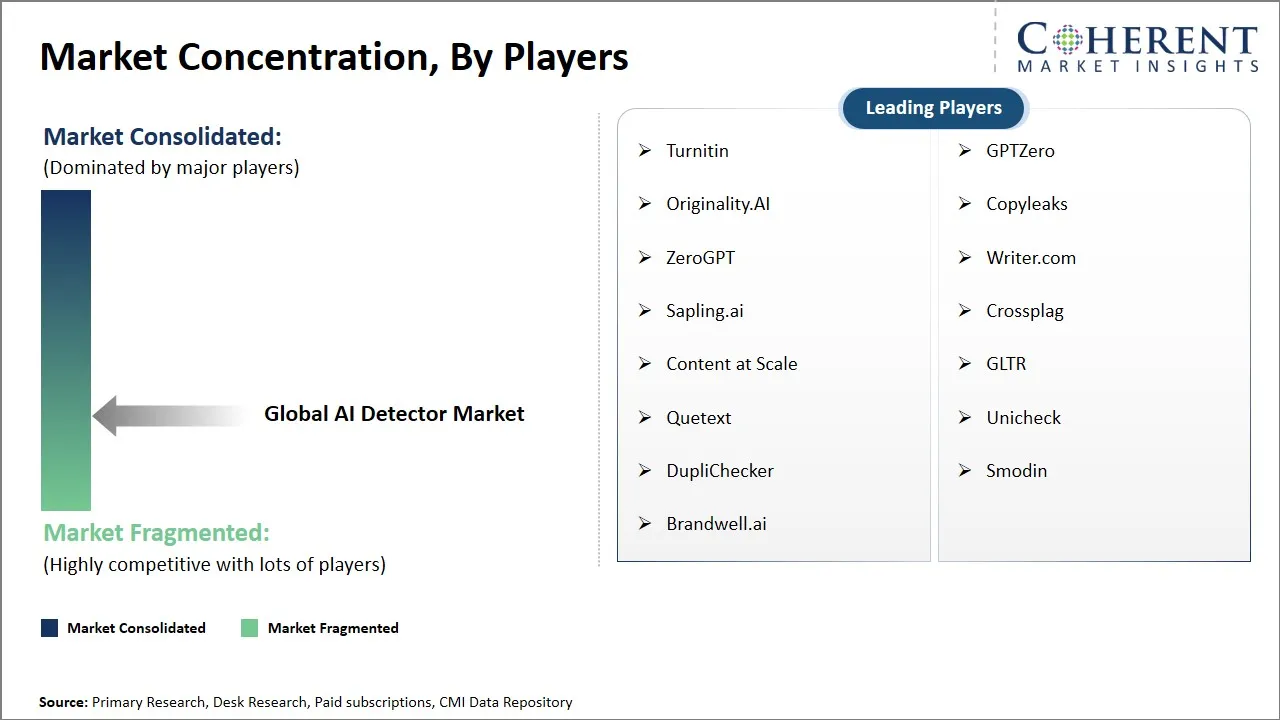
| Companies covered: | Turnitin, GPTZero, Originality.AI, Copyleaks, ZeroGPT, Writer.com, Sapling.ai, Crossplag, Content at Scale, GLTR, Quetext, Unicheck, DupliChecker, Smodin, and Brandwell.ai | ||
| Growth Drivers: |
| ||
| Restraints & Challenges: |
| ||
Market Dynamics
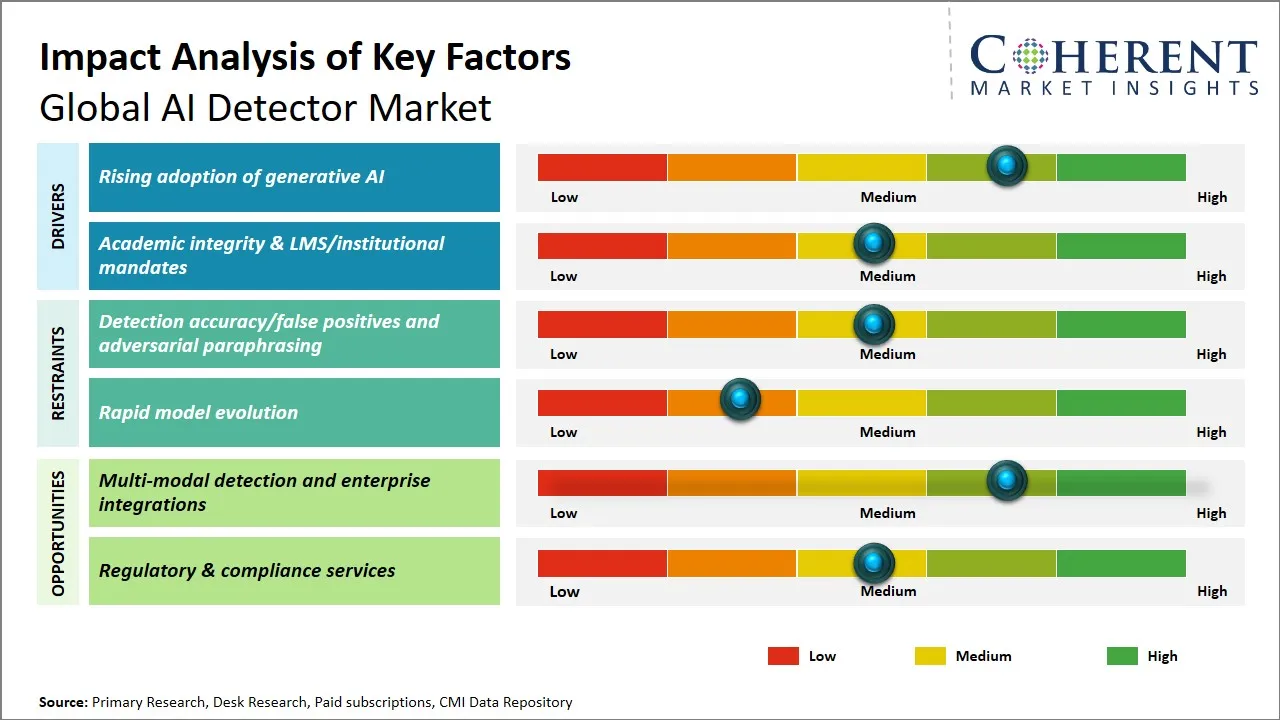
Global AI Detector Market Driver – Rising Adoption of Generative AI
The rapid expansion of generative AI across sectors such as media, education, marketing, and cybersecurity is sharply increasing the need for reliable AI detection tools. As AI-generated text, images, and multimedia become more realistic, concerns around misinformation, content authenticity, and intellectual property protection continue to grow. Organizations now need advanced detection systems to differentiate human-created content from machine-generated output and maintain trust in digital communication. The growing sophistication of generative models further makes vendors enhance detection algorithms, adding to continuous innovation in the market.
In 2024, OpenAI’s release of GPT-4o increased enterprise adoption of AI content generation a lot. Following this, several universities and publishers reported heightened dependency on AI detectors, with platforms like GPTZero and Originality.ai recording major spikes in monthly scan volumes.
Global AI Detector Market Opportunity – Multi-modal Detection and Enterprise Integrations
The growth of AI-generated content across text, image, audio, and video formats is making a lot of growth opportunities for multi-modal detection solutions. Multi-modal systems integrate signals from multiple data types, enabling higher accuracy in identifying synthetic content. This is especially useful in cybersecurity, media verification, and financial services, where multi-format fraud and deepfakes pose growing risks. At the same time, enterprises want seamless integration of AI detectors into existing workflows through APIs, scalable cloud deployments, and compliance-aligned solutions—making enterprise-grade integrations a key expansion avenue for vendors.
In 2024, Microsoft integrated multi-modal content authenticity checks into its Microsoft 365 suite, enabling organizations to verify AI-generated text and images directly within enterprise environments—illustrating rising demand for integrated, multi-format detection solutions.
Analyst Opinion (Expert Opinion)
- Despite flashy claims by vendors, the hard truth is that AI detectors are frequently outpaced by rapidly evolving generative models. Every major upgrade to LLMs makes existing detection algorithms less reliable overnight. This creates a credibility crisis — especially for enterprises that rely on precise evaluations for academic integrity, fraud prevention, and content authenticity. If vendors don’t solve this adaptability gap fast, trust in the entire category may erode.
- AI detectors often incorrectly flag human-written content as AI-generated. This is a major barrier to market adoption, especially in education and corporate compliance. Institutions are increasingly worried about wrongful accusations.
- Most tools still depend on surface-level linguistic and statistical patterns rather than deep multimodal forensics. This leaves them weak against paraphrasing tools, multilingual content, and hybrid AI-human workflows. Without a move toward context-aware, watermark-supported, and metadata-driven detection, the market risks becoming obsolete. In a world where AI content is ubiquitous, detectors must evolve from “guessing engines” to evidence based verification systems or risk becoming irrelevant.
Speak to the analyst
Want personalized insights?
Take the findings above to one of our principal consultants, or have the report rebuilt around the segments, geographies and competitors you actually track.
Market Segmentation
- Detection Modality Insights (Revenue, USD Bn, 2021 - 2033)
- Text Detection
- Image Detection
- Deepfake Detection
- Cross-Media Detection
- Regional Insights (Revenue, USD Bn, 2021 - 2033)
- North America
- U.S.
- Canada
- Latin America
- Brazil
- Argentina
- Mexico
- Rest of Latin America
- Europe
- Germany
- U.K.
- Spain
- France
- Italy
- Russia
- Rest of Europe
- Asia Pacific
- China
- India
- Japan
- Australia
- South Korea
- ASEAN
- Rest of Asia Pacific
- Middle East
- GCC Countries
- Israel
- Rest of Middle East
- Africa
- South Africa
- North Africa
- Central Africa
- North America
- Key Players Insights
- Turnitin
- GPTZero
- Originality.AI
- Copyleaks
- ZeroGPT
- Writer.com
- Sapling.ai
- Crossplag
- Content at Scale
- GLTR
- Quetext
- Unicheck
- DupliChecker
- Smodin
- Brandwell.ai
Sources
Primary Research Interviews
Stakeholders
- AI Software Developers & ML Engineers
- AI Detection Tool Manufacturers & Vendors
- Cybersecurity Firms & Digital Forensics Experts involved in content authenticity analysis
- Academic Integrity Officers & University IT Administrators
- Publishing Houses & Media Content Moderation Teams
- Enterprise Compliance Officers overseeing AI-generated content risks
- AI Policy Analysts & Responsible AI Consultants (for insights on regulatory impact)
Databases
- AI Adoption Metrics Database (AAMD)
- Global Digital Content Integrity Database (GDCID)
- OECD Digital Economy Indicators
- AI Transparency & Governance Observatory (ATGO)
- AI Tool Performance Benchmark Dataset (ATPBD)
Magazines
- AI Technology Review
- Machine Intelligence Weekly
- Digital Authenticity & Security Magazine
- Next-Gen Automation Review
- AI Integrity & Compliance Quarterly
Journals
- Journal of Artificial Intelligence Ethics & Governance
- Machine Learning Systems & Applications Journal
- Journal of Digital Forensics and Cybersecurity
- Automation & AI in Industry Journal
- International Journal of Content Verification Technologies
Newspapers
- Tech Innovation Daily
- AI Industry Times
- The Digital Observer
- Global Technology Herald
- The Economic Times (India)
Associations
- International Association for AI Content Integrity (IAACI)
- Global AI Ethics Consortium (GAIEC)
- Digital Forensics & Authenticity Association (DFAA)
- Responsible AI Developers Forum (RAIDF)
- AI in Education & Assessment Council (AIEAC)
Public Domain Sources
- UNESCO Education Digitalization Reports
- EU Artificial Intelligence Act Documentation
- U.S. National Institute of Standards & Technology (NIST) – AI Standards Hub
- World Bank Digital Governance Reports
- ResearchGate
Proprietary Elements
- CMI Data Analytics Tool
- Proprietary CMI Existing Repository of Information for Last 8 Years
Get access to 250+ pages report
Every segment, forecast, competitor profile and data table behind the analysis above — available for instant download.
- ESOMAR Member
- ISO 9001:2015 Certified
- D-U-N-S Registered
- GDPR & CCPA Compliant
Missing comfort of reading report in your local language? Find your preferred language:
Transform your Strategy with Exclusive Trending Reports
Frequently Asked Questions
The global AI detector market is estimated to be valued at USD 747.59 Bn in 2026 and is expected to reach USD 4,231.64 Bn by 2033.
The CAGR of the global AI detector market is projected to be 28.1% from 2026 to 2033.
Rising adoption of generative AI and academic integrity & LMS/institutional mandates are the major factors driving the growth of the global AI detector market.
Detection accuracy/false positives and adversarial paraphrasing and rapid model evolution are the major factors hampering the growth of the global AI detector market.
In terms of detection modality, text detection is estimated to dominate the market revenue share in 2026.
Turnitin, GPTZero, Originality.AI, Copyleaks, ZeroGPT, Writer.com, Sapling.ai, Crossplag, Content at Scale, GLTR, Quetext, Unicheck, DupliChecker, Smodin, and Brandwell.ai are the major players.
North America is expected to lead the global AI detector market in 2026.