

Global Air Cooler Market Size & Forecast – 2026 To 2033
The Global Air Cooler Market is estimated to be valued at USD 2,386.4 Mn in 2026 and is expected to reach USD 3,732.9 Mn by 2033, exhibiting a compound annual growth rate (CAGR) of 6.60% from 2026 to 2033. Market expansion is supported by longer hot-weather periods, comparatively low product and operating costs, and the suitability of evaporative cooling for homes, shops, workshops, warehouses, and semi-open spaces. Manufacturers are also broadening product portfolios through efficient motors, honeycomb cooling media, electronic controls, and multiple tank capacities.
In June 2024, EPACK Durable reported that it had started manufacturing and supplying domestic air coolers from January 2024 and had installed capacity for 0.25 million room coolers. The development indicates expanding original-design and contract-manufacturing infrastructure, which can improve production scalability, brand entry, product availability, and price competition in the air cooler industry.
Key Takeaways of the Global Air Cooler Market
- Desert air coolers are expected to hold 38.6 % of the global air cooler market in 2026 because their high airflow, larger cooling pads, and extended water storage suit spacious rooms and prolonged hot-weather use. In August 2024, Symphony listed its Silenzo 120i and Silenzo 100 desert air coolers in its official product archive.
- The 20 to 50 liters segment is projected to represent 41.6 % of the market share in 2026, offering sufficient operating time without the footprint, weight, and retail-storage burden of larger tanks. In March 2024, Thomson launched a 28-liter personal air cooler featuring portability, inverter compatibility, honeycomb media, and a water-level indicator.
- The residential segment is expected to account for 72.4 % of the global air cooler market in 2026 because air coolers provide affordable, movable, and installation-light cooling for bedrooms, rental homes, and family living spaces. In February 2025, Crompton reported its highest-ever pre-season growth in air coolers, indicating strong household-channel stocking and purchase momentum.
- Asia Pacific is expected to command 56.8 % of the market share in 2026, supported by long hot seasons, price-sensitive households, local manufacturing, and extensive appliance-dealer networks. In June 2025, the World Meteorological Organization reported prolonged heatwaves across East Asia during 2024, reinforcing the commercial need for accessible room-cooling products.
- Europe is projected to hold 14.7 % of the market share in 2026 while exhibiting the fastest growth as hotter summers, limited central air conditioning in parts of the housing stock, and energy-cost sensitivity support portable evaporative cooling. In April 2025, Copernicus reported that 2024 was Europe’s warmest year on record and that heat-stress days remained exceptionally elevated.
- Smart, Efficient Cooling Becomes a Product Differentiator: Manufacturers are integrating electronic controls, variable-speed motors, remote operation, water-level alerts, and automatic modes into air coolers. These features can support premium pricing while helping buyers manage energy use, noise, and refill cycles. Competitive advantage will increasingly depend on combining measurable cooling performance with intuitive controls, repairability, and dependable after-sales support.
- Weather-Led Omnichannel Planning Reshapes Distribution: Shorter purchasing windows and unpredictable heat episodes are pushing brands toward localized inventory planning, online discovery, rapid delivery, and coordinated dealer replenishment. Suppliers with the flexibility to transfer stock across regional warehouses and retail channels can respond quickly to demand spikes while minimizing excess preseason inventory. This model increases the importance of demand forecasting, flexible logistics, and channel-specific product assortments.
Segmental Insights
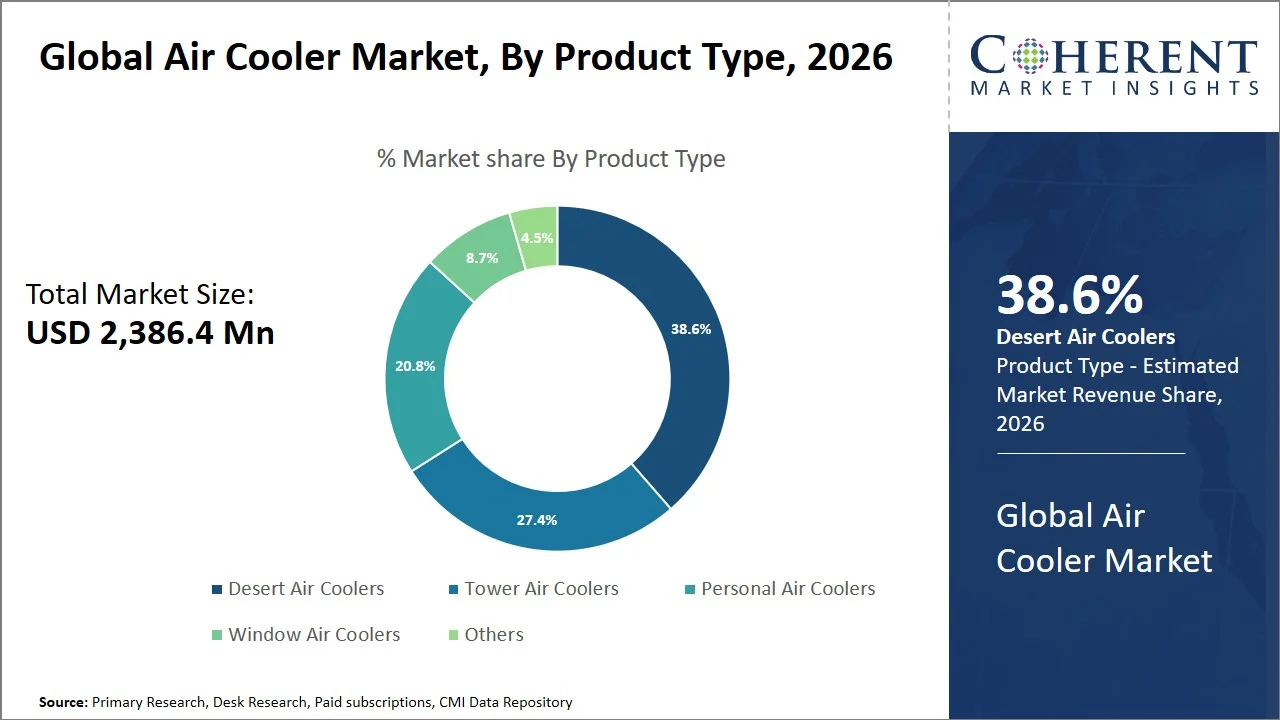
Why Do Desert Air Coolers Dominate the Global Air Cooler Market?
Desert air coolers are expected to account for 38.6% of the global air cooler market in 2026 because their high air-delivery capacity and broad cooling-pad area make them effective in large rooms, shops, halls, and semi-open spaces in hot, dry climates. Larger tanks reduce refill frequency during prolonged operation, while fan-based construction keeps purchase and servicing costs below compressor-based cooling. Manufacturers benefit from scalable plastic-body platforms that can accommodate different tank sizes, motors, controls, and airflow ratings. Dealers also favor the category because performance differences are easily demonstrated at the point of sale. In April 2026, V-Guard launched the Zivardo 100 desert air cooler with a 100-liter tank, 20-meter air throw, four-direction circulation, antifungal honeycomb pads, and coverage designed for large indoor spaces. This reinforces the category’s role in high-capacity evaporative cooling.
- Current Industry Events of 2026
- Market Size Estimation
- Regional Breakdown
- Competitive Landscape
- Customer Intelligence
- Segmental Analysis
- Pricing Analysis
- Key Market Drivers, Challenges & Future Trends
- Customized Insights Section
Why Does the 20 to 50 Liters Segment Represent the Largest Tank Capacity in the Global Air Cooler Market?
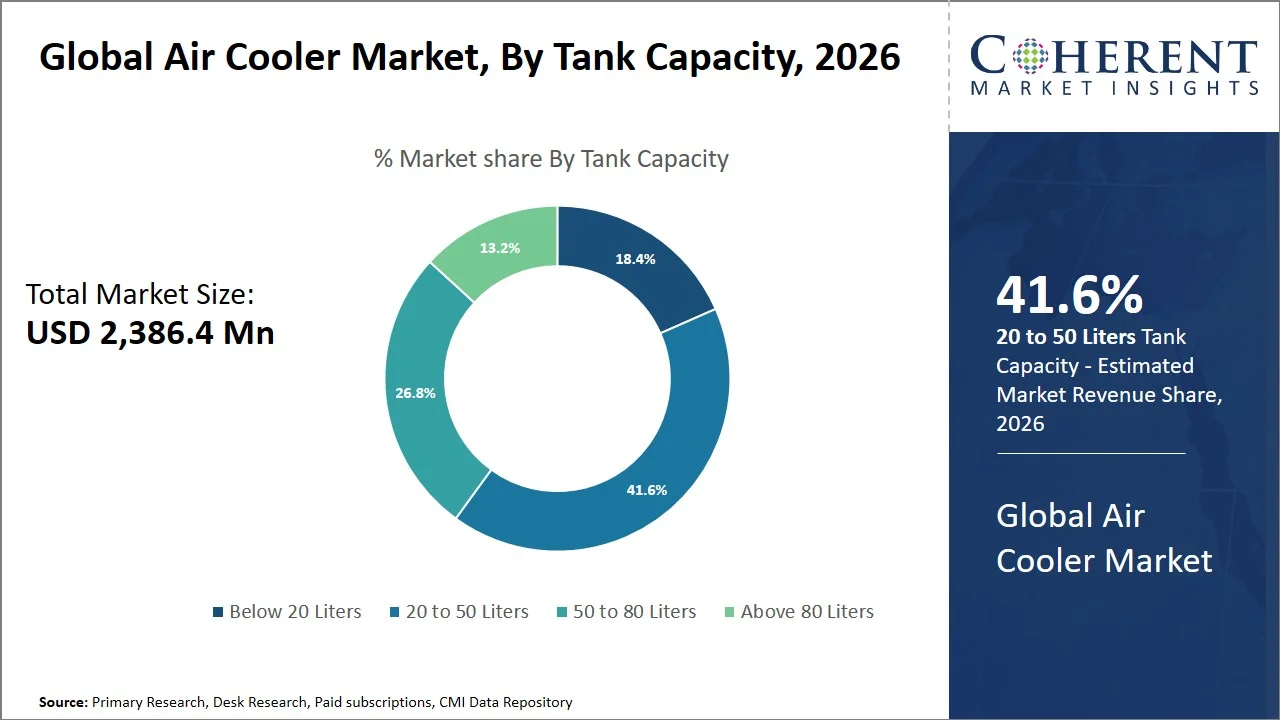
The 20 to 50 liters segment is projected to represent 41.6% of the global air cooler market in 2026 because it offers a practical compromise between operating runtime, appliance footprint, mobility, and retail price. These capacities fit bedrooms, small living rooms, rented homes, compact offices, and shops where users need several hours of cooling but may lack space for bulky reservoirs. Mid-sized tanks are also easier for manufacturers to standardize across personal, tower, and compact desert-cooler platforms, supporting component sharing and wider price ladders. Retailers can stock more units within limited floor and warehouse space, while households face less difficulty moving or cleaning the appliance. In February 2025, Havells published its 2025 air-cooler catalogue featuring a 40-liter heavy-duty cooler with three-speed operation, honeycomb media, remote and electronic controls, and an ionizer, demonstrating continued product investment within this capacity band.
Why Does the Residential Segment Dominate the End-User Category of the Global Air Cooler Market?
The residential segment is expected to contribute 72.4% of the global air cooler market in 2026 because household purchases span bedrooms, living areas, kitchens, rental properties, and smaller urban homes that require affordable seasonal cooling. Air coolers can be installed without structural modification, shifted between rooms, and operated on standard electrical connections, lowering adoption barriers for tenants and budget-conscious families.
Demand is strengthened by diverse product sizes, online comparison, installment purchasing, and extensive neighborhood appliance servicing. Suppliers serving this segment must compete on electricity consumption, noise, tank convenience, durability, warranty coverage, and after-sales reach rather than airflow alone. In March 2026, Kenstar introduced a campaign highlighting its India-first five-star BEE-rated air-cooler range and five-year warranty. The initiative shows how manufacturers are using verified efficiency and longer product assurance to influence household replacement and first-time purchase decisions.
Global Air Cooler Market Dynamics
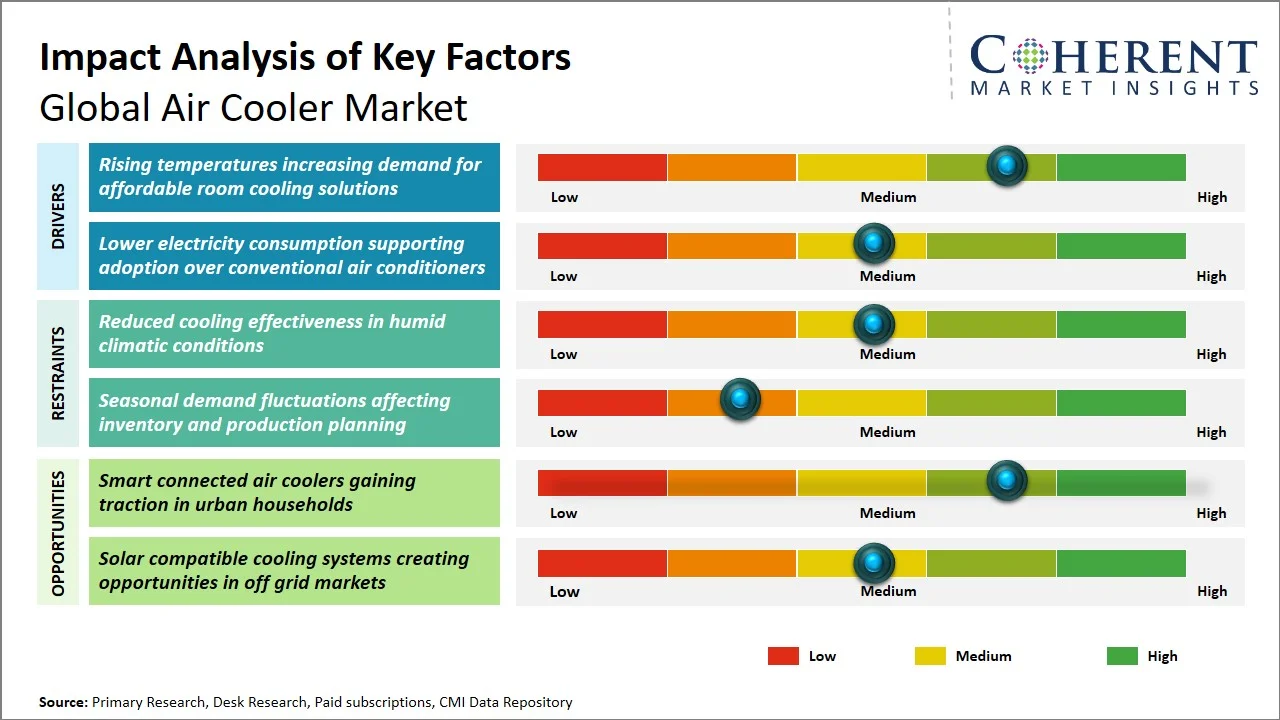
Key Market Drivers
- Longer Hot Seasons Expand the Addressable Cooling Population: Longer and more intense hot periods increase the number of households and small businesses requiring immediate room cooling, but many buyers cannot justify the purchase, installation, or operating cost of compressor-based air conditioning. Evaporative air coolers address this gap through lower upfront pricing, portable installation, and suitability for bedrooms, shops, classrooms, workshops, and semi-open areas in dry climates. The mechanism benefits cooler manufacturers, motor and pump suppliers, plastics molders, appliance dealers, and last-mile service networks because heat episodes compress purchasing into high-volume seasonal windows. Commercial success therefore depends on pre-season inventory, regional climate matching, and rapid replenishment rather than national stocking alone. In April 2024, the India Meteorological Department forecast above-normal maximum temperatures across most of India and above-normal heatwave days over several southern, central, eastern, and northwestern areas, reinforcing the need for accessible seasonal cooling products.
- Lower Electricity Use Strengthens the Ownership-Cost Advantage: Air coolers gain commercial relevance where customers compare the total cost of obtaining relief rather than cooling performance alone. Their fan-and-pump architecture generally requires less electricity than vapor-compression air conditioners, making the category attractive to households facing high tariffs, constrained electrical connections, or long daily operating periods. Lower power requirements also support use with inverters and distributed solar systems, broadening adoption in smaller cities and intermittently supplied locations. Manufacturers benefit by positioning efficient motors, optimized air paths, and pump controls as measurable ownership advantages, while retailers can sell the product without the installation complexity associated with split systems. In May 2026, India’s Bureau of Energy Efficiency released household-survey findings showing that air conditioners represented 11% of electricity use across surveyed households, compared with 2% for air coolers, providing authoritative evidence for the operating-cost distinction shaping buyer decisions.
Emerging Market Trends
- Sensor-Guided Comfort Replaces Fixed Mechanical Operation: Air cooler product development is shifting from fixed mechanical operation toward sensor-guided comfort management. Temperature and humidity sensing, electronic speed control, automatic mode selection, low-water alerts, timers, and remote interfaces allow the appliance to respond more precisely to changing room conditions. This transition changes competition because cooling performance alone no longer defines the premium tier; control accuracy, interface reliability, noise management, and electronic-component durability become equally important. Branded manufacturers and control-system suppliers are positioned to benefit, while low-cost assemblers may face higher warranty exposure if sensors, circuit boards, and pumps are poorly integrated. Over the forecast period, successful products will combine intuitive automation with manual override and simple servicing. The commercial challenge will be delivering useful control functions without turning a seasonal appliance into an expensive or difficult-to-repair electronic product.
- Water Hygiene and Maintainability Influence Product Selection: Water hygiene and maintainability are becoming stronger purchase criteria as buyers pay closer attention to tank cleanliness, odor, mineral deposition, pad condition, and pump reliability. This is reshaping product design toward removable tanks, drain plugs, accessible cooling pads, dry-run protection, dust screens, antimicrobial materials, and components that can be cleaned or replaced without specialist tools. Manufacturers that design for maintenance can reduce warranty claims and build recurring revenue from pads, pumps, filters, and authorized servicing. Conversely, products with sealed assemblies or poor spare-parts availability may lose favor even when their initial price is attractive. The trend will be especially relevant in hard-water locations and applications with prolonged daily use. During the forecast period, lifecycle convenience is likely to influence brand preference alongside airflow, tank capacity, and exterior styling.
Current Events and their Impact
Current Events | Description and its Impact |
India Issues Air Cooler and Air Filters Quality Control Order – March 2024 |
|
India Introduces Phased Air-Cooler Compliance Dates – January 2025 |
|
Regional Insights
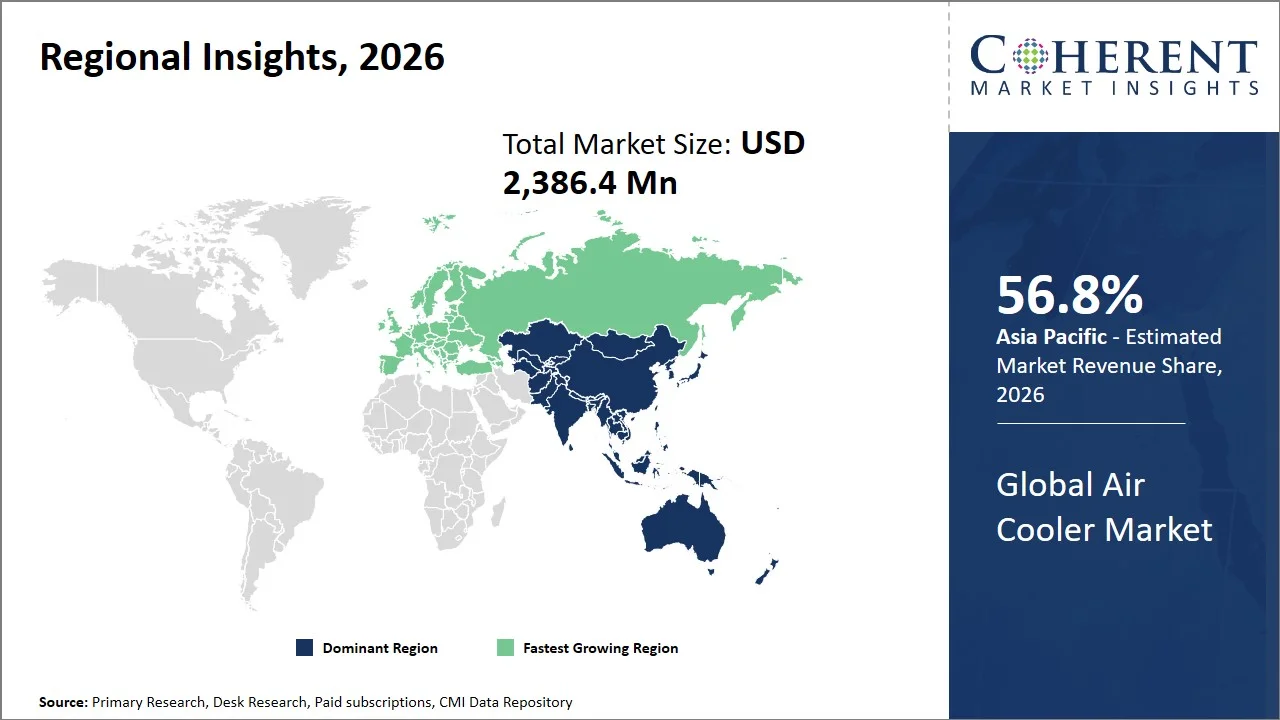
Why Does Asia Pacific Dominate the Global Air Cooler Market?
Asia Pacific is expected to hold 56.8% of the global air cooler market in 2026 because the region combines prolonged hot seasons with a large price-sensitive household base and extensive appliance manufacturing. India and China supply motors, pumps, molded cabinets, cooling media, and finished units, while dense dealer networks extend access beyond major cities. Desert and personal coolers also match the needs of homes, shops, classrooms, and workshops where compressor-based cooling remains unaffordable or difficult to install. Regional leadership therefore reflects both demand scale and locally supported supply economics. The climate exposure sustaining this need is well documented. In April 2024, a United Nations Sri Lanka report on Asia stated that extreme heat was becoming more severe and that the region’s long-term warming trend had accelerated. This reinforces the commercial importance of accessible, low-installation room cooling across Asia Pacific.
Why is Europe Emerging as the Fastest-Growing Region in the Global Air Cooler Market?
Europe is projected to account for 14.7% of the global air cooler market in 2026 while recording the fastest growth. Portable evaporative units are gaining relevance in rented homes, older buildings, temporary workspaces, hospitality terraces, and small commercial premises where permanent air-conditioning installation may be costly or restricted. Energy-price sensitivity also encourages buyers to consider lower-load cooling for localized use. The strongest opportunities will remain in southern and continental locations with comparatively dry summer conditions, as humid climates reduce evaporative performance. Climate adaptation is moving higher on the regional agenda, supporting broader evaluation of room-cooling alternatives. In March 2024, the European Environment Agency identified heat as a critical and rapidly growing climate risk and stated that residential buildings must be adapted to increasing heat. This creates a clearer commercial pathway for portable products positioned around climate suitability and easy deployment.
Global Air Cooler Market Outlook for Key Countries
Why is the U.S. a Key Market for the Global Air Cooler Market?
The U.S. is a key market for air coolers because its western and southwestern states provide dry climatic conditions that suit evaporative cooling. Demand extends beyond bedrooms into garages, workshops, warehouses, patios, restaurants, agricultural buildings, and event spaces, giving suppliers access to residential and commercial customers. Established home-improvement retailers, HVAC distributors, e-commerce platforms, and equipment-rental channels make seasonal products easier to scale. Buyers also value rugged construction, high airflow, hose connections, and replaceable cooling media for prolonged use. Market growth will remain geographically concentrated rather than uniform because humid eastern and coastal areas offer weaker performance conditions. The climate case is particularly strong in the West. In January 2026, National Oceanic and Atmospheric Administration (NOAA) reported that the western U.S. recorded its warmest year in 2025, while the Southwest also registered its warmest year on record, strengthening demand for region-specific cooling solutions.
Why Does China Support Growth in the Global Air Cooler Market?
China supports the global air cooler market primarily through manufacturing scale, component availability, and export-oriented appliance supply chains. Clusters producing electric motors, pumps, plastic housings, control boards, fans, and honeycomb media allow manufacturers to develop multiple cooler formats at competitive cost. Domestic brands and contract manufacturers can also adapt tank capacity, voltage, controls, and exterior design for distributors in Asia, the Middle East, Africa, and Latin America. This production flexibility benefits international brands seeking private-label or original-equipment-manufacturing arrangements without building dedicated factories. China’s broad e-commerce infrastructure further supports domestic testing of compact and smart appliance concepts before export. The depth of this industrial base was reaffirmed publicly. In May 2024, China’s State Council website reported that the country had become the world’s largest home-appliance manufacturing base, accounting for 60%–70% of global production capacity, supporting its strategic role in air-cooler supply.
Why is the U.A.E a Strategic Country in the Global Air Cooler Market?
The U.A.E is a strategic air cooler market because extreme seasonal heat intersects with a large base of semi-open commercial environments. Hospitality terraces, event venues, warehouses, workshops, construction areas, mosques, logistics facilities, and staff accommodation can use high-airflow evaporative systems where localized cooling is more practical than conditioning an entire space. The country’s import and re-export infrastructure also allows distributors to serve neighboring Gulf markets from regional inventories. Product selection must remain application-specific: dry inland conditions support stronger evaporation, whereas coastal humidity can limit cooling effectiveness. Suppliers therefore benefit from technical sizing, corrosion-resistant components, automatic water control, and dependable maintenance. Pressure on the electricity system strengthens interest in lower-load cooling for suitable spaces. In March 2025, Dubai Electricity and Water Authority reported that Dubai’s peak electricity demand increased during 2024, highlighting the commercial value of efficient supplementary cooling approaches.
Why is India Important in the Global Air Cooler Market?
India is central to the global air cooler market because the product aligns with household affordability, hot dry summers, limited room-air-conditioner ownership, and demand for appliances requiring no permanent installation. Local manufacturing and component sourcing support broad price bands, while neighborhood dealers and repair technicians make air coolers accessible in tier-two and tier-three cities. Inverter compatibility is particularly relevant where customers need cooling during voltage fluctuations or interruptions. Manufacturers can serve distinct spaces through personal, tower, window, and high-capacity desert models, reducing dependence on a single buyer group. The breadth of domestic portfolios demonstrates this market maturity. In January 2025, Bajaj Electricals published updated air-cooler guidance covering personal, desert, tower, and window models, with differentiated tank capacities, airflow, room coverage, and warranty propositions. This segmentation shows how Indian suppliers convert varied climatic, housing, and budget requirements into scalable product families.
Why is Brazil an Important Growth Market for the Global Air Cooler Market?
Brazil is an important growth market for air coolers because its large interior regions combine high temperatures with residential, retail, agricultural, and light-industrial spaces requiring affordable localized cooling. Portable climatizers can serve homes, small stores, workshops, livestock-related facilities, and semi-open workplaces without the capital and electrical load associated with full air-conditioning systems. Regional appliance distributors and online marketplaces provide routes to reach consumers outside major coastal cities. Commercial potential is the strongest in warmer and relatively drier inland areas; suppliers must avoid uniform national positioning because high coastal humidity can reduce evaporative efficiency. Products with strong airflow, washable media, simple water management, and local spare-parts support are likely to gain acceptance. In January 2025, Brazil’s National Institute of Meteorology reported that 2024 was the country’s hottest year since national records began in 1961, reinforcing the need for accessible cooling alternatives.
Technology Adoption Landscape in the Global Air Cooler Market
Technology | Adoption Level | Key Application Area | Business Impact |
Honeycomb cellulose cooling pads | High | Heat and moisture exchange in desert, tower, and personal coolers | Improves water retention and cooling consistency while creating recurring replacement-pad demand. |
High-efficiency BLDC and electronically controlled motors | Medium | Variable-speed fan operation | Reduces electricity consumption and noise, supports premium positioning, and improves compatibility with backup power. |
Temperature and humidity sensing | Medium | Automatic airflow and pump control | Improves comfort by adjusting operation to room conditions and limiting unnecessary moisture addition. |
Automatic water filling and low-water pump protection | Medium | Tank and water-circulation management | Extends operating continuity, prevents dry running, and reduces premature pump failure. |
Antimicrobial pads and removable hygiene components | Medium | Tanks, cooling media, filters, and wetted surfaces | Supports cleaner operation, simplifies maintenance, and differentiates products used for prolonged daily cooling. |
App, voice, and remote diagnostic controls | Low | Scheduling, operating alerts, and fault monitoring | Enables premium features and service data, although additional electronics increase cost and repair complexity. |
How are Indirect and Hybrid Evaporative Systems Creating New Growth Opportunities in the Global Air Cooler Market?
Indirect and hybrid evaporative cooling remain underdeveloped opportunities between conventional room coolers and compressor-based air-conditioning systems. By using a heat exchanger for sensible cooling and adding direct evaporation only when climatic conditions permit, these systems can serve workshops, schools, warehouses, retail spaces, outdoor hospitality areas, and transitional climates where conventional direct coolers may introduce excessive humidity. Companies can capture the opportunity through modular commercial units, psychrometric sizing tools, humidity-responsive controls, corrosion-resistant heat exchangers, and service packages covering water treatment and pad maintenance. Market entry requires application engineering, field testing across climatic zones, installer training, and clearer communication of where hybrid systems outperform basic coolers. The opportunity is likely to favor HVAC specialists, industrial evaporative-cooling firms, and vertically integrated manufacturers with access to heat-exchanger design and channel partners. Consumer-appliance brands can participate through smaller packaged systems, but they must avoid presenting hybrid technology as universally suitable. Strong climate matching and measurable operating economics will determine customer acceptance and repeat procurement.
Market Players, Key Development, and Competitive Landscape
Key Developments
- In March 2025, CG Power and Industrial Solutions entered the air-cooler category with a JetChill technology-enabled product range designed around optimized airflow, high air delivery, honeycomb cooling pads, and reduced energy use. This is important for the Global Air Cooler Market because the entry of an established electrical-engineering company broadens branded competition and connects air-cooler development with existing motor, pump, and consumer-appliance capabilities.
- In January 2025, Cellecor Gadgets entered the cooler business with a 45-liter personal model and desert coolers ranging from 65 to 110 liters. The company reported advance orders and began distribution through manufacturing and retail partners. This is important for the Global Air Cooler Market because it illustrates how consumer-electronics brands can use outsourced manufacturing and established distributor networks to enter a seasonal appliance category without first building dedicated production infrastructure.
- In April 2024, Orient Electric launched high-capacity Smartchill, Avante, Titan, and Maxochill air coolers spanning desert and commercial applications. The range incorporated large tanks, extended air throw, honeycomb cooling media, automatic filling, and selected connected-control capabilities. This is important for the Global Air Cooler Market because it expands evaporative cooling into larger rooms and business premises while demonstrating how manufacturers can combine capacity, convenience, and electronic differentiation.
Competitive Landscape
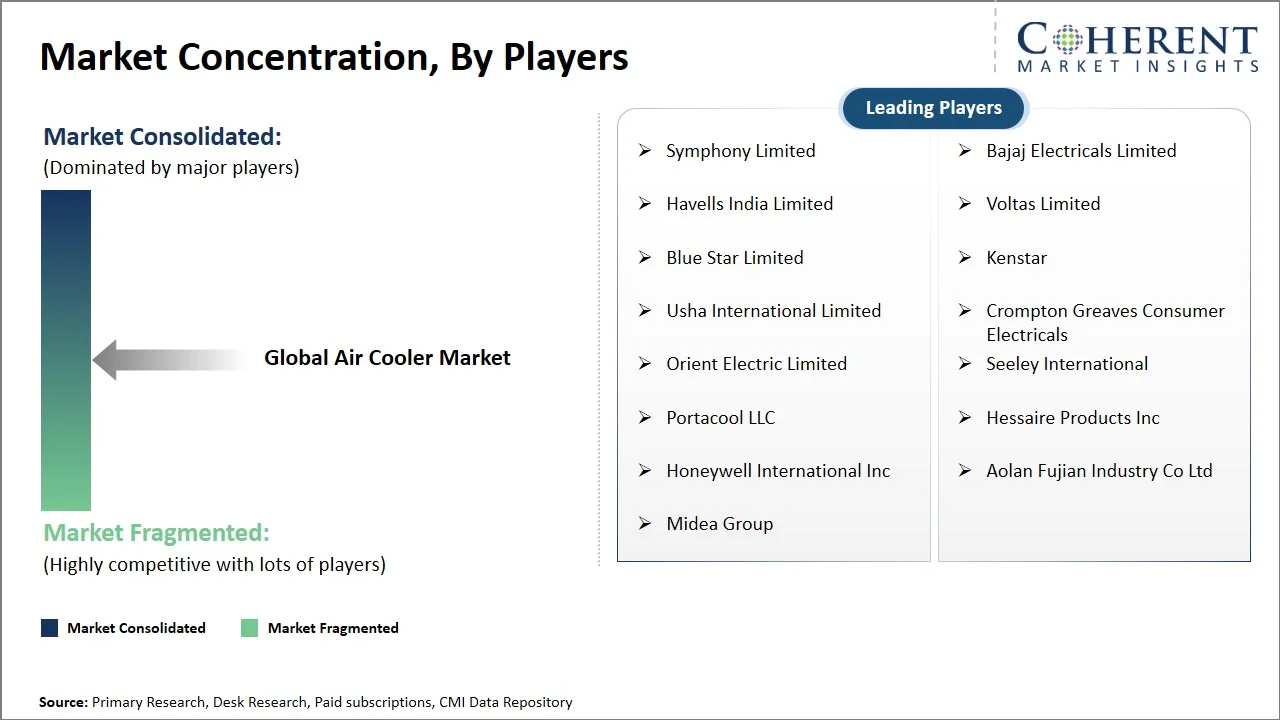
The global air cooler market is fragmented, with leading branded manufacturers competing alongside regional producers, contract assemblers, and unorganized local suppliers and price-focused local suppliers. Large appliance companies compete through product breadth, dealer coverage, warranty support, and seasonal advertising, while regional businesses frequently compete through lower prices, rapid local replenishment, and climate-specific designs. Competitive advantage depends on demonstrable air delivery, build quality, reliable pumps and motors, standards compliance, responsive service, and the ability to manage short seasonal sales cycles without excessive unsold inventory.
Key focus areas include
- Cooling-performance differentiation: Air delivery, air throw, pad area, and water distribution determine real-world cooling effectiveness.
- Component reliability: Motors, pumps, control boards, louvers, and castor assemblies strongly influence warranty costs and brand perception.
- Seasonal supply readiness: Pre-season production and rapid replenishment help brands respond to sudden heat-led purchase cycles.
- Climate-specific product design: Tank size, pad configuration, and airflow must match dry, composite, and transitional climatic conditions.
- Standards and quality assurance: Testing, certification, electrical safety, and traceable manufacturing support formal retail and institutional access.
- Dealer and service coverage: Local demonstrations, installation guidance, spare parts, and repair turnaround remain important purchase factors.
- Portfolio and price architecture: Multiple capacities, body formats, and control configurations allow manufacturers to address different rooms and budgets.
Market Report Scope
Air Cooler Market Report Coverage
| Report Coverage | Details | ||
|---|---|---|---|
| Base Year: | 2025 | Market Size in 2026: | USD 2,386.4 Mn |
| Historical Data for: | 2020 To 2024 | Forecast Period: | 2026 To 2033 |
| Forecast Period 2026 to 2033 CAGR: | 6.60% | 2033 Value Projection: | USD 3,732.9 Mn |
| Geographies covered: |
| ||
| Segments covered: |
| ||
| Companies covered: | Symphony Limited, Bajaj Electricals Limited, Havells India Limited, Voltas Limited, Blue Star Limited, Kenstar, Usha International Limited, Crompton Greaves Consumer Electricals, Orient Electric Limited, Seeley International, Portacool LLC, Hessaire Products Inc, Honeywell International Inc, Aolan Fujian Industry Co Ltd, and Midea Group | ||
| Growth Drivers: |
| ||
| Restraints & Challenges: |
| ||
Analyst Expert (Analyst Opinion)
- Competition is likely to move from selling isolated appliances toward offering climate-matched cooling portfolios supported by warranties, spare-parts availability, maintenance guidance, and clearly stated room suitability. Manufacturers that translate technical performance into dependable customer outcomes will gain influence over brands relying mainly on tank capacity and promotional pricing. Product qualification and service execution may therefore become stronger indicators of market leadership than catalogue size.
- Modular product platforms could materially alter market-entry economics. Common motors, pumps, cabinets, electronic controls, and cooling modules can be configured into multiple capacities and formats, allowing brands to refresh assortments quickly and use external manufacturing partners. This model may pressure companies with inflexible dedicated tooling. Supplier coordination, platform engineering, quality governance, and protection of design know-how will become essential capabilities.
- Participants should invest in standards-compliant testing, durable motors and pumps, water-management design, climatic performance validation, and dependable regional service. Commercial expansion should prioritize applications where evaporative cooling has a clear technical fit rather than pursuing humid markets indiscriminately. Companies should manage exposure to seasonal inventory, plastic and motor-component costs, and retailer returns, while avoiding excessive investment in connected features that do not improve core cooling or maintainability.
Speak to the analyst
Want personalized insights?
Take the findings above to one of our principal consultants, or have the report rebuilt around the segments, geographies and competitors you actually track.
Market Segmentation
- Product Type Insights (Revenue, USD Mn, 2021 - 2033)
- Desert Air Coolers
- Tower Air Coolers
- Personal Air Coolers
- Window Air Coolers
- Others
- Tank Capacity Insights (Revenue, USD Mn, 2021 - 2033)
- Below 20 Liters
- 20 to 50 Liters
- 50 to 80 Liters
- Above 80 Liters
- End User Insights (Revenue, USD Mn, 2021 - 2033)
- Residential
- Commercial
- Industrial
- Distribution Channel Insights (Revenue, USD Mn, 2021 - 2033)
- Specialty Appliance Stores
- Online Retail
- Supermarkets and Hypermarkets
- Distributors and Dealers
- Others
- Regional Insights (Revenue, USD Mn, 2021 - 2033)
- North America
- U.S.
- Canada
- Latin America
- Brazil
- Argentina
- Mexico
- Rest of Latin America
- Europe
- Germany
- U.K.
- Spain
- France
- Italy
- Russia
- Rest of Europe
- Asia Pacific
- China
- India
- Japan
- Australia
- South Korea
- ASEAN
- Rest of Asia Pacific
- Middle East
- GCC Countries
- Israel
- Rest of Middle East
- Africa
- South Africa
- North Africa
- Central Africa
- North America
- Key Players Insights
- Symphony Limited
- Bajaj Electricals Limited
- Havells India Limited
- Voltas Limited
- Blue Star Limited
- Kenstar
- Usha International Limited
- Crompton Greaves Consumer Electricals
- Orient Electric Limited
- Seeley International
- Portacool LLC
- Hessaire Products Inc
- Honeywell International Inc
- Aolan Fujian Industry Co Ltd
- Midea Group
Source
Primary Research Interviews
- Manufacturers of desert, tower, personal, window, and commercial air coolers
- Suppliers of electric motors, water pumps, honeycomb cooling pads, fans, louvers, tanks, electronic controls, sensors, and molded plastic components
- Product development, manufacturing, quality, procurement, and sales executives from consumer appliance and evaporative-cooling companies
- HVAC consultants, cooling-system designers, energy-efficiency specialists, distributors, retailers, installers, and after-sales service providers
- Facility managers and procurement professionals from residential buildings, offices, retail stores, warehouses, workshops, hospitality venues, and industrial facilities
- Testing, certification, electrical-safety, water-quality, and product-compliance professionals
Stakeholders
- Air cooler manufacturers and consumer appliance brands
- Motor, pump, cooling-pad, plastics, electronics, and water-distribution component suppliers
- Original equipment manufacturers, original design manufacturers, and contract assemblers
- Appliance distributors, specialty retailers, e-commerce platforms, wholesalers, and dealers
- HVAC contractors, maintenance companies, and spare-parts suppliers
- Residential, commercial, hospitality, industrial, warehouse, retail, and institutional users
End-use Sectors
- Residential rooms, apartments, and rental housing
- Offices, shops, restaurants, schools, and healthcare waiting areas
- Warehouses, factories, workshops, garages, and logistics facilities
- Hotels, outdoor dining areas, event venues, and semi-open commercial spaces
- Agricultural buildings, poultry facilities, greenhouses, and livestock areas
- Construction sites and temporary workspaces
Regulatory & Government Bodies
- U.S. Department of Energy
- U.S. Consumer Product Safety Commission
- European Commission
- European Committee for Standardization
- Bureau of Indian Standards
- Bureau of Energy Efficiency, India
- Department for Promotion of Industry and Internal Trade, India
- State Administration for Market Regulation, China
- Ministry of Industry and Advanced Technology, UAE
- National Institute of Metrology, Quality and Technology, Brazil
- National electrical-safety, energy-efficiency, customs, and consumer-protection authorities
Databases
- UN Comtrade Database
- International Trade Centre Trade Map
- U.S. International Trade Commission DataWeb
- Eurostat and EU PRODCOM
- World Bank Open Data
- OECD Data Explorer
- International Energy Agency databases
- U.S. Energy Information Administration
- National household electricity-consumption and appliance-ownership databases
- NOAA, World Meteorological Organization, Copernicus Climate Change Service, and national meteorological databases
- SEC EDGAR and company stock-exchange filing databases
Magazines
- The ACHR News
- Cooling Post
- HVAC&R News
- Contracting Business
- Engineered Systems
- Appliance and HVAC Report
- Electrical India
- Refrigeration and Air Conditioning
- Modern Building Services
- Facilities Management Journal
Journals
- Applied Thermal Engineering
- Energy and Buildings
- Building and Environment
- International Journal of Refrigeration
- Journal of Building Engineering
- Indoor and Built Environment
- Sustainable Energy Technologies and Assessments
- Renewable and Sustainable Energy Reviews
- Case Studies in Thermal Engineering
- International Journal of Energy Research
Newspapers
- Financial Times – Energy, Climate, and Consumer Industries
- The Wall Street Journal – Consumer Products and Energy
- The Economic Times – Consumer Durables and Manufacturing
- Business Standard – Appliances and Energy Efficiency
- The Hindu BusinessLine – Consumer Electronics and Manufacturing
Associations
- American Society of Heating, Refrigerating and Air-Conditioning Engineers
- Air-Conditioning, Heating, and Refrigeration Institute
- Eurovent Association
- Federation of European Heating, Ventilation and Air Conditioning Associations
- Indian Society of Heating, Refrigerating and Air Conditioning Engineers
- Chartered Institution of Building Services Engineers
- International Institute of Refrigeration
- Consumer Electronics and Appliances Manufacturers Association
- National and regional appliance-manufacturer and HVAC-contractor associations
Public Domain Sources
- World Meteorological Organization
- Copernicus Climate Change Service
- National Oceanic and Atmospheric Administration
- European Environment Agency
- U.S. Department of Energy
- European Commission
- India Meteorological Department
- Bureau of Indian Standards and Bureau of Energy Efficiency
- China Meteorological Administration
- UAE National Center of Meteorology
- Brazil National Institute of Meteorology
- Company annual reports, investor presentations, product catalogues, technical documents, and official press releases
Key Standards
- National safety and performance standards for evaporative air coolers
- IEC 60335 household and similar electrical-appliance safety requirements
- IEC 60335-2-98 requirements for humidifiers and related appliances, where applicable
- IEC 60529 enclosure-protection classification
- ISO 9001 quality-management requirements
- ISO 14001 environmental-management requirements
- Electrical safety, energy labeling, electromagnetic compatibility, water-contact material, and consumer-product certification requirements
- Country-specific quality-control orders, conformity-assessment rules, and import certification requirements
Proprietary Elements
- CMI Data Analytics Tool, Proprietary CMI Existing Repository of information for last 10 years.
Get access to 250+ pages report
Every segment, forecast, competitor profile and data table behind the analysis above — available for instant download.
- ESOMAR Member
- ISO 9001:2015 Certified
- D-U-N-S Registered
- GDPR & CCPA Compliant
Missing comfort of reading report in your local language? Find your preferred language:
Transform your Strategy with Exclusive Trending Reports
Frequently Asked Questions
The CAGR of the global air cooler market is projected to be 6.60% from 2026 to 2033.
The global air cooler market is estimated to be valued at USD 2,386.4 million in 2026 and is expected to reach USD 3,732.9 million by 2033.
Air coolers are widely used in homes, offices, retail spaces, workshops, warehouses, restaurants, and semi-open commercial areas.
Air coolers with medium tank capacities are commonly preferred because they balance operating runtime, portability, product size, and refill convenience.
Air coolers use fan-and-water evaporation systems that generally consume less electricity and require simpler installation than conventional air conditioners.
Rising temperatures increasing demand for affordable room cooling solutions and lower electricity consumption supporting adoption over conventional air conditioners are the major factors driving the growth of the global air cooler market.
Reduced cooling effectiveness in humid climatic conditions and seasonal demand fluctuations affecting inventory and production planning are the major factors hampering the growth of the global air cooler market.