

Condom Market Size and Forecast – 2026 to 2033
The Condom Market is anticipated to grow at a CAGR of 8.8% with USD 14.6 Bn share in 2026 and is expected to reach USD 26.5 Bn in 2033. Greater awareness of sexually transmitted infections and unintended pregnancies is driving consumers to purchase condoms worldwide. MDH reported 25,523 STI cases in 2025.
Key Takeaways
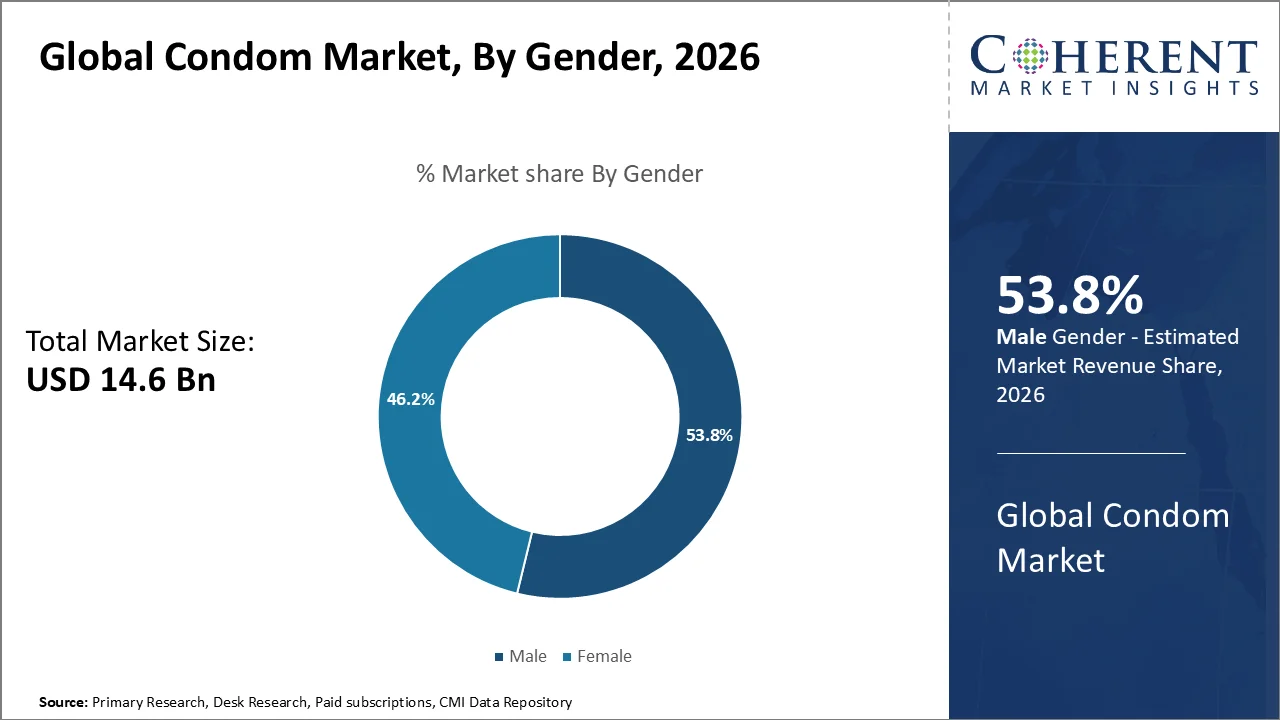
- Male hold the largest market share of 53.8% in 2026 owing to the rising awareness of STI prevention. According to PAHO, condoms are among the most effective methods for preventing STIs, including HIV.
- Non-Latex expected to hold largest market share of 52.6% in 2026 owing to its increasing latex allergies and sensitivities. Approximately 1% of the population has a latex allergy.
- Flavored Condom acquired the prominent market share of 42.7% in 2026 owing to the growing demand for sexual wellness products. Flavoured condoms account for approximately 50–70% of India’s condom industry.
- Drug Store capture the largest market share of 39.6% in 2026 owing to its consumer trust.
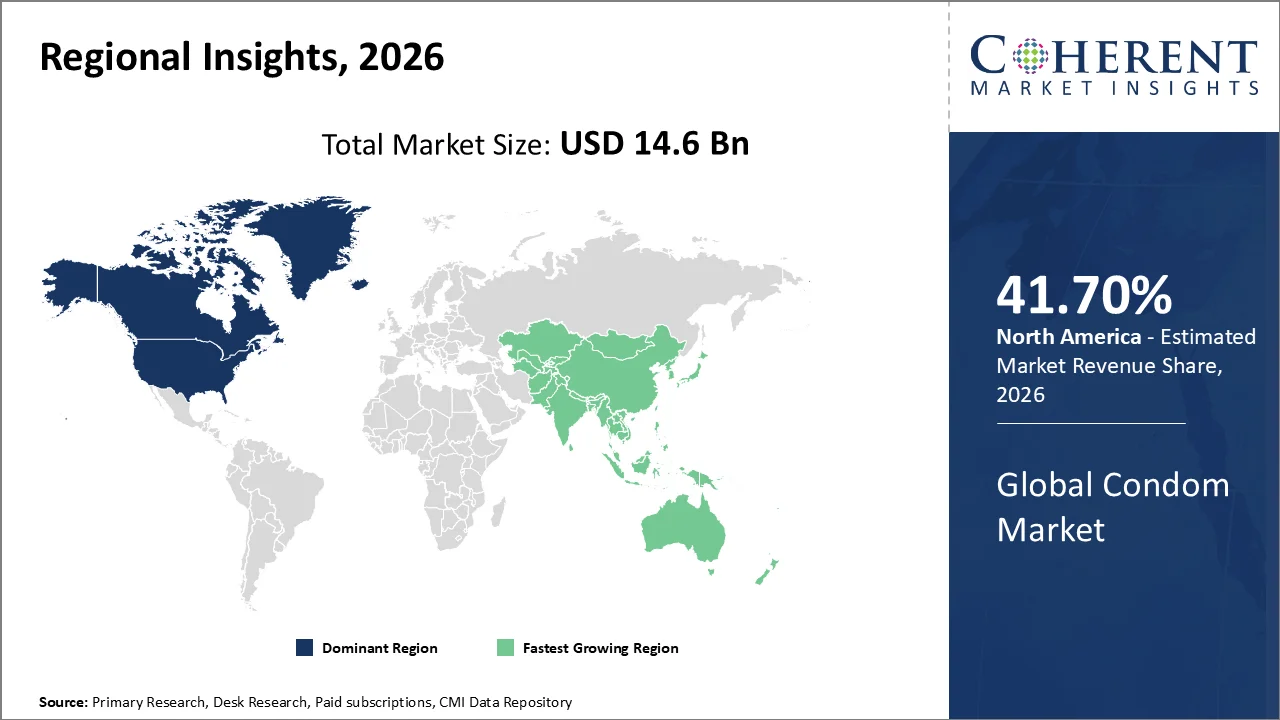
- North America is expected to acquire the dominant share of 41.7% in 2026 owing to the high awareness of sexual health.
Current Events and Their Impact on the Condom Market
Current Event | Description and its Impact |
China introduced VAT on contraceptive products from 1 January 2026 |
|
EU Medical Device Regulation (MDR) Requirements for Condoms |
|
Segmental Insights
- Current Industry Events of 2026
- Market Size Estimation
- Regional Breakdown
- Competitive Landscape
- Customer Intelligence
- Segmental Analysis
- Pricing Analysis
- Key Market Drivers, Challenges & Future Trends
- Customized Insights Section
Why is Male Acquiring the Largest Market Share?
Male hold the largest market share of 53.8% in 2026. The male condom segment grows as consumers become more aware of sexual health, contraception, and STI prevention. Government and public-health initiatives promote safe-sex practices and family planning, encouraging greater adoption. Consumers also value male condoms for their affordability, convenience, and easy availability through pharmacies, retail stores, supermarkets, and e-commerce platforms. Urbanization and changing attitudes toward reproductive health further support demand. Manufacturers also attract consumers by introducing innovative products, including textured, flavored, ultra-thin, and non-latex condoms, which broaden choices and enhance the overall user experience. Durex, a global leader in intimate wellness, unveiled premium Durex Intense condoms in New Zealand. As the world’s first nitrile male condom, this innovation aims to set a new standard in the condom category.
Non-Latex expected to hold largest market share
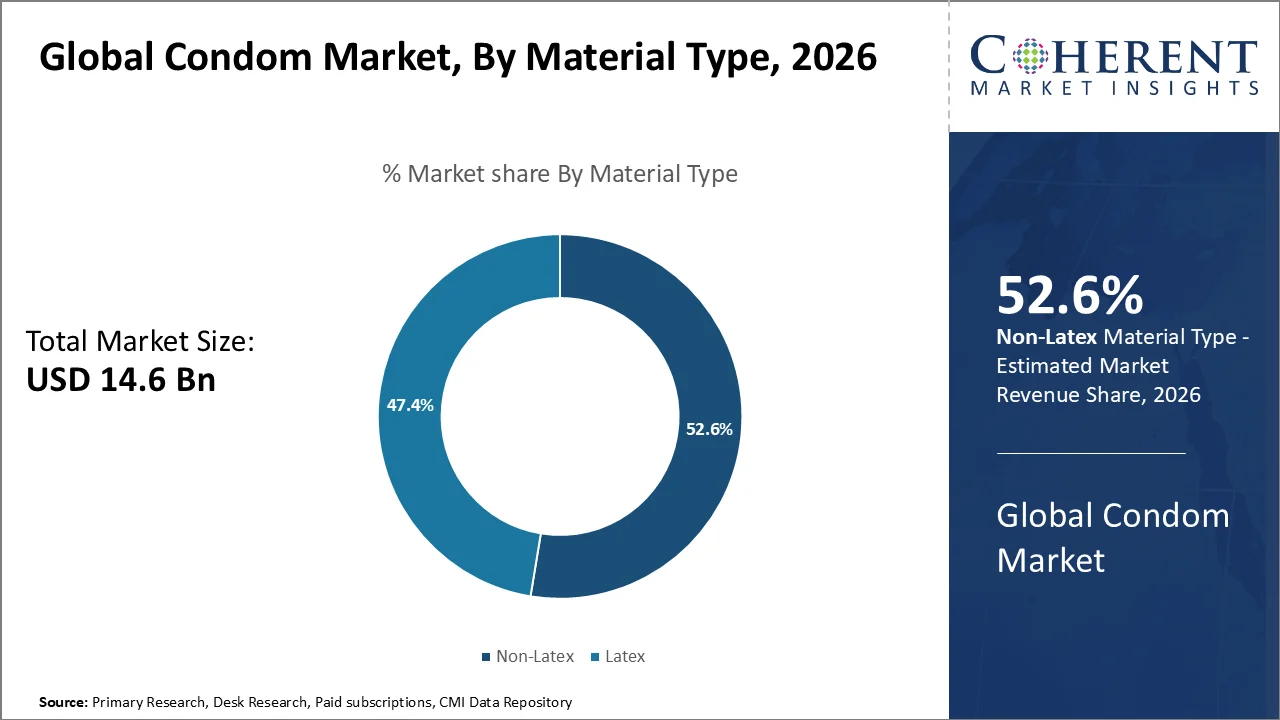
Non-Latex expected to hold largest market share of 52.6% in 2026 owing to its premiumization of sexual-wellness products. The non-latex condom segment grows as consumers become more aware of latex allergies and seek hypoallergenic alternatives. People with latex sensitivities increasingly choose polyurethane, polyisoprene, and other synthetic materials. Consumers also value these condoms for their durability, comfort, and compatibility with certain lubricants. Growing awareness of sexual health and demand for specialized contraceptive products further support market growth. Manufacturers introduce innovative materials and designs to meet evolving preferences, while expanding retail and e-commerce distribution channels makes non-latex condoms more accessible to consumers. In April 2026, LifeStyles Healthcare Australia launched SKYN Supreme Feel, a premium non-latex condom designed to strengthen its position in the high-end sexual wellness segment.
Flavored Condom acquired the prominent market share
Flavored Condom acquired the prominent market share of 42.7% in 2026 owing to the growing influence of younger adult consumers. The flavored condom segment grows as consumers increase their awareness of sexual health, embrace changing preferences, and seek enhanced intimate experiences. Consumers choose innovative products that combine protection with variety and sensory appeal. Manufacturers stimulate demand by offering diverse flavors, attractive packaging, and distinctive designs. Greater acceptance of sexual wellness products and more open attitudes toward intimacy broaden the customer base. E-commerce and modern retail channels make flavored condoms easier to access, while targeted digital marketing enables brands to engage adult consumers and encourage product trial. For instance, Mankind Pharma’s leading condom brand, Manforce, has launched Manforce Cocktail Condoms, combining two flavors—strawberry and vanilla—for a unique sensory experience.
Which Distribution Channel segment dominates the market?
Drug Store capture the largest market share of 39.6% in 2026. The drugstore channel in the condom market grows as consumers value easy access, trusted retailers, and convenient purchasing. Pharmacies and drugstores offer a broad range of condom brands and variants, enabling consumers to choose products that match their preferences. Pharmacists can provide guidance and improve consumer confidence in sexual-health products. Expanding pharmacy networks, consistent product availability, in-store promotions, and rising sexual-health awareness further drive sales. Drugstores also help reduce purchasing stigma by placing condoms alongside other personal healthcare products, making them easier to purchase discreetly and conveniently.
Condom Market Trends
- Growing demand for innovative condoms such as ultra-thin, textured, flavored, and non-latex variants is expanding product differentiation and consumer choice. This product diversification is also visible in public-sector procurement: UNFPA’s 2025 procurement plan includes multiple male-condom variants, including dotted, colored/scented and fruit-flavored products, as well as female condoms in latex and nitrile variants, including vanilla, strawberry and caramel options.
- ncreasing focus on sexual wellness and preventive healthcare is strengthening the public-health relevance of condoms beyond contraception. WHO reports that more than 1 million curable STIs are acquired every day worldwide among people aged 15–49, highlighting the continuing need for effective STI-prevention tools. WHO also identifies condoms as the only available multipurpose prevention technology against HIV, STIs and unintended pregnancy.
- Expanding government and public-health initiatives continue to support condom accessibility through HIV prevention, STI programmes and family-planning services. WHO states that condoms are included in its programmes covering STI and HIV prevention, contraception and family planning, while UNFPA's 2025 procurement plan includes substantial procurement across male and female condom categories. This institutional demand provides an important source of market volume in addition to commercial retail sales.
- Changing approaches to sexual-health communication are supporting efforts to improve condom uptake. WHO reports that research by WHO, HRP and partners found that interventions using positive language about sex, including sexual pleasure, are effective in increasing condom use. At the same time, WHO reports that in a European multi-party study, 30% of adolescents reported using neither a condom nor the contraceptive pill at their last intercourse, showing that significant gaps in protective contraceptive use remain.
Regional Insights
North America dominates owing to strong retail availability
North America is expected to acquire the dominant share of 41.70% in 2026. The North American condom market grows as consumers become more aware of sexual health, contraception, and STI prevention, supported by established sex education and public-health programs. Consumers choose condoms for their affordability, convenience, and ease of use. Strong healthcare systems and extensive retail networks ensure widespread product availability. Growing e-commerce adoption enables discreet purchases and provides consumers with a broader product selection. Manufacturers drive demand by introducing ultra-thin, textured, flavored, and non-latex condoms, while evolving attitudes toward sexual wellness encourage greater consumer acceptance. The Kinsey Institute at Indiana University launched a new Disability and Sexual Health Initiative to address gaps in research on people with disabilities, beginning with a study focused on condom use.
Asia Pacific Condom Market Trends
The Asia Pacific condom market is expanding as consumers become more aware of sexual health, family planning, and sexually transmitted infection prevention. Governments and NGOs are strengthening reproductive health programs and improving access across India, China, and Southeast Asia. Urbanization, evolving lifestyles, greater acceptance of contraception, and improved healthcare infrastructure are also increasing demand. E-commerce platforms and online pharmacies offer consumers greater convenience and privacy. Meanwhile, manufacturers are introducing ultra-thin, textured, flavored, and non-latex condoms to meet the preferences of younger and more health-conscious consumers. In July 2026, Durex launched Naturals Smooth Glide condoms with 2X more water-based lubricant to enhance comfort and complement natural wetness during sex.
United States Condom Market Trends
The United States condom market benefits from growing sexual health awareness, concerns about sexually transmitted infections and unintended pregnancies, and strong demand for accessible contraception. Government initiatives, public health campaigns, and sex education programs promote safer sexual practices and increase consumer awareness. E-commerce platforms further drive market growth by providing privacy, convenience, diverse product options, and home delivery. Manufacturers also attract consumers through product innovations such as non-latex, lubricated, textured, and female condoms, which offer greater comfort, protection, and personal choice. The Cross River State Government, in partnership with UNFPA, installed condom dispensers at 18 locations across Calabar to improve access for high-risk and vulnerable groups.
China Condom Market Trends
China’s condom market grows as consumers become more aware of sexual health, contraception, and STI prevention. Younger consumers are changing social attitudes and adopting new lifestyles, which supports demand for condoms. Government health education and disease-prevention programs also encourage safer sexual practices. Urbanization and rising disposable incomes enable consumers to choose branded and premium products. E-commerce platforms make purchases more private and convenient while offering greater product variety. Manufacturers also attract consumers through innovations such as ultra-thin, non-latex, and comfort-focused condoms.
Who are the Major Companies in Condom Industry
Some of the major key players in Condom are Ansell Ltd (Richmond, Australia), Reckitt Benckiser Group Plc (England), Sagami Rubber Industries, Reckitt Benckiser Group, Karex Industries Sdn. Bhd (Johor, Malaysia), Graphic Armor LLC, Thai Nippon rubber Industru Co. Ltd (Sathon, Bangkok), Church & Dwight, Okamoto Industries, HLL Lifecare, and Guilin Latex.
Key News
- In June 2026, BroCode and Bold Care launched BroTection, a consumer-driven condom developed in response to strong demand for safe intimacy after BroCode occasions.
- In July 2026, Durex launched Durex Naturals Smooth Glide, featuring 2X more water-based lubricant designed to complement natural moisture and reduce discomfort during sex. The launch strengthens Durex’s focus on comfort as a key aspect of sexual wellbeing.
Market Report Scope
Condom Market Report Coverage
| Report Coverage | Details | ||
|---|---|---|---|
| Base Year: | 2025 | Market Size in 2026: | USD 14.6 Bn |
| Historical Data for: | 2020 To 2024 | Forecast Period: | 2026 To 2033 |
| Forecast Period 2026 to 2033 CAGR: | 8.8% | 2033 Value Projection: | USD 26.5 Bn |
| Geographies covered: |
| ||
| Segments covered: |
| ||
| Companies covered: | Ansell Ltd (Richmond, Australia), Reckitt Benckiser Group Plc (England), Sagami Rubber Industries, Reckitt Benckiser Group, Karex Industries Sdn. Bhd (Johor, Malaysia), Graphic Armor LLC, Thai Nippon rubber Industru Co. Ltd (Sathon, Bangkok), Church & Dwight, Okamoto Industries, HLL Lifecare, and Guilin Latex. | ||
Analyst Opinion
- China’s condom market is increasingly supported by sustained public-health need rather than discretionary demand. China recorded more than 100,000 gonorrhoea cases and roughly 670,000 syphilis cases in 2024, underscoring the continuing need for accessible barrier protection. In our view, this keeps condoms strategically relevant even as consumers gain access to alternative contraceptive methods.
- Consumption data confirms that condoms have moved beyond a niche contraceptive product in China. Frost & Sullivan reports that annual condom consumption increased from 5.75 billion units in 2020 to 6 billion units in 2024. We believe this reflects a meaningful shift toward routine use, supported by greater consumer acceptance, easier purchasing, and broader adoption across demographic groups.
- The strongest commercial opportunity is shifting from basic protection toward premium user experience. Frost & Sullivan identifies growing Chinese consumer demand for comfort, discretion, and improved product experience, while WHO notes that correct condom use provides 98% protection against unplanned pregnancy and significantly reduces STI transmission. In our assessment, manufacturers that combine ultra-thin designs, improved lubrication, non-latex materials, and discreet e-commerce distribution will be better positioned than brands competing primarily on price.
Speak to the analyst
Want personalized insights?
Take the findings above to one of our principal consultants, or have the report rebuilt around the segments, geographies and competitors you actually track.
Market Segmentation
- By Gender (Revenue, USD Bn, 2021-2033)
- Male
- Female
- By Material Type (Revenue, USD Bn, 2021-2033)
- Latex
- Non-Latex
- By Product Type (Revenue, USD Bn, 2021-2033)
- Flavored Condom
- Studded
- Warming
- Pleasured
- Others
- By Distribution Channels (Revenue, USD Bn, 2021-2033)
- Drug Store
- Supermarket
- Hypermarket
- Others
- By Region (Revenue, USD Bn, 2021-2033)
- North America
- U.S.
- Canada
- Latin America
- Brazil
- Mexico
- Argentina
- Rest of Latin America
- Europe
- Germany
- U.K.
- France
- Italy
- Spain
- Russia
- Rest of Europe
- Asia Pacific
- China
- India
- Japan
- Australia
- South Korea
- ASEAN
- Rest of Asia Pacific
- Middle East
- GCC
- Israel
- Rest of Middle East
- Africa
- South Africa
- Central Africa
- North Africa
- North America
Sources
Primary Research interviews
- Interviews with condom manufacturers and production/quality-control personnel
- Interviews with distributors, wholesalers, retailers, pharmacies, and e-commerce channel participants
- Interviews with sexual and reproductive health professionals, healthcare providers, and procurement specialists
- Interviews with public-sector procurement officials and institutional buyers
- Interviews with family-planning programme managers and NGOs involved in condom distribution
- Interviews with packaging, raw-material, and latex supply-chain participants
- Interviews with consumers and end users to understand product preferences, purchasing behaviour, brand awareness, pricing sensitivity, and usage patterns
Databases
- World Health Organization (WHO) databases and statistical resources
- United Nations Population Fund (UNFPA) databases and procurement resources
- UNAIDS data and epidemiological databases
- World Bank Data
- United Nations Population Division databases
- Demographic and Health Surveys (DHS) Program
- UN Comtrade database for international trade and import/export analysis
- National statistical databases and government trade statistics
- National health, family-planning, and reproductive-health databases
- PubMed/National Library of Medicine database for scientific and clinical literature
Magazines
- Consumer health and healthcare magazines
- Pharmaceutical and healthcare trade publications
- Medical and reproductive-health magazines
- Retail and consumer-goods trade publications
- Packaging and materials-industry magazines
- Relevant regional and national business publications
Journals
- Contraception
- Sexually Transmitted Diseases
- Sexually Transmitted Infections
- The Lancet
- The Lancet HIV
- Journal of Adolescent Health
- American Journal of Public Health
- PLOS ONE
- Peer-reviewed journals covering reproductive health, contraception, sexual health, epidemiology, public health, and consumer behaviour
- PubMed-indexed clinical and epidemiological studies on condom efficacy, usage, breakage, slippage, and STI/HIV prevention
Newspapers
- International newspapers and news publications covering healthcare, demographics, consumer products, and public health
- National and regional newspapers covering reproductive health, contraception, government procurement, healthcare programmes, and consumer trends
- Business newspapers covering manufacturing, imports/exports, retail, e-commerce, and consumer spending
- Government and public-health announcements reported through established news publications
Associations
- International Organization for Standardization (ISO)
- World Health Organization (WHO)
- United Nations Population Fund (UNFPA)
- Joint United Nations Programme on HIV/AIDS (UNAIDS)
- National public-health and family-planning associations
- National standards organizations
- Reproductive-health and sexual-health professional associations
- Medical and public-health associations
- Industry and manufacturing associations relevant to latex, rubber, medical devices, packaging, and consumer healthcare
Public Domain sources
- WHO condom fact sheets, technical guidance, specifications, procurement guidelines, and reproductive-health publications
- UNFPA condom procurement resources, technical specifications, prequalification information, and supplier data
- UNAIDS HIV/AIDS statistics, reports, and condom-related publications
- United Nations Population Division demographic datasets
- World Bank population, health, income, and socioeconomic datasets
- DHS country surveys and family-planning datasets
- UN Comtrade international trade and customs data
- National government health ministry publications
- National statistical office publications
- National customs and trade databases
- Public procurement/tender documents and government purchasing records
- ISO standards and publicly available standard information, including ISO 4074 for natural rubber latex male condoms
- WHO/UNFPA/UNAIDS technical and policy publications relating to condoms, HIV, STIs, contraception, and family planning
- Academic publications and abstracts available through PubMed and other publicly accessible scholarly databases
Proprietary Elements
- CMI Data Analytics Tool
- Proprietary CMI Existing Repository of Information for the last 10 years
Get access to 250+ pages report
Every segment, forecast, competitor profile and data table behind the analysis above — available for instant download.
- ESOMAR Member
- ISO 9001:2015 Certified
- D-U-N-S Registered
- GDPR & CCPA Compliant
Missing comfort of reading report in your local language? Find your preferred language:
Transform your Strategy with Exclusive Trending Reports
Frequently Asked Questions
The market is primarily supported by the dual role of condoms in preventing unintended pregnancy and sexually transmitted infections.
STI prevention remains a fundamental demand driver because WHO estimated 374 million new infections from four curable STIs among adults aged 15–49 in 2020.
Product innovation helps manufacturers compete beyond basic contraception. Features such as improved lubrication, thinner materials, enhanced fit, and alternative materials can address consumer concerns around comfort and sexual experience.
Digital channels can address two major barriers: privacy and accessibility.
Inconsistent use remains a major challenge despite the proven effectiveness of condoms.