

Perfume Market Size and Trends - 2026 to 2033
The global perfume market is estimated to be valued at USD 64.81 Bn in 2026 and is expected to reach USD 100.71 Bn by 2033, exhibiting a compound annual growth rate (CAGR) of 6.5% from 2026 to 2033.
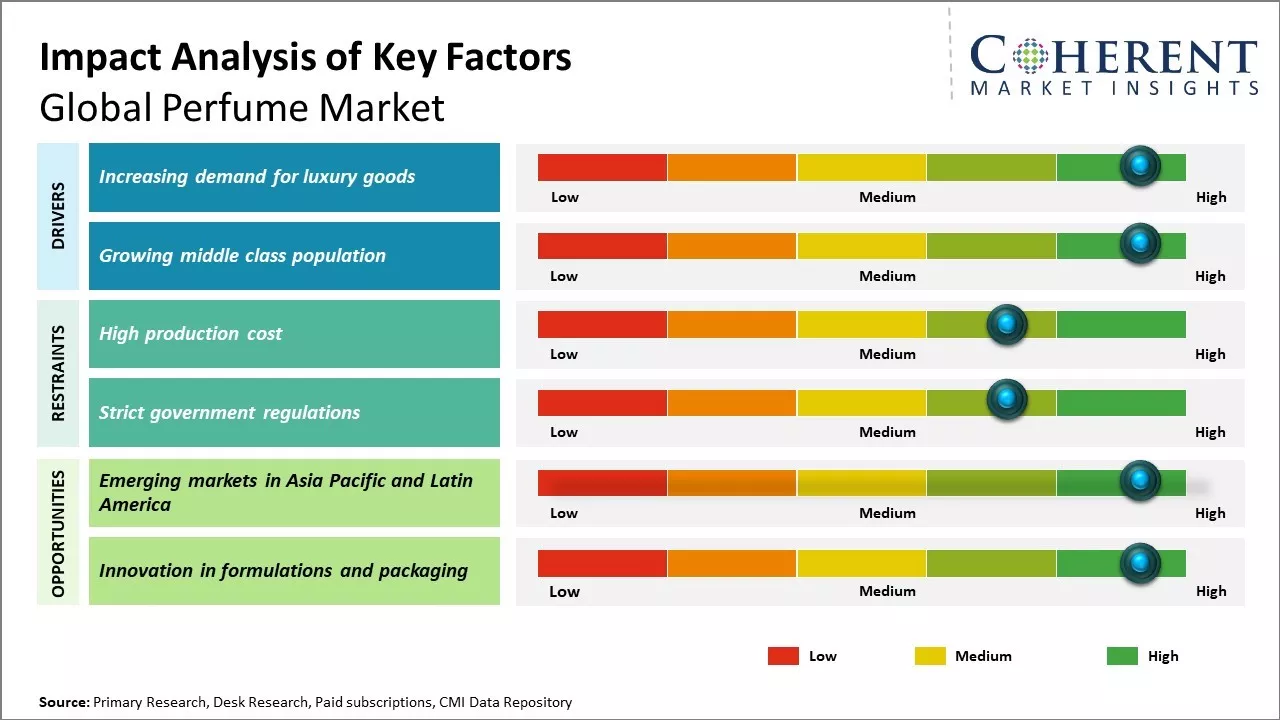
Key Takeaways
- Based on Product Type, the Premium segment is expected to lead with 56.2% share in 2026, as consumers seek luxury, personalization, and sustainable elegance in their fragrance choices.
- Based on End-User, the Women segment is expected to capture the largest share of the market in 2026, driven by diverse offerings, frequent usage, and targeted brand engagement.
- Based on Distribution Channel, the Online segment is projected to account for the highest share of the market in 2026, fueled by convenience, personalization, and digital influence.
- Based on Region, the Europe region is estimated to lead the global perfume market in 2026, with 35.4% share. While, Asia Pacific is anticipated to be the fastest growing region.
Market Overview
The global perfume market is experiencing robust growth, driven by rising disposable incomes, urbanization, and evolving consumer preferences. Demand is surging for premium, unisex, and personalized fragrances, especially among younger demographics. The influence of social media, celebrity endorsements, and experiential retail is reshaping buying behavior. E-commerce continues to expand access, while Asia-Pacific emerges as a key growth region. Innovation in scent formulation and sustainable packaging is also fueling consumer interest and brand differentiation.
Current Event and their Impact on the Perfume Market
Current Event | Description and its Impact |
European Supply Chain and Regulatory Changes |
|
Middle East Geopolitical and Cultural Dynamics |
|
Role of Artificial Intelligence (AI) in Perfume Market
Artificial intelligence (AI) is transforming the perfume market by enabling hyper-personalization, predictive analytics, and innovative scent creation. Brands are leveraging AI to analyze consumer preferences, emotions, and even biometric data to craft bespoke fragrances tailored to individual tastes. AI tools also streamline formulation processes, forecast trends, and optimize supply chains. Virtual scent discovery platforms powered by AI enhance online shopping experiences, allowing users to explore and select perfumes through digital scent profiling. This fusion of technology and artistry is redefining how perfumes are developed, marketed, and experienced, making the fragrance industry more adaptive, data-driven, and emotionally resonant.
For instance, Tom Ford unveiled a groundbreaking fragrance project merging artificial intelligence with artistic collaboration. The initiative explores how technology can interpret human emotion to craft personalized scents, redefining the boundaries of perfumery. This fusion of tech and creativity highlights the evolving role of AI in luxury beauty experiences.
- Current Industry Events of 2026
- Market Size Estimation
- Regional Breakdown
- Competitive Landscape
- Customer Intelligence
- Segmental Analysis
- Pricing Analysis
- Key Market Drivers, Challenges & Future Trends
- Customized Insights Section
Segmental Insights
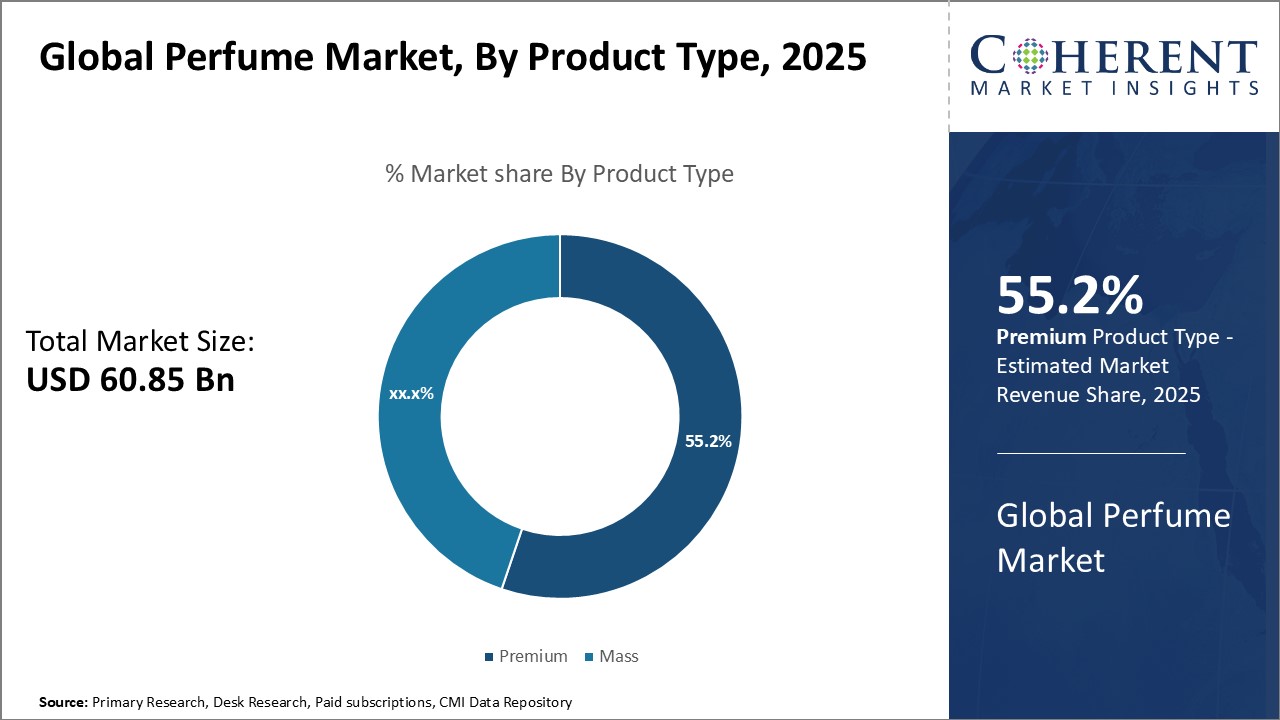
Perfume Market Insights, By Product Type: Premium dominates as consumers seek luxury, personalization, and sustainable elegance in their fragrance choices
In terms of product type, the premium segment is expected to lead the market with 56.2% share in 2026, fueled by growing consumer interest in luxury, exclusivity, and personalized fragrance experiences. As disposable incomes rise and brand consciousness deepens, shoppers are gravitating toward high-end scents that offer superior quality, longevity, and unique olfactory profiles. Premium brands are also innovating with sustainable ingredients and packaging, which appeals to environmentally conscious buyers. This shift reflects a broader trend of consumers viewing fragrance as an extension of personal identity and lifestyle.
For instance, in July 2025, Trevito Lifestyle introduced its new-age perfume brand, Eau De Parfum, in India, aiming to make luxury fragrances more accessible. The brand emphasizes high-quality, long-lasting scents crafted with premium ingredients, targeting modern consumers seeking affordable elegance. This launch marks Trevito’s entry into the growing Indian premium fragrance market.
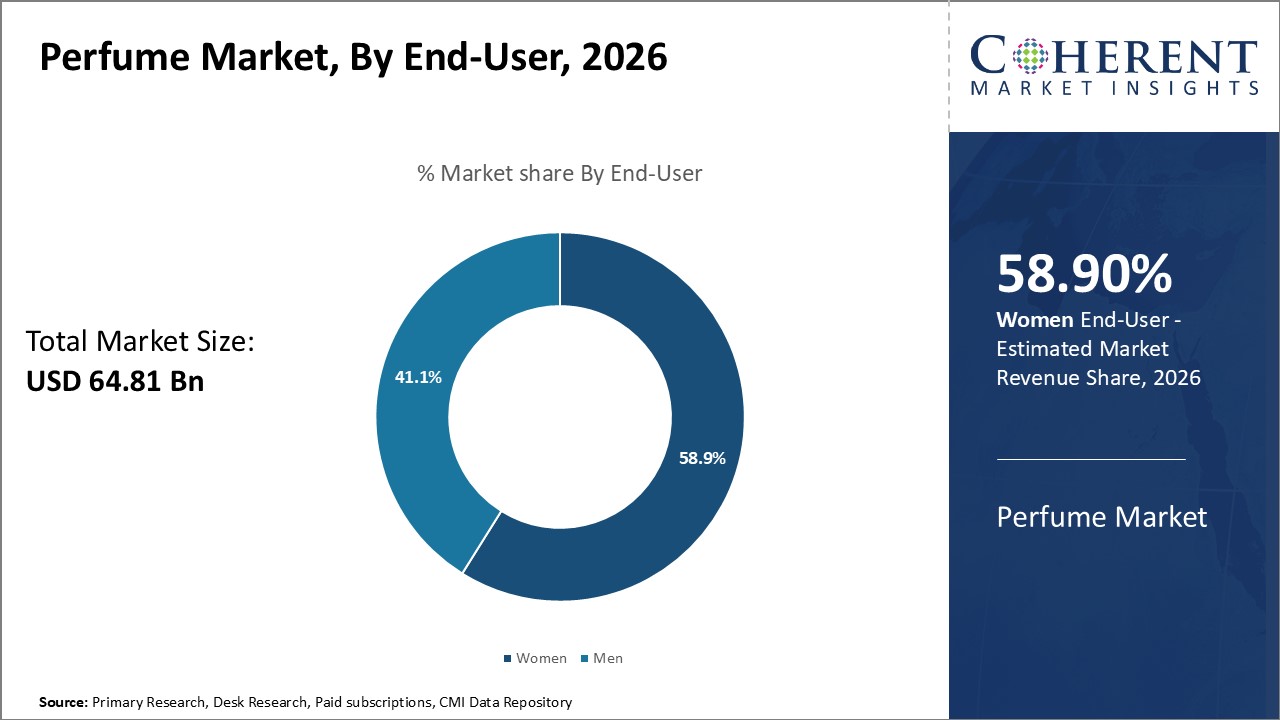
Perfume Market Insights, By End-User: Women lead is driven by diverse offerings, frequent usage, and targeted brand engagement
In terms of end-user, the women segment is expected to hold the largest share of the market in 2026. This is largely due to the wider variety of products tailored to female preferences, as well as cultural norms that associate fragrance more strongly with femininity and self-care. Women tend to purchase perfumes more frequently and are more likely to explore new scents, seasonal collections, and niche brands. Marketing campaigns and product development often target female consumers, reinforcing their central role in driving demand across both mass and premium categories.
For instance, in July 2025, Actor Rashmika Mandanna introduced Dear Diary, a premium fragrance line crafted to resonate with women through emotion and storytelling. Inspired by her personal journey, the scents aim to evoke memories and individuality. The launch reflects a growing trend of female celebrities shaping the luxury perfume market with personalized offerings.
Perfume Market Insights, By Distribution Channel: Online platforms surge ahead as the top, fueled by convenience, personalization, and digital influence
In terms of distribution channel, the online segment is projected to account for the highest share of the market in 2026, reshaping how consumers discover and purchase perfumes. The convenience of browsing from home, access to global brands, and personalized recommendations through AI and data analytics have made e-commerce a preferred choice. Social media influencers, virtual try-ons, and user-generated reviews further enhance the digital shopping experience. While brick-and-mortar stores still play a role, especially for sampling, online channels are setting the pace for growth and innovation in fragrance retail.
For instance, in October 2025, Boots launched a first-of-its-kind fragrance boutique, introducing over 400 new scents across designer and niche brands. The initiative blends in-store experiences with enhanced online accessibility, allowing customers to explore and purchase fragrances digitally. This move reinforces Boots’ commitment to innovation and personalization in the evolving perfume retail landscape.
Regional Insights
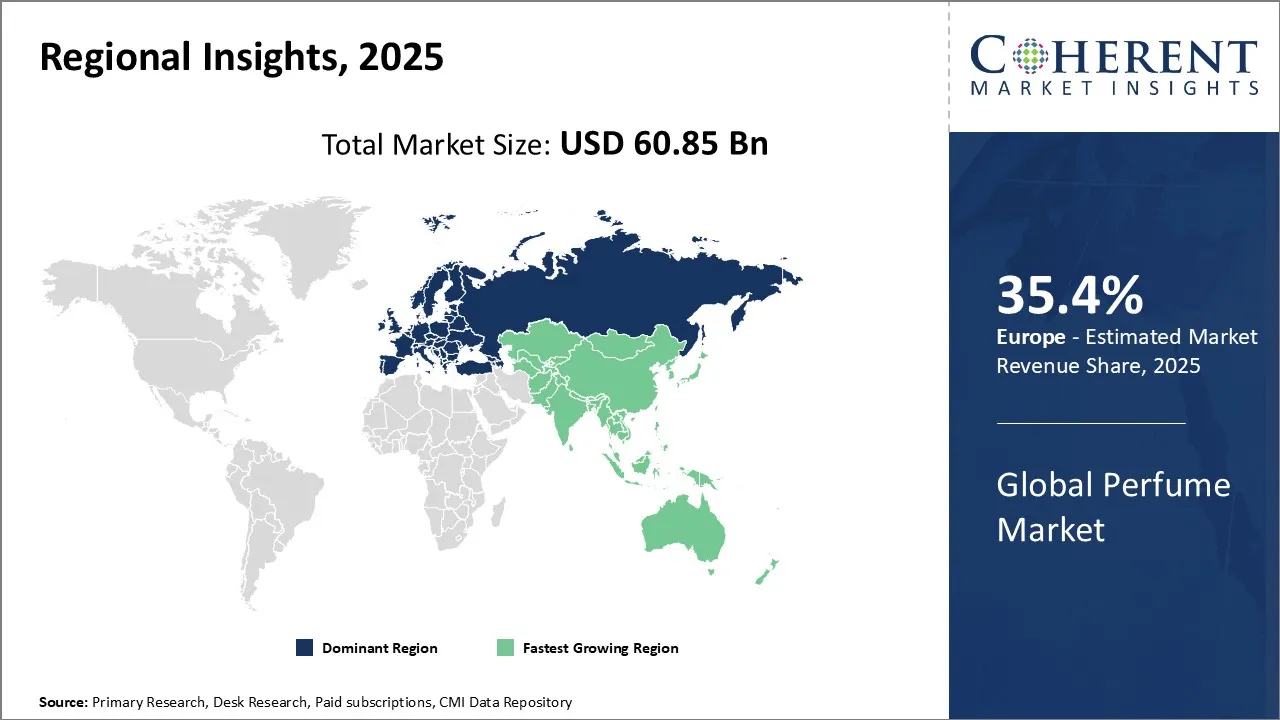
Europe Perfume Market Analysis & Trends
Europe continues to be the dominant region in the global perfume market with 35.4% share in 2026. With countries like France, the U.K., Germany, and Italy, Europe is home to some of the major players in the perfume industry including LVMH, Chanel, Estée Lauder and Puig. These companies have established strong brand recognition and penetration over decades of operation in the region. In addition, European consumers have traditionally had higher spending power and propensity to purchase high-end luxury goods and premium beauty products. Among the European countries, France towers over others in terms of perfume market size and influence given names like Chanel, Dior and Guerlain call France their home. The French perfume industry exports over 50.5% of its production volumes, earning significant foreign exchange for the country. The supportive policy environment and cultural affinity for fragrance in France have ensured new entrants also find success with uniquely crafted fragrances.
For instance, in May 2026, Pop icon Billie Eilish launched her latest fragrance, Your Turn, exclusively across Europe through the Douglas perfumery chain. The scent, part of her growing beauty portfolio, reflects her signature style and emotional depth. This strategic partnership enhances Douglas’s premium offerings and expands Eilish’s presence in the European perfume market.
Asia Pacific Perfume Market Analysis & Trends
Within Asia Pacific, India has emerged as one of the fastest growing regions for the perfume market. Coupled with strong economic growth over the past decade, increasing aspirations among the rising middle class for experiences and self-care products have boosted demand. Domestic names have established strongly alongside multinational brands. At the same time, import restrictions and pricing strategies adopted by local producers have kept costs attractive for Indian consumers. The influence of Bollywood and blended domestic fragrances suited to the warm climate have resonated well. Beauty retailers adopting omni-channel models and leveraging festive seasons are adding further impetus.
For instance, in July 2026, Nykaa unveiled Fragtok, a pioneering initiative to build India’s first fragrance creator community. The platform aims to engage perfume enthusiasts and influencers, fostering content creation and discovery around scents. By blending beauty with digital storytelling, Nykaa strengthens its position in India’s growing online fragrance market and creator economy.
Perfume Market Outlook Country-Wise
France Perfume Market Trends
As the birthplace of haute perfumery, France continues to be a dominant force in both production and consumption. French consumers value craftsmanship and heritage, and the country’s luxury houses like Chanel and Dior maintain strong domestic and international appeal.
For instance, in March 2026, Paris Perfume Week 2026 marked a pivotal moment for the fragrance industry, showcasing innovation, sustainability, and global collaboration. The event highlighted the sector’s resilience and growth, with premium brands, niche creators, and emerging markets converging to shape future trends. It reaffirmed Paris’s role as the epicenter of global perfumery excellence.
China Perfume Market Trends
China’s perfume market is expanding rapidly, fueled by rising disposable incomes, urbanization, and growing interest in personal grooming. Younger consumers are especially drawn to international luxury brands and are driving demand through online platforms and social media.
For instance, in September 2026, Givaudan inaugurated a state-of-the-art fragrance and beauty manufacturing facility in Guangzhou, China, marking a major milestone in its Asia-Pacific expansion. The new site enhances production capabilities, supports local innovation, and strengthens supply chain efficiency. This investment reflects Givaudan’s commitment to meeting rising regional demand for premium and sustainable beauty solutions.
Market Report Scope
Perfume Market Report Coverage
| Report Coverage | Details | ||
|---|---|---|---|
| Base Year: | 2025 | Market Size in 2026: | USD 64.81 Bn |
| Historical Data for: | 2020 To 2024 | Forecast Period: | 2026 To 2033 |
| Forecast Period 2026 to 2033 CAGR: | 6.5% | 2033 Value Projection: | USD 100.71 Bn |
| Geographies covered: |
| ||
| Segments covered: |
| ||
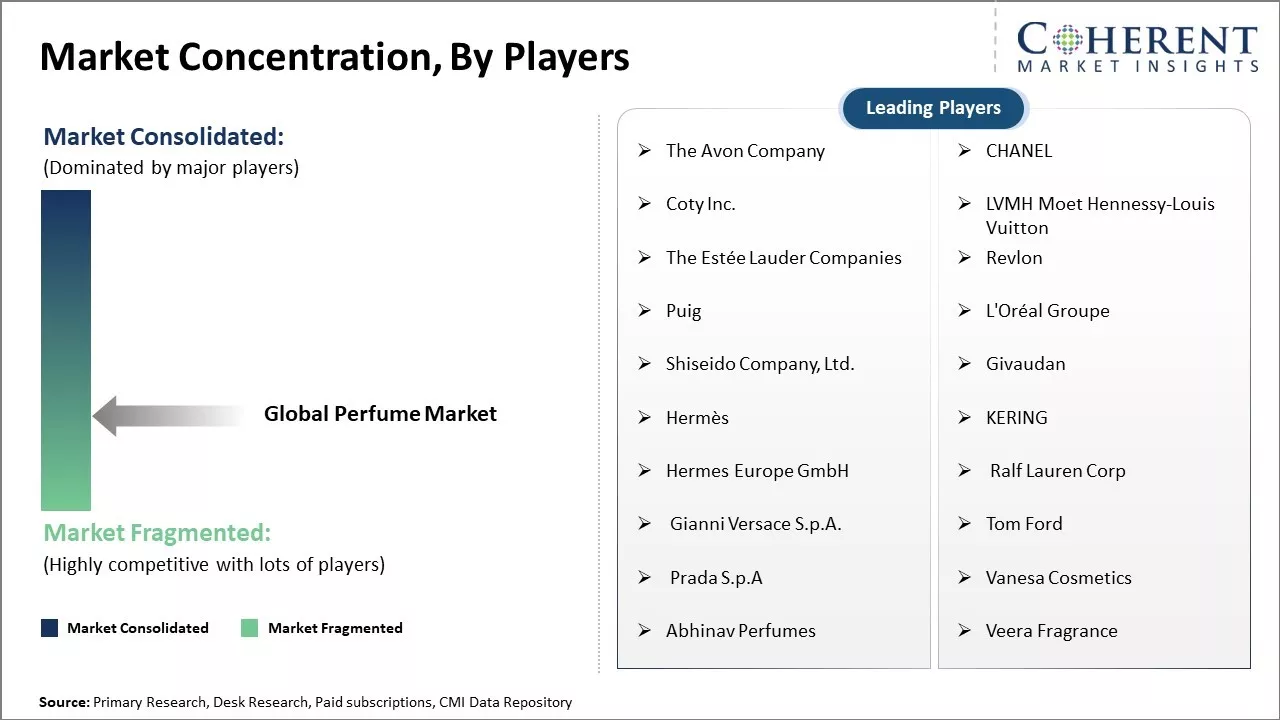
| Companies covered: | The Avon Company, CHANEL, Coty Inc., LVMH Moet Hennessy-Louis Vuitton, The Estée Lauder Companies, Revlon, Puig, L'Oréal Groupe, Shiseido Company, Ltd., Givaudan, Hermès, KERING, Hermes Europe GmbH, Ralf Lauren Corp, Gianni Versace S.p.A., Tom Ford, Prada S.p.A, Vanesa Cosmetics, Abhinav Perfumes, and Veera Fragrance | ||
| Growth Drivers: |
| ||
| Restraints & Challenges: |
| ||
Perfume Market Driver
Increasing demand for luxury goods
The global perfume market has been witnessing steady growth over the past few years driven majorly by the increasing spending power of consumers and rising demand for luxury and premium products across major economies. With higher disposable incomes, many consumers today are willing to splurge more on premium beauty and personal care brands that offer a sense of status and style. Perfumes have become an important part of everyday outfits for both professional and casual wear. Leading luxury brands are innovating with unique fragrances made from the finest ingredients to attract brand-conscious consumers looking for refined scent experiences.
Rising affluence in emerging markets like China, India, Brazil, and Indonesia is giving boost to the luxury goods sector. More number of middle-class households are entering the luxury consumption zone fueled by pride of possessing premium international brands. Strong economic growth has led to creation of wealthy class with generous spending habits. They are attracted to prestige labels and are willing to pay premium prices for products that symbolize high social rank and distinction. Luxury perfume houses are cashing in on this trend by launching high-end fragrances encased in exquisite bottles targeted at this customer base. They are also investing in brand advertising and celebrity promotions to generate buzz and desirability around new launches.
Changing social mores too have normalized the regular use of fragrances not just for special occasions but for everyday activities. Scented products are increasingly perceived as self-care accessories helping one to feel put-together and confident. Advancements in luxury e-commerce and multi-brand retail have improved accessibility of niche perfume labels worldwide. Consumers can now browse exclusive collections and make impulse buys conveniently online. This is aiding global expansion of prestige perfume players. Further, aggressive luxury marketing over digital mediums is successful in enhancing prestige perception and boosting trial among younger, affluent crowd inclined to experiment with different aromas.
Market Concentration and Competitive Landscape
Analyst Opinion (Expert Opinion)
The perfume market value is undergoing a decisive transformation driven by personalization, sustainability, and digital influence. Consumers today increasingly seek scents that express individuality rather than mere brand prestige. Studies by Firmenich and Givaudan indicate that over 60% of Gen Z and millennial buyers prefer personalized or mood-based fragrances. This trend has fueled AI-driven scent formulation and subscription models such as Scentbird and Dossier, which curate individualized fragrance experiences.
Ingredient transparency and sustainability now play central roles in shaping purchase decisions. The adoption of biotechnology-derived aroma molecules, such as lab-grown musks and synthetic ambergris, allows brands to combine ethical sourcing with olfactory complexity. Companies like IFF and Le Labo leverage science-backed sustainability and ingredient traceability to enhance brand credibility.
Digitization is redefining fragrance discovery. According to Circana, online fragrance sales rose over 15% in 2024, supported by social media trends such as TikTok’s “perfume layering,” which encourage experimentation and dupe culture. Meanwhile, Middle Eastern olfactory influences, particularly oud and amber are reshaping Western formulations, creating a hybrid luxury aesthetic.
Speak to the analyst
Want personalized insights?
Take the findings above to one of our principal consultants, or have the report rebuilt around the segments, geographies and competitors you actually track.
Perfume Industry News
- In October 2025, Decoy Perfumes teamed up with Reliance Smart Bazaar to bring affordable luxury fragrances to Indian consumers. The collaboration aims to redefine accessibility in the premium scent category by offering high-quality perfumes at competitive prices. This strategic move strengthens Decoy’s retail presence and caters to India’s growing demand for value-driven luxury.
- In September 2025, Al Abbadi Fragrances officially launched in India, 2025, introducing a premium scent experience that blends exclusivity with unique customer rewards. The brand aims to redefine luxury perfumery for Indian consumers, offering high-quality fragrances and personalized engagement. This marks a strategic expansion into one of Asia’s fastest-growing beauty markets.
- In May 2024, an India-based fragrance brand, Eze Perfumes, made its global debut by launching in the U.S. market. This expansion marks a significant milestone for the brand, showcasing its unique scent offerings and commitment to quality as it seeks to capture the attention of fragrance enthusiasts worldwide.
- In July 2024, Lavie Luxe introduced a new category of perfumes, expanding beyond bags and accessories
Market Segmentation
- Product Type Insights (Revenue, USD, 2026 - 2033)
- Mass
- Premium
- End-user Insights (Revenue, USD, 2026 - 2033)
- Men
- Women
- Distribution Channel Insights (Revenue, USD, 2026 - 2033)
- Specialty Stores
- Department Stores
- Online Platforms
- Supermarkets/Hypermarkets
- Regional Insights (Revenue, USD, 2026 - 2033)
- North America
- U.S.
- Canada
- Latin America
- Brazil
- Argentina
- Mexico
- Rest of Latin America
- Europe
- Germany
- U.K.
- Spain
- France
- Italy
- Russia
- Rest of Europe
- Asia Pacific
- China
- India
- Japan
- Australia
- South Korea
- ASEAN
- Rest of Asia Pacific
- Middle East & Africa
- GCC Countries
- Israel
- Rest of Middle East & Africa
- Key Players Insights (Revenue, USD Bn, 2021 - 2033)
- The Avon Company
- CHANEL
- Coty Inc.
- LVMH Moet Hennessy-Louis Vuitton
- The Estée Lauder Companies
- Revlon
- Puig
- L'Oréal Groupe
- Shiseido Company, Ltd.
- Givaudan
- Hermès
- KERING
- Hermes Europe GmbH
- Ralf Lauren Corp
- Gianni Versace S.p.A.
- Tom Ford
- Prada S.p.A
- Vanesa Cosmetics
- Abhinav Perfumes
- Veera Fragrance
Sources
Primary research interviews from the following stakeholder
Stakeholders
- Interviews with brand marketing teams, perfumers (“noses”), fragrance house R&D leads, contract manufacturers, packaging suppliers, retail buyers, e-commerce category managers, distributors/wholesalers, salon & spa procurement heads, importers, customs brokers, regulatory & compliance officers, and procurement heads across leading global markets.
Specific stakeholders
- Head of Fragrance / Category Lead — large retail chains and beauty specialists (e.g., Sephora, Shoppers Stop, Boots).
- Senior Merchandising / Digital Commerce leads at omnichannel retailers and marketplaces (e.g., Amazon Fashion Beauty, Myntra).
- Master perfumers and R&D heads at fragrance houses and contract manufacturers (e.g., major fragrance houses, independent perfumers).
- Raw material & aroma chemical suppliers — sales and technical managers (e.g., essential oil producers, aroma chemical manufacturers).
- Purchasing / Category leads at duty-free retailers and travel retail operators in major transport hubs (e.g., Heathrow T1/T5 retail operations, large airport duty-free operators).
- Procurement and operations managers at hospitality groups (e.g., luxury hotel chains) for in-room and amenity fragrances.
- Marketing and media managers at beauty advertising agencies and mall media operators.
- Package design leads and suppliers — carton, glass bottle, spray mechanism manufacturers.
- Quality assurance / regulatory managers responsible for IFRA / local regulatory compliance across target markets.
- Export managers and customs brokers handling fragrance shipments and HS classification.
- E-commerce fulfilment & logistics heads (cold chain/chemical handling where relevant).
- Salon/spa franchise owners and wholesale buyers for professional fragrance lines.
Databases & trade statistics
- World Trade Organization (WTO) Trade Statistics
- UN Comtrade Database (HS codes for perfumes, toilet waters, aroma chemicals)
- International Trade Centre (ITC) Trade Map
- U.S. Bureau of Economic Analysis (BEA) — relevant trade/value add data
- Eurostat — trade and retail statistics for EU markets
- China Customs Statistics — exports/imports of fragrance products and raw materials
- Korea Customs Service Data Portal — trade flows for fragrances and aroma chemicals
- Japan External Trade Organization (JETRO) — market entries and trade data
- Directorate General of Commercial Intelligence & Statistics (DGCIS), India — fragrance sector trade & production stats
- National statistical bureaus and customs portals for target countries (e.g., INSEE, ONS, IBGE)
Industry magazines & trade press
- Perfumer & Flavorist
- FragranceX / Fragrance industry newsletters (trade editions)
- CosmeticsDesign (Global and regional editions)
- BeautyMatter (industry analysis)
- Beauty Packaging (packaging for beauty & fragrance)
- Global Cosmetic Industry (GCI) / Cosmetics Business
- Retail Dive — Beauty & Personal Care section
- Duty Free News International (travel retail focus)
- Business of Fashion — Beauty coverage
Academic & technical journals
- Flavour and Fragrance Journal (Wiley)
- International Journal of Cosmetic Science
- Journal of Cosmetic Dermatology
- Journal of Consumer Research (for demand/behavioural studies)
- Journal of Retailing and Consumer Services (retail and omnichannel studies)
- Journal of Applied Polymer Science (for packaging/materials where relevant)
Newspapers & business press
- The Wall Street Journal — Consumer & Lifestyle / Retail sections
- Financial Times — Consumer, Retail & Supply Chain reporting
- The Economic Times — FMCG & Retail (India)
- The New York Times — Style/Business (when relevant to launches/trends)
- Nikkei Asia — manufacturing, supply chain, chemistry & Asia market moves
- South China Morning Post — China market & luxury retail notes
Associations & standards bodies
- International Fragrance Association (IFRA) — standards & guidance
- Research Institute for Fragrance Materials (RIFM) — safety data & research
- Personal Care Products Council (PCPC) (U.S.) — regulatory guidance for cosmetics & fragrances
- Cosmetics Europe — industry rules & regulatory information for EU
- ISO (relevant standards for labelling, packaging and testing)
- International Organization of the Flavor Industry (IOFI) — overlap on aroma chemicals
- Local/national cosmetics and chemicals associations in target markets (e.g., CII cosmetics forums, local chambers of commerce)
Public-domain government & regulatory sources
- National ministries of health / food & drug / consumer affairs (for cosmetics/fragrance regulations) — e.g., CDSCO (India), FDA (U.S. – cosmetic guidance), MHRA / NHS guidance when relevant
- Customs & excise tariff schedules (country portals) — HS codes and duty rates for perfumes & aroma chemicals
- European Chemicals Agency (ECHA) — REACH restrictions impacting aroma chemicals
- National statistical offices and retail sales reports (monthly/quarterly retail sales)
- World Customs Organization (WCO) — HS classification guidance
- Patent offices and IP registries for fragrance formulations and packaging innovation
Retail & channel intelligence sources
- Category & shelf audits (modern trade, perfumery counters, specialty stores, duty free)
- Mystery shopping and price tracking across geographies
- Online marketplace product listing audits and sentiment/review scraping (marketplace brand pages, social proof)
- SKU assortment mapping across retail and travel retail channels
Regulatory & safety data sources
- IFRA Standards and guidance documents
- RIFM toxicology and exposure assessments
- REACH dossiers and restricted substance lists affecting aroma chemicals
- Local labelling and ingredient disclosure regulations (country by country)
Consumer & trend sources
- Social listening platforms and fragrance community sites (e.g., Fragrantica, Basenotes) for consumer sentiment and trend signals
- Beauty influencer & KOL campaign analyses (YouTube, Instagram, TikTok performance for fragrance launches)
- Trend forecasting reports and retail window/visual merchandising studies (visuals, sampling & in-store activation best practices)
Proprietary sources
- CMI Data Analytics Tool
- Proprietary CMI Existing Repository of information for last 8 years
Definition: The global perfume market refers to the worldwide industry and business of manufacturing, developing, marketing and selling perfumes and fragrances. It involves companies that produce perfumes in various forms like eau de parfum, eau de toilette, cologne and body mists. The global perfume market caters to consumers across different regions and countries. Key players in this market engage in researching new fragrance combinations, sourcing essential oils, launching celebrity and brand endorse perfume lines, and distributing their products through retail stores, online stores and other channels.
Get access to 250+ pages report
Every segment, forecast, competitor profile and data table behind the analysis above — available for instant download.
- ESOMAR Member
- ISO 9001:2015 Certified
- D-U-N-S Registered
- GDPR & CCPA Compliant
Missing comfort of reading report in your local language? Find your preferred language:
Transform your Strategy with Exclusive Trending Reports
Frequently Asked Questions
The Perfume Market is estimated to be valued at USD 64.81 Bn in 2026, and is expected to reach USD 100.71 Bn by 2033.
The CAGR of the Perfume Market is projected to be 6.5% from 2026 to 2033.
Increasing demand for luxury goods and growing middle class population are the major factors driving the growth of the global perfume market.
High production cost and strict government regulations are the major factors hampering the growth of the global perfume market.
In terms of product type, mass segment is estimated to dominate the market revenue share in 2026.
The Avon Company, CHANEL, Coty Inc., LVMH Moet Hennessy-Louis Vuitton, The Estée Lauder Companies, Revlon, Puig, L'Oréal Groupe, Shiseido Company, Ltd., Givaudan, Hermès, KERING, Hermes Europe GmbH, Ralf Lauren Corp, Gianni Versace S.p.A., Tom Ford, Prada S.p.A, Vanesa Cosmetics, Abhinav Perfumes, and Veera Fragrance are the major players.
Europe is expected to lead the global perfume market in 2026.