

Global Aluminum Sheet Market Size and Forecast – 2026 To 2033
The Global Aluminum Sheet Market is estimated to be valued at USD 101.60 Bn in 2026 and is expected to reach USD 149.77 Bn by 2033, exhibiting a compound annual growth rate (CAGR) of 5.7% from 2026 to 2033. This significant growth reflects increasing demand across automotive, construction, packaging, electrical, and industrial applications, supported by aluminum’s lightweight structure, corrosion resistance, durability, recyclability, and suitability for high-volume fabrication.
global aluminum sheet market expansion is further supported by rising urbanization, EV manufacturing, recyclable packaging demand, and technological advancements in flat rolled product manufacturing. In January 2026, Hindalco Industries commissioned a USD 0.18 Mn tons per annum Flat Rolled Products (FRP) and battery-grade Aluminum foil facility in Odisha, India with an investment of USD 47.25 Mn, aimed at strengthening high-grade Aluminum supply for EVs, packaging, defense, renewable energy, and advanced manufacturing applications. (Source: Hindalco)
Key Takeaways of the Global Aluminum Sheet Market
- The 3xxx series is expected to dominate the alloy series segment with 24.7 % of the global aluminum sheet market share in 2026, supported by its balance of formability, corrosion resistance, and cost efficiency across packaging, heat exchangers, cookware, and industrial sheet applications. In May 2025, Novelis reported record beverage packaging shipments, while the Aluminum Association identifies 3004 alloys as key can-body materials.
- Plain aluminum sheets are expected to lead the product type segment with 43.8 % of the global aluminum sheet market share in 2026, as they remain the base format for construction panels, automotive parts, packaging conversion, HVAC components, signage, and fabrication. In October 2023, Alcoa announced a value-added casting capacity investment at Bécancour to increase rolling slab supply for automotive and packaging markets.
- Cold rolled sheets are expected to dominate the processing method segment with 58.7 % of the global aluminum sheet market share in 2026, owing to superior thickness control, surface finish, dimensional accuracy, and suitability for high-volume downstream conversion. In August 2025, MINO announced successful first-coil rolling at JUPALCO’s new Aluminum cold rolling mill in India, supporting advanced flat-rolled sheet production.
- Asia Pacific is expected to remain the dominant regional market with 41.3 % share in 2026, supported by integrated Aluminum production, downstream manufacturing scale, and strong demand from infrastructure, transportation, power, and packaging sectors. In July 2026, Reuters reported IHC and Adani’s planned USD 11.5 billion integrated Aluminum project in Odisha, including downstream Aluminum facilities.
- Europe is expected to be the fastest-growing region with 24.8 % of the global aluminum sheet market share in 2026, as sheet producers accelerate circular aluminum, recycling-led feedstock security, and low-carbon product positioning for packaging, mobility, and industrial users. In June 2024, Speira announced a USD 45.79 million Rheinwerk recycling expansion, with production scheduled to start at the beginning of 2026.
- Circularity-Led Sheet Procurement: Aluminum sheet buying is shifting from price-led sourcing toward recycled content, closed-loop scrap handling, and lower carbon intensity. This is strengthening the competitive position of rolling companies with integrated recycling assets, while pressuring standalone producers to build scrap partnerships, improve traceability, and align with sustainability-linked customer procurement requirements.
- Application-Specific Sheet Solutions: The market is moving from standard sheet supply toward customized alloy, temper, surface, and finish combinations. Producers with strong technical support, precision rolling, coating capability, and customer co-development models are positioned to capture higher margins, as end users increasingly seek sheets that reduce forming losses, improve durability, and support lighter product designs.
Segmental Insights
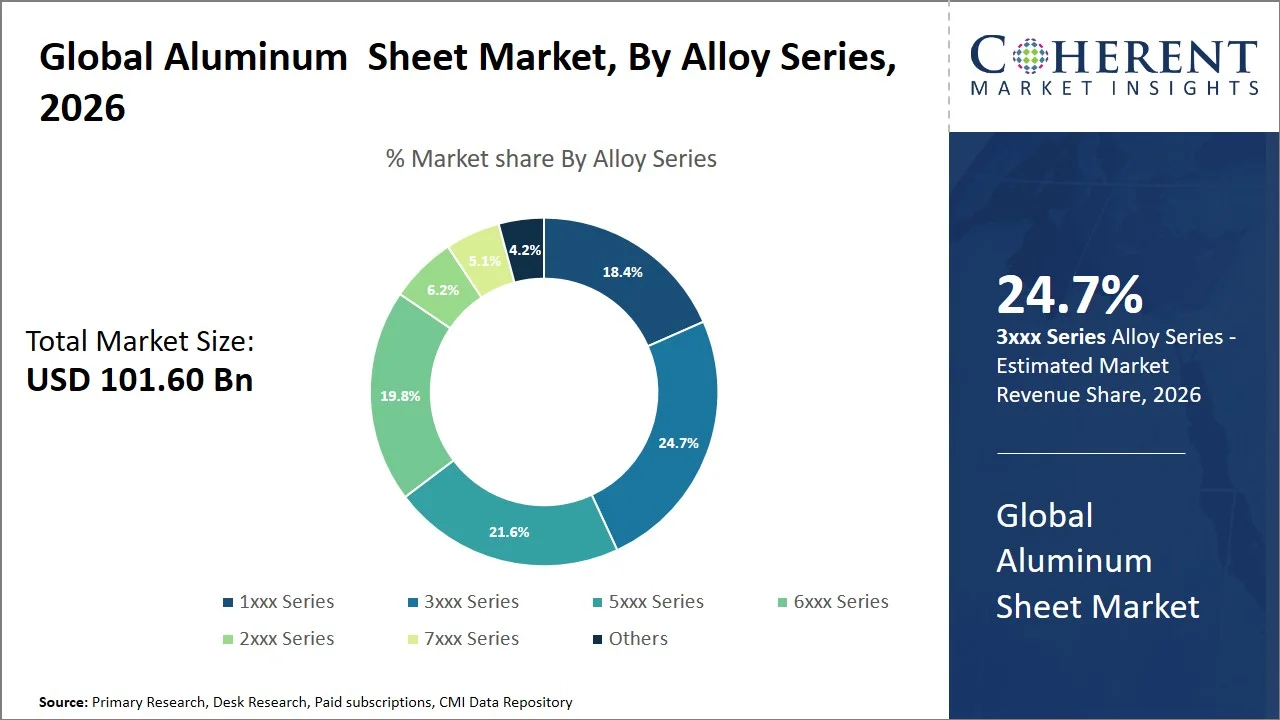
Why is the 3xxx Series the Preferred Alloy Series for High-Volume Sheet Conversion?
The 3xxx series is expected to dominate the global aluminum sheet market with 24.7% share in 2026, supported by its strong fit with continuous, high-volume sheet conversion. Its manganese-based composition enables reliable forming behavior, stable mechanical performance, and efficient downstream processing in applications that require repeatable sheet quality rather than extreme structural strength. Demand is the strongest in beverage can bodies, HVAC components, heat-transfer equipment, cookware, roofing accessories, and general fabrication, where producers need material that can be rolled, drawn, coated, and formed with low rejection rates. On the supply side, 3xxx alloys benefit from established rolling routes, scrap compatibility, and broad mill availability. In March 2025, Yamaichi Metal announced the establishment of UACJ Yamaichi Aluminum Can Recycling, where used beverage cans will be processed and rolled again into Aluminum can sheet material by UACJ, reinforcing circular supply for can-sheet applications. (Source: Yamaichi Metal Co., Ltd)
- Current Industry Events of 2026
- Market Size Estimation
- Regional Breakdown
- Competitive Landscape
- Customer Intelligence
- Segmental Analysis
- Pricing Analysis
- Key Market Drivers, Challenges & Future Trends
- Customized Insights Section
Why Do Plain Aluminum Sheets Represent the Largest Product Type in the Aluminum Sheet Market?
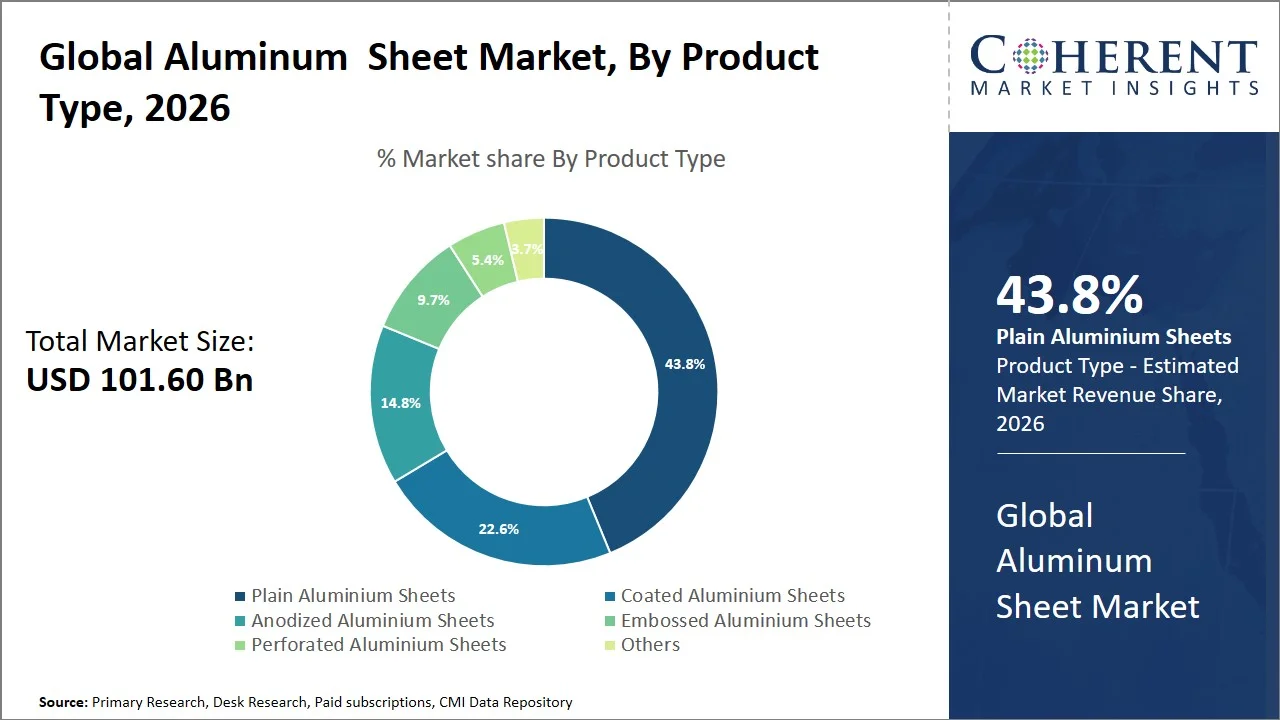
Plain Aluminum sheets are expected to represent the largest product type with 43.8% of the global aluminum sheet market share in 2026, as they function as the most flexible starting material for processors, stockists, OEMs, and fabricators. Unlike coated, anodized, or embossed sheets, plain sheets allow customers to decide the finishing route based on cost, design, corrosion requirement, or end-use specification. This makes them widely adopted in ducting, cladding substrates, trailer panels, appliance housings, industrial enclosures, machine guards, packaging conversion, and general metal fabrication. Demand is also supported by distributors, which prefer plain sheets because they simplify inventory and serve multiple customer categories. On the supply side, flat rolled product expansions improve domestic sheet availability and reduce import reliance.
Why Do Cold Rolled Sheets Lead Precision-Driven Aluminum Sheet Demand?
Cold rolled sheets are expected to dominate the processing method segment with 58.7% share in the global aluminum sheet market, as downstream users increasingly require thinner gauges, tighter flatness, better surface consistency, and predictable forming performance. Cold rolling is critical after hot-band production because it enables mills to produce sheets suitable for coil coating, stamping, lamination, printing, packaging conversion, automotive parts, consumer goods panels, and precision industrial applications. Demand-side preference comes from converters seeking lower finishing losses and stable dimensional control in automated production lines. Supply-side leadership is reinforced by advanced cold rolling mills equipped with gauge control, flatness systems, roll-shifting, and faster changeover technologies. In November 2025, Fives installed a new 4Hi cold rolling mill at Compañía Valenciana de Aluminio Baux in Spain, with the first Aluminum coil delivered on October 1, 2025, supporting higher-capacity cold-rolled coil production. (Source: Fives Group)
Global Aluminum Sheet Market Dynamics
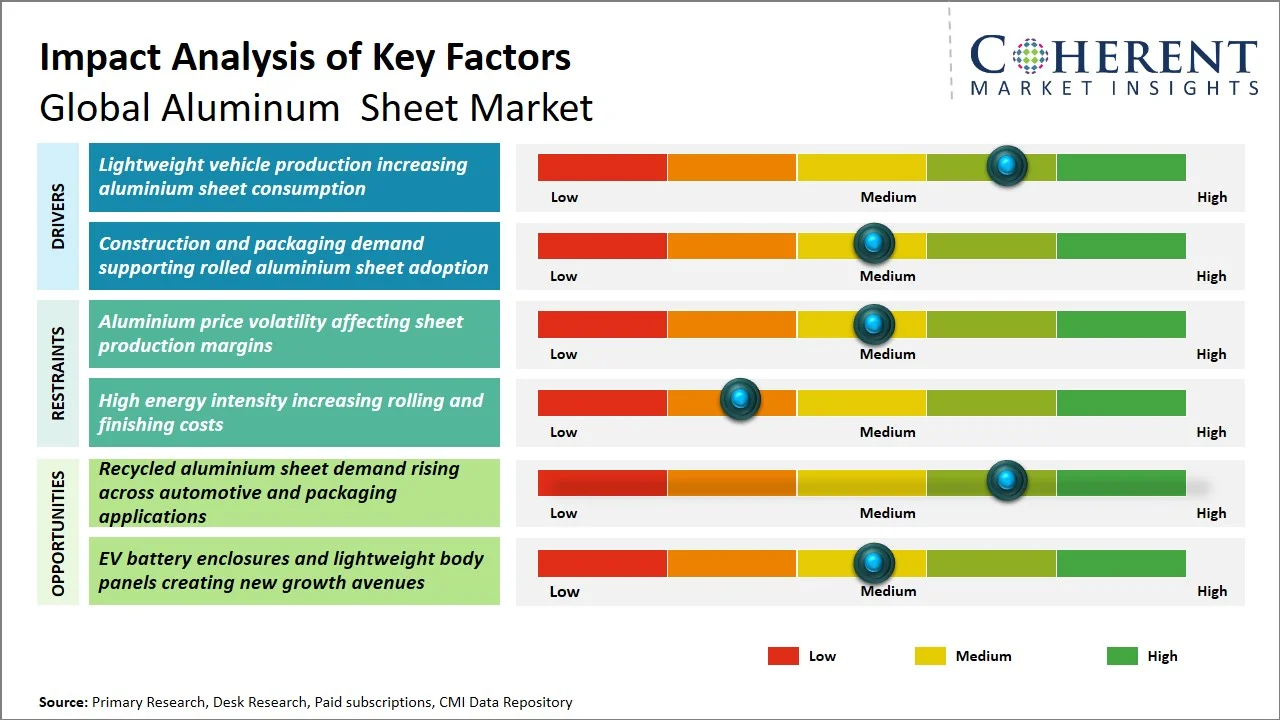
Key Market Drivers
- Lightweight Vehicle Production Increasing Aluminum Sheet Consumption: Automotive lightweighting is becoming a core demand driver for Aluminum sheets as OEMs seek lower vehicle weight, better fuel efficiency, improved EV range, and compliance with tightening emission requirements. Aluminum sheet is strongly used in closures, body panels, battery enclosures, structural reinforcements, heat shields, and crash-management components because it combines formability, corrosion resistance, and strength-to-weight performance. This is expanding the demand for higher-quality rolled sheets with controlled thickness, surface finish, and alloy consistency. In January 2026, Hydro joined Alumobility to accelerate adoption of Aluminum in modern vehicles, with the association specifically focused on advancing Aluminum automotive body sheet applications for lighter, safer, and more sustainable vehicle architectures.
- Construction and Packaging Demand Supporting Rolled Aluminum Sheet Adoption: Construction and packaging are strengthening Aluminum sheet consumption because both sectors require durable, lightweight, recyclable, and formable flat-rolled material. In construction, sheets are used in roofing, cladding, façades, composite panels, HVAC ducting, insulation jacketing, and architectural interiors. In packaging, Aluminum sheet and can-stock support beverage cans, closures, trays, and premium recyclable packaging formats. The segment benefits from rising preference for corrosion-resistant materials, design flexibility, and circular packaging. In April 2026, Crown Holdings announced a state-of-the-art beverage can facility in Northern India, expected to produce approximately 2.2 billion Aluminum cans annually at full capacity, reflecting strong downstream packaging demand for rolled Aluminum inputs.
Emerging Market Trends
- Shift Toward Low-Carbon and Recycled Aluminum Sheet Specifications: Aluminum sheet procurement is increasingly shifting from standard grade-based buying toward sustainability-linked sourcing. Customers in automotive, building materials, packaging, electronics, and consumer goods are asking suppliers to provide lower-carbon material, recycled-content traceability, and closed-loop scrap recovery support. This trend is changing competitive positioning across the sheet value chain because mills with remelting, scrap sorting, certified emissions disclosure, and recycled-content control can command stronger customer loyalty. It also supports premiumization, as buyers are willing to differentiate products through lower carbon footprint rather than only through mechanical properties. Over the forecast period, recycled and low-carbon sheet grades are expected to become a commercial qualifier in export-oriented supply chains, particularly where buyers face carbon reporting, green building, and brand sustainability commitments.
- Greater Specification Segmentation Across Mobility, Building, and Packaging Applications: The global aluminum sheet market is moving toward more application-specific grades, finishes, and processing routes. End users are no longer treating sheet as a commodity input; they increasingly require precise alloy selection, surface treatment, forming performance, coil width, thickness tolerance, and finish quality for specific downstream processes. Automotive customers prioritize formability, dent resistance, and paintability; construction users seek weather resistance, aesthetics, and long service life; packaging converters focus on drawability, hygiene, and coating compatibility. This creates growth for mills that can offer technical support, rapid product qualification, and customized sheet solutions. The trend also raises entry barriers because customers increasingly depend on suppliers that can match material science, process control, certification, and logistics reliability within one integrated value proposition.
Current Events and their Impact
Current Events | Description and its Impact |
June 2026 – U.S. Section 232 Metal Tariff Regime Adjustment |
|
January 2026 – EU CBAM Definitive Regime Started |
|
May 2025 / March 2026 – India BIS Quality Control Orders for Aluminum and Aluminum Alloy Products |
|
Regional Insights
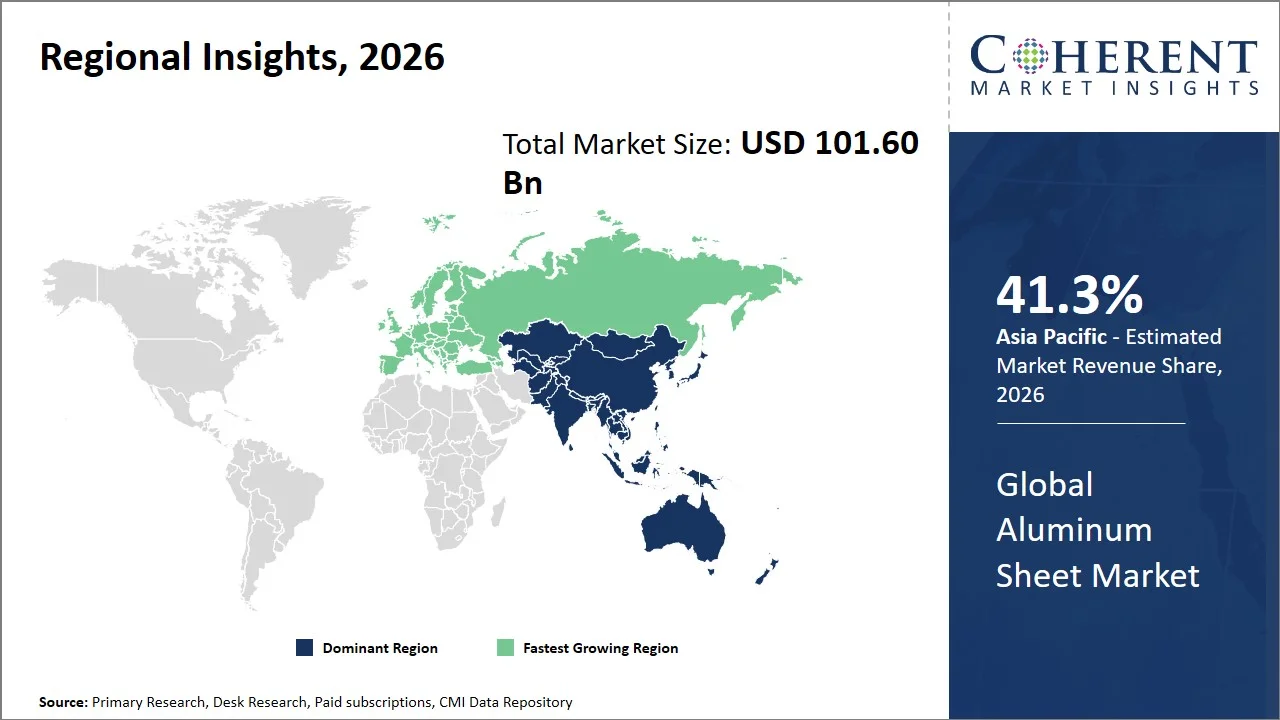
Why Does Asia Pacific Dominate the Global Aluminum Sheet Market?
Asia Pacific dominates the global aluminum sheet market with an expected 41.3% share in 2026, supported by large-scale Aluminum production, strong rolling capacity, and high downstream consumption across transportation, construction, packaging, electrical equipment, and consumer goods. China provides the region’s manufacturing scale, Japan contributes advanced automotive and precision sheet demand, and Southeast Asia supports packaging and infrastructure-linked consumption. The region also benefits from integrated industrial clusters, lower conversion costs, and proximity to major end-use manufacturers. In July 2026, ALUMINUM CHINA will be held in Shanghai, serving as Asia’s leading trade platform for the aluminum industry. covering Aluminum value-chain technologies, lightweight automotive applications, metal recycling, and supplier connectivity. This reflects Asia Pacific’s concentration of producers, converters, equipment suppliers, and end-use buyers within one major Aluminum ecosystem.
Why is Europe Emerging as the Fastest-Growing Region in the Aluminum Sheet Market?
Europe is emerging as the fastest-growing region with an expected 24.8% share in 2026, driven by low-carbon material procurement, circular economy regulation, automotive lightweighting, premium packaging, and construction-grade sheet demand. Unlike Asia Pacific’s volume-led position, Europe’s growth is more value-led, with buyers emphasizing recycled content, carbon disclosure, traceability, and high-performance sheet specifications. Automotive, aerospace, façade systems, beverage packaging, and engineered industrial applications are strengthening the demand for certified and application-specific Aluminum sheet. In May 2026, ACEA called for revisions to EU CO₂ rules for cars and vans to recognize low-carbon Aluminum as a lightweighting material, supporting material-neutral innovation and alignment with CBAM, ESPR, and end-of-life vehicle regulations. This policy direction strengthens Europe’s demand for low-carbon Aluminum sheet.(Source: ACEA)
Global Aluminum Sheet Market Outlook for Key Countries
Why is China a Key Market for the Aluminum Sheet Market?
China is a key market because it combines large primary aluminum capacity, advanced downstream rolling, export-oriented fabrication, and domestic demand from electric vehicles, building materials, electronics, renewable energy, and packaging. The country’s sheet market benefits from scale advantages across smelting, casting, rolling, coating, and fabrication, enabling suppliers to serve both commodity and specification-driven applications. China also influences global Aluminum sheet pricing through raw material demand, semi-finished exports, and manufacturing cost benchmarks. In April 2026, China’s National Bureau of Statistics reported that March industrial output increased, with manufacturing value added up year-on-year and ten kinds of non-ferrous metals output reaching 7.07 million tons, reinforcing the country’s strong non-ferrous metals production base. This scale supports Aluminum sheet availability for domestic converters and international supply chains.
Why is Japan Important in the Global Aluminum Sheet Market?
Japan is important in the global aluminum sheet market because its demand is concentrated in technically demanding applications rather than only high-volume commodity consumption. Automotive panels, can stock, heat exchangers, electronics, batteries, precision machinery, and transport equipment require consistent gauge, surface quality, formability, and alloy performance. Japanese customers typically emphasize qualification standards, long-term supplier reliability, and material performance in automated production environments. This strengthens demand for high-quality flat rolled Aluminum sheet and coil. In June 2026, the Japan Aluminum Association updated its monthly statistics for Aluminum rolled product production and shipments, including May 2026 Aluminum rolled product data. The association’s ongoing publication of rolled product statistics reflects Japan’s structured monitoring of sheet, plate, foil, and related downstream demand.
Why is the U.S. a Key Market for the Aluminum Sheet Market?
The U.S. is a key aluminum sheet market due to strong demand from automotive body sheet, beverage packaging, aerospace, defense, construction products, HVAC, and electrical applications. Aluminum sheet consumption is supported by lightweight pickup trucks, EV battery structures, beverage can production, building panels, and industrial fabrication. The country also places strategic value on domestic Aluminum supply security, given its reliance on imported primary metal and downstream products. In February 2026, the Oklahoma Department of Commerce announced that U.S. Aluminum Company signed an agreement with EGA and Century Aluminum to explore a fabrication plant near the planned Oklahoma Primary Aluminum project, which is expected to double U.S. primary Aluminum production and support downstream industries such as electrical, defense, aerospace, automotive, and machinery.
Why is Germany a Strategic Country in the Aluminum Sheet Market?
Germany is strategic because it anchors Europe’s premium Aluminum sheet demand through automotive engineering, machinery, aerospace supply chains, packaging technology, electrical equipment, and sustainable construction. German buyers require high-quality rolled products with tight tolerances, strong documentation, and compliance with EU sustainability and industrial standards. Although the local Aluminum industry faces energy and cost pressures, Germany remains a high-value demand center because of its export-oriented manufacturing base and focus on lightweight, recyclable, and technically certified materials. In October 2026, Düsseldorf will host ALUMINUM 2026, described by the U.S. Commercial Service as the world’s leading Aluminum trade show and B2B platform, focusing on automotive, mechanical engineering, building and construction, aerospace, electronics, packaging, and transportation solutions.
Why is the U.A.E an Important Growth Market for the Aluminum Sheet Market?
The U.A.E is an important growth market because it links low-cost primary Aluminum production, export logistics, industrial diversification, and circular Aluminum development. While the country is better known for primary and premium aluminum, its role is expanding through recycling, downstream fabrication, construction demand, packaging, transportation, and regional supply to the Middle East, Europe, and Asia. global aluminum sheet market credentials, and regional sourcing options. In June 2026, Emirates Global Aluminum inaugurated the U.A.E’s largest Aluminum recycling plant at Al Taweelah, with 185,000 tons per year production capacity for recycled billets and T-bars under the RevivAL brand. This strengthens circular Aluminum availability and supports future downstream value-added Aluminum applications.
Technology Adoption Landscape in the Global Aluminum Sheet Market
Technology | Adoption Level | Key Application Area | Business Impact |
Continuous casting and rolling | High | High-volume sheet and coil production | Improves throughput, reduces conversion cost, and supports consistent feedstock for flat-rolled products |
Automated gauge and flatness control | High | Cold rolled Aluminum sheets | Enhances thickness precision, surface uniformity, and rejection-rate reduction for converters |
Coil coating and surface treatment lines | Medium | Construction panels, appliance sheets, packaging substrates | Adds corrosion resistance, aesthetics, and value-added differentiation |
Scrap sorting and closed-loop remelting | Medium | Recycled-content sheet production | Reduces raw material risk, supports sustainability claims, and strengthens circular supply chains |
Vision-based surface defect inspection | Medium | Automotive, packaging, and decorative sheets | Improves quality assurance, reduces downstream failures, and supports premium-grade supply |
Digital mill monitoring and predictive maintenance | Medium | Rolling mills and finishing lines | Improves uptime, process stability, energy efficiency, and production planning accuracy |
How are Low-Carbon Rolling, Recycled Feedstock, and Application-Specific Sheet Grades Creating New Growth Opportunities in the Global Aluminum Sheet Market?
The strongest growth opportunity lies in shifting aluminum sheet from a standard flat-rolled commodity into a differentiated, application-engineered material platform. Automotive, construction, packaging, electrical, and consumer goods customers are increasingly selecting sheet suppliers based on carbon footprint, recycled content, surface finish, forming behavior, and supply-chain reliability. This creates opportunity for producers to expand premium sheet grades, certified low-carbon products, and custom alloy-temper combinations aligned with specific end-use requirements. Recycled-feedstock integration also reduces dependence on primary Aluminum price volatility and helps suppliers meet customer sustainability audits. For export-focused producers, emissions traceability and quality certification can improve access to regulated markets and large multinational buyers. Over the forecast period, companies that combine rolling scale, technical service, coating capability, and circular Aluminum sourcing will be better positioned to capture higher-margin contracts and long-term supply agreements.
Market Players, Key Development, and Competitive Landscape
Key Developments
- In March 2026, Novelis received the MMK Award of Excellence 2026 for its automotive Aluminum sheet made with 100% end-of-life vehicle scrap for exterior car body applications. This development highlights the growing commercial shift toward closed-loop automotive Aluminum sheet production and supports automakers seeking lightweight, recycled, and lower-carbon materials for next-generation vehicle platforms.
- In January 2026, Speira introduced speira.ID, a Digital Product Passport for Aluminum coils and sheets. The system provides product-level information such as carbon footprint, recycled content, chemical composition, origin, input mix, and production details. This strengthens traceability, ESG compliance, and customer transparency across Aluminum sheet supply chains, especially for packaging, mobility, and construction buyers.
- In February 2025, Kobe Steel finalized the registration of a joint venture with Baoshan Iron & Steel and Baowu Aluminum Technology to produce automotive Aluminum panels in China. The venture will manufacture and sell Aluminum panels for automakers, while promoting scrap recycling from its own operations and customers. This supports lightweight vehicle production and rising Aluminum sheet adoption in China’s automotive sector.
Competitive Landscape
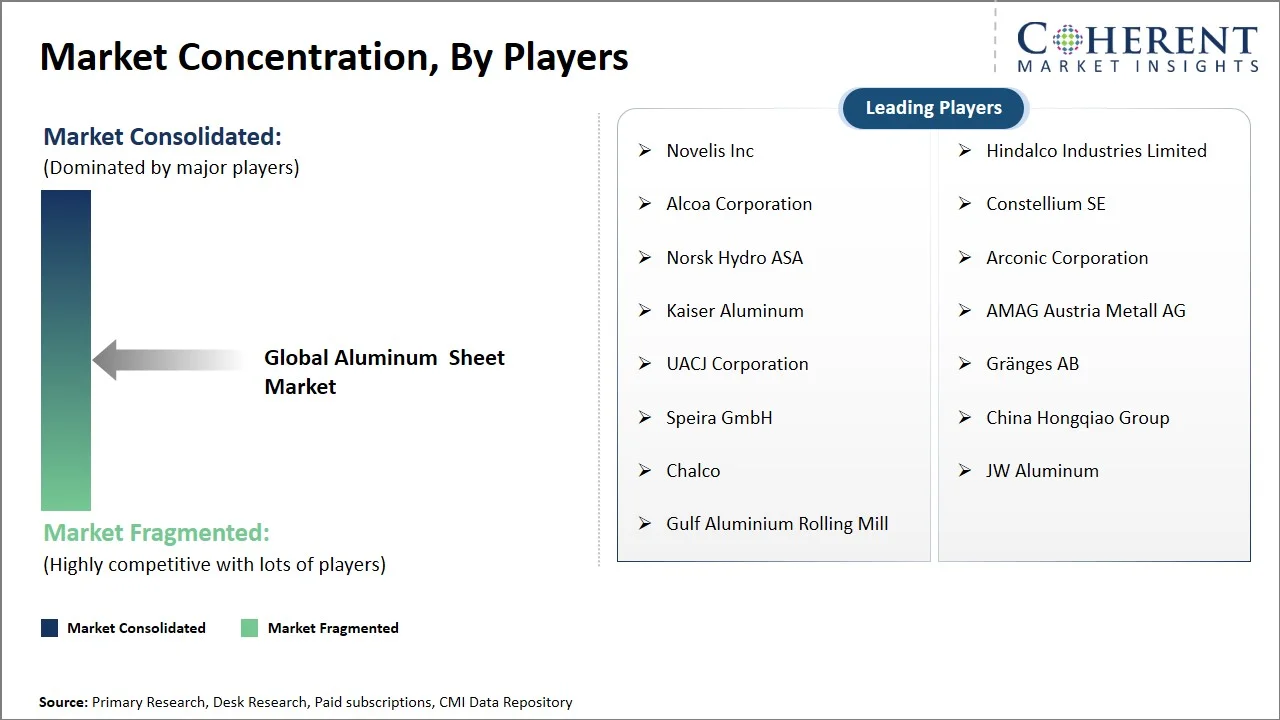
The global aluminum sheet market is moderately consolidated at the upstream and rolling-mill level, but more fragmented across distributors, processors, stockists, and regional fabricators. Competition is shaped by rolling capacity, alloy capability, quality consistency, raw material access, end-use qualification, and long-term customer relationships. Large integrated producers compete on scale and supply reliability, while regional players compete through price, flexibility, and faster delivery.
Key focus areas include
- Product quality, surface finish, gauge tolerance, and alloy consistency remain key differentiation areas.
- Technology adoption in rolling, coating, inspection, and automation is improving process efficiency.
- Pricing competitiveness depends heavily on alumina, primary aluminium, scrap, energy, and freight costs.
- Capacity reliability and multi-region supply capability are important for automotive and packaging customers.
- Certifications, BIS/ASTM/EN compliance, and customer audits influence supplier qualification.
- Distribution reach and stock availability support small and mid-volume fabrication demand.
- Grade, temper, thickness, coating, and surface-treatment customization are becoming more important.
- Sustainability positioning through recycled content and low-carbon production is strengthening buyer preference.
Market Report Scope
Aluminum Sheet Market Report Coverage
| Report Coverage | Details | ||
|---|---|---|---|
| Base Year: | 2025 | Market Size in 2026: | USD 101.60 Bn |
| Historical Data for: | 2020 To 2024 | Forecast Period: | 2026 To 2033 |
| Forecast Period 2026 to 2033 CAGR: | 5.7% | 2033 Value Projection: | USD 149.77 Bn |
| Geographies covered: |
| ||
| Segments covered: |
| ||
| Companies covered: | Novelis Inc, Hindalco Industries Limited, Alcoa Corporation, Constellium SE, Norsk Hydro ASA, Arconic Corporation, Kaiser Aluminum, AMAG Austria Metall AG, UACJ Corporation, Gränges AB, Speira GmbH, China Hongqiao Group, Chalco, JW Aluminum, and Gulf Aluminum Rolling Mill | ||
| Growth Drivers: |
| ||
| Restraints & Challenges: |
| ||
Analyst Opinion (Expert Opinion)
- The global aluminum sheet market is expected to maintain a positive outlook over the forecast period, supported by transportation lightweighting, recyclable packaging formats, and steady construction material substitution. Demand will be strongest where aluminum sheet provides measurable value through weight reduction, corrosion resistance, formability, and circularity.
- The most attractive growth pockets are expected in automotive body sheet, packaging sheet, coated construction sheet, cold rolled precision sheet, and recycled-content aluminum sheet. Asia Pacific remains the volume anchor, while Europe is strategically important for low-carbon and regulation-led demand transformation.
- Key risks include energy cost volatility, aluminum price fluctuations, carbon-compliance costs, trade restrictions, and availability of high-quality scrap. Smaller processors may face pressure from certification requirements and investment needs in quality systems.
- Market players should focus on application-specific grades, recycled-feedstock integration, carbon footprint documentation, downstream partnerships, and high-reliability supply contracts. Competitive advantage will increasingly come from combining cost control with technical capability, sustainability proof, and customer-specific sheet solutions.
Speak to the analyst
Want personalized insights?
Take the findings above to one of our principal consultants, or have the report rebuilt around the segments, geographies and competitors you actually track.
Market Segmentation
- Alloy Series Insights (Revenue, USD Bn, 2021 - 2033)
- 1xxx Series
- 3xxx Series
- 5xxx Series
- 6xxx Series
- 2xxx Series
- 7xxx Series
- Others
- Product Type Insights (Revenue, USD Bn, 2021 - 2033)
- Plain Aluminum Sheets
- Coated Aluminum Sheets
- Anodized Aluminum Sheets
- Embossed Aluminum Sheets
- Perforated Aluminum Sheets
- Others
- Processing Method Insights (Revenue, USD Bn, 2021 - 2033)
- Cold Rolled Sheets
- Hot Rolled Sheets
- Surface Treated Sheets
- End-use Industry Insights (Revenue, USD Bn, 2021 - 2033)
- Transportation
- Construction and Infrastructure
- Packaging and Foil Conversion
- Electrical and Electronics
- Consumer Goods
- Industrial Manufacturing
- Others
- Regional Insights (Revenue, USD Bn, 2021 - 2033)
- North America
- U.S.
- Canada
- Latin America
- Brazil
- Argentina
- Mexico
- Rest of Latin America
- Europe
- Germany
- U.K.
- Spain
- France
- Italy
- Russia
- Rest of Europe
- Asia Pacific
- China
- India
- Japan
- Australia
- South Korea
- ASEAN
- Rest of Asia Pacific
- Middle East
- GCC Countries
- Israel
- Rest of Middle East
- Africa
- South Africa
- North Africa
- Central Africa
- North America
- Key Players Insights
- Novelis Inc
- Hindalco Industries Limited
- Alcoa Corporation
- Constellium SE
- Norsk Hydro ASA
- Arconic Corporation
- Kaiser Aluminum
- AMAG Austria Metall AG
- UACJ Corporation
- Gränges AB
- Speira GmbH
- China Hongqiao Group
- Chalco
- JW Aluminum
- Gulf Aluminum Rolling Mill
Source
Primary Research Interviews
- Aluminum sheet and flat rolled product manufacturers producing plain, coated, anodized, embossed, perforated, hot rolled, and cold rolled Aluminum sheets
- Integrated Aluminum producers involved in bauxite mining, alumina refining, primary Aluminum smelting, casting, and downstream rolling
- Aluminum rolling mills, coil processors, slitting centers, service centers, and sheet distributors
- Aluminum alloy producers and metallurgical experts specializing in 1xxx, 2xxx, 3xxx, 5xxx, 6xxx, 7xxx, and specialty alloy series
- Automotive OEMs, EV manufacturers, commercial vehicle makers, rail component manufacturers, and transport equipment suppliers using Aluminum body sheet and structural sheet
- Construction material companies, façade system providers, roofing and cladding manufacturers, Aluminum composite panel producers, and infrastructure contractors
- Packaging converters, beverage can manufacturers, foil converters, closure manufacturers, and flexible packaging companies
- Electrical and electronics manufacturers, HVAC component producers, appliance manufacturers, consumer durable companies, and industrial fabrication users
- Aluminum coating, anodizing, surface treatment, heat treatment, and finishing service providers
- Recycling companies, secondary Aluminum producers, scrap processors, remelters, and circular Aluminum supply-chain consultants
- Certification agencies, quality testing laboratories, metallurgical consultants, and Aluminum industry experts
Stakeholders
- Aluminum sheet and flat rolled product manufacturers: Novelis Inc., Hindalco Industries Limited, Alcoa Corporation, Constellium SE, Norsk Hydro ASA, Arconic Corporation, Kaiser Aluminum, AMAG Austria Metall AG, UACJ Corporation, Gränges AB, Speira GmbH, JW Aluminum, Gulf Aluminum Rolling Mill
- Integrated Aluminum and upstream producers: China Hongqiao Group, Aluminum Corporation of China Limited, Emirates Global Aluminium, Rio Tinto Aluminium, Rusal, Vedanta Aluminium, South32, Century Aluminum
- Rolling mills and downstream processors: Aluminum rolling mills, coil coating companies, slitting centers, service centers, stockists, sheet fabricators, and regional distributors
- Alloy, billet, slab, and casting suppliers: primary Aluminum ingot suppliers, rolling slab producers, recycled billet producers, master alloy suppliers, and grain refiner suppliers
- Surface treatment and finishing ecosystem: anodizing companies, coil coating suppliers, paint and coating producers, surface cleaning chemical suppliers, and protective film suppliers
- End-use sectors: automotive, electric vehicles, railways, aerospace components, construction and infrastructure, packaging and foil conversion, electrical and electronics, HVAC, consumer goods, industrial machinery, marine, and general fabrication
- Supporting ecosystem: Aluminum recycling companies, scrap collection networks, furnace technology providers, rolling mill equipment suppliers, quality inspection system providers, logistics companies, and trade consultants
- Regulatory and certification bodies: Bureau of Indian Standards, ASTM International, European Committee for Standardization, ISO, U.S. Department of Commerce, European Commission, U.S. International Trade Commission, World Trade Organization, London Metal Exchange, and national customs authorities
Databases
- UN Comtrade Database – import/export analysis for Aluminum plates, sheets, strips, coils, foil, Aluminum scrap, and downstream Aluminum products
- ITC Trade Map – country-wise trade flows, export dependency, import dependency, and supplier concentration for Aluminum sheet and flat rolled products
- World Bank Commodity Markets – Aluminum price trends, macroeconomic indicators, and raw material cost movement
- London Metal Exchange – Aluminum benchmark pricing, inventory trends, and global metal price indicators
- U.S. Geological Survey Mineral Commodity Summaries – aluminium, bauxite, alumina, and related raw material supply data
- U.S. International Trade Commission DataWeb – U.S. import/export statistics for Aluminum sheet, plate, foil, and semi-finished Aluminum products
- Eurostat Comext – Europe import/export data for Aluminum flat rolled products, Aluminum plates, sheets, strips, and foil
- China Customs Statistics – Aluminum product exports, semi-finished Aluminum shipments, and trade flow analysis
- Japan Aluminum Association statistics – rolled Aluminum product production, shipments, and application-wise consumption trends
- International Aluminum Institute statistical database – global Aluminum production, recycling, carbon footprint, and industry sustainability data
- CRU / Fastmarkets / S&P Global Commodity Insights – Aluminum pricing, capacity, trade, and value-chain intelligence
- Company annual reports, investor presentations, sustainability reports, and technical product data sheets of key Aluminum sheet producers
Magazines / Industry Publications
- Aluminum International Today
- Aluminum Insider
- Light Metal Age
- Metal Bulletin / Fastmarkets
- Recycling Today
- Metal Construction News
- Packaging Europe
- CanTech International
- Automotive World
- Automotive Manufacturing Solutions
- The Fabricator
- MetalForming Magazine
- Modern Metals
- SteelOrbis / MetalMiner
- Construction Week
- Packaging World
- Materials Performance
- Manufacturing Today
- International Aluminum Journal
- Aluminum Leader
Journals
- Journal of Materials Processing Technology
- Materials Science and Engineering A
- Journal of Alloys and Compounds
- Materials Today: Proceedings
- Metallurgical and Materials Transactions A
- Journal of Manufacturing Processes
- Surface and Coatings Technology
- Corrosion Science
- Materials & Design
- International Journal of Lightweight Materials and Manufacture
- Journal of Cleaner Production
- Resources, Conservation and Recycling
- Metals
- Materials
- Applied Surface Science
- Thin Solid Films
- Engineering Failure Analysis
- CIRP Journal of Manufacturing Science and Technology
- Transactions of Nonferrous Metals Society of China
- International Journal of Advanced Manufacturing Technology
Credible News Sources
- Financial Times – Aluminum industry strategy, sustainability, trade policy, and industrial competitiveness
- The Wall Street Journal – automotive lightweighting, packaging demand, manufacturing investment, and metal supply chains
- CNBC – industrial metals, manufacturing, EV supply chain, and commodity market updates
- China Daily – China Aluminum production, exports, manufacturing policy, and downstream demand
- The Hindu BusinessLine – India aluminum, packaging, automotive, and infrastructure-related developments
- Business Standard – Indian Aluminum industry, metal pricing, manufacturing, and policy updates
- Gulf News / The National – UAE Aluminum industry, primary Aluminum production, recycling, and regional industrial strategy
Associations
- International Aluminum Institute
- The Aluminum Association
- European Aluminium
- Japan Aluminum Association
- Aluminum Federation
- Aluminum Association of India
- Gulf Aluminum Council
- China Nonferrous Metals Industry Association
- China Nonferrous Metals Fabrication Industry Association
- Can Manufacturers Institute
- Metal Construction Association
- European Aluminum Foil Association
- Aluminum Stewardship Initiative
- International Council on Mining and Metals
- ASTM International
- International Organization for Standardization
- European Committee for Standardization
- London Metal Exchange
- World Trade Organization
- SAE International
Public Domain Sources
- International Aluminum Institute – global Aluminum production, recycling, emissions, sustainability, and industry outlook data
- The Aluminum Association – Aluminum sheet, plate, automotive, packaging, and construction application information
- European Aluminum – EU Aluminum industry policy, recycling, trade, CBAM, and low-carbon Aluminum updates
- U.S. Geological Survey – aluminium, bauxite, alumina, and mineral commodity supply data
- U.S. Department of Commerce – Aluminum trade, tariff, import monitoring, and Section 232-related data
- U.S. International Trade Commission – Aluminum import/export, trade remedy, and tariff classification data
- European Commission – CBAM, circular economy, packaging regulation, industrial policy, and sustainability rules affecting aluminum
- Bureau of Indian Standards – Aluminum and Aluminum alloy product quality control orders and standards
- Ministry of Steel / Ministry of Mines India – non-ferrous metal policy, Aluminum production, and downstream industry information
- China Ministry of Industry and Information Technology – Aluminum industry, non-ferrous metals production, and manufacturing policy updates
- Japan METI – industrial materials, manufacturing, energy efficiency, and aluminum-related policy data
- UN Comtrade – global trade flows for Aluminum sheets, plates, strips, foil, scrap, and semi-finished Aluminum products
- ITC Trade Map – country-level export/import dependency and trade competitiveness data
- London Metal Exchange – Aluminum price and inventory reference data
- World Bank Commodity Markets – Aluminum price trend and commodity outlook data
- OECD and WTO – trade policy, tariffs, industrial competitiveness, and global supply-chain analysis
Proprietary Elements
- CMI Data Analytics Tool, Proprietary CMI Existing Repository of information for last 10 years.
Get access to 250+ pages report
Every segment, forecast, competitor profile and data table behind the analysis above — available for instant download.
- ESOMAR Member
- ISO 9001:2015 Certified
- D-U-N-S Registered
- GDPR & CCPA Compliant
Missing comfort of reading report in your local language? Find your preferred language:
Transform your Strategy with Exclusive Trending Reports
Frequently Asked Questions
The CAGR of the global aluminum sheet market is projected to be 5.7% from 2026 to 2033.
The global aluminum sheet market is estimated to be valued at USD 101.60 billion in 2026 and is expected to reach USD 149.77 billion by 2033.
Rising demand for low-carbon Aluminum sheets, recycled-content flat rolled products, EV battery components, and high-performance construction materials are creating strong growth opportunities in the global aluminum sheet market .
Aluminum sheet is widely used due to its lightweight nature, corrosion resistance, durability, recyclability, formability, and suitability for automotive, packaging, construction, electrical, and industrial manufacturing applications.
Sustainability is encouraging manufacturers to increase recycled aluminum usage, reduce carbon emissions in rolling operations, and offer traceable, low-carbon Aluminum sheet products for packaging, mobility, and construction applications.
Lightweight vehicle production increasing Aluminum sheet consumption and construction and packaging demand supporting rolled Aluminum sheet adoption are the major factors driving the growth of the global aluminum sheet market.
Aluminum price volatility affecting sheet production margins and high energy intensity increasing rolling and finishing costs are the major factors hampering the growth of the global aluminum sheet market.