

Synthetic Sapphire Market Size and Trends - 2026 to 2033
The Synthetic Sapphire Market is estimated to be valued at USD 8.9 Bn in 2026 and is expected to reach USD 14.9 Bn by 2033, growing at a compound annual growth The rate (CAGR) of 7.6% from 2026 to 2033.
Key Takeaways
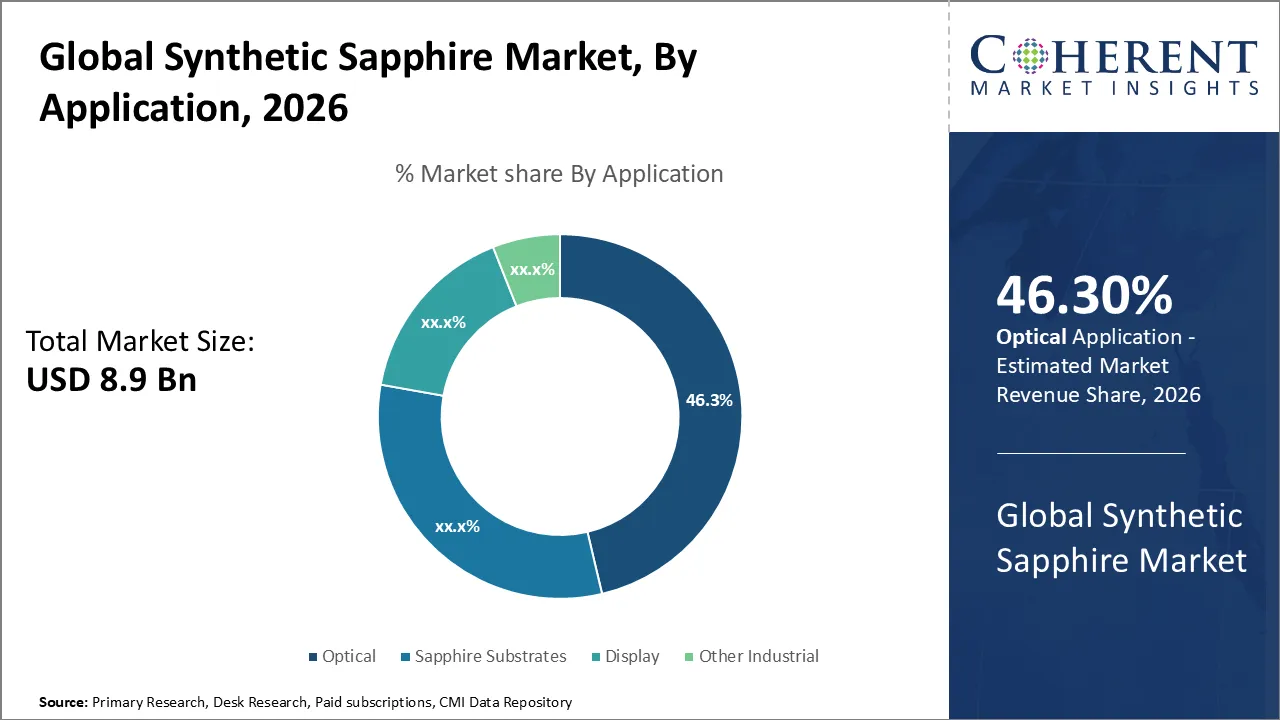
- Based on Application, the Optical segment is expected to lead the market with 46.30% share in 2026, due to strong demand in high‑precision optical systems and imaging devices.
- Based on End User, the Light Emitting Diode (LED) Manufacturing segment is expected to hold 32.80% share of the market in 2026 reflecting rapid global LED adoption.
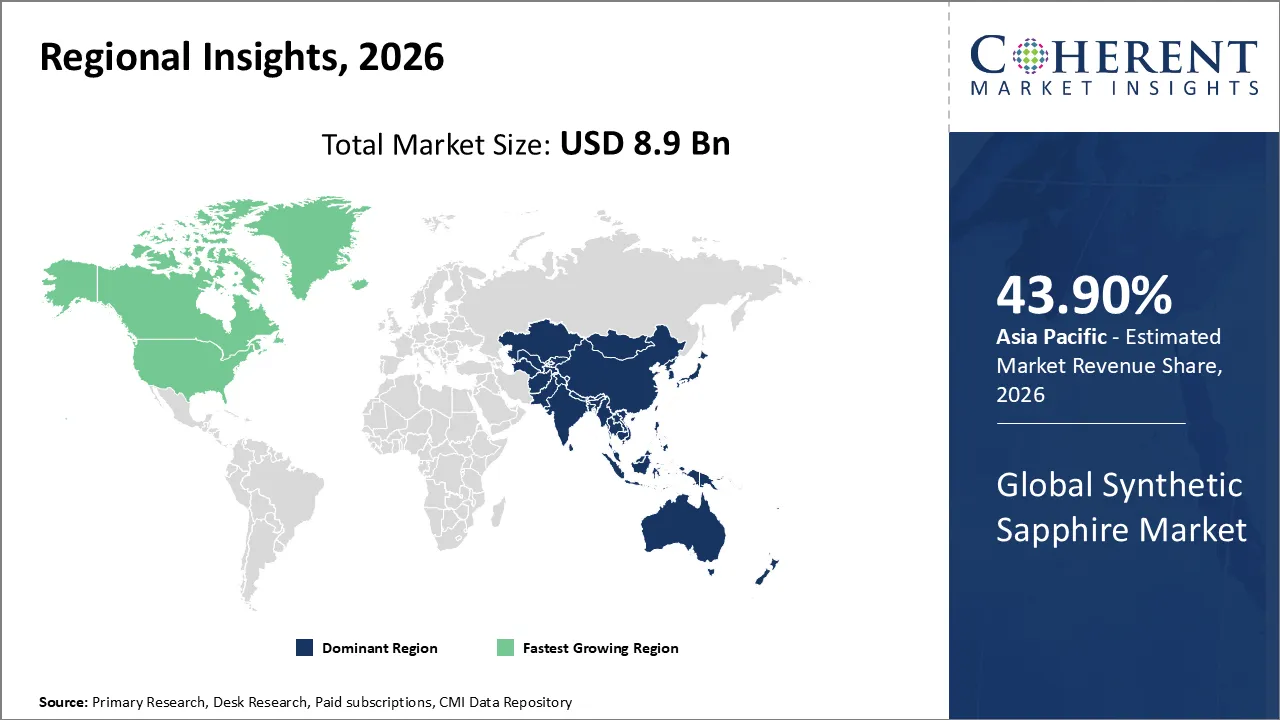
- Based on Region, Asia Pacific is set to lead the market with 43.90% share in 2026. While, North America is anticipated to be the fastest growing region.
Market Overview
The synthetic sapphire market is advancing significantly with the rising applications in LED manufacturing, semiconductor fabrication, and aerospace optics. Moreover, expanding consumer demand research for high-durability mobile displays and tightening technical standards for scratch-resistant wearable technology are expected to drive market growth over the forecast period.
Synthetic sapphires are the high-purity, single-crystal derivatives of aluminum oxide (Al_{2}O_{3}). The crystal growth is a widely used production technique and utilizes methods like Kyropoulos and Czochralski to serve the electronics, defense, and medical industries. The synthetic sapphire is used for its extreme hardness (9 on the Mohs scale) and wide optical transmission range. This helps in the effective replacement of traditional glass and quartz in high-stress or high-precision environments.
The synthetic sapphire industry is entering a new era driven by advancing production factors, the adoption of advanced automated crystallization and high-precision wafer slicing systems, along with high demand for crystal-based solutions in industries such as 5G communications, medical lasers, infrared sensors, and luxury horology. These developments have improved the capabilities of synthetic sapphires and enhanced their thermal conductivity, dielectric strength, and cost efficiency. This marks a transformative phase in the market as it transitions from a niche industrial material to a cornerstone of modern optoelectronics.
Current Events and their Impacts on the Synthetic Sapphire Market
Current Event | Description and the Impact |
Technological Advancements in Sapphire Growth and Processing |
|
Macroeconomic Trends and Industry Demand Dynamics
|
|
Regulatory and Environmental Policy Developments
|
|
Segmental Insights
- Current Industry Events of 2026
- Market Size Estimation
- Regional Breakdown
- Competitive Landscape
- Customer Intelligence
- Segmental Analysis
- Pricing Analysis
- Key Market Drivers, Challenges & Future Trends
- Customized Insights Section
Synthetic Sapphire Market Insights, By Application – Optical Leads Due to Strong Demand in High ‑ precision Optical Systems
In terms of application, the optical segment contributes the highest share of 46.30% in 2026 of the Synthetic Sapphire Market. The growth is owing to sapphire’s exceptional physical properties. It is positioned as the second hardest natural substance after diamond. Its ability to maintain near-perfect optical clarity while resisting scratches and chemical erosion makes it an ideal choice for specialized windows, lenses, and transparent armor. In addition, the proliferation of high-end consumer electronics has bolstered this growth. The manufacturers are incorporating sapphire for camera lens covers and smartwatch displays in order to ensure long term durability. In medical and industrial fields, its chemical inertness allows for reliable use in surgical tools and high-pressure viewing ports.
Synthetic Sapphire Market Insights, By End User – Light Emitting Diode (LED) Manufacturing Leads Due to Rapid Global LED Adoption
In terms of end user, the Light Emitting Diode (LED) manufacturing segment contributes the highest share of 32.80% in the Synthetic Sapphire Market in 2026. The growth is owing to the its role as the preferred substrate for Gallium Nitride (GaN) crystals. It is a crucial material for the production of high brightness Light Emitting Diode (LEDs). The special properties of synthetic sapphire which include high thermal conductivity, electrical insulation, and high chemical resistance makes it a material of choice for the high-temperature conditions involved in manufacturing.
The rising global demand for energy-saving lighting solutions has also boosted the growth of this segment. The widespread use of LED technology in general lighting, automotive headlamps, and display backlighting is also propelling the growth in the segment. The LED industry remains the backbone of the market, absorbing the vast majority of synthetic sapphire output to meet the world’s transition toward sustainable illumination.
Regional Insights
Asia Pacific Synthetic Sapphire Market Analysis & Trends
Asia Pacific has remained the dominant region with 43.90% in 2026 of the global synthetic sapphire market over the past decade. The growth is owing to the region's status as the world’s manufacturing hub for LEDs, semiconductors, and consumer electronics. The countries of China, Japan, Taiwan, and South Korea are at the forefront in this growth. In addition, the concentration of major tech firms like Samsung, Huawei, and various Apple suppliers in the region ensures a consistent and growing demand for scratch-resistant camera lens covers, smartwatch crystals, and sensor windows.
The market also boasts a highly integrated supply chain for High Purity Alumina (HPA) and employs cost-efficient manufacturing processes like the Kyropoulos growth method. The region is at the forefront of global 5G technology adoption and is now moving toward making advanced semiconductors. The Asia Pacific synthetic sapphire market is projected to maintain its superior growth, outperforming all other geographic regions in both revenue and innovation.
North America Synthetic Sapphire Market Analysis & Trends
The North America region is the fastest-growing market for synthetic sapphires. The market is characterized by its strategic focus on high-value, high-precision applications particularly in the aerospace, defense, and medical device industries. The market is experiencing a strong demand for optical-grade sapphire, which is essential for mission-critical hardware like missile domes, infrared sensor windows, and transparent armor.
The region's growth in these specialized sectors is also driven by a robust R&D infrastructure and the presence of industry firms like Rubicon Technology and Saint-Gobain. In addition, the region’s leadership in medical innovation is propelling the use of sapphire for biocompatible surgical tools and endoscopes. North America continues to set the global standard for high-performance sapphire technology and supply chain resilience. This is achieved by focusing on superior material purity and large-diameter crystal growth rather than on mass-market commodities.
Synthetic Sapphire Market Outlook Country-Wise
China Synthetic Sapphire Market Trends
The China synthetic sapphire market has strengthened its position as the global powerhouse of the industry. It serves both the world's largest producer and its most significant consumer. This regional growth is owing to China's LED manufacturing ecosystem and its leadership in the global consumer electronics supply chain. The government initiatives aimed at high-tech self-sufficiency have led to notable investments in domestic crystal growth facilities, particularly in hubs like Wuzhou. They account for a staggering majority of the world's synthetic gemstone and industrial sapphire output.
The market's expansion is further accelerated by the rapid rollout of 5G infrastructure and the high demand for sapphire-based substrates in the semiconductor sector. The domestic firms like Aurora Optoelectronics and HC Semitek benefit from a localized supply chain that provides high-purity alumina (HPA) and advanced growth technologies like the Kyropoulos method.
The US Synthetic Sapphire Market Trends
The US synthetic sapphire market is evolving towards specialized applications in aerospace, defense, and medical fields. Due to its exceptional hardness and heat resistance, synthetic sapphire is essential for critical components that prioritize safety and performance. Also, the US boasts a robust manufacturing infrastructure. It has a substantial presence of major firms like Rubicon Technology and Saint-Gobain. These firms specialize in high-purity crystal growth for industrial optics. In addition, the resurgence of domestic semiconductor fabrication has significantly increased demand for sapphire components used in plasma-etching and high-temperature wafer processing equipment. In the medical field, the material's chemical inertness and biocompatibility render it ideal for use in advanced surgical instruments and endoscopes.
Market Report Scope
Synthetic Sapphire Market Report Coverage
| Report Coverage | Details | ||
|---|---|---|---|
| Base Year: | 2025 | Market Size in 2026: | USD 8.9 Bn |
| Historical Data for: | 2020 To 2024 | Forecast Period: | 2026 To 2033 |
| Forecast Period 2026 to 2033 CAGR: | 7.6% | 2033 Value Projection: | USD 14.9 Bn |
| Geographies covered: |
| ||
| Segments covered: |
| ||
| Companies covered: | Rubicon Technology Inc., KYOCERA Corporation, Saint-Gobain, SCHOTT AG, Monocrystal, Rayotek Scientific Inc., CRYSTALWISE TECHNOLOGY INC., ILJIN Display CO. Ltd, Namiki Precision Jewel Co., Ltd., Juropol Sp. z o.o. | ||
| Growth Drivers: |
| ||
| Restraints & Challenges: |
| ||
Synthetic Sapphire Market Drivers
Growing demand from various sectors
The rising adoption of Light Emitting Diode (LED) lighting over incandescent bulbs and compact fluorescent lamps (CFLs) due to their energy efficiency and longer lifespan is expected to drive market growth for synthetic sapphire. Sapphire substrates are widely utilized in LED production, and the increasing awareness of the benefits of LEDs, along with the implementation of stricter regulations, is anticipated to further boost the synthetic sapphire market throughout the forecast period.
The growth of the global synthetic sapphire market is influenced by factors such as the rising demand for high-quality optical materials, advancements in manufacturing technologies, and an increase in research and development activities. In addition to this, the use of sapphires in various sectors like medical devices and aviation is projected to propel industry growth in the coming years.
The growing demand for synthetic sapphire from the semiconductor industry is expected to drive market expansion. Moreover, the increasing demand for patterned sapphire substrates, particularly those with larger diameters (4’’, 6’’, 8’’), is another major factor likely to enhance growth in the global synthetic sapphire market.
The rise in application of synthetic sapphire in the medical industry, where it is used to manufacture various devices, is expected to drive market growth over the forecast period. It is used to produce endoscope lenses, laser hair removal systems, blood cell counters, insulators, and blades. As a result, the growing demand from the healthcare sector is likely to drive market expansion during this time.
Additionally, due to its excellent optical and mechanical properties, sapphire is widely utilized in ultraviolet to infrared spectroscopy ranges, which have numerous applications in aeronautical jewel applications. This trend is anticipated to further enhance market growth. Some of the emerging applications of synthetic sapphire in the aerospace industry are viewports, infrared countermeasure lamps, FLIR (forward-looking infrared) systems, environments with salt or sand blowing, vibration sensors, fire and flame sensors for aircraft, and instrumentation or aircraft gauges.
Analyst Opinion (Expert Opinion)
The Synthetic Sapphire Market demonstrates structurally strong demand fundamentals driven by electronics, optoelectronics, medical devices, and industrial applications. More than half of global sapphire consumption is concentrated in LED substrates and optoelectronic components, reflecting the material’s high thermal conductivity, optical transparency, and mechanical hardness. The shift toward micro-LED and high-brightness LED technologies continues to reinforce substrate demand, particularly for 4-inch and 6-inch wafer formats.
Consumer electronics represents another measurable volume contributor. Sapphire windows and protective covers are integrated into tens of millions of smartphones, wearable devices, and camera modules annually, supported by rising requirements for scratch resistance and durability. In parallel, gallium nitride (GaN) device manufacturing increasingly utilizes sapphire substrates for RF and power applications, aligning with the broader electrification and 5G infrastructure expansion.
Asia-Pacific accounts for the majority of global production capacity, led by large-scale crystal growth facilities and vertically integrated wafer processing operations. Europe and North America maintain relevance in precision optics, aerospace components, and medical instrumentation, where high-purity optical-grade sapphire is required.
Ongoing investments in larger boule growth, improved yield rates, and automation technologies indicate production scalability. Overall, application diversification, wafer size migration, and technology integration collectively position synthetic sapphire as a strategically important advanced material across multiple high-performance industries.
Speak to the analyst
Want personalized insights?
Take the findings above to one of our principal consultants, or have the report rebuilt around the segments, geographies and competitors you actually track.
Synthetic Sapphire Industry News
- In December 2024, Richard Mille has launched the first 07-02 model as part of its new Automatic Sapphire collection. This collection features four new models, showcasing a brand-new lilac sapphire color, gem-set pink sapphire, green sapphire, and gem-set green sapphire.
- In May 2024, Alpha HPA has completed its first run of synthetic sapphire growth, marking an Australian first. Its wholly owned subsidiary, Alpha Sapphire, successfully produced 300kg of C-axis sapphire crystal boules intended for the consumer electronics, medical, defense, and LED markets.
- In July 2023, Kyocera Corporation announced that its DuraForce PRO 3 Android smartphone has received the iF DESIGN AWARD 2023 in the Communications Devices category. The company is known for its ultra-rugged smartphones, which feature a distinctive screen called Sapphire Shield.
Market Segmentation
- Application Insights (Revenue, USD Bn, 2026 - 2033)
- Optical
- Sapphire Substrates
- Display
- Other Industrial
- End User Insights (Revenue, USD Bn, 2026 - 2033)
- Light Emitting Diode (LED) Manufacturing
- Semiconductor
- Medical Devices
- Consumer Electronics
- Industrial
- Regional Insights (Revenue, USD Bn, 2026 - 2033)
- North America
- U.S.
- Canada
- Latin America
- Brazil
- Argentina
- Mexico
- Rest of Latin America
- Europe
- Germany
- U.K.
- France
- Italy
- Russia
- Rest of Europe
- Asia Pacific
- China
- India
- Japan
- Australia
- South Korea
- ASEAN
- Rest of Asia Pacific
- Middle East
- GCC
- Israel
- Rest of Middle East
- Africa
- North Africa
- Central Africa
- South Africa
- Key Players Insights
- Rubicon Technology Inc.
- KYOCERA Corporation
- Saint-Gobain
- SCHOTT AG
- Monocrystal
- Rayotek Scientific Inc.
- CRYSTALWISE TECHNOLOGY INC.
- ILJIN Display CO. Ltd
- Namiki Precision Jewel Co., Ltd.
- Juropol Sp. z o.o.
Sources
Primary Research Interviews
- Synthetic Sapphire Manufacturers
- Sapphire Wafer & Substrate Fabricators
- LED & Optoelectronics Component Manufacturers
- Semiconductor Device Manufacturers
- Consumer Electronics OEMs
- Aerospace & Defense Component Engineers
- Optical Lens & Industrial Window Producers
- Others
Databases
- Bloomberg Terminal
- Thomson Reuters Eikon
- S&P Global Market Intelligence
- Euromonitor International
- Factiva
- Others
Magazines
- Compound Semiconductor Magazine
- Semiconductor Today
- Photonics Spectra
- Advanced Materials & Processes Magazine
- Others
Journals
- Journal of Crystal Growth
- Applied Physics Letters
- Materials Science and Engineering B
- Journal of the American Ceramic Society
- Optical Materials Journal
- Others
Newspapers
- Financial Times
- The Wall Street Journal
- Reuters
- Bloomberg
- Others
Associations
- SEMI
- International Society for Optics and Photonics (SPIE)
- IEEE
- Optica
- Others
Public Domain Sources
- U.S. Geological Survey (USGS)
- U.S. Department of Energy (DOE)
- European Commission
- World Bank Open Data
- National Renewable Energy Laboratory (NREL)
- Others
Proprietary Elements
- CMI Data Analytics Tool
- Proprietary CMI Existing Repository of Information for the Last 8 Years
Definition: The synthetic sapphire market involves the large-scale production and distribution of man-made corundum, which is a crystalline form of aluminum oxide (Al_{2}O_{3}) that shares the same chemical properties as natural sapphire. This industrial sector is defined by the material's remarkable physical characteristics, most probably its extreme hardness and its ability to remain transparent across a wide range of light wavelengths. The manufacturers utilize sophisticated growth techniques like the Kyropolous or Czochralski processes to create high-purity crystals for a wide range of applications. These lab-grown stones are essential for the fabrication of LED substrates, semiconductor wafers, and scratch-resistant covers to grow within the aerospace, medical, and telecommunication sectors as global industries demand materials with higher durability and heat resistance.
Get access to 250+ pages report
Every segment, forecast, competitor profile and data table behind the analysis above — available for instant download.
- ESOMAR Member
- ISO 9001:2015 Certified
- D-U-N-S Registered
- GDPR & CCPA Compliant
Missing comfort of reading report in your local language? Find your preferred language:
Transform your Strategy with Exclusive Trending Reports
Frequently Asked Questions
The Synthetic Sapphire Market is estimated to be valued at USD 8.9 Bn in 2026, and is expected to reach USD 14.9 Bn by 2033.
The CAGR of the Synthetic Sapphire Market is projected to be 7.6% from 2026 to 2033.
Growing demand from the semiconductor industry for synthetic sapphire by the key players across the globe is one of the major factors driving the growth of the Synthetic Sapphire Market.
Increasing prices by key players is one of the major factors hampering the growth of the Synthetic Sapphire Market.
In terms of application, the optical segment is estimated to dominate the market revenue share in 2026.
Rubicon Technology Inc., KYOCERA Corporation, Saint-Gobain, SCHOTT AG, Monocrystal, Rayotek Scientific Inc., CRYSTALWISE TECHNOLOGY INC., ILJIN Display CO. Ltd, Namiki Precision Jewel Co., Ltd., and Juropol Sp. z o.o. are the major players.
Asia Pacific is expected to lead the Synthetic Sapphire Market in 2026.