

Global Aluminum Welding Market Size and Forecast – 2026-2033
The Global Aluminum Welding Market is estimated to be valued at USD 5.50 Bn in 2026 and is expected to reach USD 8.00 Bn by 2033, exhibiting a compound annual growth rate (CAGR) of 5.5% from 2026 to 2033.
Key Takeaways of the Aluminum Welding Market
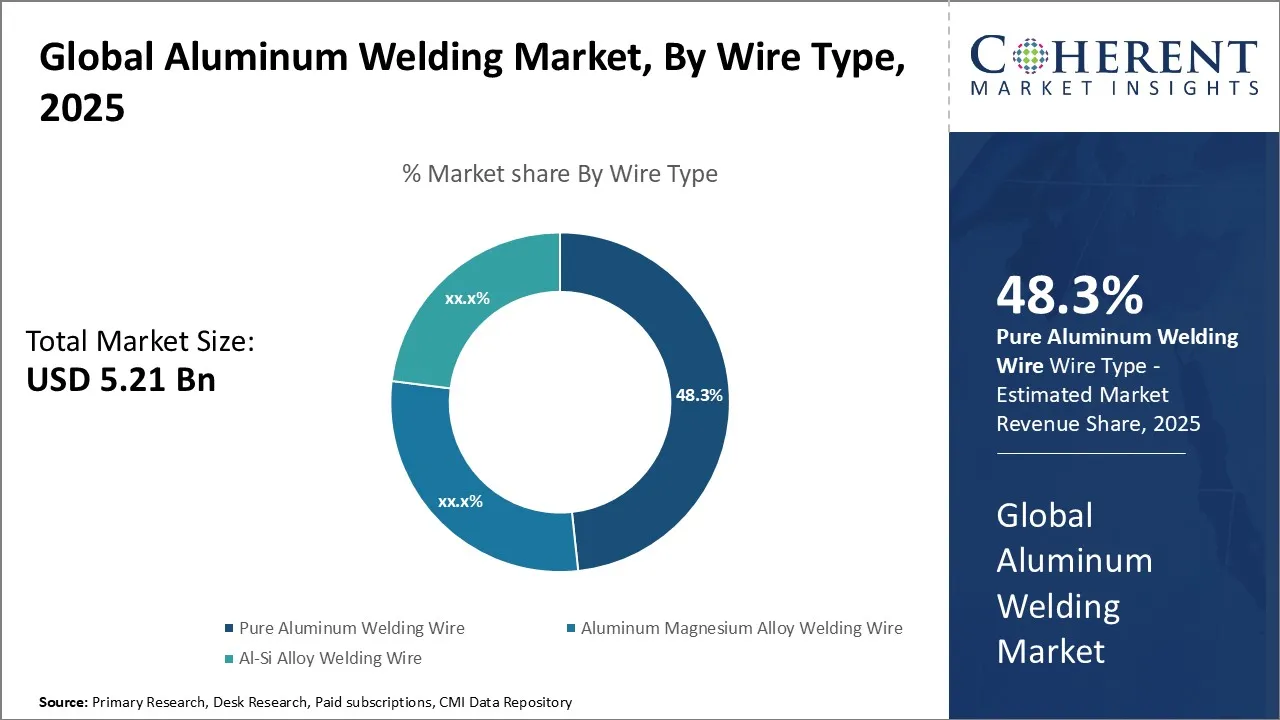
- Pure aluminum welding wire is expected to hold 49.3 % of the market share in 2026 due to its superior electrical and thermal conductivity essential for high-quality aluminum welds.
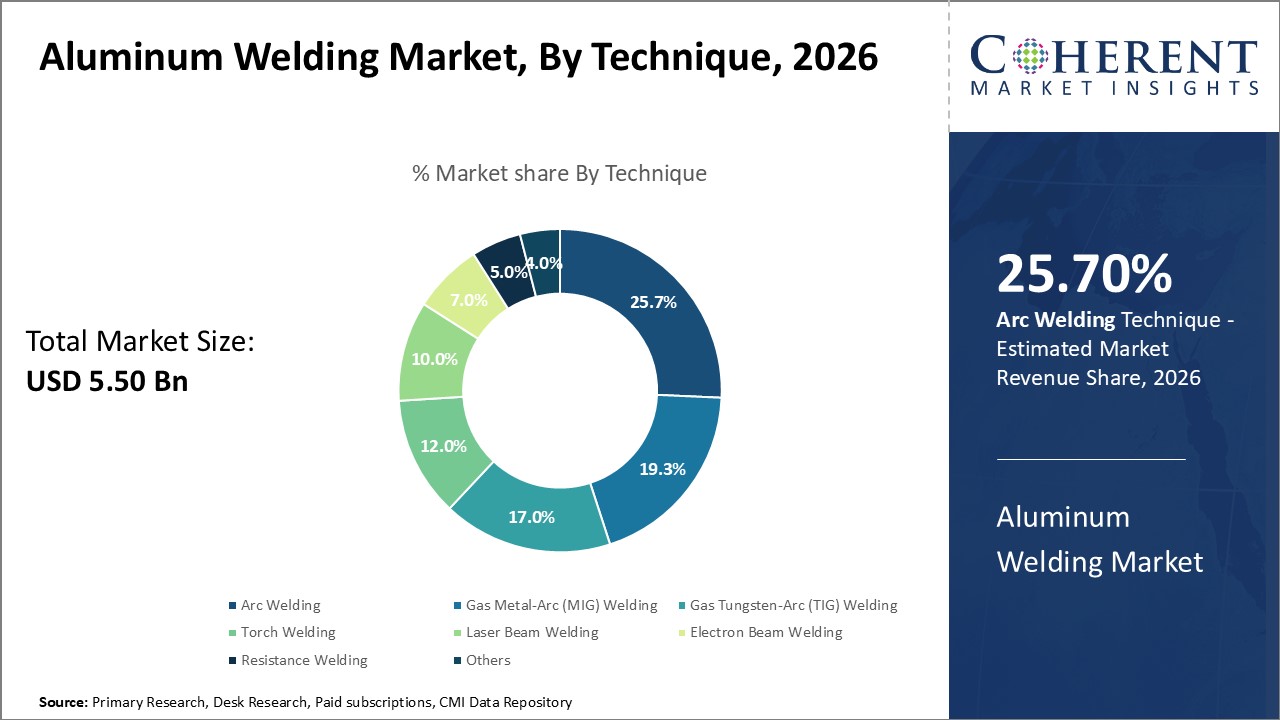
- Arc welding is projected to account for 25.7 % of the aluminum welding market in 2026, driven by its versatility and wide use in fabricating aluminum components.
- The automotive segment is expected to capture 33.5 % of the aluminum welding market in 2026, fueled by the worldwide shift to energy-efficient, lightweight vehicles.
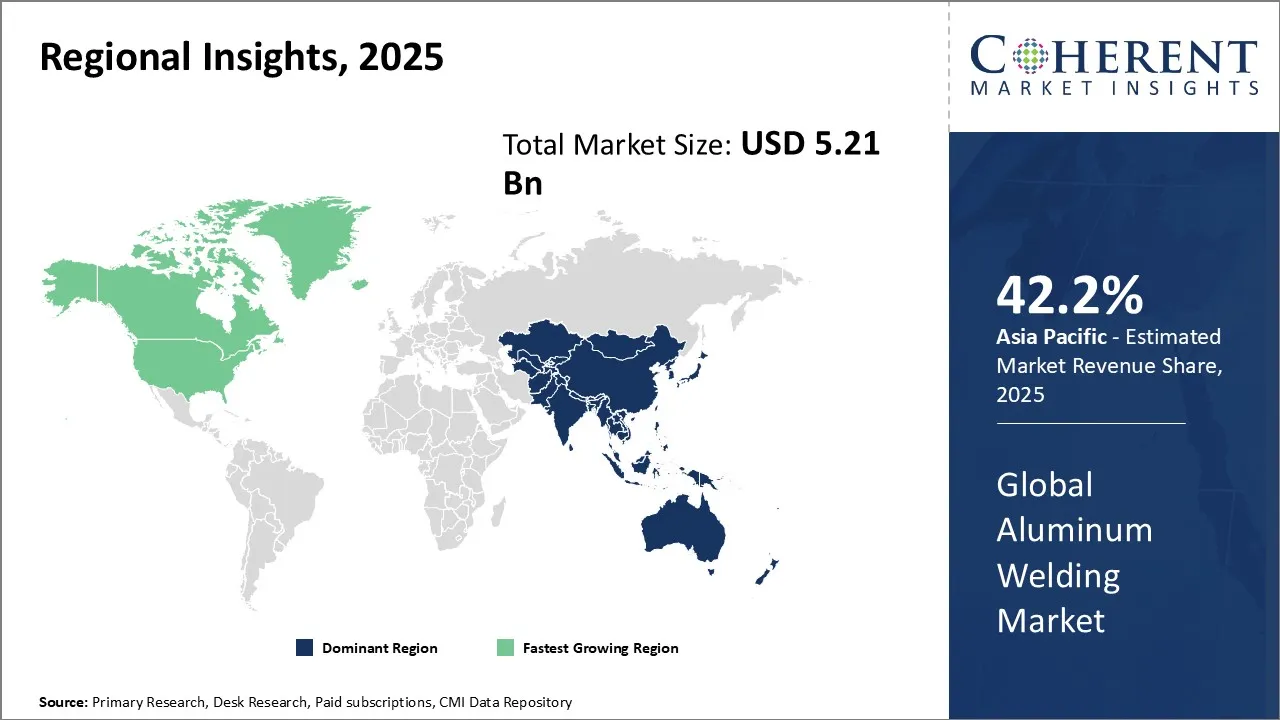
- Asia Pacific is anticipated to lead the global aluminum welding market in 2026 with a 42.2 % share, driven by expanding automotive and construction industries, along with increasing adoption of advanced welding technologies. North America, with a 21.5% share, will be the fastest-growing region, fueled by rising demand for lightweight materials in transportation, aerospace advancements, and significant investments in manufacturing modernization.
Market Overview
A key trend shaping the aluminum welding market is the adoption of advanced welding techniques such as laser beam welding and friction stir welding, which enhance precision and joint quality while reducing material waste. Additionally, the emphasis on sustainability and lightweight materials in transportation sectors is accelerating the demand for aluminum welding solutions. Growing urbanization and industrialization in emerging economies further support market growth, alongside increased automation and digital integration optimizing production efficiency in welding processes.
Current Events and Its Impact
Current Events | Description and its impact |
Global Tariff Disruptions and Trade Policy Shifts |
|
Advancements in Welding Technology |
|
Segmental Insights
- Current Industry Events of 2026
- Market Size Estimation
- Regional Breakdown
- Competitive Landscape
- Customer Intelligence
- Segmental Analysis
- Pricing Analysis
- Key Market Drivers, Challenges & Future Trends
- Customized Insights Section
Aluminum Welding Market Insights, By Wire Type - Pure Aluminum Welding Wire Segment Dominates the Market due to Superior Conductivity and Ease of Use
Pure aluminum welding wire segment is expected to hold 49.3% share of the global aluminum welding market in 2026, primarily because of its unparalleled electrical and thermal conductivity, which are critical for achieving high-quality welds in aluminum joining processes. The intrinsic properties of pure aluminum, such as excellent corrosion resistance and malleability, make the pure aluminum welding wires the preferred choice for a wide range of applications where maintaining structural integrity and weight reduction are paramount. Industries that require lightweight yet durable components especially favor pure aluminum wire for its ability to produce clean, uniform welds with minimal defects.
Another key factor driving the growth of the pure aluminum welding wire segment is the increasing demand in sectors emphasizing precision and high conductivity, such as electrical and electronics manufacturing. Since pure aluminum wires promote superior arc stability and reduce the likelihood of contamination or porosity during welding, they contribute directly to the enhancement of product performance and longevity. Furthermore, advances in alloy design have allowed manufacturers to develop welding wire with controlled purity levels that optimize melting characteristics, thereby improving the overall efficiency of the welding process.
Aluminum Welding Market Insights, By Technique - Arc Welding Segment Dominates the Market due to its Versatility and Cost-Effectiveness Across Various Industries
Arc welding segment is expected to hold 25.7% share in the aluminum welding market in 2026, due to its broad applicability and adaptability, making it a preferred method for fabricators dealing with aluminum components. Arc welding’s capacity to generate intense heat precisely at the joint enables deep penetration and strong bonding between aluminum parts, which is crucial to maintain the lightweight and corrosion-resistant properties of aluminum structures. This technique’s strength lies also in its compatibility with numerous wire types, especially pure aluminum wires, facilitating wide implementation across various manufacturing setups.
One of the main drivers behind the dominance of arc welding is its cost-efficiency. Compared to advanced welding technologies like laser or electron beam welding, arc welding equipment is relatively inexpensive to acquire and maintain, making it accessible to both large manufacturing plants and small to medium enterprises. Moreover, the operational simplicity of arc welding reduces the training time needed for welders, helping companies manage skilled labor shortages while maintaining productivity. The ease of integrating arc welding with mechanized and robotic systems further contributes to its prevalence in the market, particularly in automated production lines that demand consistent quality and high throughput.
Aluminum Welding Market Insights, By End-use Industry – Automotive Segment Dominates the Market driven by Lightweight Vehicle Trends and Electric Vehicle Adoption
The automotive segment is projected to hold 33.5% share of the aluminum welding market in 2026, largely influenced by the global push towards energy-efficient and lightweight vehicles. Aluminum’s high strength-to-weight ratio offers significant advantages in reducing the overall vehicle weight, thereby improving fuel efficiency and reducing emissions in internal combustion engine vehicles as well as extending driving range in electric vehicles. Consequently, automotive manufacturers widely employ aluminum welding technologies to fabricate structural components, chassis parts, and body panels that satisfy stringent safety and performance standards.
A critical factor sustaining the growth of the aluminum welding segment in automotive is the rapid expansion of electric vehicles (EVs). EVs require lightweight battery enclosures and chassis designs to maximize battery efficiency and vehicle range. Aluminum welding provides a reliable method to join complex component geometries while maintaining the necessary mechanical and electrical properties. Moreover, the increasing adoption of mixed-material construction—combining aluminum with high-strength steel and composites—requires welding techniques capable of producing durable, lightweight joints, where aluminum welding excels.
Regional Insights
Asia Pacific Aluminum Welding Market Analysis and Trends
The Asia Pacific region is projected to lead the market with a 42.2% share in 2026, driven by a robust manufacturing ecosystem, rapid industrialization, and strong infrastructure development. Countries like China, Japan, South Korea, and India have established themselves as manufacturing hubs with significant production capacities in automotive, aerospace, shipbuilding, and construction sectors—key end-users of aluminum welding. Government initiatives focusing on manufacturing excellence and export promotion further boost the regional market.
The presence of major aluminum producers and welding equipment manufacturers fuels innovation and adoption of advanced aluminum welding technologies. Notable companies such as Panasonic Corporation (Japan), ESAB India Ltd., and China’s Hua Wei Welding Equipment Co. Ltd. lead in product development and market penetration. Additionally, trade policies aimed at enhancing regional exports and investments create a favorable environment for growth and competitiveness. Asia Pacific’s cost-effective labor market and expanding industrial base continue to consolidate its commanding position in the aluminum welding market.
North America Aluminum Welding Market Analysis and Trends
The North America region is expected to exhibit the fastest growth in the market contributing 21.5% share in 2026, propelled by robust demand from the automotive, aerospace, defense, and construction industries. The region benefits from strong manufacturing infrastructure, stringent quality standards, and significant investments in advanced welding technologies such as laser welding, friction stir welding, and robotic automation. U.S. federal initiatives promoting domestic manufacturing, along with Canada’s infrastructure modernization programs, are fostering an environment where high-performance aluminum welding solutions are increasingly essential.
Major industry players such as Lincoln Electric (U.S.) and ESAB Corporation (headquartered in the U.S. with significant Canadian operations) are at the forefront of technological advancements, offering training programs, automation solutions, and welding consumables tailored to regional market needs.
Global Aluminum Welding Market Outlook for Key Countries
China Aluminum Welding Market Trends
China’s aluminum welding market benefits from its position as the world’s largest aluminum producer and consumer. Extensive use of aluminum welding in automotive manufacturing, infrastructure projects, and electronics assembly supports steady demand. Chinese market leaders like Hua Wei Welding Equipment and Fangda Special Steel Company Ltd. focus on integrating automation and robotics into welding processes, improving efficiency and quality. Government support for “Made in China 2026” promotes advanced manufacturing technologies, including aluminum welding innovations, further entrenching China’s leadership.
U.S. Aluminum Welding Market Trends
The U.S. aluminum welding market is characterized by high technological advancement and a mature industrial base. Strong automotive, aerospace, and defense sectors drive demand for precision aluminum welding solutions. Industry giants such as Lincoln Electric and Miller Electric are instrumental in developing cutting-edge welding equipment and consumables. Policy emphasis on reshoring manufacturing and infrastructure development adds further impetus to demand. The U.S. aluminum welding market prioritizes safety certifications and environmental regulations, which encourage the adoption of advanced and eco-friendly welding technologies.
Germany Aluminum Welding Market Trends
Germany continues to lead Europe in the aluminum welding market due to its dominance in the automotive and machinery sectors. Known for precision engineering and innovation, companies like Fronius International and EWM AG contribute significant R&D efforts to welding automation and quality assurance. The country’s stringent environmental regulations also push manufacturers toward energy-efficient welding technology. Germany’s central location in Europe allows it to serve as a distribution hub for neighboring markets, leveraging strong industrial clusters and trade links.
India Aluminum Welding Market Trends
India’s aluminum welding market is set to expand rapidly due to ongoing infrastructure development, growth in the automotive and railway sectors, and rising industrial investments. Government initiatives like “Make in India” and infrastructure modernization projects promote domestic production and technology adoption. Major players such as ESAB India Ltd. and Ador Welding Ltd. actively pursue product localization and workforce training to capture rising demand. The country’s cost advantages and improving regulatory framework make it an increasingly attractive market for global aluminum welding equipment suppliers.
U.A.E Aluminum Welding Market Trends
The U.A.E’s aluminum welding market is gaining momentum due to rapid urbanization and extensive oil & gas infrastructure investments. Emirates global aluminum, a world-class aluminum producer, plays a vital role in advancing regional aluminum welding technologies. Government diversification strategies and mega projects like Expo 2020 underpin demand for lightweight, corrosion-resistant aluminum structures, driving welding application growth. The U.A.E also serves as a regional logistics and trading hub, supporting imports and exports of aluminum welding consumables and equipment, enhancing market accessibility across the Middle East and Africa.
Microeconomic Factors Impacting Aluminum Welding Market Growth
- Raw Material Price Fluctuations: The price of aluminum as a raw material, which fluctuates based on the London Metal Exchange (LME) prices, significantly impacts production costs, vendor profit margins, and purchasing decisions. For example, aluminum prices fluctuated between USD 2,100 and USD 2,580 per ton in 2023, causing uncertainty in welding wire procurement and affecting production budgets of welding wire manufacturers.
- Workforce Skill Shortage: The aluminum welding industry faces a shortage of skilled welders, with a projected deficit of 360,000 skilled workers by 2027. This shortage reduces capacity utilization in fabrication shops and limits the consumption of aluminum welding materials in downstream sectors.
- Technological Advancements: Innovations in welding techniques (e.g., friction, inertia, laser welding) enhance precision, efficiency, and joint strength, driving higher demand for aluminum welding solutions, especially in high-performance sectors such as aerospace and automotive.
Macroeconomic Factors Impacting Aluminum Welding Market Growth
- Global Economic Indicators: Economic growth rates, manufacturing activity (measured via indices like the Purchasing Managers' Index), consumer confidence, and GDP projections directly influence aluminum demand. For example, a global GDP growth projection of 3.2% in 2025 suggests aluminum demand growth around 3.8-4.8%.
- Construction and Automotive Industry Demand: The construction sector accounts for roughly 25% of global aluminum consumption. Growth in housing starts, infrastructure spending, and automotive production are leading indicators for increased aluminum welding demand, propelled by aluminum’s lightweight and corrosion-resistant properties.
- Monetary Policy and Inflation: Interest rate changes impact financing costs for inventory and production. For instance, anticipated rate cuts by the US Federal Reserve in late 2025 could reduce aluminum financing costs and stabilize prices. Inflation moderation also affects production costs and market confidence.
- Trade Policies and Geopolitical Tensions: Tariffs, export restrictions, and trade negotiations between major aluminum producers and consumers affect supply chains and pricing. For example, recent tariff adjustments between the U.S. and China created a “tariff window period” leading to boosted consumption due to buyer urgency.
Market Players, Key Development, and Competitive Intelligence
Key Developments
- In May 2025, Alstom, a global leader in smart and sustainable mobility, announced the expansion of its railway rolling stock production capacities in Poland, with total investments of USD 133.6 million planned between 2022 and 2027. Over the past three years, USD 87.9 million has been allocated to infrastructure expansion and modernization at its sites in Chorzów, Wrocław, and Nadarzyn. This includes the establishment of a new aluminum welding line at the Wrocław site, enabling the facility to diversify beyond carbon steel products and significantly enhance its production capabilities for future projects.
- In November 2024, Brigham Young University (BYU) and Toyota jointly developed an innovative refill friction stir spot welding method for aluminum sliding doors used in minivans. This advanced technique consumes less energy while producing stronger, more durable welds, aligning with the automotive industry's push toward energy efficiency and sustainable manufacturing practices. The breakthrough has the potential to set a new benchmark in vehicle production, enhancing both performance and environmental responsibility in automotive design.
- In October 2022, Alstom, inaugurated a modern aluminum welding line at its rolling stock site in Wroclaw. The investment created 100 new jobs and support new projects, aligning with the company’s sustainable mobility strategy. By replacing heavier, harder-to-machine steel with lightweight, corrosion-resistant aluminum that offers a high strength-to-weight ratio, Alstom aims to enhance efficiency, performance, and sustainability in rail vehicle manufacturing.
Top Strategies Followed by Global Aluminum Welding Market Players
- Established industry leaders dominate through significant investments in research and development (R&D), which enable them to innovate and introduce high-performance welding products tailored to meet evolving customer demands. Expansion into emerging markets is another critical tactic; by broadening their global distribution networks and establishing localized service centers, these players not only increase their geographical footprint but also cater to region-specific needs, which bolsters their competitive advantage in high-growth areas such as Asia Pacific and Latin America.
- For example, Lincoln Electric Company has invested in advanced laser-hybrid welding systems tailored for high-volume automotive aluminum body assembly, helping major automakers meet stringent lightweighting goals.
- Mid-level players in the aluminum welding market adopt a somewhat different approach, focusing primarily on offering cost-effective solutions that strike an optimal balance between quality and affordability. These companies target price-sensitive customers, including small and medium enterprises and users in developing regions where budget constraints are more pronounced. To enhance their market competitiveness, mid-tier firms actively engage in collaborations and joint ventures with technology providers, suppliers, or other manufacturers.
- For example, Panasonic Welding Systems focuses on mid-range MIG/TIG systems that deliver reliability without the premium price tag, attracting customers in Latin America and Eastern Europe.
- Small-scale players in the global aluminum welding space distinguish themselves by focusing on niche markets and highly specialized technological features. These companies often target specific welding applications or industry verticals, such as electronics assembly or custom manufacturing, where unique product attributes are valued. To maintain relevancy and competitiveness, they embrace cutting-edge innovative technologies like automation, digital controls, and smart sensors incorporated into welding systems.
- For example, OTC Daihen Inc. provides robot-integrated aluminum welding cells for low-volume but precision-intensive industries, such as aerospace component repair. They also embrace emerging tech like automation, AI-driven weld monitoring, and IoT-enabled welding machines to stay relevant.
Market Report Scope
Aluminum Welding Market Report Coverage
| Report Coverage | Details | ||
|---|---|---|---|
| Base Year: | 2025 | Market Size in 2026: | USD 5.50 Bn |
| Historical Data for: | 2020 To 2024 | Forecast Period: | 2026 To 2033 |
| Forecast Period 2026 to 2033 CAGR: | 5.5% | 2033 Value Projection: | USD 8.00 Bn |
| Geographies covered: |
| ||
| Segments covered: |
| ||
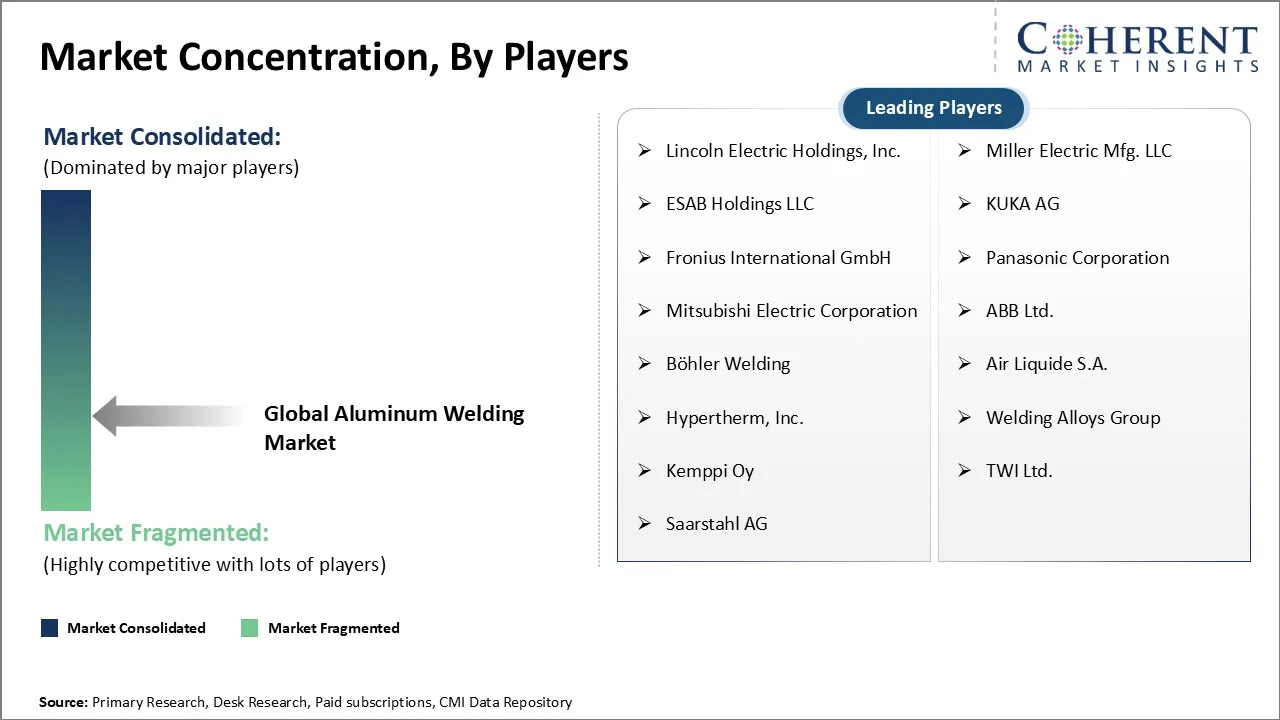
| Companies covered: | Lincoln Electric Holdings, Inc., Miller Electric Mfg. LLC, ESAB Holdings LLC, KUKA AG, Fronius International GmbH, Panasonic Corporation, Mitsubishi Electric Corporation, ABB Ltd., Böhler Welding, Air Liquide S.A., Hypertherm, Inc., Welding Alloys Group, Kemppi Oy, TWI Ltd., and Saarstahl AG | ||
| Growth Drivers: |
| ||
| Restraints & Challenges: |
| ||
Aluminum Welding Market Dynamics
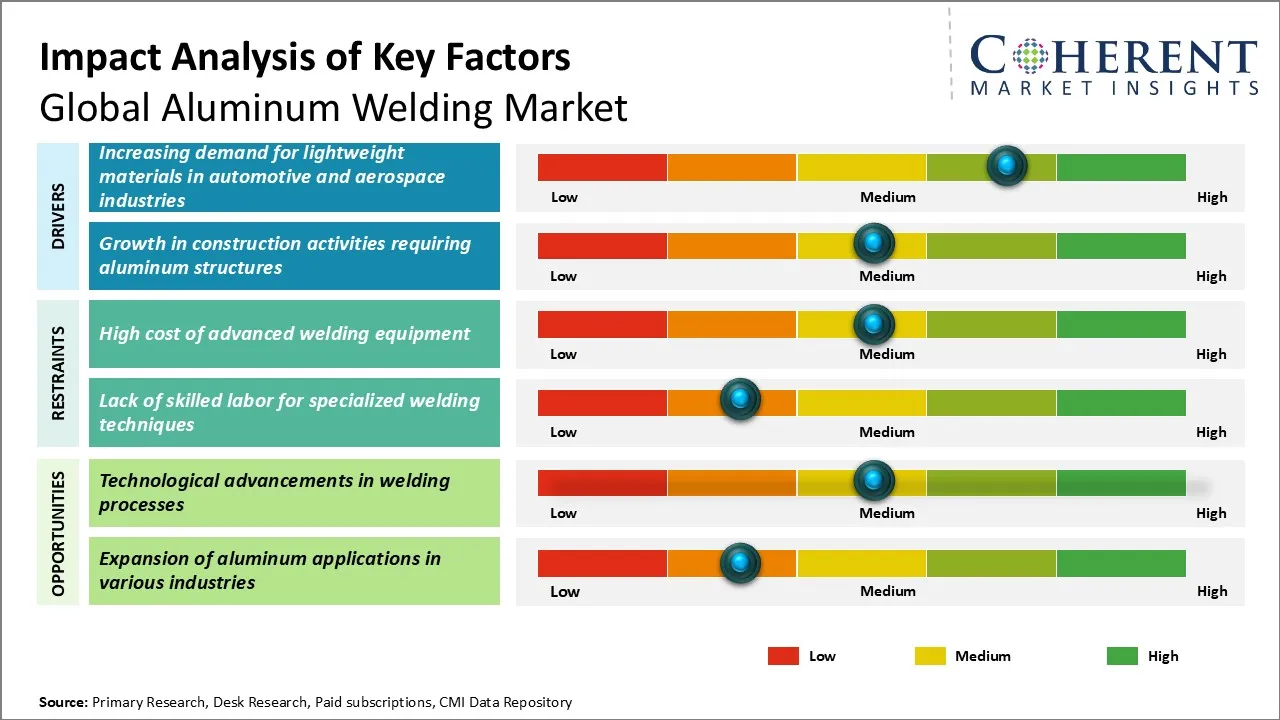
Aluminum Welding Market Driver - Increasing Demand for Lightweight Materials in Automotive and Aerospace Industries
The escalating emphasis on fuel efficiency and stringent emission regulations have propelled the adoption of lightweight materials across automotive and aerospace sectors, significantly driving the aluminum welding market. Aluminum’s unique combination of low density and high strength makes it a preferred choice for manufacturers aiming to reduce vehicle weight without compromising structural integrity or safety. In automotive applications, the integration of aluminum components has surged to achieve better mileage and comply with environmental standards, necessitating advanced welding techniques capable of handling aluminum’s specific properties.
According to the International Energy Agency's Global EV Outlook 2023, the transportation sector accounts for approximately 24% of energy-related CO2 emissions globally, prompting automakers to adopt aluminum components extensively in body panels, engine blocks, and chassis systems. Similarly, the aerospace industry is leveraging aluminum alloys for aircraft fuselages, wings, and internal structures to achieve significant weight reductions that translate directly into fuel savings and enhanced performance.
Aluminum Welding Market Opportunity - Technological Advancements in Welding Processes
The global aluminum welding market is poised for significant growth driven by rapid technological advancements in welding processes. Innovations such as laser welding, friction stir welding (FSW), and ultrasonic welding have transformed aluminum joining methods by enhancing precision, reducing heat distortion, and improving overall structural integrity. These cutting-edge techniques enable manufacturers to meet the increasing demand for lightweight and durable aluminum components, especially in industries such as aerospace, automotive, and construction.
These innovations are particularly transformative in aerospace and automotive industries, where lightweight aluminum components are increasingly critical for fuel efficiency and emission reduction. The integration of artificial intelligence and machine learning algorithms into welding systems enables real-time monitoring and adaptive control, ensuring consistent weld quality while reducing material waste and rework costs. According to the International Energy Agency's Global EV Outlook 2023, electric vehicle sales reached 10.5 million units globally in 2022, representing a significant increase from previous years, which directly correlates with increased demand for advanced aluminum welding technologies as manufacturers seek to optimize battery housing and structural components through superior joining processes.
Analyst Opinion (Expert Opinion):
- The global aluminum welding market is poised for significant expansion, driven by the increasing demand for lightweight materials in automotive and aerospace applications. Insights from the International Conference on Welding Technology (2023) and the Welding & Fabrication Expo (2022) highlighted the growing complexity of aluminum welding techniques, particularly in high-strength applications.
- For instance, at the 2024 FABTECH Expo in Orlando, leading manufacturers demonstrated next-gen friction stir welding systems capable of joining ultra-thin aerospace-grade aluminum with minimal distortion, a breakthrough that drew strong interest from automotive and aviation OEMs seeking weight reduction without sacrificing integrity.
- The International Institute of Welding (IIW) Annual Assembly spotlighted case studies where laser hybrid welding was deployed in shipbuilding, reducing assembly times by over 25%. Industry-specific collaborations, such as the partnership between Lincoln Electric and NASA’s MaterialsLab for space-grade aluminum joining, illustrate how R&D-driven initiatives are influencing commercial standards.
Speak to the analyst
Want personalized insights?
Take the findings above to one of our principal consultants, or have the report rebuilt around the segments, geographies and competitors you actually track.
Market Segmentation
- Wire Type Insights (Revenue, USD Bn, 2021 - 2033)
- Pure Aluminum Welding Wire
- Aluminum Magnesium Alloy Welding Wire
- Al-Si Alloy Welding Wire
- Technique Insights (Revenue, USD Bn, 2021 - 2033)
- Arc Welding
- Gas Metal-Arc (MIG) Welding
- Gas Tungsten-Arc (TIG) Welding
- Torch Welding
- Laser Beam Welding
- Electron Beam Welding
- Resistance Welding
- Others
- End-use Industry Insights (Revenue, USD Bn, 2021 - 2033)
- Automotive
- Aerospace
- Marine
- Construction
- Others
- Regional Insights (Revenue, USD Bn, 2021 - 2033)
- North America
- U.S.
- Canada
- Latin America
- Brazil
- Argentina
- Mexico
- Rest of Latin America
- Europe
- Germany
- U.K.
- Spain
- France
- Italy
- Russia
- Rest of Europe
- Asia Pacific
- China
- India
- Japan
- Australia
- South Korea
- ASEAN
- Rest of Asia Pacific
- Middle East
- GCC Countries
- Israel
- Rest of Middle East
- Africa
- South Africa
- North Africa
- Central Africa
- North America
- Key Players Insights
- Lincoln Electric Holdings, Inc.
- Miller Electric Mfg. LLC
- ESAB Holdings LLC
- KUKA AG
- Fronius International GmbH
- Panasonic Corporation
- Mitsubishi Electric Corporation
- ABB Ltd.
- Böhler Welding
- Air Liquide S.A.
- Hypertherm, Inc.
- Welding Alloys Group
- Kemppi Oy
- TWI Ltd.
- Saarstahl AG
Sources
Primary Research Interviews
- Technology Manager – Leading Aluminum Welding Manufacturer
- Procurement Lead – Major Automotive OEM (Original Equipment Manufacturer)
- Product Development Head – Well-known Welding Equipment Brand
- Sustainability Manager – Industry Association for Welding and Fabrication
Stakeholders
- Manufacturers
- End-use Sectors:
- Automotive Industry (vehicle assembly, body parts)
- Aerospace & Aviation (structural components)
- Construction (building facades, structural welding)
- Shipbuilding (ship hulls, marine structures)
- Appliance Manufacturing
- Regulatory & Certification Bodies
- E-commerce Platforms and Retailers
- Technology Integration Players (Automated welding solution providers, AI-enabled quality control, digital supply chain platforms)
Databases
- UN Comtrade Database
- India Import Export (EXIM) Database
- European Union Import/Export Statistics
- USITC DataWeb (U.S. International Trade Commission)
Magazines
- Welding Journal – Global aluminum welding trends and innovations
- Fabricator Magazine – New technologies in aluminum joining
- Construction Week – Use of aluminum welding in infrastructure projects
- Automotive Manufacturing Solutions – Lightweight vehicle assembly and welding
- Aerospace Manufacturing and Design – Welding challenges for aerospace-grade aluminum
Journals
- Journal of Materials Processing Technology – Advances in aluminum welding methods
- International Journal of Welding Science and Technology – Welding quality analysis and defect mitigation for aluminum
- Journal of Manufacturing Processes – Automated welding systems for aluminum
- Materials Science and Engineering – Properties of welded aluminum alloys
- Journal of Constructional Steel Research – Application of welding in building aluminum structures
Newspapers
- Financial Times – Growth trends of lightweight materials (aluminum) in transportation
- Nikkei Asia – Demand for aluminum welding in Asian automotive production
- The Guardian – Sustainability in the metals fabrication industry
- The Economic Times – Indian infrastructure and aluminum product demand
- South China Morning Post – Aluminum welding in shipbuilding and construction sectors
Associations:
- American Welding Society (AWS)
- International Institute of Welding (IIW)
- European Welding Federation (EWF)
- Aluminum Association
- International Aluminum Institute (IAI)
Public Domain Sources
- U.S. Department of Commerce – Aluminum industry reports
- European Commission – Regulations on aluminum fabrication and welding
- World Trade Organization – Global trade flows of aluminum products
- Occupational Safety and Health Administration (OSHA) – Welding safety standards
Proprietary Elements
- CMI Data Analytics Tool, Proprietary CMI Existing Repository of information for last 8 years.
Get access to 250+ pages report
Every segment, forecast, competitor profile and data table behind the analysis above — available for instant download.
- ESOMAR Member
- ISO 9001:2015 Certified
- D-U-N-S Registered
- GDPR & CCPA Compliant
Missing comfort of reading report in your local language? Find your preferred language:
Transform your Strategy with Exclusive Trending Reports
Frequently Asked Questions
The global aluminum welding market is estimated to be valued at USD 5.50 Bn in 2026 and is expected to reach USD 8.00 Bn by 2033.
The CAGR of global aluminum welding market is projected to be 5.5% from 2026 to 2033.
Increasing demand for lightweight materials in automotive and aerospace industries and growth in construction activities requiring aluminum structures are the major factors driving the growth of the global aluminum welding market.
High cost of advanced welding equipment and lack of skilled labor for specialized welding techniques are the major factors hampering the growth of the global aluminum welding market.
In terms of wire type, pure aluminum welding wire is estimated to dominate the market revenue share in 2026.
Lincoln Electric Holdings, Inc., Miller Electric Mfg. LLC, ESAB Holdings LLC, KUKA AG, Fronius International GmbH, Panasonic Corporation, Mitsubishi Electric Corporation, ABB Ltd., Böhler Welding, Air Liquide S.A., Hypertherm, Inc., Welding Alloys Group, Kemppi Oy, TWI Ltd., and Saarstahl AG are the major players.
Asia Pacific is expected to lead the global aluminum welding market in 2026.