

Positive Displacement Pumps Market Size and Trends
The global positive displacement pumps market is estimated to be valued at USD 20.84 Bn in 2026 and is expected to reach USD 29.33 Bn by 2033, exhibiting a compound annual growth rate (CAGR) of 5.0% from 2026 to 2033.
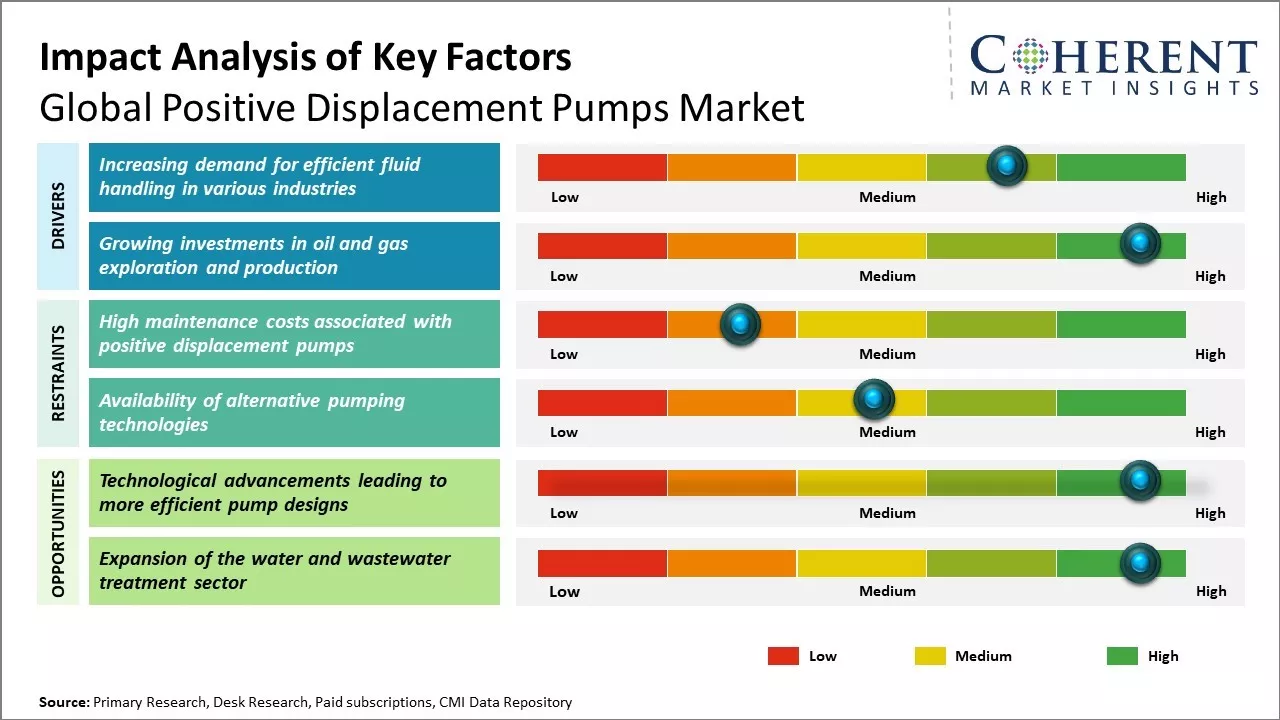
Key Takeaways
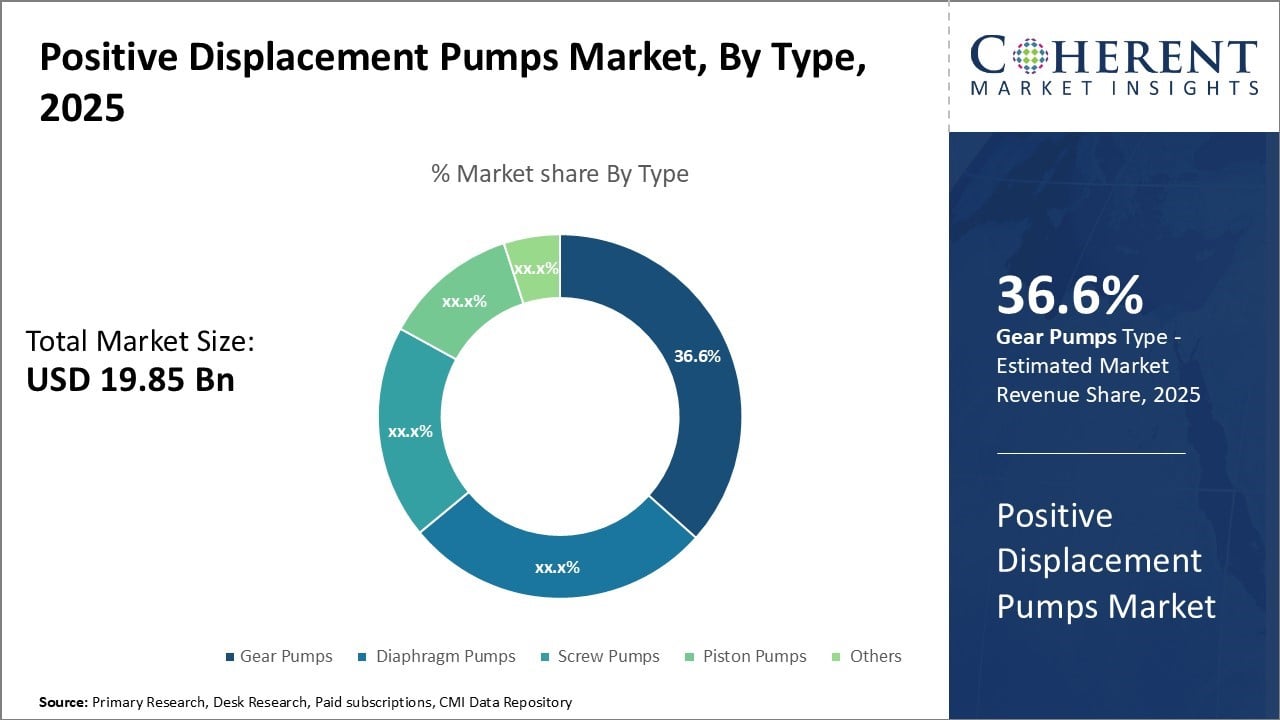
- Based on Type, the Gear Pumps segment is dominating the market with 37.6% share in 2026 as they have no seals or packing to wear out.
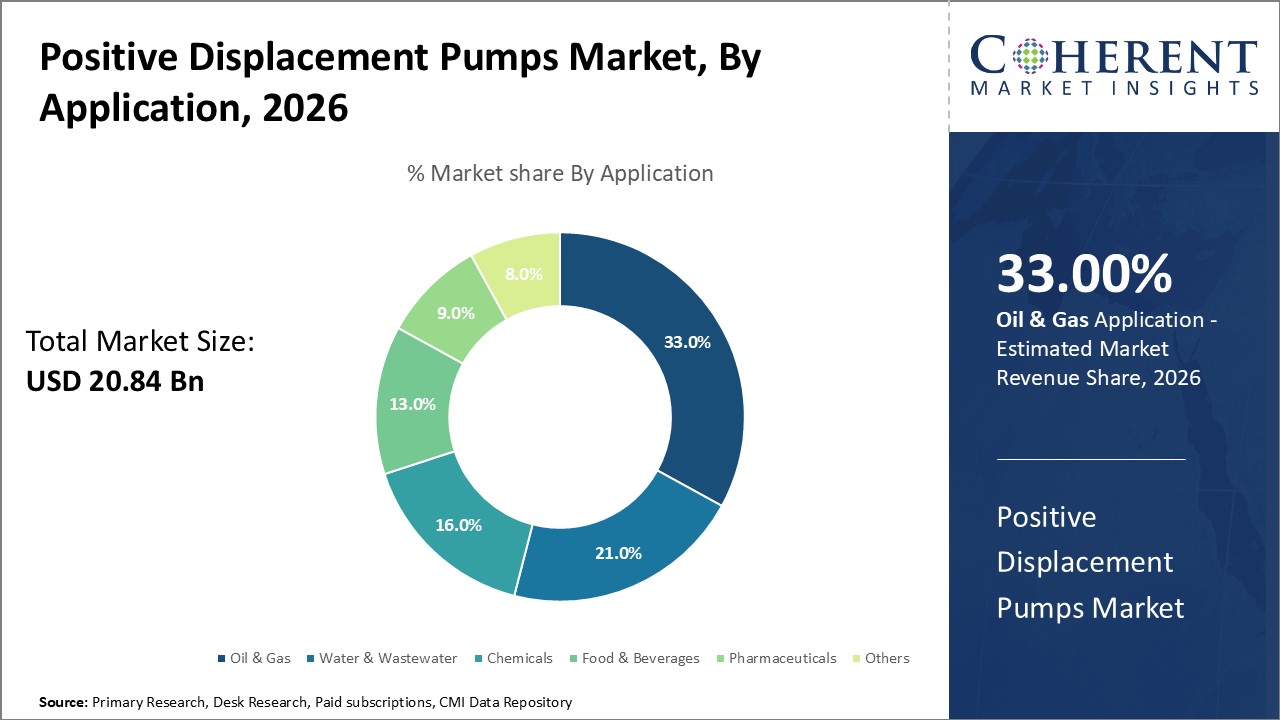
- Based on Application, the Oil & Gas segment is leading the market with 33% share, owing to the need for essential infrastructure.
- Based on End User, the Industrial segment is dominating with 56.2% share, owing to its criticality in plant adoption.
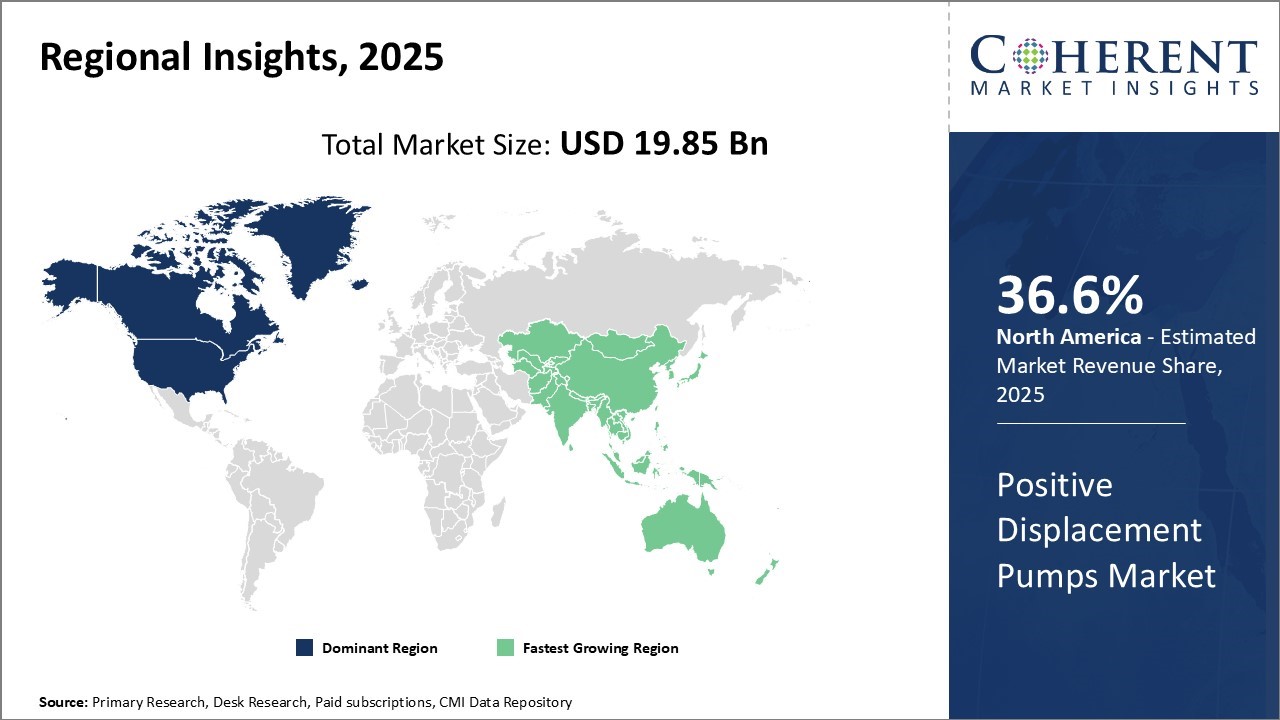
- Based on Region, North America is leading the market in 2026, with 36.6% share, owing to the strong presence of oil & gas industries.
Market Overview
Positive displacement pumps function by entrapping a fixed amount of fluid and pumping it with 100% volumetric efficiency. These pumps are used extensively across various industries like oil & gas, chemical, water & wastewater, and are suitable for high viscosity fluids and solids handling applications. The Global Positive Displacement Pumps market is expected to witness steady growth driven by the growing oil & gas industry and increasing demand for water & wastewater management. Moreover, the rising investments in process industries for production enhancements, coupled with demand for solids handling capabilities of positive displacement pumps, will further support the market growth during the forecast period.
Current Events and Their Impact
Current Events | Description and its impact |
Water Infrastructure Modernization Initiatives |
|
Industrial Automation and Digitalization Surge |
|
End-User Feedback on Positive Displacement Pumps
- Maintenance and Downtime
End users consistently highlight the need for frequent maintenance, particularly related to seals, valves, and other wear components. Unplanned downtime resulting from these issues is a major concern, especially in continuous production environments.
- Reliability Over Time
There are widespread concerns about long-term reliability. Many users report a decline in performance due to internal component wear, which affects the pump's ability to maintain consistent flow and pressure.
- Noise and Vibration Issues
Operators working in regulated or indoor environments often point to high noise and vibration levels—especially in gear and piston-type PD pumps—as a significant drawback.
Unmet Needs in the PD Pump Market
- Extended Durability
There is a strong demand for pumps with longer-lasting components that reduce the frequency and cost of maintenance. Innovations in wear-resistant materials and advanced seal designs are particularly needed.
- Energy Efficiency Improvements
Users are looking for more energy-efficient PD pump solutions, particularly those that can adapt to variable load conditions without excessive power consumption.
- Smart Pump Technology
The market lacks PD pumps with built-in IoT capabilities or connectivity for predictive maintenance. Integration with plant-wide control systems (e.g., SCADA or PLCs) is becoming an essential requirement for many industrial users.
- Improved Sanitary Design
Industries with strict hygiene standards require PD pumps with better sanitary engineering to support effective CIP/SIP protocols. More user-friendly designs that minimize contamination risks are in high demand.
- Current Industry Events of 2026
- Market Size Estimation
- Regional Breakdown
- Competitive Landscape
- Customer Intelligence
- Segmental Analysis
- Pricing Analysis
- Key Market Drivers, Challenges & Future Trends
- Customized Insights Section
Segmental Insights
Positive Displacement Pumps Market Insights, By Type
Gear Pump Segment Dominates the Overall Market
In terms of type, the gear pumps segment is estimated to contribute the highest market share of 37.6% in 2026 owing to their reputation for dependability and reliability. Gear pumps are positive displacement pumps that use a set of meshing teeth to force fluid from the pump's inlet to its outlet. Their simplicity makes them virtually maintenance-free, as they have no seals or packing to wear out over time. This helps gear pumps operate continuously for decades with minimal service required. Their ability to transfer abrasive or viscous fluids also makes them well-suited for many industrial processes that require precise fluid movement. Gear pumps are durable enough to withstand pressure spikes and fluid surges without damage. These attributes give gear pumps an advantage in industries like manufacturing, water treatment, food production, and, more where dependable pump operation is mission-critical.
Positive Displacement Pumps Market Insights, By Application
Essential Infrastructure Drives Oil & Gas Segment
In terms of application, the oil & gas segment estimated to contribute the highest market share of 33% in 2026 as positive displacement pumps play an essential role in petroleum infrastructure. Pumps are needed at every stage of oil and gas operations, from initial extraction to finished product transportation. Drilling rigs use displacement pumps to circulate drilling mud. Fracking operations employ powerful pumps to fracture shale formations. Pipelines require pumps to maintain ain constant pressurized flow over long distances. Storage tanks and shipping vessels also rely on pumps. Given the immense scale of global oil and gas infrastructure, the industry has an enormous demand for pumps that can handle abrasive slurries, high pressures, and corrosive or flammable fluids. Positive displacement designs like reciprocating plunger pumps are well-suited to meet these operational challenges.
Positive Displacement Pumps Market Insights, By End User
Industrial Segment Process Criticality Drives Plant Adoption
In terms of by end user, the industrial segment is estimated to contribute the highest market share of 56.2% in 2026 due to factories' reliance on process-critical pumps. Manufacturing plants have myriad liquid handling needs that often require precision flow control. Positive displacement pumps are mainstays in industries like automotive, electronics, food processing, and chemicals because they deliver consistent, pulse-free flow even at low speeds or high viscosities. For example, piston pumps are mainstays in precision coating and dispensing applications. Diaphragm pumps are commonly used to transfer sanitary or sterile fluids in pharmaceutical plants. Given manufacturing's need for efficient, regulated fluid transfer, industrial facilities turn to positive displacement designs to keep production lines running smoothly. Uptime is paramount, making these durable and service-friendly pumps a necessity across many sectors.
For instance, Atlas Copco, a global manufacturer of industrial tools and equipment, acquired LEWA GmbH, a prominent manufacturer of diaphragm metering pumps, process pumps, and complete metering systems. This strategic acquisition aims to enhance Atlas Copco's offerings in the industrial pumps sector, allowing the company to leverage LEWA's expertise and technology to better serve its customers. This is further accelerating the positive displacement pumps market share.
Regional Insights
North America Positive Displacement Pumps Market Trends
North America has established itself as the dominant region in the global positive displacement pumps market. The region is expected to hold 36.6% of the market share in 2026. The oil & gas industry has a commanding presence in the region, especially in the U.S. With extensive onshore and offshore activities, pumping solutions are extensively used for exploration, extraction, and transportation of oil and natural gas. For instance, Eco Wave Power Global AB, announced to launch the first U.S.-based onshore wave energy pilot project in September 2026. Apart from this, leading pump manufacturers have set up production bases as well as research and development centers in the region to cater to the demand from regional oil companies.
Stringent regulations regarding the safety and efficiency of pumps used in the industry have further encouraged manufacturers to innovate. Thanks to rapid technological adoption, pumps produced in North America often have advanced features. This prompts significant pump exports to other mature markets. However, trade uncertainties and policies impact export volumes. Localized manufacturing helps counter import restrictions to some extent.
United States Positive Displacement Pumps Market Trends
The United States is the prominent market in North America. The positive displacement pump market in the U.S. is driven by the strong presence of oil & gas, chemical, water, and food & beverage industries. For instance, in April 2024, Vogelsang USA rolled out its new EP series of rotary lobe positive displacement pumps that are specifically tailored for oil, gas, and chemical sectors. This is further propelling the positive displacement market demand.
Canada Positive Displacement Pumps Market Trends
Canada follows the U.S. and is the second-largest market in North America. The growth of the positive displacement pump market in the country is fueled by the presence of the oil sands industry, large amounts of investments in oil operations, an increase in the food processing and mining industry, etc. For instance, in February 2023, CPCPumps, which is a part of Atlas Copco’s Gas & Process division, introduced its BB5 centrifugal pump. It allows a tailored hydraulics with its barrel-style double casing.
Asia Pacific Positive Displacement Pumps Market Trends
Asia Pacific has emerged as the fastest-growing region. Rapid industrialization and infrastructure development across developing nations propel pump installation. The region is now a manufacturing powerhouse for several industries, including automotive, chemicals, and oil & gas. Growing plant capacities and new production facilities amplify pumping needs.
Strong economic growth also boosts process industry investments. This increases the requirement for slurry, liquid natural gas, and other specialized pumps. Water treatment initiatives in urbanizing markets open up opportunities as well. However, the pandemic impacted several developing Asian economies like China, Japan, etc., curbing the pump demand recovery.
Ongoing projects like the expansion of refining capacities and the construction of new petrochemical complexes bode well for the long run. This will sustain the momentum of the Asia Pacific positive displacement pumps market. Additionally, free trade policies assist manufacturers to procure components at competitive costs, giving their products an edge in export markets.
China Positive Displacement Pumps Market Trends
China is the largest in the Asia Pacific region. The positive displacement pump market in the country is rapidly growing due to industrial growth, infrastructural development, expansion of the manufacturing sector, large investments, and technological innovations. For instance, in December 2024, IDEX China launched its PulsaMax8480 Series positive displacement pump. It is a leak-free pump that offer precise dosing and reliability, finding its applications in the refinery, oil & gas industries.
India Positive Displacement Pumps Market Trends
India follows China closely. It is the second-largest market in Asia- Pacific. The Positive Displacement Pumps Market in the country has a strong growth driven by the expansion of the pharmaceutical, chemical, and agriculture sector. The rapid urbanization, and industrialization enable the need for wastewater management which further boosts the market. For instance, in October 2024, Roto Pumps Ltd. unveiled its new Roto Cake Pumps at the IFAT 2024. This is further accelerating the positive displacement pumps market share in India.
Market Report Scope
Positive Displacement Pumps Market Report Coverage
| Report Coverage | Details | ||
|---|---|---|---|
| Base Year: | 2025 | Market Size in 2026: | USD 20.84 Bn |
| Historical Data for: | 2020 To 2024 | Forecast Period: | 2026 To 2033 |
| Forecast Period 2026 to 2033 CAGR: | 5.0% | 2033 Value Projection: | USD 29.33 Bn |
| Geographies covered: |
| ||
| Segments covered: |
| ||
| Companies covered: | Grundfos Holding A/S, Schlumberger Limited, Flowserve Corporation, KSB SE & Co. KGaA, ITT Inc., Alfa Laval AB, Cat Pumps, Parker Hannifin Corporation, Xylem Inc., SPX Flow, Inc., ARO (Ingersoll Rand), Honeywell International Inc., Weir Group PLC, Wilo SE, and Dover Corporation | ||
| Growth Drivers: |
| ||
| Restraints & Challenges: |
| ||
Positive Displacement Pumps Market Driver - Increasing demand for efficient fluid handling in various industries
With increasing industrialization, the need for efficient fluid handling has gained immense importance. Various industries such as chemicals, petroleum, food and beverage, pharmaceuticals, and others rely heavily on precise fluid transfer systems. Positive displacement pumps play a pivotal role in these industries as they can transfer highly viscous liquids and slurries with utmost accuracy. These pumps are also suitable for transferring dangerous fluids, given their enclosed construction, which prevents leaks.
Over the past few years, there has been a considerable rise in manufacturing activities across major developing regions. The chemical industry in particular has expanded rapidly in countries such as China, India, Brazil, and others, owing to growing domestic demand for chemicals from sectors like construction and automotive. This has augmented the production of bulk chemicals, specialty chemicals, and life science chemicals globally. Since precise dosing and metering of chemicals are critical in these industries, demand for positive displacement pumps has increased substantially. Their self-priming capability allows these pumps to transfer chemicals efficiently from storage tanks to reaction vessels without losing pressure.
Similarly, the global pharmaceutical industry has witnessed steady growth on the back of increasing healthcare spending and demand for generics. Large pharmaceutical companies are continuously expanding and setting up new production facilities, which involve extensive fluid transfer networks for manufacturing and processing activities. Positive displacement pumps play a vital role in critical pharmaceutical applications such as isolation of chemical intermediates, precise dosage of reagents, heat transfer, and temperature control. Their seal-less and chemically resistant designs make them suitable for handling even highly corrosive and complex pharmaceutical formulations.
Positive Displacement Pumps Market Trends
Growing Investments in Oil and Gas Exploration and Production
The oil and gas sector has been witnessing sizable investments over the past few years, driven by rising energy demand worldwide, coupled with volatility in crude oil prices. Significant capital is being channeled into upstream exploration and production activities aimed at replenishing depleting reserves and boosting existing output. The advent of unconventional oil and gas extraction technologies has opened up massive untapped reserves and revived investments in previously considered mature fields as well.
On the exploration front, oil companies supported by national oil companies are investing heavily in high-risk, deep-water, and Arctic exploration projects to discover major new fields. Setting up offshore drilling rigs and platforms in remote ultra-deepwater locations involves the deployment of an extensive network of sophisticated pumps for fluid transfer needs. Positive displacement pump varieties, including plunger pumps and progressive cavity pumps, have become indispensable for offshore drilling operations due to their fuel efficiency, ability to handle slurries, and greater reliability in corrosive marine environments.
For instance, in March 2023, KSB Limited, a prominent supplier of pumps, valves, and systems, acquired proprietary technology from Bharat Pumps and Compressors Ltd. (BP&CL), granting it exclusive ownership and rights to BP&CL's product line technology. This strategic acquisition enables KSB Limited to leverage its strengths and market potential, expanding its product offerings in both new pump systems and aftermarket markets. With this move, KSB Limited aims to enhance its service capabilities and support a wide range of industries, including oil and gas exploration and nuclear power plants, while contributing to the 'Make in India' initiative.
Positive Displacement Pumps Market Opportunity - Technological advancements leading to more efficient pump designs
Recent advancements in materials, engineering, and manufacturing technologies have enabled the development of next-generation positive displacement pump designs with improved efficiencies. New surface coating techniques have increased the wear resistance of components, prolonging the life of rubbers, gears, and sealing elements inside pumps. Advanced 3D printing is being used to produce complex internal configurations that minimize fluid turbulence and leakage. Digital tools allow virtual prototyping and hydrodynamic analysis during the design stage itself to optimize flow parameters.
Internet of Things (IoT) integration in new pumps provides real-time performance monitoring, reducing unexpected failures. Predictive maintenance enabled by IoT and data analytics can schedule repairs before breakdown. More efficient pump designs translate to significant energy savings and higher process yields for end users. This presents lucrative business opportunities for pump manufacturers to target more application areas and expand into new geographies.
Key Developments
- In April 2025, Roto Pumps introduced its new P-Range Compact Pumps. These pumps are specifically tailored to enhance durability, and easy installation.
- In February 2025, SPX FLOW’s APV introduced the APV DW+ Positive Displacement Pump. It is designed for high-value, and shear-sensitive fluids. It finds applications across the food, beverage, chemical, and personal care industries.
- In April 2023, Packo, a leading manufacturer of pumps and related technologies, unveiled its ZLC rotary lobe pump, which has been certified as 3A compliant. This innovative pump is specifically designed for the pharmaceutical, biotechnology, and cosmetic industries, making it suitable for a wide range of applications.
- In June 2021, Anderson Process, a leading Midwest supplier of process equipment and services, acquired Premier Pump Inc., a long-standing pump distributor and service provider based in Cleveland, Ohio. This strategic acquisition strengthened Anderson Process's service and support capabilities throughout the Midwest region.
- In May 2021, CDI Energy Products, a provider of high-performance polymer components for the energy and chemical process industries, announced the development and launch of its newest proprietary thermoplastic polymer composite material.
Analyst Viewpoint
- The global positive displacement pumps market shows promise for steady growth, driven by rising oil and gas exploration activities, and growth in the water and wastewater treatment industry will boost demand. Additionally, the increasing focus on automation in various end-use industries, along with the rising need for transporting hazardous and toxic fluids, will fuel market expansion. However, the availability of substitute pumping technologies may threaten market growth to some extent.
- The North America region is expected to dominate the global positive displacement pumps market owing to rapid industrialization and infrastructure development projects in the region. Asia Pacific will also present profitable opportunities driven by shale gas exploration activities and refurbishment projects in mature markets. Europe, on the other hand, may witness relatively slower growth due to stringent emissions regulations hindering operations.
- Ongoing focus on product innovations tailored for niche applications, as well as integration of IoT capabilities, are positive trends that will create growth opportunities for market players. Manufacturers must also invest in aftermarket services and strengthen distribution networks to leverage opportunities arising from infrastructure investments in developing markets. However, market stakeholders need to keep a close watch on rising raw material costs and address challenges related to changing trade policies and protectionist measures to sustain long-term growth.
Market Segmentation
- Type Insights (Revenue, USD Bn, 2021 - 2033)
- Gear Pumps
- Diaphragm Pumps
- Screw Pumps
- Piston Pumps
- Others
- Application Insights (Revenue, USD Bn, 2021 - 2033)
- Oil & Gas
- Water & Wastewater
- Chemicals
- Food & Beverages
- Pharmaceuticals
- Others
- End User Insights (Revenue, USD Bn, 2021 - 2033)
- Industrial
- Commercial
- Residential
- Regional Insights (Revenue, USD Bn, 2021 - 2033)
- North America
- U.S.
- Canada
- Latin America
- Brazil
- Argentina
- Mexico
- Rest of Latin America
- Europe
- Germany
- U.K.
- Spain
- France
- Italy
- Russia
- Rest of Europe
- Asia Pacific
- China
- India
- Japan
- Australia
- South Korea
- ASEAN
- Rest of Asia Pacific
- Middle East
- GCC Countries
- Israel
- Rest of Middle East
- Africa
- South Africa
- North Africa
- Central Africa
- North America
- Key Players Insights
- Grundfos Holding A/S
- Schlumberger Limited
- Flowserve Corporation
- KSB SE & Co. KGaA
- ITT Inc.
- Alfa Laval AB
- Cat Pumps
- Parker Hannifin Corporation
- Xylem Inc.
- SPX Flow, Inc.
- ARO (Ingersoll Rand)
- Honeywell International Inc.
- Weir Group PLC
- Wilo SE
- Dover Corporation
Sources
Primary Research Interviews
- In-depth interviews with key industry stakeholders, including pump manufacturers, engineers, distributors, procurement managers, and end-users across sectors such as oil & gas, water treatment, chemicals, and food & beverage.
Databases
- Statista
- International Trade Centre (ITC)
- UN Comtrade Database
- World Bank Data
- OECD iLibrary
- Global Import Export Data
- Company Annual Reports & SEC Filings
Magazines
- World Pumps
- Processing Magazine
- Pump Engineer
- Flow Control Magazine
- Hydraulics & Pneumatics
Journals
- Journal of Fluids Engineering
- Industrial & Engineering Chemistry Research
- Journal of Hydraulic Engineering
- International Journal of Fluid Machinery and Systems
Newspapers
- The Hindu Business Line
- Business Standard
- Financial Express
- The Economic Times
Associations
- Hydraulic Institute (HI)
- American Society of Mechanical Engineers (ASME)
- European Pump Manufacturers Association (Europump)
- International Desalination Association (IDA)
- Water Environment Federation (WEF)
Public Domain Sources
- Government ministry websites (e.g., Ministry of Industry, Ministry of Water Resources)
- Trade fair press releases (e.g., IFAT, OTC, ACHEMA)
- National and regional statistics portals
- Patent databases (e.g., WIPO, Google Patents)
- Environmental regulations and policy documents
Get access to 250+ pages report
Every segment, forecast, competitor profile and data table behind the analysis above — available for instant download.
- ESOMAR Member
- ISO 9001:2015 Certified
- D-U-N-S Registered
- GDPR & CCPA Compliant
Missing comfort of reading report in your local language? Find your preferred language:
Transform your Strategy with Exclusive Trending Reports
Frequently Asked Questions
The Positive Displacement Pumps Market is estimated to be valued at USD 20.84 Bn in 2026, and is expected to reach USD 29.33 Bn by 2033.
The CAGR of the Positive Displacement Pumps Market is projected to be 5.0% from 2026 to 2033.
Increasing demand for efficient fluid handling in various industries and growing investments in oil and gas exploration and production are the major factors driving the growth of the global positive displacement pumps market.
High maintenance costs associated with positive displacement pumps and the availability of alternative pumping technologies are the major factors hampering the growth of the global positive displacement pumps market.
In terms of type, gear pumps are estimated to dominate the market revenue share in 2026.
Grundfos Holding A/S, Schlumberger Limited, Flowserve Corporation, KSB SE & Co. KGaA, ITT Inc., Alfa Laval AB, Cat Pumps, Parker Hannifin Corporation, Xylem Inc., SPX Flow, Inc., ARO (Ingersoll Rand), Honeywell International Inc., Weir Group PLC, Wilo SE, and Dover Corporation are the major players.
North America is expected to lead the global positive displacement pumps market.