

Global Ambient Computing Market and Forecast – 2026 to 2033
Coherent Market Insights estimates that the global ambient computing market stood at USD 59 Bn in 2025 and will expand to USD 438 Bn by 2033, registering a CAGR of 25% between 2026 and 2033.
Key Takeaways of the Ambient Computing Market
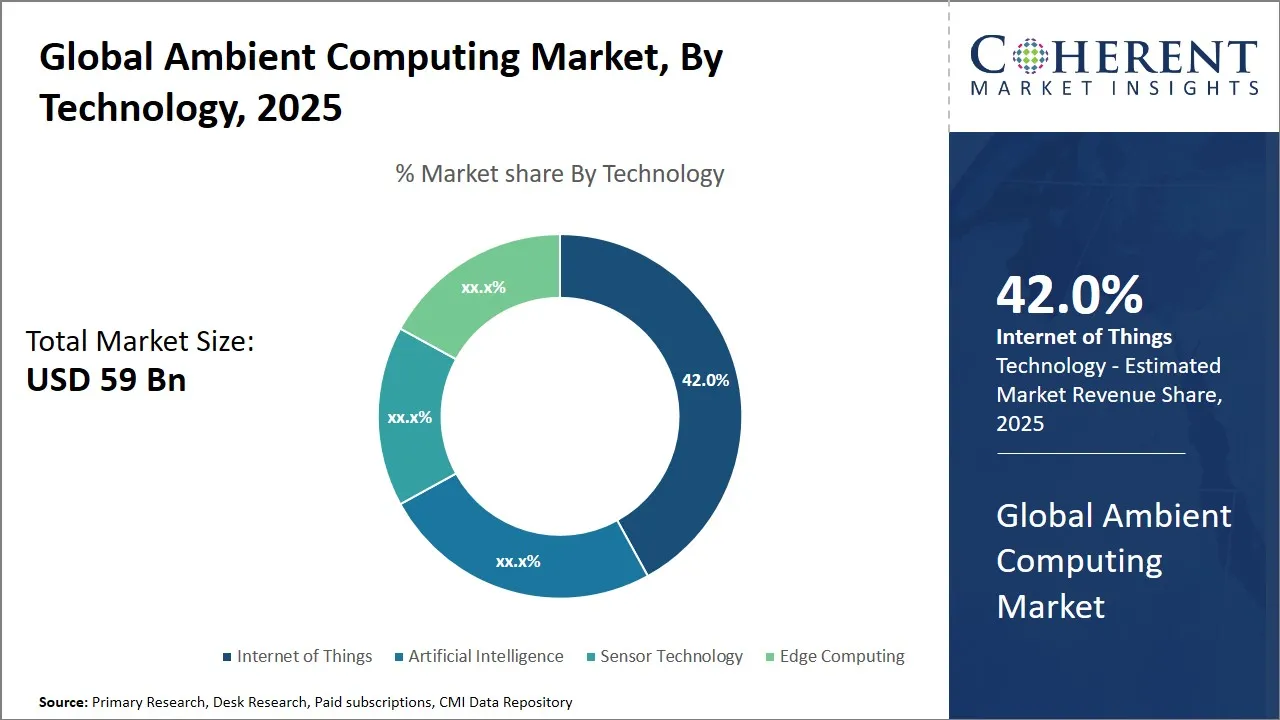
- The internet of things segment accounted for 42% of the ambient computing market share in 2025.
- The lighting control segment captured 33% of the market share in 2025.
- The consumer electronics segment held 44% of the global ambient computing market share in 2025.
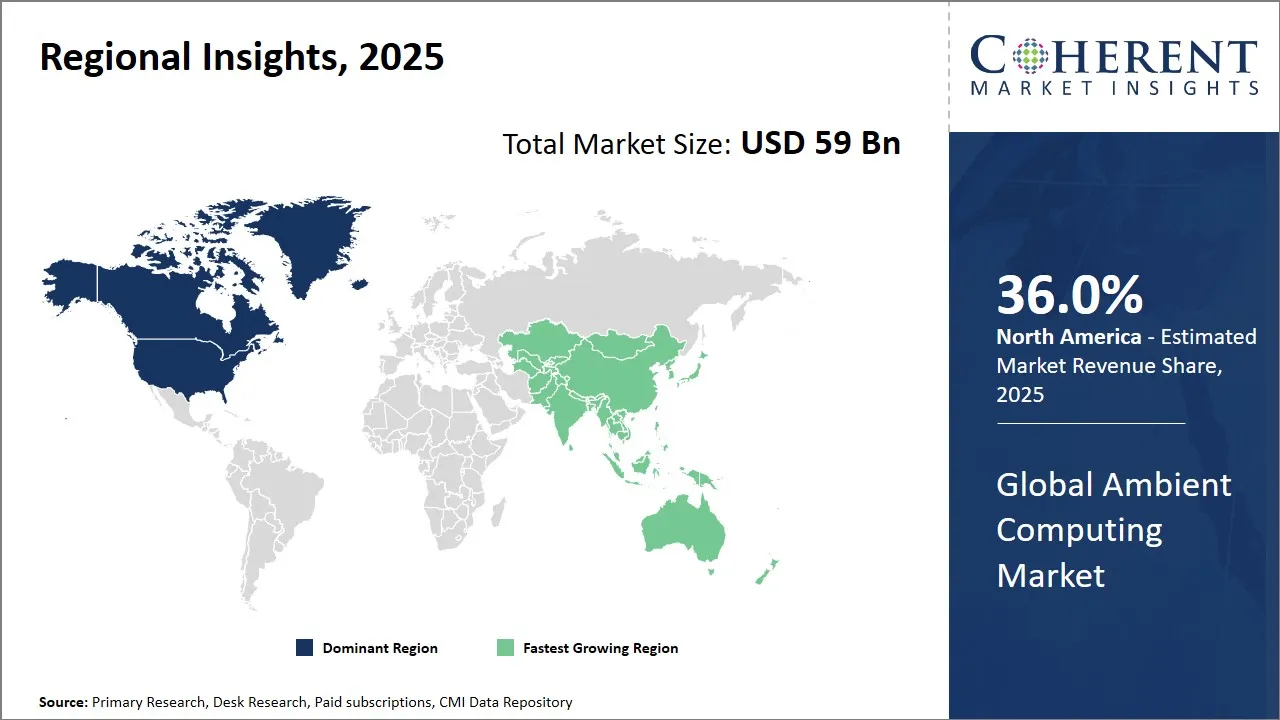
- North America dominated the ambient computing market in 2025 with a 36% market share.
- Asia Pacific held 25% market share in 2025 and is expected to record the fastest growth over the forecast period.
Current Events and Its Impact
Current Events | Description and its Impact |
AWS at ReInvent 2025 |
|
Segmental Insights
- Current Industry Events of 2026
- Market Size Estimation
- Regional Breakdown
- Competitive Landscape
- Customer Intelligence
- Segmental Analysis
- Pricing Analysis
- Key Market Drivers, Challenges & Future Trends
- Customized Insights Section
Why Does the Internet of Things Segment Dominate the Global Ambient Computing Market in 2025?
The internet of things segment captured 42.0% of the global ambient computing market share in 2025. Growth stems not just from technology, but from how tightly it links environments to real-time demands. What drives progress is a web of sensors, gadgets, and networks - each part feeding into smarter background operations. In homes, offices, and factories, more connected tools appear every day, shifting usage patterns slowly upward.
For instance, on October 2, 2025, Wiliot collaborated with Walmart to shift how inventory moves behind the scenes. Not just another test, this rollout marks a turning point as ambient sensing enters mainstream retail through widespread placement of IoT tags across distribution networks.
(Source: wiliot.com)
Lighting Control Segment Dominates the Global Ambient Computing Market
The lighting control segment accounted for 33.0% of the ambient computing market share in 2025. Driven by a need for better energy use and improved surroundings, progress takes shape through smart lighting solutions. Where people are present, lights adapt, responding to sunlight levels and personal settings without manual input. These adjustments rely on ambient sensing methods that quietly observe and react. Adoption spreads steadily into offices, homes, and shared facilities alike. What results is less waste, more comfort, achieved through subtle automation.
Why is Consumer Electronics the Most Crucial End User in the Ambient Computing Market?
The consumer electronics segment accounted for 44.0% of the market share in 2025. Primarily driven by seamless access to daily users, expansion follows the steady advancement of intelligent living tools. Starting from simple gadgets, systems now predict preferences while reducing effort through tailored responses - this alignment fits current user demands well. Embedded awareness in household technology makes routine tasks smoother, often before being asked.
For instance, on November 11, 2025, Innatera announced that Xiamen Joyatech Co., Ltd. became its first Original Design Manufacturer (ODM) customer. Through this collaboration, Innatera’s processors are set be be embedded into a new generation of Joyatech-designed consumer electronics, IoT, smart home, and lifestyle devices.
(Source: innatera.com)
Integration Complexity & Legacy System Friction
Region | Integration Complexity Score (0-100) | Data Privacy & Trust Readiness (0-100) |
North America | 72 | 78 |
Europe | 81 | 84 |
Asia Pacific | 68 | 53 |
Latin America | 76 | 47 |
Middle East & Africa | 82 | 42 |
Regional Insights
North America Ambient Computing Market Analysis and Trends
North America accounted for a market share of 36% in 2025. A major factor behind the expansion lies in sophisticated tech frameworks, alongside dominant sector participation, combined with policy backing that encourages progress in IoT, AI, and cloud systems. Found within this area is an evolved marketplace - home to numerous emerging tech firms, long-standing corporations, academic centers, and financial support from investors focused on innovation.
The region’s deep focus on intelligent household solutions, corporate shifts toward digital integration, along with refined interaction design, is pushing forward ambient computing in both personal and operational settings. Leading contributors such as Amazon, through voice-enabled gadgets, Microsoft via intelligent cloud offerings, and Google by advancing contextual awareness tools using assistant functions and machine learning, help define direction through steady upgrades and broader application reach.
Asia Pacific Ambient Computing Market Analysis and Trends
Asia Pacific accounted for a market share of 25% in 2025 and is expected to register the fastest growth rate over the forecast period. Urban areas are expanding fast, contributing to higher demand for connected gadgets. Smartphones now reach nearly every corner of daily life. Device usage rises steadily in homes and factories alike. Government strategies emphasize intelligent infrastructure and digital transformation efforts. Funding flows into artificial intelligence and next-generation networks.
China, Japan, South Korea, and India lead change through innovation and scale. A rising number of citizens embrace new tools without hesitation. Startups emerge frequently alongside established leaders reshaping industries. Firms like Alibaba, Tencent, Samsung, and SoftBank influence system design and connectivity patterns. Cooperation between nations shapes how technologies spread across borders. Investment activity crosses national lines, boosting seamless computing environments.
Global Ambient Computing Market Outlook for Key Countries
Why is the U.S. Emerging as a Major Hub in the Ambient Computing Market?
Even as gains appear across regions, breakthroughs in ambient computing surface with greatest intensity in the U.S. This edge grows from extensive research investment combined with well-established technology ecosystems. Companies including Amazon, Apple, Google, and Microsoft shape platforms where voice-driven AI functions together with decentralized computation and seamless device interaction.
Public programs targeting smart technologies and advanced city frameworks contribute to this momentum. Startups push forward through sharper sensors, responsive settings, space where humans interact with systems evolves. Taken together, local efforts shape patterns noticed across nations.
Is China the Next Growth Engine for the Ambient Computing Market?
Backed by state initiatives, China’s ambient computing sector grows through strategic directives like "Made in China 2025" combined with city-level investments in digital foundations. Although firms such as Alibaba, Baidu, Xiaomi, and Huawei advance capabilities in cloud services, voice recognition, and connected hardware, their efforts form integrated ecosystems enabling fluid technology use. Since widespread public adoption occurs rapidly, urban centers install reactive solutions throughout homes, transit routes, and industrial zones. In areas where crowded populations overlap with expanding connectivity, intelligent settings emerge quietly, almost unnoticed.
Japan Ambient Computing Market Analysis and Trends
Even as worldwide dynamics change, robotic integration continues shaping daily digital operations across Japan. Because of focused investment in Society 5.0, government strategy supports smart frameworks designed to improve living standards alongside demographic decline. Companies such as Sony, Panasonic, and SoftBank contribute through developments in cognitive computing and sensor technology, along with physical automation - deployed especially within healthcare assistance, city design, and consumer electronics. Given mature technological networks combined with high societal confidence, growth proceeds without abrupt fluctuation.
Germany Ambient Computing Market Analysis and Trends
Within Germany’s industrial framework, automation plays a central role through unobtrusive yet sophisticated operational setups. Progress moves forward methodically, supported by strong technical expertise and structured initiatives like Industry 4.0. Real-time decisions increasingly rely on interconnected sensor arrays, machine learning models, along with uninterrupted information flow rather than standalone devices. Companies such as Siemens, Bosch, and SAP deliver flexible systems that respond to shifting production needs. Gains in performance stem less from radical change, more from steady adoption throughout one of Europe’s core manufacturing regions.
India Ambient Computing Market Analysis and Trends
A rise in web availability alters device communication within homes throughout India. Urban development projects by authorities move forward together with advances in cloud-based storage methods. Devices equipped with automation attract regular attention from younger users. As comfort grows with portable electronics, voice activation spreads widely. Companies such as Tata Consultancy Services adjust offerings where continuous links between machines gain ground. Behind regional needs, Infosys develops context-sensitive software. Without visible interaction, Wipro advances systems that act on subtle cues.
Market Players, Key Development, and Competitive Intelligence
Key Developments
- On September 4, 2025, at Innovation For All (IFA) 2025, Samsung Electronics showcased its vision for AI Home. Samsung’s AI Home aims to be a reality people can experience. These products will connect to SmartThings, delivering Samsung's unique AI Home experience that makes life more convenient, efficient, healthy, and safe.
- On February 18, 2025, HP Inc. announced an agreement to acquire key AI capabilities from Humane for USD 116 million, including the AI platform Cosmos, skilled technical talent, and extensive intellectual property.
Top Strategies Followed by Global Ambient Computing Market Players
Player Type | Strategic Focus | Example |
Established Market Leaders | Microsoft Industry Recognition | On June 23, 2025, Microsoft Azure was named a Leader in The Forrester Wave: Serverless Development Platforms, Q2 2025, showcasing its strength with services like Azure Functions and Azure Container Apps for empowering developers, scaling applications, and driving innovation, especially with AI integration. |
Mid-Level Players | Business Collaboration | On April 9, 2024, MongoDB, Inc. at Google Cloud Next ‘24 announced an expanded collaboration with Google Cloud to make it even easier and more cost-effective to build, scale, and deploy generative AI applications using MongoDB Atlas Vector Search and Vertex AI from Google Cloud, along with additional support for data processing with BigQuery. |
Small-Scale Players | Feature Launch | On November 25, 2024, Kinesis Network, a global compute optimization platform, announced a new serverless feature enabling enterprises to run workloads across a dynamic, multi-cloud environment. |
Market Report Scope
Ambient Computing Market Report Coverage
| Report Coverage | Details | ||
|---|---|---|---|
| Base Year: | 2025 | Market Size in 2026: | USD 59 Bn |
| Historical Data for: | 2020 To 2024 | Forecast Period: | 2026 To 2033 |
| Forecast Period 2026 to 2033 CAGR: | 25% | 2033 Value Projection: | USD 438 Bn |
| Geographies covered: |
| ||
| Segments covered: |
| ||
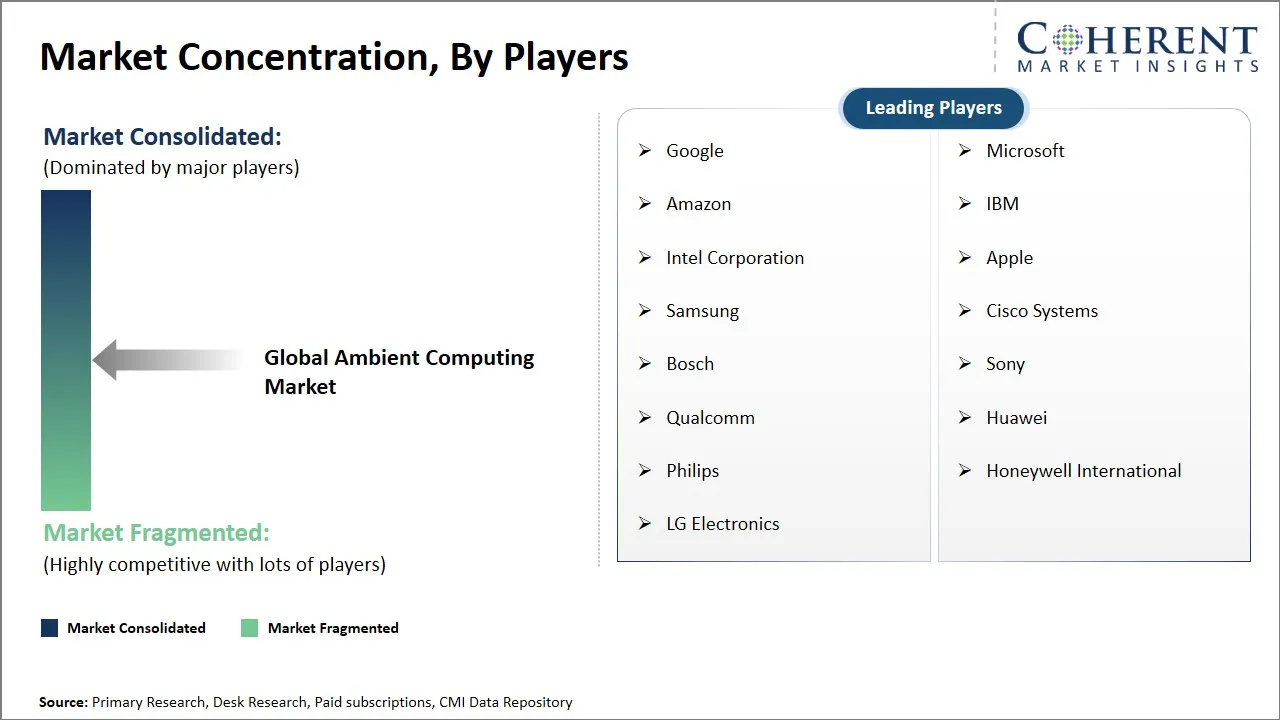
| Companies covered: | Google, Microsoft, Amazon, IBM, Intel Corporation, Apple, Samsung, Cisco Systems, Bosch, Sony, Qualcomm, Huawei, Philips, Honeywell International, and LG Electronics | ||
| Growth Drivers: |
| ||
| Restraints & Challenges: |
| ||
Global Ambient Computing Market Dynamics
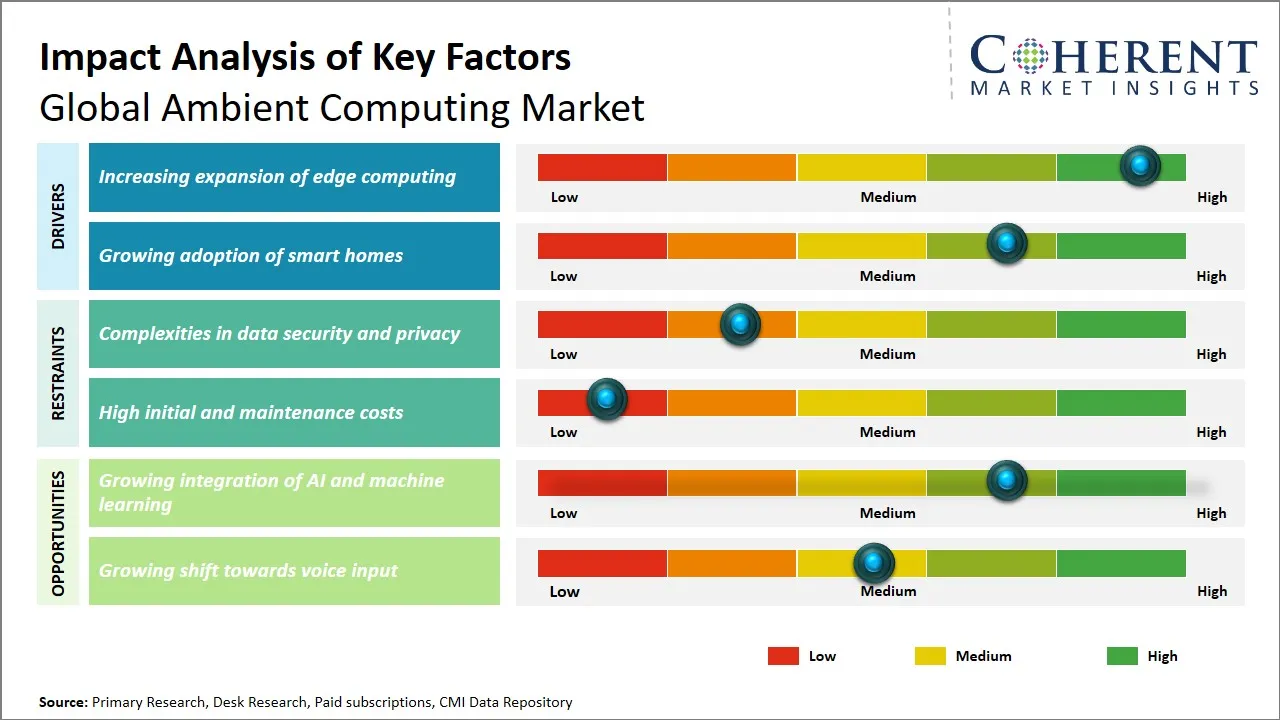
Global Ambient Computing Market Driver - Increasing Expansion of Edge Computing
Nowhere is growth seen more clearly than at the boundary where edge computing meet day to day spaces. Processing information nearer to its point of origin reshapes how systems respond across networks of connected tools. Because tasks are handled locally, delays shrink while decisions happen faster. Responses adapt based on surroundings when intelligence lives within the environment itself. Efficiency rises when constant communication with distant servers becomes less necessary. Personalized actions emerge naturally through proximity-driven design choices. Central hubs lose dominance as autonomy spreads into individual nodes.
For instance, on February 1, 2024, Gcore announced the launch of FastEdge, a cutting-edge revolutionizing application deployment and performance. Designed for cloud-native development, FastEdge is a low-latency, high-performance solution for creating responsive and personalized applications without the complexities of server management.
(Source: gcore.com)
Global Ambient Computing Market Opportunity - Growing Integration of AI and Machine Learning
A major opening within the worldwide ambient computing market emerges through deeper connections between artificial intelligence and machine learning. Since smooth engagement between humans and devices forms a core requirement, intelligent algorithms become essential support structures. Systems now understand behavior, decisions, and contexts with improved accuracy due to advances in computational reasoning. Because of these changes, voice recognition, understanding speech, and predicting outcomes grow more capable, anticipating actions before they are voiced. As a consequence, interactions appear less rigid, closer to underlying intentions. The outcome? A setting where reactions seem naturally tuned rather than pre-programmed.
For instance, on February 19, 2025, Wiliot announced that it had joined the Ambient IoT Alliance alongside Atmosic, Infineon Technologies AG, Intel, PepsiCo, Qualcomm, and VusionGroup. The alliance aims to standardize and scale low-power, battery-free sensor networks that feed continuous AI-enhanced context and analytics into larger ambient computing solutions.
(Source: wiliot.com)
Analyst Opinion (Expert Opinion)
- A shift unfolds where technology blends quietly into daily life, shaped by AI, machine learning, IoT, and edge computing working together over time. Interaction changes as machines respond without waiting for commands, guided instead by surroundings and anticipated needs. Progress grows through generative AI, local processing power, and combined sensor data, pushing wider use in devices people already own. Environments such as homes, vehicles, medical spaces, offices, and factories begin relying on these quiet systems more deeply. This steady weave of intelligence becomes part of how digital frameworks operate ahead.
- Success begins within connected systems rather than isolated gadgets. While integration of sensors, code, information flow, and machine learning defines leading platforms - such as voice-aware environments, networked wearables, or household intelligence - the strongest gains go to those balancing performance with openness. Concerns about access rights, compatibility across brands, and power demands influence how these networks evolve over time. In broad agreement, experts view context-sensitive computing as an expanding domain guided by intelligent processing; dominance emerges through continuous development alongside governance of interconnected tools.
Speak to the analyst
Want personalized insights?
Take the findings above to one of our principal consultants, or have the report rebuilt around the segments, geographies and competitors you actually track.
Market Segmentation
- Technology Insights (Revenue, USD Billion, 2021 - 2033)
- Internet of Things
- Artificial Intelligences
- Sensor Technology
- Edge Computing
- Application Insights (Revenue, USD Billion, 2021 - 2033)
- Lighting Control
- Patient Monitoring
- Inventory Management
- Autonomous Vehicles
- Smart Manufacturing
- Others
- End User Insights (Revenue, USD Billion, 2021 - 2033)
- Consumer Electronics
- Hospitals
- Automotive
- Others
- Regional Insights (Revenue, USD Billion, 2021 - 2033)
- North America
- U.S.
- Canada
- Latin America
- Brazil
- Argentina
- Mexico
- Rest of Latin America
- Europe
- Germany
- U.K.
- Spain
- France
- Italy
- Russia
- Rest of Europe
- Asia Pacific
- China
- India
- Japan
- Australia
- South Korea
- ASEAN
- Rest of Asia Pacific
- Middle East
- GCC Countries
- Israel
- Rest of Middle East
- Africa
- South Africa
- North Africa
- Central Africa
- North America
- Key Players Insights
- Microsoft
- Amazon
- IBM
- Intel Corporation
- Apple
- Samsung
- Cisco Systems
- Bosch
- Sony
- Qualcomm
- Huawei
- Philips
- Honeywell International
- LG Electronics
Sources
Primary Research Interviews
- Technology Integration Specialists and Solution Architects
- IoT Device Manufacturers and Hardware Vendors
- Smart Home and Smart Building System Integrators
- Enterprise Digital Transformation Leaders
Databases
- International Data Corporation (IDC) Technology Database
- IEEE Xplore Digital Library
Magazines
- IoT World Magazine
- Smart Cities Magazine
- Connected World Magazine
- Embedded Computing Design Magazine
Journals
- IEEE Internet of Things Journal
- Journal of Ambient Intelligence and Smart Environments
- ACM Transactions on Cyber-Physical Systems
Newspapers
- TechCrunch Technology News
- VentureBeat Technology Reports
- Forbes Technology Section
- Reuters Technology News
Associations
- IoT Consortium
- Industrial Internet Consortium (IIC)
- Smart Cities Council
- Consumer Technology Association (CTA)
Public Domain Sources
- U.S. Department of Commerce Technology Reports
- European Commission Digital Innovation Reports
- International Telecommunication Union (ITU) Publications
- World Economic Forum Technology Reports
Proprietary Elements
- CMI Data Analytics Tool
- Proprietary CMI Existing Repository of information for last 8 years
Get access to 250+ pages report
Every segment, forecast, competitor profile and data table behind the analysis above — available for instant download.
- ESOMAR Member
- ISO 9001:2015 Certified
- D-U-N-S Registered
- GDPR & CCPA Compliant
Missing comfort of reading report in your local language? Find your preferred language:
Transform your Strategy with Exclusive Trending Reports
Frequently Asked Questions
The global ambient computing market stood at USD 59 Bn in 2025 and is expected to reach USD 438 Bn by 2033.
The CAGR of global ambient computing market is projected to be 25% from 2026 to 2033.
Increasing expansion of edge computing and growing adoption of smart homes are the major factors driving the growth of the global ambient computing market.
Complexities in data security and privacy and high initial and maintenance costs are the major factors hampering the growth of the global ambient computing market.
In terms of technology, the internet of things segment is estimated to dominate the market revenue share in 2025.
Edge computing supports real-time decision-making by processing data closer to devices, reducing latency and privacy risks.
Unlike traditional systems, ambient computing emphasizes continuous context awareness and minimal user interaction.