

Armored Vehicle Market Size and Forecast – 2026 to 2033
The Global Armored Vehicle Market is estimated to be valued at USD 32.00 Bn in 2026 and is expected to reach USD 48.80 Bn by 2033, exhibiting a compound annual growth rate (CAGR) of 6.2% from 2026 to 2033.
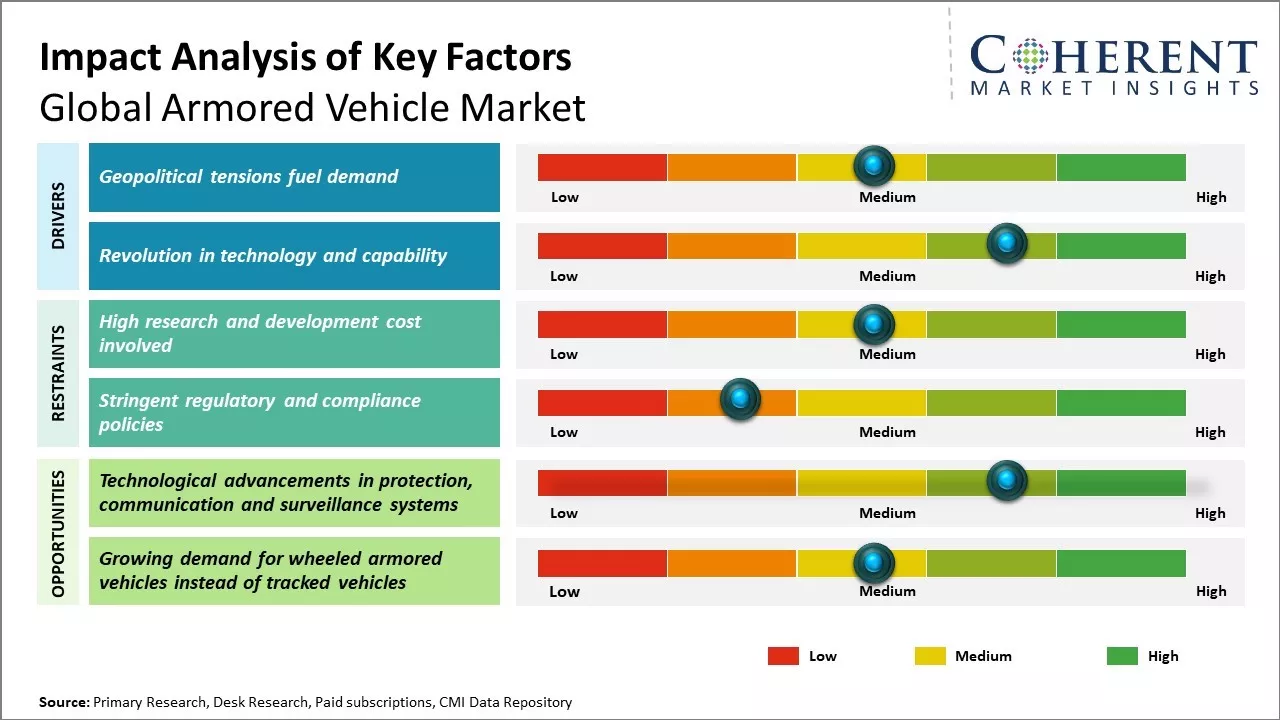
Key Takeaways
- Based on Type, Conventional Armored Vehicles segment is projected to account for 70.1% of the global market in 2026, owing to continuous technological advancements.
- Based on Mode of Operation, Manned Armored Vehicles segment is expected to capture 73.6% share of the market in 2026, due to growing understanding of cancer biology.
- Based on System, the Drive Systems segment is projected to command 36.6% share of the market in 2026, due to its vast majority of molecular analyses to identify disease-associated biomarkers.
- Based on Region, North America is set to dominate the global market with a 36. 9% share in 2026.
Market Overview
The armored vehicle market growth can be attributed to increasing defense spending across countries amid geopolitical tensions. Several government initiatives to upgrade armed forces with improved protective systems will also drive demand. The market is expected to witness significant growth due to rising threats from extremists and militants. More countries are investing in armored vehicles like tanks, armored personnel carriers, and combat support vehicles to enhance security. Adoption of advanced technologies like active protection systems, composite armors, and upgraded weaponry in vehicles is expected to provide lucrative opportunities.
Current Events and Its Impact
Current Event | Description and its Impact |
Advanced Protection Technology Integration |
|
Rising Geopolitical Tensions in Asia-Pacific Region |
|
Role of AI (Artificial Intelligence) in Armored Vehicle
Artificial Intelligence (AI) plays a transformative role in armored vehicles by enhancing situational awareness, decision-making, and operational efficiency on the battlefield. AI systems process data from sensors, cameras, and communication networks in real time to detect threats, navigate complex terrains, and identify targets with high precision. This reduces the cognitive load on soldiers and allows for faster, more informed responses. AI also supports autonomous or semi-autonomous vehicle operations, route optimization, and predictive maintenance.
In February 2025, defense and communications firm Mer Group introduced mSphere, an AI-driven situational awareness system for armored vehicles that was developed during the war.
- Current Industry Events of 2026
- Market Size Estimation
- Regional Breakdown
- Competitive Landscape
- Customer Intelligence
- Segmental Analysis
- Pricing Analysis
- Key Market Drivers, Challenges & Future Trends
- Customized Insights Section
Market Trends
Geopolitical tensions fuel demand
With ongoing conflicts and instability across several regions, countries around the world continue to significantly invest in their armed forces and protect assets at risk. The proliferation of non-state militant groups and terrorist organizations operating across borders has made national security a top priority. For many nations, upgrading and expanding their fleets of armored vehicles is crucial to effectively protect borders as well as military and peacekeeping operations deployed in conflict zones.
The terrain optimization and survivability features of modern armored vehicles make them indispensable tools for missions conducted in hazardous terrain and hostile environments. With countries actively scaling up their defense budgets to deter cross-border threats, major procurements of technologically advanced armored vehicles remain an integral part of these investments.
Revolution in technology and capability
Over the years, there has been a revolution in military land technology with cutting-edge innovations completely transforming modern armored vehicles. Advanced armor composites, active protection systems, networked C4ISR capabilities are now allowing unprecedented levels of survivability, mobility and lethality. Vehicles can now be equipped for a vast array of missions with versatile and customizable platform architectures.
Militaries seek to gain decisive edge through vehicles integrated with lastest sensors, command and control interfaces, high-energy weapons. This has prompted upgrading of existing fleets as well as new product development. Continuous modernization remains crucial as adversaries also gain capabilities.
Technology leaders continuously invest heavily in R&D to integrate newest materials, propulsion and digital systems - giving platforms multi-domain flexibility. Novel platforms promise revolutionary capabilities, attracting defense modernization budgets and development orders from early adopter nations.
Segmental Insights
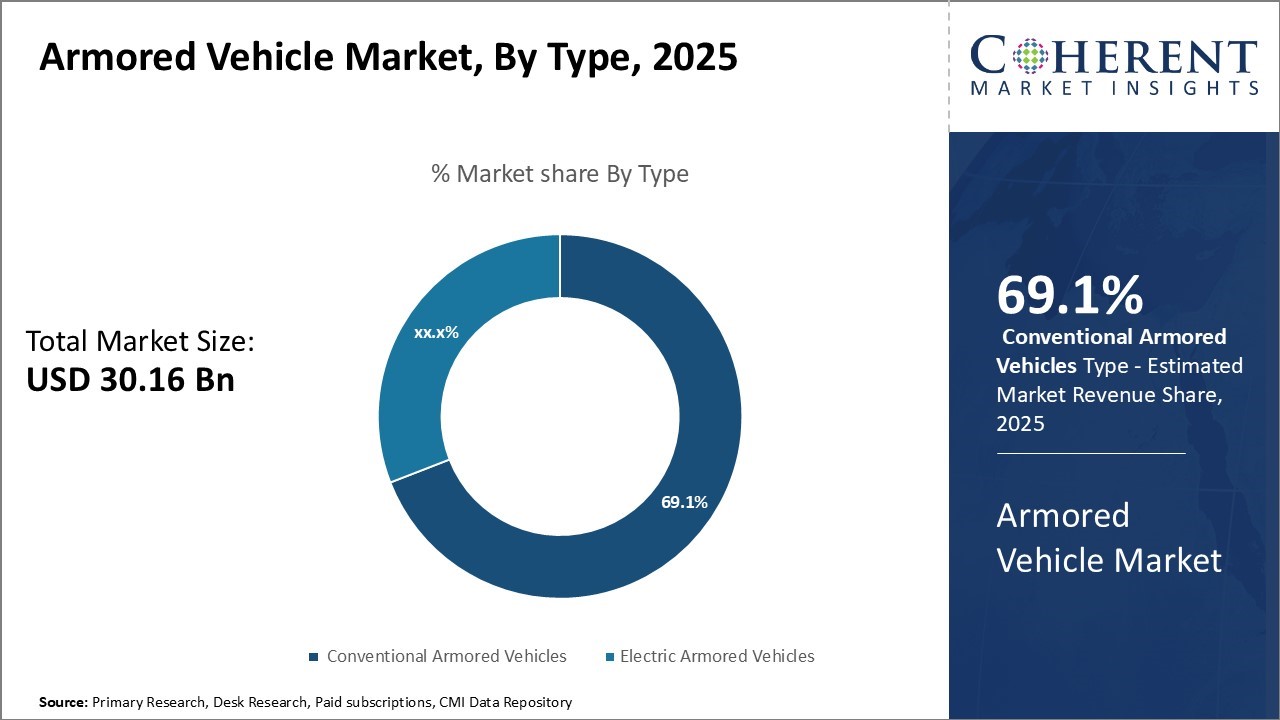
Armored Vehicles Market Insights, by Type - Growth in Technological Advancements and Rise of Insurgencies drive the Conventional Armored Vehicles Segment Growth
In terms of Type, Conventional Armored Vehicles contributes the 70.1% share in 2026 of the market owing to continuous technological advancements as well as a rise in global insurgencies and internal conflicts. Conventional armored vehicles are being upgraded with advanced armor materials, active protection systems, sophisticated surveillance, and communications equipment to deal with emerging threats.
Manufacturers are also focusing on improving mobility, payload capacity and ease of maintenance of conventional vehicles. The growing investments by military forces around the world to replace or modernize their aging vehicle fleet is bolstering demand. Further, rising cross-border tensions and instability in various regions has increased deployment of conventional vehicles for patrolling borders and internal security duties, thus supplementing their sales.
For instance, in May 2025, EM&E Group exhibited its new Ferox 6×6 armored vehicle at an international military solutions convention in Madrid.
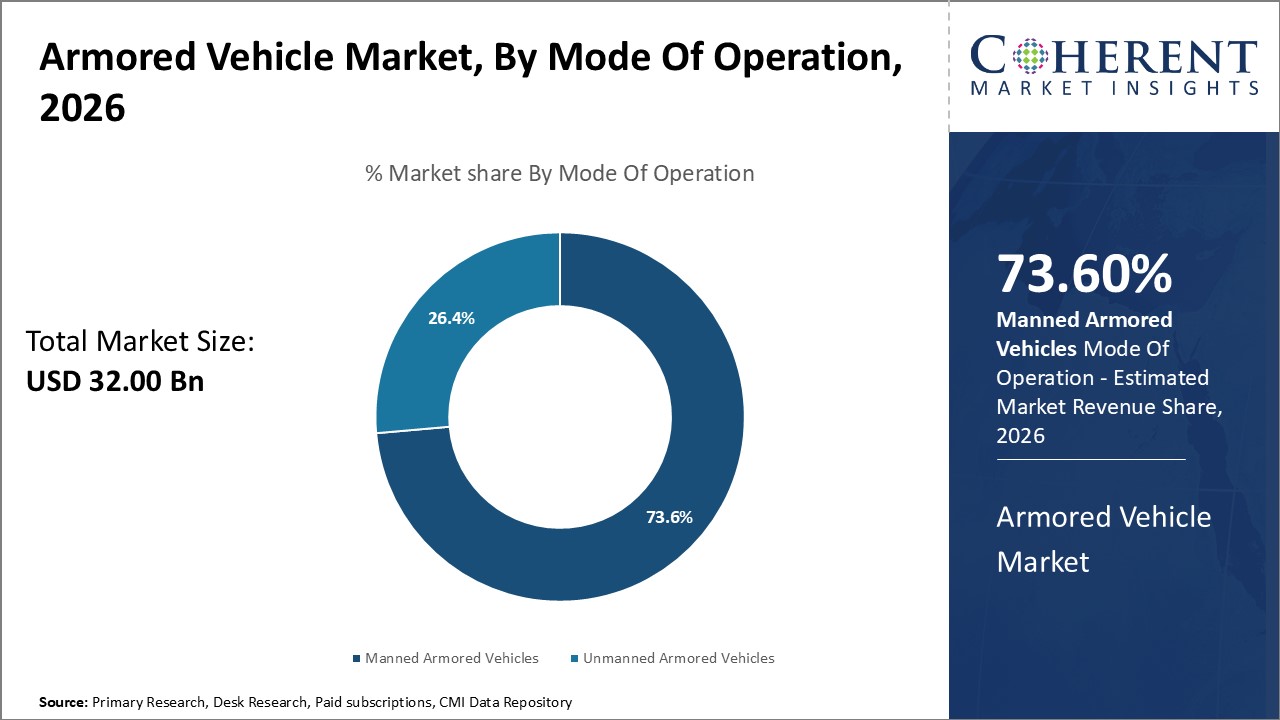
Armored Vehicles Market Insights, by Mode of Operation - Escalating Threats from Asymmetric Warfare fuel demand for Manned Armored Vehicles
In terms of Mode of Operation, Manned Armored Vehicles contributes the 73.6% share in 2026, owing to the continued relevance of manned systems in combat and surveillance missions. The threats posed by guerrilla tactics, ambushes and improvised explosive devices have grown significantly in current battlefields.
Manned vehicles with enhanced situational awareness, survivability and firepower provide commandos and soldiers an edge over non-state actors employing asymmetric warfare. Their ability to transport troops into hotzones and provide cover-fire makes them irreplaceable compared to unmanned systems.
Armored Vehicles Market Insights, by System - Emphasis on C4ISR Systems Drives Growth in Drive Systems segment
In terms of System, Drive Systems contributes the 36.6% share in 2026 as focus shifts towards mobility, networking and transport ability of armored vehicles. Modern battlefields demand swift movement of armored units alongside real-time sharing of intelligence. This has directed R&D focus onto developing more robust and durable drive systems fitted with advanced C4ISR (Command, Control, Computers, Communications, Intelligence, Surveillance and Reconnaissance) suites.
Drive systems are being made lighter, more fuel efficient and digitally integrated with a vehicles’ command and sensor network. Features such as remote turret control, 360-degree situational awareness and automatic transmission are being integrated at affordable costs.
Additionally, independent suspension, run-flat tires and routes planning software are helping drive systems navigate varied terrains at top speeds while staying networked with other assets. The need for strategic transport of troops and supplies in active conflict zones continues to drive investments into modernized drive systems.
For instance, in September 2025, Rolls-Royce expanded its mtu Series 199 for military land vehicles into a comprehensive product family with an increased power range for new vehicles and for the repowering of existing vehicles. It is optimised for armoured vehicles with a power requirement of up to 1,100 kW in order to achieve compact and weight-optimised drives.
Regional Insights
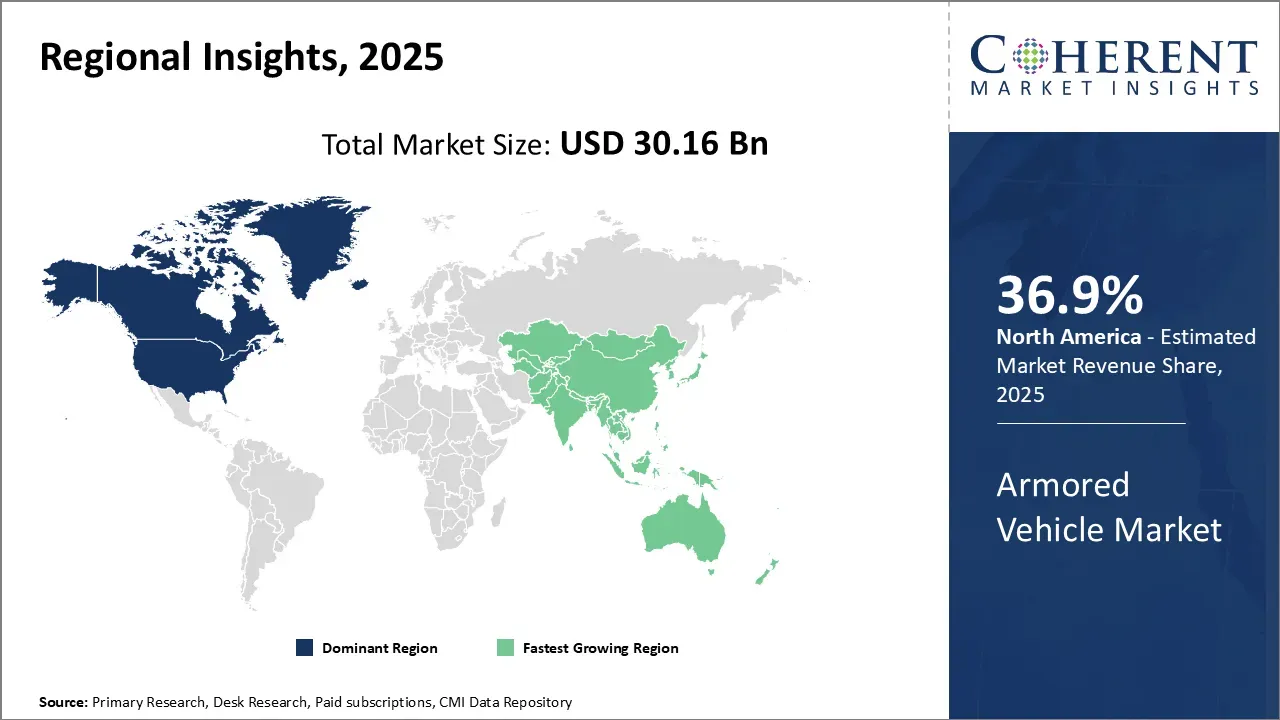
North America Armored Vehicle Market Analysis and Trends
North America has dominated the global armored vehicle market with 36.9% share in 2026 for decades owing to significant military spending and substantial demand from defense and homeland security agencies. The U.S. is the largest military spender in the world and has high demands for technologically advanced protection solutions.
Major American companies like General Dynamics, Oshkosh, and Textron have dominated the indigenous production of light, medium, and heavy armored vehicles. These firms have decades of experience and capabilities developed to cater to the exact requirements of the U.S. military and security forces.
Additionally, North American nations import certain types of vehicles to supplement their fleets. The extensive defense budgets allotted every year guarantee a steady flow of contracts and support the North American regional market's top position. In July 2026, Canadian armored vehicle maker Roshel began manufacturing operations in Ukraine.
Asia Pacific Armored Vehicle Market Analysis and Trends
The Asia Pacific region has emerged as the fastest-growing market for armored vehicles globally in recent years. Growing defense expenditures, evolving geopolitical scenarios, and increasing indigenization efforts are some key factors driving the APAC market growth.
China has become a major player in the domestic production and export of vehicles. Other nations are also boosting their Military, Police, and Peacekeeping capabilities through new procurements. The openness to imports from other established makers in the past few years has nurtured healthy competition and technology transfers in the region.
Moreover, some Asian nations have started joint ventures with European and American OEMs to manufacture armored vehicles as per their needs utilizing global expertise. The large and rapidly expanding market size along with lucrative opportunities presented by domestic requirements as well as external exports make Asia Pacific the future hotspot for global armored vehicle manufacturers.
For instance, in October 2024, China has been modernising its approach to armoured vehicles by introducing new platforms based on the VT4 MBT, including the HZT 26B armoured bridge and GSL 135E mine-clearing vehicle, designed for improved mobility and protection.
Armored Vehicle Market Outlook Country-Wise
U.S. Armored Vehicle Market Trends
The armored vehicle industry in the U.S. is expected to grow in 2024, driven by ongoing modernization programs targeting legacy platforms such as the M1 Abrams tank. The Department of Defense allocates significant funds for upgrading vehicle survivability, mobility, and firepower to meet future battlefield challenges. Expanding military operations and evolving security threats increase demand for advanced armored vehicles across various branches. Leading defense contractors invest heavily in research and development to deliver cutting-edge solutions.
For instance, in October 2024, GM Defense, announced its new “Next Gen” tactical vehicle prototype at AUSA 2024, the annual meeting and exposition of the Association of the U.S. Army
India Armored Vehicle Market Trends
India’s armored vehicle market is trending toward steady growth, driven by increasing defence budgets, emphasis on indigenous manufacturing, and heightened internal as well as border security challenges. The government’s “Make in India” / Atmanirbhar Bharat push is accelerating domestic production of main battle tanks, infantry combat vehicles, MRAPs (Mine-Resistant Ambush Protected), and support vehicles.
In January 2026, the Ministry of Defence signed a ₹1,560.52 crore contract with Heavy Vehicles Factory (HVF), a unit of Armoured Vehicle Nigam Limited, for 47 Bridge Laying Tanks (BLT-T72) for the Indian Army. These BLTs will enhance battlefield mobility by enabling quick bridge deployment during offensive and defensive operations.
Analyst Opinion (Expert Opinion)
Rising geopolitical tensions and increasing defense budgets of major economies are likely to drive demand for advanced armored vehicles for military and law enforcement applications. Additionally, growing instances of cross-border terrorism and internal insurgencies have compelled several nations to bolster their land warfare and border protection capabilities.
However, high research and development costs associated with the production of technologically advanced armored vehicles could limit market expansion to a certain extent. Moreover, fiscal austerity measures imposed by various governments may negatively impact defense outlays. On the other hand, growing maritime territorial disputes and regional conflicts in the Middle East and Asia Pacific are expected to spur opportunities for key manufacturers.
North America currently dominates the global armored vehicle landscape owing to large-scale military modernization programs being undertaken by the U.S. and Canada. Going forward, the market is anticipated to witness rising demand from the Asia Pacific region attributed to increasing defense budgets of India, China, and South Korea. Major players could also explore opportunities in the Middle East on account of ongoing conflicts and security threats faced by various nations.
Speak to the analyst
Want personalized insights?
Take the findings above to one of our principal consultants, or have the report rebuilt around the segments, geographies and competitors you actually track.
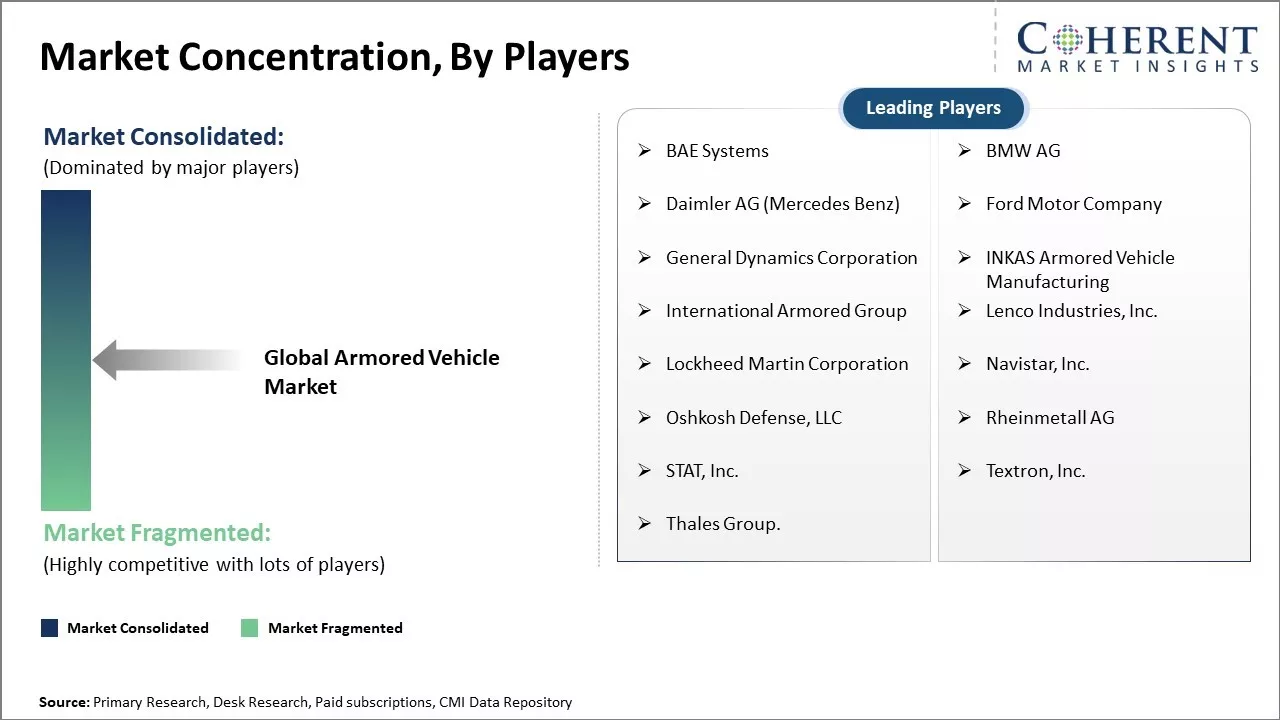
Market Concentration and Competitive Landscape
Armored Vehicle Market Industry News
- In February 2025, Tata Advanced Systems Limited (TASL) has inaugurated a new Light Armored Multirole Vehicle (LAMV) built according to NATO requirements for international military customers.
- In April 2025, Axon Vision partnered with CZECHOSLOVAK GROUPs., through its subsidiary RETIA, a.s., to modernize European armored vehicle fleets. The collaboration began with integrating Axon Vision’s EdgeSA system into the PANDUR 8×8 EVO and expanded to other platforms, such as the TADEAS 6×6.
Market Report Scope
Armored Vehicle Market Report Coverage
| Report Coverage | Details | ||
|---|---|---|---|
| Base Year: | 2025 | Market Size in 2026: | USD 32.00 Bn |
| Historical Data for: | 2020 To 2024 | Forecast Period: | 2026 To 2033 |
| Forecast Period 2026 to 2033 CAGR: | 6.2% | 2033 Value Projection: | USD 48.80 Bn |
| Geographies covered: |
| ||
| Segments covered: |
| ||
| Companies covered: | BAE Systems, BMW AG, Daimler AG (Mercedes Benz), Ford Motor Company, General Dynamics Corporation, INKAS Armored Vehicle Manufacturing, International Armored Group, Lenco Industries, Inc., Lockheed Martin Corporation, Navistar, Inc., Oshkosh Defense, LLC, Rheinmetall AG, STAT, Inc., Textron, Inc., and Thales Group | ||
| Growth Drivers: |
| ||
| Restraints & Challenges: |
| ||
Market Opportunities: Technological advancements in protection, communication and surveillance systems
Technological advancements have significantly impacted the global armored vehicle market by improving protection, communication, and surveillance capabilities. Protection systems have seen rapid developments with active protection systems (APS) and enhanced armor.
APS uses radar, laser, or projectile interceptors to detect and neutralize incoming fire within fractions of a second before impact. They provide 360-degree coverage against rockets, anti-tank missiles, and even artillery shells. Some recent APS includes the Israeli-developed Trophy system and Russian-developed Arena.
Communication and surveillance technologies have also grown tremendously. Vehicles now have high-speed satellite links with advanced encryption for seamless communication on the move. Systems like Barrett's VCS and Harris Falcon III allow real-time sharing of situational awareness with complete battlefield visibility through day and night vision cameras, thermal imaging as well as nuclear, biological and chemical detection capabilities.
Market Segmentation
- Type Insights (Revenue, US$ Bn, 2021 - 2033)
- Electric Armored Vehicles
- Conventional Armored Vehicles
- Mode Of Operation Insights (Revenue, US$ Bn, 2021 - 2033)
- Manned Armored Vehicles
- Unmanned Armored Vehicles
- System Insights (Revenue, US$ Bn, 2021 - 2033)
- Drive Systems
- Structures & Mechanisms
- Weapons & Ammunition Control Systems
- Countermeasure Systems
- Command & Control Systems
- Navigation Systems
- Observation & Display Systems
- Others
- Regional Insights (Revenue, US$ Bn, 2021 - 2033)
- North America
- U.S.
- Canada
- Latin America
- Brazil
- Argentina
- Mexico
- Rest of Latin America
- Europe
- Germany
- U.K.
- Spain
- France
- Italy
- Russia
- Rest of Europe
- Asia Pacific
- China
- India
- Japan
- Australia
- South Korea
- ASEAN
- Rest of Asia Pacific
- Middle East & Africa
- GCC Countries
- Israel
- South Africa
- Rest of Middle East & Africa
- Key Players Insights
- BAE Systems
- BMW AG
- Daimler AG (Mercedes Benz)
- Ford Motor Company
- General Dynamics Corporation
- INKAS Armored Vehicle Manufacturing
- International Armored Group
- Lenco Industries, Inc.
- Lockheed Martin Corporation
- Navistar, Inc.
- Oshkosh Defense, LLC
- Rheinmetall AG
- STAT, Inc.
- Textron, Inc.
- Thales Group.
Sources
Primary Research Interviews
- Armored vehicle manufacturers and OEMs
- Defense procurement officials and military personnel
- Security service providers and fleet operators
- Raw material suppliers and component manufacturers
- Others
Databases
- Stockholm International Peace Research Institute (SIPRI) Military Expenditure Database
- Jane's Defence Budget Database
- Global Defence Trade Database
- IHS Markit Defense & Security Intelligence
- Others
Magazines
- Defense News
- Armada International
- Military Technology
- Jane's Defence Weekly
- Others
Journals
- International Journal of Automotive Technology
- Defence Science Journal
- Journal of Defense Analytics and Logistics
- Others
Newspapers
- Defense Daily
- Army Times
- Military & Aerospace Electronics
- Breaking Defense
- Others
Associations
- Association of the United States Army (AUSA)
- International Armoured Vehicles Conference
- National Defense Industrial Association (NDIA)
- European Defence Agency (EDA)
- Others
Public Domain Sources
- U.S. Department of Defense procurement reports
- NATO standardization agreements and publications
- Government defense budgets and military modernization programs
- International trade statistics and customs data
- Others
Proprietary Elements
- CMI Data Analytics Tool
- Proprietary CMI Existing Repository of information for last 8 years
Get access to 250+ pages report
Every segment, forecast, competitor profile and data table behind the analysis above — available for instant download.
- ESOMAR Member
- ISO 9001:2015 Certified
- D-U-N-S Registered
- GDPR & CCPA Compliant
Missing comfort of reading report in your local language? Find your preferred language:
Transform your Strategy with Exclusive Trending Reports
Frequently Asked Questions
The Armored Vehicle Market is estimated to be valued at USD 32.00 Bn in 2026, and is expected to reach USD 48.80 Bn by 2033.
The CAGR of the Armored Vehicle Market is projected to be 6.2% from 2026 to 2033.
Geopolitical tensions fuel demand and revolution in technology and capability are the major factors driving the growth of the global armored vehicle market.
High research and development cost involved and stringent regulatory and compliance policies are the major factors hampering the growth of the global armored vehicle market.
In terms of Type, Conventional Armored Vehicles is estimated to dominate the market revenue share in 2026.
BAE Systems, BMW AG, Daimler AG (Mercedes Benz), Ford Motor Company, General Dynamics Corporation, INKAS Armored Vehicle Manufacturing, International Armored Group, Lenco Industries, Inc., Lockheed Martin Corporation, Navistar, Inc., Oshkosh Defense, LLC, Rheinmetall AG, STAT, Inc., Textron, Inc., and Thales Group. are the major players.
North America is expected to lead the global armored vehicle market.