

Shipbroking Market Size and Forecast — 2026 - 2033
Shipbroking Market Size and Forecast – 2025 – 2032
The Global Shipbroking Market size is estimated to be valued at USD 9.1 billion in 2025 and is expected to reach USD 14.3 billion by 2032, exhibiting a compound annual growth rate (CAGR) of 6.2% from 2025 to 2032.
Overview
Shipbroking products consist of professional brokerage services that facilitate the buying, selling, and chartering of commercial vessels. Shipbrokers act as intermediaries between ship owners, charterers, and cargo interests, providing market intelligence, contract negotiation, and transaction support. Services include chartering agreements, sale and purchase brokerage, and freight rate advisory. Shipbroking products rely heavily on maritime expertise, global networks, and real-time shipping data to support efficient vessel deployment and trade operations.
Key Takeaways
Dry Bulk Chartering remains the dominant market segment, generating 45% of the market share in 2025, driven by sustained commodity trade flows, particularly iron ore and coal.
Meanwhile, Gas Carriers, as the fastest-growing subsegment, reflect rising LNG demand and new-energy shipping requirements.
Asia Pacific holds the largest industry share, accounting for approximately 38% of the shipbroking market revenue in 2025, flourishing through infrastructural investments and a high volume of imports/exports.
Meanwhile, Latin America emerges as the fastest-growing region with a CAGR exceeding 7%, benefiting from expanding commodity exports and governmental trade facilitation policies.
Shipbroking Market Segmentation Analysis
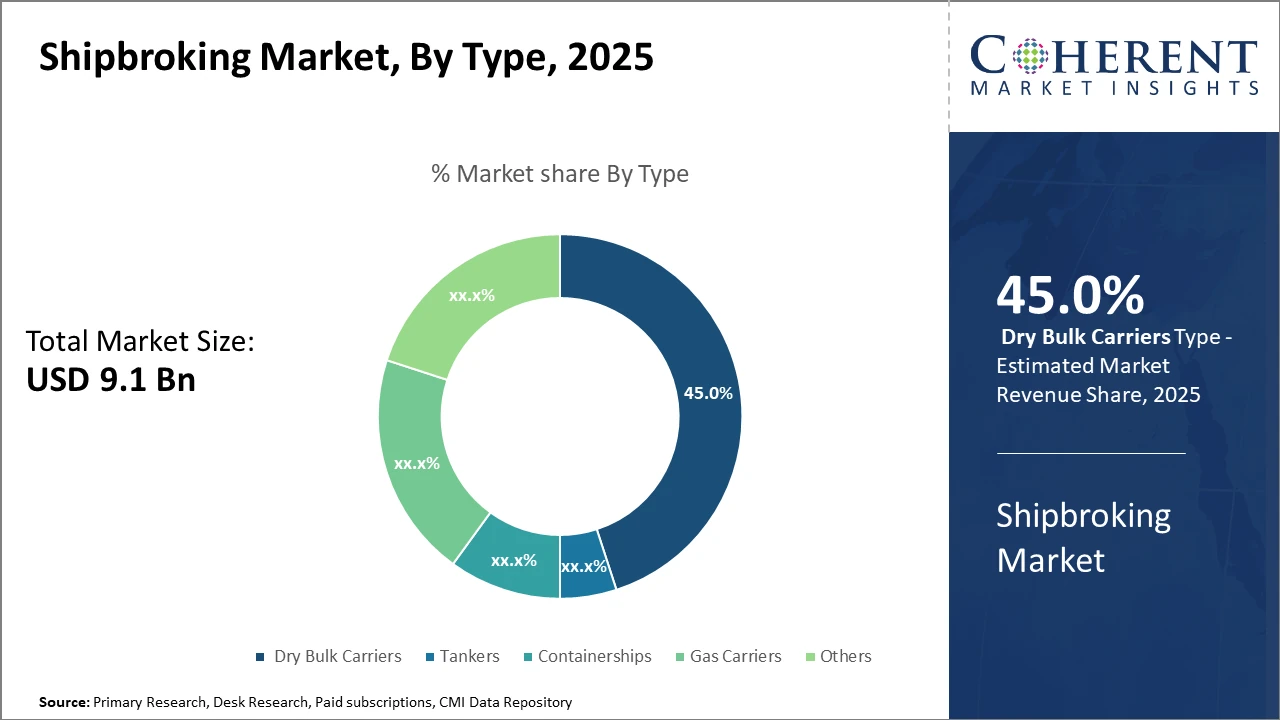
Shipbroking Market Insights, By Type
Dry Bulk Carriers dominate the market share with 45%, driven predominantly by high-volume trade in commodities such as coal, iron ore, and grain. This segment’s dominance reflects sustained industrial demand and trade route stability. The fastest-growing subsegment is Gas Carriers, particularly LNG ships, as the global energy transition accelerates LNG imports and cleaner fuel mandates. Tankers hold steady, important for oil transport, adapting to evolving regulations.
Shipbroking Market Insights, By Service Type
Voyage Chartering dominates due to flexibility and cost-effectiveness for shippers managing irregular cargo movements, holding the largest market share. Time Chartering is the fastest growing, fueled by long-term contracts and fleet utilization optimization, especially as shipping lines seek stability amidst freight rate volatility. Sale and Purchase services sustain broker revenue streams driven by vessel trading cycles. Demurrage negotiation remains critical to dispute resolution, while Others cover freight derivatives and insurance brokerage, complementing the core services.
Shipbroking Market Insights, By End-User Industry
Commodities Trading leads market share, reflecting the vital role bulk carriers play in moving raw materials globally. Oil & Gas is a fast-growing segment, driven by renewed exploration and rising LNG trade altering tanker and gas carrier demands significantly. Manufacturing relies on containerships for inbound and outbound logistics, supporting steady growth. Agriculture’s demand, with bulk shipments of grain and fertilizers, maintains consistent chartering needs. The Others category serves specialized industries including chemicals and project cargo, further diversifying market dynamics.
Shipbroking Market Trends
The shipbroking market trends emphasize accelerated digitalization to enhance operational transparency and efficiency.
Blockchain-enabled contracts have reduced transactional disputes and processing times, as observed in Europe’s adoption in recent years.
Additionally, increasing environmental compliance requirements have pivoted chartering demands toward LNG and low-emission vessels, integrating sustainability with market growth strategies.
Another notable trend is expanding trade routes in Asia Pacific and Latin America due to evolving geopolitical dynamics and infrastructure development, fostering new brokerage opportunities.
Shipbroking Market Insights, By Geography
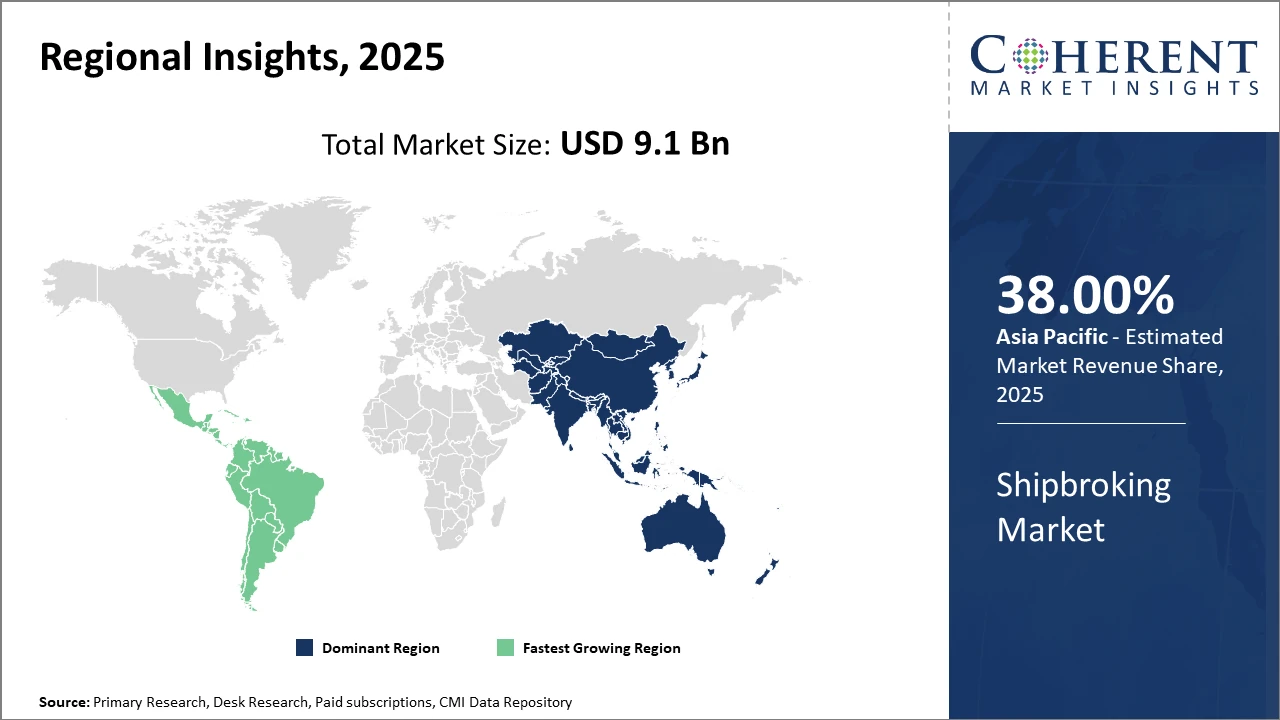
Asia Pacific Shipbroking Market Analysis and Trends
In Asia Pacific, the dominance in the market is defined by heavy commodity imports and exports, advanced port infrastructure, and rising industrialization. The region accounts for approximately 38% market share in 2025, supported by key players like Clarkson PLC and Howe Robinson Partners capitalizing on export demand from China, India, and Southeast Asia.
Latin America Shipbroking Market Analysis and Trends
Meanwhile, Latin America exhibits the fastest growth, registering a CAGR over 7%, driven by escalating exports of minerals and agricultural products. Supportive government policies in Brazil and Argentina facilitate smoother trade operations, attracting brokerage activities. Companies like Braemar ACM have notably expanded presence here, benefiting from the trade volume surge.
Shipbroking Market Outlook for Key Countries
USA Shipbroking Market Analysis and Trends
The USA shipbroking market benefits from its status as a key importer/exporter of energy commodities and manufactured goods. With extensive Gulf Coast ports and LNG export terminals, the U.S. market leverages advanced digital chartering platforms for efficient transaction execution, which contributed to an increase exceeding 5% in brokerage revenues in 2024. Major players such as McQuilling Partners command significant portions of the market by offering tailored services catering to energy and agricultural shipments.
China Shipbroking Market Analysis and Trends
China’s market expansion is fueled by its position as the world’s largest commodity importer, driving robust demand for dry bulk chartering services. Government initiatives focused on maritime logistics enhancement and Belt and Road infrastructural investments have bolstered port capabilities, supporting increased shipbroking transactions. Leading market companies have amplified local partnerships in 2024 to capitalize on China’s growing freight volumes and digital integration, underpinning its market share surge.
Analyst Opinion
Supply-side dynamics have had a crucial impact on market share expansion. Increased vessel delivery rates in 2024, particularly in the dry bulk sector, raised shipbrokers’ transactional volumes, pushing market revenue growth by nearly 4.5% in that year alone. For instance, the surge of Capesize vessels added significant brokerage activity in Asia Pacific and North America.
Demand segmentation reveals that tanker chartering contracted marginally in Q1 2025 due to fluctuating crude oil demands yet rebounded robustly by Q3, buoyed by geopolitical-driven shifts in petroleum flow patterns. These cyclic demand changes underpin the volatility brokers must navigate, influencing pricing strategies directly impacting business growth.
Micro-indicators such as the rise of digital platforms aiding transparent and real-time bidding have expedited contract closures, reducing negotiation timelines by up to 18% during 2024. Enhanced transparency has benefitted market players by broadening the customer base across emerging economies, improving market penetration.
Nano-level operational efficiencies noted in key hubs, such as Singapore, which increased brokerage transaction throughput by 22% in 2024 due to streamlined port operations and digital document handling. This operational agility supports sustained market growth and diversifies regional revenue streams.
- Current Industry Events of 2026
- Market Size Estimation
- Regional Breakdown
- Competitive Landscape
- Customer Intelligence
- Segmental Analysis
- Pricing Analysis
- Key Market Drivers, Challenges & Future Trends
- Customized Insights Section
Market Scope
| Report Coverage | Details | ||
|---|---|---|---|
| Base Year: | 2025 | Market Size in 2025: | USD 9.1 billion |
| Historical Data for: | 2020 To 2024 | Forecast Period: | 2025 To 2032 |
| Forecast Period 2025 to 2032 CAGR: | 6.2% | 2032 Value Projection: | USD 14.3 billion |
| Geographies covered: |
| ||
| Segments covered: |
| ||
| Companies covered: | Gibson Shipbrokers Ltd., Howe Robinson Partners (HR Shipping), Simpson Spence Young (SSY), Galbraith’s Ltd., McQuilling Partners, Affinity Shipping, RS Platou Markets, Charles R. Weber Company, E.A. Gibson Shipbrokers. | ||
| Growth Drivers: |
| ||
Shipbroking Market Growth Factors
The rise in global seaborne trade remains the dominant driver, with the UNCTAD reporting a 3% increase in global maritime freight volumes during 2024. This growth propels demand for shipbroking services across all vessel categories. Regulatory shifts, such as IMO 2023 sulfur cap enforcement, have elevated chartering complexities, driving brokers' value-added service demands. Additionally, technological integration—digital platforms enabling on-demand chartering and real-time market data—reduces broker latency and expands client reach. Apart from this, geographic diversification, notably increased shipbroking transactions in Latin America and the Middle East, fuels market expansion amid evolving trade routes and energy flows.
Shipbroking Market Development
In March 2025, Kpler launched a next-generation chartering solution, introducing an AI-powered interface that leverages real-time market data to streamline end-to-end shipping workflows. The platform enhances decision-making, improves fixture efficiency, and reduces manual complexity for charterers and shipbrokers, supporting faster, data-driven chartering operations in a volatile global shipping market.
In July 2024, the Singapore Maritime and Port Authority (MPA) launched a digital shipbroking platform, aimed at improving transparency, efficiency, and trust across Singapore’s shipbroking ecosystem. The initiative digitizes core broking processes, standardizes data exchange, and strengthens Singapore’s position as a leading global maritime and shipbroking hub.
Key Players
Leading Companies of the Market
Gibson Shipbrokers Ltd.
Howe Robinson Partners (HR Shipping)
Simpson Spence Young (SSY)
Galbraith’s Ltd.
McQuilling Partners
Affinity Shipping
RS Platou Markets
Charles R. Weber Company
E.A. Gibson Shipbrokers
Leading shipbroking companies have increasingly leaned into digital transformation strategies, deploying AI-enabled market intelligence platforms enabling predictive chartering and optimized route planning; for example, Clarkson PLC reported increased efficiency and client retention by integrating such technologies in 2024. Others, like Braemar ACM, pursued strategic geographic expansion, opening offices in emerging maritime hubs across Southeast Asia, significantly boosting their market revenue and foothold in 2024–2025.
Shipbroking Market Future Outlook
The future outlook for the market will be influenced by continued globalization, digital transformation, and sustainability regulations in the maritime industry. Digital broking platforms, advanced analytics, and blockchain-enabled contracts will streamline transaction execution and transparency. Brokers will increasingly act as strategic advisors, helping clients navigate decarbonization policies, vessel performance optimization, and alternative fuel transitions. Growth in emerging markets and maritime infrastructure investment will create new trade corridors and demand for chartering services. Despite automation, the market will still rely on expert judgment and human relationships, especially in complex negotiations and bespoke charter structures. Continued integration with logistics, insurance, and supply-chain data will further evolve shipbroking beyond traditional dispatching.
Shipbroking Market Historical Analysis
The shipbroking market is rooted in centuries of maritime trade, evolving from informal intermediaries who connected shipowners with cargo interests in early port cities to organized professional services during the age of sail. With the advent of steamships and global trade expansion in the 19th and early 20th centuries, shipbrokers became key facilitators of chartering contracts, vessel sales and purchases, and freight rate negotiations. Post-World War II industrialization and containerization dramatically increased shipping volumes and complexity, driving the professionalization of shipbroking with specialized expertise in different vessel types and trade routes. Technological innovation in communications and data analytics later transformed information flow, enabling brokers to access real-time freight rates and logistics data. Over time, shipbroking expanded to include financial advisory, risk management, and digital platforms linking market participants.
Sources
Primary Research Interviews:
Shipbrokers
Chartering Managers
Fleet Operators
Maritime Consultants
Shipping Analysts
Databases:
UN Trade Statistics
OECD Transport Data
Magazines:
Lloyd’s List, TradeWinds
Maritime Executive
Shipping Today
Port Strategy
Journals:
Maritime Economics & Logistics
Journal of Shipping and Trade
Transport Policy Journal
Ocean Economics Journal
Maritime Studies
Newspapers:
Financial Times (Shipping)
Reuters Maritime
Lloyd’s List Daily
Bloomberg Transport
The Economic Times
Associations:
Baltic Exchange
Institute of Chartered Shipbrokers
International Chamber of Shipping
BIMCO
International Maritime Organization
Get access to 250+ pages report
Every segment, forecast, competitor profile and data table behind the analysis above — available for instant download.
- ESOMAR Member
- ISO 9001:2015 Certified
- D-U-N-S Registered
- GDPR & CCPA Compliant
Missing comfort of reading report in your local language? Find your preferred language:
Transform your Strategy with Exclusive Trending Reports
Frequently Asked Questions
The leading players include Clarkson PLC, Braemar ACM, Golden Ocean Group, and several specialized shipbrokers such as Ardmore Shipping Corporation and Howe Robinson Partners, collectively commanding a significant market share through their diversified service offerings and global reach.
The market is projected to grow from USD 9.1 billion in 2025 to USD 14.3 billion by 2032, reflecting a CAGR of 6.2%, driven primarily by expanding seaborne trade and technology adoption.
Dry Bulk chartering dominates currently; however, the Gas Carrier segment tied to LNG shipments offers the fastest growth opportunities influenced by global energy transition and shipping industry decarbonization.
Digitization, environmental regulation compliance, and geographic diversification of trade will shape market dynamics, fostering innovative chartering services and expanding emerging regional markets, especially in Asia Pacific and Latin America.
The market is characterized by intensified competition, with firms leveraging technology for efficiency and transparency. Challenges include navigating regulatory changes and volatile freight rates that affect market revenue predictability.
Strategies include digital transformation to enhance customer experience, expansion into emerging regional markets such as Southeast Asia and Latin America, and service diversification to include integrated logistics solutions.