

Global Freight Market Size and Forecast – 2026-2033
The Global Freight Market is estimated to be valued at USD 234.51 Bn in 2026 and is expected to reach USD 336.64 Bn by 2033, exhibiting a compound annual growth rate (CAGR) of 5.3% from 2026 to 2033.
Key Takeaways of the Global Freight Market
- The land freight forwarding segment is projected to lead the market, holding a share of 44.5 % in 2026.
- The transportation and warehousing segment is expected to dominate with a share of 57.2 % in 2026.
- The retail and e-commerce segment leads the market holding an estimated share of 20.6 % in 2026.
- Asia Pacific, holding a projected share of 44.7 % in 2026, will dominate the market.
- Europe, holding an estimated share of 24.4 % in 2026, shows the fastest growth in the market.
Market Overview
The freight market is seeing a big transformation due to the integration of digital technologies such as IoT, AI, and Blockchain, enhancing supply chain visibility and operational efficiency. Also, sustainability initiatives are pushing greener freight solutions, with companies adopting electric and alternative fuel vehicles to reduce carbon footprints. E-commerce expansion continues is a big growth driver, demanding faster and more flexible freight services, while geopolitical dynamics and infrastructure developments also shape regional market trends.
Current Events and Its Impact
Current Events | Description and its Impact |
Geopolitical and Trade Developments |
|
Economic and Industrial Trends |
|
Segmental Insights
- Current Industry Events of 2026
- Market Size Estimation
- Regional Breakdown
- Competitive Landscape
- Customer Intelligence
- Segmental Analysis
- Pricing Analysis
- Key Market Drivers, Challenges & Future Trends
- Customized Insights Section
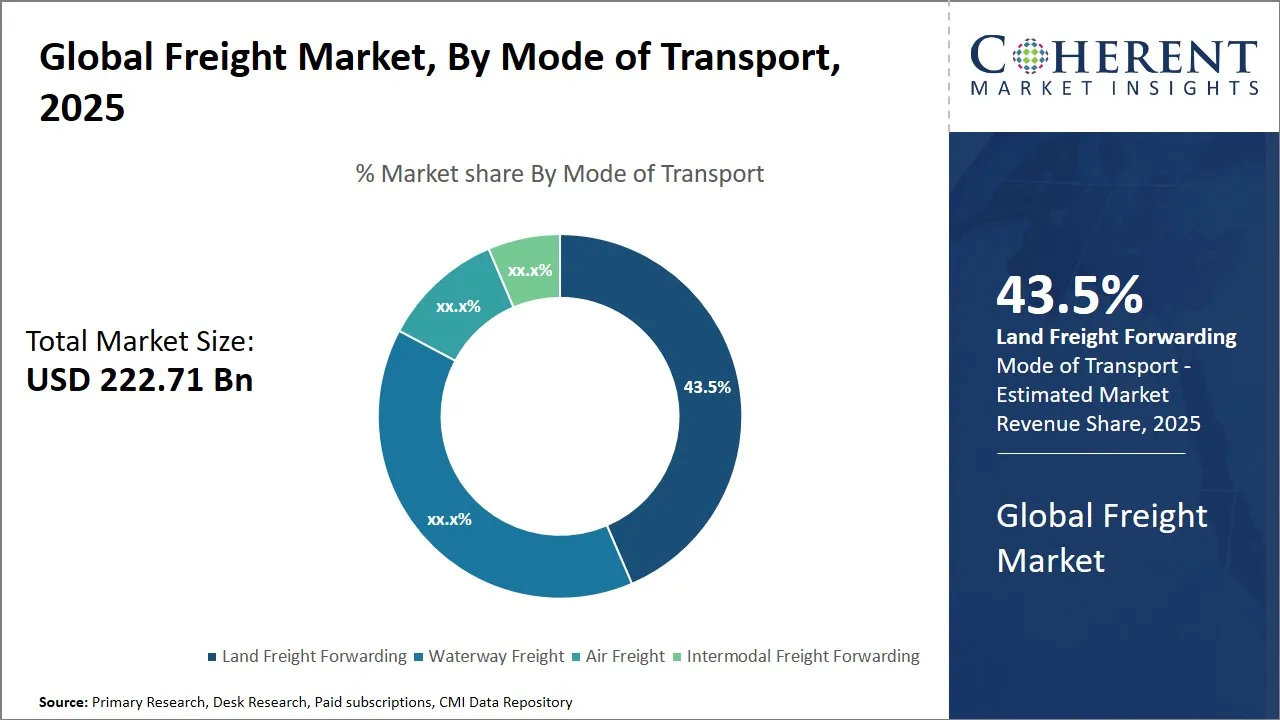
Global Freight Market Insights, By Mode of Transport – Land Freight Forwarding’s Dominance is Because of its Infrastructure and Flexibility
The land freight forwarding segment is expected to hold the largest share at 44.5% in 2026, driven by flexible infrastructure and connectivity. Land freight supports full and less-than-truckload shipments, allowing timely door-to-door delivery over short and medium distances. Digital tools like GPS tracking and route optimization add to efficiency and sustainability. DHL’s smart trucking program in Germany uses real-time telematics to optimize routes, reducing fuel consumption by 15% and making possible faster delivery.
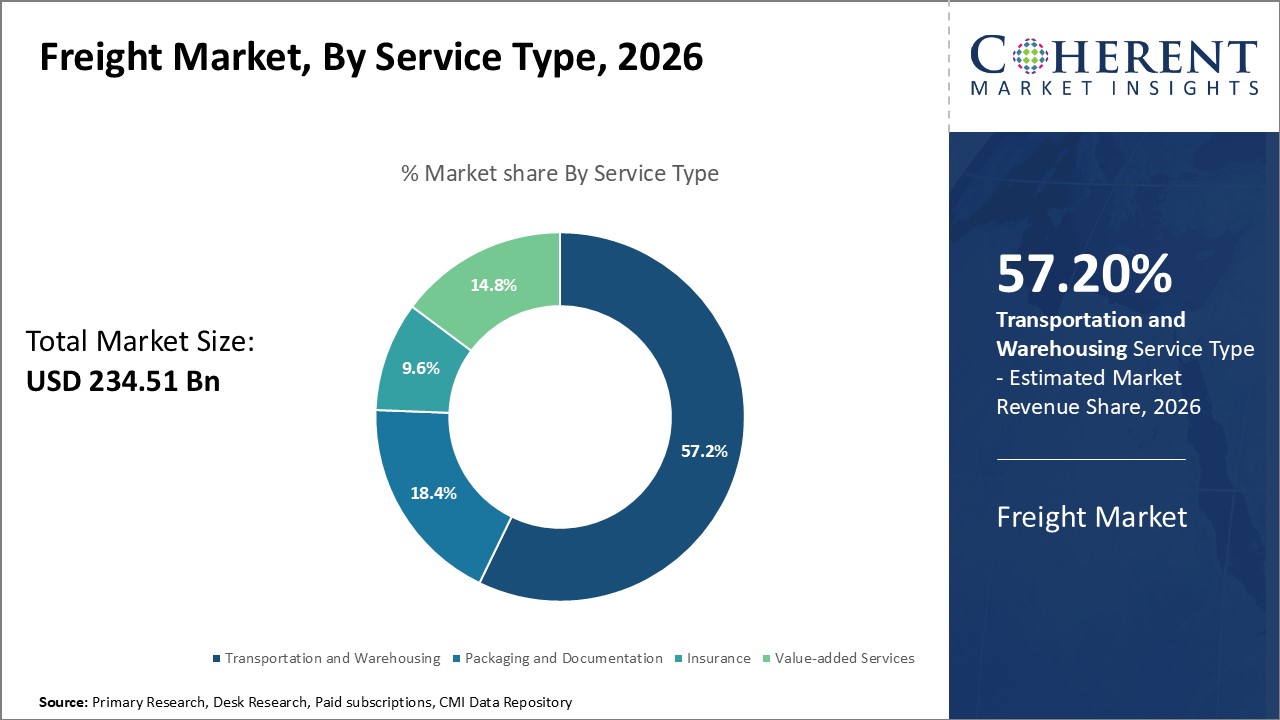
Global Freight Market Insights, By Service Type – Transportation and Warehousing Lead Because of their End-to-End Supply Chain Integration
The transportation and warehousing segment is expected to dominate with 57.2% of the market share in 2026, being the backbone of integrated supply chains. Warehouses now include automation, cross-docking, and advanced inventory management, and multimodal transport makes possible seamless delivery. Maersk’s integrated warehousing in Rotterdam mixes ocean transport, road freight, and automated storage systems to make order fulfillment faster for European e-commerce clients.
Global Freight Market Insights, By End-use Industry – Retail and E-Commerce Pushes Freight Market Growth Because of Rising Consumer Demand and Technological Adoption
The retail and e-commerce segment is projected to account for 20.6% of the market share in 2026 because of rising online shopping and direct-to-consumer demand. Freight solutions must handle frequent, small shipments with speed, traceability, and flexibility. Sustainability is very important, prompting eco-friendly packaging and alternative fuel use. Amazon’s last-mile delivery network in the U.S. uses electric delivery vans and regional fulfillment centers to meet same-day delivery expectations while cutting emissions.
Pricing Analysis of the Freight Market
Mode of Transport | Estimated Rate (USD/Mile) |
Land Freight (Road) | 2.20 – 2.50 |
Rail Freight | 1.50 – 2.00 |
Air Freight (Standard) | 3.00 – 6.00 |
Air Freight (Express) | 5.00 – 8.00 |
Ocean Freight (LCL) | 0.50 – 1.00 |
Ocean Freight (FCL) | 1,500 – 3,000 |
Container Shipping (Global Avg.) | 1,687 |
LNG Shipping (Atlantic) | 3,500 – 4,250 |
LNG Shipping (Pacific) | 11,000 |
Regional Insights
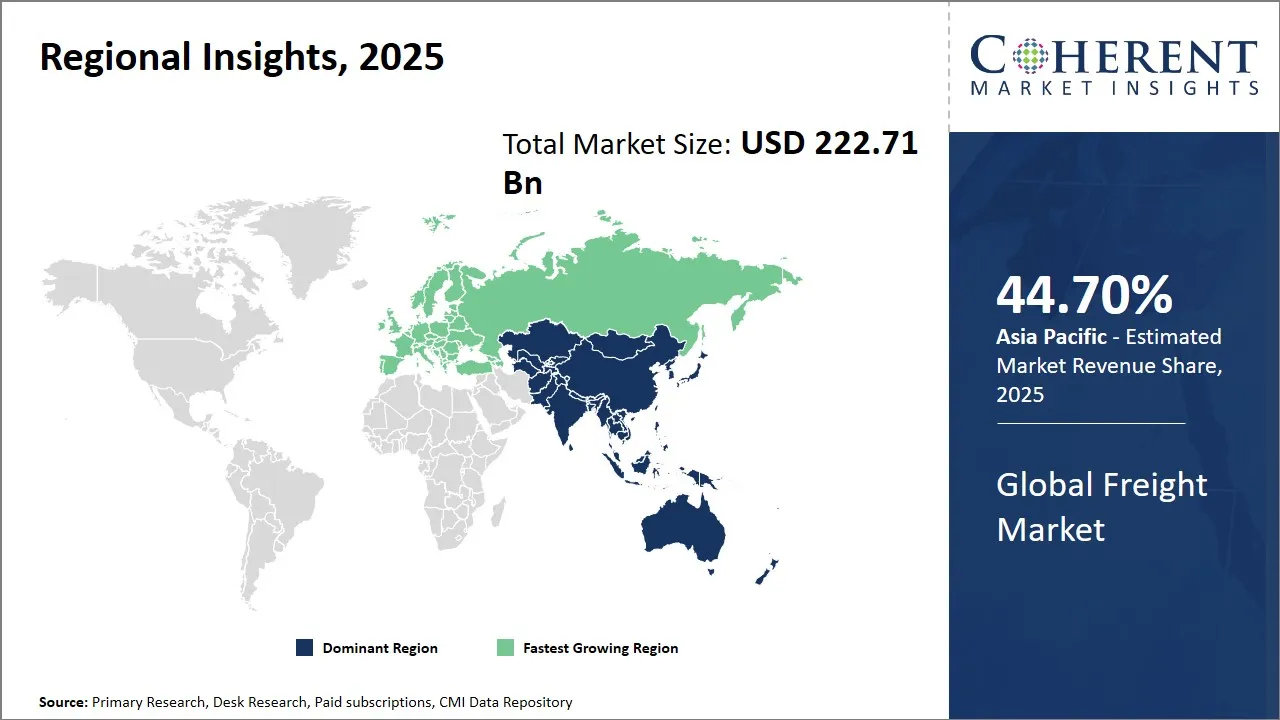
Asia Pacific Freight Market Analysis and Trends
The Asia Pacific region, holding a share of 44.7% in 2026, is expected to dominate the global freight market because of fast industrialization, urbanization, and expanding trade volumes within and beyond the region. Growing e-commerce penetration and rising demand from manufacturing hubs in countries like China, India, and Southeast Asia have accelerated freight logistics development.
Government initiatives pushing infrastructure improvements, like China’s Belt and Road Initiative and India’s Development of Inland Waterways, are adding to connectivity and reducing transit times. The region is also seeing a lot of investments in digital freight solutions and multimodal transport systems. Big companies like DHL, SF Express, and COSCO Shipping play significant roles by expanding service portfolios and integrating advanced logistics technologies tailored to this dynamic market.
Europe Freight Market Analysis and Trends
Europe, holding a share of 24.4% in 2026, is projected to show the fastest growth in the global freight market, because of fast cross-border trade, advanced infrastructure, and high demand for efficient multimodal transport solutions. The region sees a big network of highways, rail corridors, and inland waterways that facilitate seamless movement of goods across countries such as Germany, France, and the Netherlands.
E-commerce growth and the rise of just-in-time manufacturing have also made demand for integrated freight services, including warehousing, last-mile delivery, and temperature-controlled logistics. Regulatory frameworks like the European Green Deal and stricter emissions standards are pushing adoption of sustainable freight practices like electrified trucks and alternative-fuel vessels.
Big logistics and freight companies operating in Europe like DHL, DB Schenker, Kuehne+Nagel, and Maersk are investing in digital freight platforms, automation, and multimodal capabilities to optimize transit efficiency and meet customer expectations in this technologically advanced market.
Global Freight Market Outlook for Key Countries
U.S. Freight Market Analysis and Trends
The U.S. freight market leads because of its sophisticated logistics infrastructure and extensive intermodal freight corridors. Big freight carriers like FedEx and UPS dominate express delivery and third-party logistics services, investing a lot in automation and green freight solutions. Government initiatives for upgrading transport networks and sustainable logistics add to the market’s efficiency and capacity. The big consumer base and different industrial sectors continuously generate high freight volumes both domestically and for international trade.
China Freight Market Analysis and Trends
China continues to lead in freight volumes because of its role as the world’s manufacturing hub and an export giant. Big infrastructure investments, like high-speed rail freight lines and port expansions, support efficient cargo movement. State-owned enterprises like COSCO Shipping and China Railway Express lead the freight market, seeing policy support under the Belt and Road Initiative. E-commerce growth also adds to last-mile delivery innovations, and government reforms in customs and trade facilitation improve cross-border freight efficiency.
Germany Freight Market Analysis and Trends
Germany freight market sees growth because of its central location in Europe, providing seamless access to neighboring countries and acting as a logistics gateway to the continent. Its advanced manufacturing industry and big automotive sector make a lot of freight demand.
Deutsche Post DHL Group, a global logistics leader headquartered in Germany, plays a big role by offering integrated freight management services and investing in digitization and sustainable logistics solutions. The country’s well-maintained road, rail, and inland waterway networks support multimodal freight transport, supported by government policies that emphasize environmentally friendly cargo transport.
India Freight Market Analysis and Trends
India freight market shows the country’s fast economic expansion and improving transport infrastructure. Government policies like the Dedicated Freight Corridor and the National Logistics Policy reduce bottlenecks and improve freight efficiency. The growth of e-commerce and increased industrial output add to growth in both road and rail freight sectors.
Big players like Blue Dart Express and Mahindra Logistics actively expand their networks, using technology to streamline operations. Continuous investments in port modernization and warehousing facilities improve market competitiveness.
Brazil Freight Market Analysis and Trends
Brazil freight market sees a vast geography and resource-rich economy, with significant freight volumes linked to agricultural exports and mining. Although infrastructural challenges persist, initiatives to upgrade highways and railroads are underway to improve freight connectivity.
Major companies like JSL S.A. and Rumo Logística contribute to market development through integrated road and rail freight services. The government's focus on public-private partnerships is addressing logistical inefficiencies, making Brazil an important player in the Latin America freight market.
Market Players, Key Developments, and Competitive Landscape
Key Developments
- On October 16, 2025, the CMA CGM Group signed a letter of intent for six LNG-powered 1,700 TEU containerships to be built at Cochin Shipyard Limited (CSL), India, making it the first major foreign carrier to commission LNG-fueled vessels from an Indian shipyard.
- In May 2025, Kuehne+Nagel launched its carrier engagement sustainability programme. As part of the programme, Kuehne+Nagel, signed individual Memoranda of Understanding (MoU) agreements with fourteen global airline carriers to advance sustainability initiatives and innovations around the world.
- In April 2025, CEVA Logistics, a subsidiary of the CMA CGM Group, signed a binding agreement to acquire 100 percent of Borusan Tedarik Zinciri Çözümleri ve Teknoloji Anonim Şirketi. Borusan Tedarik offers comprehensive logistics solutions in Turkey, including contract logistics, finished vehicle logistics (FVL), full truckload (FTL) and less than truckload (LTL) ground transport, as well as air and ocean freight and customs.
- In January 2023, Maersk acquired Martin Bencher Group, a Danish Project Logistics expert with premium capabilities within non-containerized project logistics and global operations.
Top Strategies Followed by Freight Market Players
- Established players dominate the landscape by using their huge resources to invest a lot in R&D.
- Maersk has invested significantly in digital platforms and autonomous vessel technologies to improve efficiency and reduce emissions.
- Mid-level players in the global freight market use a strategy based on cost-effective offerings, balancing product quality with affordability.
- Logistics focuses on providing affordable less-than-truckload (LTL) and regional freight solutions for price-sensitive SMEs in North America and Europe.
- Small-scale players in the global freight market focus on niche segments and specialty products.
- Flexport targets specialized freight forwarding for e-commerce and tech companies, offering solutions like end-to-end supply chain visibility and expedited shipping.
Market Report Scope
Freight Market Report Coverage
| Report Coverage | Details | ||
|---|---|---|---|
| Base Year: | 2025 | Market Size in 2026: | USD 234.51 Bn |
| Historical Data for: | 2020 To 2024 | Forecast Period: | 2026 To 2033 |
| Forecast Period 2026 to 2033 CAGR: | 5.3% | 2033 Value Projection: | USD 336.64 Bn |
| Geographies covered: |
| ||
| Segments covered: |
| ||
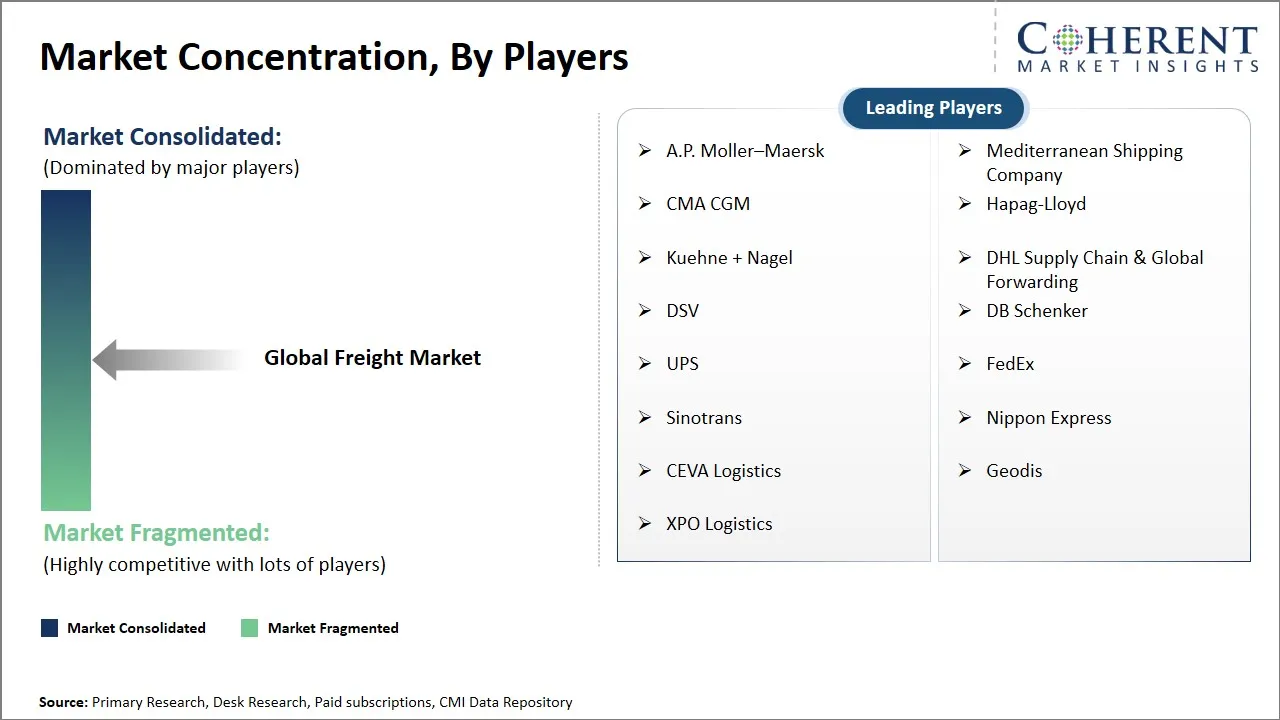
| Companies covered: | A.P. Moller–Maersk, Mediterranean Shipping Company, CMA CGM, Hapag-Lloyd, Kuehne + Nagel, DHL Supply Chain & Global Forwarding, DSV, DB Schenker, UPS, FedEx, Sinotrans, Nippon Express, CEVA Logistics, Geodis, and XPO Logistics | ||
| Growth Drivers: |
| ||
| Restraints & Challenges: |
| ||
Market Dynamics
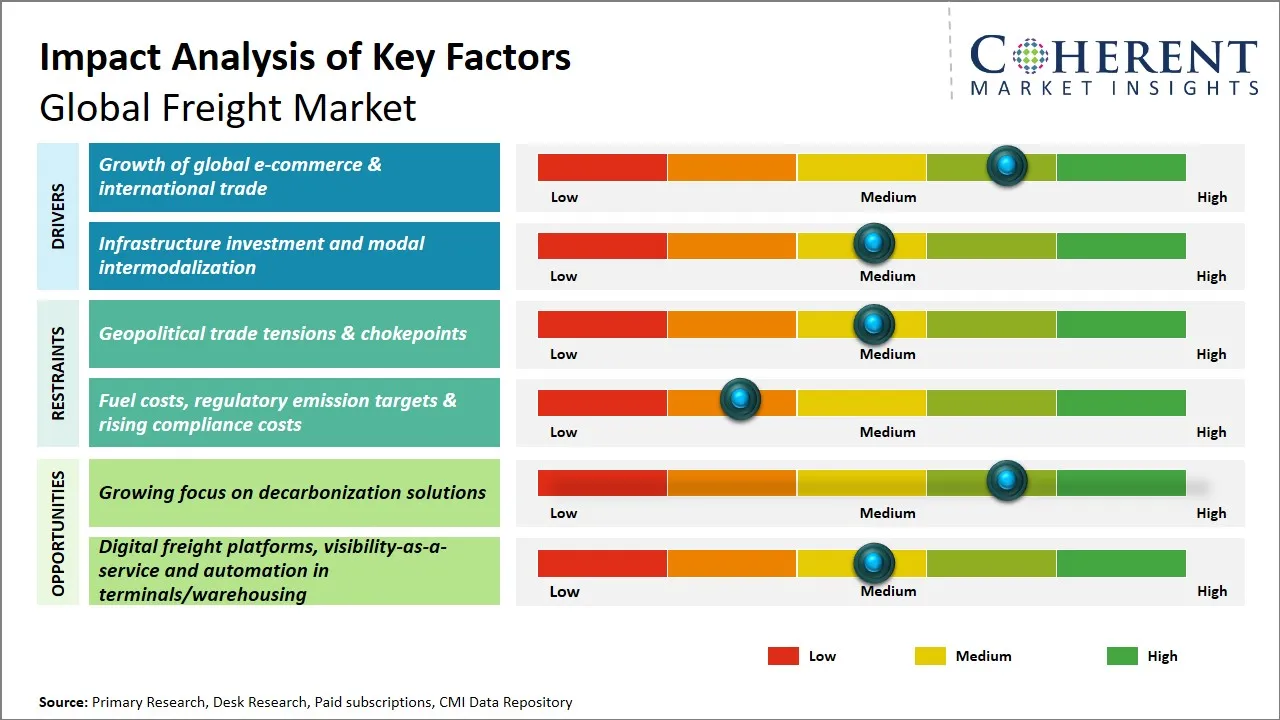
Global Freight Market Driver – Growth of Global E-Commerce & International Trade
The rapid expansion of global e-commerce has significantly intensified the need for efficient and reliable freight transportation, driving the growth of the global freight market. As consumers look to purchase goods from international sellers, the volume of cross-border shipments has grown. This pushes logistics providers to improve their capabilities to meet different delivery timelines and service expectations. Simultaneously, the steady rise in international trade, fueled by ongoing globalization and trade agreements, has further boosted freight movement across continents. For instance, DHL’s “Parcel Metro” network in Europe optimizes urban freight routes for faster delivery of e-commerce shipments
This interplay between broader trade flows and the dynamic nature of e-commerce has created a complex demand landscape, requiring advances in freight management, tracking technologies, and multimodal transportation solutions. Moreover, businesses are compelled to optimize supply chains, ensuring cost-effective and timely deliveries in an increasingly competitive market.
Global Freight Market Opportunity – Growing Focus on Decarbonization Solutions
The increasing focus on sustainability and environmental responsibility presents a big opportunity in the global freight market as companies and governments worldwide are putting in efforts to reduce carbon emissions. With freight transportation being a big contributor to global greenhouse gas emissions, stakeholders are prioritizing the adoption of decarbonization solutions to meet stringent regulatory standards and align with evolving consumer expectations.
This shift is adding to innovation and investment in cleaner technologies such as electric and hydrogen-powered vehicles, alternative fuels like biodiesel and renewable natural gas, and enhanced logistics optimization tools aimed at minimizing fuel consumption. For instance, Maersk is investing in decarbonization through the launch of carbon-neutral container vessels powered by biofuel and LNG.
Also, the use of more efficient supply chain practices and advances in digital freight platforms make possible better route planning and load management, directly supporting emission reduction goals. The emergence of carbon pricing and stricter emission regulations in key markets also makes demand for environmentally friendly freight options, encouraging freight providers to upgrade fleets and infrastructure. Moreover, partnerships between freight companies, technology providers, and energy firms are fostering the development of integrated decarbonization ecosystems.
Analyst Opinion (Expert Opinion)
- Despite technological advancements, the market continues to suffer from unpredictable disruptions, including port congestion, labor shortages, and geopolitical tensions.
- Fuel price fluctuations, stricter emission regulations, and escalating labor expenses are squeezing margins across all freight modes. The harsh reality is that many players, especially mid-sized operators, are barely able to maintain profitability without passing costs to customers, which could stunt volume growth in price-sensitive sectors.
- While leading players push digital freight platforms and AI-driven optimization, a significant portion of the market still relies on outdated systems.
Speak to the analyst
Want personalized insights?
Take the findings above to one of our principal consultants, or have the report rebuilt around the segments, geographies and competitors you actually track.
Market Segmentation
- Mode of Transport Insights (Revenue, USD Bn, 2021 - 2033)
- Land Freight Forwarding
- Waterway Freight
- Air Freight
- Intermodal Freight Forwarding
- Service Type Insights (Revenue, USD Bn, 2021 - 2033)
- Transportation and Warehousing
- Packaging and Documentation
- Insurance
- Value-added Services
- End-use Industry Insights (Revenue, USD Bn, 2021 - 2033)
- Retail and E-commerce
- Industrial & Construction
- Food & Beverage
- Automotive
- Chemicals
- Pharmaceuticals
- Technology & Electronics
- Energy & Utilities
- Agriculture
- Textiles & Apparel
- Aerospace & Defense
- Healthcare
- Others
- Regional Insights (Revenue, USD Bn, 2021 - 2033)
- North America
- U.S.
- Canada
- Latin America
- Brazil
- Argentina
- Mexico
- Rest of Latin America
- Europe
- Germany
- U.K.
- Spain
- France
- Italy
- Russia
- Rest of Europe
- Asia Pacific
- China
- India
- Japan
- Australia
- South Korea
- ASEAN
- Rest of Asia Pacific
- Middle East
- GCC Countries
- Israel
- Rest of Middle East
- Africa
- South Africa
- North Africa
- Central Africa
- North America
- Key Players Insights
- P. Moller–Maersk
- Mediterranean Shipping Company
- CMA CGM
- Hapag-Lloyd
- Kuehne + Nagel
- DHL Supply Chain & Global Forwarding
- DSV
- DB Schenker
- UPS
- FedEx
- Sinotrans
- Nippon Express
- CEVA Logistics
- Geodis
- XPO Logistics
Sources
Primary Research Interviews
Stakeholders
- Freight Operators and Logistics Companies
- Freight Forwarders and 3PL Providers
- Port and Terminal Authorities
- E-Commerce and Retail Supply Chain Heads
- Government Transport Departments and Regulatory Agencies
- Sustainability and Green Logistics Experts
Databases
- Global Transport Statistics Database (GTSD)
- International Freight Analytics Repository (IFAR)
- World Trade & Logistics Data Center (WTLDC)
- OECD Transport and Infrastructure Database
Magazines
- Freight Logistics Today
- Global Shipping Review
- Transport & Supply Chain Monthly
- Maritime & Air Cargo Magazine
Journals
- Journal of Freight Transport and Logistics
- International Journal of Supply Chain Management
- Transportation Research Part E: Logistics and Transportation Review
- Journal of Maritime Economics & Logistics
Newspapers
- The Logistics Times
- Transport & Cargo Daily
- The Financial Courier (Global Trade Section)
- The Shipping Herald
Associations
- International Federation of Freight Forwarders Associations (FIATA)
- Global Logistics Council (GLC)
- European Shippers’ Council (ESC)
- American Trucking Associations (ATA)
- International Air Transport Association (IATA)
Public Domain Sources
- United Nations Conference on Trade and Development (UNCTAD)
- World Bank – Transport and Infrastructure Reports
- Eurostat – Transport and Logistics Statistics
- International Transport Forum (ITF)
Proprietary Elements
- CMI Data Analytics Tool, Proprietary CMI Existing Repository of information for last 8 years
Get access to 250+ pages report
Every segment, forecast, competitor profile and data table behind the analysis above — available for instant download.
- ESOMAR Member
- ISO 9001:2015 Certified
- D-U-N-S Registered
- GDPR & CCPA Compliant
Missing comfort of reading report in your local language? Find your preferred language:
Transform your Strategy with Exclusive Trending Reports
Frequently Asked Questions
The global freight market is estimated to be valued at USD 234.51 billion in 2026 and is expected to reach USD 336.64 billion by 2033.
The CAGR of the global freight market is projected to be 5.3% from 2026 to 2033.
Growth of global e-commerce & international trade and infrastructure investment and modal intermodalization are the major factors driving the growth of the global freight market.
Geopolitical trade tensions & chokepoints and fuel costs, regulatory emission targets & rising compliance costs are the major factors hampering the growth of the global freight market.
In terms of mode of transport, the land freight forwarding segment is estimated to dominate the market revenue share in 2026.
It refers to the worldwide transportation of goods via road, rail, air, and sea, including freight forwarding, warehousing, and logistics services.
Emission standards, carbon pricing, and trade policies influence operational costs, modal choices, and fleet upgrades.