

Logistics Automation Market Size and Trends Forecast: 2026 - 2033
The logistics automation market is estimated to be valued at USD 67.14 Bn in 2026 and is expected to reach USD 147.50 Bn by 2033, exhibiting a compound annual growth rate (CAGR) of 11.9% from 2026 to 2033.
Key Takeaways of the Logistics Automation Market
- By component, the hardware segment is expected to contribute the highest share of 51.9% to the logistics automation market in 2026.
- By organization size, the small & medium enterprises segment is expected to hold the highest share of the logistics automation market with 65.4% in 2026.
- By vertical, the retail & e-commerce segment is expected to account for the highest share of the logistics automation market with 35.6% in 2026.
- North America has established itself as the dominant region with a projected market share of 35.0% in 2026 in the global logistics automation market.
Market Overview
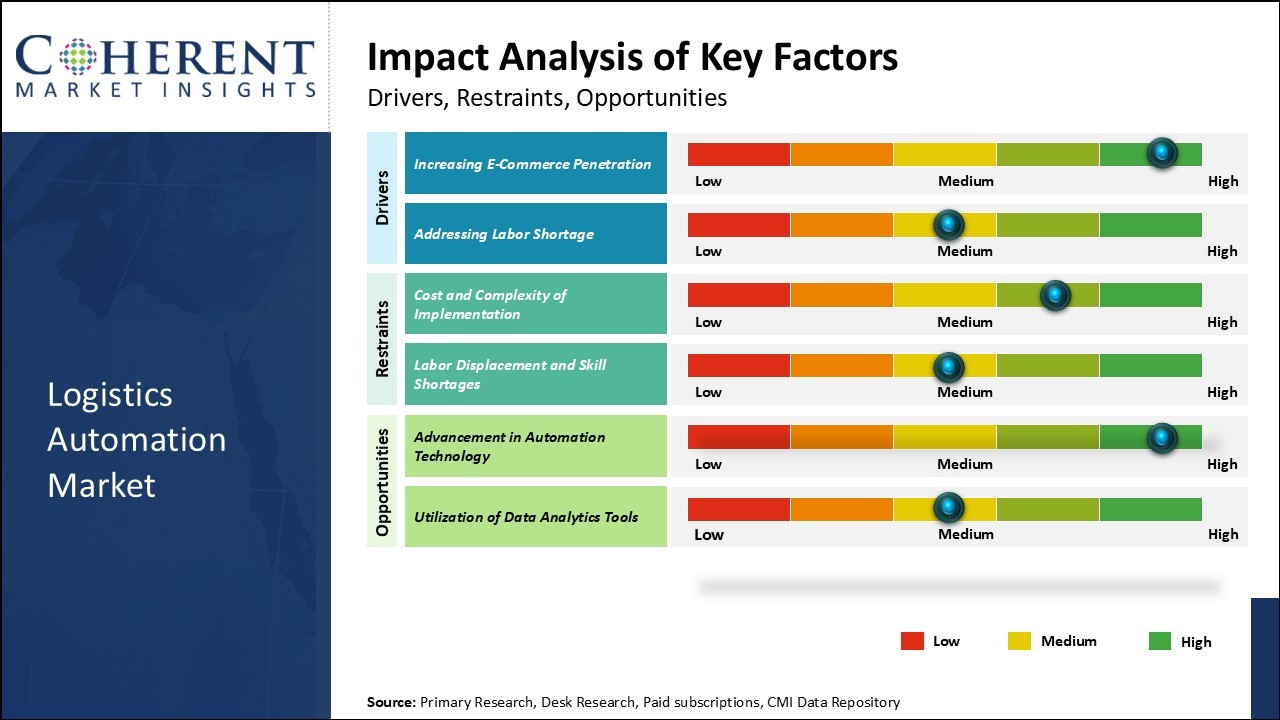
The logistics automation market is witnessing significant trend of automation and advanced technologies. The industry players are continuously focusing on incorporating new technological advancements such as autonomous vehicles, robotics, internet of things, and analytics solutions to enhance efficiency and optimize logistics operations. Various companies in different industry verticals are increasingly adopting automation in their supply chain and logistics operations to minimize costs, improve productivity and remain competitive.
However, the implementing logistics automation can be costly and complex which is one of the factors restraining the growth of the market.
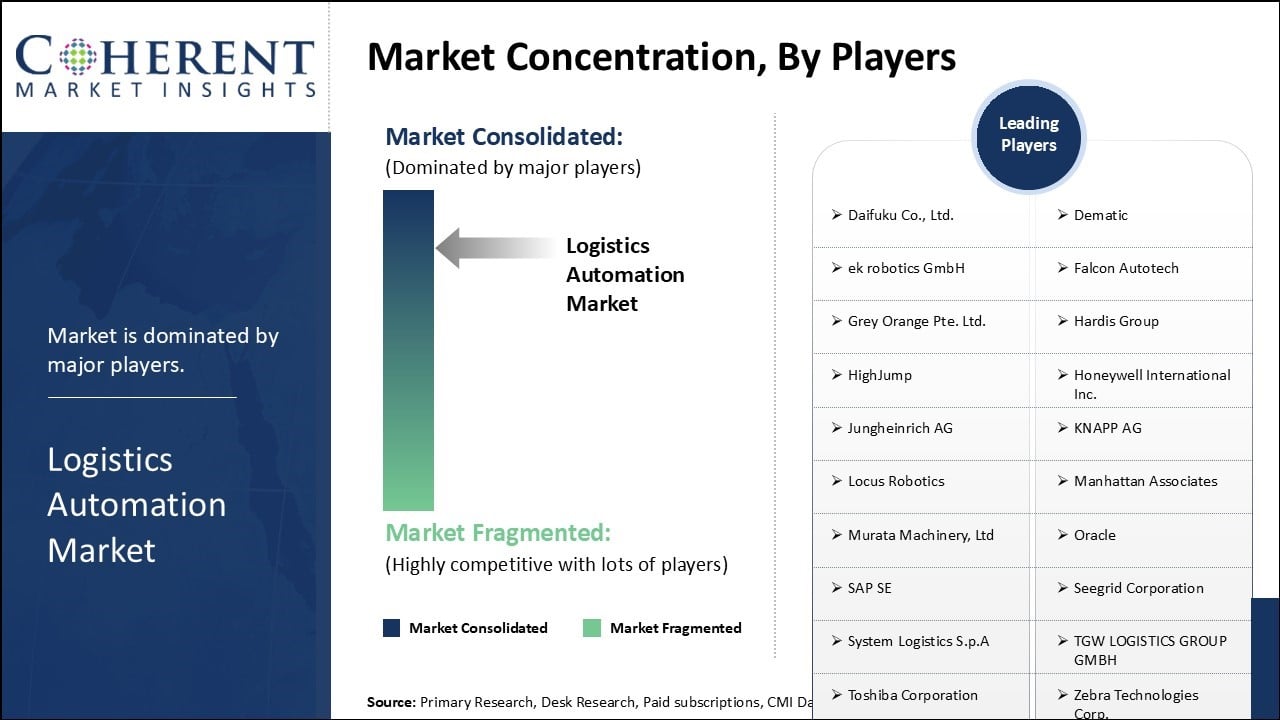
Market Concentration and Competitive Landscape
Current Events and their Impact on the Logistics Automation Market
Current Events | Description and its impact |
Geopolitical and Trade Developments |
|
Economic Factors and Investment Trends |
|
- Current Industry Events of 2026
- Market Size Estimation
- Regional Breakdown
- Competitive Landscape
- Customer Intelligence
- Segmental Analysis
- Pricing Analysis
- Key Market Drivers, Challenges & Future Trends
- Customized Insights Section
Market Trends
Growing Demand for the Electric Vehicles and Hybrid Vehicles
The automotive industry's shift toward the electric and hybrid vehicles is fundamentally transforming logistics automation needs, as these vehicles require complex components—such as lithium-ion batteries and electric drivetrains—that involve stricter handling, storage, and transport protocols. This shift is accelerating the adoption of advanced warehouse automation and intelligent supply chain systems.
For instance, according to the International Energy Agency, the global electric car sales topped 17 million in 2024, rising by more than 25%, highlighting the scale at which logistics infrastructure must adapt.
Segmental Insights
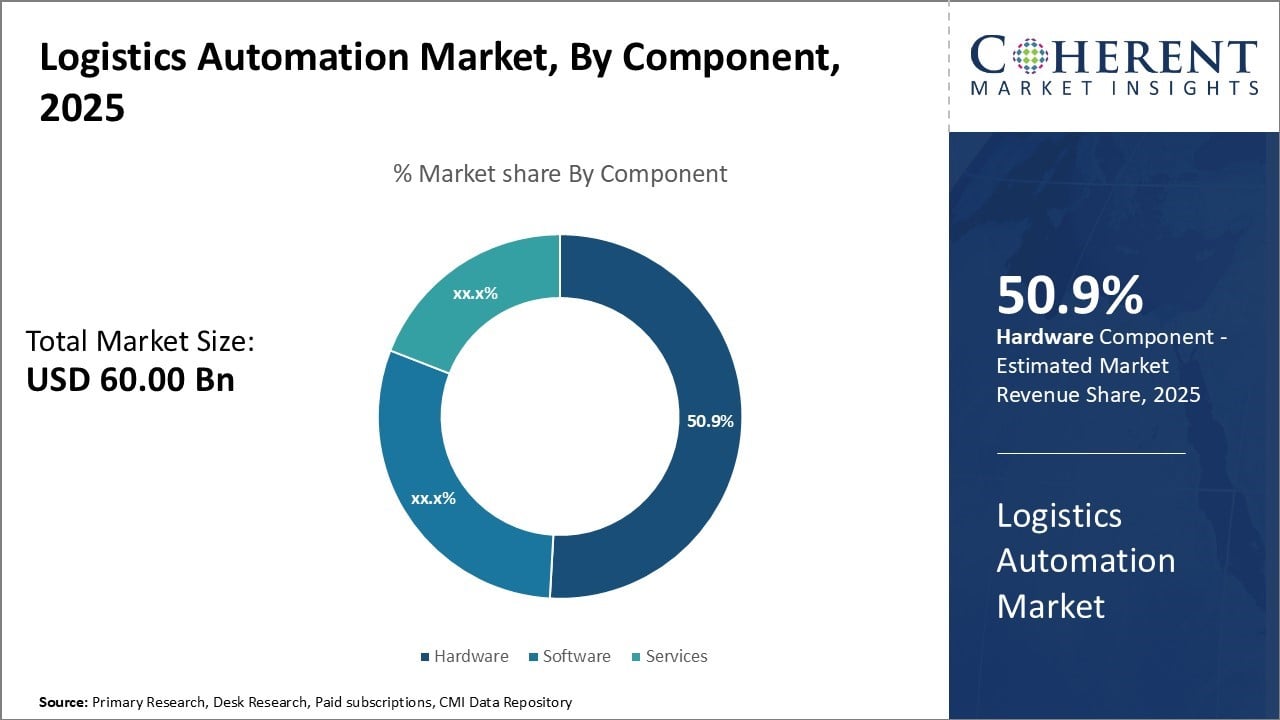
Logistics Automation Market Insights, By Component: Hardware Segment is Expected to Dominate Due to Its Critical Importance
The hardware segment is expected to contribute the highest share of 51.9% in 2026 owing to its critical importance in logistics automation. Hardware forms the core foundation for automation of logistics operations and includes devices such as automated conveyor systems, automated guided vehicles, automated storage and retrieval systems, robotics, and more.
These hardware systems are designed specifically to automate material handling processes and optimize workflow in warehouses, distribution centers and logistics facilities. The integration of advanced sensors, actuators and control mechanisms within hardware enables capabilities like object detection, navigation, sorting and tracking of shipments and inventory in real-time.
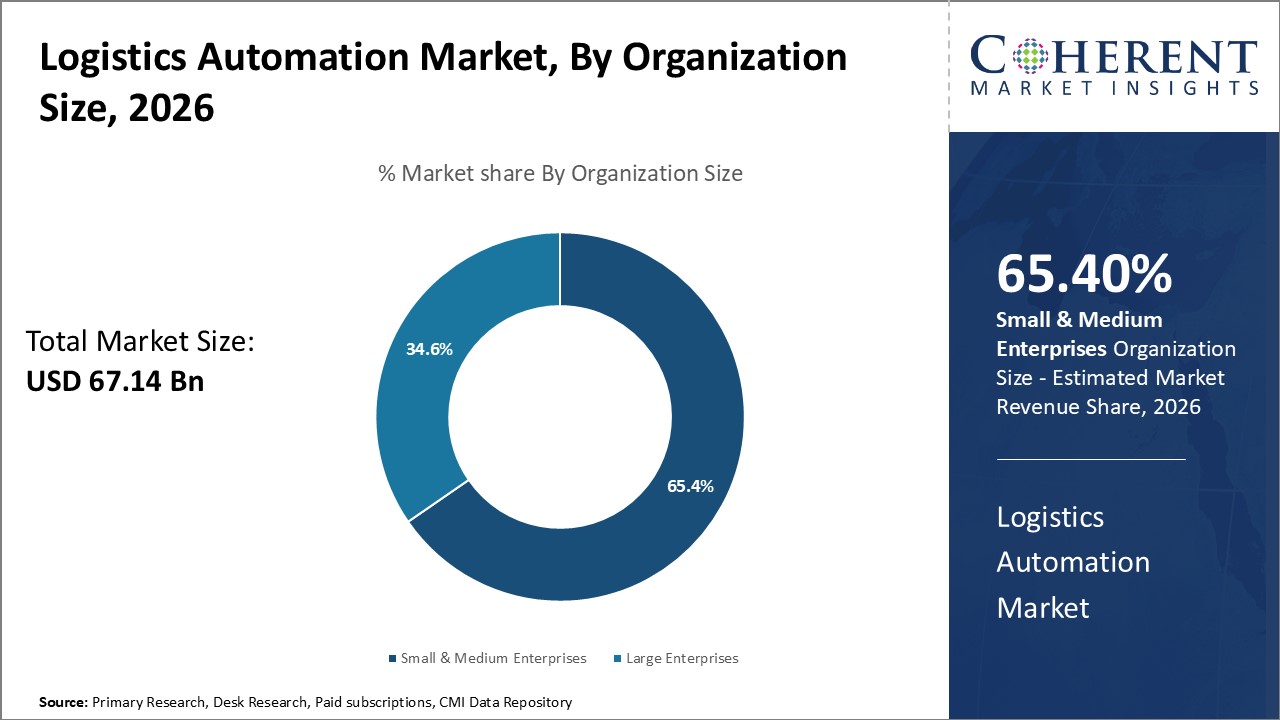
Logistics Automation Market Insights, By Organization Size: Small & Medium Enterprises Segment Leads Due to Cost-Related Drivers
The small & medium enterprises segment is expected to contribute the highest share of 65.4% in 2026 owing to cost-related drivers. While large enterprises are also actively automating their logistics chains, the promise of relatively quicker paybacks makes automation more valuable for SMEs.
These companies have limited financial resources at their disposal and see logistics automation as a way to boost productivity, reduce manual errors and streamline operations with limited investments. Automation solutions tailored for SMEs by vendors are easy to implement and maintain. The capex costs associated with hardware procurement and software licensing can also be better absorbed by smaller companies through consumption-based pricing models.
Logistics Automation Market Insights, By Vertical: Retail & E-Commerce Segment Dominates Due to Surging Distribution Demands and Rising Customer Expectations
The retail & e-commerce segment is expected to contribute the highest share of 35.6% in 2026 driven by surging distribution demands and rising customer expectations. As online shopping continues to grow rapidly, retailers are facing unprecedented pressure to process higher order volumes throughput their distribution networks on time.
This has necessitated significant upgrades to existing fulfillment infrastructure incorporating cutting-edge automation technologies. Automated distribution and shipping facilities allow retailers to increase picking rates manifold and achieve extremely quick turnaround times. New fulfillment models like micro-warehouses further accelerate speedy last-mile deliveries.
Emerging Innovations in the Logistics Automation Market
- The Widespread Adoption of Robotics and Automated Guided Vehicles (AGVs)
- Robotics automation has moved beyond simple conveyor belts and sorting systems to encompass highly adaptable robots that can navigate complex warehouse layouts, pick and pack varying sizes of items, and collaborate safely alongside human workers. Innovations such as logistics robots and Autonomous Mobile Robots (AMRs) equipped with advanced sensors and real-time mapping capabilities allow for dynamic route optimization within storage facilities, minimizing downtime and maximizing throughput.
- The Introduction and Expansion of Autonomous Delivery Systems
- The introduction and expansion of autonomous delivery systems, encompassing both aerial drones and ground-based self-driving vehicles. While drones are increasingly used for last-mile delivery in urban and remote environments, self-driving trucks are being tested for long-haul freight movement. These autonomous solutions promise to reduce labor costs, increase delivery speed, and improve safety by minimizing human errors.
Analysis of Manufacturing Facilities and Production Capacities of Manufacturers in the Logistics Automation Market
Manufacturers | Manufacturing Facilities |
Daifuku Co., Ltd. | Daifuku Co., Ltd. is one of the dominant players with manufacturing plants primarily in Japan, the U.S., China, and Europe. Their main production facility in Nagoya, Japan, is equipped to produce a wide array of automated material handling equipment, including conveyor systems and sortation solutions. The U.S. facility in Georgia focuses on Automated Storage and Retrieval Systems (AS/RS) and warehouse control software. Daifuku's combined production capacity stands at approximately 10,000 units annually, allowing them to service high volumes, particularly in ecommerce and manufacturing sectors. |
Vanderlande Industries | Vanderlande Industries, a Dutch company now part of Toyota Industries Corporation, operates multiple manufacturing facilities across Europe, the U.S., and Asia. Their primary production plants in the Netherlands and Germany specialize in automated baggage handling systems, sorters, and parcel handling equipment. The company’s facility in Suzhou, China, has been expanded recently to focus on logistics automation solutions for the Asian market, with an estimated production capacity exceeding 7,000 equipment units per year. |
Regional Insights
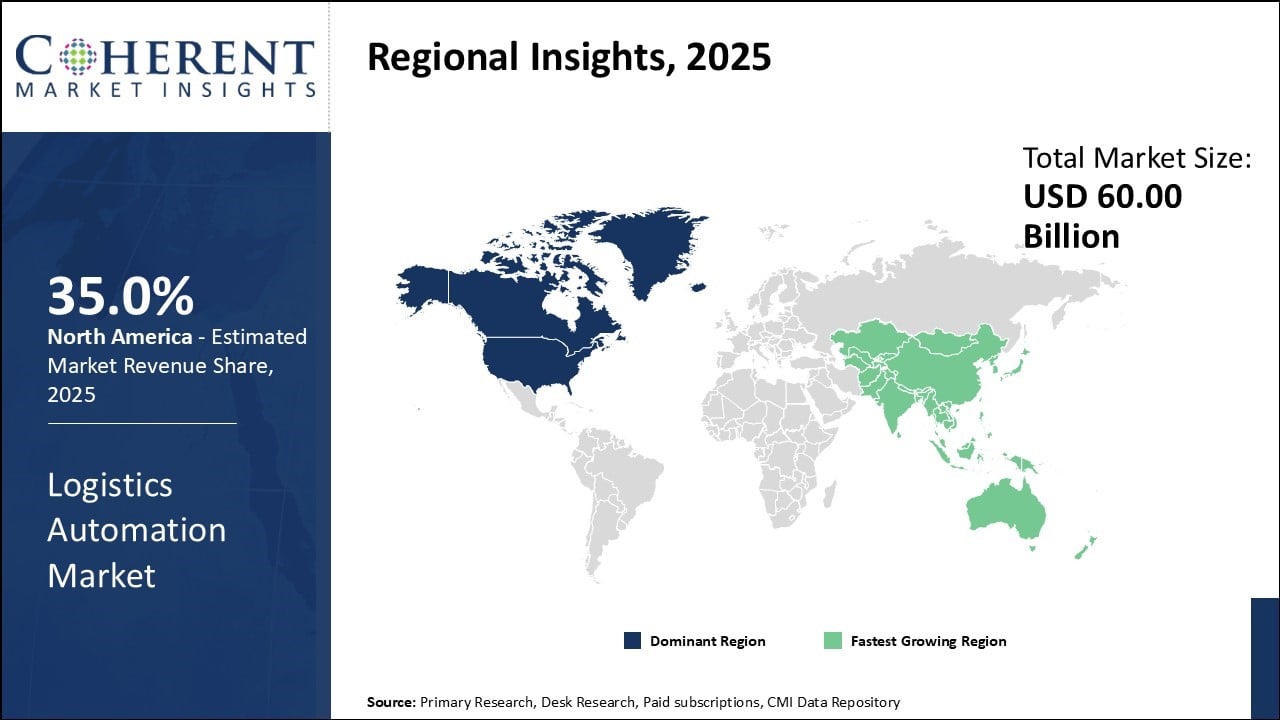
North America Logistics Automation Market Analysis and Trends
North America has established itself as the dominant region with a projected market share of 35.0% in 2026 in the global logistics automation market. The region is home to leading logistics and supply chain companies that have heavily invested in automation technologies across warehouses and distribution centers. U.S. and Canadian logistics giants have automated key operations such as material handling, inventory tracking, and order fulfillment using robotics, conveyor systems, and warehouse management software.
For instance, in September 2024, according to IBM report, the automotive sector was the top adopter of industrial robots in the U.S. last year, accounting for 33% of all installations—illustrating how industries with complex logistics needs are driving automation demand across both production and supply chain environments.
Asia Pacific Logistics Automation Market Analysis and Trends
Asia Pacific region is poised to be the fastest growing logistics automation market with a CAGR of 13.8%. Countries like China, India, Japan, and South Korea are experiencing strong growth in both manufacturing and e-commerce, driven by a rapidly expanding middle class. This surge is generating unprecedented volumes of goods movement and warehouse activities, fueling demand for advanced logistics automation solutions.
For instance, according to the International Federation of Robotics, 73% of all newly deployed industrial robots were installed in Asia underscoring the region’s rapid shift toward automation across manufacturing and logistics sectors.
Logistics Automation Market Outlook for Key Countries
U.S. Logistics Automation Market Analysis and Trends
The U.S. leads in logistics automation driven by its advanced technological infrastructure and the presence of the major global e-commerce and logistics companies. Continuous innovation in robotics, AI, and warehouse management systems fuels demand, while companies focus on enhancing efficiency and reducing labor costs to meet growing consumer expectations for fast delivery.
China Logistics Automation Market Analysis and Trends
China's rapid industrialization and booming e-commerce sector are primary drivers for logistics automation. The country’s commitment to modernizing its supply chain infrastructure, coupled with government support for smart manufacturing and automation, accelerates adoption of cutting-edge technologies in warehouses and distribution centers.
Germany Logistics Automation Market Analysis and Trends
Germany’s strong manufacturing base and its central position in European trade make it a key player in logistics automation. The country prioritizes precision engineering and Industry 4.0 initiatives, fostering integration of automated systems in logistics to improve supply chain transparency, reliability, and operational excellence.
Japan Logistics Automation Market Analysis and Trends
Japan’s emphasis on robotics and automation as part of its broader technological advancement strategy significantly impacts its logistics sector. Faced with a shrinking workforce, Japanese companies adopt automation to maintain productivity and competitiveness, driving innovation in automated material handling and intelligent warehouse solutions.
Pricing Analysis of the Logistics Automation Market
Brand, Solution | Pricing Model in USD |
SAP Extended Warehouse Management (EWM), On-premises/Cloud, License + Implementation | 100,000 - 5 million and above |
Manhattan Associates, Manhattan WMS, Subscription + License | 50,000 - 3 million and above |
Blue Yonder (JDA), Luminate WMS, SaaS Subscription | 20,000 - 1 million+ annually |
Oracle WMS Cloud, Cloud-based WMS, Subscription | 10,000 - 500,000 annually |
HighJump (Scan), WMS, License + Maintenance | 30,000 - 2 million and above |
Market Report Scope
Logistics Automation Market Report Coverage
| Report Coverage | Details | ||
|---|---|---|---|
| Base Year: | 2025 | Market Size in 2026: | USD 67.14 Bn |
| Historical Data for: | 2020 To 2024 | Forecast Period: | 2026 To 2033 |
| Forecast Period 2026 to 2033 CAGR: | 11.9% | 2033 Value Projection: | USD 147.50 Bn |
| Geographies covered: |
| ||
| Segments covered: |
| ||
| Companies covered: | Daifuku Co., Ltd., Dematic, ek robotics GmbH, Falcon Autotech, Grey Orange Pte. Ltd., Hardis Group, HighJump, Honeywell International Inc., Jungheinrich AG, KNAPP AG, Locus Robotics, Manhattan Associates, Murata Machinery, Ltd, Oracle, SAP SE, Seegrid Corporation, System Logistics S.p.A, TGW LOGISTICS GROUP GMBH, Toshiba Corporation, and Zebra Technologies Corp. | ||
| Growth Drivers: |
| ||
| Restraints & Challenges: |
| ||
Logistics Automation Industry News
- In July 2025, the Alfa Laval S.p.A. commissioned Jungheinrich to implement a fully automated high-bay warehouse at its site in San Bonifacio (VR). The project included a new warehouse for raw materials and finished goods with around 5,000 pallet storage locations. Acting as general contractor, Jungheinrich is responsible for all system components – from the seismically designed racking to the integrated conveyor system and the complete IT infrastructure, including a Warehouse Management System (WMS) and a Warehouse Control System (WCS).
- In May 2025, Dematic, announced the launch of its latest innovation in case handling technology, the FD Shuttle system. The high-performance, floor rail-free rack supported automated storage and retrieval solution is designed to meet the growing demands of modern storage technology across the Asia Pacific region.
- In April 2025, Daifuku Co., Ltd. announced that the Daifuku Group company Daifuku Intralogistics India Pvt. Ltd., constructed a new manufacturing plant in Hyderabad, and launched full-scale operations in April 2025. This plant is part of Daifuku's Intralogistics business, which handles systems for general manufacturing and distribution industries.
- In February 2025, BITO Lagertechnik and Locus Robotics, announced a strategic partnership aimed at delivering integrated, end-to-end solutions for automated order fulfillment.
Analyst View
- The logistics automation market is witnessing significant transformation driven by increasing demand for operational efficiency and cost reduction in supply chain management. Automation technologies such as robotics, Automated Guided Vehicles (AGVs), and warehouse management systems are increasingly being adopted to streamline processes, reduce human error, and enhance accuracy in inventory handling.
- One of the primary drivers is the surge in e-commerce activities, which has intensified the need for faster order fulfillment and last-mile delivery solutions. Additionally, labor shortages and rising wages in developed economies push companies to automate their logistics operations to maintain competitiveness.
- However, the high initial investment and complexity in integrating automation systems pose considerable challenges for small to medium-sized enterprises, which may slow adoption rates in some regions. Despite this, advancements in AI and machine learning offer promising opportunities to optimize route planning, demand forecasting, and predictive maintenance, further boosting automation benefits.
- Geographically, North America continues to dominate due to the presence of key industry players and early technology adopters, while the Asia Pacific region is emerging as the fastest-growing market. The expansion in Asia Pacific is supported by increasing industrialization, rapid urbanization, and the growing use of smart technologies in logistics hubs. Additionally, government initiatives promoting smart infrastructure and Industry 4.0 adoption are accelerating growth in this region.
Market Segmentation
- Component Insights (Revenue, USD Bn, 2021 - 2033)
- Hardware
- Autonomous Robots (AGV and AMR)
- Automated Storage and Retrieval Systems (AS/RS)
- Automated Sorting Systems
- De-Palletizing/Palletizing Systems
- Conveyor Systems
- Automatic Identification and Data Collection (AIDC)
- Software
- Warehouse Management System
- Transportation Management System
- Services
- Consulting
- Deployment & Integration
- Support & Maintenance
- Organization Size Insights (Revenue, USD Bn, 2021 - 2033)
- Large Enterprises
- Small & Medium Enterprises
- Vertical Insights (Revenue, USD Bn, 2021 - 2033)
- Retail & E-commerce
- Healthcare
- Automotive
- Aerospace & Defense
- Electronics & Semiconductors
- Others
- Regional Insights (Revenue, USD Bn, 2021 - 2033)
- North America
- U.S.
- Canada
- Latin America
- Brazil
- Argentina
- Mexico
- Rest of Latin America
- Europe
- Germany
- U.K.
- Spain
- France
- Italy
- Russia
- Rest of Europe
- Asia Pacific
- China
- India
- Japan
- Australia
- South Korea
- ASEAN
- Rest of Asia Pacific
- Middle East
- GCC Countries
- Israel
- Rest of Middle East
- Africa
- South Africa
- North Africa
- Central Africa
- Key Players Insights
- Daifuku Co., Ltd.
- Dematic
- ek robotics GmbH
- Falcon Autotech
- Grey Orange Pte. Ltd.
- Hardis Group
- HighJump
- Honeywell International Inc.
- Jungheinrich AG
- KNAPP AG
- Locus Robotics
- Manhattan Associates
- Murata Machinery, Ltd.
- Oracle
- SAP SE
- Seegrid Corporation
- System Logistics S.p.A
- TGW LOGISTICS GROUP GMBH
- Toshiba Corporation
- Zebra Technologies Corp.
Sources
Primary Research Interviews
- Logistics Service Providers
- Warehouse Managers
- Supply Chain Technology Experts
- Automation Solution Vendors
- Others
Magazines
- Logistics Management
- Supply Chain Digital
- Modern Materials Handling
- Others
Journals
- Journal of Business Logistics
- International Journal of Physical Distribution & Logistics Management
- Transportation Journal
- Others
Newspapers
- The Wall Street Journal
- Financial Times
- The Economic Times
- Logistics Insight Asia
- Others
Associations
- Council of Supply Chain Management Professionals (CSCMP)
- Warehousing Education and Research Council (WERC)
- International Warehouse Logistics Association (IWLA)
- Material Handling Industry (MHI)
- Others
Public Domain Sources
- U.S. Department of Transportation
- European Logistics Association
- World Bank Logistics Performance Index
- International Labour Organization
- Others
Proprietary Elements
- CMI Data Analytics Tool – Logistics Automation Market
- CMI Existing Repository of Information for the Last 8 Years
*Definition: The logistics automation market involves the use of automated systems and software to optimize logistics operations and help companies efficiently move materials and goods through the supply chain. Logistics automation utilizes technologies like industrial robots, autonomous mobile robots, sensors, machine vision, automated storage and retrieval systems, and big data analytics to automate processes like material handling, warehouse management, transportation management, order processing and fulfilment, fleet management, and inventory management with minimal or no human intervention for better productivity, visibility and cost savings.
Get access to 250+ pages report
Every segment, forecast, competitor profile and data table behind the analysis above — available for instant download.
- ESOMAR Member
- ISO 9001:2015 Certified
- D-U-N-S Registered
- GDPR & CCPA Compliant
Missing comfort of reading report in your local language? Find your preferred language:
Transform your Strategy with Exclusive Trending Reports
Frequently Asked Questions
The logistics automation market is estimated to be valued at USD 67.14 Bn in 2026, and is expected to reach USD 147.50 Bn by 2033.
The CAGR of the logistics automation market is projected to be 11.9% from 2026 to 2033.
Increasing e-commerce penetration and addressing labor shortages are the major factors driving the growth of the logistics automation market.
Cost and complexity of implementation and labor displacement and skill shortages are the major factors hampering the growth of the logistics automation market.
In terms of component, hardware segment is estimated to dominate the market revenue share in 2026.
Major players operating in the logistics automation market are Daifuku Co., Ltd., Dematic, ek robotics GmbH, Falcon Autotech, Grey Orange Pte. Ltd., Hardis Group, HighJump, Honeywell International Inc., Jungheinrich AG, KNAPP AG, Locus Robotics, Manhattan Associates, Murata Machinery, Ltd, Oracle, SAP SE, Seegrid Corporation, System Logistics S.p.A, TGW LOGISTICS GROUP GMBH, Toshiba Corporation, and Zebra Technologies Corp.
North America is expected to lead the logistics automation market in 2026.