

ASEAN and MEA UTV Market Size and Forecast – 2026 To 2033
The ASEAN and MEA UTV market is expected to grow from USD 308.2 Mn in 2026 to USD 458.7 Mn by 2033, registering a compound annual growth rate (CAGR) of 5.8% from 2026 to 2033. The ASEAN and MEA UTV market growth is primarily driven by increasing need from defense applications for rugged terrain mobility.
For instance, on February 12, 2026, at the World Defense Show 2026, Armored Group introduced the LD-1 armored all-terrain vehicle, a compact, rifle-rated quad designed to provide protected mobility in dense urban and confined environments. (Source: The Defense Watch)
Key Takeaways of the ASEAN and MEA UTV Market
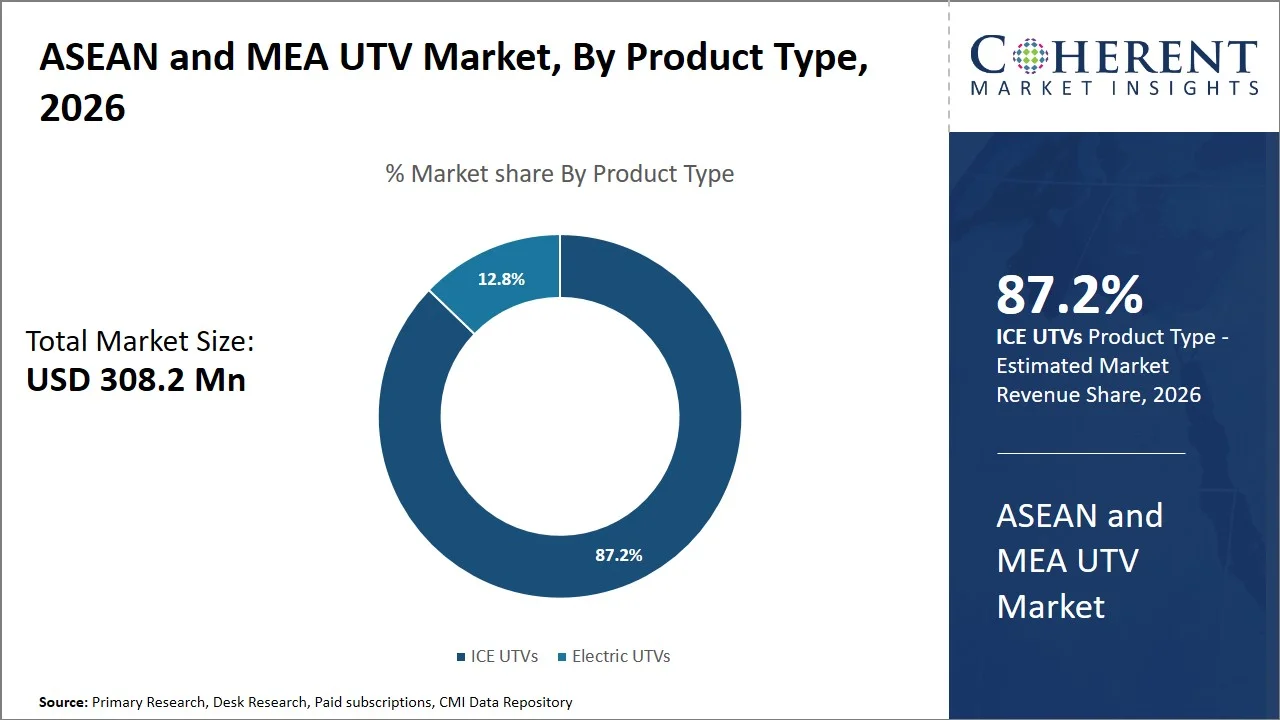
- The ICE UTVs segment is expected to account for 87.2 % of the ASEAN and MEA UTV market share in 2026. Military investments on long range vehicles is a major growth factor for the segment. On January 20, 2026, the UAE signed four major defense contracts worth around USD 240 million. The deals cover unmanned vehicles, advanced aircraft, and remotely operated systems, highlighting the growing activity in the nation’s defense and technology sectors. (Source: Times of India)
- The 2WD segment is estimated to capture 77. 9% of the market share in 2026. The preference for 2WD is increasing as they are cost effective, both in purchase and maintenance and the growing efforts on fleet cost optimization and fleet upgradation is driving the demand for 2WD. On June 9, 2025, Saudi Roads General Authority (RGA) has launched the largest and most advanced AI-powered road inspection fleet in the world for the Hajj season. (Source: Zawya)
- The light-duty (≤ 450 Kg) segment is projected to hold 53.6 % of the ASEAN and MEA UTV market share in 2026. The growing use of light duty UTVs for agricultural applications is a major factor driving the growth.
- Growth in Tourism and Adventure Recreation: UTVs are increasingly being adopted for desert rides, adventure sports tourism & recreation, and mobility applications in resorts and theme parks.
- Adoption for Rural Utility and Agriculture: The use of UTVs for livestock handling, goods transportation, and crop management in rough terrains across countries like Vietnam and Indonesia are driving the market growth.
Segmental Insights
Why Does ICE UTVs Segment Dominate the ASEAN and MEA UTV Market ?
The ICE UTVs segment is expected to account for 87.2% of the ASEAN and MEA UTV market share in 2026. ICE UTVs are more suitable for deployment in the Gulf Deserts and Southeast Asian off-road terrains where there is little to no charging infrastructure. Moreover, these vehicles provided improved reliability in extreme heat and sand conditions when compared to their electric counterparts. ICE units are also much cheaper to acquire and maintain, which is suitable for large scale tourism and defense activities. Overall, ICE UTVs are the most practical real-world choices for high utility rural applications.
- Current Industry Events of 2026
- Market Size Estimation
- Regional Breakdown
- Competitive Landscape
- Customer Intelligence
- Segmental Analysis
- Pricing Analysis
- Key Market Drivers, Challenges & Future Trends
- Customized Insights Section
Why is 2WD the Most Preferred Drive Type?
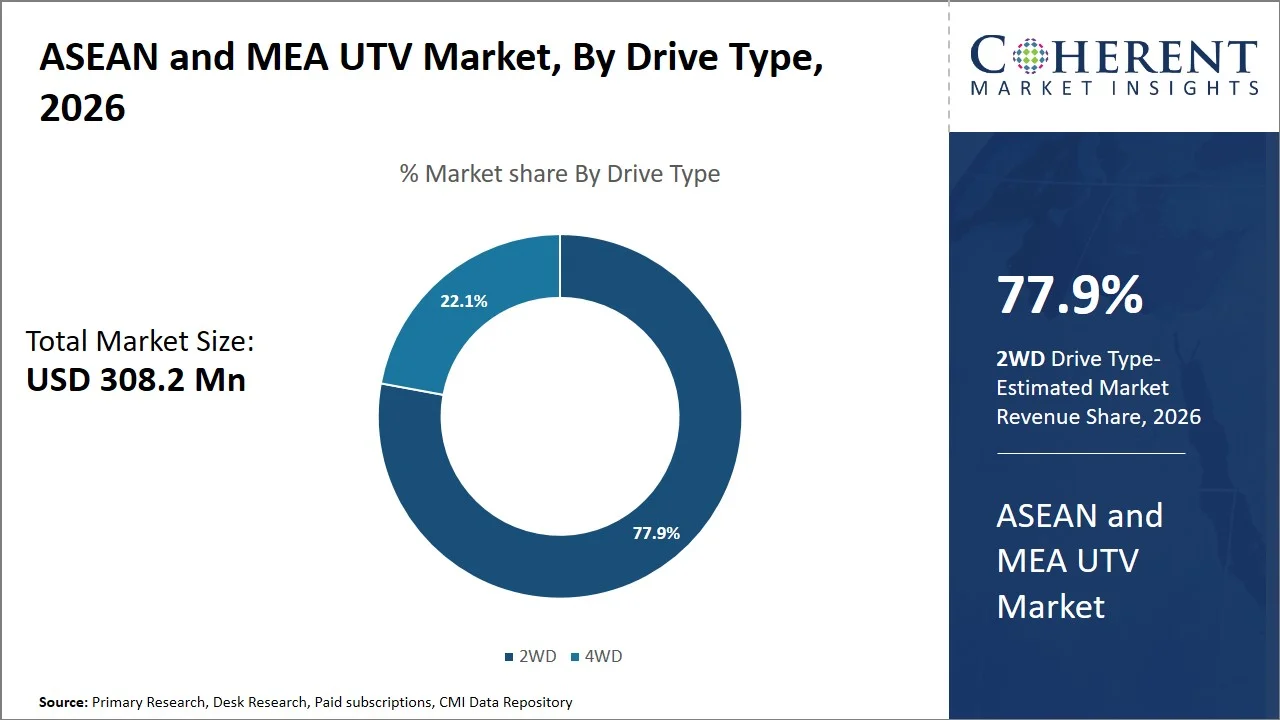
The 2WD segment is expected to account for 77.9% of the ASEAN and MEA UTV market share in 2026. 2WD vehicles are preferred over traditional 4WD as they offer lower maintenance downtime easier maintenance. This is especially useful for government inspection fleets and desert safari activities as lower maintenance downtime reduces repair cycles and dependency on spare parts in remote regions. Moreover, as operators of large-scale fleets are prioritizing fleet cost optimization, the use of 2WD vehicles is increasing substantially.
Light-Duty (≤ 450 Kg) Segment Dominates the ASEAN and MEA UTV Market
The light-duty (≤ 450 Kg) segment is expected to account for 53.6% of the ASEAN and MEA UTV market share in 2026. The growing use of light-duty UTVs for various rural applications is a key driver for the market growth. In addition, the developments in agricultural machinery in countries like Thailand and Vietnam are also driving the segment growth. On June 6, 2025, Kubota Corporation announced that it is expanding Kubota Research & Development Asia (KRDA), its research and development base in Thailand, to meet the growing demand to develop products for Southeast Asia (Source: Kubota)
ASEAN and MEA UTV Market - Agricultural Mechanization & Plantation Mobility
Category | ASEAN (Indonesia, Thailand, Malaysia, Vietnam) | MEA (Saudi Arabia, UAE, South Africa, Oman) |
UTV penetration in palm oil plantations | 40–70% in large estates (Indonesia, Malaysia) | Very limited (0–10%, niche farms) |
Rubber plantation logistics usage | 30–60% usage in Thailand & Indonesia estates | Minimal usage (<10%) |
Livestock mobility applications | 25–50% adoption in mixed farms | 20–40% in desert livestock farms (Saudi, UAE) |
Farm-to-storage transport efficiency | 20–40% faster logistics | 15–35% faster logistics |
Labor reduction metrics | 25–55% reduction in plantation labor needs | 20–45% reduction in farm workforce |
Smart-farming telematics adoption | 20–35% adoption (rising in large estates) | 25–50% adoption in modern farms & agribusiness |
Fleet usage per 100 hectares | 2–6 UTVs per 100 ha (palm oil/rubber) | 1–4 UTVs per 100 ha (mixed farming) |
Downtime reduction vs tractors | 15–30% improvement | 10–25% improvement |
Currents Events and their Impact
Current Events | Description and its Impact |
ASEAN – Vehicle Standards Harmonization (ASEAN MRA 2025 rollout) |
|
(Source: JASIC)
ASEAN and MEA UTV Market Dynamics
Market Drivers
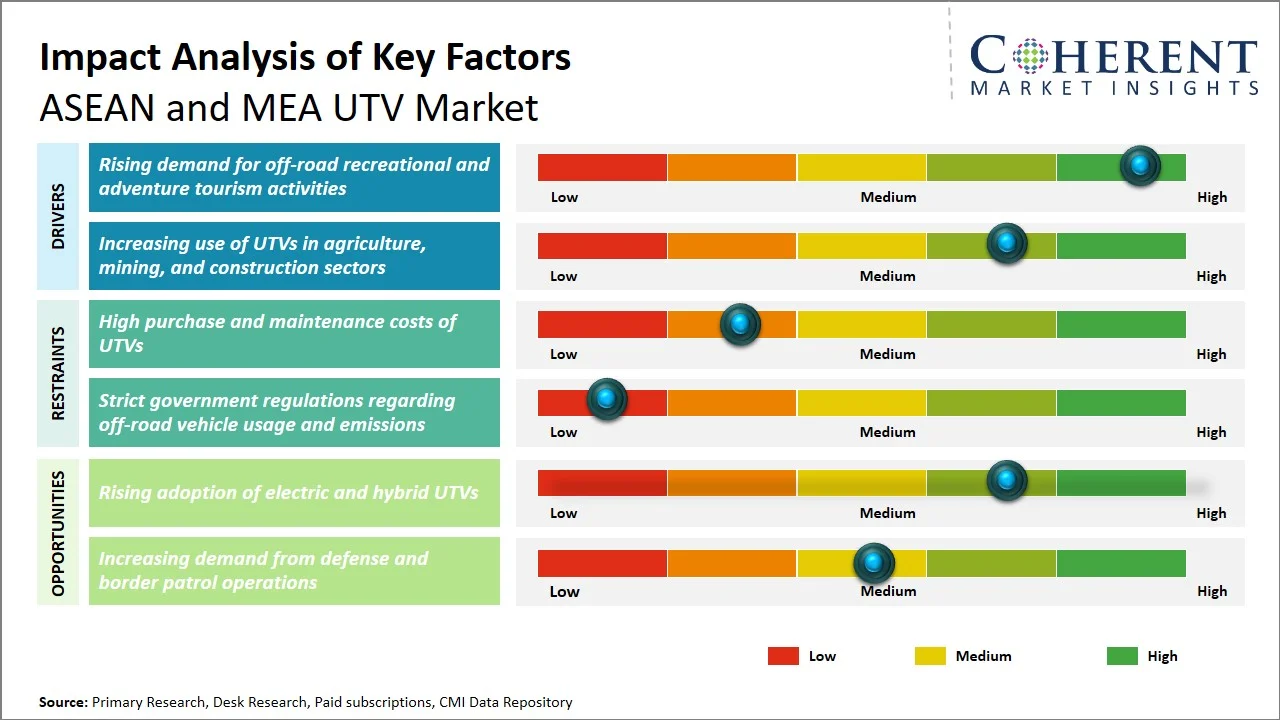
- Rising demand for off-road recreational and adventure tourism activities: The rising demand for off-road recreational and adventure tourism in ASEAN and MEA is being driven by expanding desert safaris in the UAE and Saudi Arabia, dune-based adventure parks in Oman, and jungle and plantation-based eco-tourism in countries like Thailand and Indonesia, where UTVs are increasingly used by operators to offer guided experiences in rugged terrains. On October 28, 2025, Dubai-based adventure tour operator Dune Buggy Dubai announced the launch of its exclusive desert adventure packages to coincide with the Dubai Airshow, offering visitors a chance to experience the UAE’s red dunes through professionally guided off-road tours. (Source: Gulf News)
- Increasing use of UTVs in agriculture, mining, and construction sectors: The increasing use of UTVs in agriculture, mining, and construction sectors in ASEAN and MEA is driven by the need for efficient light-utility mobility in difficult terrains, where they are used for transporting workers, tools, and small loads across plantations, mining sites, and construction zones; for example, agricultural estates in Indonesia and Thailand use UTVs for plantation logistics, mining operations in South Africa and Saudi Arabia deploy them for site inspection and material movement in remote areas. On April 1, 2026, Gold Fields announced USD 95 million investment pledge for 2026 and 2027, at the Sixth South Africa Investment Conference (SAIC 2026) in Sandton, South Africa. The investment supports South Deep Expansion Project, and will focus on infrastructure development, early access to new mining areas, and the expansion of our renewable energy capacity. (Source: Gold Fields)
Emerging Trends
- Shift toward utility-driven fleet adoption: UTVs are increasingly being integrated into agriculture, mining, construction, and municipal services as “work utility platforms” rather than recreational vehicles, with operators prioritizing durability, payload capacity, and low operating cost for continuous field operations in plantations, mines, and infrastructure projects.
- Rising preference for light-duty and cost-efficient models: Demand is growing for light-duty UTVs (≤450 kg payload class) and 2WD variants, especially in ASEAN agriculture and MEA tourism/utilities, where fleets prioritize fuel efficiency, easier maintenance, and lower total cost of ownership over high-end off-road capability.
ASEAN and MEA UTV Market - Tourism & Adventure Fleet Economics
Economic Factor | MEA (Desert Safari – UAE/Saudi/Oman) | ASEAN (Eco/Adventure Tourism – Thailand/Indonesia) |
Fleet deployment size per operator | 20–300 UTVs per operator | 10–80 UTVs per operator |
Adventure-tourism rental utilization rate | 60–90% peak season | 40–75% peak season |
Revenue per vehicle per tour (avg) | USD 80–USD 250 per ride | USD 40–USD 120 per ride |
Trips per vehicle per day | 4–8 tours/day | 2–5 tours/day |
Operating cost per vehicle (annual) | USD 8,000–USD 20,000 | USD 5,000–USD 12,000 |
Revenue per vehicle per month (peak season) | USD 6,000–USD 25,000 | USD 3,000–USD 10,000 |
Utilization downtime | 10–20% | 15–30% |
How is the Rising Adoption of Electric and Hybrid UTVs Creating New Growth Opportunities in the ASEAN and MEA UTV Market?
The rising adoption of electric and hybrid UTVs are creating new growth opportunities in the ASEAN and MEA markets by opening demand in sectors that prioritize low-emission and quieter operations, such as eco-tourism resorts, smart city projects, and indoor or semi-urban industrial sites, while government sustainability initiatives in places like the UAE and Singapore are encouraging fleet electrification. At the same time, OEMs are using this shift to introduce premium, technology-enabled models alongside traditional ICE UTVs, expanding the market into new customer segments that previously avoided off-road utility vehicles due to environmental and noise concerns.
Market Players, Key Development, and Competitive Intelligence
Key Development
- On August 17, 2025, BRP Inc. announced the launch of the all-new 2026 Can-Am Outlander Electric, an all-terrain vehicle engineered for performance, durability, and a whisper-quiet ride. This latest innovation strengthens BRP’s long-term commitment to redefining the riding experience through purpose-built electric models that deliver all the excitement of combustion, but with a different, equally thrilling ride experience.
Competitive Landscape
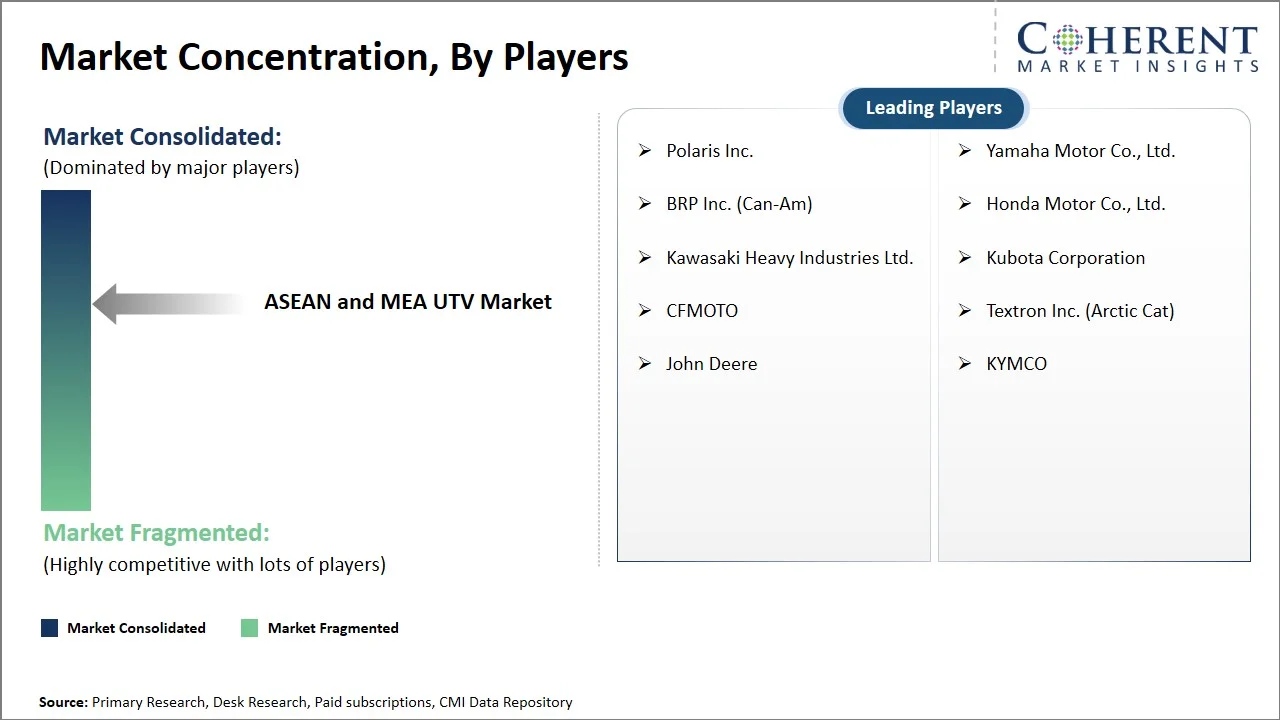
The competitive landscape of the ASEAN and MEA UTV market is led by global OEMs such as Polaris Inc., BRP (Can-Am), Yamaha Motor Co., and Kubota, which dominate with strong portfolios in high-performance, utility, and agriculture-focused vehicles, while CFMOTO is rapidly expanding its footprint through aggressive pricing and localized distribution in Southeast Asia and parts of the Middle East; competition is intensifying as established players focus on premium desert, tourism, and industrial applications in the MEA region, whereas ASEAN markets are more price-sensitive and driven by agricultural and plantation demand, creating a dual structure where premium North American/Japanese brands compete with cost-competitive Chinese manufacturers across different end use segments.
Market Report Scope
ASEAN and MEA UTV Market Report Coverage
| Report Coverage | Details | ||
|---|---|---|---|
| Base Year: | 2025 | Market Size in 2026: | USD 308.2 Mn |
| Historical Data for: | 2020 To 2024 | Forecast Period: | 2026 To 2033 |
| Forecast Period 2026 to 2033 CAGR: | 5.8% | 2033 Value Projection: | USD 458.7 Mn |
| Segments covered: |
| ||
| Companies covered: | Polaris Inc., Yamaha Motor Co., Ltd., BRP Inc. (Can-Am), Honda Motor Co., Ltd., Kawasaki Heavy Industries Ltd., Kubota Corporation, CFMOTO, Textron Inc. (Arctic Cat), John Deere, and KYMCO | ||
| Growth Drivers: |
| ||
| Restraints & Challenges: |
| ||
Analyst Opinion (Expert Opinion)
- The ASEAN and MEA UTV market is a structurally expanding segment driven by practical, real-world utility rather than lifestyle demand, where Polaris, BRP (Can-Am), Yamaha, and Kubota maintain strong leadership in premium and utility applications, while CFMOTO continues to gain share through aggressive pricing and rapid ASEAN distribution expansion; overall, experts highlight that market dynamics are increasingly split between MEA’s high-demand desert tourism, defense, and industrial fleets, and ASEAN’s agriculture- and plantation-driven demand, making the sector highly application-specific rather than uniform.
- Future prospects for the ASEAN and MEA UTV market remain positive, with sustained growth expected due to rising mechanization in agriculture, continued mining and construction expansion, and strong tourism-driven fleet demand in MEA, while upcoming trends such as electrified UTVs, hybrid utility platforms, and stricter regulatory compliance in ASEAN are expected to reshape product strategies; OEMs are likely to focus on more durable, multi-purpose, and cost-efficient vehicles, with increasing adoption in government fleets, commercial plantations, and eco-tourism operations driving long-term market expansion.
Speak to the analyst
Want personalized insights?
Take the findings above to one of our principal consultants, or have the report rebuilt around the segments, geographies and competitors you actually track.
Market Segmentation
- Product Type Insights (Revenue, USD Million, 2021 - 2033)
- ICE UTVs
- Gasoline
- Diesel
- Electric UTVs
- Lead-Acid Battery
- Lithium-Ion Battery
- ICE UTVs
- Drive Type Insights (Revenue, USD Million, 2021 - 2033)
- 2WD
- 4WD
- Load Capacity Insights (Revenue, USD Million, 2021 - 2033)
- Light-Duty (≤ 450 Kg)
- Medium-Duty (451–750 Kg)
- Heavy-Duty (>750 Kg)
- Seating Capacity Insights (Revenue, USD Million, 2021 - 2033)
- 2-Seater
- 4-Seater
- 6-Seater
- Sales Channel Insights (Revenue, USD Million, 2021 - 2033)
- Online
- Offline
- End User Insights (Revenue, USD Million, 2021 - 2033)
- Agriculture & Farming
- Construction
- Mining
- Forestry
- Industrial & Warehouse Operations
- Defense & Security
- Military/Government & Defense Forces
- Police & Law Enforcement
- Emergency Response (Fire, Disaster, and Medical)
- Border Security & Patrol
- Utilities & Municipal Services
- Recreation, Tourism & Resorts
- Commercial Facilities & Large Campuses
- Key Players Insights
- Polaris Inc.
- Yamaha Motor Co., Ltd.
- BRP Inc. (Can-Am)
- Honda Motor Co., Ltd.
- Kawasaki Heavy Industries Ltd.
- Kubota Corporation
- CFMOTO
- Textron Inc. (Arctic Cat)
- John Deere
- KYMCO
Sources
Primary Research Interviews
- UTV Manufacturers and Equipment Suppliers
- Regional Distributors and Dealers
- End-user Industries (Agriculture, Construction, Mining)
- Regulatory Authorities and Government Officials
Magazines
- ATV World Magazine
- Off-Road Business Magazine
- PowerSports Business
- Utility Vehicle Guide
Journals
- International Journal of Automotive Technology
- SAE International Journal of Commercial Vehicles
- Journal of Terramechanics
Associations
- ASEAN Automotive Federation (AAF)
- Specialty Vehicle Institute of America (SVIA)
- International Association of Chiefs of Police (IACP)
- Recreation Vehicle Industry Association (RVIA)
Public Domain Sources
- ASEAN Statistical Database
- Middle East and Africa Trade Statistics
- Government Ministry Publications
- UN Comtrade Database
Proprietary Elements
- CMI Data Analytics Tool
- Proprietary CMI Existing Repository of information for last 10 years
Get access to 250+ pages report
Every segment, forecast, competitor profile and data table behind the analysis above — available for instant download.
- ESOMAR Member
- ISO 9001:2015 Certified
- D-U-N-S Registered
- GDPR & CCPA Compliant
Missing comfort of reading report in your local language? Find your preferred language:
Transform your Strategy with Exclusive Trending Reports
Frequently Asked Questions
The ASEAN and MEA UTV market is expected to stand at USD 308.2 Mn in 2026 and is expected to reach USD 458.7 Mn by 2033.
The CAGR of the ASEAN and MEA UTV market is projected to be 5.8% from 2026 to 2033.
Rising demand for off-road recreational and adventure tourism activities and increasing use of UTVs in agriculture, mining, and construction sectors are the major factors driving the growth of the ASEAN and MEA UTV Market.
High purchase and maintenance costs of UTVs and strict government regulations regarding off-road vehicle usage and emissions are the major factors hampering the growth of the ASEAN and MEA UTV market.
In terms of product type, ICE UTVs are estimated to dominate the market revenue share in 2026.
Yes, they are widely used for site inspection, personnel transport, and light cargo movement in mining areas.
They provide safe, fast, and durable off-road mobility for safari and adventure tourism operators.