

Global Auto Transportation Market Size and Forecast – 2026-2033
The Global Auto Transportation Market is estimated to be valued at USD 468.2 Mn in 2026 and is expected to reach USD 802.4 Mn by 2033, exhibiting a compound annual growth rate (CAGR) of 8.0% from 2026 to 2033.
Key Takeaways of the Global Auto Transportation Market
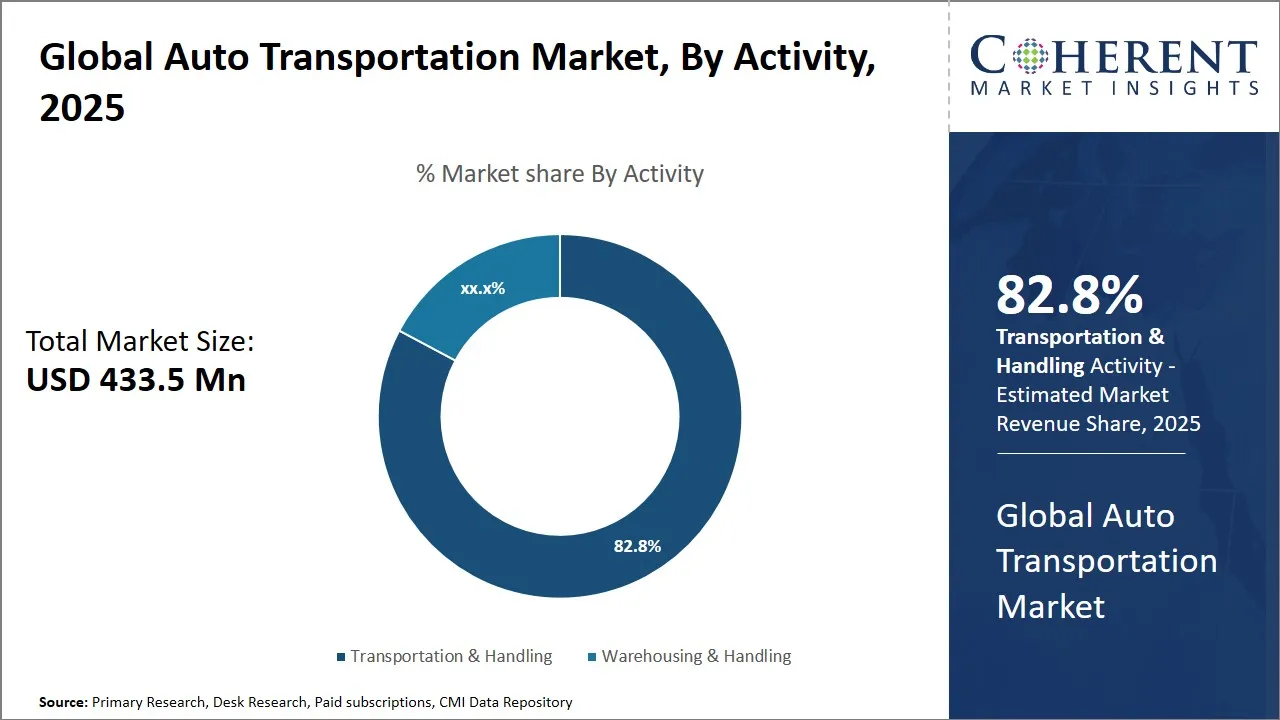
- The transportation & handling segment is expected to lead the market holding a share of 83.8 % in 2026.
- The automobile parts segment is projected to dominate with a share of 52% in 2026.
- The roadways segment lead the market holding an estimated share of 42.7 % in 2026.
- Asia Pacific, holding a projected share of 47.8% in 2026, and dominate the market.
- North America, holding an estimated share of 27% in in 2026, and shows the fastest growth in the market.
Market Overview
The market sees a shift towards sustainable and technology-driven solutions in auto transportation. The use of electric and autonomous vehicles and improved digital platforms for fleet management, is changing traditional transportation models. Also, increasing consumer preference for eco-friendly transport options and regulatory focus on reducing carbon emissions are adding to innovation and adoption of greener alternatives within the industry, shaping its growth trajectory for the coming years.
Current Events and Its Impact
Current Events | Description and its Impact |
Geopolitical and Trade Developments |
|
Economic and Industrial Trends |
|
Segmental Insights
- Current Industry Events of 2026
- Market Size Estimation
- Regional Breakdown
- Competitive Landscape
- Customer Intelligence
- Segmental Analysis
- Pricing Analysis
- Key Market Drivers, Challenges & Future Trends
- Customized Insights Section
Global Auto Transportation Market Insights, By Activity – Transportation & Handling Dominates Owing to Efficiency and Real-Time Coordination
The transportation & handling segment hold the largest share of 83.8% in the global auto transportation market in 2026, because of its critical role in ensuring the timely and safe movement of vehicles and automotive components across regions. The segment leads because of rising global vehicle production, cross-border trade expansion, and increasing consumer expectations for quick and damage-free deliveries.
Technological innovations like GPS-enabled fleet management, IoT-based tracking systems, and automated dispatch optimization have also enhanced operational efficiency. Companies are adopting real-time logistics coordination to reduce lead times and in-transit risks.
Wallenius Wilhelmsen’s implementation of AI-powered cargo handling solutions improved route efficiency and reduced vehicle handling times by nearly 20%. This shows how digital transformation in transportation and handling is becoming a big differentiator for global logistics providers, solidifying the segment’s leading position in the market.
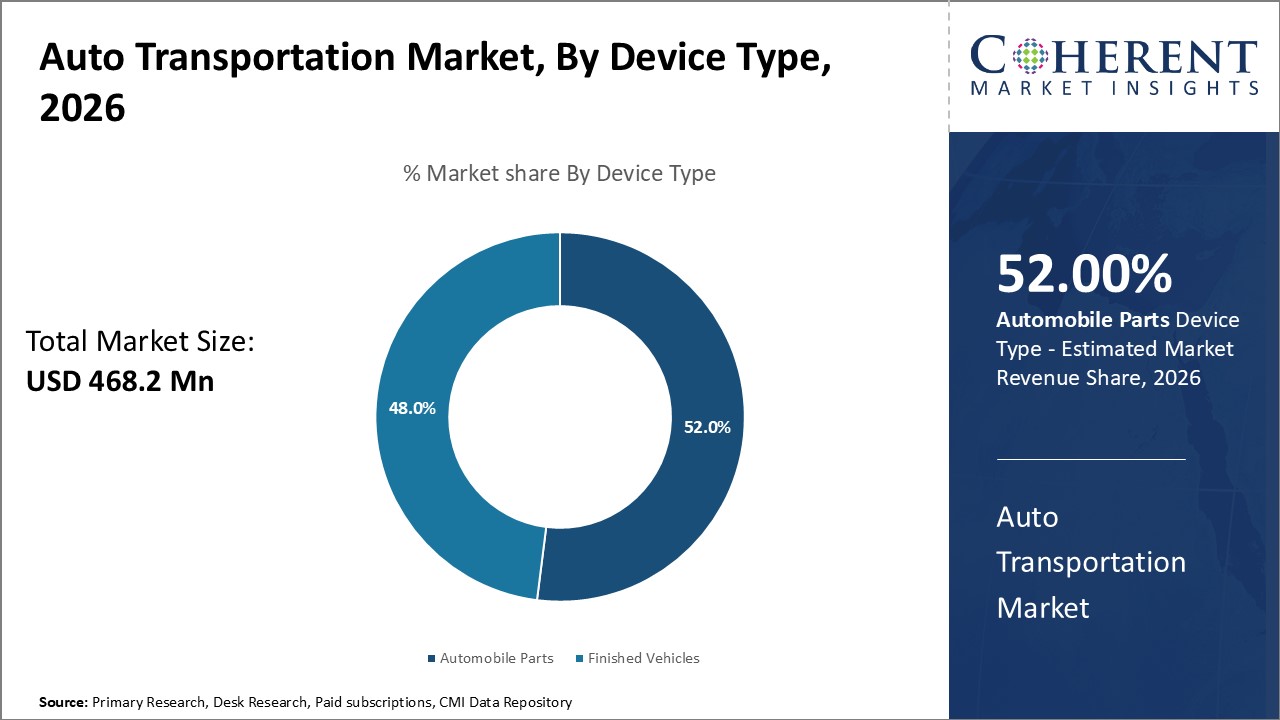
Global Auto Transportation Market Insights, By Device Type – Dominance of Automobile Parts Because of Complex Supply Chain Integration
The automobile parts segment is projected to hold the highest share of 52% in 2026 due to the complex global supply chains involved. Parts like engines, electronics, and transmissions are often sourced from multiple suppliers worldwide, needing frequent, smaller shipments compared to finished vehicles. The growth of electric vehicles (EVs) has also made demand for specialized components like batteries and electric drivetrains, which require careful handling and temperature control. Outsourcing to low-cost regions also extends transportation routes, making integrated shipment coordination essential.
Denso Corporation, a big automotive parts supplier, uses advanced logistics tracking and cold-chain solutions to ensure timely delivery of sensitive EV components across Asia and Europe, exemplifying efficient parts-focused transport.
Global Auto Transportation Market Insights, By Mode of Transport – Roadways Segment Leads Driven by Flexibility and Extensive Infrastructure Network
Road transport accounts for the largest share at 42.7% in 2026, driven by its flexibility, extensive infrastructure, and door-to-door delivery capability. Roads efficiently connect manufacturing plants, warehouses, and dealerships, making possible just-in-time production and short- to medium-haul deliveries. Technological advancements in fleet telematics, route optimization, and digital dispatch have improved operational efficiency. Road transport also integrates smoothly with rail, port, and air networks for multimodal logistics.
Montway Auto Transport uses GPS-enabled fleet management and dynamic routing to deliver vehicles across the U.S. efficiently, demonstrating the advantages of road-based transportation in auto logistics.
Pricing Analysis of the Auto Transportation Market
Service/Item | Typical Price (USD) | Price Range (USD) |
Open-carrier (domestic) — per mile (average) | USD 0.75/mile | USD 0.40 – USD 2.00/mile |
Open-carrier (domestic) — short haul (≤500 mi) — typical trip | USD 400 | USD 300 – USD 900 |
Open-carrier (domestic) — cross-country (≈2,500–3,000 mi) — typical trip | USD 1,100 | USD 800 – USD 1,800 |
Enclosed transport — per mile (average) | USD 1.80/mile | USD 1.50 – USD 2.50/mile |
Enclosed transport — cross-country (2,500+ mi) | USD 2,500 | USD 2,000 – USD 6,000+ |
Rail (auto-rack/train) — per vehicle (where available) | USD 600 | USD 200 – USD 1,100 |
International — RoRo (ocean) per vehicle (short/typical) | USD 900 | USD 700 – USD 2,000 |
International — Ocean (container) per vehicle | USD 2,200 | USD 1,500 – USD 5,500+ |
International — Air freight (per vehicle, urgent/luxury) | USD 6,000 | USD 5,000 – USD 30,000+ |
Terminal handling & port destination charges — per vehicle (typical add-ons) | USD 50 | USD 10 – USD 500 |
Customs, duties & government fees — example (U.S.) | 0.125% of declared ocean cargo value (HMF) + MPF (varies) | Varies by vehicle value; e.g., USD 62.50 on USD 50k @ 0.125% HMF |
Insurance (cargo/vehicle transit) — per vehicle | USD 50–USD 300 | 0.1% – 1.0% of declared value (typical) |
Fuel/BAF surcharge — per shipment (typical add) | USD 25–USD 150 | Varies by lane & fuel index |
Door-to-door premium (service add) | USD 75–USD 500 | Depends on pickup/drop locations & distance to terminals |
Regional Insights
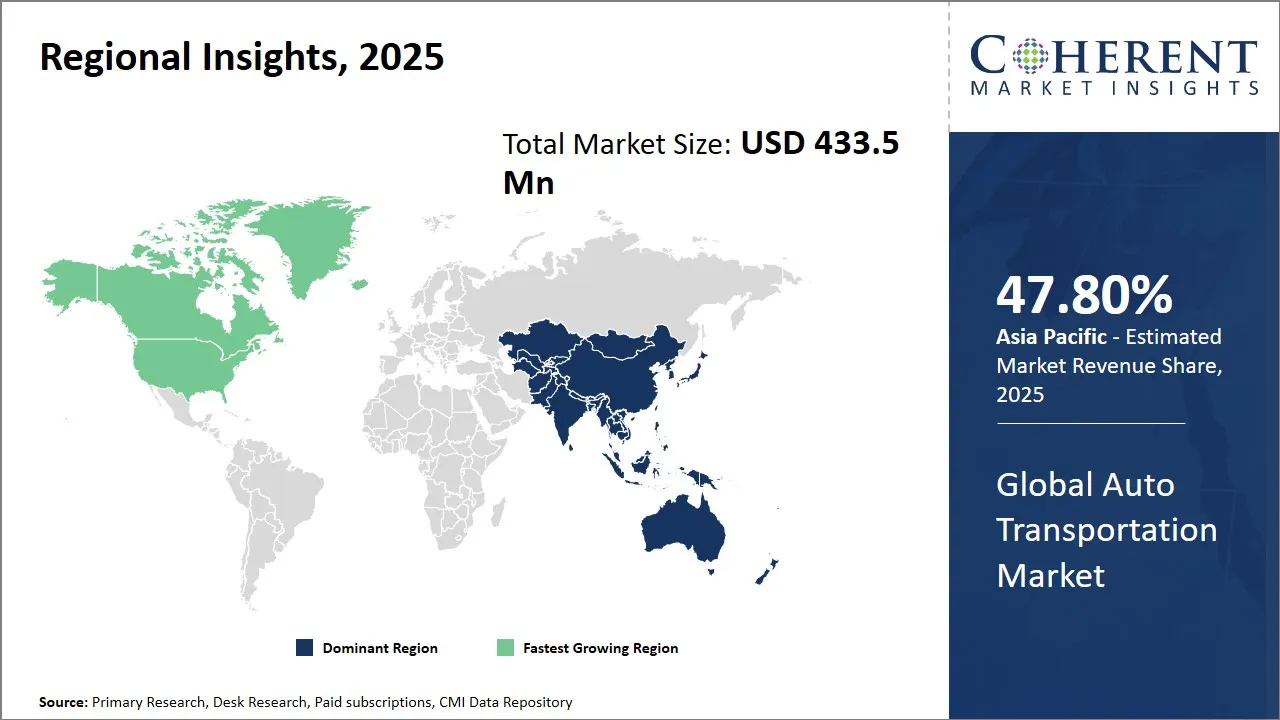
Asia Pacific Auto Transportation Market Analysis and Trends
The Asia Pacific, holding a projected share of 47.8% in 2026, dominates the auto transportation market because of fast industrialization, increasing automobile production, and rising demand in emerging economies such as China, India, and Southeast Asia. The region’s growing manufacturing base, led by automotive giants like Toyota, Hyundai, and SAIC Motor, needs agile and scalable transportation networks.
Government initiatives for improving road infrastructure and logistics efficiency and trade expansions in ASEAN and China’s Belt and Road Initiative, have enhanced connectivity and market accessibility. The increasing preference for electric vehicles also adds to innovation in transportation modes. Also, investments from third-party logistics providers like Yusen Logistics and Nippon Express are making service delivery better and expanding capacity.
North America Auto Transportation Market Analysis and Trends
North America, holding an estimated share of 27% in 2026, shows the fastest growth in the global auto transportation market because of a mature and highly integrated transportation infrastructure, strong industrial presence, and advanced technological adoption. The well-established road and rail networks facilitate efficient movement of automobiles, while the presence of major automotive manufacturers like General Motors, Ford, and Tesla has bolstered demand for sophisticated logistics and specialized transportation solutions.
Government policies supporting infrastructure modernization and emissions regulations have pushed investment in eco-friendly and smart transportation methods. Also, the region sees strong supply chain dynamics with Canada and Mexico, improved by trade agreements such as USMCA, which help streamline cross-border auto transport, increases operational efficiencies, and supports a vast aftermarket and OEM network.
Global Auto Transportation Market Outlook for Key Countries
U.S. Auto Transportation Market Analysis and Trends
The U.S. remains critical because of its extensive highway infrastructure, technological innovation, and presence of key players like Ryder System and J.B. Hunt Transport Services. These companies offer advanced logistics solutions like fleet telematics and optimized routing needed for auto transportation. U.S. government regulations for safety and environmental standards add to the adoption of green transportation.
China Auto Transportation Market Analysis and Trends
China auto transportation market is highly dynamic, supported by the world’s largest automobile production hub. Key companies like Sinotrans and China COSCO Shipping play important roles in domestic and international auto movement. The Chinese government’s policies for infrastructure upgrades like new expressways and rail freight corridors improve efficiency. Also, the strong push for electric vehicle adoption creates the need for specialized transportation, affecting the logistics ecosystem. Trade policies for exports and imports add to the market expansion.
Germany Auto Transportation Market Analysis and Trends
Germany continues to lead as Europe’s automotive powerhouse, seeing global giants like Volkswagen, BMW, and Daimler. The country’s advanced transport network like dense highways and efficient rail systems supports huge volumes of auto transport. Companies like Dachser and DB Schenker provide integrated logistics made for automotive clients, focusing on precision and reliability. Strong regulatory frameworks for emissions and safety add to technology investments in the transport segment. Germany’s big role in intra-European supply chains shows its significance in the global auto transportation market.
India Auto Transportation Market Analysis and Trends
India auto transportation market shows huge potential because of burgeoning automobile manufacturing and growing domestic demand. The government’s focus on improving road infrastructure through initiatives like the Bharatmala project improves connectivity in key industrial corridors. Companies like Mahindra Logistics and Blue Dart are growing their capabilities with innovative transport solutions like multi-modal logistics. The increasing export orientation and gradual integration with global automotive supply chains contribute to market growth, alongside a growing interest in electric vehicle transportation frameworks supported by government incentives.
Brazil Auto Transportation Market Analysis and Trends
Brazil auto transportation market is influenced by its expanding automotive industry and substantial internal demand in Latin America. Companies like Tegma Gestão Logística lead in transportation services made for Brazil’s geographic diversity and infrastructural challenges. Government programs for improving road conditions and logistics efficiency, and policy support for auto exports, improves the market environment. Brazil’s growing logistics technologies and growing e-commerce sectors also add to innovations in auto delivery and distribution.
Market Players, Key Development, and Competitive Intelligence
Key Developments
- On October 13, 2025, French auto parts giant OP Mobility announced plans to invest up to USD 300 million in India, doubling factories and boosting hydrogen and battery tech to drive clean mobility growth.
- In August 2025, VinFast officially inaugurated its electric vehicle (EV) assembly plant at the SIPCOT Industrial Park in Thoothukudi, Tamil Nadu, India. This milestone marks a major step in VinFast’s global expansion, reinforcing the company’s long-term commitment to the world’s third-largest automobile market.
- In August 2025, SYCN Auto Logistics, Mercury Auto Transport, and Rite Way Auto Transport Group merged to form the largest founder-led, privately owned automotive logistics company in North America.
- In June 2025, Toyota and Daimler Truck just sealed a USD 6.4 billion merger between their Japanese truck divisions, Hino Motors and Mitsubishi Fuso, setting the stage for a heavyweight in commercial vehicles.
Top Strategies Followed by Auto Transportation Market Players
- Established market leaders, often multinational corporations with substantial resources, make a lot of investment in research and development (R&D) to continually innovate high-performance, reliable products that meet evolving consumer and regulatory demands.
- United Road Services has invested in AI-based load optimization and telematics systems that enhance fleet efficiency and minimize empty miles.
- Mid-level players in the auto transportation sector strategically focus on delivering cost-effective solutions that strike a balance between quality and affordability.
- Montway Auto Transport introduced dynamic pricing models and expanded its network of independent carriers to provide more affordable rates for online used-car platforms like Carvana and Vroom.
- Small-scale players in the global auto transportation market carve out their niches by concentrating on specialized features and innovative solutions tailored to specific consumer needs or unique regional demands.
- Intercity Lines specializes in enclosed luxury and classic car transport, catering to high-end clients and auctions, which allows them to maintain premium pricing despite smaller scale.
Market Report Scope
Auto Transportation Market Report Coverage
| Report Coverage | Details | ||
|---|---|---|---|
| Base Year: | 2025 | Market Size in 2026: | USD 468.2 Mn |
| Historical Data for: | 2020 To 2024 | Forecast Period: | 2026 To 2033 |
| Forecast Period 2026 to 2033 CAGR: | 8.0% | 2033 Value Projection: | USD 802.4 Mn |
| Geographies covered: |
| ||
| Segments covered: |
| ||
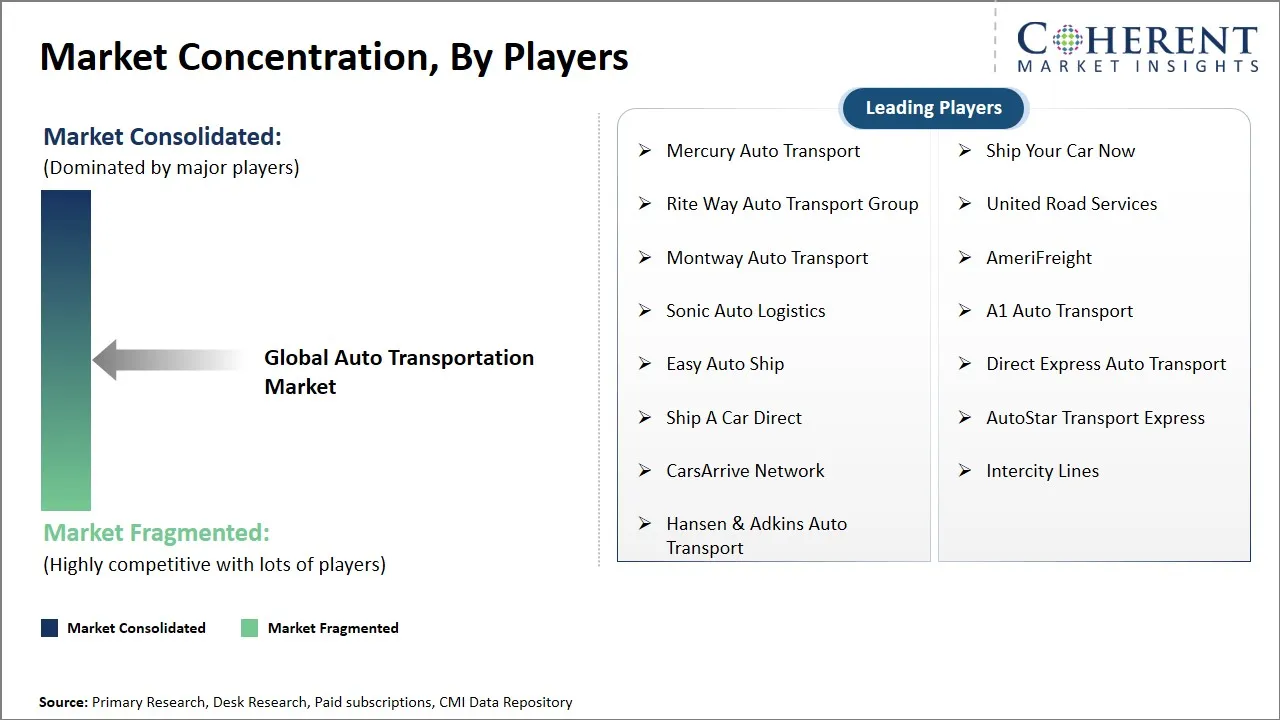
| Companies covered: | Mercury Auto Transport, Ship Your Car Now, Rite Way Auto Transport Group, United Road Services, Montway Auto Transport, AmeriFreight, Sonic Auto Logistics, A1 Auto Transport, Easy Auto Ship, Direct Express Auto Transport, Ship A Car Direct, AutoStar Transport Express, CarsArrive Network, Intercity Lines, and Hansen & Adkins Auto Transport | ||
| Growth Drivers: |
| ||
| Restraints & Challenges: |
| ||
Market Dynamics
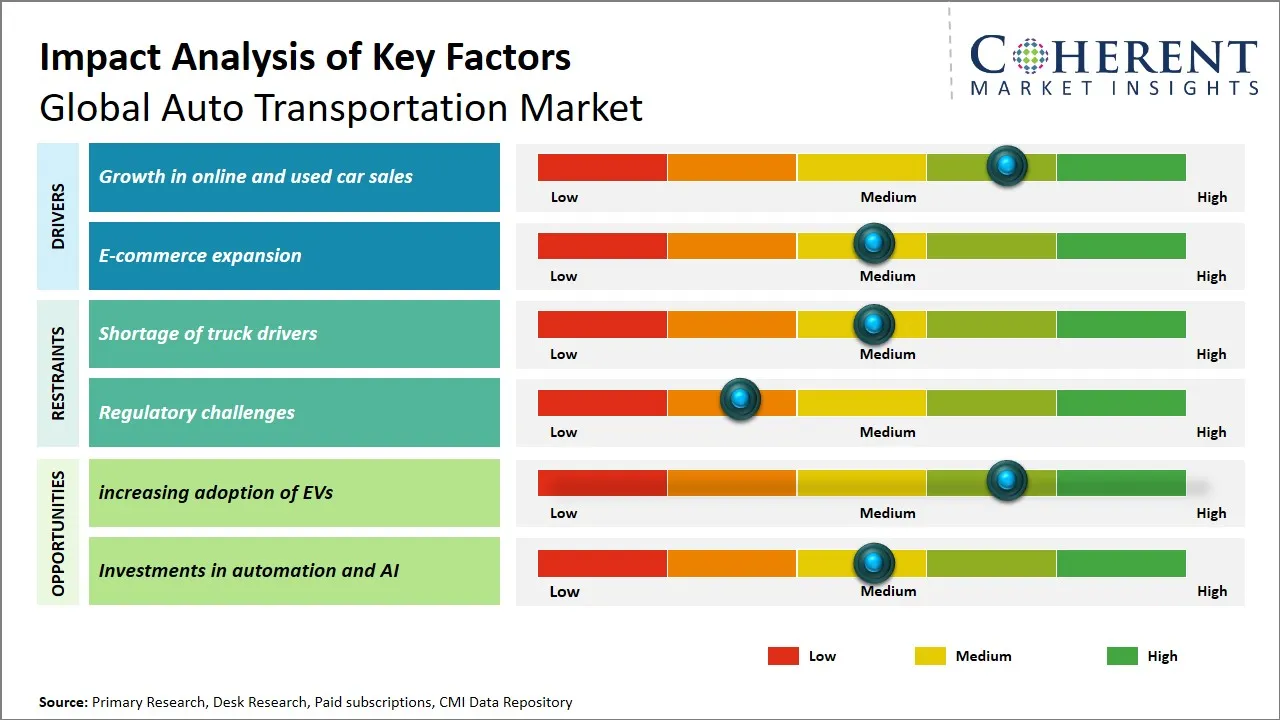
Global Auto Transportation Market Driver – Growth in Online and Used Car Sales
The rapid growth of online platforms facilitating vehicle sales, especially in the used car segment, has significantly propelled the global auto transportation market. As consumers increasingly prefer buying cars through digital channels, the geographical reach of car sales has expanded beyond local markets, necessitating reliable and efficient logistics solutions to transport vehicles over long distances. Online marketplaces have made it easier for buyers to access a wider selection of vehicles, including from remote locations, thereby driving demand for specialized transportation services that ensure safe and timely delivery.
Additionally, the surge in used car transactions further intensifies the need for dependable auto transportation, as these vehicles often require transfer between dealerships, auction houses, and private buyers. This shift in purchase behavior compels manufacturers, dealers, and logistics providers to optimize their distribution networks, adopting advanced tracking technologies and flexible delivery options to meet evolving customer expectations, ultimately reinforcing the integral role of auto transportation in the evolving automotive ecosystem.
Global Auto Transportation Market Opportunity – Increasing Adoption of EVs
The accelerating shift towards electric vehicles (EVs) presents a significant growth opportunity in the global auto transportation market. Governments worldwide are implementing stringent emission regulations and offering substantial incentives to promote cleaner transportation alternatives, which is driving both consumer demand and manufacturer investment in EV technology. Advances in battery technology, enhanced charging infrastructure, and decreasing production costs are making EVs more accessible and practical for a broader range of consumers. This trend not only stimulates the automotive sector but also creates a ripple effect across the transportation ecosystem, including logistics, fleet operations, and ride-sharing services, all of which are increasingly integrating electric vehicles to reduce carbon footprints and operational costs.
Moreover, the surge in EV adoption encourages innovation in related markets such as battery recycling, smart grid integration, and energy storage solutions, fostering a multidisciplinary growth environment. Automotive manufacturers are prioritizing EV model expansions to capture emerging market segments, intensifying competition and accelerating technological advancements. Additionally, the rising consumer preference for sustainable products, coupled with improving EV performance metrics like range and charging speed, enhances market acceptance. As urbanization drives demand for eco-friendly mobility solutions, the electrification of public and private transportation modes offers a pathway to reduce urban pollution, positioning electric vehicles as a cornerstone of the future global transportation landscape.
Analyst Opinion (Expert Opinion)
- The persistent shortage of qualified drivers — projected to exceed 100,000 vacancies globally by 2025 — is increasing wage pressures and limiting transport capacity. This has led to higher freight rates and longer vehicle delivery times, particularly in the North American and European markets where cross-country routes rely heavily on long-haul drivers.
- In response, major logistics firms are investing in automation technologies such as AI-assisted dispatch systems, driver-assist vehicles, and digital freight matching platforms to mitigate dependency on manual operations. This shortage is thus fast-tracking industry digitization, pushing both large and mid-level players toward advanced telematics and semi-autonomous fleet trials.
- With limited driver availability, companies are diversifying transport modes — increasing reliance on rail and maritime RoRo (Roll-on/Roll-off) carriers for long-distance shipments. Additionally, third-party logistics (3PL) partnerships are becoming more common as automakers and dealers seek to stabilize delivery schedules and reduce exposure to domestic trucking constraints.
Speak to the analyst
Want personalized insights?
Take the findings above to one of our principal consultants, or have the report rebuilt around the segments, geographies and competitors you actually track.
Market Segmentation
- Activity Insights (Revenue, USD Mn, 2021 - 2033)
- Transportation & Handling
- Warehousing & Handling
- Device Type Insights (Revenue, USD Mn, 2021 - 2033)
- Automobile Parts
- Finished Vehicles
- Mode of Transport Insights (Revenue, USD Mn, 2021 - 2033)
- Roadways
- Maritime
- Railways
- Airways
- Distribution Insights (Revenue, USD Mn, 2021 - 2033)
- Domestic
- International
- Regional Insights (Revenue, USD Mn, 2021 - 2033)
- North America
- U.S.
- Canada
- Latin America
- Brazil
- Argentina
- Mexico
- Rest of Latin America
- Europe
- Germany
- U.K.
- Spain
- France
- Italy
- Russia
- Rest of Europe
- Asia Pacific
- China
- India
- Japan
- Australia
- South Korea
- ASEAN
- Rest of Asia Pacific
- Middle East
- GCC Countries
- Israel
- Rest of Middle East
- Africa
- South Africa
- North Africa
- Central Africa
- North America
- Key Players Insights
- Mercury Auto Transport
- Ship Your Car Now
- Rite Way Auto Transport Group
- United Road Services
- Montway Auto Transport
- AmeriFreight
- Sonic Auto Logistics
- A1 Auto Transport
- Easy Auto Ship
- Direct Express Auto Transport
- Ship A Car Direct
- AutoStar Transport Express
- CarsArrive Network
- Intercity Lines
- Hansen & Adkins Auto Transport
Sources
Primary Research Interviews
Stakeholders
- Vehicle Transport & Logistics Companies
- Automotive OEMs and Dealers
- Fleet Management and 3PL Service Providers
- Rail & Maritime Carriers
- Independent Trucking Associations and Driver Unions
- EV Logistics Specialists and Battery Transport Experts
- Automotive Supply Chain Consultants and Digital Freight Platform Managers
Databases
- U.S. Bureau of Transportation Statistics (BTS)
- European Automobile Manufacturers Association (ACEA)
- Japan Automobile Manufacturers Association (JAMA)
- International Transport Forum (ITF)
- Auto Logistics Data Portal (ALDP)
- Freight Analytics Network (FAN)
- OECD Transport Statistics
Magazines
- Transport Topics
- Automotive Logistics Magazine
- Fleet Owner Magazine
- Global Trade Review
- Heavy Duty Trucking (HDT)
- EV Fleet World
- Commercial Carrier Journal (CCJ)
Journals
- Journal of Transport Geography
- Transportation Research Part E: Logistics and Transportation Review
- International Journal of Physical Distribution & Logistics Management
- Journal of Supply Chain Management and Operations
- Global Journal of Automotive and Transport Systems
- Smart Mobility and Logistics Journal
Newspapers
- The Wall Street Journal (U.S.)
- The Economic Times (India)
- Financial Times (U.K.)
- The Korea Herald (South Korea)
- Nikkei Asia (Japan)
- Gulf Business News (U.A.E.)
- The Globe and Mail (Canada)
Associations
- International Road Transport Union (IRU)
- American Trucking Associations (ATA)
- European Road Haulers Association (ERHA)
- National Automobile Dealers Association (NADA)
- Society of Motor Manufacturers and Traders (SMMT, UK)
- Asia-Pacific Automotive Logistics Association (APALA)
- Electric Vehicle Transport & Safety Council (EVTSC)
Public Domain Sources
- World Bank Logistics Performance Index (LPI)
- International Monetary Fund (IMF) Trade & Logistics Data
- United Nations Economic Commission for Europe (UNECE)
- U.S. Department of Transportation (DOT)
- EUROSTAT Transport Data
- ResearchGate
- World Trade Organization (WTO) Transport Reports
Proprietary Elements
- CMI Data Analytics Tool, Proprietary CMI Repository of information for last 8 years
Get access to 250+ pages report
Every segment, forecast, competitor profile and data table behind the analysis above — available for instant download.
- ESOMAR Member
- ISO 9001:2015 Certified
- D-U-N-S Registered
- GDPR & CCPA Compliant
Missing comfort of reading report in your local language? Find your preferred language:
Transform your Strategy with Exclusive Trending Reports
Frequently Asked Questions
The global auto transportation market is estimated to be valued at USD 468.2 million in 2026 and is expected to reach USD 802.4 million by 2033.
The CAGR of the global auto transportation market is projected to be 8.0% from 2026 to 2033.
Growth in online and used car sales and e-commerce expansion are the major factors driving the growth of the global auto transportation market.
Shortage of truck drivers and regulatory challenges are the major factors hampering the growth of the global auto transportation market.
In terms of activity, the transportation & handling segment is estimated to dominate the market revenue share in 2026.
Mercury Auto Transport, Ship Your Car Now, Rite Way Auto Transport Group, United Road Services, Montway Auto Transport, AmeriFreight, Sonic Auto Logistics, A1 Auto Transport, Easy Auto Ship, Direct Express Auto Transport, Ship A Car Direct, AutoStar Transport Express, CarsArrive Network, Intercity Lines, and Hansen & Adkins Auto Transport are the major players.
It refers to the logistics sector dedicated to moving vehicles—cars, trucks, and motorcycles—across domestic and international routes via road, rail, sea, or air.