

Global Automated Sanding Sealing System Market Size and Forecast – 2026-2033
The Global Automated Sanding Sealing System Market is estimated to be valued at USD 1.62 Bn in 2026 and is expected to reach USD 3.15 Bn by 2033, exhibiting a compound annual growth rate (CAGR) of 10.0% from 2026 to 2033.
Key Takeaways of the Global Automated Sanding Sealing System Market
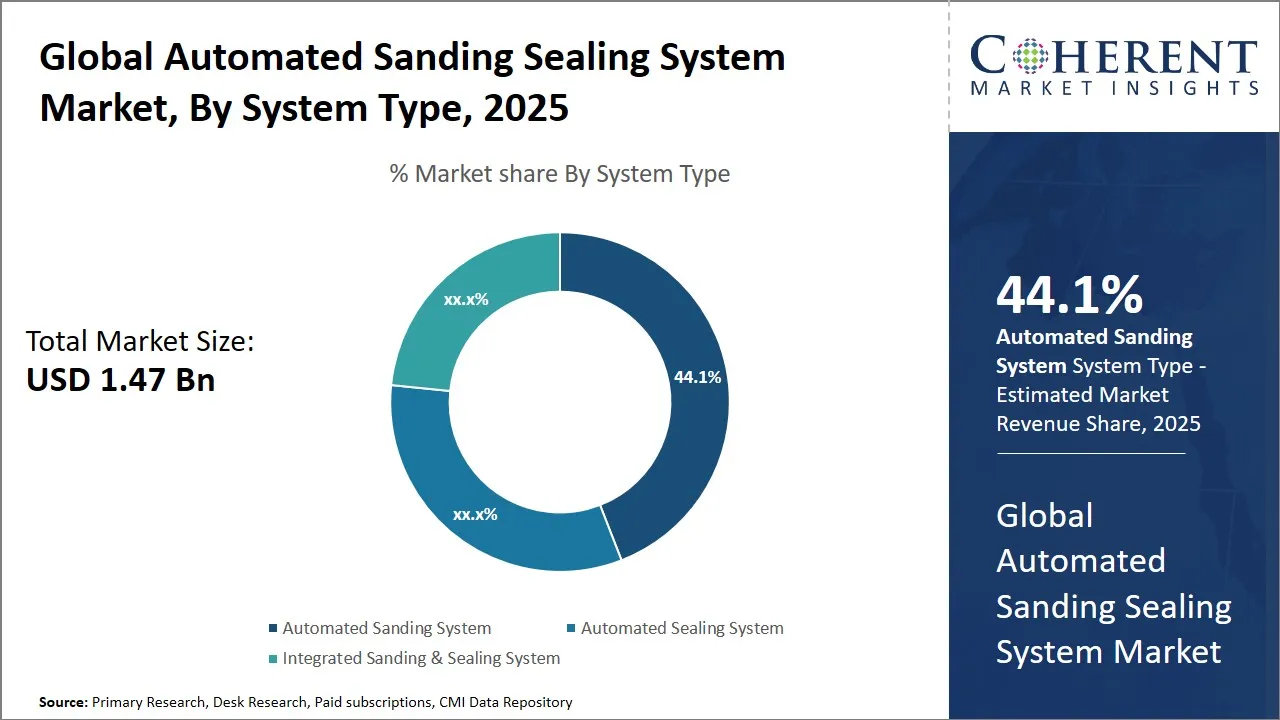
- The automated sanding system segment is expected to lead the market, holding a share of 45.1 % in 2026.
- The continuous system segment is projected to dominate with a share of 59.4 % in 2026.
- The automotive & transportation segment leads the market holding an estimated share of 22.5 % in 2026.
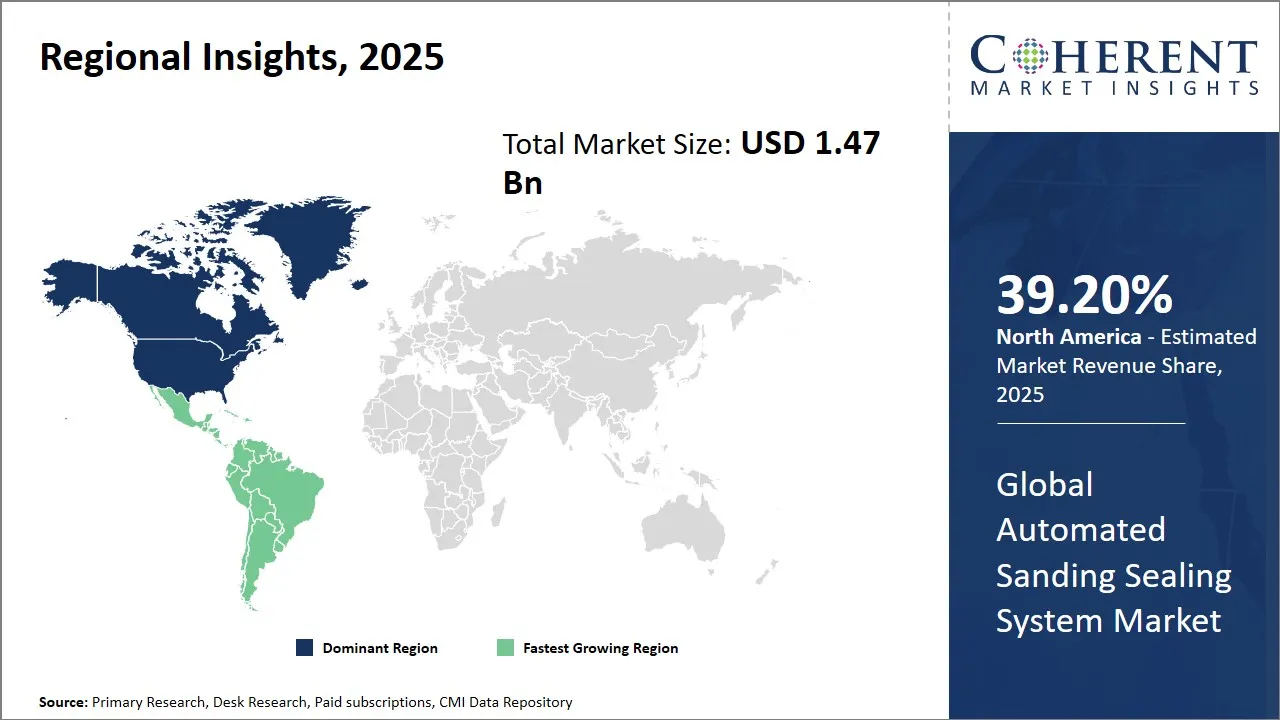
- North America, holding a share of 39.2 % in 2026, is expected to dominate the market.
- Latin America, holding a share of 5.9 % in 2026, is anticipated to show the fastest growth in the market.
Market Overview
The market is seeing the integration of advanced technologies such as AI and IoT to enhance system efficiency, precision, and reliability. Companies are focusing on making smarter, more adaptive sanding sealing machines that reduce material waste and energy consumption. Also, growing environmental regulations are encouraging manufacturers to adopt automated systems that ensure consistent quality and reduce emissions, further propelling the market expansion in the coming years.
Current Events and Its Impact
Current Events | Description and its Impact |
Geopolitical and Trade Developments |
|
Economic and Infrastructure Trends |
|
Segmental Insights
- Current Industry Events of 2026
- Market Size Estimation
- Regional Breakdown
- Competitive Landscape
- Customer Intelligence
- Segmental Analysis
- Pricing Analysis
- Key Market Drivers, Challenges & Future Trends
- Customized Insights Section
Global Automated Sanding Sealing System Market Insights, By System Type – Dominance of Automated Sanding System is Because of Precision and Efficiency
The automated sanding system segment is expected to lead the market with a 45.1% share in 2026 because of its precision, consistency, and speed compared to manual alternatives. Industries such as wood, metal, and composites depend on automated systems for uniform finishes that enhance both aesthetics and durability.
Advancements in sensor and adaptive control technologies allow real-time adjustments in sanding pressure and speed, increasing quality while reducing maintenance costs. Sustainability factors, such as reduced material waste and improved dust control, add to adoption.
Mirka’s AIROS robotic sanding system, integrated with ABB cobots, shows this shift toward intelligent, fully automated surface finishing solutions designed for continuous, high-accuracy operations.
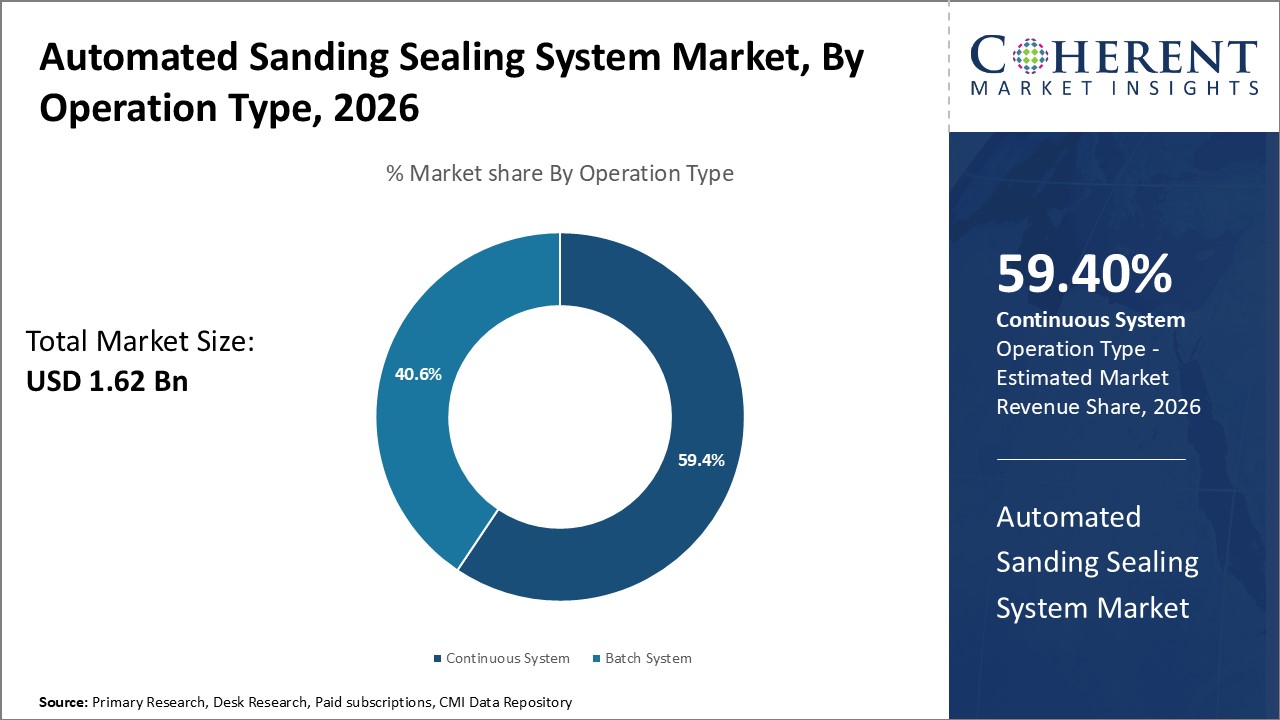
Global Automated Sanding Sealing System Market Insights, By Operation Type – Continuous System's Market Lead is Fueled by Demand for High-volume, Streamlined Production
The continuous system segment is projected to dominate with a 59.4% market share in 2026, supported by the growing demand for uninterrupted, high-volume production lines. Continuous systems improve productivity, cost efficiency, and quality by synchronizing with upstream and downstream operations like coating and assembly.
These systems are suited for manufacturers using lean production and just-in-time (JIT) models, minimizing downtime and labor requirements. Cefla’s Smartcoater PRO continuous finishing line brings together sanding, sealing, and coating into a single automated flow.
Global Automated Sanding Sealing System Market Insights, By End-use Industry – Automotive & Transportation Segment is Leading Because of High Standards for Surface Quality and Durability
The automotive & transportation sector is anticipated to hold the largest share at 22.5% in 2026, because of stringent standards for surface quality and corrosion resistance. Automated sanding and sealing systems ensure consistent preparation for coatings, needed for both conventional and electric vehicles. The rise of lightweight materials and EV components needing precise surface treatment adds to automation adoption, improving throughput and minimizing defects.
Dürr Group’s automated paint and surface preparation lines for Volkswagen show the integration of sanding and sealing processes to enhance finish quality and production efficiency in large-scale automotive manufacturing.
Pricing Analysis of the Automated Sanding Sealing System Market
System Type/Scale | Typical Price (USD) |
Entry-level automated sanding robot/cell (small footprint, e.g., gantry + robot arm) | 50,000 |
Mid-scale automated sanding machine (woodworking wide belt / brush sanding) | 60,000-80,000 |
Mid-scale automatic finishing (sanding + sealing/coating line) | 100,000-300,000 |
Large turnkey continuous sanding + sealing line (industrial, automotive or high-volume furniture) | 500,000-1,000,000+ |
Small automated/semi-automated sanding kit (cobot compatible) | Request-quote/>10,000 |
Regional Insights
North America Automated Sanding Sealing System Market Analysis and Trends
North America, holding a share of 39.2% in 2026, is expected to dominate the global automated sanding sealing system market, driven by the region’s advanced manufacturing ecosystem, strong presence of automotive and aerospace industries, and significant investment in industrial automation. The U.S. and Canada see well-established supply chains and technological infrastructure that make the integration of automated systems possible. Government initiatives pushing Industry 4.0 and smart factories further add to adoption.
North America hosts big companies such as 3M, Dynabrade Inc., and Festool (U.S. division), which actively innovate and provide highly efficient, customizable automated sanding and sealing solutions. Trade policies that encourage imports of automation technology and supportive legislation for workforce training have strengthened the market’s competitive edge.
Latin America Automated Sanding Sealing System Market Analysis and Trends
Latin America, holding a share of 5.9% in 2026, is projected to be the fastest-growing region in the global automated sanding sealing system market, driven by accelerating industrialization, expanding automotive assembly operations, and the strengthening furniture and wood manufacturing sectors in countries such as Brazil, Mexico, and Chile.
Big industry participants, including Cefla Finishing (Brazil operations), Dürr de México, and Graco Latin America, are growing their regional presence through partnerships, training centers, and after-sales support. The growth of regional trade blocs like MERCOSUR and USMCA further enhances cross-border equipment movement and supply chain integration, enabling faster technology diffusion.
Automated Sanding Sealing System Market Outlook for Key Countries
U.S. Automated Sanding Sealing System Market Analysis and Trends
The U.S. automated sanding sealing system market sees a mature manufacturing landscape with a lot of emphasis on precision finishing in automotive, aerospace, and furniture sectors. Big companies like 3M and Dynabrade have led innovation in automated sanding tools, offering integrated sealing solutions that improve production efficiency. High adoption rates of Industry 4.0 initiatives and automation subsidies push modernization of production lines, keeping the U.S. at the forefront of the market.
Germany Automated Sanding Sealing System Market Analysis and Trends
Germany automated sanding sealing system market grows because of its highly developed automotive and industrial machinery sectors. With a tradition of engineering excellence, companies like Festool and Leitz GmbH provide cutting-edge automated sanding and sealing equipment tailored to meet rigorous European standards. Government policies pushing industrial digitization and vocational training support the adoption of automation solutions. Germany’s strong export orientation makes its market position stronger by allowing companies to use international partnerships.
China Automated Sanding Sealing System Market Analysis and Trends
China has emerged as a pivotal market driven by expanding manufacturing hubs and infrastructure development. The focus on upgrading factory capabilities with automated sanding and sealing systems is supported by policy frameworks like “Made in China 2026.” Local manufacturers including U-POL and an increasing number of multinational subsidiaries enhance technology transfer and supply chain localization. China’s fast urbanization and increased consumer demand for quality manufacturing drive intensive adoption across automotive and electronics industries.
Japan Automated Sanding Sealing System Market Analysis and Trends
Japan continues to lead in technological innovation and precision automation within the automated sanding sealing system market. Established firms such as Matsui Machinery Co. and the Japanese arms of Bosch Rexroth push product advancements in robotic sanding and sealing systems, using the country’s robotics expertise. Government strategies supporting smart manufacturing (Society 5.0) and continuous workforce upskilling make a supportive environment for market expansion.
India Automated Sanding Sealing System Market Analysis and Trends
India automated sanding sealing system market is seeing a lot of growth due to its burgeoning automotive and wood furniture industries, combined with a growing emphasis on industrial automation to improve quality and reduce production costs. Government initiatives like “Make in India” and incentives for adopting smart technologies push investments in automated sanding and sealing systems. Several global players including Bosch and 3M have expanded their presence by making solutions for local manufacturing needs, while domestic firms are beginning to emerge with competitive offerings made for price-sensitive sectors.
Market Players, key Development, and Competitive Intelligence
Key Developments
- In September 2025, Mirka joined ABB’s trusted network of automation partners, the ABB Robotics Ecosystem. This new collaboration expands access to automated surface finishing solutions, making them more accessible to both end customers and system integrators.
- In September 2025, Dürr built a paint shop designed to slash CO2 emissions at one of the Volkswagen Group’s biggest manufacturing facilities. The turnkey project includes two identical painting lines that are particularly environmentally friendly due to their electrified equipment, such as the electric drying system.
- In July 2025, Graco Inc. entered into a definitive agreement to acquire Color Service, a global leader in automated dosing systems for powder and liquid applications.
- In March 2024, Mirka introduced new robotic sanders and polishers for automation. The Mirka AIROS, the first smart electric sander designed for robotic sanding applications, was joined by new models: the Mirka AIOS sanding heads and the Mirka AIROP polishing head. The AIROS is also now available in a new small size.
Top Strategies Followed by Automated Sanding Sealing System Market Players
- Established players dominate the market through huge investments in research and development, aiming to innovate high-performance and technologically advanced sanding sealing solutions.
- Dürr has been investing a lot in advanced, sustainable paint-shop and application technology, illustrating continued heavy R&D and product development for high-end turnkey finishing solutions.
- Mid-level players in the automated sanding sealing system market use a different approach focused on delivering cost-effective yet reliable solutions that appeal to price-sensitive segments.
- Timesavers offers a big lineup of wide-belt and combination-head sanders at accessible price points.
- Small-scale players in the automated sanding sealing system market carve out distinct niches by focusing on specialized product features and leveraging innovation to differentiate themselves.
- LÄGLER focuses on the floor-sanding niche (the HUMMEL belt sander is widely regarded as an icon in floor sanding), exemplifying a small/specialist OEM that dominates a well-defined segment through product depth and reputation rather than broad product breadth
Market Report Scope
Automated Sanding Sealing System Market Report Coverage
| Report Coverage | Details | ||
|---|---|---|---|
| Base Year: | 2025 | Market Size in 2026: | USD 1.62 Bn |
| Historical Data for: | 2020 To 2024 | Forecast Period: | 2026 To 2033 |
| Forecast Period 2026 to 2033 CAGR: | 10.0% | 2033 Value Projection: | USD 3.15 Bn |
| Geographies covered: |
| ||
| Segments covered: |
| ||
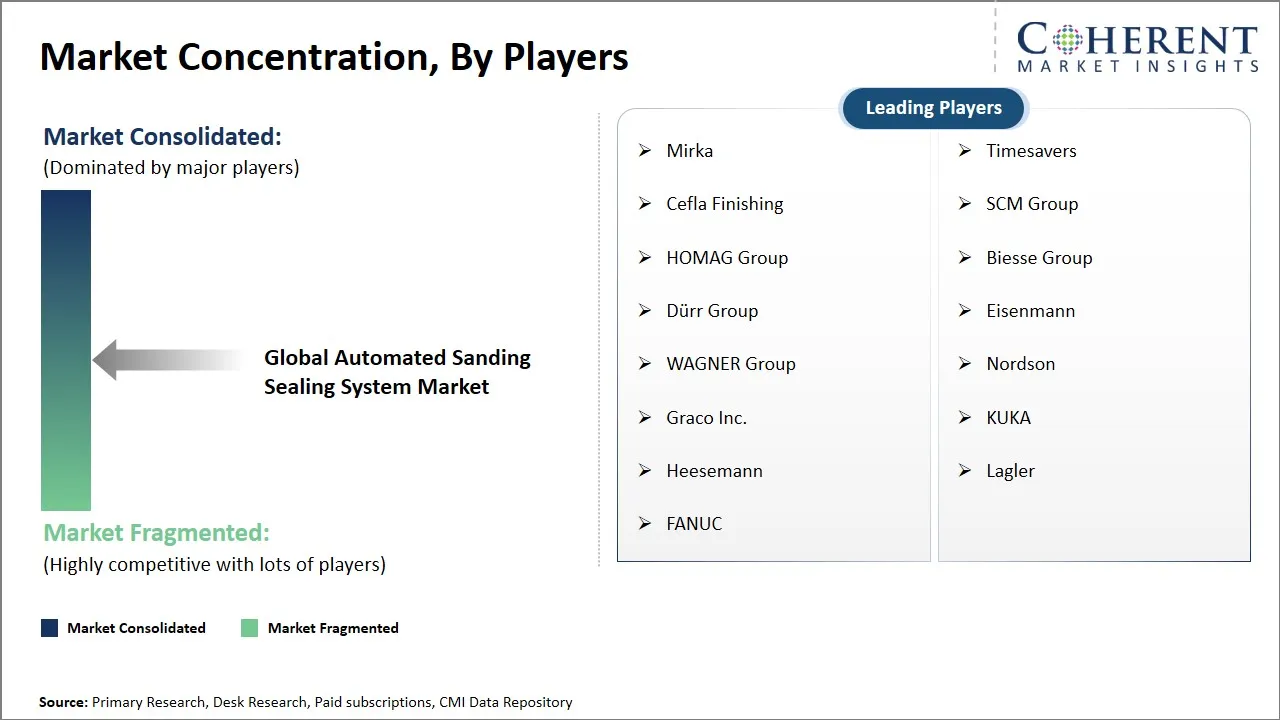
| Companies covered: | Mirka, Timesavers, Cefla Finishing, SCM Group, HOMAG Group, Biesse Group, Dürr Group, Eisenmann, WAGNER Group, Nordson, Graco Inc., KUKA, Heesemann, Lagler, and FANUC | ||
| Growth Drivers: |
| ||
| Restraints & Challenges: |
| ||
Market Dynamics
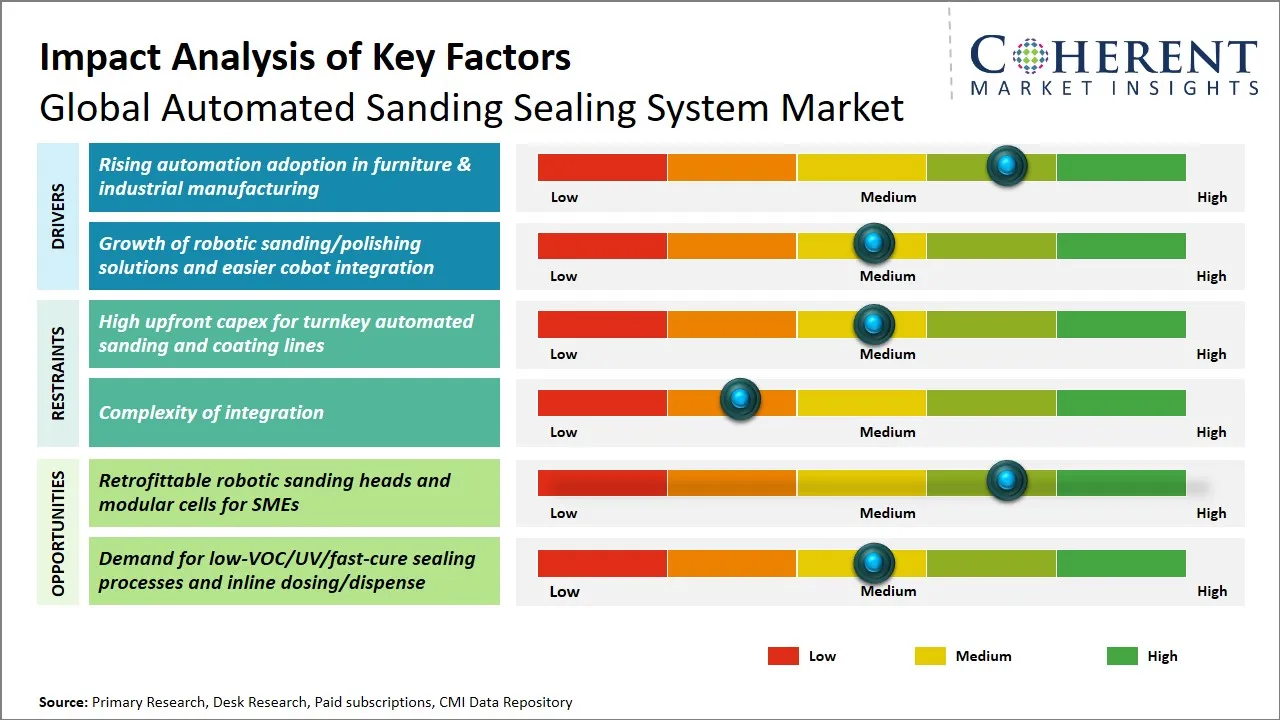
Global Automated Sanding Sealing System Market Driver – Rising Automation Adoption in Furniture & Industrial Manufacturing
The surge in automation across furniture and industrial manufacturing is a key driver for the global automated sanding sealing system market. Automation improves precision, reduces defects, and makes production cycles faster. With Industry 4.0 initiatives pushing smart factories, manufacturers are using robotics to improve consistency and reduce labor dependency. In furniture production, automated sanding systems give smooth, high-quality finishes while minimizing material waste and dust emissions.
For instance, HOMAG Group (Germany) has put automated sanding lines in major European furniture plants, achieving up to 30% higher productivity and improved surface uniformity. This growing move toward smart automation is reshaping global manufacturing efficiency and driving demand for advanced sanding and sealing technologies.
Global Automated Sanding Sealing System Market Opportunity – Retrofittable Robotic Sanding Heads and Modular Cells for SMEs
Rising automation demand in SMEs presents a big growth opportunity through retrofittable robotic sanding heads and modular automation cells. These cost-effective, scalable systems allow small manufacturers to improve productivity without full-scale plant overhauls. Retrofittable solutions can easily be added with existing production lines, improving finish quality while reducing labor reliance.
For example, ABB’s GoFa collaborative robots equipped with sanding attachments are being adopted by small woodworking shops in Italy and India, offering affordable automation that boosts throughput by 20–25%.
Analyst Opinion (Expert Opinion)
- Despite technological advancements, the steep upfront investment needed for automated sanding and sealing systems remains a big hurdle—especially for SMEs. Many smaller manufacturers still see automation as an expensive luxury rather than a necessity, slowing market penetration.
- A big challenge lies in the use of modern automated systems into outdated production environments. Many factories, especially in emerging markets, operate on legacy machinery not made for digital connectivity. The lack of standardization and skilled technicians complicates retrofitting efforts, leading to costly downtime and slower returns on investment.
- The industry faces a growing skills gap in robotics operation, programming, and maintenance, affecting the benefits of automation. Even advanced manufacturers struggle to find technicians that can handle sensor calibration, AI-assisted controls, and process optimization.
Speak to the analyst
Want personalized insights?
Take the findings above to one of our principal consultants, or have the report rebuilt around the segments, geographies and competitors you actually track.
Market Segmentation
- System Type Insights (Revenue, USD Bn, 2021 - 2033)
- Automated Sanding System
- Automated Sealing System
- Integrated Sanding & Sealing System
- Operation Type Insights (Revenue, USD Bn, 2021 - 2033)
- Continuous System
- Batch System
- End-use Industry Insights (Revenue, USD Bn, 2021 - 2033)
- Automotive & Transportation
- Aerospace
- Woodworking & Furniture
- Metal Fabrication
- Marine & Shipbuilding
- Construction & Building Materials
- Consumer Appliances & Electronics
- Industrial Equipment & Machinery
- Renewable Energy Industry
- Regional Insights (Revenue, USD Bn, 2021 - 2033)
- North America
- U.S.
- Canada
- Latin America
- Brazil
- Argentina
- Mexico
- Rest of Latin America
- Europe
- Germany
- U.K.
- Spain
- France
- Italy
- Russia
- Rest of Europe
- Asia Pacific
- China
- India
- Japan
- Australia
- South Korea
- ASEAN
- Rest of Asia Pacific
- Middle East
- GCC Countries
- Israel
- Rest of Middle East
- Africa
- South Africa
- North Africa
- Central Africa
- North America
- Key Players Insights
- Mirka
- Timesavers
- Cefla Finishing
- SCM Group
- HOMAG Group
- Biesse Group
- Dürr Group
- Eisenmann
- WAGNER Group
- Nordson
- Graco Inc.
- KUKA
- Heesemann
- Lagler
- FANUC
Sources
Primary Research Interviews
Stakeholders
- Industrial Automation Equipment Manufacturers
- Sanding & Sealing System Integrators and Suppliers
- Automotive OEMs and Tier-1 Suppliers
- Woodworking and Furniture Manufacturers
- Metal Fabrication Companies and Industrial Coaters
- Automation Consultants and System Integrators specializing in surface finishing
- Sustainability Experts and Occupational Safety Engineers (for dust control and eco-compliance in manufacturing facilities)
Databases
- International Federation of Robotics (IFR)
- Eurostat
- U.S. Census Bureau
- Manufacturing Global
- OECD
- Machinery Industry Data Exchange (MIDE)
Magazines
- Industrial Automation Review
- Manufacturing Today
- Woodworking Network
- Surface Finishing Magazine
- Smart Manufacturing Journal
- Automation World
Journals
- Journal of Manufacturing Processes
- Automation in Construction
- Journal of Surface Engineering and Applied Coatings
- International Journal of Advanced Manufacturing Technology
- Journal of Robotics and Computer-Integrated Manufacturing
Newspapers
- The Economic Times (India)
- Nikkei Asia
- The Guardian (U.K.)
- IndustryWeek News
- The Business Standard
- South China Morning Post
Associations
- Association for Manufacturing Technology (AMT)
- International Federation of Robotics (IFR)
- European Federation of Woodworking Machinery Manufacturers (EUMABOIS)
- Surface Engineering Association (SEA)
- American Coatings Association (ACA)
- Robotics Industries Association (RIA)
Public Domain Sources
- United Nations Industrial Development Organization (UNIDO)
- World Bank
- U.S. Department of Commerce – International Trade Administration (ITA)
- EUROSTAT
- ResearchGate
- National Institute of Standards and Technology (NIST)
Proprietary Elements
- CMI Data Analytics Tool, Proprietary CMI Existing Repository of Information for Last 8 Years
Get access to 250+ pages report
Every segment, forecast, competitor profile and data table behind the analysis above — available for instant download.
- ESOMAR Member
- ISO 9001:2015 Certified
- D-U-N-S Registered
- GDPR & CCPA Compliant
Missing comfort of reading report in your local language? Find your preferred language:
Transform your Strategy with Exclusive Trending Reports
Frequently Asked Questions
The global automated sanding sealing system market is estimated to be valued at USD 1.62 billion in 2026 and is expected to reach USD 3.15 billion by 2033.
The CAGR of global automated sanding sealing system market is projected to be 10.0% from 2026 to 2033.
Rising automation adoption in furniture & industrial manufacturing and growth of robotic sanding/polishing solutions and easier cobot integration are the major factors driving the growth of the global automated sanding sealing system market.
High upfront capex for turnkey automated sanding and coating lines and complexity of integration are the major factors hampering the growth of the global automated sanding sealing system market.
In terms of system type, automated sanding system is estimated to dominate the market revenue share in 2026.
It’s a machinery setup that automates the sanding and sealing process to ensure consistent surface finishing with minimal manual intervention.
Market trends include the integration of AI-driven controls, smart sensors, and eco-efficient systems for sustainable, high-precision manufacturing.