

Global Automotive Blockchain Market Size and Forecast – 2026 To 2033
The global automotive blockchain market is expected to grow from USD 1.70 Bn in 2026 to USD 12.90 Bn by 2033, registering a compound annual growth rate (CAGR) of 15.3% from 2026 to 2033. The global automotive blockchain market is driven by the growing use of smart contracts in vehicle financing and leasing. In 2025, Figure Technology Solutions expanded the use of its Provenance Blockchain platform for automated lending, demonstrating continued commercial deployment of smart contract-based loan origination, servicing, and securitization.
Key Takeaways of the Global Automotive Blockchain Market
- The platform segment is expected to account for 58.0 % of the global automotive blockchain market share in 2026. Increasing cybersecurity concerns in connected and autonomous vehicles is driving the growth of the segment. On January 5, 2026, Kodiak AI and Bosch announced a strategic partnership at CES 2026 to develop a production-ready autonomous truck platform integrating automotive-grade hardware, firmware, and software designed to strengthen the cybersecurity and reliability of autonomous driving systems before large-scale commercial deployment.
- The application providers segment is estimated to capture 44.0 % of the market share in 2026. Expansion of electric vehicle battery passport initiatives is majorly driving the growth of the segment. On July 31, 2024, The Global Battery Alliance launched the second wave of its Battery Passport pilots including 11 pilot consortia. The second wave of pilots will establish the Minimum Viable Product of the GBA Battery Passport.
- The public Blockchain segment is estimated to capture 51.0 % of the market share in 2026. Growing government support for digital vehicle identity and mobility ecosystems is driving the growth of the segment. On January 14, 2025, the U.S. Department of Commerce’s Bureau of Industry and Security (BIS) published a rule banning the import and sale of certain connected vehicles and associated hardware/software connected to China or Russia. BIS said these transactions pose national security risks because corporations in these nations could be pressured to disclose data or give remote access to linked automobiles in the U.S.
- North America is expected to dominate the automotive blockchain market in 2026 with a market share of 39.0 %. Expansion of mobility as a service ecosystems in North America is driving the growth of the regional market. On May 1, 2025, Uber Technologies, Inc. and May Mobility, Inc announced a new multi-year strategic partnership. May Mobility aims to deploy thousands of AVs on the Uber platform over the next few years, with an initial launch planned for Arlington, Texas, by the end of 2025.
- Asia Pacific is expected to account for 31.0 % of the market share in 2026 and is projected to record the fastest growth over the forecast period. Growth in tokenized automotive insurance and financing across Asia Pacific is driving the growth of the regional market. On September 17, 2025, Carro raised USD 60 million from Japan’s Cool Japan Fund to scale its automotive platform across Asia Pacific.
- Adoption of Blockchain for EV Battery Passports and Circular Economy Compliance: Automotive manufacturers and battery suppliers are adopting blockchain-based battery passports to comply with regulations and manage sustainable battery lifecycles by tracking raw material origin, carbon footprint, battery health, ownership history, and recycling data.
- Integration with Software Defined Vehicles and Connected Mobility Platforms: Blockchain is increasingly being integrated with software defined vehicle architectures to enable secure identity management, trusted over the air software updates, encrypted vehicle data exchange and tamper resistant communication between vehicles and cloud platforms.
Segmental Insights
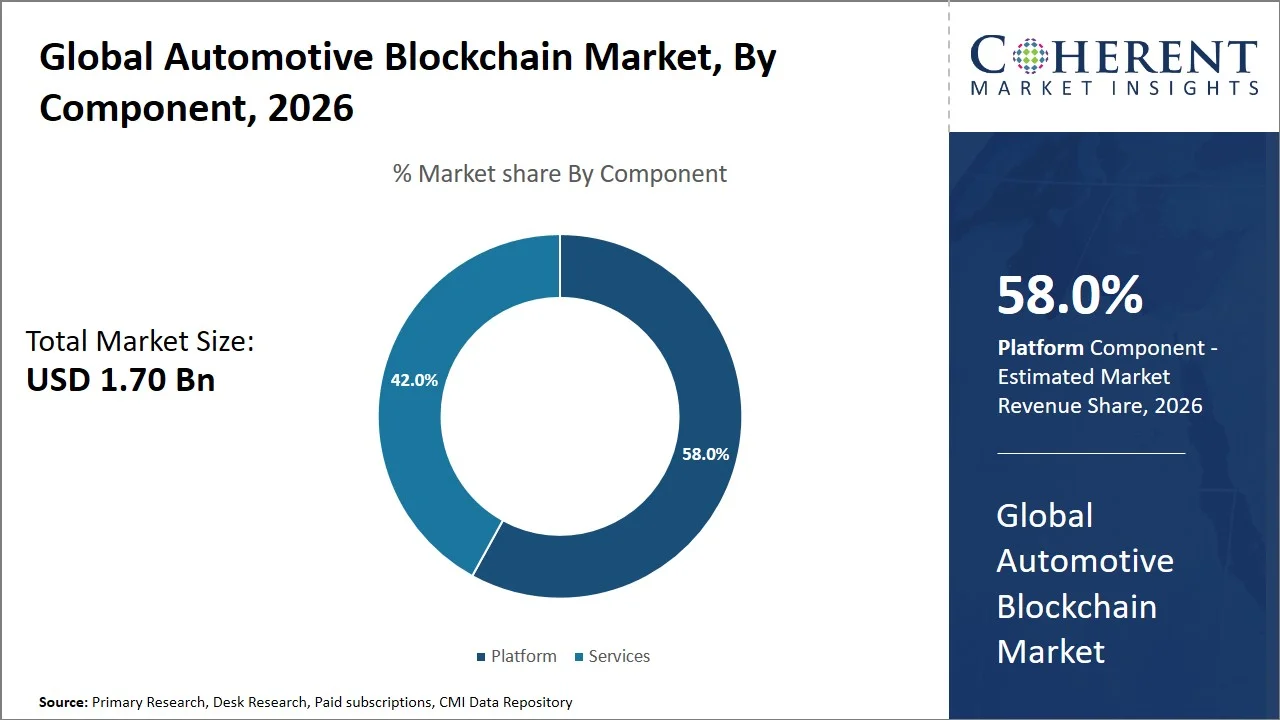
Why Does Platform Dominate the Global Automotive Blockchain Market?
The platform segment is expected to account for 58.0% of the global automotive blockchain market share in 2026. The platform segment is projected to dominate the automotive blockchain market during the forecast period as the platform provides the basic infrastructure for safe data sharing, identity management, smart contract execution, and transaction validation amongst numerous parties in the automotive ecosystem. Blockchain solutions can connect different systems, provide unchangeable recording, and enable interoperability between enterprise applications for automotive manufacturers, component suppliers, logistics providers, car dealers, insurance and mobility service operators. As organizations use blockchain for supply chain traceability, battery passport management, connected vehicle data security and digital vehicle identities, most investment is going into scalable platform solutions that can support multiple use cases and large transaction volumes. On July 22, 2025, Oracle announced that it will join the Stargate AI infrastructure project, dramatically boosting the capacity of Oracle Cloud Infrastructure for enterprise workloads including automotive digital platforms that need secure blockchain integration, high-performance data processing and scalable transaction management for connected vehicle ecosystems.
- Current Industry Events of 2026
- Market Size Estimation
- Regional Breakdown
- Competitive Landscape
- Customer Intelligence
- Segmental Analysis
- Pricing Analysis
- Key Market Drivers, Challenges & Future Trends
- Customized Insights Section
Why are Application Providers the Most Preferred Provider?
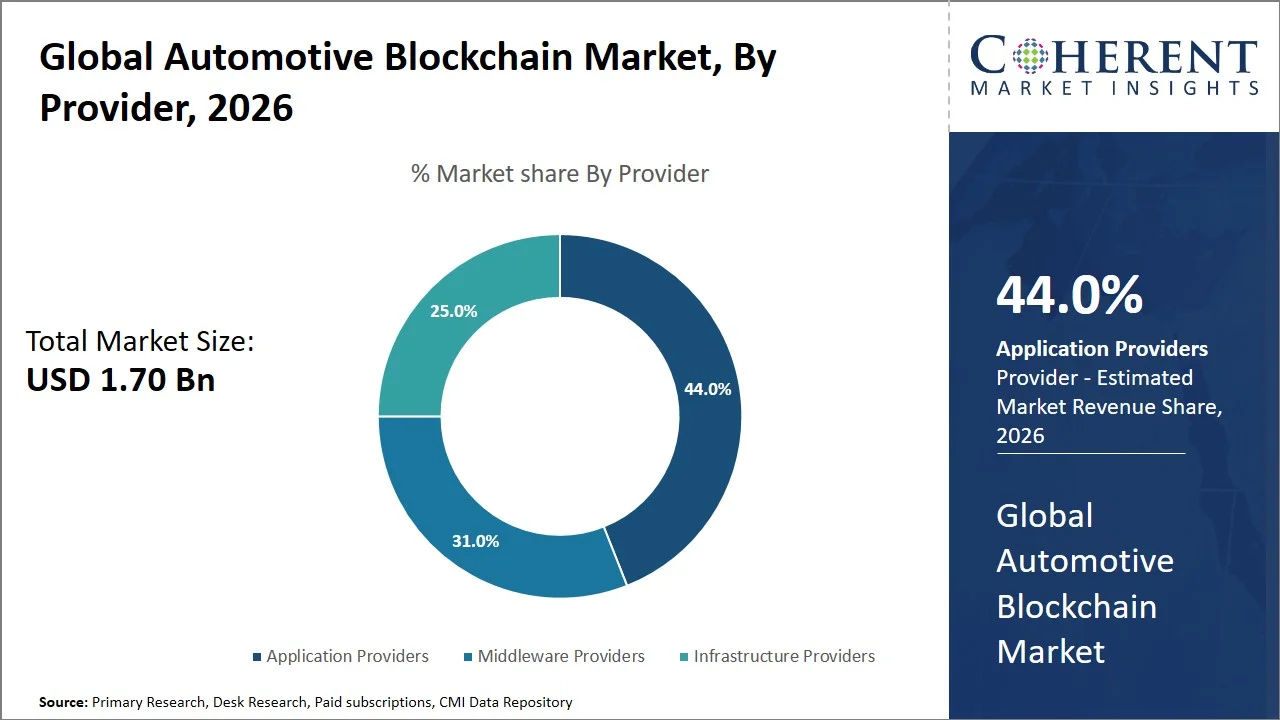
The application providers segment is expected to account for 44.0% of the global automotive blockchain market share in 2026. The preferred providers are the application providers who offer industry specialized blockchain solutions, addressing real automotive use cases without manufacturers needing to develop apps from scratch. These providers provide out-of-the-box platforms for supply chain traceability, digital vehicle identity, battery passport management, warranty administration and smart contract automation, allowing automotive companies to accelerate implementation while reducing development complexity and integration time. They can be flexibly integrated into a wide variety of business processes and enterprise systems, making them the application of choice for enterprises looking for speedier digital transformation, with demonstrable operational benefits. On January 21, 2025, Tata Elxsi, a global leader in design and technology services, joined forces with Minespider, a blockchain-powered traceability solutions provider, to launch MOBIUS+, an advanced battery lifecycle management platform. Designed to address the growing need for sustainability, compliance, and performance optimization in the battery industry, MOBIUS+ aims to revolutionize the way batteries are managed from production to recycling.
Public Blockchain Dominates the Global Automotive Blockchain Market
The public blockchain segment is expected to account for 51.0% of the global automotive blockchain market share in 2026. Public blockchain has the largest share as it provides a transparent and tamper resistant environment where several independent participants can securely verify and exchange transaction data without the need of a central authority. Its decentralized design helps automotive manufacturers, suppliers, logistics providers, recycling firms and mobility service operators to verify component provenance, validate digital identities and keep immutable records across worldwide supply chains. The level of transparency and trust is significant, making public blockchain especially suitable for applications involving multiple organizations that require verifiable and auditable data sharing. On February 27, 2025, Cario launched in the U.S., replacing paper-based vehicle ownership records with decentralized digital titles. The platform utilizes blockchain infrastructure to establish verifiable ownership records that can be accessed by vehicle owners, dealerships, lenders, and other approved stakeholders, which helps to reduce title fraud and increase the efficiency of ownership transfers.
Current Events and their Impact
Current Events | Description and its Impact |
European Union Battery Regulation 2023/1542 |
|
European Union Data Act Regulation 2023/2854 |
|
Global Automotive Blockchain Market Dynamics
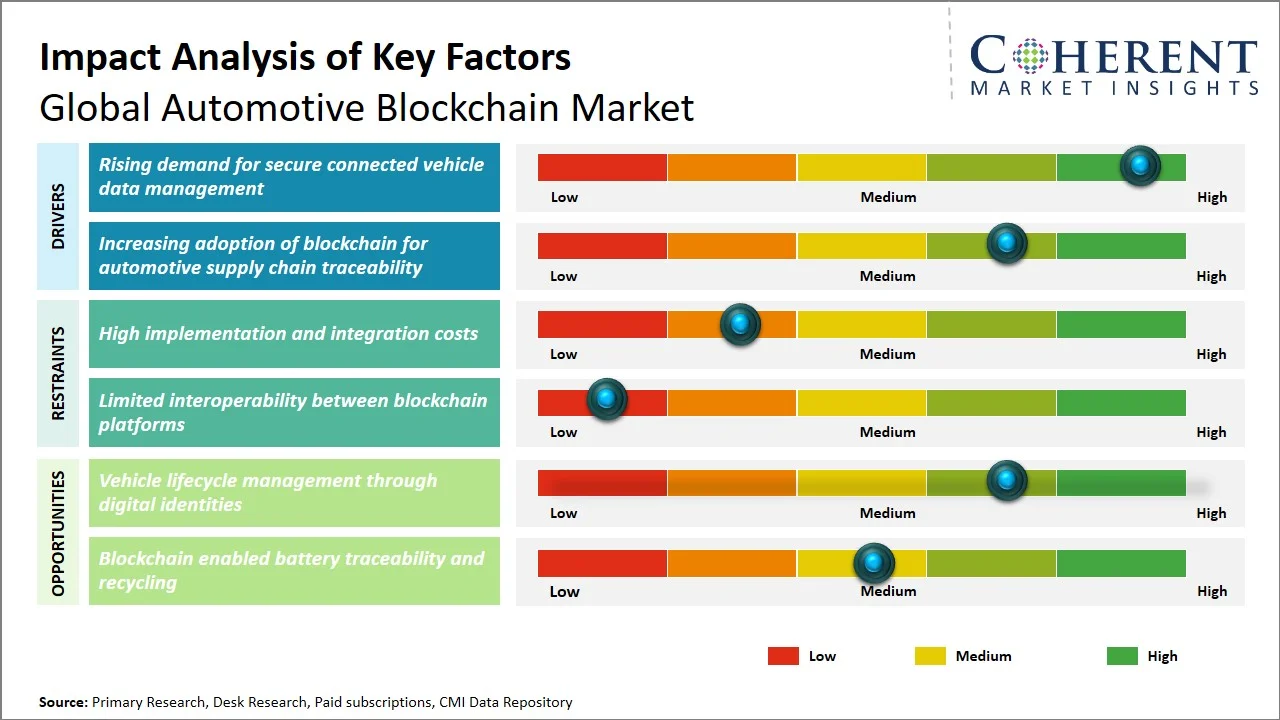
Market Drivers
- Rising demand for secure connected vehicle data management: As the number of connected vehicles continues to expand, the amount of data transferred between vehicles, cloud platforms, infrastructure, service providers, and manufacturers is increasing, hence creating a higher need for secure and trusted data management. Blockchain provides decentralized storage of transaction records, tamper resistant data verification and authenticated access control, and diminishes the risk of cyberattacks and unlawful data tampering. With proliferation of software defined vehicles, vehicle to everything communication and over the air software updates, automotive companies are increasingly adopting blockchain to improve data integrity, establish trusted digital identities and secure information sharing across connected mobility ecosystems. On February 24, 2026, IDEMIA announced that IDEMIA Secure Transactions is providing Hyundai Motor Group its advanced car connectivity management solution.
- Increasing adoption of blockchain for automotive supply chain traceability: Automotive companies are increasingly deploying blockchain technology to provide end to end visibility across complex global supply chains with thousands of suppliers and components. Blockchain offers immutable records of raw materials procurement, component production, logistics, quality checks and final vehicle assembly, with all parties being able to verify the chain of custody and transaction history of the product. The system is proven particularly valuable in tracking electric vehicle batteries, semiconductors and safety crucial components, helping manufacturers reduce counterfeit risks, regulatory compliance and improve supplier accountability as well as respond more quickly to product recalls.
- On December 11, 2025, BMW Group expanded its Catena-X digital supply chain ecosystem to enhance automotive traceability across its global supplier network. The program enables regulated and safe data exchange between BMW, suppliers, logistics partners and recycling partners and thereby increases the transparency on the origin of components, sustainability statistics and production processes.
Emerging Trends
- Expansion of Supply Chain Traceability for Critical Automotive Components: Automakers and Tier 1 suppliers are leveraging blockchain to enhance transparency in multi-tier supply chains by authenticating component provenance, tracing production history, preventing counterfeit parts, and increasing transparency for semiconductors, batteries and electronic modules.
- Growing Use of Smart Contracts for Automotive Finance and Mobility Services: Financial institutions, mobility providers and automotive companies are using blockchain enabled smart contracts to automate vehicle leasing, insurance claims, fleet management, usage-based payments and vehicle ownership transfers, reducing administrative complexity and improving transaction security.
Regional Insights
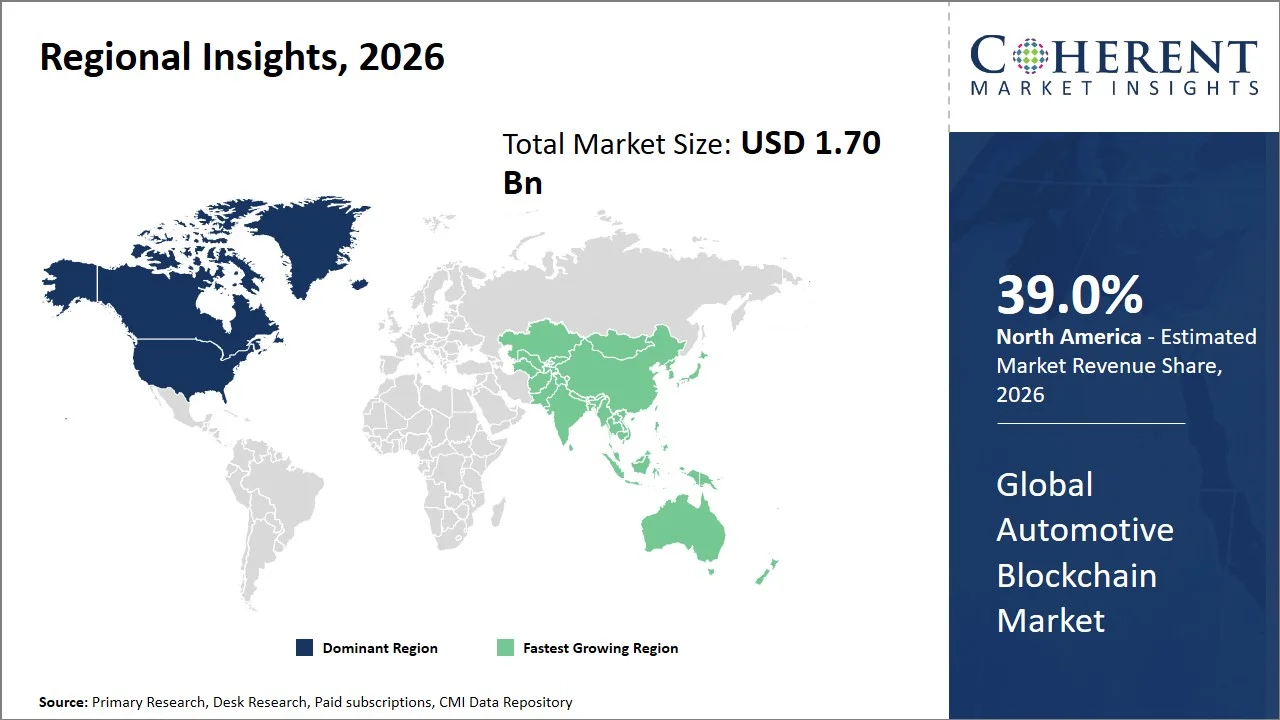
Why is North America a Strong Market for Automotive Blockchain?
North America is expected to account for a market share of 39.0% in 2026. North America is one of the first adopters of blockchain in the automobile industry and has a large ecosystem of connected car developers, cloud infrastructure providers, and automotive tech companies. General Motors has integrated blockchain into the patents of its Global B platform for secure vehicle data management, while Ford has been participating with the Mobility Open Blockchain Initiative to develop standards for vehicle identity, supply chain transparency and electric mobility applications. IBM, Microsoft, Amazon Web Services, and Oracle provide enterprise blockchain infrastructure that is increasingly deployed by automotive manufacturers and mobility providers across the region. The United States and Canada are also witnessing growing implementation of blockchain for electric vehicle battery traceability, digital vehicle titles, fleet management, and over the air software update verification. Several logistics providers supplying North American automotive manufacturers are using blockchain based documentation to improve component provenance and reduce counterfeit risks across cross border supply chains.
Why Does the Asia Pacific Automotive Blockchain Market Exhibit High Growth?
Asia Pacific is projected to account for 31.0% of the global automotive blockchain market and expected to register the fastest growth. The rapid growth of automotive blockchain adoption in Asia Pacific is driven by the region’s leading automotive manufacturing base and expanding electric vehicle ecosystem. China, Japan and South Korea are using blockchain to increase traceability of battery materials, transparency in semiconductor supply chains and car lifetime data management. Major battery suppliers such as CATL, BYD, LG Energy Solution, Panasonic Energy and Samsung SDI are reinforcing digital traceability systems to meet changing battery passport requirements for shipments to Europe. Car makers in the region are also joining blockchain-based platforms to verify suppliers, track carbon emissions across production networks and improve transparency in the sourcing of electric vehicle components. Government-backed digital transformation initiatives and advanced manufacturing programs continue to drive the integration of blockchain into automotive production ecosystems.
Global Automotive Blockchain Market Outlook for Key Countries
Why is the U.S. Emerging as a Major Hub in the Automotive Blockchain Market?
The U.S. remains the largest market, owing to its concentration of technology providers, blockchain developers and connected vehicle inventors. General Motors received patents for blockchain enabled autonomous vehicle data exchange and secure navigation systems. Ford is continuing its partnership with the Mobility Open Blockchain Initiative to create standards for blockchain applications for mobility services and supply chain management. In the automobile industry, IBM has partnered with several automotive businesses to build blockchain solutions for parts traceability and logistics visibility, and Amazon Web Services and Microsoft Azure provide enterprise blockchain infrastructure to assist car manufacturers and fleet operators. Tesla’s highly software driven vehicle ecosystem has further spurred industry interest in blockchain based verification of over the air software updates, digital vehicle identities and cybersecurity frameworks. The country has a well-established venture capital ecosystem that supports startups in decentralized mobility platforms and automotive data security.
Is China the Next Growth Engine for the Automotive Blockchain Market?
China is one of the fastest developing automotive blockchain ecosystems, driven by its dominance in electric vehicle production and battery manufacturing. CATL has broadened its digital battery lifecycle management activities, which enable traceability of lithium, nickel, cobalt and graphite across the battery production and recycling process. BYD is also investing in digital manufacturing technologies to boost supply chain transparency in its vertically integrated electric vehicle operations. SAIC Motor, Geely and Changan Automobile are also adding blockchain-backed digital records to connected car services and smart manufacturing activities. China also benefits from government supported Blockchain based Service Network infrastructure that enables enterprise blockchain implementation across industry sectors such as car production. The country’s substantial exports of electric vehicles have facilitated the scaling up of investment in blockchain-enabled battery passport solutions to comply with international sustainability mandates.
Germany Automotive Blockchain Market Analysis and Trends
Germany leads the way in automotive blockchain innovation, due to its premium vehicle manufacturers and sophisticated industrial supply chains. BMW Group has developed the PartChain platform to increase the end-to-end traceability of automotive components and ethically sourced raw materials in its global supplier network. Mercedes Benz has adopted blockchain-based solutions for responsible sourcing of battery materials. Volkswagen Group has examined blockchain use cases for vehicle identity, mobility services and secure charging transactions. Bosch and Continental are teaming up to enhance production traceability and digital quality assurance by integrating blockchain and Industrial Internet of Things technologies. Due to Germany’s high commitment to Industry 4.0 and compliance with the European Union Battery Regulation, the use of blockchain for battery passport implementation and verification of sustainable supply chains has expanded dramatically.
Japan Automotive Blockchain Market Analysis and Trends
Japan is using its lead in automobile production with sophisticated digital technologies to improve automotive blockchain adoption. Toyota has partnered with blockchain developers to test distributed ledger technology for connected car data sharing, mobility services and transaction management. Denso is deploying digital supply chain visibility across its worldwide component production network. Panasonic Energy is investing in battery traceability systems that provide lifecycle transparency and comply with international sustainability regulations. Honda and Nissan are still working on connected vehicle ecosystems where blockchain can contribute to better secure software management and authenticated vehicle communication. Japanese auto suppliers are also incorporating blockchain into factory automation and quality management systems, enhancing component authentication and manufacturing transparency across global production networks.
South Korea Automotive Blockchain Market Analysis and Trends
South Korea has become a major automotive blockchain market thanks to its automotive and battery industries, which are globally competitive. “Hyundai Motor Group is pushing forward software defined vehicle development and connected mobility platforms which need secure digital identity management and trusted data exchange. Kia is extending connected vehicle services where blockchain can enhance software integrity, and secure messaging across mobility ecosystems. LG Energy Solution and Samsung SDI are deploying innovative battery traceability systems that record raw material procurement, manufacturing history and recycling information for electric vehicle batteries supplied to global automobile manufacturers. Hyundai Mobis is also investing in digital supply chain technologies to improve transparency throughout automotive electronics and advanced mobility components, furthering South Korea’s position as a leading developer of blockchain enabled automotive ecosystems.
Global Automotive Blockchain Market - Blockchain Integration with Electric Vehicle Battery Passports
Company | Battery Passport / Blockchain Initiative | Key Data Tracked | Application Area |
BMW Group | Digital battery passport and trusted data exchange initiatives through Catena-X ecosystem | Battery carbon footprint | EV battery traceability |
CATL | Battery passport collaboration and lifecycle transparency initiatives | Raw material origin | Regulatory compliance |
Global Battery Alliance | Global Battery Passport framework based on digital product passport technologies | Supplier information | Circular economy management |
Volvo Cars | Blockchain-enabled battery passport developed with Circulor | Lifecycle data | Battery supply chain transparency |
Circulor | Blockchain-based battery material traceability platform | Sustainability metrics | Responsible sourcing verification |
Tata Technologies | WATTSync digital battery passport platform | Manufacturing data | Consumer transparency |
Tata Elxsi | MOBIUS+ battery lifecycle management platform with blockchain capabilities | Carbon accounting information | Battery lifecycle tracking |
LG Energy Solution | Global Battery Alliance battery passport pilot participation | Recycling information | EV ecosystem management |
Samsung SDI | Battery passport pilot participation through Global Battery Alliance initiatives | ESG performance | Sustainable battery manufacturing |
BYD | Digital battery lifecycle management initiatives | Material provenance | Recycling and second-life battery applications |
How is Vehicle Lifecycle Management Through Digital Identities Creating New Growth Opportunities in the Global Automotive Blockchain Market?
Digital identities are creating new growth opportunities for vehicle lifecycle management, as every vehicle can have a permanent, tamper resistant digital record from production to end of life. An increasing number of automakers are connecting vehicle identification numbers to blockchain-based records that include manufacturing specifications, software versions, maintenance history, warranty claims, ownership changes, accident history, battery health and recycling details. This allows all authorized stakeholders to access a single trusted source of data. This would eliminate fraud in the used vehicle market, enable cross border vehicle registration, better residual value assessment for leasing firms, enable automated warranty validation and predictive maintenance utilizing verified service data. Electric vehicle makers are further expanding the opportunity by integrating battery passports and software defined vehicle updates into blockchain-based digital identities that enable regulators, insurers, fleet operators, charging providers and recycling companies to securely verify vehicle information throughout its operational lifecycle without relying on fragmented databases.
On September 14, 2025, VehiclePassport announced a blockchain-anchored digital vehicle identity framework to create a trusted lifecycle record for vehicles from manufacturing to end-of-life. The framework allows to verify the manufacture data of vehicles, ownership history, maintenance records, insurance data and operational data in a privacy-preserving manner for the upcoming digital car ecosystem based on decentralized identity models.
Market Players, Key Development, and Competitive Landscape
Key Developments
- On August 20, 2025, Tata Technologies, a global product engineering and digital services company, launched WATTSync, a blockchain-enabled, scalable digital battery passport solution designed to transform transparency, traceability, and sustainability across the entire battery lifecycle, from mining to mobility to recycling.
- On March 31, 2025, Siemens announced it will invest USD 110 million over five years to establish a Global AI Manufacturing Technologies Research and Development (R&D) Center for Battery Production in Canada. The new R&D center, located initially at Siemens Canada’s head office in Oakville, as well as in Toronto and Kitchener-Waterloo, Ontario, will focus on developing cutting-edge AI manufacturing technologies with an initial emphasis on battery and electric vehicle (EV) production.
Competitive Landscape
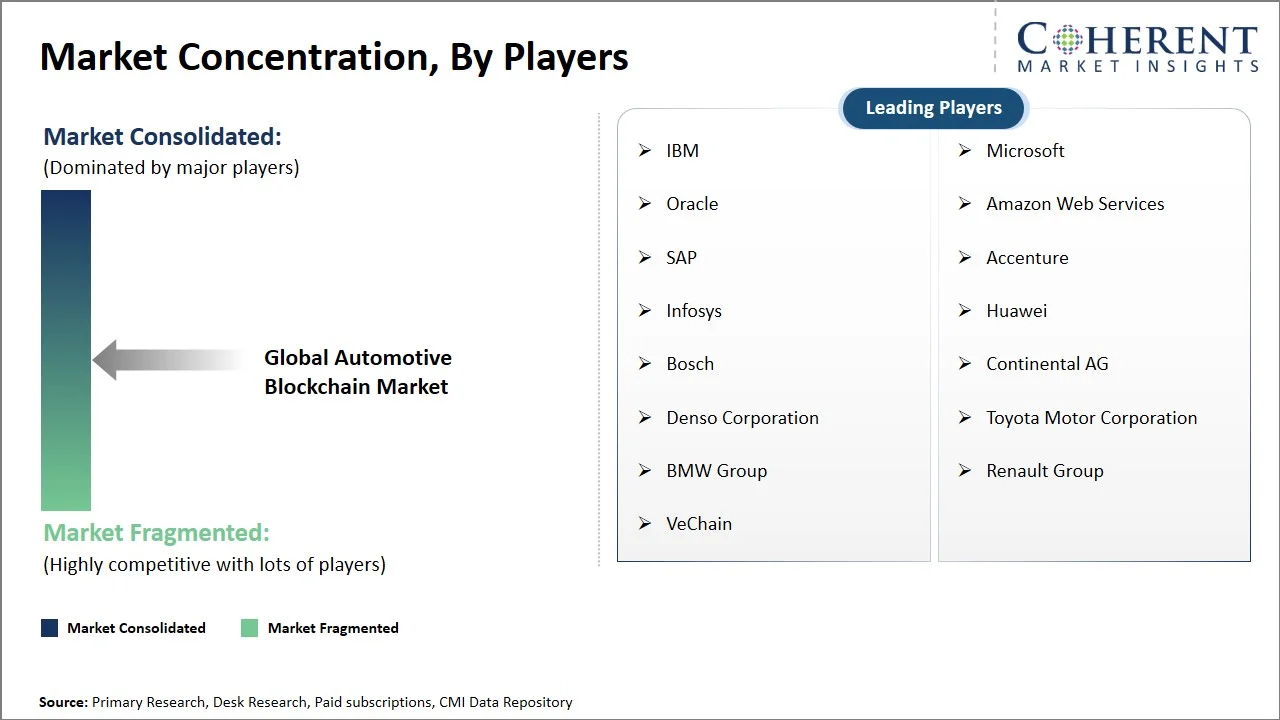
Competition in the automotive blockchain market is led by technology companies such as IBM, Microsoft, Oracle, Amazon Web Services, and SAP, alongside automotive manufacturers including BMW Group, Toyota Motor Corporation, and Renault Group that are embedding blockchain into operational workflows rather than offering standalone platforms. BMW Group has extended its PartChain platform to enhance the tracing of automotive components and sustainably sourced raw materials across worldwide suppliers. Renault Group uses blockchain technology to streamline compliance documentation and trace components in its industrial ecosystem.
IBM continues to focus on enterprise blockchain solutions for supply chain transparency, logistics and digital asset management. Microsoft Azure provides blockchain enabled cloud infrastructure for connected vehicle data management and enterprise integration. Bosch and Continental are exploring solutions that link blockchain with Industrial Internet of Things (IIoT) technology to improve traceability in production and in digital quality assurance. VeChain is developing blockchain applications for lifecycle management, including automotive parts authenticity and battery traceability.
Market Report Scope
Automotive Blockchain Market Report Coverage
| Report Coverage | Details | ||
|---|---|---|---|
| Base Year: | 2025 | Market Size in 2026: | USD 1.70 Bn |
| Historical Data for: | 2020 To 2024 | Forecast Period: | 2026 To 2033 |
| Forecast Period 2026 to 2033 CAGR: | 15.3% | 2033 Value Projection: | USD 12.90 Bn |
| Geographies covered: |
| ||
| Segments covered: |
| ||
| Companies covered: | IBM, Microsoft, Oracle, Amazon Web Services, SAP, Accenture, Infosys, Huawei, Bosch, Continental AG, Denso Corporation, Toyota Motor Corporation, BMW Group, Renault Group, and VeChain | ||
| Growth Drivers: |
| ||
| Restraints & Challenges: |
| ||
Analyst Opinion (Expert Opinion)
- The strongest long term growth is expected to come from blockchain platforms supporting software defined vehicles, battery passport compliance, and digital vehicle identities rather than from cryptocurrency related automotive applications. As electric vehicles become increasingly software centric, blockchain is likely to evolve into a core infrastructure for secure lifecycle data management, trusted software verification, and regulatory reporting across global automotive supply chains.
- The greatest commercial opportunity is expected to be in battery traceability and digital vehicle identity platforms for electric vehicles in China and Germany. China's dominance in battery manufacturing and Germany's regulatory driven implementation of battery passports and sustainable supply chains are creating sustained demand for enterprise blockchain solutions that connect battery manufacturers, automotive OEMs, logistics providers, and recycling companies through a unified digital record.
- Industry players should shift away from offering stand-alone distributed ledger solutions and provide industry specific blockchain platforms that integrate seamlessly with enterprise resource planning systems, manufacturing execution systems and connected vehicle platforms to improve competitive position. Companies that establish strategic partnerships with automotive OEMs, battery manufacturers, Tier 1 suppliers, and cloud infrastructure providers while delivering interoperable blockchain platforms capable of supporting battery passports, secure over the air software updates, and vehicle lifecycle management are expected to secure the strongest competitive advantage.
Speak to the analyst
Want personalized insights?
Take the findings above to one of our principal consultants, or have the report rebuilt around the segments, geographies and competitors you actually track.
Market Segmentation
- Component Insights (Revenue, USD Billion, 2021 - 2033)
- Platform
- Services
- Provider Insights (Revenue, USD Billion, 2021 - 2033)
- Application Providers
- Middleware Providers
- Infrastructure Providers
- Deployment Type Insights (Revenue, USD Billion, 2021 - 2033)
- Public Blockchain
- Private Blockchain
- Hybrid Blockchain
- Application Insights (Revenue, USD Billion, 2021 - 2033)
- Supply Chain Management
- Vehicle Identity Management
- Smart Contracts
- Automotive Financing
- Warranty Management
- Mobility Services
- Parts Traceability
- Battery Passport
- Regional Insights (Revenue, USD Billion, 2021 - 2033)
- North America
- U.S.
- Canada
- Latin America
- Brazil
- Argentina
- Mexico
- Rest of Latin America
- Europe
- Germany
- U.K.
- Spain
- France
- Italy
- Russia
- Rest of Europe
- Asia Pacific
- China
- India
- Japan
- Australia
- South Korea
- ASEAN
- Rest of Asia Pacific
- Middle East
- GCC Countries
- Israel
- Rest of Middle East
- Africa
- South Africa
- North Africa
- Central Africa
- North America
- Key Players Insights
- IBM
- Microsoft
- Oracle
- Amazon Web Services
- SAP
- Accenture
- Infosys
- Huawei
- Bosch
- Continental AG
- Denso Corporation
- Toyota Motor Corporation
- BMW Group
- Renault Group
- VeChain
Sources
Primary Research Interviews
- Automotive OEM Executives & Product Managers
- Blockchain Technology Solution Providers & Developers
- Supply Chain & Logistics Management Professionals
- Connected Vehicle & Telematics Specialists
Magazines
- Automotive World Magazine
- Blockchain Magazine
- SAE Automotive Engineering International
- MIT Technology Review (Automotive & Blockchain Editions)
Journals
- Journal of Cleaner Production (Automotive Supply Chain Studies)
- International Journal of Blockchain and Cryptocurrency Research
- IEEE Transactions on Intelligent Transportation Systems
Associations
- Mobility Open Blockchain Initiative (MOBI)
- International Organization of Motor Vehicle Manufacturers (OICA)
- Society of Automotive Engineers (SAE International)
- Blockchain in Transport Alliance (BiTA)
Public Domain Sources
- U.S. Department of Transportation (DOT) – Official Reports & Publications
- European Automobile Manufacturers' Association (ACEA) – Public Reports
- World Economic Forum (WEF) – Automotive & Blockchain Whitepapers
- National Highway Traffic Safety Administration (NHTSA) – Data & Publications
Proprietary Elements
- CMI Data Analytics Tool
- Proprietary CMI Existing Repository of Information for Last 10 Years
Get access to 250+ pages report
Every segment, forecast, competitor profile and data table behind the analysis above — available for instant download.
- ESOMAR Member
- ISO 9001:2015 Certified
- D-U-N-S Registered
- GDPR & CCPA Compliant
Missing comfort of reading report in your local language? Find your preferred language:
Transform your Strategy with Exclusive Trending Reports
Frequently Asked Questions
The global automotive blockchain market is expected to stand at USD 1.70 Bn in 2026 and is expected to reach USD 12.90 Bn by 2033.
The CAGR of the global automotive blockchain market is projected to be 15.3% from 2026 to 2033.
Rising demand for secure connected vehicle data management and increasing adoption of blockchain for automotive supply chain traceability are the major factors driving the growth of the global automotive blockchain market.
High implementation and integration costs and limited interoperability between blockchain platforms are the major factors hampering the growth of the global automotive blockchain market.
In terms of component, the platform segment is estimated to dominate the market revenue share in 2026.
It creates immutable records that allow every component to be tracked from raw material sourcing to vehicle assembly.
It records battery origin, manufacturing history, usage, and recycling information throughout the battery lifecycle.