

Global Automotive Metal Stamping Market Size and Forecast – 2026 To 2033
The global automotive metal stamping market is expected to grow from USD 94 Bn in 2026 to USD 126 Bn by 2033, registering a compound annual growth rate (CAGR) of 4.2% from 2026 to 2033. The global automotive metal stamping market is driven by growing adoption of advanced high strength steel and aluminum. On July 16, 2025, ArcelorMittal Nippon Steel India announced the commissioning of a new, state-of-the-art Continuous Galvanizing Line (CGL) at its flagship plant in Hazira, Gujarat. This development establishes AM/NS India as the only company in India with a modern CGL line capable of producing Advanced High-Strength Steel (AHSS) with strength levels up to 1180 megapascals (MPa).
Key Takeaways of the Global Automotive Metal Stamping Market
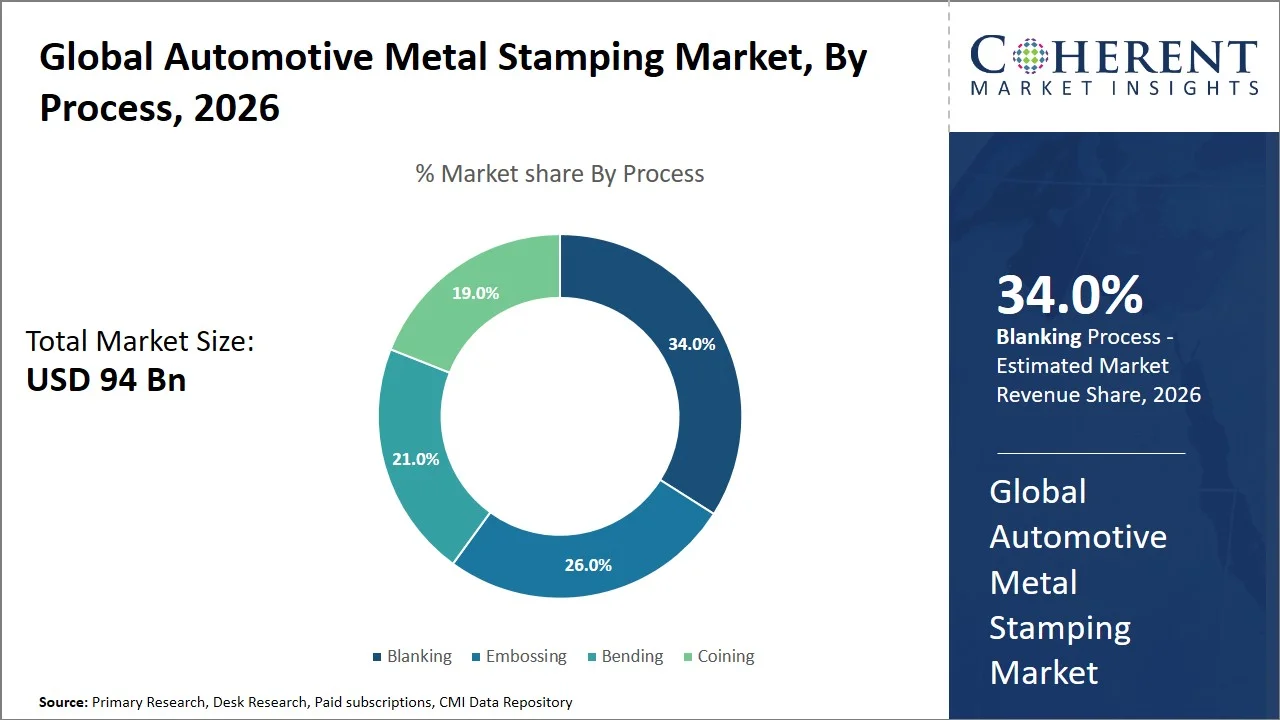
- The Blanking segment is expected to account for 34.0 % of the global automotive metal stamping market share in 2026. Increasing demand for stamped battery enclosures and structural components is driving the growth of the segment. On March 12, 2025, Novelis, Shape Corp and Metalsa announced a collaboration to develop aluminum roll formed EV battery tray concepts combining advanced roll forming, next generation aluminum alloys and precision assembly.
- The Passenger Cars segment is estimated to capture 57.0 % of the market share in 2026. Increasing vehicle body and chassis component complexity is majorly driving the growth of the segment. On May 27, 2025, Gestamp introduced its Ges-Gigastamping family to the Japanese market, including the Ges-One Piece Floor and Wave Rocker, which integrate multiple body parts into larger structural units while addressing crash energy absorption, weight reduction, and assembly simplification.
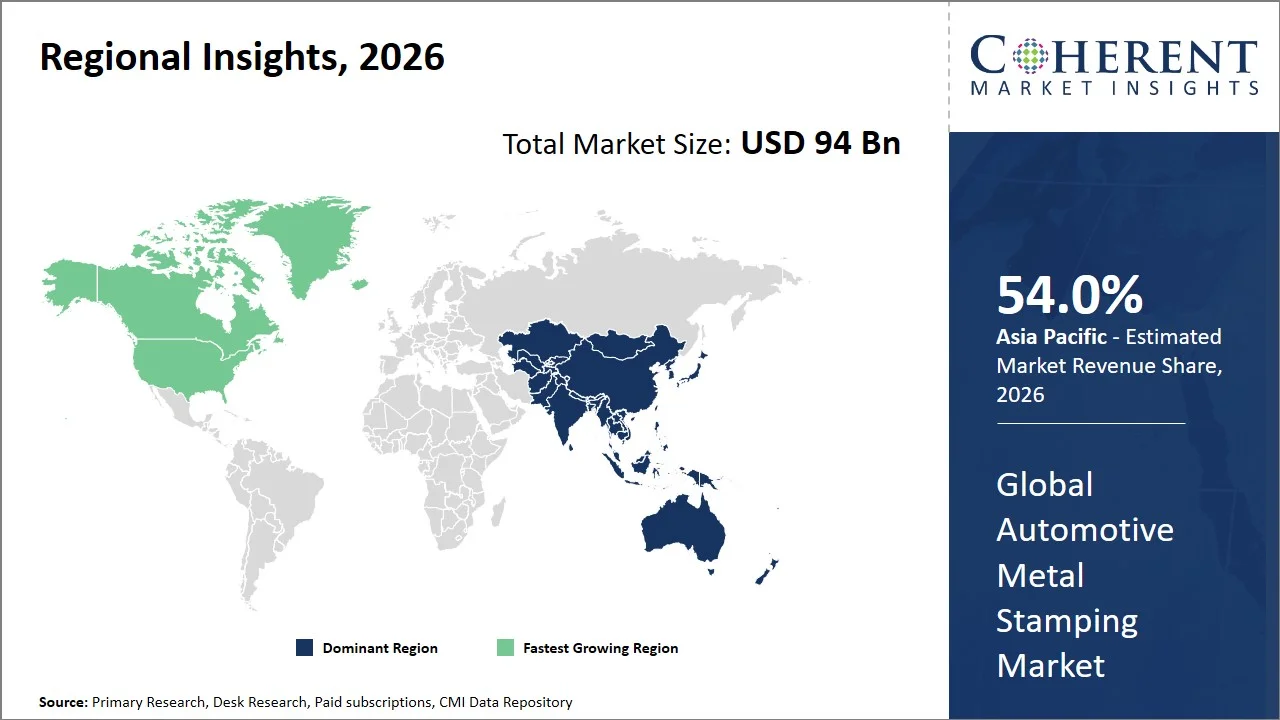
- Asia Pacific is expected to dominate the automotive metal stamping market in 2026 with a market share of 54.0 %. Development of gigafactory linked stamping facilities in Asia Pacific is driving the growth of the regional market. On August 7, 2026, Ola Electric’s Krishnagiri Gigafactory moved toward vertically integrated EV manufacturing, with cell production, battery pack assembly, and vehicle manufacturing being developed within the same broader manufacturing ecosystem.
- North America is expected to account for 21.0% share in 2026 and is projected to record the fastest growth over the forecast period. Development of digitally optimized stamping and forming processes in North America is driving the growth of the regional market. On October 21, 2025, AutoForm acquired Stampack GmbH, strengthening its portfolio for sheet metal forming simulation and extending its digital engineering capabilities for complex stamping applications.
Segmental Insights
Why Does Blanking Dominate the Global Automotive Metal Stamping Market?
The blanking segment is expected to account for 34.0% of the global automotive metal stamping market share in 2026. Blanking is a common and economical first-stage method for making exact flat components from sheet metal at high production volumes, such as body panels, brackets, reinforcements and structural pieces. This process allows manufacturers to quickly produce uniform shapes from large metal sheets while maintaining dimensional accuracy and reducing material waste. It is particularly well suited for automated stamping lines that feed high volume passenger car and commercial vehicle production. On June 26, 2026, Stellantis installed a blanking press at its Warren Stamping Plant in Michigan, capable of producing between 4.5 million and 6 million parts annually for the Ram 1500 and three Jeep models. The addition brings upstream sheet metal cutting in-house and supports the automaker’s FaSTLane 2030 targets and USD 13 billion US manufacturing investment.
- Current Industry Events of 2026
- Market Size Estimation
- Regional Breakdown
- Competitive Landscape
- Customer Intelligence
- Segmental Analysis
- Pricing Analysis
- Key Market Drivers, Challenges & Future Trends
- Customized Insights Section
Why is Passenger Cars the Most Widespread Application?
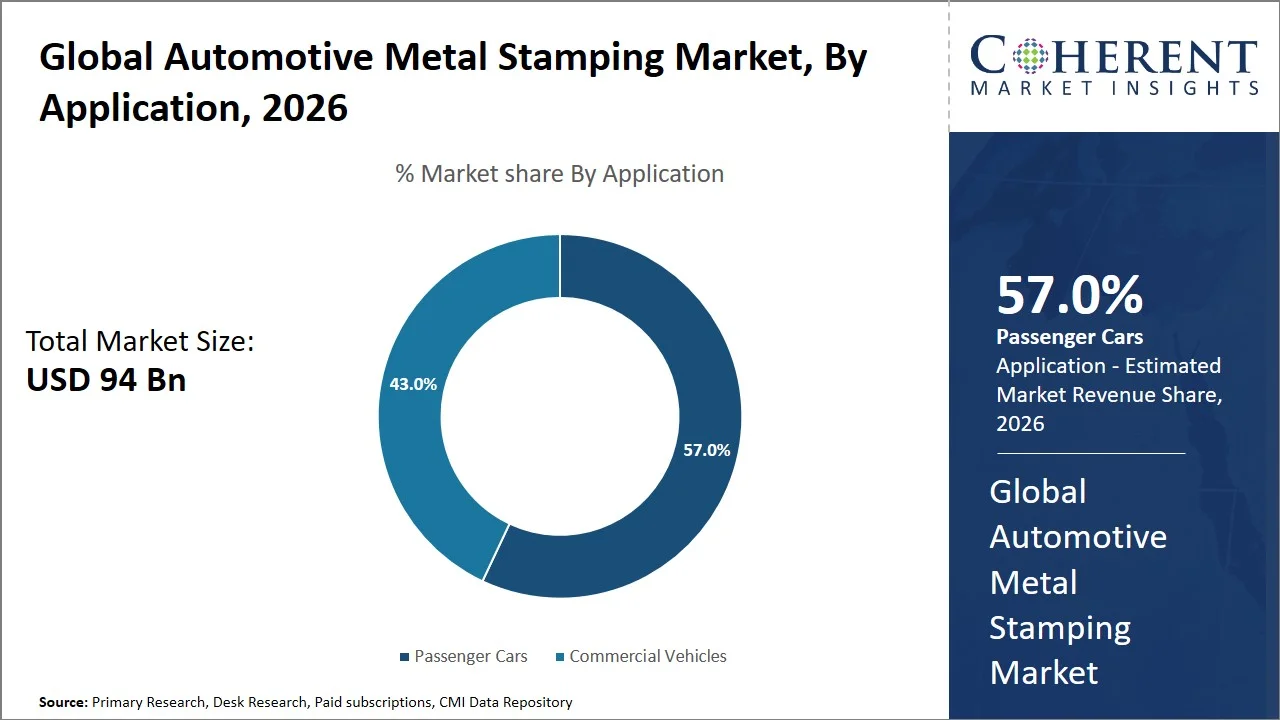
The passenger cars segment is expected to account for 57.0% of the global automotive metal stamping market share in 2026. The complexity of passenger car designs is increasing and passenger cars are produced in huge quantities, therefore a great volume and variety of stamped components are needed, such as body panels, doors, hoods, brackets, seat structures, chassis parts, structural reinforcements, etc. Metal stamping is particularly suited to mass production programs as it can create these components reliably at high speed and with tight dimensional tolerances. Automated stamping lines may sustain a continuous supply to big vehicle assembly facilities. For example, Gestamp continued to develop big BIW parts such as roofs, doors, bonnets, floors, pillars, rails and wheel arches, as well as chassis parts such as control arms and axle components. The company’s integrated press and die development and component manufacturing capabilities offer passenger vehicle manufacturers the ability to source multiple stamped and formed parts from a more integrated supplier relationship, particularly in the case of platforms in need of lightweighting and improved crash performance.
Current Events and their Impact
Current Events | Description and its Impact |
European Union Carbon Border Adjustment Mechanism, CBAM, 2026 |
|
U.S. EPA Rescission of Greenhouse Gas Endangerment Finding and Vehicle GHG Standards, 2026 |
|
Automotive Metal Stamping Market Dynamics
Market Drivers
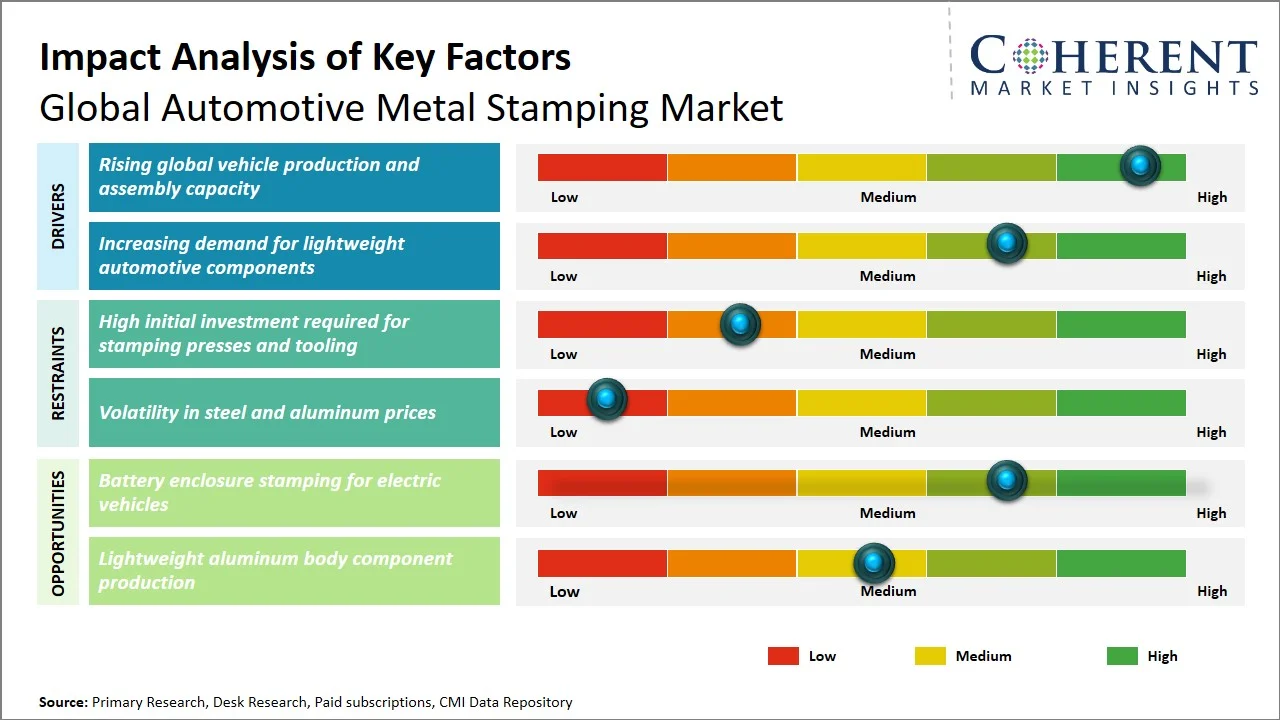
- Rising Global Vehicle Production and Assembly Capacity: The expansion of vehicle production capacity in China, India, Mexico, Southeast Asia and other growing automotive hubs is boosting the necessity for large volume metal stamping components. The need for a constant supply of body panels, chassis parts, brackets, reinforcements and structural components for new and expanded vehicle assembly plants is encouraging stamping suppliers to establish production facilities closer to OEM manufacturing locations and to invest in automated high speed stamping lines. On June 10, 2025, General Motors announced plans to invest about USD 4 billion over the next two years in its domestic manufacturing plants to increase U.S. production of both gas and electric vehicles. The new investment will give GM the ability to assemble more than two million vehicles per year in the U.S. This announcement comes on the heels of the company’s recently announced plan to invest USD 888 million in the Tonawanda Propulsion plant near Buffalo, New York to support GM’s next-generation V-8 engine.
- Increasing Demand for Lightweight Automotive Components: Automobile manufacturers are increasingly using lightweight steel, aluminum and advanced high strength steel components to lower the weight of vehicles and improve structural strength and safety performance. This trend is offering opportunities for stamping producers to shape complex lightweight materials into doors, hoods, structural reinforcements, chassis components and other parts with tight dimensional tolerances and less material utilization. On April 2, 2026, Renault Group started serial deliveries of ArcelorMittal Usibor 1500 XCarb steel for five hot-stamped structural elements for Renault 5 E-Tech electric, Alpine A290 and Renault 4 E-Tech electric. The 1,500 MPa steel allows for a weight reduction of roughly 40% compared to traditional steel solutions for complicated, cold-formed structural components with strong passenger-cell protection, illustrating the trend to thinner high-strength stamped parts.
Emerging Trends
- Growing Adoption of Advanced High Strength Steel in Structural Components: Car manufacturers are turning more and more toward advanced high strength steel and ultrahigh strength steel for such structural elements as pillars, roof rails, crash reinforcements, cross members, etc. This enables stamped parts to attain higher strength at lower material thickness, which reduces vehicle weight.
- Increasing Use of Hot Stamping for Safety Critical Components: Hot stamping is being used for components such as A pillars, B pillars, side impact beams and bumper reinforcements as it allows complex geometries to be manufactured from very high strength steel, while maintaining crash performance and dimensional stability.
- Expansion of Stamping Applications for Electric Vehicles: The increase in electric vehicle production is expected to drive up demand for stamped battery trays, battery housings, structural members, motor casings and lightweight body parts, with manufacturers developing stamping solutions tailored to EV platforms.
- Integration of Automation and Digital Quality Control: Stamping plant automation, including robotic material handling, automated press lines, machine vision inspection, sensors, and real time production monitoring are being integrated to improve dimensional consistency, reduce material waste, detect tooling abnormalities, and increase production efficiency across high volume automotive programs.
Regional Insights
Why is Asia Pacific a Strong Market for Automotive Metal Stamping?
Asia Pacific is expected to account for a market share of 54.0% in 2026. The concentration of vehicle production, EV manufacturing and huge component supply networks in China, Japan, India, South Korea, Thailand and Indonesia is supporting Asia Pacific and creating a persistent need for high volume stamped body and structural components. In 2025, China produced more than 34 million automobiles. Chinese manufacturers including BYD, Chery, Great Wall and Leapmotor are also expanding overseas production and related supply chains for components, which provides further opportunity for regional stamping suppliers to participate in domestic and export-oriented vehicle programs. India is also expanding its automotive manufacturing base, with automobile exports surpassing 5.3 million units in fiscal 2024-2025, and companies like Maruti Suzuki exporting around 280,000 vehicles annually, which helps meet the demand for locally manufactured stamped body panels, brackets, chassis components and structural parts.
Why Does North America Automotive Metal Stamping Market Exhibit High Growth?
North America is expected to register the fastest growth with a CAGR of 5.1% over the forecast period. The region is projected to account for 21.0% of the global automotive metal stamping market in 2026. In North America, the regionalization of the automotive supply chain is driving growth, as is the growth of vehicle manufacturing in the U.S., particularly as car manufacturers seek more control over locally sourced parts and manufacturing capacity. The U.S. has 55 light vehicle assembly plants operated by 20 automakers across 15 states, while Stellantis announced a more than USD 13 billion U.S. investment program in 2025 that includes reopening the Belvidere Assembly Plant for Jeep Cherokee and Jeep Compass production, creating approximately 3,300 jobs and generating additional requirements for locally produced stamped structures and body components.
Global Automotive Metal Stamping Market Outlook for Key Countries
Why is China Emerging as a Major Hub in the Automotive Metal Stamping Market?
The super scale of domestic vehicle production and the quick shift to new energy vehicles are driving China’s growth, generating high demands for stamped battery protection structures, lightweight body parts, crash structures and conventional chassis parts. In 2025, vehicle manufacturing surpassed 34 million units, and EV penetration has grown substantially, with research suggesting EVs accounted for over 45% of Chinese car sales in 2024 compared to about 1% in 2015. The expansion of BYD, Geely, Chery, Great Wall, and other Chinese manufacturers into overseas assembly locations is also creating opportunities for Chinese stamping companies and component suppliers to transfer manufacturing capabilities into Thailand, Brazil, Hungary, Turkey, Morocco, and other production hubs.
Is U.S. the Next Growth Engine for the Automotive Metal Stamping Market?
The U.S. automotive metal stamping market is supported by increased localization of vehicle production and domestic automotive investment, particularly for SUVs, pickup trucks, EVs and key structural assemblies. Stellantis announced plans in 2025 to invest more than USD 13 billion in U.S. operations, including more than USD 600 million to reopen the Belvidere Assembly Plant for Jeep Cherokee and Jeep Compass production, while the company expects the wider investment program to support approximately 5,000 new jobs across several locations. A further separate growth driver is the push for domestic vehicle component production, such as Ford’s August 2026 announcement to move production of selected Lincoln models from China to U.S. facilities from 2030, which is expected to increase requirements for locally sourced body, structural and metal components.
Germany Automotive Metal Stamping Market Analysis and Trends
The German automotive industry landscape is rapidly converting to electric vehicles and hence needs specialized stamping structures that can host battery platforms and lightweight vehicle layouts. Germany’s electric passenger car production hit a high of 1.67 million in 2025, including 1.22 million battery electric vehicles and around 450,000 plug in hybrids, marking Germany as the world’s second largest EV production base after China. This transition is especially important for stamping suppliers because battery electric platforms require new floor structures, cross members, crash management components, battery trays and lightweight body structures. Germany’s dense OEM and tier one supplier network enables specialized stamping technologies to be integrated directly into large vehicle production programs.
Japan Automotive Metal Stamping Market Analysis and Trends
Japan is being helped by the continued strength of its highly integrated OEM and tier one supplier ecosystem where Toyota, Honda, Nissan, Mazda and other manufacturers have sophisticated high volume manufacturing processes that are highly dependent on precision formed sheet metal components. Another growth driver is the country’s emphasis on advanced high strength steel and manufacturing efficiency, which is encouraging suppliers to develop more sophisticated stamping, forming, tooling and automated inspection capabilities for thinner structural components without sacrificing crash performance. Just in time component delivery and tightly synchronized supplier networks characterize Japanese OEM production systems as well. This encourages stamping companies to keep geographically close production capacity and highly reliable automated press operations rather than depend on distant component imports.
India Automotive Metal Stamping Market Analysis and Trends
India is being propelled by rising car exports and localization of component manufacturing. The country’s automobile industry posted exports of over 5.3 million units across vehicle categories during fiscal 2024-2025, including about 770,000 passenger vehicles. Maruti Suzuki exports nearly 280,000 vehicles annually while Škoda Auto Volkswagen India exports roughly 30% of its production. This shows the growing importance of India as an export manufacturing hub, not just as a domestic vehicle market. Another interesting feature is the growing investment in localized component capacity as the FDI inflows in the automotive sector stood at USD 37.85 billion from April 2000 to March 2025, which has prompted local stamping suppliers to increase their capabilities for body panels, chassis parts, brackets, reinforcements and other components for local OEM programs as well as export production.
Global Automotive Metal Stamping Market - Press Capacity Distribution By Stamping Facility (2025)
Press Capacity Class | Typical Applications | Estimated Share Of Global Automotive Stamping Facilities |
Below 500 tons | Brackets, clips, small reinforcements, seat components | 18% |
500-999 tons | Medium brackets, reinforcements, seat structures, chassis components | 24% |
1,000-1,499 tons | Door inners, pillars, floor reinforcements, structural parts | 23% |
1,500-1,999 tons | Body-side components, roof rails, floor panels, chassis structures | 16% |
2,000-2,999 tons | Large body panels, roof outers, dash panels, structural components | 12% |
3,000 tons and above | Large body sides, one-piece floors, large structural components, EV battery enclosures | 7% |
How is Battery Enclosure Stamping for Electric Vehicles Creating New Growth Opportunities in the Automotive Metal Stamping Market?
Battery enclosure stamping is opening new growth opportunities as it moves stamping suppliers away from traditional body parts to safety-critical EV structural systems. Magna is already supplying stamped steel battery structures to GM EV programs, and has developed its OPTiForm one-piece enclosure through deep draw stamping, which can eliminate hundreds of welds and fasteners and increase usable battery space by as much as 10%. Similarly, Gestamp is developing EV specific battery boxes and reported in 2025 Indian OEMs were making orders for locally manufactured EV battery boxes employing giga stamping technology signaling big format stamping moving directly into EV platform architectures. The opportunity is also expanding into aluminum, where Hindalco delivered 10,000 aluminum battery enclosures to Mahindra for the BE 6 and XEV 9e in 2025 and planned to double its production capacity, creating additional demand for precision forming and enclosure manufacturing capabilities in India.
On April 25, 2025, Hindalco Industries Ltd. delivered 10,000 aluminum battery enclosures for Mahindra, one of the largest automobile manufacturers, for its state-of-the-art e-SUVs, BE 6 and XEV 9e. The company also unveiled its state-of-the-art dedicated EV component manufacturing facility in Chakan, Pune, India’s premier automotive manufacturing hub.
Market Players, Key Development, and Competitive Landscape
Key Developments
- On July 27, 2026, Gestamp, the multinational specialized in the design, development and manufacture of highly engineered metal components for the automotive industry, has started operations at its new plant in Piracicaba (São Paulo), marking the company's eighth facility in Brazil.
- On June 24, 2026, Feintool officially inaugurated its first production facility in India, located in the industrial hub of Pune. Production is now being ramped up to fulfil initial customer orders, with a focus on fine-blanked automotive components.
Competitive Landscape
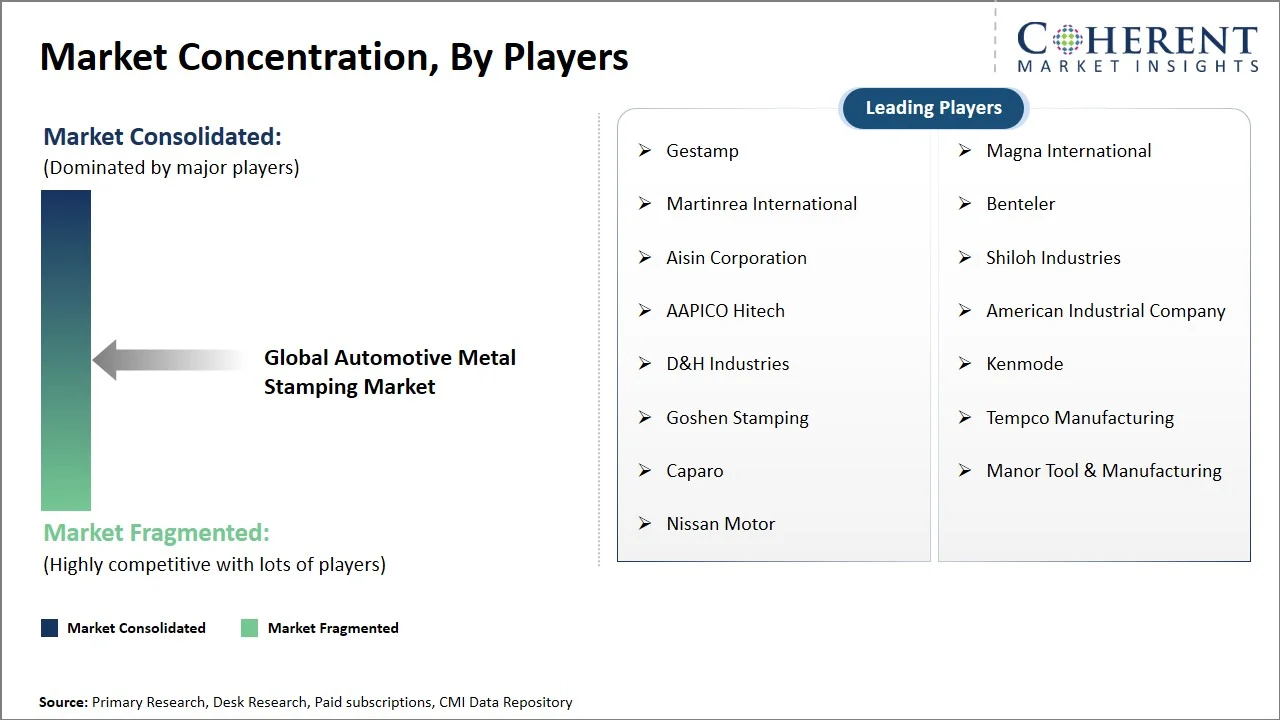
The competitive landscape is being shaped by large Tier 1 suppliers that are moving beyond conventional body stamping toward integrated lightweight structures, EV battery systems, advanced forming, and engineering led solutions. Magna is pursuing this strategy particularly aggressively through its heavy stamping capabilities and its OptiForm one piece battery enclosure, which uses a two stage deep draw process to produce a near rectangular enclosure while eliminating hundreds of welds and fasteners and increasing usable battery space by up to 10%; Magna has also supplied battery enclosure systems in North America since 2022 and developed steel, aluminum, cast hybrid, and one piece enclosure solutions for different EV architectures. Gestamp is developing the integration of high strength steel, lightweighting, hydroforming and EV structural systems. Its Ges-Enubox battery box was launched at Auto Shanghai 2025 as a solution combining safety, lightweighting and cost optimization. Shiloh Industries is emphasizing material agnostic EV battery enclosures and lightweight structural technologies, positioning its portfolio around precision sealing, structural integrity, crash performance, and weight reduction rather than conventional stamping alone.
Market Report Scope
Automotive Metal Stamping Market Report Coverage
| Report Coverage | Details | ||
|---|---|---|---|
| Base Year: | 2025 | Market Size in 2026: | USD 94 Bn |
| Historical Data for: | 2020 To 2024 | Forecast Period: | 2026 To 2033 |
| Forecast Period 2026 to 2033 CAGR: | 4.2% | 2033 Value Projection: | USD 126 Bn |
| Geographies covered: |
| ||
| Segments covered: |
| ||
| Companies covered: | Gestamp, Magna International, Martinrea International, Benteler, Aisin Corporation, Shiloh Industries, AAPICO Hitech, American Industrial Company, D&H Industries, Kenmode, Goshen Stamping, Tempco Manufacturing, Caparo, Manor Tool & Manufacturing, Nissan Motor | ||
| Growth Drivers: |
| ||
| Restraints & Challenges: |
| ||
Analyst Opinion (Expert Opinion)
- The future of the industry is expected to shift increasingly toward complex structural stamping rather than high volume production of relatively simple body panels, particularly as EV platforms require battery trays, battery covers, cross members, crash structures, and integrated floor assemblies. Magna's development of a single component deep drawn battery enclosure illustrates the direction of process innovation, where reducing welds, fasteners, assembly stages, and enclosure weight can provide direct value to OEMs.
- The strongest opportunities are expected to be concentrated in EV battery enclosures, advanced high strength steel components, aluminum forming, and large structural parts, with China and India offering particularly attractive production opportunities because of their expanding EV manufacturing and automotive supplier ecosystems. Suppliers supporting developing EV programs should focus on capabilities that combine stamping with shaping, joining, sealing, simulation and lightweight material engineering, rather than compete on conventional press capacity.
- Manufacturers must invest in high tonnage automated presses, advanced die design, real time process monitoring, and digital forming simulation. They need to develop proprietary processes that solve specific OEM manufacturing problems to gain competitive advantage. The emergence of AI based stamping simulation, including 2026 research demonstrating sub second prediction of critical forming characteristics, also indicates that faster virtual manufacturability assessment could become an important competitive differentiator by reducing development iterations before tooling is commissioned.
Speak to the analyst
Want personalized insights?
Take the findings above to one of our principal consultants, or have the report rebuilt around the segments, geographies and competitors you actually track.
Market Segmentation
- Process Insights (Revenue, USD Billion, 2021 - 2033)
- Blanking
- Embossing
- Bending
- Coining
- Application Insights (Revenue, USD Billion, 2021 - 2033)
- Passenger Cars
- Commercial Vehicles
- Regional Insights (Revenue, USD Billion, 2021 - 2033)
- North America
- U.S.
- Canada
- Latin America
- Brazil
- Argentina
- Mexico
- Rest of Latin America
- Europe
- Germany
- U.K.
- Spain
- France
- Italy
- Russia
- Rest of Europe
- Asia Pacific
- China
- India
- Japan
- Australia
- South Korea
- ASEAN
- Rest of Asia Pacific
- Middle East
- GCC Countries
- Israel
- Rest of Middle East
- Africa
- South Africa
- North Africa
- Central Africa
- North America
- Key Players Insights
- Gestamp
- Magna International
- Martinrea International
- Benteler
- Aisin Corporation
- Shiloh Industries
- AAPICO Hitech
- American Industrial Company
- D&H Industries
- Kenmode
- Goshen Stamping
- Tempco Manufacturing
- Caparo
- Manor Tool & Manufacturing
- Nissan Motor
Sources
Primary Research Interviews
- Automotive Die Manufacturers, Tool-and-Die Specialists and Progressive-Die Manufacturers
- Procurement Managers Responsible for Body Panels, Chassis Structures, Battery Enclosures and Other Stamped Components
Associations
- Association for Iron & Steel Technology (AIST)
- International Organization of Motor Vehicle Manufacturers (OICA)
Public Domain Sources
- U.S. Environmental Protection Agency (EPA)
- European Automobile Manufacturers' Association (ACEA)
- India Ministry of Heavy Industries (MHI)
Proprietary Elements
- CMI Data Analytics Tool
- Proprietary CMI Existing Repository of Information for the Last 10 Years
Get access to 250+ pages report
Every segment, forecast, competitor profile and data table behind the analysis above — available for instant download.
- ESOMAR Member
- ISO 9001:2015 Certified
- D-U-N-S Registered
- GDPR & CCPA Compliant
Missing comfort of reading report in your local language? Find your preferred language:
Transform your Strategy with Exclusive Trending Reports
Frequently Asked Questions
The global automotive metal stamping market is expected to stand at USD 94 Bn in 2026 and is expected to reach USD 126 Bn by 2033.
The CAGR of the global automotive metal stamping market is projected to be 4.2% from 2026 to 2033.
Rising global vehicle production and assembly capacity and increasing demand for lightweight automotive components are the major factors driving the growth of the global automotive metal stamping market.
Automotive metal stamping is a manufacturing process that uses presses and dies to transform sheet metal into automotive components such as body panels, brackets, chassis parts, and structural reinforcements.
EV production is creating additional applications for stamped battery enclosures, floor structures, crash components, cross members, and lightweight body parts.
High initial investment required for stamping presses and tooling and volatility in steel and aluminum prices are the major factors hampering the growth of the global automotive metal stamping market.
In terms of process, blanking segment is estimated to dominate the market revenue share in 2026.