

Global Baking Enzymes Market Size and Forecast – 2026 To 2033
The Global Baking Enzymes Market is estimated to be valued at USD 2.05 Bn in 2026 and is expected to reach USD 3.16 Bn by 2033, exhibiting a compound annual growth rate (CAGR) of 6.4% from 2026 to 2033. Growth will be supported by industrial bakeries seeking better dough consistency, loaf volume, crumb softness, production yield, and shelf-life while reducing dependence on conventional emulsifiers and chemical processing aids. Clean-label reformulation is encouraging the use of amylases, xylanases, lipases, proteases, and oxidases across bread, cakes, biscuits, and other baked products.
Expanding organized bakery production in emerging economies will further increase the demand for scalable and cost-efficient enzyme solutions. In July 2024, Biocatalysts Ltd launched its Plug & Produce microbial fermentation platform to reduce enzyme scale-up time and cost and support immediate large-scale commercial production, strengthening the supply and commercialization potential of advanced food-enzyme solutions.
Key Takeaways of the Global Baking Enzymes Market
- Carbohydrases are expected to hold 44.8 % of the global baking enzymes market in 2026 because amylases and xylanases solve several production requirements simultaneously, including flour correction, fermentable-sugar release, dough tolerance, loaf volume, and freshness control. In January 2025, Novonesis detailed how Fungamyl amylase and xylanase systems support fermentation, oven spring, mixing tolerance, and dough stability in bromate-free baking.
- The powder segment is expected to account for 68.4 % of the market share in 2026, reflecting their compatibility with flour batching, dry improver systems, centralized premix production, ambient storage, and cost-efficient shipment. Their handling profile also supports accurate low-dose dispersion across industrial bakery lines. In October 2024, AB Enzymes introduced VERON POLARUM, officially specified in powder form, for dough strengthening in butter-rich bakery applications.
- Bread is expected to represent 43.6 % of the market share in 2026 because high-throughput loaf production uses enzymes at several control points, from dough machinability and gas retention to crumb resilience and freshness consistency. These functions protect yield, distribution reach, and repeat-purchase quality. In August 2025, IFF launched POWERFRESH ACE 2000 for U.S. industrial bakeries to improve bread softness, resilience, and cohesiveness throughout shelf life.
- Europe is expected to account for 38.6 % of the global market in 2026, supported by its concentrated bakery manufacturing base, varied bread traditions, established ingredient-technology capabilities, and sustained reformulation toward processing aids that preserve quality while simplifying labels. In May 2025, BRAIN Biotech announced a larger Netherlands production hub and expanded Baking Application Center for enzyme-based customer development.
- North America is expected to hold 28.4 % of the market share in 2026 and remain the fastest-growing region as packaged-bread scale, extended retail distribution, formulation transparency, and waste-reducing freshness solutions strengthen enzyme economics. Regulatory clarity also lowers commercialization friction. In September 2024, the U.S. Food Drug Administration closed GRN No. 1161 with no questions, covering a lipase enzyme preparation intended for baking applications.
- Precision Enzyme Stacking: Suppliers are moving from single-function products toward application-specific enzyme combinations tuned to flour quality, fat systems, process temperature, and targeted eating characteristics. This changes competition from catalogue breadth to formulation intelligence, trial data, and technical service. Vendors that shorten validation cycles and demonstrate robust line performance can gain pricing power, deepen customer integration, and create higher switching costs.
- Clean-Label Cost Engineering: Enzymes are increasingly positioned as formulation tools that can reduce dependence on emulsifiers, chemical oxidants, excess gluten, and other costly functional inputs without sacrificing throughput or sensory quality. This will redirect investment toward reformulation laboratories, documentation, and customer trials, while procurement teams evaluate total recipe economics rather than ingredient price alone. Competitive advantage will favor suppliers that quantify savings and manage changeovers reliably.
Segmental Insights
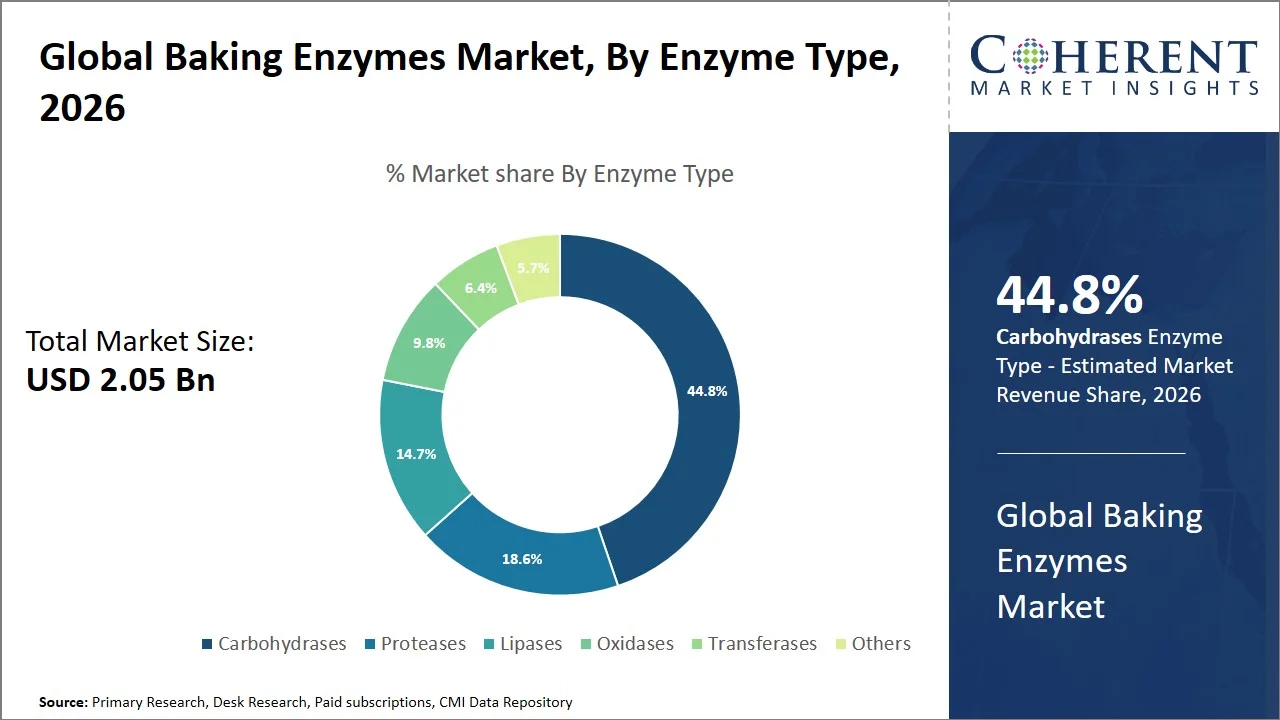
Why Do Carbohydrases Dominate the Global Baking Enzymes Market?
Carbohydrases are expected to hold 44.8% of the global baking enzymes market in 2026 because they address both starch and non-starch polysaccharides across milling and baking. Amylases regulate starch conversion, while xylanases and related hemicellulases modify arabinoxylans that otherwise disrupt water distribution and dough structure. This functional breadth allows suppliers to build flour-specific systems for whole-wheat, high-fiber, frozen, and variable-protein formulations rather than relying on one corrective mechanism. Their microbial production routes also support standardized activity, scalable manufacturing, and precise dosing across industrial and artisan operations. For enzyme producers, the segment offers recurring formulation and technical-service revenue across bread, rolls, cakes, and biscuits. In March 2024, the Journal of Food Science published research showing that a bioengineered xylanase from Trichoderma atroviride reduced bread hardness and chewiness after dosage optimization, reinforcing the commercial potential of targeted carbohydrase development.
- Current Industry Events of 2026
- Market Size Estimation
- Regional Breakdown
- Competitive Landscape
- Customer Intelligence
- Segmental Analysis
- Pricing Analysis
- Key Market Drivers, Challenges & Future Trends
- Customized Insights Section
Why Does Powder Represent the Largest Form in the Global Baking Enzymes Market?
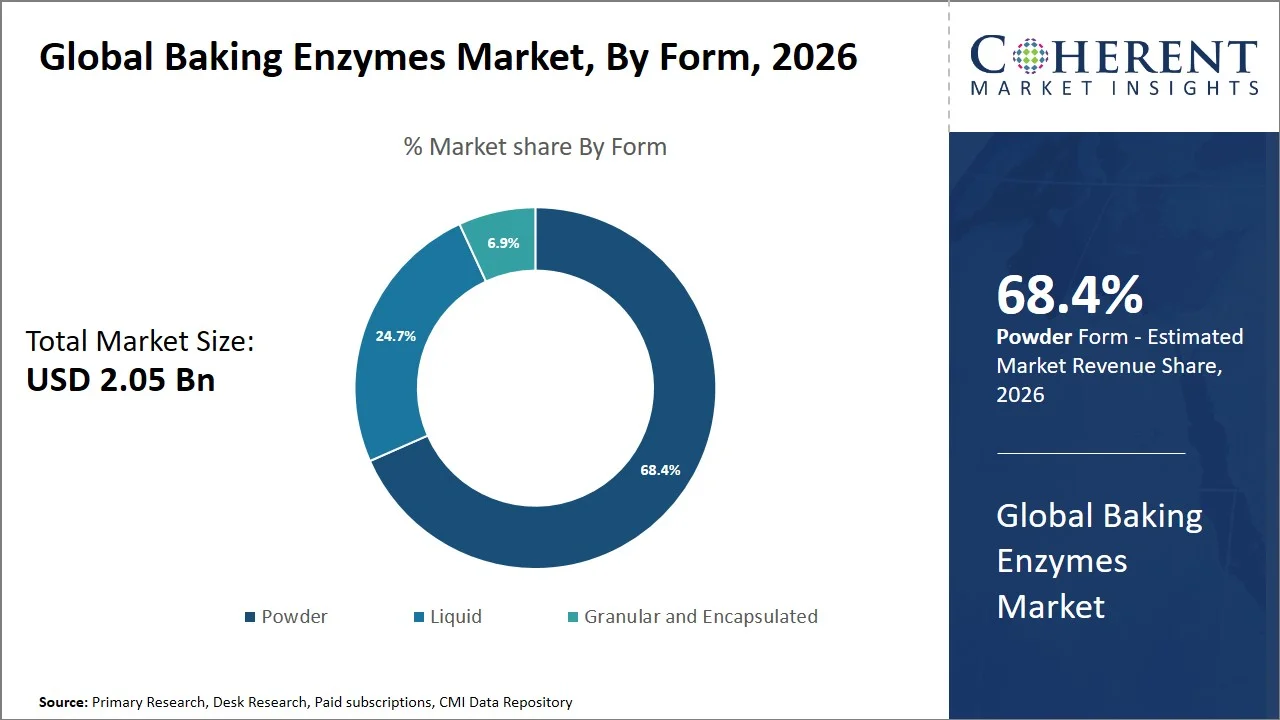
Powder is expected to represent 68.4% of the global baking enzymes market in 2026 because it offers a practical stability and handling profile for ingredient manufacturers, distributors, and bakeries. Low-moisture formulations can protect enzyme activity during warehousing, simplify export packaging, and permit concentration adjustment through carriers before sale. Granulation and spray-drying technologies further allow suppliers to manage particle size, flowability, segregation, and occupational dust while retaining compatibility with automated micro-dosing equipment. The format is especially useful for multi-enzyme improvers, unit-dose systems, and customers without dedicated liquid storage or pumping infrastructure. Commercially, powder enables broader distributor coverage and smaller order sizes across industrial and regional bakery accounts. In April 2024, European patent EP3723506B1 was published for DSM IP Assets, covering an enzyme granulate with a carrier and vegetable oil designed to remain flowable, reduce segregation, and support the preparation of dough, premixes, and food products.
Why Does Bread Dominate the Application Segment of the Global Baking Enzymes Market?
Bread is expected to account for 43.6% of the global baking enzymes market in 2026 because it combines large production volumes with unusually high sensitivity to flour quality, fermentation control, and post-bake texture changes. Enzymes can be applied across straight-dough, sponge-and-dough, frozen-dough, wholegrain, and high-speed continuous processes, giving suppliers multiple entry points within one application. Bakers also face strict retailer specifications for loaf dimensions, slicing performance, crumb softness, and consistency throughout distribution. Small performance improvements therefore translate into fewer rejects, lower returns, better line utilization, and stronger product standardization across plants. Bread consequently supports both high-volume enzyme sales and premium application-service contracts. In October 2024, MC Mühlenchemie expanded its Alphamalt Fresh range with Fresh & Soft and Fresh & Spring enzyme preparations for industrial bread, targeting different crumb-moisture, softness, and elasticity requirements while extending product freshness.
Current Events and Their Impact
Current Event | Description and Its Impact |
December 2025 – Health Canada authorizes phospholipase A1 from a new production source |
|
February 2026 – EFSA updates the safety assessment of maltogenic alpha-amylase |
|
Global Baking Enzymes Market Dynamics
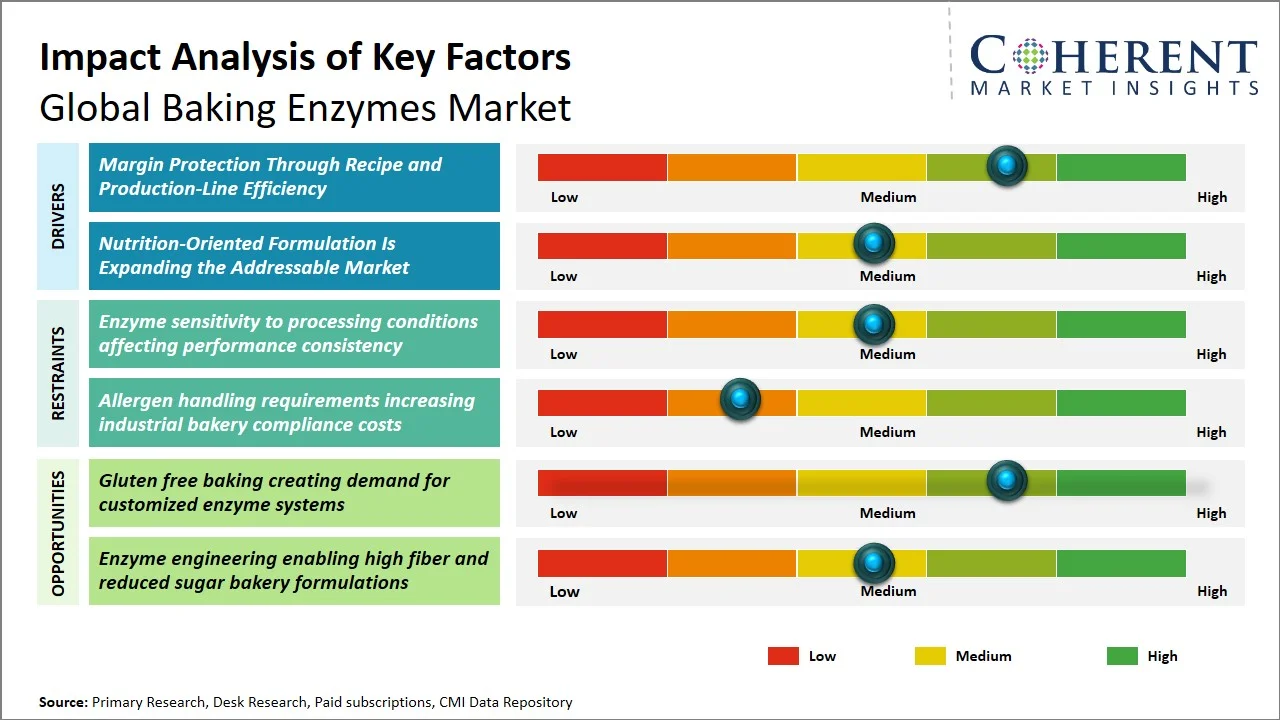
Key Market Drivers
- Margin Protection Through Recipe and Production-Line Efficiency: Industrial bakeries increasingly evaluate enzymes as margin-protection tools rather than optional improvers. Variable wheat quality, expensive functional ingredients, labor constraints, and high-speed lines can magnify minor formulation weaknesses into downtime, rejects, and inconsistent finished products. Targeted enzyme systems improve dough tolerance, machinability, yield, and texture at low inclusion rates, allowing manufacturers to protect throughput without major equipment changes. This benefits enzyme producers, premix formulators, millers, and technical-service providers capable of linking dosage to measurable plant economics. The commercial significance lies in shifting purchasing decisions from price per kilogram toward cost per ton of flour, line efficiency, and avoided waste. In October 2025, Kerry reported an enzyme-capacity expansion in Cork, Ireland, alongside bakery growth supported by enzyme solutions, indicating continued supplier investment in scalable fermentation-based functionality.
- Nutrition-Oriented Formulation Is Expanding the Addressable Market: Bakery portfolios are incorporating more plant proteins, whole grains, fibers, and nutrition-oriented ingredients, but these materials alter water absorption, gluten development, aeration, and crumb structure. This creates demand for enzymes that modify starches and proteins selectively rather than relying on heavier use of gums, emulsifiers, or added gluten. The opportunity extends beyond standard bread into protein-enriched cakes, nutritional bars, specialty rolls, and hybrid grain products. Enzyme manufacturers with protein-modification expertise, application laboratories, and regulatory coverage can secure higher-value formulation projects, while bakery brands gain access to differentiated products with acceptable texture and process stability. In December 2025, Amano Enzyme highlighted Protein-Glutaminase “Amano” 500 as an organic, non-GMO enzyme solution with applications including baked goods, demonstrating how specialty enzymes are moving into complex protein-rich food formulations.
Emerging Market Trends
- Cold-Chain Performance Becomes a Formulation Requirement: Frozen, refrigerated, and par-baked supply chains are changing how baking enzymes are specified. Products must tolerate mixing, proofing interruptions, freezing, thawing, transport, and final baking at locations with different equipment and operator skill. Enzyme selection is therefore moving toward process-stage resilience rather than performance measured only in freshly baked laboratory samples. Suppliers will need to validate activity across freeze–thaw cycles, delayed fermentation, and variable finishing conditions. Industrial bakeries, quick-service restaurant suppliers, and centralized commissaries stand to benefit from lower variability and fewer rejected batches. By contrast, vendors offering generic enzyme preparations without application-specific testing may face pressure. The trend will encourage closer collaboration between enzyme developers, frozen-dough producers, equipment specialists, and foodservice customers, with procurement increasingly favoring systems that preserve predictable performance throughout the complete cold-chain operating model.
- Regulatory-Ready Portfolio Design Reshapes Product Investment: Regulatory readiness is becoming part of product architecture rather than a final administrative step. Suppliers are designing enzyme portfolios around well-characterized production strains, standardized activity specifications, traceable fermentation inputs, and documentation that can support submissions across multiple jurisdictions. This approach affects investment priorities because a technically effective enzyme has limited commercial value when approval, customer assurance, or import documentation is incomplete. Larger producers can benefit from reusable toxicology packages and regulatory teams, while specialists may compete through non-genetically modified strains, narrower application claims, or market-specific dossiers. Buyers will increasingly compare not only baking performance but also allergen assessments, manufacturing consistency, occupational handling, and the continuity of regulatory support. Over the forecast period, portfolio rationalization may accelerate as suppliers concentrate resources on enzyme platforms that can be commercialized efficiently across several applications and countries.
Regional Insights
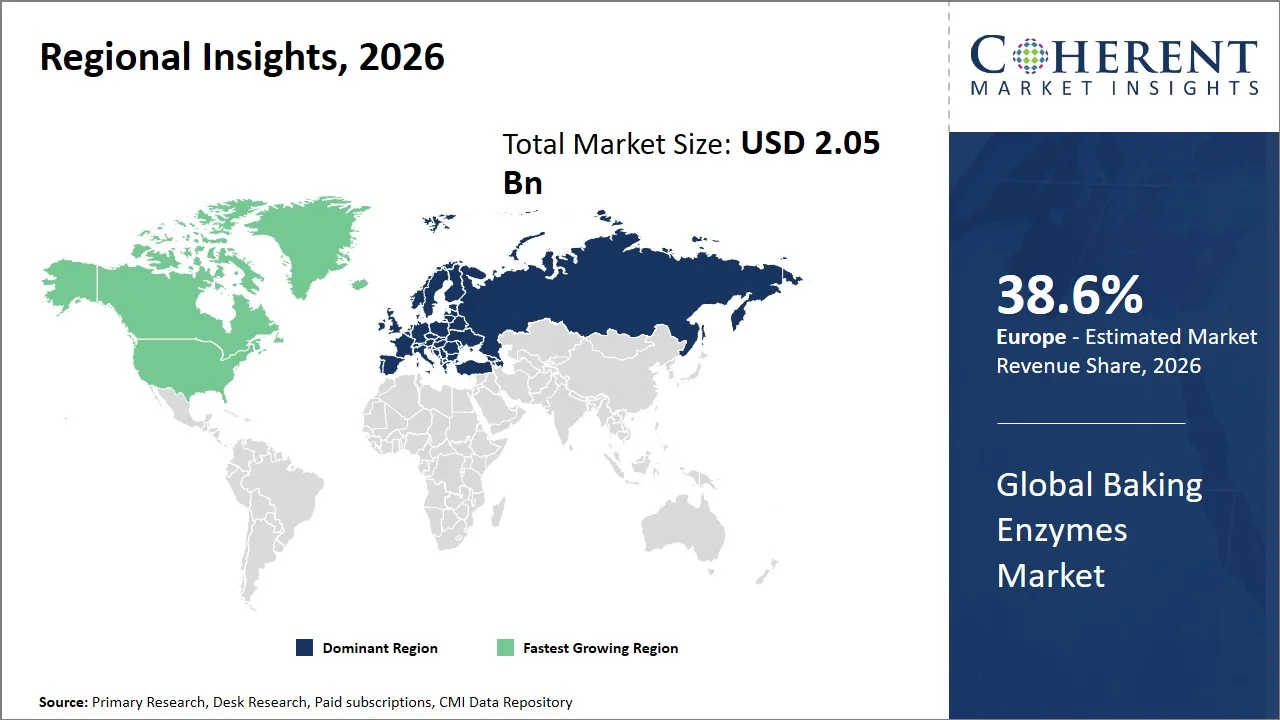
Why Does Europe Dominate the Global Baking Enzymes Market?
Europe is expected to lead the global baking enzymes market with 38.6% of the market share in 2026. The region combines technically demanding bread traditions with a mature network of mills, industrial bakeries, craft producers, ingredient specialists, and application laboratories. Product diversity across wheat, rye, multigrain, laminated, and long-fermentation formats creates recurring demand for enzymes that stabilize flour performance, improve dough handling, protect crumb quality, and support label simplification. European manufacturers also face pressure to control energy use, food waste, and formulation costs without weakening sensory standards, increasing the commercial value of customized enzyme systems and supplier-led trials. In June 2024, Belgium-headquartered Puratos and Bota announced a partnership to develop natural enzyme solutions for bakery applications by combining bakery formulation expertise with enzyme discovery and engineering capabilities.
Why is North America Emerging as the Fastest-Growing Region in the Global Baking Enzymes Market?
North America is projected to be the fastest-growing region and account for 28.4% of the global baking enzymes market in 2026. Expansion is supported by high-output production of packaged bread, buns, tortillas, sweet goods, and foodservice bakery products, where manufacturers must preserve softness, sliceability, and process consistency across extensive distribution networks. Automated plants and tight labor availability increase the value of low-dose processing aids that reduce line disruptions and compensate for flour variability. Retailers and brand owners are also reformulating products to simplify ingredient statements, strengthen nutritional positioning, and extend usable shelf life. In September 2025, Corbion introduced Ultra Fresh Plus 100 at IBIE 2025, positioning the label-friendly bakery solution to replace synthetic emulsifiers while maintaining softness, freshness, sliceability, and production consistency.
Global Baking Enzymes Market Outlook for Key Countries
Why is the U.S. a Key Market for the Global Baking Enzymes Market?
The U.S. is a key market for baking enzymes because it has a highly concentrated commercial bakery, milling, and ingredient-processing ecosystem serving national retail, foodservice, institutional, and private-label customers. Large production runs across sliced bread, buns, tortillas, cakes, cookies, pizza crusts, and nutrition-oriented products create strong demand for reproducible dough behavior and longer quality retention. Manufacturers also work with increasingly diverse grain systems, including whole grains, pulses, and alternative cereals, which require targeted enzyme selection to manage hydration, structure, flavor, and machinability. Technical service, pilot-scale validation, and reliable domestic supply therefore influence purchasing decisions as much as enzyme price. In April 2024, Ardent Mills expanded its U.S. innovation network with a Pullman, Washington, research facility containing an analytical laboratory and experimental mill for alternative-grain characterization and customer product development.
Why is India Important in the Global Baking Enzymes Market?
India is becoming increasingly important to the baking enzymes market as organized production expands across biscuits, packaged bread, cakes, rusks, buns, and value-added convenience foods. Manufacturers must balance price-sensitive purchasing with consistent texture, volume, and shelf stability under warm climatic and fragmented distribution conditions. Enzymes offer attractive recipe economics because small inclusion rates can improve flour tolerance, reduce processing losses, support softer crumb, and limit dependence on more expensive functional ingredients. Demand is also broadening as international brands localize production and regional bakeries modernize their plants. In June 2024, Mondelēz International and Lotus Bakeries announced that Mondelēz would manufacture, market, distribute, and sell Lotus Biscoff cookies in India. The partnership highlights investment in premium cookie production and wider retail availability, supporting the demand for reliable processing technologies and formulation solutions.
Why Does China Support Growth in the Global Baking Enzymes Market?
China supports growth in the baking enzymes market through its extensive food-manufacturing capacity, expanding urban bakery formats, and increasing commercialization of breads, cakes, cookies, doughnuts, and filled products. Producers operating at scale require enzyme systems that accommodate variable flour characteristics while delivering repeatable volume, softness, color, and processing tolerance. China’s domestic fermentation and biotechnology capabilities also improve access to locally supported formulations and shorten technical-response times for bakery customers. Growth in premium stores, café chains, frozen dough, and packaged convenience products is encouraging more application-specific solutions rather than universal improver blends. In May 2024, Angel Yeast partnered with BakeMark at Bakery China in Shanghai and introduced three product lines covering more than 40 bread, cake, cookie, doughnut, filling, icing, and related bakery products, demonstrating the widening industrial ingredient platform available to Chinese manufacturers.
Why is Germany a Strategic Country in the Global Baking Enzymes Market?
Germany is a strategic country for baking enzymes because its bakery sector combines a large craft base with sophisticated industrial production and exceptionally broad bread variety. Rye, wheat, mixed-grain, seeded, sourdough, and premium specialty products require precise control of dough viscosity, gas retention, crumb structure, and freshness. Producers also face high labor, energy, and raw-material costs, making process reliability and waste reduction commercially important. Enzyme suppliers can therefore compete through flour-specific application support, clean-label reformulation, and solutions compatible with automated as well as artisanal production. In April 2025, the German Bakers’ Confederation reported that craft bakery revenue reached USD 20.46 billion in 2024 and that 8,912 bakery businesses remained active. The scale and diversity of this customer base creates opportunities for differentiated enzyme portfolios rather than standardized, single-function products.
Why is Brazil an Important Growth Market for the Global Baking Enzymes Market?
Brazil is an important growth market for baking enzymes because packaged bread, rolls, cakes, biscuits, and other convenient bakery products have broad household penetration and national distribution. The country’s large geography and warm conditions make softness retention, mold management, and transport durability central formulation priorities. Manufacturers also need to manage wheat-cost exposure and differences in flour performance, strengthening the case for enzyme-based correction and yield optimization. Large industrial bakeries can use tailored systems to reduce waste, while regional producers benefit from robust premixes requiring limited process adjustment. In October 2025, ABIMAPI reported that industrialized bread was present in more than 95% of Brazilian households and that category sales reached USD 1.63 billion through June 2025. This consumption depth supports continued investment in scalable bakery processing and formulation technologies.
Technology Adoption Landscape in the Global Baking Enzymes Market
Technology | Adoption Level | Key Application Area | Business Impact |
Submerged microbial fermentation | High | Commercial production of amylases, xylanases, lipases, proteases, and oxidases | Supports scalable output, controlled production conditions, consistent enzyme activity, and competitive manufacturing costs. |
Dust-controlled enzyme granulation | High | Powder enzyme preparations and bakery-improver premixes | Reduces airborne-particle exposure and blend segregation while improving flowability, warehouse handling, and dosing accuracy. |
Multi-activity enzyme standardization and blending | High | Bread improvers, cake systems, biscuit formulations, and flour correction | Combines complementary functions in one preparation, simplifies bakery dosing, and enables application-specific performance positioning. |
Recombinant strain and protein engineering | Medium | Optimization of substrate specificity, thermal tolerance, pH performance, and activity profiles | Creates differentiated intellectual property and targeted functionality, although development requires extensive safety and regulatory documentation. |
Rheology-guided flour and dough mapping | Medium | Customer-specific enzyme selection and industrial application trials | Links flour characteristics with enzyme dosage, reduces scale-up failure, and improves consistency across changing wheat and milling conditions. |
Controlled-release enzyme encapsulation | Low | Frozen dough, delayed fermentation, par-baked products, and long-process bakery systems | Protects enzyme activity and manages interaction timing, but additional formulation costs and industrial validation limit widespread adoption. |
How are Alternative-Grain and Protein-Enriched Formulations Creating New Growth Opportunities in the Global Baking Enzymes Market?
Alternative-grain and protein-enriched bakery products represent an underdeveloped opportunity because conventional enzyme systems are usually optimized for standard wheat flour. Formulations containing pulses, oats, millet, sorghum, resistant starch, seeds, or concentrated plant proteins create different hydration, viscosity, gas-retention, flavor, and crumb-setting challenges. Suppliers can capture this opportunity by developing matrix-specific enzyme combinations, establishing reference recipes, and validating performance on industrial lines rather than relying solely on bench-scale trials. Priority customers include nutritional bakery brands, industrial bread producers, premix companies, institutional suppliers, and regional manufacturers seeking to localize grain inputs. Commercial differentiation can come from improved softness, reduced crumbling, better machinability, and lower dependence on expensive texturizers. Participation will require substrate-screening capabilities, protein and starch analytics, sensory evaluation, regulatory expertise, and access to representative regional flours. Established enzyme companies have fermentation and dossier advantages, but specialist formulators and vertically integrated millers may compete effectively by combining local raw-material knowledge with rapid application development and customer-specific technical support.
Market Players, Key Development, and Competitive Landscape
Key Developments
- In May 2026, Sunson Industry Group showcased new baking enzyme preparations and customized biological solutions at the China International Baking Exhibition in Shanghai. The portfolio addressed bread, biscuits, and other processed bakery applications while emphasizing biological alternatives to conventional additives. This is important for the global baking enzymes market because it reflects stronger Asian supplier participation, localized technical support, and intensifying competition around application-specific and label-friendly enzyme systems.
- In August 2025, Kemin Industries announced the expansion of its global enzyme platform into bakery applications, supported by a focused initiative covering freshness retention, dough handling, volume improvement, and reformulation. This is important for the global baking enzymes market because it adds a diversified bioscience participant with fermentation, stabilization, regional application, and technical-education capabilities, increasing competition for customer-specific bakery projects.
- In July 2025, Lallemand integrated AIT Ingredients into the Lallemand group, combining AIT’s baking and cereal-ingredient capabilities with Lallemand’s resources and international reach. This is important for the global baking enzymes market because the transaction strengthens integrated support across flour correction, baking-solution development, enzyme formulation, and customer commercialization, while expanding access to industrial bakeries and milling customers across multiple regions.
Competitive Landscape
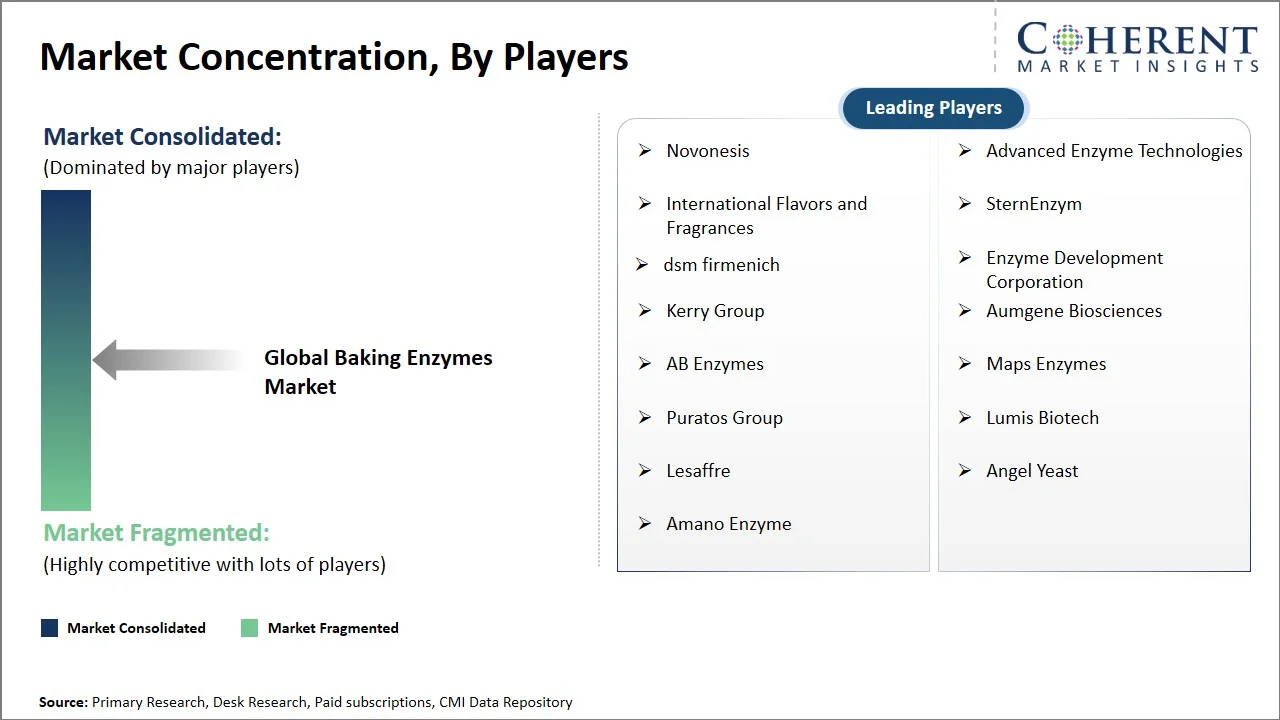
The global baking enzymes market is moderately consolidated at the fermentation-manufacturing level but more fragmented across formulation, blending, and distribution. Large bioscience groups compete with enzyme specialists, bakery-improver producers, regional formulators, and technical distributors. Market position depends less on catalogue size than on repeatable activity, regulatory documentation, application validation, supply continuity, and plant-scale troubleshooting. Regional companies remain relevant were local flour knowledge, smaller orders, language-specific support, or short delivery times influence purchasing. Pricing pressure is the strongest for established single-activity enzymes, while proprietary strains, specialty functions, and customized systems provide stronger margin protection.
Key focus areas include
- Activity reproducibility: Buyers require consistent performance across production batches, storage periods, flour origins, and processing environments.
- Regulatory dossier strength: Documented production strains, safety evaluations, activity specifications, and jurisdiction-specific approvals determine market access.
- Application-service capability: Pilot baking, rheology testing, recipe optimization, and industrial troubleshooting strengthen customer retention.
- Supply reliability: Fermentation redundancy, inventory planning, regional finishing, and alternative logistics routes reduce operational exposure.
- Cost-in-use evidence: Suppliers must demonstrate improvements in throughput, waste reduction, yield, recipe economics, or finished-product consistency.
- Format and handling differentiation: Low-dust powders, stable liquids, standardized granules, and compatible premixes affect workplace safety and dosing efficiency.
- Distribution quality: Local inventories and technically trained distributors are more valuable than broad geographic coverage without application support.
Market Report Scope
Baking Enzymes Market Report Coverage
| Report Coverage | Details | ||
|---|---|---|---|
| Base Year: | 2025 | Market Size in 2026: | USD 2.05 Bn |
| Historical Data for: | 2020 To 2024 | Forecast Period: | 2026 To 2033 |
| Forecast Period 2026 to 2033 CAGR: | 6.4% | 2033 Value Projection: | USD 3.16 Bn |
| Geographies covered: |
| ||
| Segments covered: |
| ||
| Companies covered: | Novonesis, International Flavors and Fragrances, dsm-firmenich, Kerry Group, AB Enzymes, Puratos Group, Lesaffre, Amano Enzyme, Advanced Enzyme Technologies, SternEnzym, Enzyme Development Corporation, Aumgene Biosciences, Maps Enzymes, Lumis Biotech, and Angel Yeast. | ||
| Growth Drivers: |
| ||
| Restraints & Challenges: |
| ||
Analyst Opinion (Expert Opinion)
- The global baking enzymes market leadership will increasingly be determined by regulatory asset quality and commercialization speed. Suppliers that can reuse validated production-strain platforms, activity methods, manufacturing controls, and safety packages across jurisdictions should introduce portfolio extensions faster and carry lower approval risk. This may concentrate value around platform owners even when finished enzyme functionality is technically comparable, shifting negotiating power away from undifferentiated resellers.
- Model-assisted protein design combined with high-throughput screening and bakery-process simulation could compress development cycles and replace broad trial-and-error discovery with targeted performance engineering. Legacy catalogues built around a limited set of established activities may face pressure as customers expect enzymes tuned to specific flour, process, and storage conditions. Participants integrating computational design, fermentation, and industrial validation will be best positioned.
- Suppliers should prioritize production-strain redundancy, localized finishing, regulatory intelligence, and application capabilities for difficult ingredient matrices and cold-chain systems. Margin discipline is essential because commodity enzymes may face price erosion, while highly customized programs can absorb excessive technical-service costs. Companies should use partnerships to enter fragmented markets and avoid adding capacity without secured customer validation, scalable manufacturing economics, or transferable regulatory approvals.
Speak to the analyst
Want personalized insights?
Take the findings above to one of our principal consultants, or have the report rebuilt around the segments, geographies and competitors you actually track.
Market Segmentation
- Enzyme Type Insights (Revenue, USD Bn, 2021 - 2033)
- Carbohydrases
- Proteases
- Lipases
- Oxidases
- Transferases
- Others
- Form Insights (Revenue, USD Bn, 2021 - 2033)
- Powder
- Liquid
- Granular and Encapsulated
- Application Insights (Revenue, USD Bn, 2021 - 2033)
- Bread
- Cakes and Pastries
- Biscuits and Cookies
- Rolls and Buns
- Pizza and Flatbreads
- Others
- End User Insights (Revenue, USD Bn, 2021 - 2033)
- Industrial Bakeries
- Artisan Bakeries
- Foodservice and In Store Bakeries
- Household and Retail Premixes
- Regional Insights (Revenue, USD Bn, 2021 - 2033)
- North America
- U.S.
- Canada
- Latin America
- Brazil
- Argentina
- Mexico
- Rest of Latin America
- Europe
- Germany
- U.K.
- Spain
- France
- Italy
- Russia
- Rest of Europe
- Asia Pacific
- China
- India
- Japan
- Australia
- South Korea
- ASEAN
- Rest of Asia Pacific
- Middle East
- GCC Countries
- Israel
- Rest of Middle East
- Africa
- South Africa
- North Africa
- Central Africa
- North America
- Key Players Insights
- Novonesis
- International Flavors and Fragrances
- dsm firmenich
- Kerry Group
- AB Enzymes
- Puratos Group
- Lesaffre
- Amano Enzyme
- Advanced Enzyme Technologies
- SternEnzym
- Enzyme Development Corporation
- Aumgene Biosciences
- Maps Enzymes
- Lumis Biotech
- Angel Yeast
Sources
Primary Research Interviews
- Baking enzyme manufacturers, ingredient formulators, flour millers, industrial bakeries, distributors, and technical consultants
- R&D, procurement, production, quality, regulatory, marketing, sales, and application-support executives
Stakeholders
- Amylase, xylanase, protease, lipase, oxidase, transferase, and multi-enzyme manufacturers
- Fermentation technology providers, premix companies, flour mills, bakery improver producers, distributors, and bakery manufacturers
End-use Sectors
- Bread, buns, rolls, pizza, flatbreads, cakes, pastries, biscuits, and cookies
- Industrial bakeries, artisan bakeries, foodservice bakeries, frozen-dough producers, and household premix users
Regulatory & Government Bodies
- U.S. Food and Drug Administration
- European Commission and European Food Safety Authority
- UK Food Standards Agency, Health Canada, Food Standards Australia New Zealand, and FSSAI
- China NHC, Japan MHLW, Brazil ANVISA, and FAO/WHO JECFA
Databases
- UN Comtrade, UNCTADstat, ITC Trade Map, Eurostat, and USITC DataWeb
- China Customs, India DGCI&S, Brazil Comex Stat, FAOSTAT, World Bank, and OECD
- FDA GRAS Inventory, EFSA opinions, company filings, patents, product catalogues, and trade databases
Magazines and Journals
- Baking & Snack, World Bakers, Baking Business, and Food Ingredients First
- Journal of Cereal Science, Cereal Chemistry, Food Chemistry, and LWT – Food Science and Technology
Associations
- American Bakers Association
- International Association of Plant Bakers
- Cereals & Grains Association
- Institute of Food Technologists
- Association of Manufacturers and Formulators of Enzyme Products
- All India Bread Manufacturers’ Association and ABIMAPI
Public Domain Sources
- Government food-safety and regulatory authorities
- Industry associations, customs databases, scientific journals, company reports, product catalogues, patents, and press releases
- Bakery production, flour consumption, retail, foodservice, and trade data
Key Standards and Regulations
- U.S. FDA GRAS framework and Food Chemicals Codex specifications
- EU Regulations EC 1332/2008, EC 1331/2008, and EC 1333/2008
- Canada List of Permitted Food Enzymes
- Australia New Zealand Food Standards Code
- India food-additive and processing-aid regulations
- China GB 2760, Japan MHLW requirements, Brazil ANVISA rules, and JECFA specifications
Proprietary Elements
- CMI Data Analytics Tool, Proprietary CMI Existing Repository of information for last 10 years.
Get access to 250+ pages report
Every segment, forecast, competitor profile and data table behind the analysis above — available for instant download.
- ESOMAR Member
- ISO 9001:2015 Certified
- D-U-N-S Registered
- GDPR & CCPA Compliant
Missing comfort of reading report in your local language? Find your preferred language:
Transform your Strategy with Exclusive Trending Reports
Frequently Asked Questions
The CAGR of the global baking enzymes market is projected to be 6.4% from 2026 to 2033.
The global baking enzymes market is estimated to be valued at USD 2.05 billion in 2026 and is expected to reach USD 3.16 billion by 2033.
Baking enzymes are widely used in bread, cakes, pastries, biscuits, cookies, rolls, buns, pizza, and flatbread production.
Baking enzymes help improve dough handling, texture, volume, and freshness while reducing dependence on chemical dough conditioners and synthetic additives.
Industrial bakeries are the primary end users, followed by artisan bakeries, foodservice and in-store bakeries, and household premix manufacturers.
Clean label baking increasing replacement of chemical dough improvers and shelf life extension needs supporting anti staling enzyme adoption are the major factors driving the growth of the global baking enzymes market.
Enzyme sensitivity to processing conditions affecting performance consistency and allergen handling requirements increasing industrial bakery compliance costs are the major factors hampering the growth of the global baking enzymes market.