

Global Food Enzymes Market Size and Forecast – 2026-2033
According to Coherent Market Insights, the global food enzymes market is estimated to be valued at USD 3.83 Bn in 2026 and is expected to reach USD 5.53 Bn by 2033, expanding at a compound annual growth rate (CAGR) of 5.4% from 2026 to 2033.
Key Takeaways of the Food Enzymes Market
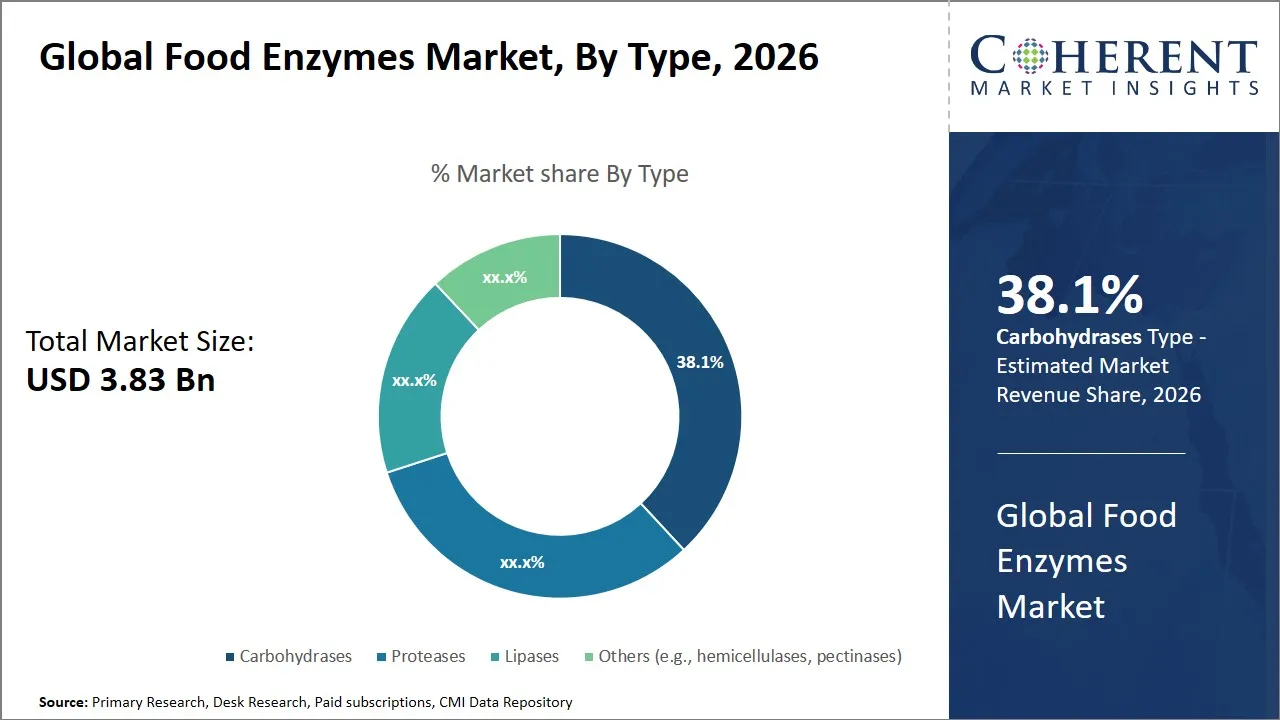
- The carbohydrases segment is expected to account for 38.1 % of the market share in 2026.
- The microbial segment is projected to capture 45.6 % of the food enzymes market share in 2026.
- The dairy processing segment is expected to hold 30.7 % of the global food enzymes share market in 2026.
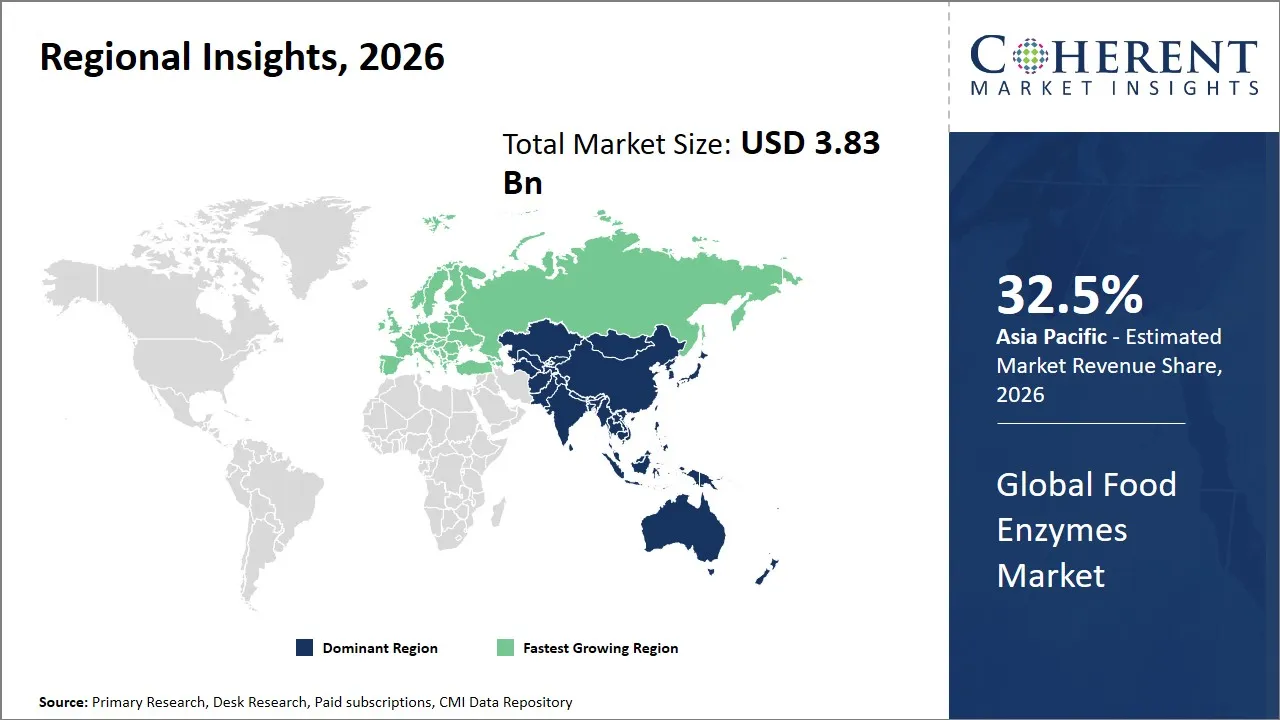
- The Asia Pacific region is expected to dominate the food enzymes market with a 32.5 % share in 2026.
- Europe will hold 18.3 % share in 2026 and record the fastest growth.
Market Overview
- Market trends indicate a strong inclination towards sustainable and clean-label products, with food enzymes playing a crucial role in improving food quality, shelf life, and nutritional value.
- Innovations in biotechnology have enabled the development of tailored enzymes for specific food processes, processed food further enhancing efficiency and product differentiation.
- Additionally, growing demand from emerging economies and expanding applications in dairy, baking, and meat processing sectors are anticipated to shape the future trajectory of the food enzymes market.
Current Events and Its Impact
Current Events | Description and its Impact |
Rising Demand for Clean‑Label & Sustainable Foods |
|
Technological Innovation in Enzyme Applications |
|
Segmental Insights
- Current Industry Events of 2026
- Market Size Estimation
- Regional Breakdown
- Competitive Landscape
- Customer Intelligence
- Segmental Analysis
- Pricing Analysis
- Key Market Drivers, Challenges & Future Trends
- Customized Insights Section
Why Does the Carbohydrases Segment Dominate the Global Food Enzymes Market in 2026?
Carbohydrases segment is expected to hold 38.1% of the global food enzymes market share in 2026. The large numbers of their usage in the food industry are a major growth force in this segment. Some of the enzymes found under the category of carbohydrases are amylases, cellulases and maltase’s, which are widely applied in the manufacture and modification of various food products. The demand of carbohydrases lies in their capacity to increase the texture and shelf life and make nutritional improvements.
For example, in the baking industry, amylases are used extensively for starch hydrolysis. This enzymatic action enhances dough handling properties, fermentation, and overall product quality, leading to increased volume, softer crumb, and an extended shelf life of bread and bakery products.
Microbial Segment Dominates the Global Food Enzymes Market
Microbial segment is projected to represent 45.6% in the global food enzymes market share in 2026, owing to a number of economic and practical benefits that they have over plant- and animal-derived enzymes. Microbial sources are usually bacteria, fungi and yeast strains which can be cultured in controlled fermentation conditions that allow large scale, consistent and sustainable production of enzymes.
The scalability of microbial enzymes and the reduction in production is one of the main factors that have influenced their domination. In comparison to plant or animal sources, which are usually constrained by changes in season, extraction complexities, and ethical issues, microbial fermentation enables the generation of enzymes all year round with reduced supply chain outages. This stability is critical to food manufacturers who require stable quality and quantity in the provision of enzymes.
Dairy Processing Dominates the Food Enzymes Market
Dairy processing segment is expected to hold 30.7% of the food enzymes market share in 2026, because of the importance of enzymes to enhance the quality, consistency and nutritional value of dairy products. Proteases, lipases, and other enzymes have widely been utilized to alter the contents of the milk producing desired textures, tastes, and sales longevity in products that include cheese and yogurt as well as in infant formula and lactose-free milk.
Among the major growth drivers in the enzyme use related to dairy is the increasing customer demand of high-end dairy products that are of high quality in terms of sensory qualities. Proteins that are used to boost cheese production include proteins that boost the formation of cheese and enhance the melting and flavor characteristics of cheeses. On the same note, lipases also add unique flavors in specialty cheeses because they catalyze the liberation of free fatty acids, which are essential in producing the true taste.
Regional Insights
Asia Pacific Food Enzymes Market Analysis and Trends
The Asia Pacific region is projected to lead the market with a 32.5% share in 2026, due to the pace at which the region is urbanizing, dietary habits, and increasing demand of processed and convenience foods. The growing consumer consciousness as far as health and nutrition are concerned promotes the use of enzymatic food additives to enhance the digestibility and nutritional value of foods. The presence of government programs to facilitate biotechnology and food innovation in such countries as China and India causes an even greater increase in the market.
What is good about the region is that there is an increasing population of local enzyme manufacturers, and there are developed global players like DuPont (U.S.) and Kerry Group (Ireland) whose manufacturing and distribution systems are increasing. The supply chain ecosystem is reinforced by trade dynamics whereby exports of processed foods are rising and so are foreign direct investment. This is facilitated by the enhancement of cold chain logistics and food safety facilities that can allow more intensive use of enzymes in food processing.
Europe Food Enzymes Market Analysis and Trends
The Europe region is expected to exhibit the fastest growth in the market, contributing 18.3% share in 2026, due to the fact that the region has developed a well-established food processing industry, rigid food safety laws, and the government is willing to support innovation in biotechnology. The European nations focus on clean-label and natural food ingredients, and this has resulted in the increased demand in the enzymes that help improve the food quality and shelf life without use of synthetic additives.
The sustainable existence of the strong enzyme producers such as Novozymes (Denmark) and DSM (Netherlands) provides the competitive advantage in terms of constant investment in research and development, as well as diversification of the product range. In addition, the harmonization of the regulatory frameworks by the EUs makes cross-border trading and market growth easier, as there are uniform quality and safety standards of the food enzymes. Also, academia and industry in Europe collaborate to develop technology, which helps in coming up with specific enzyme molecules to bakery, dairy, and beverage industries.
Global Food Enzymes Market Outlook for Key Countries
U.S. Food Enzymes Market Trends
The U.S. food enzymes industry is exhibiting a mature ecosystem with high levels of consumerism in functional and specialty food products. Having high representation of multinational corporations such as DuPont Nutrition & Health and Associated British Foods (ABF), the U.S. has the advantage of having good research facilities and partnership with institutions of higher learning in the innovation of applications of enzymes.
The FDA and other regulatory authorities strictly uphold their standards that foster consumer trust and allow the markets to stabilize. There are vast enzyme applications in the dairy, bakery, and meat processing industries that are created by the flourishing processed food and beverage industry. Also, the tendency of consumers to plant-based and clean-label products promotes the re-development of products based on natural enzymes.
Germany Food Enzymes Market Trends
The dominance of Germany’s position in the food enzymes market is based on its strategic position in Europe as a manufacturing and technological hub. Germany has a high presence of companies like BASF and Chr. Hansen which are involved in the production and application innovation of enzyme products specific to the food and beverage industry. The entire food safety laws and the sustainability mindset of the country are some of the reasons that make the use of the eco-friendly enzyme solutions a possibility.
The fact that Germany is among the largest exporters of processed foods is also a draw to the investment of enzyme technologies that will allow them to produce a better quality and shelf life of their products. Also, enablers to biotechnology startups in the government enhance innovation so as to develop tailor-made enzyme blends to suit various culinary cultures.
China Food Enzymes Market Trends
The fast growing food processing industry and growing consumer buying capacity of China characterize it as a major force in the Asia Pacific food enzymes market. The investment and enzyme manufacturing is promoted by the Made in China 2025 initiative and biotechnology promotion policies. The local companies such as Angel Yeast Co and the foreign firms have been increasing the production levels to cater to the increasing demand in the bakery, dairy, and beverage sectors.
Local firms like Angel Yeast Co. and international companies have been expanding production capacities to meet surging demand across bakery, dairy, and beverage segments. Rapid urbanization and modernization of supply chains enhance the ability to integrate enzyme technologies efficiently. Increased exports of processed food products further stimulate demand for enzymes that improve flavor, texture, and preservation. Strategic partnerships with global enzyme producers help transfer technology and improve product offerings.
Brazil Food Enzymes Market Trends
Brazil’s role in the Latin America food enzymes market is high and supported by its large agricultural base and good food processing industry. The government of the country is promoting biotech innovation by providing favorable policies and financing systems, which promote the use of enzymes in meat processing, brewing, and dairy industries. Large players like Novozymes and local firms are joining forces in order to create enzymes that are modified to suit region-specific raw materials and foods.
The increased export of processed foods by Brazil’s encourages investments in enzyme technologies by improving quality and adherence to international standards. In addition, the new market of organic and natural foods in Brazil encourages the application of enzymes to substitute the use of chemicals.
India Food Enzymes Market Trends
The market in India is an exceptional market in the Asia Pacific region in terms of its dynamism and swiftly changing food enzymes market. Enzyme demand is driven by a growing middle-income population, health and nutrition awareness and is propelled by the growth of processed food consumption. Government subsidies such as Make in India promote enzyme production within the country and R&D.
The market leaders like Advanced enzyme technologies have been developing cost effective enzyme solutions that are relevant to food processing needs in the region which includes dairy, confectionaries as well as snacks. The outsourcing of the world enzyme manufacturers aids in the increase of technology transfer and market penetration. The increase in food exports and better food safety infrastructure helps create a more competitive market environment in which enzymes are becoming a component of product innovation and product quality control.
Cost-in-Use vs Price-Per-Kg Economics
Price-Per-Kg (USD) | Cost-in-Use (USD/Unit of Application) | Application Efficiency (%) |
15 | 0.08 | 90 |
25 | 0.12 | 80 |
30 | 0.15 | 75 |
Market Players, Key Development, and Competitive Intelligence
Key Developments
- In February 2025, Novonesis sealed a deal to purchase DSM-Firmenich’s stake in the Feed Enzyme Alliance for a whopping USD 1.6 billion (EUR 1.5 billion).
- In November 2024, International Flavors & Fragrances launched TEXSTAR, a pioneering enzyme set designed to transform fresh fermented food textures, targeting premium applications in dairy and fermented food categories.
- In October 2024, Biocatalysts Ltd. unveiled an enzymatic solution tailored to elevate flavor profiles in enzyme-modified dairy ingredients. This innovative enzyme is crafted to enhance the inherent flavor traits of dairy components. With this distinct solution, manufacturers can accentuate savory, umami-rich nuances in their dairy products, aligning with contemporary consumer preferences for pronounced tastes and transparent, cleaner labels.
Top Strategies Followed by Global Food Enzymes Market Players
Player Type | Strategic Focus | Example |
Established Market Leaders | Heavy investment in R&D and innovation | For example, Novozymes introduced Chymostar, a cheese-specific enzyme that can be used to improve cheese yield, and which also consumes less energy in the dairy sector. The area of interest of these companies is on how to produce high-performance enzymes that are highly stable, selective and multifunctional in order to meet the highly complex needs of the various food processing processes. |
Mid-Level Players | Cost-effective solutions with balanced quality | For instance, DSM provides a variety of enzymes that are applicable to producing bread that enhances the bread manufacturing process and shelf life at an affordable price. |
Small-Scale Players | Niche specialization & innovative variants | For example, the Enzyme Development Corporation is the manufacturer of custom-made enzymes to be used in plant based food products, a field with much momentum with the emergence of plant-based meat products such as Beyond Meat and Impossible Foods. |
Market Report Scope
Food Enzymes Market Report Coverage
| Report Coverage | Details | ||
|---|---|---|---|
| Base Year: | 2025 | Market Size in 2026: | USD 3.83 Bn |
| Historical Data for: | 2020 To 2024 | Forecast Period: | 2026 To 2033 |
| Forecast Period 2026 to 2033 CAGR: | 5.4% | 2033 Value Projection: | USD 5.53 Bn |
| Geographies covered: |
| ||
| Segments covered: |
| ||
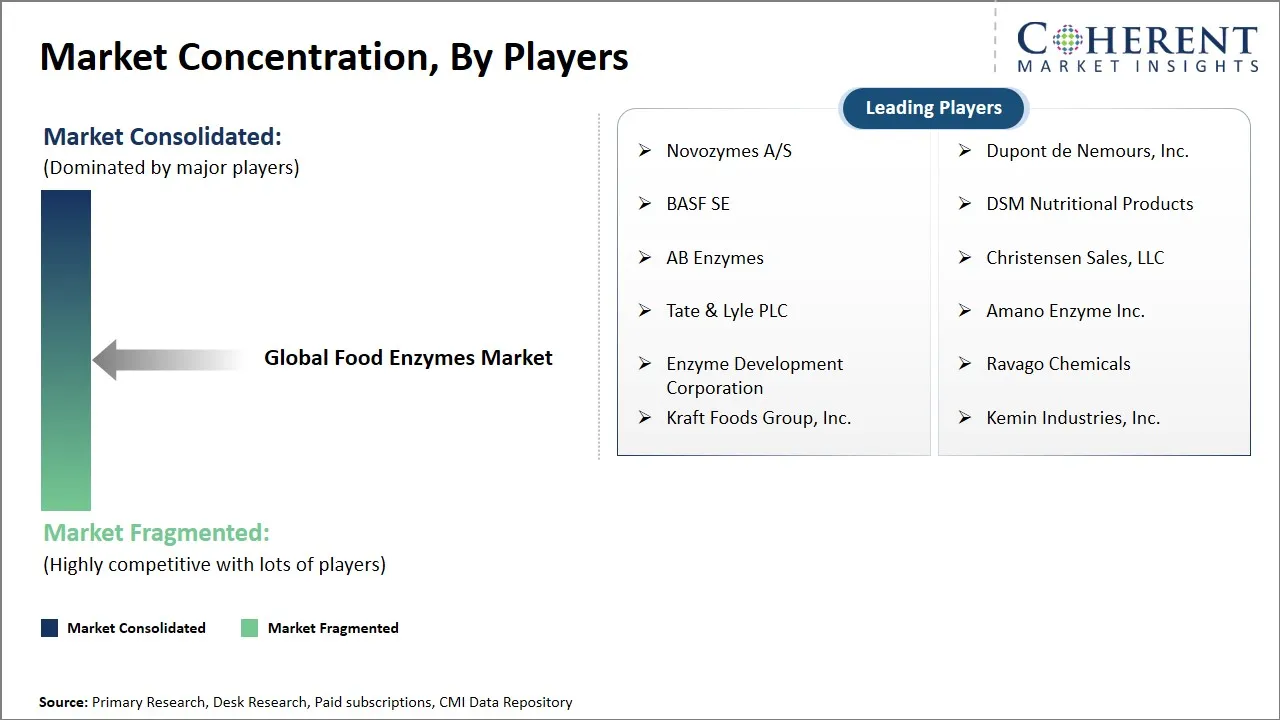
| Companies covered: | Novozymes A/S, Dupont de Nemours, Inc., BASF SE, DSM Nutritional Products, AB Enzymes, Christensen Sales, LLC, Tate & Lyle PLC, Amano Enzyme Inc., Enzyme Development Corporation, Ravago Chemicals, Kraft Foods Group, Inc., and Kemin Industries, Inc. | ||
| Growth Drivers: |
| ||
| Restraints & Challenges: |
| ||
Food Enzymes Market Dynamics
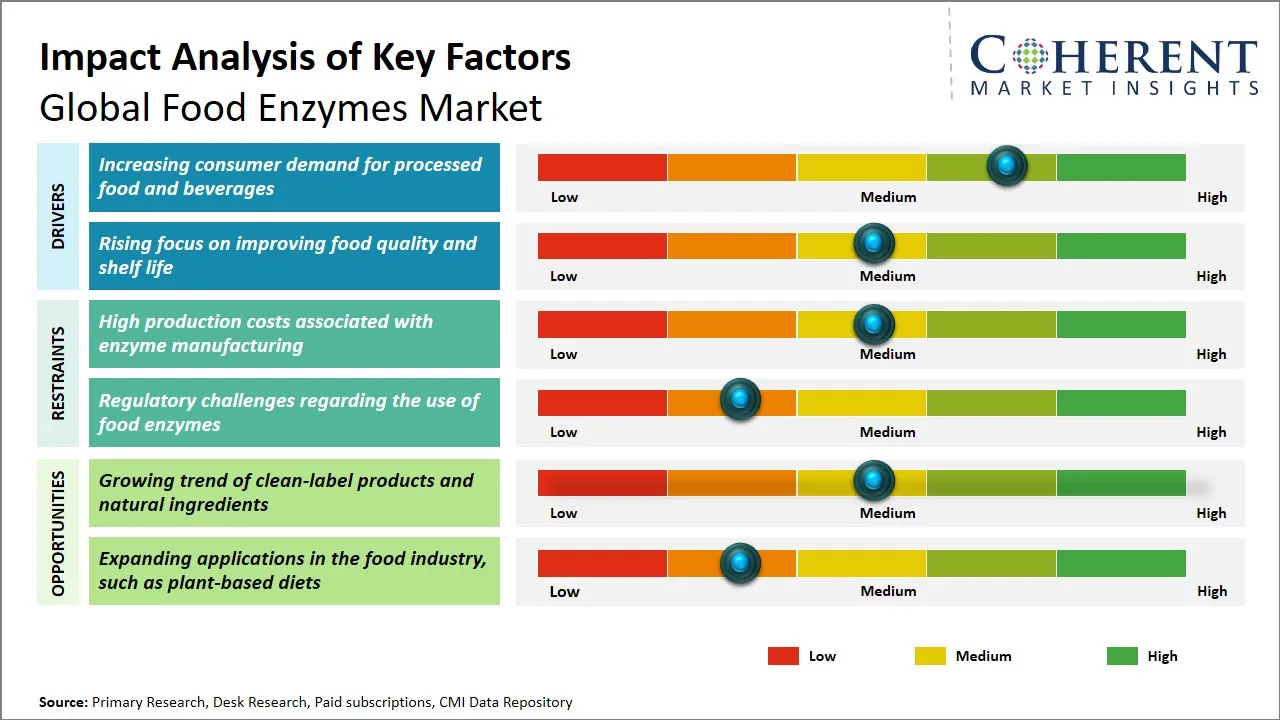
Food Enzymes Market Driver - Increasing Consumer Demand for Processed Food and Beverages
The growing consumer trend towards processed and convenience foods is an important driver of the rising demand of food enzymes in the world. With the growing fast-paced lifestyles, consumers are more concerned with ready-to-eat and easy-to-prepared food and beverage products, which has been forcing manufacturers to create and streamline their products. Food enzymes are essential in improving texture, flavor, shelf life, and nutrition thus being essential in the manufacture of a large number of processed foods including baked goods, baking mixes, dairy products, and beverages. Moreover, enzymes can be used to save time and energy consumed during the processing process, which can be considered in line with the industry trend of efficiency and sustainability.
For example, major industry players such as Unilever and nestle have widely introduced enzymes in their baked goods lines to boost the performance of the dough, decrease the processing time and the shelf life. Enzymes such as amylases and lipases are used to enhance texture, flavor and crust color in bread and other products.
Food Enzymes Market Opportunity - Rising Demand for Clean-Label Products and Natural Ingredients
The increasing customer demand of clean-label products and natural ingredients will be of great benefit to the global food enzymes market. With consumers becoming more health conscious and transparent about their food products, manufacturers are reacting by using enzymes that are natural in nature to substitute synthetic additives and preservatives. This trend is fueled by a change in the consumption of less processed foods where purity, sustainability, and nutritional value are considered and enzymes are appealing as a functional ingredient that fits in these consumers tastes. Food enzymes improve the texture, flavor, shelf life and nutritional profiles without affecting the natural attractiveness of the products.
For example, General Mills introduced a clean-label line of its brand Nature Valley that utilizes enzymes produced by natural origins, rather than artificial preservatives and additives. These enzymes are used to preserve the freshness and the flavor of the products and enable the company to sell the items as less processed and natural.
(Source: https://www.generalmills.com/food-we-make/brands/nature-valley)
Analyst Opinion (Expert Opinion)
- The food enzymes market is also going through a tremendous growth that has been fueled by increasing demand of effective and clean-label solutions in food processing and formulation. The International Enzyme Conference (2023) and the Food Technology Summit (2022) provided insights into the emerging trends in innovation and showed that such companies as Novozymes and DuPont are leading the way in creating enzymes that can improve the texture, flavor, and nutrition of food products.
- This is evidenced by the recent release of an enzyme mix by Novozymes, whose main market targets plant-based foods, which means the industry is responsive to the increasing popularity of vegan and vegetarian products. It was discussed that enzymes play a vital role in the reduction of food waste and improvement in sustainability of the production process, which conforms to the preference of consumers to environmentally friendly products.
- The issues like regulatory obstacles, variation in the activity of enzymes when subjected to various processing environments, were often cited as obstacles to the increased usage. Firms which emphasize on R&D to develop and produce targeted enzyme solutions as well as working in close consultation with the food manufacturers are likely to take up large market share. Finally, the development of the food enzymes market will be reliant on its capacity to keep on innovating and be able to adapt to the changing demands of efficiency, transparency, and sustainability in food production.
Speak to the analyst
Want personalized insights?
Take the findings above to one of our principal consultants, or have the report rebuilt around the segments, geographies and competitors you actually track.
Market Segmentation
- Type Insights (Revenue, USD Bn, 2021 - 2033)
- Carbohydrases
- Proteases
- Lipases
- Others (e.g., hemicellulases, pectinases)
- Source Insights (Revenue, USD Bn, 2021 - 2033)
- Microbial
- Plant
- Animal
- Application Insights (Revenue, USD Bn, 2021 - 2033)
- Dairy processing
- Bakery & confectionery
- Animal feed
- Beverages
- Processed foods
- Regional Insights (Revenue, USD Bn, 2021 - 2033)
- North America
- U.S.
- Canada
- Latin America
- Brazil
- Argentina
- Mexico
- Rest of Latin America
- Europe
- Germany
- U.K.
- Spain
- France
- Italy
- Russia
- Rest of Europe
- Asia Pacific
- China
- India
- Japan
- Australia
- South Korea
- ASEAN
- Rest of Asia Pacific
- Middle East
- GCC Countries
- Israel
- Rest of Middle East
- Africa
- South Africa
- North Africa
- Central Africa
- North America
- Key Players Insights
- Novozymes A/S
- Dupont de Nemours, Inc.
- BASF SE
- DSM Nutritional Products
- AB Enzymes
- Christensen Sales, LLC
- Tate & Lyle PLC
- Amano Enzyme Inc.
- Enzyme Development Corporation
- Ravago Chemicals
- Kraft Foods Group, Inc.
- Kemin Industries, Inc.
Sources
Primary Research Interviews
- CEO – Leading Food Enzymes Producer (e.g., Novonesis or DSM equivalent)
- Supply Chain Director – Major Food Enzymes Distributor
- Production Lead – Specialty Food Enzymes Manufacturer (e.g., AB Enzymes)
- Sustainability Officer – Food Enzymes Certification Authority
Stakeholders
- Manufacturers
- End-use Sectors
- Bakery Industry (Bread, Pastries)
- Dairy Producers
- Beverages (Juices, Beer)
- Regulatory & Certification Bodies (e.g., EFSA Food Enzymes Panel, FDA for food additives)
- E-commerce Platforms and Retailers (Alibaba, Industrial Suppliers, Sigma-Aldrich)
- Technology Integration Players: Advanced enzyme engineering and biotech firms using microbial enzymes
Databases
- UN Comtrade Database (HS Code for enzymes)
- India Import Export (EXIM) Database
- USGS Mineral Commodity Summaries (related industrial enzymes where applicable)
- Eurostat Trade Statistics for Chemicals and Enzymes
Magazines
- Food Processing Magazine – Trends in food enzymes supply
- Bakery International – Enzymes in baking innovations
- Dairy Industries International – Applications in dairy processing
- Food Technology – Market dynamics for food enzymes
- Beverage Industry – Enzyme use in beverage production
Journals
- Journal of Food Science – Food enzymes in processing durability
- Food Chemistry – Global food enzymes supply chain analysis
- Journal of Agricultural and Food Chemistry – Environmental impact of enzyme production
- Enzyme and Microbial Technology – Synthesis and purification techniques
- Applied Microbiology and Biotechnology – Extraction and refining of enzyme sources
Newspapers
- The Wall Street Journal – Global demand for food enzymes
- The Guardian – Sustainability in enzyme production
- Business Standard (India) – Food enzymes imports and Asia market growth
- Chemical Week – Supply disruptions in enzyme production
- Reuters – Price volatility in industrial enzymes
Associations
- Association of Manufacturers and Formulators of Enzyme Products (AMFEP)
- Food Enzyme Database (FEDA) initiative
- Institute of Food Technologists (IFT)
- American Society of Baking (ASB)
- European Federation of Enzyme Producers
- Green Chemistry Institute
Public Domain Sources
- EFSA – Guidelines for food enzymes safety assessment
- European Commission – REACH and food enzyme regulations
- World Health Organization (WHO)/FAO JECFA – Safety standards for food enzymes
- FDA – GRAS status and regulations for food enzymes
- OECD – Chemical trade and sustainability reports for enzymes
Proprietary Elements
- CMI Data Analytics Tool, Proprietary CMI Existing Repository of information for last 8 years.
Get access to 250+ pages report
Every segment, forecast, competitor profile and data table behind the analysis above — available for instant download.
- ESOMAR Member
- ISO 9001:2015 Certified
- D-U-N-S Registered
- GDPR & CCPA Compliant
Missing comfort of reading report in your local language? Find your preferred language:
Transform your Strategy with Exclusive Trending Reports
Frequently Asked Questions
The global food enzymes market is estimated to be valued at USD 3.83 Bn in 2026 and is expected to reach USD 5.53 Bn by 2033.
Food enzymes are proteins that catalyze biochemical reactions in food processing, enhancing texture, flavor, and preservation.
The CAGR of global food enzymes market is projected to be 5.4% from 2026 to 2033.
Increasing consumer demand for processed food and beverages and rising focus on improving food quality and shelf life are the major factors driving the growth of the global food enzymes market.
Enzymes improve product consistency, reduce processing times, and enhance nutritional content in food products.
High production costs associated with enzyme manufacturing and regulatory challenges regarding the use of food enzymes are the major factors hampering the growth of the global food enzymes market.
In terms of type, the carbohydrases segment is estimated to dominate the market revenue share in 2026.