

Global Biomass Briquette Market Size and Forecast – 2026 to 2033
The Global Biomass Briquette Market is estimated to be valued at USD 1.45 Bn in 2026 and is expected to reach USD 2.44 Bn by 2033, exhibiting a compound annual growth rate (CAGR) of 7.7% from 2026 to 2033.
Key Takeaways of the Biomass Briquette Market
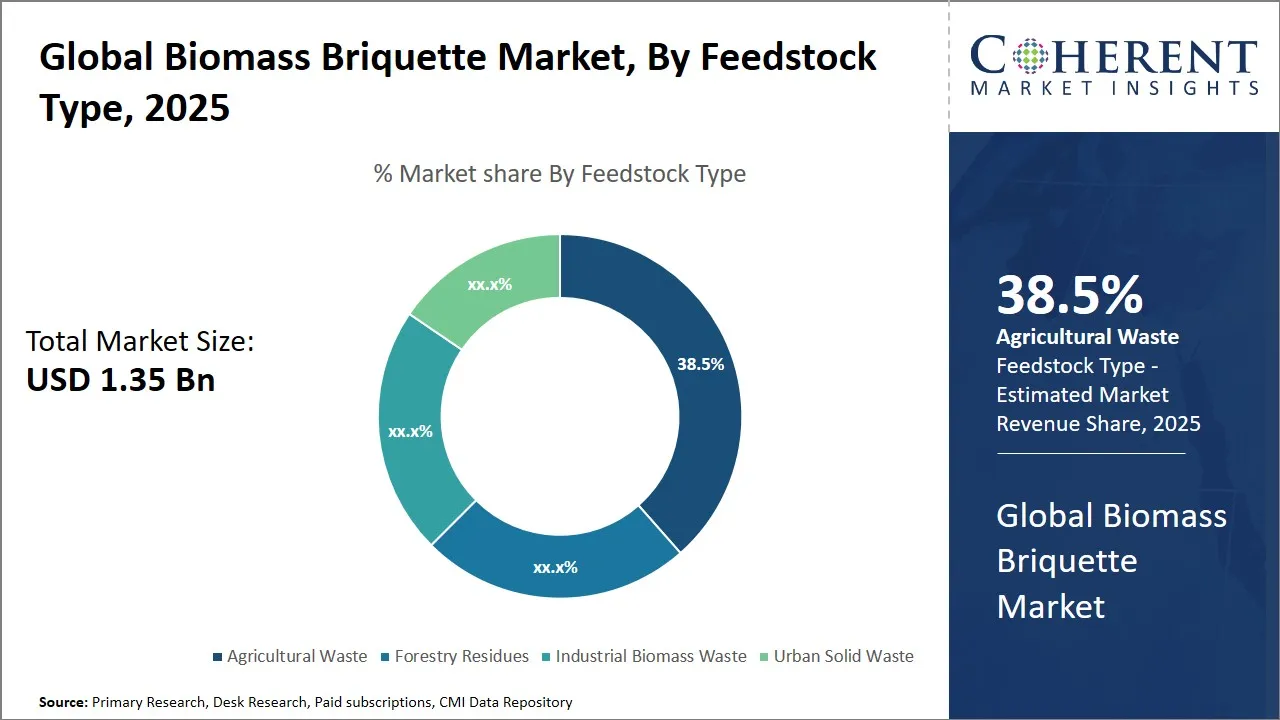
- Agricultural waste segment is projected to hold 39.5 % of the global biomass briquette market share in 2026.
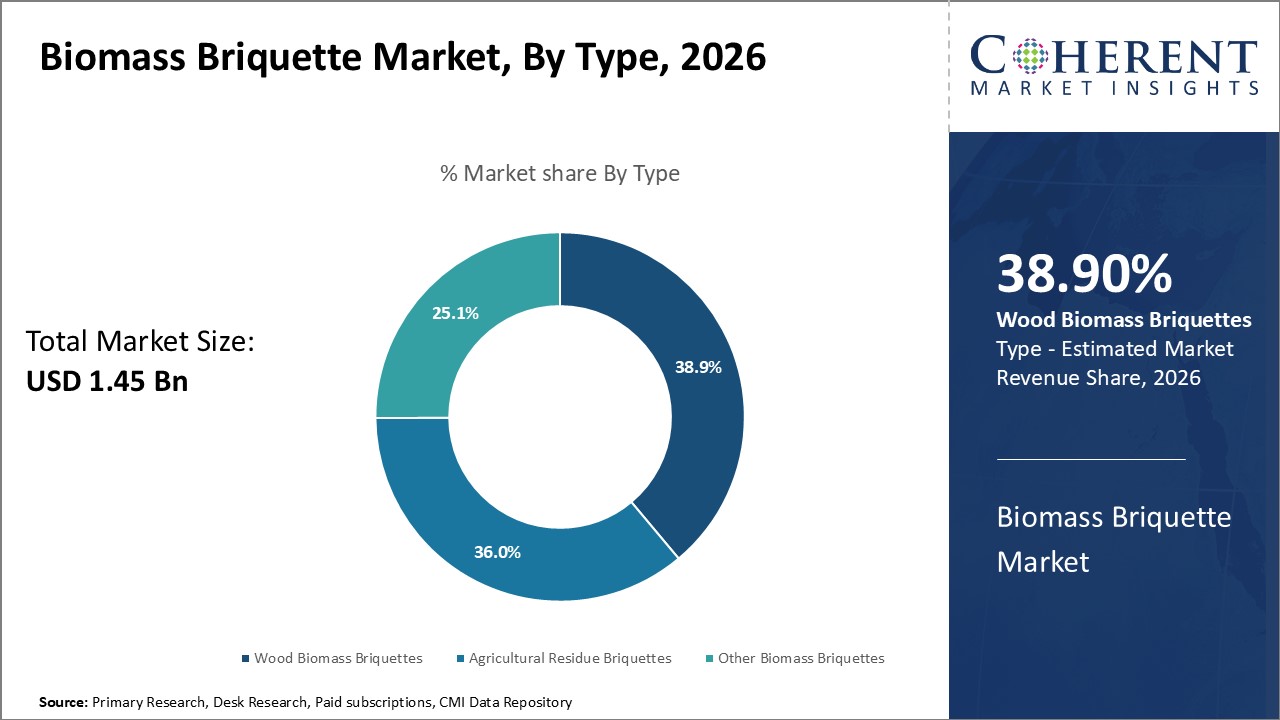
- Wood biomass briquettes segment is expected to account for 38.9 % of the biomass briquette market share in 2026.
- The heating segment is estimated to hold 33.6 % of the market share in 2026.
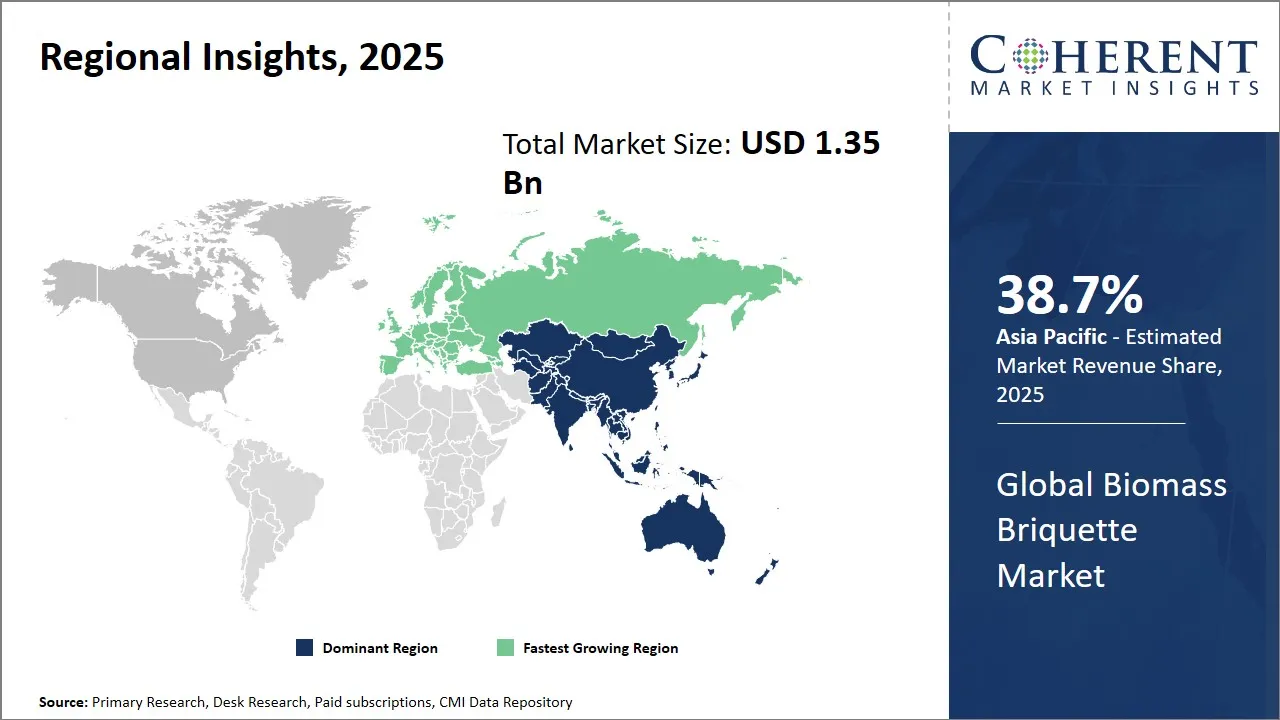
- Asia Pacific will dominate the biomass briquette market in 2026 with an estimated 38.7 % share.
- Europe will hold 19.3% share in 2026 and record the fastest growth.
Market Overview
- A prominent market trend is the rising adoption of biomass briquettes in industrial and residential sectors as governments worldwide enforce stricter environmental regulations and promote carbon neutrality.
- Technological advancements in briquette production, such as improved binding materials and machinery efficiency, are enhancing product quality, thereby expanding applications.
- Additionally, increasing investments in green energy infrastructure and growing awareness about reducing carbon footprints further propel the market's expansion.
Current Events and Its Impact
Current Events | Description and its impact |
EU Anti‑Deforestation Law Delay (December 2025) |
|
UNDP & Japan Support for Solid Biofuel Producers |
|
Segmental Insights
- Current Industry Events of 2026
- Market Size Estimation
- Regional Breakdown
- Competitive Landscape
- Customer Intelligence
- Segmental Analysis
- Pricing Analysis
- Key Market Drivers, Challenges & Future Trends
- Customized Insights Section
Why Does Agricultural Waste Dominate the Biomass Briquette Market in 2026?
Agricultural waste segment is expected to contribute 39.5% of the biomass briquette market share in 2026, owing to its widespread availability and sustainable nature. The industrial remains of agricultural products in the form of crop stalk, husks and straw among other by-products are produced in enormous quantities on the global environment, particularly in economies that are agrarian. Agricultural waste is the seasonally renewable resource, unlike forestry residues or industrial biomass, which makes it a stable and reliable source of raw material in the production of briquette. The high level of agricultural activity in the developing and emerging economies is creating unlimited feedstock that is fueling local production centers aimed at biomass briquettes.
In India, the large-scale rice production in states like Punjab and Uttar Pradesh generates significant quantities of rice husk and straw. These agricultural residues are being repurposed for biomass briquette production, with companies like Shriram Bioenergy leading the charge in converting these waste materials into high-energy, environmentally friendly fuel alternatives for both domestic use and export.
Why are Wood Biomass Briquettes Leading the Global Biomass Briquettes Market?
Wood biomass briquettes are projected to hold 38.9% of the market share in 2026, due to their superior energy density and ease of processing. Wood biomass is a product that is obtained by means of forestry residues, sawdust, wood chips, wood shavings, and wood biomass has a better calorific value than most other biomass types. This increased energy content translates into increased burn time and better output of heat, and so wood briquettes are specifically attractive in the use of the product commercially and in households.
The uniformity and standard quality of the wood biomass briquettes is one of the primary factors that contribute to the popularity of such products. Wood processing industries and sawmills produce a lot of residual wood waste that can be collected and compacted into high density briquette easily. Such briquettes are less aggressive and contain less moisture content and hence wear on combustion system is limited and the duration of boilers and stoves is prolonged.
Heating Application Dominates the Biomass Briquette Market
The heating segment is projected to command 33.6% of the global biomass briquette market share in 2026, because of high demand due to the necessity to have an efficient and sustainable generation of heat. The uses of heating include space heating and water heating in residential settings, commercial and small-scale industry heat generation, and biomass briquettes are an ideal fuel to these settings since they provide a high-energy output and a cleaner combustion profile.
Among the driving forces that are moving the heating applications to the fore, the increasing consciousness surrounding environmental issues associated with the traditional fossil fuel is a major determinant. Biomass briquettes especially those of agricultural residues or wood biomass burn much less carbon and fewer pollutants like sulfur oxides and nitrogen oxides. This renders them appealing to consumers and businesses which want to limit their carbon footprint or meet strict environmental standards.
Regional Insights
Asia Pacific Biomass Briquette Market Analysis and Trends
The Asia Pacific region is projected to lead the market with a 38.7% share in 2026, fueled by rising energy demand, industrialization, and increasing environmental awareness. The area has plenty agricultural residues and forestry wastes, and this forms a strong foundation of raw materials in making biomass briquette. The emerging economies like India, China and Southeast Asian states have also come up with favorable policies such as subsidies, tax incentives and renewable energy requirements that encourage the use of briquette made out of biomass.
Demand is caused by the growing manufacturing industry and the large rural electrification programs. Shriram Bioenergy, Jiangsu Liangyou International, and Biojoice Biomass LTD are some of the key players enjoying the opportunities by investing in local production plants and technology transfers to enhance the growth dynamics of the region.
Europe Biomass Briquette Market Analysis and Trends
The Europe region is expected to exhibit the fastest growth in the market contributing 19.3% share in 2026, driven by a well-established ecosystem that supports renewable energy initiatives and sustainable fuel alternative adoption. The high government policies to cut down carbon emissions and focus on the principles of a circular economy have stimulated the use of biomass briquettes in residential heat and industries.
The availability of mature supply chains and the presence of such established companies as ABEL Energy, RUF Briquetting Systems and Odersun guarantee the technological progress and the stability of products supply. The unity of trade policies and biomass use incentives in the European Unions also allow cross-border cooperation and market growth, especially in such countries as Germany, France, and the Nordic countries which brings additional power to the European leadership.
Global Biomass Briquette Market Outlook for Key Countries
Germany Biomass Briquette Market Trends
The biomass briquette market in Germany can be described as having a high level of government support of renewable energy, steady investments in biomass infrastructure and a developed industrial sector that is interested in finding a sustainable source of fuel. The organizations like the ABEL Energy play a major role in the provision of advanced briquetting technologies that enhance fuel density and fuel combustion efficiency. The policy of the Germanys adherence to the Energiewende policy attests to biomass briquettes as a potential solution in heating and power production, stimulating innovation and implementation in home and business.
Why is India’s Biomass Briquette Market Expanding Rapidly?
The market of biomass briquette in India is driven by the large agricultural base in the country that offers large quantities of raw materials to make briquettes. Such programs as the National Biomass Cookstoves Programme and subsidies on biomass briquette machines promoted the mass use of biomass briquettes among rural and industrial consumers. Major players such as Shriram Bioenergy and Eco roots are actively contributing in the growth of briquette production and distribution channels, especially in the states that boast of good agro residue. The emphasis on the decrease of air pollution by means of traditional biomass fuels also leads to the formation of the greater demand on the cleaner briquette options.
China Biomass Briquette Market Trends
China remains to be a key market in its push by the government to diversify energy and rural development. The penetration of biomass briquettes in the national renewable energy strategies and emission cuts increases the market penetration. Players such as Jiangsu Liangyou International focus on research and development to improve the quality of the briquette and cost-effectiveness to serve the power plants, industries, and residential markets. Mass production of agricultural produce in China guarantees feedstock sustainability and therefore, it is a crucial component of stability in the regional and global market.
Why is Brazil’s Biomass Briquette Market Gaining Traction in Latin America?
The Brazil biomass briquette market has some advantages because of the high agricultural economy and the availability of sugarcane bagasse as a prime raw material in the production of biomass briquette. Bioenergy and rural energy availability programs by the government promote market developments. One of the companies that is involved in perfecting the briquetting technology based on the agro-waste profile of Brasils to enhance fuel alternatives both locally and in export markets include BrasBio Energia.
South Africa Biomass Briquette Market Trends
The market of biomass briquette in South Africa is expanding as a result of the rising energy shortages and the energy diversification agenda of the government. The large forestry residues and coal substitutions are also driving the attention to biomass briquettes as a fuel resource in industries and domestic heating. The local firms such as St. Francis equipment and BioTherm energy are in the process of establishing efficient briquette production unit and creating awareness campaigns to the rural and urban customers. The markets expansion potential is also supported by the supportive trade policies in the Southern African Development Community (SADC).
Feedstock Supply Stability Mapping (Seasonal availability, price volatility, sourcing risk)
Parameter | Biomass Briquettes | Coal | LPG |
Seasonal Availability | High variability based on harvest seasons | Stable year-round | Stable year-round |
Sourcing Risk | Medium (depends on regional availability and infrastructure) | Low (stable supply chain, but mining issues can arise) | Low (import dependency, but stable supply) |
Price Volatility | Moderate (affected by seasonality) | High (commodity-dependent) | Moderate (market-dependent) |
Energy Conversion Efficiency (%) | 85-90% (depends on briquette type) | 70-75% | 80-85% |
Fuel Substitution Economics vs Coal & LPG
One of the primary factors in this dataset is the cost comparison between biomass briquettes, coal, and LPG. Biomass briquettes are typically more affordable than coal and LPG, primarily due to the lower cost of raw materials, which often come from agricultural and forestry residues. These materials are typically underutilized, which keeps their cost low compared to coal, a mined resource, and LPG, which is derived from natural gas. Coal, being a fossil fuel, tends to have fluctuating prices due to the volatility in global coal markets and the cost of mining and transportation.
Energy Conversion Efficiency
The energy conversion efficiency of biomass briquettes is typically around 85-90%, depending on the type and quality of the briquettes. This efficiency is competitive compared to coal, which has an energy efficiency of 70-75%. LPG, being a cleaner and more refined fuel, typically operates at an energy efficiency of 80-85%. However, while biomass may have a slightly lower energy conversion rate compared to LPG, it still holds a significant advantage in terms of renewable sourcing and lower environmental impact. Biomass briquettes often provide similar or even better energy output when considering the environmental benefits they bring, such as reduced carbon emissions.
Market Players, Key Development, and Competitive Intelligence
Key Developments
- In February 2024, ProcMart announced a collaboration with local vendors in the biomass-briquettes and pellets manufacturing sector across four locations, focusing on machinery upgrades and sourcing efficiencies.
- In April 2025, the Madhya Pradesh government launched its Scheme for Implementation of Biofuel Projects under its Renewable Energy Policy 2025, offering incentives to boost bio-CNG, briquettes, pellets and biodiesel production, and create rural jobs.
Top Strategies Followed by Global Biomass Briquette Market Players
Player Type | Strategic Focus | Example |
Established Market Leaders | Heavy investment in R&D and innovation | Enviva has come up with wood pellets that have an ability to reduce greenhouse gases as compared to coal. They also create strategic alliances and partnerships with industry giants (including partnership with original equipment manufacturers (OEMs) to incorporate their biomass briquettes into power generation), through which they seek to incorporate their biomass briquettes into power generation systems. |
Mid-Level Players | Cost-effective solutions with balanced quality | Green Energy Biomass in India which introduces competitive briquettes priced reasonably to offer affordable energy to the rural population. Such companies streamline the production processes to cut on the operation costs like through automated systems or waste to energy technologies. |
Small-Scale Players | Niche specialization & innovative variants | Biomass Briquette Enterprises in East Africa that produce briquettes out of the regionally available agricultural waste, such as sugarcane bagasse and corn stover. In this way, they are able to serve regional needs and manage the niche markets well even with fewer resources and scope. |
Market Report Scope
Biomass Briquette Market Report Coverage
| Report Coverage | Details | ||
|---|---|---|---|
| Base Year: | 2025 | Market Size in 2026: | USD 1.45 Bn |
| Historical Data for: | 2020 To 2024 | Forecast Period: | 2026 To 2033 |
| Forecast Period 2026 to 2033 CAGR: | 7.7% | 2033 Value Projection: | USD 2.44 Bn |
| Geographies covered: |
| ||
| Segments covered: |
| ||
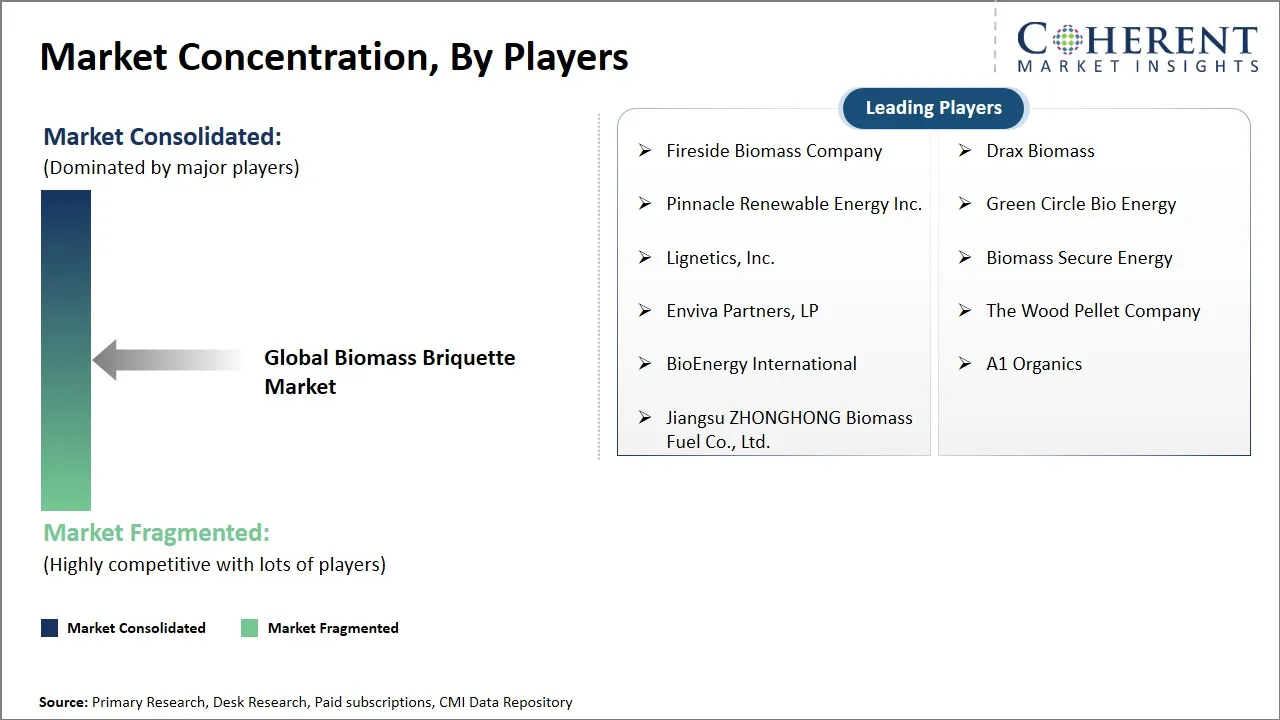
| Companies covered: | Fireside Biomass Company, Drax Biomass, Pinnacle Renewable Energy Inc., Green Circle Bio Energy, Lignetics, Inc., Biomass Secure Energy, Enviva Partners, LP, The Wood Pellet Company, BioEnergy International, A1 Organics, and Jiangsu ZHONGHONG Biomass Fuel Co., Ltd. | ||
| Growth Drivers: |
| ||
| Restraints & Challenges: |
| ||
Biomass Briquette Market Dynamics
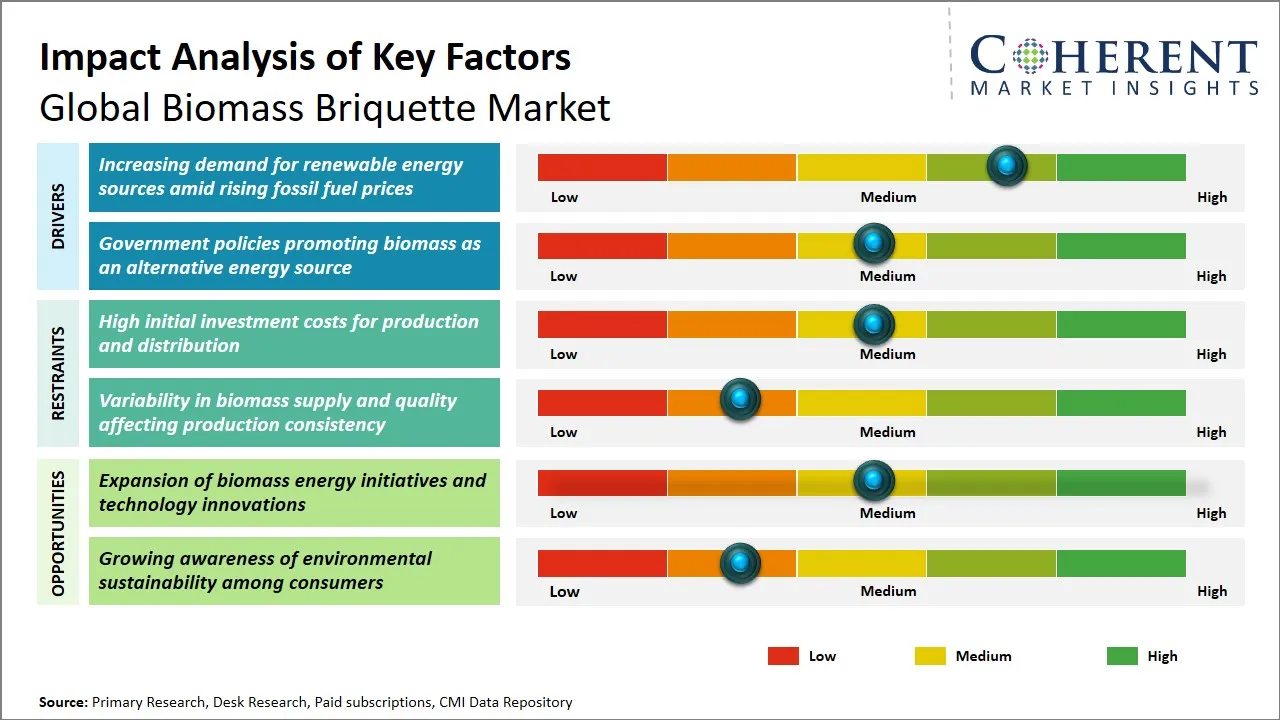
Biomass Briquette Market Driver - Increasing Demand for Renewable Energy Sources Amid Rising Fossil Fuel Prices
The rising cost of fossil fuel has greatly complicated the quest to find alternative and sustainable energy products which have intensified the use of briquettes made of biomass in many parts of the world. With the traditional fuel prices increasingly unpredictable and unstable, both industries and consumers are resorting to more cost and sustainable energy source, the biomass briquettes. Biomass briquettes, a type of renewable energy generated by using agricultural waste, forestry matter, and other organic resources, has the benefit of not only decreasing the reliance on fossil fuels, but also allow cutting the carbon emissions.
As an example, in 2022, the Indian government launched the National Biomass Cookstoves Programme that will decrease the levels of use of traditional cooking fuels, such as firewood and liquefied petroleum gas (LPG). This project has seen a rapid increase in the usage of biomass briquettes especially in the rural communities whereby agricultural wastes can be used in the production of briquettes.
(Source:https://policy.thinkbluedata.com/sites/default/files/National%20Biomass%20Cookstoves%20Programme.pdf)
Biomass Briquette Market Opportunity - Expansion of Biomass Energy Initiatives and Technology Innovations
The global biomass briquette market is poised to see a lot of gains due to the growing interest being taken in the biomass energy project initiated by the international commitments of cutting down the carbon emission and the need to use renewable sources of energy. Governments in various parts of the world, especially in Europe, Asia Pacific and North America are enacting favorable policies and subsidies on the utilization of bio-mass as a renewable source of energy. These efforts are speeding up the investments in biomass fuel energy infrastructure thus increasing the demand of biomass briquettes as clean source of fuels.
For example, Swedens Green Tax Reform, which is a plan to provide tax incentives to industries that use renewable fuels, such as biomass briquettes. Such a policy, together with technological advances in the production of briquettes, has led to the development of biomass energy infrastructure, which has opened biomass briquette market.
Analyst Opinion (Expert Opinion)
- The biomass briquette is a developing market with great potential as the future energy requirements of increasing numbers of individuals worry about fossil fuels due to the environmental impact of this energy source. The International Biomass Conference (2023) and the Renewable Energy Forum (2022) revealed the main trends in the field of innovations, with such companies as Bioenergy Solutions and Greenway Energy standing out as the creators of efficient biomass briquette technologies.
- The recent introduction by Bioenergy Solutions of a high-density briquette which takes advantage of agricultural waste is not only a demonstration of how the industry has been keen on ensuring sustainability, but it also serves to solve the problem of waste management.
- The conferences have discussed the centrality of biomass briquettes in mitigating greenhouse gas emissions and increasing energy security, especially in the places that use conventional biomass. Nevertheless, there were some difficulties that were often mentioned like market fluctuations in prices of raw materials and consumers should be more aware of the advantages and efficiency of briquettes.
- Those companies which concentrate on educating stakeholders and making strategic alliance will have a high opportunity of growth. In the end, the biomass briquette market will be dependent on its innovativeness with regard to helping in a sustainable energy transition and ensuring that the needs of nature-conscious consumers are met.
Speak to the analyst
Want personalized insights?
Take the findings above to one of our principal consultants, or have the report rebuilt around the segments, geographies and competitors you actually track.
Market Segmentation
- Feedstock Type Insights (Revenue, USD Bn, 2021 - 2033)
- Agricultural Waste
- Forestry Residues
- Industrial Biomass Waste
- Urban Solid Waste
- Type Insights (Revenue, USD Bn, 2021 - 2033)
- Wood Biomass Briquettes
- Agricultural Residue Briquettes
- Other Biomass Briquettes
- Application Insights (Revenue, USD Bn, 2021 - 2033)
- Heating
- Power Generation
- Cooking Fuel
- Industrial Fuel
- End User Industry Insights (Revenue, USD Bn, 2021 - 2033)
- Power Plants
- Residential
- Industrial
- Commercial
- Regional Insights (Revenue, USD Bn, 2021 - 2033)
- North America
- U.S.
- Canada
- Latin America
- Brazil
- Argentina
- Mexico
- Rest of Latin America
- Europe
- Germany
- U.K.
- Spain
- France
- Italy
- Russia
- Rest of Europe
- Asia Pacific
- China
- India
- Japan
- Australia
- South Korea
- ASEAN
- Rest of Asia Pacific
- Middle East
- GCC Countries
- Israel
- Rest of Middle East
- Africa
- South Africa
- North Africa
- Central Africa
- North America
- Key Players Insights
- Fireside Biomass Company
- Drax Biomass
- Pinnacle Renewable Energy Inc.
- Green Circle Bio Energy
- Lignetics, Inc.
- Biomass Secure Energy
- Enviva Partners, LP
- The Wood Pellet Company
- BioEnergy International
- A1 Organics
- Jiangsu ZHONGHONG Biomass Fuel Co., Ltd.
Sources
Primary Research Interviews
- CEO – Leading Biomass Briquette Manufacturer (e.g., Radhe Industrial Corporation or ECOSTAN equivalent)
- Supply Chain Director – Major Biomass Pellets and Briquettes Distributor
- Production Lead – Agro-Residue Briquette Producer
- Sustainability Officer – Biomass Energy Certification Authority
Stakeholders
- Manufacturers
- End-use Sectors
- Biomass Power Plants and Thermal Energy Producers
- Brick Kilns and Food Processing Industries
- Industrial Boilers (Cement, Textiles)
- Regulatory & Certification Bodies (e.g., MNRE India for biomass energy, EU Renewable Energy Directive)
- E-commerce Platforms and Retailers (Alibaba Industrial Suppliers, BioBiz Platform)
- Technology Integration Players: Briquetting machinery producers (C.F. Nielsen A/S, RUF Briquetting Systems)
Databases
- UN Comtrade Database (HS Code 4401 for wood pellets/briquettes, biomass fuels)
- India Import Export (EXIM) Database (biomass briquettes imports)
- US EIA Densified Biomass Fuel Reports (production capacity data)
- Eurostat Trade Statistics for Renewables and Bioenergy
Magazines
- Bioenergy Insight – Trends in biomass briquettes and pellets supply
- Renewable Energy World – Biomass fuel market innovations
- Industrial Biomass Review – Global briquette production dynamics
Journals
- Renewable Energy Journal – Biomass briquette production and characterization
- Biomass & Bioenergy – Agro-based briquettes durability studies
- Energy for Sustainable Development – Loose biomass briquetting processes
- Journal of Cleaner Production – Calorific value enhancement methods
Newspapers
- Reuters – Price volatility in biomass fuels
- Business Standard (India) – Biomass briquettes market growth in Asia
- The Economic Times – Agro-residue utilization in energy sector
Associations
- Association of Briquette Manufacturers India (ABM)
- International Biomass Torrefaction Council
- Bioenergy Europe (European Biomass Association)
- Pellet Fuels Institute
- Indian Biogas Association (biomass energy focus)
Public Domain Sources
- IEA Bioenergy Task Reports – Global biomass densification guidelines
- European Commission – Renewable Energy Directive on solid biomass
- MNRE India – Biomass briquettes program standards
Proprietary Elements
- CMI Data Analytics Tool, Proprietary CMI Existing Repository of information for last 8 years.
Get access to 250+ pages report
Every segment, forecast, competitor profile and data table behind the analysis above — available for instant download.
- ESOMAR Member
- ISO 9001:2015 Certified
- D-U-N-S Registered
- GDPR & CCPA Compliant
Missing comfort of reading report in your local language? Find your preferred language:
Transform your Strategy with Exclusive Trending Reports
Frequently Asked Questions
The global biomass briquette market is estimated to be valued at USD 1.45 Bn in 2026 and is expected to reach USD 2.44 Bn by 2033.
The CAGR of global biomass briquette market is projected to be 7.7% from 2026 to 2033.
Increasing demand for renewable energy sources amid rising fossil fuel prices and government policies promoting biomass as an alternative energy source are the major factors driving the growth of the global biomass briquette market.
High initial investment costs for production and distribution and variability in biomass supply and quality affecting production consistency are the major factors hampering the growth of the global biomass briquette market.
Growth drivers are carbon regulation, decarbonization commitments, rising energy costs, waste management pressure, and industrial demand for stable renewable fuels.
They emit lower CO₂ and particulate matter, offer more consistent energy output than raw biomass, and often cost less than coal when logistics are optimized.
In terms of feedstock type, agricultural waste is estimated to dominate the market revenue share in 2026.