

Global Biopharmaceutical Environmental Monitoring Market Size and Forecast – 2026 To 2033
The global biopharmaceutical environmental monitoring market is expected to grow from USD 2,235.9 Mn in 2026 to USD 3,864.2 Mn by 2033, registering a compound annual growth rate (CAGR) of 8.1 % from 2026 to 2033. The market for global biopharmaceutical environmental monitoring is poised for significant expansion, fueled by the continued expansion of biologics and advanced therapy manufacturing, which increases the need for stringent contamination monitoring across production environments.
According to the U.S. Food and Drug Administration (FDA), the Center for Biologics Evaluation and Research (CBER) approved 17 Biologics License Applications (BLAs) and 26 BLA supplements in 2024, reflecting continued activity in biologics development and manufacturing
Key Takeaways of the Global Biopharmaceutical Environmental Monitoring Market
- Media is projected to hold 56.0% of the global biopharmaceutical environmental monitoring market share in 2026, making it dominant product type segment, across North America, where stringent aseptic manufacturing controls sustain demand for microbiological monitoring media. For instance, in March 2026, the U.S. FDA cited deficiencies involving the selection and positioning of settle plates used for passive air monitoring in an ISO 5 sterile manufacturing environment, underscoring the importance of appropriate media-based environmental monitoring.
- Pharmaceutical companies are projected to hold 59.3% of the global biopharmaceutical environmental monitoring market share in 2026, making it dominant end user segment, across Asia-Pacific, particularly India, as government-backed initiatives expand domestic biologics and biosimilars manufacturing. For instance, India’s Biopharma SHAKTI initiative, announced in 2026 with an outlay of USD 1.15 billion (INR 10,000 crore) over five years, aims to establish a globally competitive ecosystem for biologics and biosimilars and strengthen domestic biopharmaceutical manufacturing
- North America market maintains dominance with an expected share of 39.8% in 2026, bolstered by stringent contamination-control requirements across sterile and aseptic manufacturing facilities. For instance, in July 2026, the U.S. FDA identified inadequate environmental monitoring and contamination-control practices at International Medication Systems, including severe contamination events in an aseptic processing area, highlighting the need for robust environmental monitoring programs.
- Asia Pacific is expected to exhibit the fastest growth with an estimated contribution of 19.4% share in 2026, driven by continued expansion of regional biopharmaceutical manufacturing infrastructure. For instance, Singapore Economic Development Board (EDB) reported in its 2025 Year in Review that biomedical manufacturers expanded capacity to capture demand for high-value biopharmaceutical products, supporting the region's growing manufacturing base and associated environmental monitoring requirements.
Segmental Insights
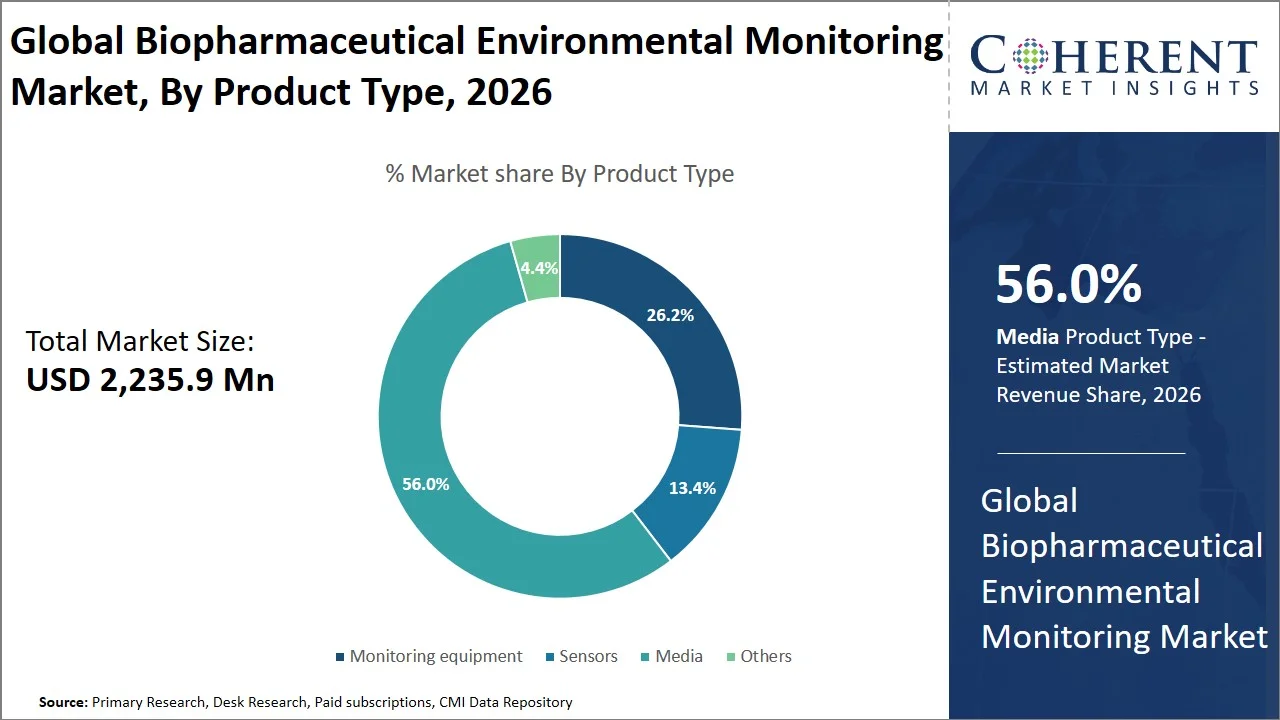
Why Do Media Dominate the Global Biopharmaceutical Environmental Monitoring Market?
Media is projected to hold the market share of 56.0% in 2026, due to its indispensability in recovering and detecting viable microbes present in the air and on surfaces in controlled biopharmaceutical manufacturing setting. The continued reliance on culture media stems from their ease of microbial detection in key cleanroom areas and the availability of a documented record for contamination-control programs, and support for their continued use comes from active air, passive air and surface sampling. For instance, bioMerieux’s 3P ENTERPRISE is a unique integrated solution for environmental monitoring, enabling automation, data centralization and traceability, while providing efficient culture media through bioMerieux 3P SMART and automated colony counting features.
- Current Industry Events of 2026
- Market Size Estimation
- Regional Breakdown
- Competitive Landscape
- Customer Intelligence
- Segmental Analysis
- Pricing Analysis
- Key Market Drivers, Challenges & Future Trends
- Customized Insights Section
Why Does Pharmaceutical Companies Represent the Largest End User Segment in the Biopharmaceutical Environmental Monitoring Market?
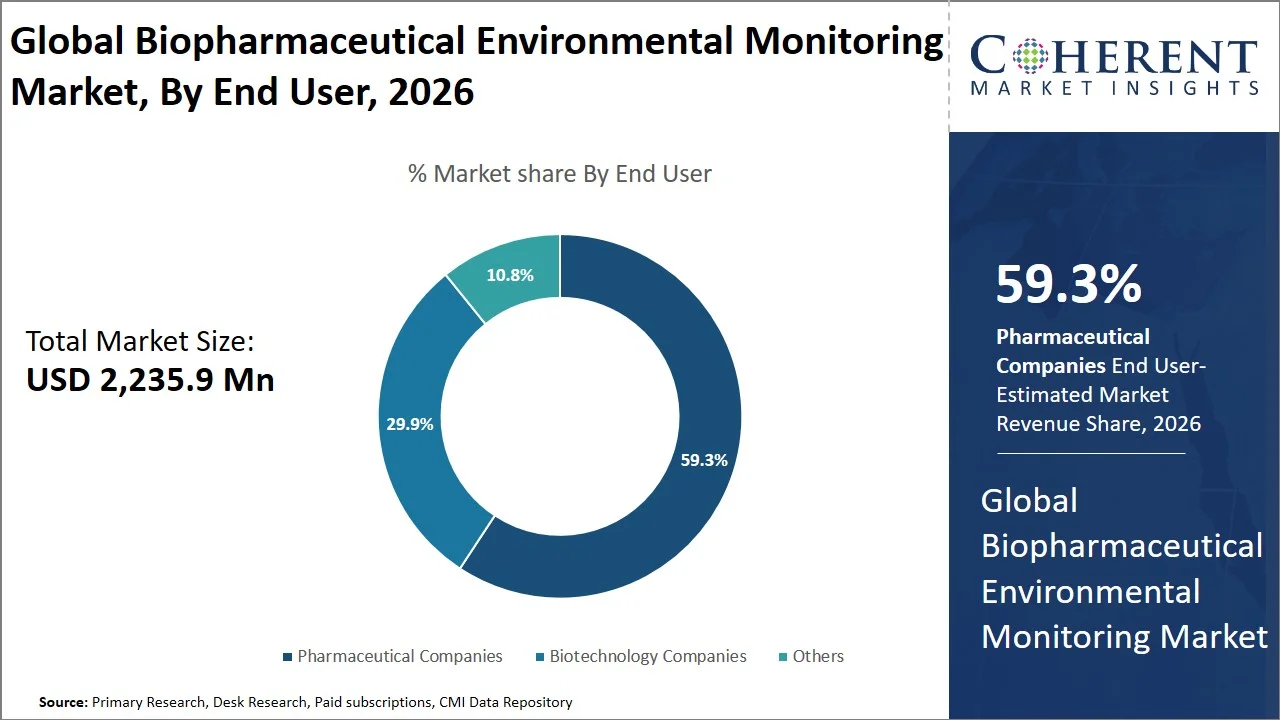
Pharmaceutical companies are projected to hold a market share of 59.3% in 2026, due to the heavy environmental controls necessary throughout their facilities. They utilize sterilize and controlled manufacturing zones for their large-scale manufacturing. A higher investment in biologics, injectables and specialized therapies increases the need for particulate and microbial and clean room monitoring through the processes. They also utilize validated quality systems and contamination control programs to generate continual demand in the environmental monitoring products and services market. For instance, in April 2025, Merck & Co., Inc. officially started construction on a 470,000-sq-ft, USD 1 billion biomanufacturing facility in Wilmington, Delaware. This facility is to be used for advanced biologics (like antibody drug conjugates) that Merck develops and manufactures at a commercial scale adding important manufacturing capabilities and strengthens Merck’s product offerings to address surging demand for environmental monitoring solutions.
Currents Events and their Impact
Current Events | Description and its Impact |
U.S. FDA Strengthens Enforcement of Environmental Monitoring Requirements (March 2026) |
|
EU GMP Annex 1 Drives Risk-Based Contamination Control (August 2025) |
|
Biopharmaceutical Environmental Monitoring Market Dynamics
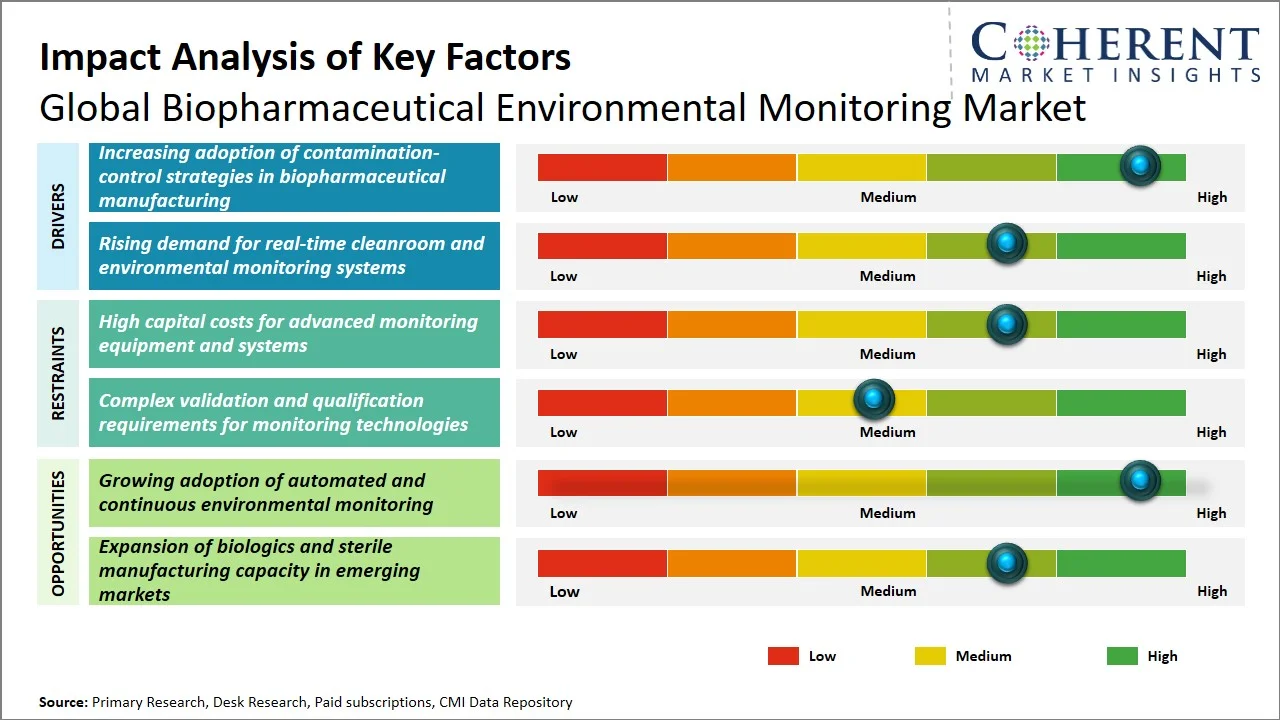
Market Drivers
Increasing adoption of contamination-control strategies in biopharmaceutical manufacturing
The increasing focus on contamination control and sterility assurance is driving demand for advanced environmental monitoring across biopharmaceutical manufacturing. Growing complexity of aseptic processes requires more comprehensive monitoring of viable microorganisms, non-viable particles, air quality, and critical surfaces, supporting earlier detection of contamination risks and stronger quality oversight. For instance, in March 2026, the U.S. FDA cited Simtra Biopharma Solutions for deficiencies in contamination-risk assessment and ongoing monitoring of aseptic processing operations, emphasizing vigilant environmental monitoring to maintain control of sterile manufacturing environments.
Rising demand for real-time cleanroom and environmental monitoring systems
The shift toward real-time environmental monitoring is increasing demand for systems capable of continuously tracking airborne microbial contamination and other critical cleanroom conditions. Continuous monitoring provides earlier identification of contamination trends and reduces dependence on periodic manual sampling, strengthening contamination-control programs in aseptic manufacturing. The trend is particularly relevant to Grade A and other critical pharmaceutical environments, where rapid detection is essential. For instance, Sartorius’ MD8 Airscan provides continuous, intervention-free microbial air monitoring for Grade A pharmaceutical environments, enabling detection of airborne microorganisms and supporting earlier identification of contamination risks.
Expansion of Biopharmaceutical Manufacturing Capacity
The continued expansion of biologics and sterile manufacturing capacity is increasing the number of controlled production environments that require routine environmental monitoring. New and expanded manufacturing facilities require validated systems for monitoring microbial contamination and airborne particles throughout critical processing areas. This expansion is therefore creating a broader installed base for environmental monitoring equipment, consumables, and software. For instance, in February 2025, Eli Lilly announced plans to build four additional U.S. manufacturing sites, bringing its planned U.S. manufacturing investment since 2020 to more than USD 5 billion. The expansion is expected to increase the footprint of controlled pharmaceutical manufacturing environments and associated contamination-monitoring requirements.
Emerging Trends
Rising Adoption of Advanced Environmental Technologies
Biopharmaceutical manufacturers are increasingly adopting advanced environmental technologies that combine automated sensing, data acquisition, and analytics to improve monitoring accuracy. These technologies support more efficient contamination detection and environmental control across critical manufacturing areas.
Increasing Use of Single-Use Manufacturing Environments
The expansion of single-use bioprocessing is influencing environmental monitoring requirements, particularly around closed and disposable production systems. Monitoring strategies are increasingly being adapted to assess contamination risks associated with flexible, modular manufacturing setups.
Increasing Adoption of Smart Environmental Sensors
The adoption of smart environmental sensors is increasing in biopharmaceutical facilities for continuous tracking of temperature, humidity, pressure, and airborne particles. Their connectivity with digital monitoring platforms enables faster detection of environmental deviations and more responsive contamination control.
Regional Insights
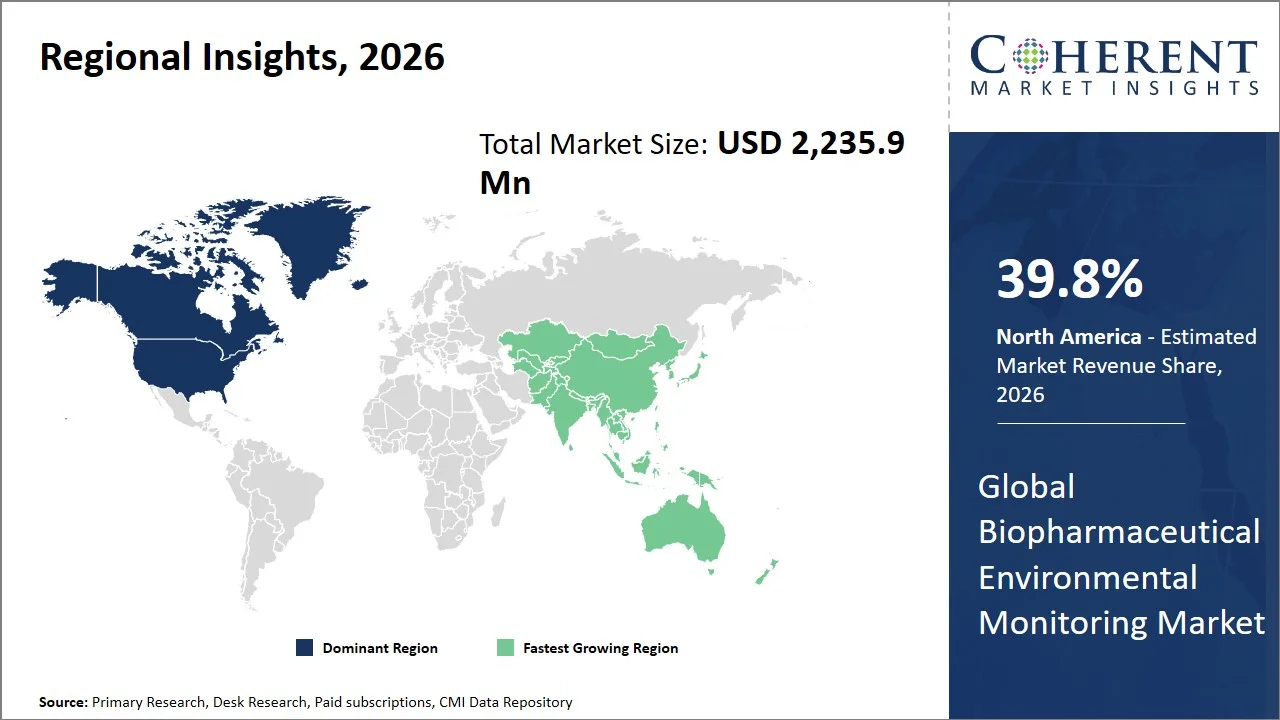
Why is North America a Strong Market for Biopharmaceutical Environmental Monitoring?
North America leads the global biopharmaceutical environmental monitoring market, accounting for an estimated 39.8% share in 2026, driven by a mature biopharmaceutical manufacturing sector, an advanced production infrastructure as well as stringent quality control requirements. Focus on contamination monitoring, cleanroom monitoring and data-driven manufacturing by the industry is driving the market for advanced environmental monitoring solutions. Government programs geared to support drug safety and quality, like U.S. Food and Drug Administration’s (FDA’s) Process Analytical Technology (PAT) approach and current good manufacturing practice (GMP) oversight, provide additional support for developing smart monitoring technologies.
For instance, in August 2025, U.S. Food and Drug Administration (FDA) introduced the FDA PreCheck program with the objective of easing and streamlining the process for new U.S. pharmaceutical manufacturing facility development under GMP and regulatory supervision. This program is likely to promote modern facilities and quality-monitoring technologies. Furthermore, robust R&D capabilities and continuous investment in biological therapies reinforce the region’s leadership in the biopharmaceutical environmental monitoring market.
Why Does Asia Pacific Biopharmaceutical Environmental Monitoring Market Exhibit High Growth?
The Asia Pacific biopharmaceutical environmental monitoring market is expected to exhibit the fastest growth with an estimated contribution of 19.4% share to the global market in 2026, due to the swift growth in biopharmaceutical manufacturing and CDMO capacity among China, India, South Korea and Japan. Government initiatives, such as tax incentives, funding, manufacturing-linked assistance, and regulatory reforms boost domestic pharmaceutical production which are increasingly harmonized to international standards, enhancing the manufacturing strength in region.
For instance, in December 2025, the Government of India reported in a release that its PLI Scheme for Pharmaceuticals garnered the collective investment of USD 4.29 billion (INR 40,890 crore) and facilitated the production of advanced products like biopharmaceuticals, cell-based therapies, and gene-based therapies. The rise in these advanced production capabilities is predicted to enhance the need for the monitoring environment and control on contamination equipment. (Source: Press Information Bureau) Moreover, the increase in biologics manufacturing and pharmaceutical exports is driving the requirement for microbial, particulate and cleanroom environmental monitoring.
Global Biopharmaceutical Environmental Monitoring Market Outlook for Key Countries
Why is the U.S. Leading Innovation and Adoption in the Biopharmaceutical Environmental Monitoring Market?
The U.S. dominates the biopharmaceutical environmental monitoring market driven by broad implementation of automated particle monitoring, microbial detection and digital integrated environmental monitoring within biopharmaceutical manufacturing. The expansion of the U.S. biologics and sterile-production footprint drive adoption of real-time, connected monitoring solutions, integrating environmental information with quality control processes. This is driving shift towards more automated and data-driven contamination control.
Is Japan a Favorable Market for Biopharmaceutical Environmental Monitoring Market?
Japan is one of the most promising markets for the biopharmaceutical environmental monitoring market due to its mature pharmaceutical manufacturing ecosystem and its focus on quality-controlled manufacturing. The demand is relevant for sterile biologics, vaccines and advanced therapies where environmental monitoring is an element of contamination control. In addition to this, the market represents a potential for microbial & particulates automated monitoring solutions, as manufacturers upgrade their quality control process.
Is China Emerging as a Key Growth Hub for the Biopharmaceutical Environmental Monitoring Market?
China is positioned as a key growth hub in the global biopharmaceutical environmental monitoring market due to growing domestic biologics manufacturing industry and need for advanced contamination control infrastructure at biologics manufacturing plants. The market is particularly attractive in sterile biologics and advanced manufacturing plants where the monitoring is required in cleanrooms and aseptic processing areas. The adoption of automated microbial and particle monitoring technology opens business opportunities for advance monitoring solution providers.
Why Does Germany Top the European Biopharmaceutical Environmental Monitoring Market?
Germany leads European biopharmaceutical environmental monitoring market owing to the substantial manufacturing base of biologics and presence of high-tech pharmaceutical manufacturing facilities across the country. The demand is dominated by microbial and particulate monitoring systems in cleanroom / aseptic processes with strong opportunities available in areas such as industrial automation and digital connected environment monitoring solutions within the robust German regulatory framework
Is Biopharmaceutical Environmental Monitoring Market Developing in India?
India is a high-potential market for biopharmaceutical environmental monitoring driven by the increased manufacturing capabilities of India-based biologics and biosimilar products and investments in advanced facilities. Microbial, particulate and automated cleanroom environmental monitoring systems for sterile applications are well-positioned for growth, while, on the contrary, the strengthening push for high production biopharmaceutical capabilities will build wider installed bases of this technology.
Evolution of Environmental Monitoring Approaches
Evolution Stage | Monitoring Approach | Key Technologies / Methods | Impact on Biopharmaceutical Manufacturing |
Traditional Monitoring | Periodic manual sampling | Settle plates, contact plates, manual air sampling | Basic contamination detection with limited real-time visibility |
Standardized Monitoring | Structured cleanroom environmental monitoring | Active air sampling, surface monitoring, particle counters | Improved contamination control and GMP compliance |
Automated Monitoring | Automated and continuous data collection | Continuous particle monitoring, automated microbial sampling | Faster detection of environmental deviations and reduced manual intervention |
Digital Monitoring | Centralized, connected environmental data | IoT sensors, cloud platforms, electronic data capture | Improved data integrity, traceability, and real-time visibility |
Intelligent Monitoring | Predictive and risk-based contamination control | AI analytics, predictive algorithms, integrated quality systems | Proactive contamination management and more efficient batch-release decisions |
How is the growing adoption of automated and continuous environmental monitoring creating new growth opportunities in the biopharmaceutical environmental monitoring market?
Incorporation of automated, real-time environmental monitoring offers tremendous advantages to the biopharmaceutical market for global environmental monitoring, offering real-time particulate and environmental anomaly identification while minimizing the reliance on physical sampling. The addition of sensor-technology, digital work processes, and automated data collection can significantly improve a facility’s contamination control effectiveness, traceability and response times across aseptic manufacturing facilities. For instance, In June 2026, Samsung Biologics adopted a paperless environmental monitoring workflow integrating environmental monitoring with electronic laboratory notebooks (ELNs) and laboratory information management systems (LIMS) to enable automated data acquisition, tracking the process flow for biologics manufacturing.
Market Players, Key Development, and Competitive Intelligence
Key Developments
- In January 2026, Veeva Systems announced Veeva Environmental Monitoring, a cloud-native solution integrated with Veeva LIMS to automate the scheduling, collection, and analysis of environmental samples. The solution is designed to support GMP and internal sterility compliance while integrating environmental monitoring data with quality management and batch-release workflows. It is planned for availability in December 2026.
- In May 2024, Pacific BioLabs launched comprehensive environmental monitoring services for biotechnology and pharmaceutical manufacturers, covering environmental sample collection, viable and non-viable particle measurement, enumeration, reporting, and trend analysis. The service portfolio supports cleanroom monitoring and contamination control in pharmaceutical and biopharmaceutical manufacturing environments, with testing aligned with ISO 14644 and USP <1116> requirements.
Competitive Landscape
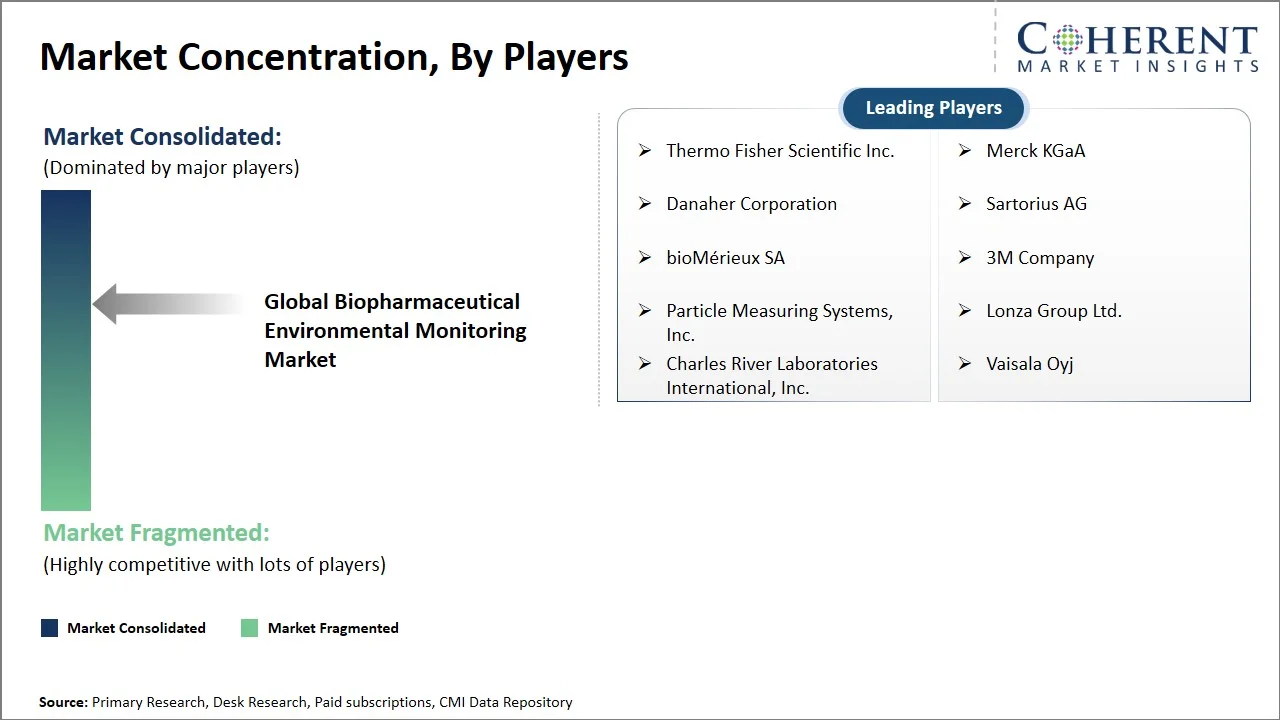
The global biopharmaceutical environmental monitoring market is moderately consolidated, with competition centered on real-time monitoring, contamination detection, data integrity, and regulatory compliance. Key players are expanding automated viable and non-viable particle monitoring, microbial detection, and integrated software solutions to improve cleanroom oversight. Strategic partnerships and portfolio expansion are also strengthening capabilities across biopharmaceutical manufacturing environments. Key focus areas include:
- Development of automated and continuous environmental monitoring systems for cleanrooms and aseptic processing areas
- Integration of IoT-enabled sensors, cloud platforms, and analytics for real-time monitoring and data management
- Expansion of microbial and particulate monitoring solutions to strengthen contamination-control programs
- Strategic partnerships and acquisitions to broaden biopharmaceutical environmental monitoring portfolios and global reach
Market Report Scope
Biopharmaceutical Environmental Monitoring Market Report Coverage
| Report Coverage | Details | ||
|---|---|---|---|
| Base Year: | 2025 | Market Size in 2026: | USD 2,235.9 Mn |
| Historical Data for: | 2020 To 2024 | Forecast Period: | 2026 To 2033 |
| Forecast Period 2026 to 2033 CAGR: | 8.1 % | 2033 Value Projection: | USD 3,864.2 Mn |
| Geographies covered: |
| ||
| Segments covered: |
| ||
| Companies covered: | Thermo Fisher Scientific Inc., Merck KGaA, Danaher Corporation, Sartorius AG, bioMerieux SA, 3M Company, Particle Measuring Systems, Inc., Lonza Group Ltd., Charles River Laboratories International, Inc., Vaisala Oyj | ||
| Growth Drivers: |
| ||
| Restraints & Challenges: |
| ||
Analyst Opinion (Expert Opinion)
- The future outlook for the biopharmaceutical environmental monitoring market will center on the transition from periodic, manual sampling toward continuous, automated, and digitally integrated monitoring. Environmental data will increasingly connect with quality management, contamination-control, and batch-release systems, enabling faster identification of deviations and more proactive manufacturing oversight.
- The maximum opportunities will probably exist within automated viable and non-viable particle monitoring for aseptic manufacturing facilities in India, where expanding biologics and biosimilars production is creating demand for scalable contamination-control infrastructure. Manufacturers should focus on solutions that combine real-time monitoring, automated data capture, and regulatory-ready reporting for pharmaceutical production environments.
- In order to obtain a competitive advantage, market participants should prioritize integrated environmental monitoring platforms that combine microbial monitoring, particle detection, data analytics, and cloud-based quality systems. Partnerships with biopharmaceutical manufacturers and CDMOs, alongside investments in automation and interoperability, can strengthen customer retention and differentiate solutions beyond standalone monitoring hardware.
Speak to the analyst
Want personalized insights?
Take the findings above to one of our principal consultants, or have the report rebuilt around the segments, geographies and competitors you actually track.
Market Segmentation
- Product Type Insights (Revenue, USD Mn, 2021 - 2033)
- Monitoring Equipment
- Sensors
- Media
- Others
- End User Insights (Revenue, USD Mn, 2021 - 2033)
- Pharmaceutical Companies
- Biotechnology Companies
- Others
- Regional Insights (Revenue, USD Mn, 2021 - 2033)
- North America
- U.S.
- Canada
- Latin America
- Brazil
- Argentina
- Mexico
- Rest of Latin America
- Europe
- Germany
- U.K.
- Spain
- France
- Italy
- Russia
- Rest of Europe
- Asia Pacific
- China
- India
- Japan
- Australia
- South Korea
- ASEAN
- Rest of Asia Pacific
- Middle East
- GCC Countries
- Israel
- Rest of Middle East
- Africa
- South Africa
- North Africa
- Central Africa
- North America
Sources
Primary Research Interviews
- Environmental monitoring and contamination-control specialists from biopharmaceutical manufacturing facilities
- Quality assurance (QA) and quality control (QC) managers responsible for cleanroom monitoring
- Microbiology and sterility-testing laboratory managers
- Cleanroom and aseptic-processing engineers
- Environmental monitoring equipment and microbial testing solution providers
- CDMO executives and manufacturing quality specialists
Stakeholders
- Biopharmaceutical manufacturers and contract development and manufacturing organizations (CDMOs)
- Environmental monitoring equipment, consumables, and software providers
- Cleanroom technology and contamination-control solution suppliers
- Pharmaceutical testing laboratories and microbiology service providers
- Biopharmaceutical quality assurance and quality control departments
- End-use Sectors
- Biopharmaceutical manufacturing facilities
- Vaccine and sterile pharmaceutical manufacturing facilities
- Cell and gene therapy manufacturing facilities
- Contract manufacturing organizations (CMOs/CDMOs)
- Research and development laboratories
- Regulatory & Health Bodies
- U.S. Food and Drug Administration (FDA)
- European Medicines Agency (EMA)
- World Health Organization (WHO)
- Medicines and Healthcare products Regulatory Agency (MHRA), U.K.
- Pharmaceuticals and Medical Devices Agency (PMDA), Japan
- National Medical Products Administration (NMPA), China
- Central Drugs Standard Control Organisation (CDSCO), India
Databases
- FDA Drugs@FDA Database
- FDA Warning Letters Database
- EMA Medicines Database
- WHO Global Health Observatory (GHO)
- OECD Health Statistics Database
- World Bank Data
Magazines
- Pharmaceutical Technology
- BioPharm International
- Cleanroom Technology
- Pharmaceutical Manufacturing
- European Pharmaceutical Review
- Outsourced Pharma
Journals
- PDA Journal of Pharmaceutical Science and Technology
- Journal of Pharmaceutical Sciences
- AAPS PharmSciTech
- Journal of Validation Technology
- Pharmaceutical Research
- American Pharmaceutical Review
Newspapers
- Financial Times
- The Wall Street Journal
- USA Today
- The Guardian
- The New York Times
Associations
- International Society for Pharmaceutical Engineering (ISPE)
- Parenteral Drug Association (PDA)
- International Organization for Standardization (ISO)
- Association for the Advancement of Medical Instrumentation (AAMI)
Public Domain Sources
- U.S. Food and Drug Administration (FDA) – Aseptic Processing and Contamination Control Guidance
- European Medicines Agency (EMA) – Good Manufacturing Practice (GMP) Guidelines
- World Health Organization (WHO) – GMP and sterile pharmaceutical manufacturing guidance
- International Organization for Standardization (ISO) – Cleanrooms and associated controlled environments standards
- U.K. MHRA – GMP Guidance
- Pharmaceuticals and Medical Devices Agency (PMDA) – GMP-related guidance
- National Medical Products Administration (NMPA) – Pharmaceutical GMP and sterile manufacturing guidance
Proprietary Elements
- CMI Data Analytics Tool
- Proprietary CMI Existing Repository of information for last 10 years.
Get access to 250+ pages report
Every segment, forecast, competitor profile and data table behind the analysis above — available for instant download.
- ESOMAR Member
- ISO 9001:2015 Certified
- D-U-N-S Registered
- GDPR & CCPA Compliant
Missing comfort of reading report in your local language? Find your preferred language:
Transform your Strategy with Exclusive Trending Reports
Frequently Asked Questions
The global biopharmaceutical environmental monitoring market is estimated to be valued at USD 2,235.9 Mn in 2026 and is expected to reach USD 3,864.2 Mn by 2033.
Media dominate due to their widespread use in microbial monitoring, growth promotion testing, and detection of viable microorganisms in controlled biopharmaceutical manufacturing environments.
Biopharmaceutical environmental monitoring is the systematic sampling and analysis of air, surfaces, personnel, and other cleanroom environments to detect microbial and particulate contamination during drug manufacturing.
The CAGR of global biopharmaceutical environmental monitoring market is projected to be 8.1 % from 2026 to 2033.
Increasing adoption of contamination-control strategies in biopharmaceutical manufacturing, and rising demand for real-time cleanroom and environmental monitoring systems are the major factors driving the growth of the global biopharmaceutical environmental monitoring market.
High capital costs for advanced monitoring equipment and systems, and complex validation and qualification requirements for monitoring technologies are the major factors hampering the growth of the global biopharmaceutical environmental monitoring market.
In terms of end user, pharmaceutical companies are estimated to dominate the market revenue share in 2026.