

Global Blood Group Typing Market Size and Forecast – 2026 To 2033
The global blood group typing market is expected to grow from USD 2,185.7 Mn in 2026 to USD 3,612.8 Mn by 2033, registering a compound annual growth rate (CAGR) of 7.4% from 2026 to 2033. The market for blood group typing is poised for significant expansion, fueled by the surging demand for blood transfusions and blood safety testing globally.
According to the World Health Organization, approximately 118.5 million blood donations are collected globally each year, underscoring the importance of accurate blood group typing to ensure the safety of transfusions and compatibility testing.
(Source: World Health Organization)
Key Takeaways of the Global Blood Group Typing Market
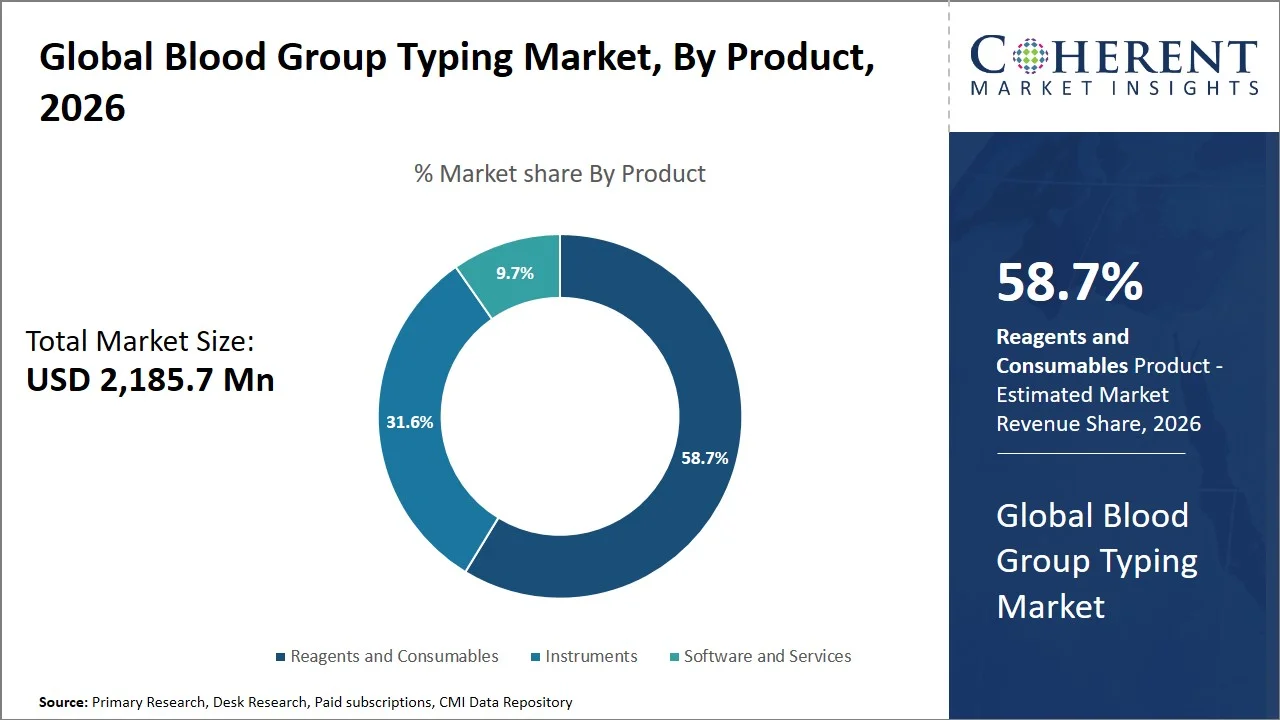
- Reagents and consumables are projected to hold 58.7% of the global blood group typing market share in 2026, making it the dominant product segment across North America due to the substantial volume of blood screening and transfusion testing performed by blood banks and hospitals in the region. For instance, the U.S. Department of Health and Human Services (HHS) states that every two seconds someone in the U.S. needs blood or blood products to help cancer patients, accident and burn victims, transplant recipients and individuals suffering from rare and chronic conditions. (Source: U.S. Department of Health and Human Services) Such sustained demand for transfusion calls for continuous procedures of blood grouping and cross-matching, resulting in recurring use of reagents, antisera, test cards, and other consumables used in blood typing laboratories.
- Serological testing is projected to hold 72.4 % of the global blood group typing market share in 2026, making it the dominant technique segment across Europe due to the pervasive use of serological methods for routine blood grouping, antibody screening, and pre-transfusion compatibility testing. For instance, The Blood Guide, published by the European Directorate for the Quality of Medicines & HealthCare (EDQM), serves as a technical appendix to Council of Europe Recommendation No. R (95)15. The guide establishes common standards for both the preparation, application and quality testing of blood components. (Source: European Directorate for the Quality of Medicines & HealthCare) Such standardized procedures encourage the broad application of serological testing throughout Europe in blood establishments and in healthcare facilities.
- Hospitals are projected to hold 38.8 % of the global blood group typing market share in 2026, making it the dominant end user segment across Asia Pacific due to rapid expansion of healthcare infrastructure and rising volume of surgical procedures. For instance, as part of India's Ayushman Bharat initiative, the government is increasingly focusing on developing secondary and tertiary health services and expanding access to necessary diagnostic and blood transfusion services. (Source: Make in India) The increasing number of patients and the necessity for pretransfusion tests in hospital environments continue to drive the demand for blood group typing solutions across the region.
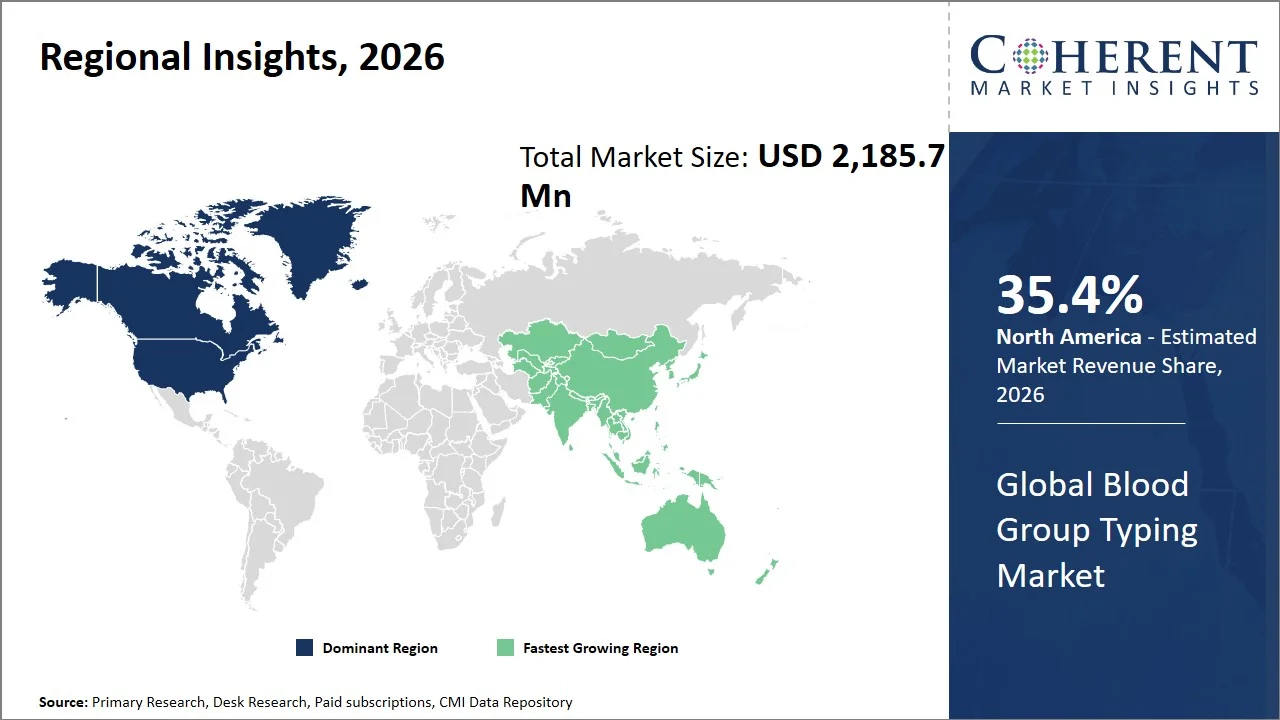
- North America maintains its dominance with an expected share of 35.4 % in 2026, bolstered by sophisticated transfusion medicine infrastructure, a vast blood banking network, and a strong emphasis on blood safety. The region benefits from the widespread adoption of automated immunohematology systems and routine pre-transfusion testing practices. For instance, according to the American National Red Cross, approximately 29,000 units of red blood cells are needed every day in the U.S. (Source: The American National Red Cross) This high demand for transfusion contributes to a sustained need for blood grouping and compatibility testing solutions in the region.
- Asia Pacific is expected to exhibit the fastest growth with an estimated contribution of 24.3 % share in 2026, driven by the expanding healthcare infrastructure, increasing blood donation activities, and growing investments in diagnostic laboratory capabilities. Rising demand for safe transfusion practices and improving access to healthcare services are further supporting market expansion across the region. For instance, the National Blood Transfusion Council (NBTC) in India, through the National Blood Transfusion Programme, promotes voluntary non-remunerated blood donation and standardized testing methods for blood for safer blood supplies. (Source: Ministry of Health and Family Welfare) These initiatives lead to an increase in blood collection and screening, fueling blood group typing solution demand in the region.
- Growing Adoption of Molecular Blood Group Typing Technologies: Molecular blood grouping methods are becoming increasingly prevalent, with many being capable of precisely identifying blood group and some identifying uncommon antigen variations missed by serological methods. Increasingly, these methods are being utilized in patients requiring repeated transfusion and more intricate crossmatching techniques, as well as to facilitate better donor-recipient matching to avoid potential complications. With ongoing development in precision medicine, molecular typing is predicted to be in very high demand.
- Expansion of Rare Blood Donor Registries: The development of registries for rare blood donors is now opening new avenues for cutting edge blood group typing techniques. With increasing interest by hospitals and blood banks in screening donors for their blood type and creating large registries of rare blood donors, the need for detailed antigen profiling and precise typing techniques has become essential. An increased access to appropriately typed blood units will translate to better transfusion responses, solidifying the role of blood group typing in blood transfusion
Segmental Insights
Why Do Reagents and Consumables Dominate the Global Blood Group Typing Market?
Reagents and consumables are projected to hold a market share of 58.7% in 2026, owing to their usage in blood grouping, antibody screening and compatibility testing. As compared to instruments which can be used over years, reagents and consumables are used for every test performed creating a recurring demand among blood banks, hospitals and diagnostic labs. Furthermore, there is a surging demand for accurate and standard transfusion testing to achieve a better level of patient safety, along with advanced reagent systems launched by the companies to improve testing efficiency and reliability. For instance, Bio-Rad Laboratories, Inc. offers IH-500 NEXT system that interfaces with its immunohematology reagents and gel cards, thereby automating blood typing and screening procedures. (Source: Bio-Rad Laboratories, Inc). Such developments continue to strengthen the impact of high-quality reagents and consumables on routine transfusion medicine workflows.
- Current Industry Events of 2026
- Market Size Estimation
- Regional Breakdown
- Competitive Landscape
- Customer Intelligence
- Segmental Analysis
- Pricing Analysis
- Key Market Drivers, Challenges & Future Trends
- Customized Insights Section
Why Does Serological Testing Represent the Largest Technique Segment in the Blood Group Typing Market?
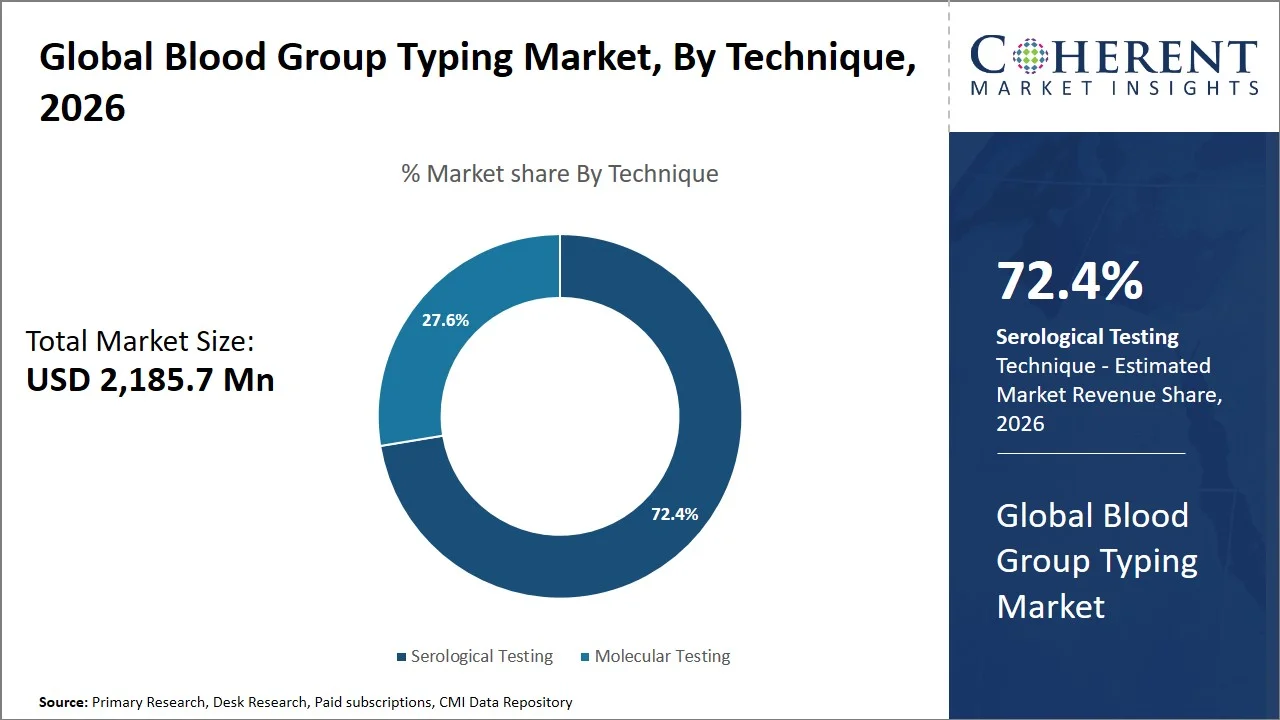
Serological testing is projected to hold a market share of 72.4% in 2026, due to its clinical applicability, quick turn-around time and reliability for routine transfusion testing. Serological testing is widely used as the primary blood grouping and antibody screening method within hospitals, blood banks and diagnostic laboratories. Companies are continually producing more sophisticated serological based testing platforms to enhance accuracy and productivity in the laboratory. For instance, ORTHO VISION Analyzer by QuidelOrtho uses sophisticated serologic technologies to automate ABO/Rh typing, antibody screening, crossmatch and donor testing processes, enabling laboratories to process substantial sample volumes with reduced manual intervention. (Source: QuidelOrtho) Such innovations are reinforcing the role of serological methods in high-throughput transfusion medicine laboratories.
Hospitals Segment Dominates the Global Blood Group Typing Market
The hospitals segment is projected to hold a market share of 38.8% in 2026, because a large proportion of blood grouping, compatibility testing, and transfusion practices are carried out in hospitals. This reliance on rapid blood typing is essential for supporting the demands of surgery, emergencies, trauma, organ transplant and blood disorders. Moreover, a growing pool of in-house blood banks and state-of-the-art laboratory infrastructure further reinforces the demand for blood typing solutions. For instance, according to the American Hospital Association (AHA), each year in the U.S., more than 4.5 million lives are saved by blood transfusions, and about 1 in 5 people admitted to the hospital need blood. (Source: American Hospital Association) These significant transfusion demands require the constant typing and cross-matching of blood groups, reinforcing hospitals as key end-users for blood group typing solutions.
Currents Events and their Impact
Current Events | Description and its Impact |
European Union Advances IVDR Implementation for Blood Group Marker Diagnostics (December 2025) |
|
U.S. FDA Draft Guidance on Hepatitis B Surface Antigen Testing of Blood Donations (July 2025) |
|
(Source: European Commission, Food and Drug Administration)
Blood Group Typing Market Dynamics
Market Drivers
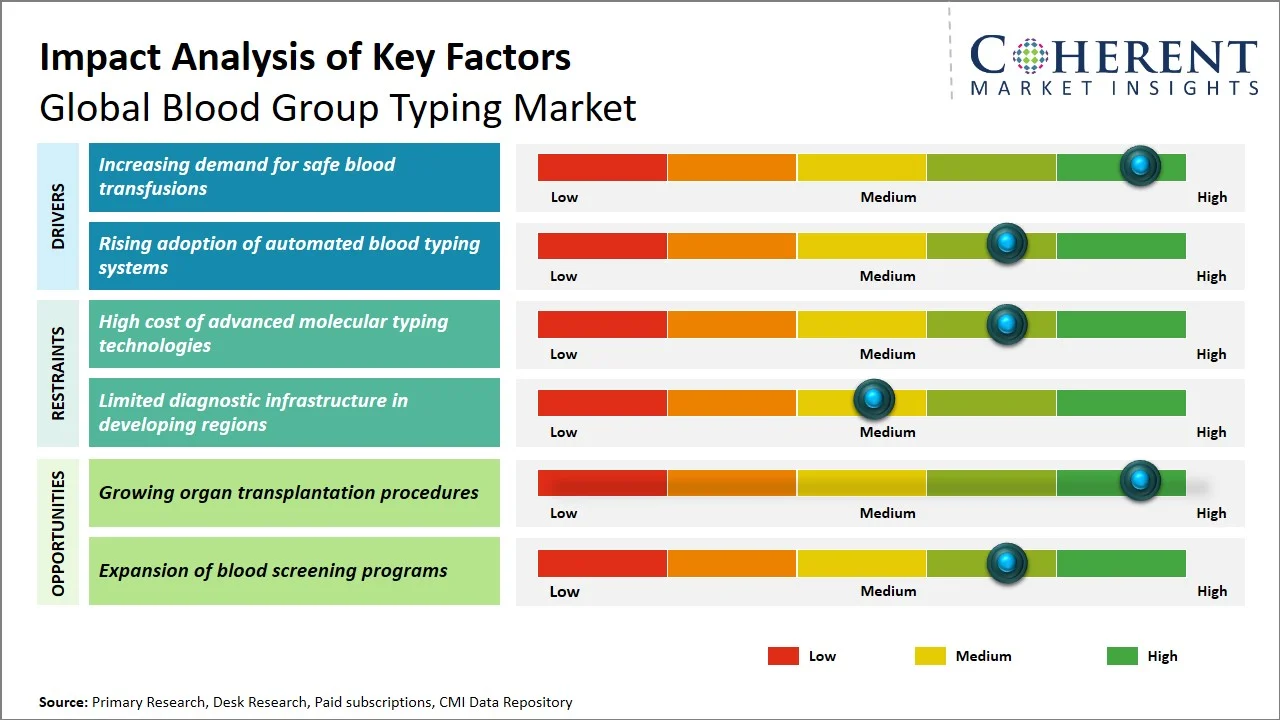
- Increasing demand for safe blood transfusions: The emphasis on minimizing transfusion complications has paved the way for the use of sophisticated blood group typing technologies globally. The precision of blood typing is imperative for establishing donor recipient compatibility during complex transfusion and transplantation procedures. In addition, the demand for blood group typing devices will also be driven by growing activities in blood collection and processing activities within healthcare systems. For instance, according to the World Health Organization, global number of blood donations each year is about 106 million which is collected at around 13,300 blood centers in 169 countries. (Source: World Health Organization) These significant testing needs continue to drive the demand for blood grouping solutions in blood banks and healthcare facilities.
- Rising adoption of automated blood typing systems: In transfusion medicine, the increase in usage of automated blood typing systems is leading to a paradigm shift to high-volume, rapid, and standardized testing workflows. Healthcare facilities are adopting automated platforms to enhance operational efficiency, turnaround time and quality management in blood group and compatibility testing. It is also apparent that the increase is being seen most acutely at large blood banks and hospital laboratories dealing with increased testing demands. For instance, in April, 2024 Grifols, S.A. introduced its Erytra Eflexis blood typing analyzer into China. This all-in-one automated system performs pre-transfusion compatibility tests while maintaining the necessary workflow flexibility for any laboratory size. (Source: Grifols, S.A.) Such innovations are paving the way for more widespread use of automated blood typing technology.
Emerging Trends
- Increasing Integration of Automation and Digital Immunohematology: A significant trend in blood banks and diagnostic labs is the implementation of automated immunohematology platforms for increased test accuracy, less manual labor and a more efficient workflow. Digital data management and traceability capabilities are helping the transition to automated blood grouping and compatibility testing.
- Growing Demand for Extended Antigen and Rare Blood Group Typing: Extended antigen profiles are becoming a priority among healthcare professionals in order to achieve better donor/recipient matching, minimize transfusion reactions and other transfusions-related adverse effects. This tendency favors the implementation of innovative blood typing methods which are sensitive for detecting rare blood groups and enable tailor-made transfusion approaches for difficult cases.
Regional Insights
Why is North America a Strong Market for Blood Group Typing?
North America leads the global blood group typing market, accounting for an estimated 35.4% share in 2026, due to its superior healthcare infrastructure, extensive adoption of advanced diagnostics technologies, and well-established government support in blood safety and transfusion services. The existing large number of biotech and medical device companies ensures continuous development and product launches in the market. Additionally, agencies like the U.S. FDA maintain high standards for quality and safety, thus encouraging customer confidence and rapid product acceptance. For instance, in the U.S., blood establishment is governed by 21 CFR Part 606 (Current Good Manufacturing Practice for Blood and Blood Components), which describes the requirements concerning collection of blood and blood products, processing of blood products, compatibility testing of blood products, storage of blood products and distribution of blood products. (Source: ECA Foundation) These standards of regulation continue to promote the use of reliable blood grouping and transfusion testing solutions throughout the region.
Why Does the Asia Pacific Blood Group Typing Market Exhibit High Growth?
The Asia Pacific blood group typing market is expected to exhibit the fastest growth with an estimated contribution of 24.3% share to the global market in 2026, due to increase in healthcare expenditure, expanding healthcare infrastructure and rising awareness regarding the safe blood transfusion methods. The growing populations coupled with the initiatives by governments to boost blood transfusion services in the developing countries like India and China have driven robust demand. For instance, National Health Commission, China advocates the development of a nationwide voluntary blood donation system and a modernized blood collection and testing service in China in order to ensure blood safety and availability. In 2023, China recorded a historic surge in voluntary blood donations, with 16.99 million donations, a 5.9% increase from the previous year. (Source: CGTN) These have led to the reinforcement of the specifications related to the tests for blood screening and blood group compatibility, thereby encouraging the introduction of blood group typing technologies in the region.
Global Blood Group Typing Market Outlook for Key Countries
Why is the U.S. Leading Innovation and Adoption in the Blood Group Typing Market?
The U.S. is at the forefront of innovation and adoption in the blood group typing market due to the penetration of automated immunohematology instruments in hospital laboratories, blood banks and transfusion services. The country is home to several global manufacturers and R&D facilities (such as Bio-Rad Laboratories, QuidelOrtho Corporation, Thermo Fisher Scientific, and Danaher Corporation), which constantly upgrade the technologies associated with blood group typing such as molecular typing, high-throughput automated systems.
Strong collaboration between blood banks, transplant services, and the laboratories offering diagnostic services, contributes to its use of the best compatibility testing technologies. For instance, the United Network for Organ Sharing (UNOS) collaborates with the Organ Procurement and Transplantation Network (OPTN), transplant centers, organ procurement organizations, histocompatibility laboratories, and donor hospitals to systemize organ allocation and donor-recipient matching across the U.S. (Source: Health Resources and Services Administration)
Is Japan a Favorable Market for Blood Group Typing?
Japan is one of the most promising markets for the blood group typing market due to the country's well-developed healthcare system and attention to blood transfusion quality management. Blood grouping and compatibility testing is routinely performed using automation on both a hospital and a blood center level due to wide adoption of automated laboratory devices. Advanced transplantation and hematology treatment (for example, The University of Tokyo Hospital provides sophisticated hematopoietic stem cell transplantation, hematology-oncology, and organ transplantation services) in the country contributes to the need for high performance immunohematology tests. Growing interest and practice of laboratory standardization and high-quality diagnosis, also contributes to increased usage of highly sensitive blood group typing systems in Japan.
Is China Emerging as a Key Growth Hub for the Blood Group Typing Market?
China is positioned as a key growth hub in the global blood group typing market as the country’s healthcare and laboratory infrastructure is rapidly modernizing. Automatic immunohematology instruments are widely accepted in the blood centers and hospitals in China to enhance blood testing efficiency and safety of blood transfusion. Additionally, the presence of a large number of domestic and international diagnostics manufacturers (such as Grifols, Bio-Rad Laboratories, QuidelOrtho, Mindray and Snibe) is expected to provide access to innovative blood grouping and cross-match technologies.
Why Does Germany Top the European Blood Group Typing Market?
Germany is the leader in the European market for blood group typing due to the country’s highly developed infrastructure in transfusion medicine and a vast number of blood donation and testing centers in the country. Germany has an early and established record of adopting automation of immunohematology systems and lab equipment, leading to the efficient grouping and compatibility testing of large numbers of samples. Moreover, the dominance of key companies in diagnostics and life science sectors (such as Grifols Germany, Bio-Rad Laboratories, Sysmex and Siemens Healthineers) ensures steady innovation and adoption of technologies in the blood group typing market.
Is the Blood Group Typing Market Developing in India?
The increasing development in blood banking, diagnostic laboratory and hospital networks is making India a lucrative market for blood group typing. The tertiary hospitals and blood centers are gradually implementing automated immunohematology systems. An increasing emphasis on developing strong transfusion services, better safety standards in the labs, and latest laboratory practices is pushing the market to new heights. Also, increasing competition from domestic players (such as Transasia Bio-Medicals, Tulip Diagnostics, Meril Life Sciences, Agappe Diagnostics, and Erba Mannheim India) as well as international players (such as Bio-Rad Laboratories, Grifols, QuidelOrtho, Immucor, and Sysmex Corporation) is providing better access to advanced blood grouping and compatibility testing technologies throughout the country.
Technology Adoption Landscape Across the Global Blood Group Typing Market
Region | Predominant Testing Method | Automation Adoption | Key Trend |
North America | Serological + Molecular | High | Automated immunohematology |
Europe | Serological + Molecular | High | IVDR-driven modernization |
Asia Pacific | Predominantly Serological | Medium to High | Laboratory automation expansion |
Latin America | Serological | Medium | Blood bank modernization |
Middle East & Africa | Serological | Low to Medium | Infrastructure development |
How are growing organ transplantation procedures creating new growth opportunities in the blood group typing market?
The increasing volume of organ transplantation procedures has presented a major opportunity for the growth of the blood group typing market, since compatibility testing between blood groups of recipient and donor is crucial for transplant success. The increased level of transplant activity is escalating the demand for sensitive blood typing and cross-matching systems which can support intensive transplant procedures. In addition, high-accuracy immunohematology testing is being developed and applied by health care professionals to reduce the possibility of graft rejection. For instance, a report by the Global Observatory on Donation and Transplantation (GODT) documented more than 173,000 solid organ transplants globally in 2024, reflecting sustained growth in transplant activity globally. (Source: The European Society for Organ Transplantation)
Market Players, Key Development, and Competitive Intelligence
Key Developments
- In June 2025, Devyser announced the global launch of Devyser Genomic Blood Typing, an NGS-based comprehensive genetic blood typing assay. This assay allows one single process to test all three systems in one streamlined workflow, those being the RBC, HPA and HNA system. This launch was a response to the rise in the use of molecular blood typing platforms and a request for more high-resolution blood compatibility testing in research into transfusions and transplantation.
- In May 2024, New York Blood Center Enterprises (NYBCe) joins forces with Thermo Fisher Scientific for the research and development of next-generation blood typing technologies. This partnership intends to facilitate more comprehensive molecular blood group testing, enable better donor-recipient matching and make transfusion medicine processes more efficient. The cooperation also indicates an increased effort of new blood typing technology researches to ensure blood safety.
Competitive Landscape
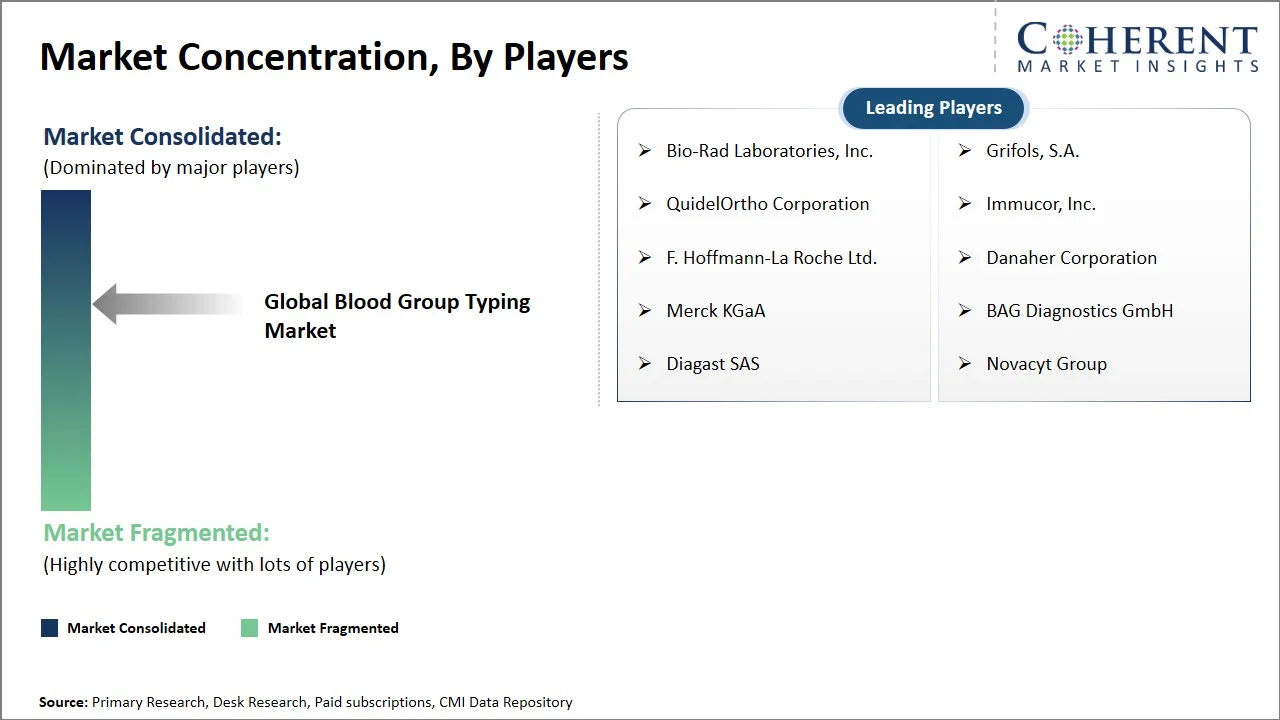
The global blood group typing market is moderately consolidated, driven by established immunohematology and diagnostics companies focused on further development of automated testing and blood transfusion safety. Players in this market are developing cutting-edge serological and molecular typing techniques to increase laboratory efficiency, testing accuracy and workflow standardization. Automation of blood bank processes, high-throughput analyzers, a broad reagent portfolio and consistent regulatory compliance in markets around the world are key strategic imperatives. Key focus areas include:
- Development of automated immunohematology analyzers and digital laboratory workflows
- Expansion of molecular blood typing and extended antigen profiling capabilities
- Enhancement of reagent, gel card, and compatibility testing portfolios
- Strengthening partnerships with hospitals, blood banks, and transfusion medicine laboratories
Market Report Scope
Blood Group Typing Market Report Coverage
| Report Coverage | Details | ||
|---|---|---|---|
| Base Year: | 2025 | Market Size in 2026: | USD 2,185.7 Mn |
| Historical Data for: | 2020 To 2024 | Forecast Period: | 2026 To 2033 |
| Forecast Period 2026 to 2033 CAGR: | 7.4% | 2033 Value Projection: | USD 3,612.8 Mn |
| Geographies covered: |
| ||
| Segments covered: |
| ||
| Companies covered: | Bio-Rad Laboratories, Inc., Grifols, S.A., QuidelOrtho Corporation, Immucor, Inc., F. Hoffmann-La Roche Ltd., Danaher Corporation, Merck KGaA, BAG Diagnostics GmbH, Diagast SAS, and Novacyt Group | ||
| Growth Drivers: |
| ||
| Restraints & Challenges: |
| ||
Analyst Opinion (Expert Opinion)
- Blood group typing market will show a steady rise over the next few years with an increasing trend in demand for safe blood transfusions, growing rates of organ transplantation and increased adoption of automated instruments in transfusion medicine laboratories. The market is expected to witness a paradigm shift from conventional manual blood typing procedures to automated immunohematology analyzers and molecular typing techniques to ensure accuracy, traceability and enhanced efficiency. The ever-changing regulatory standards concerning the safety of blood, and assurance of blood quality will further encourage the investment in sophisticated blood typing procedures by various institutions like hospitals, blood banks and diagnostic labs.
- The maximum opportunities will probably exist within automated blood typing systems for hospital and blood bank uses in China and India. Both of these countries are investing in healthcare systems, increasing their blood collection levels and improving their transfusion and transplant facilities to cope with demands. Large patient pools, increasing number of operations and constant modernization of laboratory functions are creating ideal conditions to introduce high throughput blood grouping and compatibility testing systems in the markets. Public awareness of transfusion safety and a drive towards quicker laboratory response times will further encourage sustained growth in the years ahead.
- In order to obtain a competitive advantage, market participants should successfully implement integrated testing platforms by merging automation with digital workflow management and improved immunohematology techniques. Product portfolio expansion for molecular blood typing and interlinking with laboratory information systems, and enhanced performance of reagents will be a crucial differentiator. Moreover, strategic partnerships with hospitals, blood banks and transplant centers and strengthening its presence in the developing market via local manufacturing, distribution partnerships and technical support services will be key initiatives by the players. The strategies will help to fulfill evolving needs of the customers and cash in on growing demand of accurate and efficient blood typing.
Speak to the analyst
Want personalized insights?
Take the findings above to one of our principal consultants, or have the report rebuilt around the segments, geographies and competitors you actually track.
Market Segmentation
- Product Insights (Revenue, USD Mn, 2021 - 2033)
- Reagents and Consumables
- Instruments
- Software and Services
- Technique Insights (Revenue, USD Mn, 2021 - 2033)
- Serological Testing
- Molecular Testing
- End User Insights (Revenue, USD Mn, 2021 - 2033)
- Hospitals
- Blood Banks
- Diagnostic Laboratories
- Others
- Regional Insights (Revenue, USD Mn, 2021 - 2033)
- North America
- U.S.
- Canada
- Latin America
- Brazil
- Argentina
- Mexico
- Rest of Latin America
- Europe
- Germany
- U.K.
- Spain
- France
- Italy
- Russia
- Rest of Europe
- Asia Pacific
- China
- India
- Japan
- Australia
- South Korea
- ASEAN
- Rest of Asia Pacific
- Middle East
- GCC Countries
- Israel
- Rest of Middle East
- Africa
- South Africa
- North Africa
- Central Africa
- North America
- Key Players Insights
- Bio-Rad Laboratories, Inc.
- Grifols, S.A.
- QuidelOrtho Corporation
- Immucor, Inc.
- F. Hoffmann-La Roche Ltd.
- Danaher Corporation
- Merck KGaA
- BAG Diagnostics GmbH
- Diagast SAS
- Novacyt Group
Sources
Primary Research Interviews
- Transfusion medicine specialists and immunohematology laboratory directors
- Blood bank managers and donor screening professionals
- Hospital laboratory managers overseeing blood grouping and compatibility testing
- Clinical pathologists and hematologists involved in transfusion services
- Regulatory affairs professionals specializing in in vitro diagnostics (IVDs) and blood safety compliance
Stakeholders
- Blood group typing manufacturers and immunohematology solution providers
- End-use Sectors
- Hospitals and multispecialty healthcare centers
- Blood banks and blood collection organizations
- Diagnostic and reference laboratories
- Organ transplantation centers
- Academic and research institutions
- Regulatory & Health Bodies
- U.S. Food and Drug Administration (FDA) – Blood Products & In Vitro Diagnostics
- European Medicines Agency (EMA) and European Commission (IVDR)
- AABB (Association for the Advancement of Blood & Biotherapies)
- World Health Organization (WHO) – Blood Safety Programme
- National Health Authorities and Blood Transfusion Services
Databases
- FDA Medical Device Databases (510(k), PMA)
- AABB Blood Banking and Transfusion Medicine Resources
- WHO Global Database on Blood Safety
- OECD Health Statistics – Surgical Procedures and Healthcare Utilization
- Global Observatory on Donation and Transplantation (GODT)
Magazines
- Transfusion News
- Medical Laboratory Observer (MLO)
- Clinical Lab Products
- Lab Manager Magazine
- Diagnostics World News
Journals
- Transfusion
- Vox Sanguinis
- Transfusion Medicine
- Journal of Clinical Apheresis
- Blood Transfusion
- Financial Times – Blood Banking, Diagnostics, and Healthcare Industry Developments
- The Wall Street Journal – In Vitro Diagnostics, Medical Device, and Laboratory Testing Trends
- The New York Times (Health Section) – Blood Donation, Transfusion Medicine, and Public Health Updates
- The Guardian (Health Section) – Blood Safety, Healthcare Policy, and Diagnostic Technology Developments
- USA Today (Health Section) – Clinical Diagnostics, Blood Testing, and Consumer Healthcare Trends
Associations
- Association for the Advancement of Blood & Biotherapies (AABB)
- International Society of Blood Transfusion (ISBT)
- European Society for Blood and Marrow Transplantation (EBMT)
- American Society of Hematology (ASH)
- European Blood Alliance (EBA)
Public Domain Sources
- World Health Organization (WHO) – Blood Safety and Availability
- Centers for Disease Control and Prevention (CDC) – Blood Disorders and Transfusion Safety
- National Institutes of Health (NIH) – Hematology and Transfusion Research
- U.S. Department of Health and Human Services (HHS) – Blood and Tissue Safety
- Global Observatory on Donation and Transplantation (GODT) – Organ Donation and Transplantation Statistics
Proprietary Elements
- CMI Data Analytics Tool, Proprietary CMI Existing Repository of information for last 10 years.
Get access to 250+ pages report
Every segment, forecast, competitor profile and data table behind the analysis above — available for instant download.
- ESOMAR Member
- ISO 9001:2015 Certified
- D-U-N-S Registered
- GDPR & CCPA Compliant
Missing comfort of reading report in your local language? Find your preferred language:
Transform your Strategy with Exclusive Trending Reports
Frequently Asked Questions
The global blood group typing market is estimated to be valued at USD 2,185.7 Mn in 2026 and is expected to reach USD 3,612.8 Mn by 2033.
Reagents and consumables dominate due to their indispensable role in blood grouping, antibody screening, and compatibility testing procedures.
Blood group typing is a laboratory procedure used to identify an individual's blood type based on the presence or absence of specific antigens on red blood cells.
The CAGR of the global blood group typing market is projected to be 7.4% from 2026 to 2033.
Increasing demand for safe blood transfusions, and rising adoption of automated blood typing systems are the major factors driving the growth of the global blood group typing market.
High cost of advanced molecular typing technologies, and limited diagnostic infrastructure in developing regions are the major factors hampering the growth of the global blood group typing market.
Molecular blood typing identifies blood group genes through DNA analysis, while serological typing determines blood groups through antigen-antibody reactions.